Skip to content

169 results for β€œACE”

What you seeeverything
microsoft.comwriteupπŸ›‘οΈ Security

Inside a malicious Claude Code-branded extension and its persistent SSH backdoor

Microsoft Threat Intelligence analyzes a tampered anthropic.claude-code extension (versions 2.1.312 and 2.1.313) served on the Cursor marketplace on 29 October 2026. The injected JavaScript loader adds an SSH key labeled svc-telemetry, opens a reverse SSH tunnel and sets up persistence on macOS, Linux and Windows. The post gives cleanup steps, IOCs and Defender XDR hunting queries. VS Code Marketplace and npm were not affected.

CursorClaude CodeSSH+3
Protocol Tunneling (T1572)reverse SSH tunnelMicrosoft Threat Intelligence+2

Supply Chain, Blue Team & Detection, Malware & REΒ· Published and added 31 Oct 2026

huggingface.cowriteup🧠 AI

nemotron-halloween

MonsterHouse is a Halloween interactive projection built on the NVIDIA Nemotron Voice Agent: Nemotron Speech ASR, Nemotron 3.5 Bolt E4B 4GB with a LoRA persona adapter, Magpie TTS Zeroshot and Audio2Face-3D in Unreal Engine, on two RTX Blackwell GPUs. Median end-of-speech-to-audio is 1.70 seconds live and 0.72 seconds with cached responses. The post gives a build path and tips on caching and state handling.

Nemotron Voice AgentNemotron Speech ASRNemotron 3.5 Bolt E4B 4GB+11
NVIDIANemotronQwen3 30B-A3B+3

multimodal, agents, trainingΒ· Published and added 30 Oct 2026

phorion.iowriteupπŸ›‘οΈ Security

Backdoor in Claude Code for VS Code extension on the Cursor Marketplace

Phorion analyzes a backdoor injected into versions 2.1.312 and 2.1.313 of the official Claude Code for VS Code extension on the Cursor Marketplace. An IIFE prepended to extension.js plants an SSH key, opens a reverse SSH tunnel to 134.209.82[.]225, persists via a fake com.apple.sysmond LaunchAgent and beacons host recon. A macOS systemsetup check bug usually stops SSH from being enabled. The post lists detections and remediation.

Claude CodeCursorVS Code+3
Phorionsvc-telemetrycom.apple.sysmond+1

Supply Chain, Malware & RE, Blue Team & DetectionΒ· Added 31 Oct 2026, published 30 Oct 2026

opensourcemalware.comwriteupπŸ›‘οΈ Security

Earliest Known PolinRider Malware Found in 2025 npm Packages

OpenSourceMalware traces nine itsa-* npm package versions published on 4 May 2025 from a hijacked maintainer account to the PolinRider campaign, eight months before documented victims. It decodes the EtherHiding chain (BNB Smart Chain and Ethereum calldata, JADESNOW, INVISIBLEFERRET bootstrapper, Socket.IO RAT, Python stealer) and links the 2025 sample to 2026 force-push infections. It lists IOCs, hashes, a timeline and hunting guidance.

npmNode.jsPython+3
PolinRiderEtherHidingJADESNOW+9

Supply Chain, Malware & RE, Threat IntelΒ· Published and added 30 Oct 2026

rekt.newswriteupπŸ›‘οΈ Security

Rekt - SingularityNET - Rekt

SingularityNET exploit (19 September 2026): attackers with signing authority exposed through a cloud infrastructure breach drained 8.72M FET from the Ethereum bridge converter, then minted about 2.3 billion AGIX, NTX, WMTX and CGV. Rekt's transaction-level reconstruction puts gross liquid proceeds near $2.29M, not the $16.77M headline, and traces laundering via Chainflip, Baltex and THORChain. It notes conversionIn() skipped checkLimits() and trusted a single EOA signature.

EthereumCardanoUniswap+2
SingularityNETASI AllianceFetch.ai+19

Blockchain, Cloud & InfraΒ· Added 29 Oct 2026

rekt.newswriteupπŸ›‘οΈ Security

Rekt - Duelbits - Rekt

Duelbits is a crypto casino that lost an estimated $6.07 million traced across Ethereum, BNB Chain, Tron, Solana and Bitcoin on 24 September 2026, which co-founder Joe put at about $7 million. The Ethereum hot wallet drained was the replacement named after a roughly $4.6 million theft in February 2024. Rekt lists addresses and transactions, deBridge and SunSwap conversions, and Tornado Cash deposits. Duelbits has not published a root cause.

EthereumBitcoinSolana+3
Duelbitsprivate key compromiseScam Sniffer+8

Blockchain, Threat IntelΒ· Added 29 Oct 2026

wiz.iowriteupπŸ›‘οΈ Security

The Rise of Agentic Attacks: What They Look Like, and Where They're Headed

Wiz research on intrusions where AI agents do the hands-on attacker work. It reviews public cases (ARTEX against South Korean banks and the ConnectWise compromise, Hermes at Thailand's Ministry of Finance, JPCERT/CC, CrowdStrike, DIVD) and three Wiz-investigated attacks. It distills fingerprints: machine-paced iteration, embedded natural-language reasoning, self-correcting scripts, checklist enumeration, noisy lateral movement, probe-before-payload habits and self-named scratch files. It also covers attribution, scale and defense implications.

WizKubernetesAWS+2
ARTEXHermesStorm-0940+12

Threat Intel, Blue Team & Detection, AI Security, Cloud & InfraΒ· Published and added 29 Oct 2026

tailworm.comwriteupπŸ›‘οΈ Security

Tailworm – Tailscale Vulnerabilities

Tailworm is a security assessment report by Erica Windisch (Cyberdione Labs) on Tailscale v1.104.2 and headscale v0.29.5, tested 22-24 October 2026. It documents 11 findings: Tailscale SSH unix-socket forwarding that runs as root (bind, dial and TOCTOU races), conn25 app-connector egress bypass, gliderssh memory exhaustion, serve/funnel flaws and headscale DoS. It includes PoC references, mitigations and fix status as of 27 October 2026. The page is truncated, so the later sections were not read.

TailscaleheadscaleSSH+3
CVE-2025-14282Erica WindischCyberdione Labs+7

Offensive Security, Cloud & Infra, AppSecΒ· Added 27 Oct 2026, published 25 Oct 2026

huggingface.cowriteup🧠 AI

Train in Simulation, Deploy on a Real Robot: Microduck with Isaac Lab 3.0

Tutorial for training a walking policy for Microduck, an open-source bipedal robot from Pollen Robotics and Hugging Face, in NVIDIA Isaac Lab 3.0 with Newton. It covers RSL-RL training with the backlash preset, BAM actuator models and domain randomization, then ONNX export (61 observations, 14 joint-position actions) and deployment with robotctl. Policies can be shared on the Hugging Face Hub or tested in Microduck Arena.

Isaac LabNewtonMJWarp+7
NVIDIAPollen RoboticsMicroduck+2

trainingΒ· Published and added 21 Oct 2026

huggingface.cowriteup🧠 AI

Profiling TorchNeuron (Part 1): System-level profiling on AWS Trainium.

Part 1 of a series on profiling TorchNeuron, the open source PyTorch backend for AWS Trainium. It shows how to configure torch.profiler with NeuronConfig, read the key_averages() table, and trace one op through Neuron Explorer. Three RMSNorm variants are compared: naive eager (2.355 ms device time), torch.rms_norm (403 ΞΌs) and torch.compile (375 ΞΌs).

PyTorchTorchNeuronAWS Trainium+8
AmazonHugging Face

inference, ai-infraΒ· Published and added 21 Oct 2026

wiz.iowriteupπŸ›‘οΈ Security

PHP2Shell: AI uncovers critical RCE vulnerabilities affecting 70% of the Internet

PHP2Shell is Wiz Research's disclosure of memory-safety bugs in core PHP, grouped under two CVEs (up to CVSS 9.2) and fixed in patched releases on 21 October 2026. The post details four bugs, all triggered by out-of-memory fatal errors that leave stale state: an upload-progress unserializer use-after-free, a session-ID memory disclosure, a fatal-error backtrace use-after-free and an OPcache type confusion. It describes unauthenticated RCE on WordPress, Drupal and Joomla, plus detection signals and a disclosure timeline.

PHPWordPressDrupal+3
PHP2ShellWiz ResearchCalif+6

AppSec, Offensive Security, AI SecurityΒ· Published and added 21 Oct 2026
wiz.iowriteupπŸ›‘οΈ Security

From Phishing to LLMjacking: Threat Actors Targeting Cloud Billing Accounts for LLM Usage

Wiz CIRT investigation of LLMjacking campaigns against Google Cloud billing accounts. Attackers phished admins through malicious Google Search ads and a fake login page that captured MFA codes, then deleted the iam.allowedPolicyMemberDomains policy, added Gmail accounts as billing admins, and linked attacker-controlled projects to the victim's billing account. Victims saw tens to hundreds of thousands of dollars in Gemini API charges within 24 to 48 hours, with no log visibility into prompts. Includes hunting guidance for Workspace, Admin Activity and billing logs.

Google CloudGeminiGoogle Workspace+1
LLMjackingWiz CIRTiam.allowedPolicyMemberDomains+5

Cloud & Infra, Threat Intel, Blue Team & DetectionΒ· Published and added 20 Oct 2026

huggingface.cowriteup🧠 AI

ALTK-Evolve: How learned memory tops the τ²-bench leaderboard on customer service tasks without a frontier model

ALTK-Evolve is an IBM Research method that distills an agent's own training-task trajectories into short behavioral guidelines appended to the system prompt, with no weight updates. On τ²-bench, a stock ReAct agent with gpt-4.1 reaches 67.5% Pass^4 on retail, and gpt-5.5 reaches 82% on airline. The post compares support-count thresholds, token cost, turn counts and leaderboard placement.

ALTK-Evolveτ²-benchReAct+1
IBMSierraGPT-4.1+4

agents, evals, promptingΒ· Published and added 20 Oct 2026
opensourcemalware.comwriteupπŸ›‘οΈ Security

Glassworm Hacks OVH Clouds CLI tool

OVHcloud CLI (ovh/ovhcloud-cli) release assets for v0.11.0 to v0.15.0 were replaced on 19 October 2026 with a secret-stealing build, uploaded through the hijacked contributor account HassenBF via the GitHub Releases API. No CI ran and source was untouched. The post gives a UTC timeline, go version -m build forensics, a GlassWorm-style Solana memo loader decode, IOCs, affected install routes, and remediation steps.

GitHubGoSolana+3
GlassWormForceMemoHassenBF+9

Supply Chain, Threat Intel, DevSecOpsΒ· Published and added 19 Oct 2026

anthropic.comwriteupπŸ›‘οΈ Security

Claude reveals ECDSA curve origins

Anthropic's Frontier Red Team reports that Claude recovered how the NIST P-192/224/256/384/521 and ANSI X9.62 curve seeds were generated. They are outputs of the C library's lrand48 LCG seeded with 1997–98 Unix timestamps, not hashes of a passphrase. The method scanned for weak-PRNG signatures, then used LLL lattice reduction to recover the truncated LCG state and stepped it back to srand48 initialization. Claude also traced some base points to the FreeLIP/NTL random generator. Reproducible Python is included. The authors say this is not an attack and makes deliberate backdoors less plausible. The B-163 seed and the base points of P-224/256/384/521 and the binary curves remain unexplained.

ClaudeNTLFreeLIP+1
NISTECDSANIST P-256+16

otherΒ· Added 17 Oct 2026, published 16 Oct 2026

anthropic.comwriteup🧠 AI

Claude reveals ECDSA curve origins

Anthropic's Frontier Red Team reports that Claude, given no hint, worked out how the NIST P-192/224/256/384/521 and ANSI X9.62 curve seeds were generated. They came from the C library's lrand48 LCG seeded with Unix timestamps from 1997–98, not from a hash of a phrase. Claude found this by scanning for weak-PRNG signatures and recovering the PRNG state with LLL lattice reduction. It also traced several prime-curve base points to the FreeLIP random generator. The post includes Python code that reproduces the seeds and base points. It says this is not an attack and makes backdoor claims less plausible. B-163 and the other base points remain unexplained.

ECDSAlrand48LLL+4
AnthropicClaudeNIST+10

researchΒ· Added 17 Oct 2026, published 16 Oct 2026

unit42.paloaltonetworks.comwriteupπŸ›‘οΈ Security

Unit 42 Uncovers PEERSTITCH, a Stealthy FortiGate Implant

PEERSTITCH is a memory-resident ARM64 implant that Unit 42 found in a September 2024 telecom intrusion (cluster CL-STA-0954, aka UNC5820). Attackers used CVE-2024-47575 on FortiManager to steal configs for more than 500 FortiGates, then CVE-2025-61624 auto-script path traversal to reach root. The report covers ptrace injection into miglogd and iked, an Apache mod_md ACME reverse shell, FGFM impersonation, anti-forensics, hunting guidance, IOCs and YARA.

FortiManagerFortiGateFortiOS+3
CVE-2024-47575CVE-2025-61624CVE-2024-26009+10

Threat Intel, Malware & RE, Blue Team & DetectionΒ· Added 30 Oct 2026, published 14 Oct 2026

dfir.chwriteupπŸ›‘οΈ Security

Field Notes: EtherRAT Distributed Through a Legitimate Intune Workflow

DFIR case where a malicious MSI impersonating Advanced IP Scanner, sourced from a fake GitHub repo found via Bing, was imported by a customer into Microsoft Intune and deployed to four endpoints, running a Node.js-based EtherRAT chain. It traces the infections by correlating the MSI ProductCode, MDMAppInstaller/omadmclient process ancestry and Intune app inventory (Graph PowerShell query). It also covers renamed node.exe hash-hunting pitfalls, Ethereum RPC dead-drop C2 traffic, a screen-capture script and a second impersonating repo.

Microsoft IntuneNode.jsEthereum+3
EtherRATEtherHidingAtos Threat Research Center+4

Blue Team & Detection, Threat Intel, Malware & REΒ· Added 14 Oct 2026, published 13 Oct 2026

xbow.comwriteupπŸ›‘οΈ Security

Zero to calc in six days: inside XBOW's Chrome full chain

XBOW researchers describe a Chrome full-chain exploit that combines a V8/Maglev deoptimization bug (mutable HeapNumber treated as immutable), a TOCTOU flaw in Blink's animated-WebP decoder exploiting a transferred ArrayBuffer, and a race in Crashpad's remote-memory reader to achieve code execution outside the renderer sandbox. The chain, built in six days largely by AI agents using OpenAI's gpt-5.6-sol model orchestrated by XBOW researchers, won Google's first $250,000 Chrome full-chain VRP reward, and the post walks through root causes, exploitation mechanics (including a WASM Code Pointer table hijack and an "island hopping" shellcode loader), and the landed fixes for each Chromium issue.

ChromeV8WebAssembly+3
Chromium issue 547819997Chromium issue 548509153Chromium issue 545820931+13

Offensive Security, AI SecurityΒ· Added 18 Oct 2026, published 13 Oct 2026

anthropic.comwriteup🧠 AI

AI models may be capable of self-replicating without access to a datacenter

Anthropic's Frontier Red Team tests whether small open-weight models (30B and under) could run as self-replicating "AI worms" on commodity IoT hardware. A 9B model set up inference on 8 of 9 hardware types. In an 8-node Android emulator fleet only GLM-5.2 replicated end to end. Gemma4-26B-A4B was sharded across 15 ~$55 Android TV boxes at 0.39 tok/s. Qwen3.5-9B lineages that inherit notes improve at inference setup (45% to 61-84%), while a frontier advisor (Opus 4.8) doesn't help. An ECI trend fit puts small models at GLM-5.2's level by end of 2026, and the post estimates botnet-scale compute and spread speed. It adds defensive suggestions (drive R0 below 1) and a harness called Memento built on the Pi coding agent.

PiMementoPetals+10
AnthropicGLM-5.2Gemma 4+14

ai-safety, evals, inferenceΒ· Published and added 12 Oct 2026

vulnerablemcp.infowriteup🧠 AI

ETDI: Comprehensive MCP Security Framework

ETDI (Enhanced Tool Definition Interface) is a proposed security extension to the Model Context Protocol that adds cryptographically signed and versioned tool definitions, OAuth 2.0 scope-based permissions, Cedar-policy-driven context-aware access control (via engines like Amazon Verified Permissions/OPA), and call-stack verification to stop tool chaining and privilege escalation. It is designed to counter two named MCP threat classes β€” Tool Poisoning (spoofed/impersonated tool definitions) and Rug Pull attacks (post-approval silent modification of tool behavior) β€” with concrete pseudocode for signature verification, version/integrity checking, and policy evaluation. The page functions as an implementation guide for MCP client/server builders wanting to harden tool approval and invocation flows.

Model Context ProtocolOAuthCedar+1
ETDI

mcpΒ· Added 8 Oct 2026

huntress.comwriteupπŸ›‘οΈ Security

Threat Actors Exploit Critical AhsayCBS Flaws to Drop Webshells and XMRig Cryptominer

Huntress documents active exploitation of two AhsayCBS (Ahsay Cloud Backup Server) vulnerabilities being chained together: CVE-2026-105133, an authentication bypass in checkSysPwd, and CVE-2026-105134, an unauthenticated RCE in the Replication Receiver's UpdateReceivers.do endpoint that grants SYSTEM. Attackers use the chain to drop JSP webshells, then deploy a renamed XMRig cryptominer (masquerading as msedge.exe via a modified NSSM binary), a Task-Manager-aware anti-detection PowerShell script, and the vulnerable WinRing0x64.sys kernel driver for hardware-level miner access. Huntress provides IOCs, mitigation guidance (restrict management interface, re-image if compromised) and four Sigma rules targeting each stage of the intrusion chain.

AhsayCBSXMRigSigma+3
CVE-2026-105133CVE-2026-105134WinRing0x64.sys+2

Threat Intel, Blue Team & Detection, AppSecΒ· Added 9 Oct 2026, published 8 Oct 2026

vulnerablemcp.infowriteupπŸ›‘οΈ Security

ETDI: Comprehensive MCP Security Framework

ETDI (Enhanced Tool Definition Interface) is a proposed security extension to the Model Context Protocol that defends against Tool Poisoning (spoofed/impersonated tool definitions) and Rug Pull attacks (silent post-approval modification of tool behavior) using cryptographic signing of tool definitions, immutable versioning with mandatory re-approval, OAuth 2.0 scopes, and Cedar/Amazon Verified Permissions-based policy-aware access control. The page includes detailed attack scenarios, a call-stack verification scheme to prevent tool-chaining privilege escalation, and implementation code for key management, signature verification, and policy evaluation.

Model Context ProtocolOAuthETDI+2
Tool PoisoningRug Pull attackCall Stack Verification

AI SecurityΒ· Added 8 Oct 2026

socket.devwriteupπŸ›‘οΈ Security

16 Malicious Firefox Extensions Steal Cryptocurrency Wallet Credentials

Socket Threat Research uncovered a coordinated campaign of 16 malicious Firefox extensions split into a Rabby Wallet clone family (4 extensions, full repackaged Rabby codebase) and an OKX Wallet-impersonating "Portal WALLET" family (12 extensions), all hooking wallet import flows to steal mnemonic seed phrases and private keys and exfiltrate them via GET/POST/sendBeacon to attacker-controlled Cloudflare Workers endpoints under the icy-star-f45c.workers.dev namespace. The writeup includes campaign markers (EQOx7EIPZSNi), background.js SHA-256 hashes, extension IDs/XPI hashes, and ties the activity to a prior August 2026 crypto-theft extension campaign Socket tracked, plus concrete detection and incident-response guidance.

FirefoxCloudflare WorkersEthereum+3
EQOx7EIPZSNiicy-star-f45c.workers.devRaabby WaIIet+2

Threat Intel, Malware & RE, BlockchainΒ· Published and added 7 Oct 2026

latent.spacewriteup🧠 AI

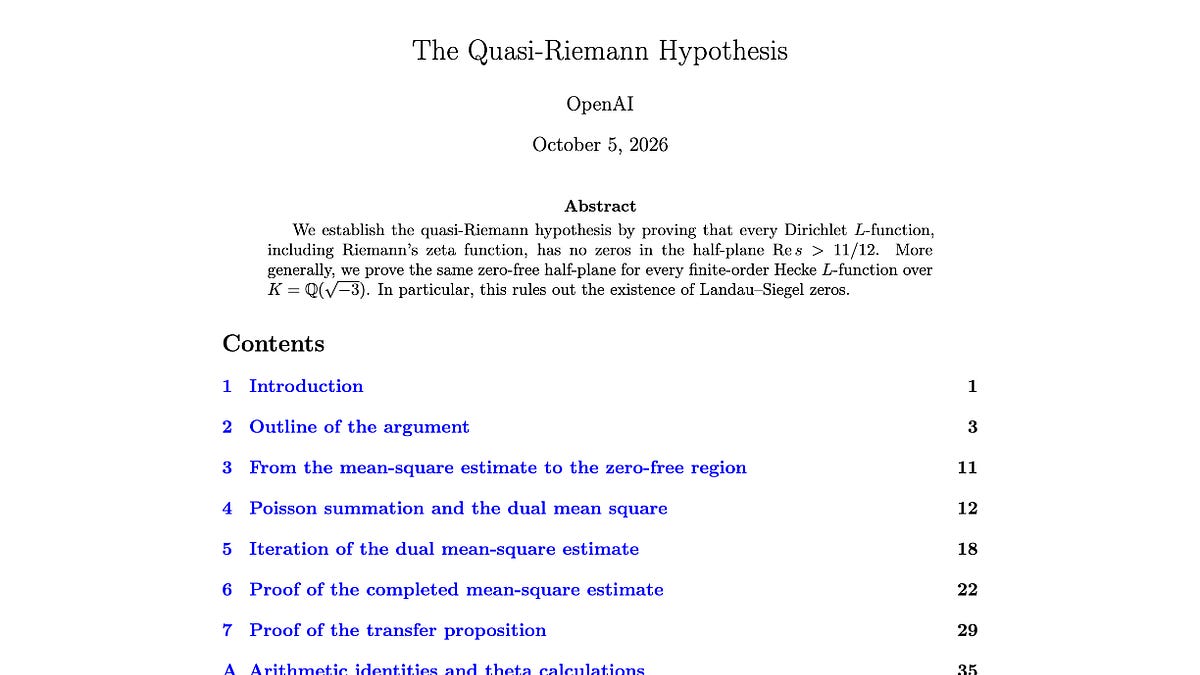
[AINews] Quasi-Riemann-Hypothesis: OpenAI publishes 722 math papers solving 90 of the top 500 open math problems; β€œthe most significant moment” in >100 years of mathematics

AINews daily digest (Oct 5–6, 2026) from Latent Space, synthesizing Twitter/Reddit AI discussion. Lead story: OpenAI published 722 math manuscripts (372 result families) from an unreleased internal model, averaging ~3 hours of ChatGPT Pro compute per result, including a quasi-Riemann Hypothesis result, a no-Siegel-zeros result, an integer-multiplication-faster-than-n-log-n claim, and partial progress on Hodge and BSD β€” drawing both "most significant moment in mathematical history" praise and skepticism about verification and compute framing. The issue also covers Mistral Large 4 ("Le Chonk")'s launch and contested benchmark claims, Google's EmbeddingGemma 2 multimodal embedding model, OpenAI's new Decisions API, safety/observability research (CIAware benchmark, METR's warning on agents hacking log-review tooling), and assorted research and infra items (H-JEPA, ANVIL III optimizer, CoreWeave RL rollouts).

GitHubHugging Facellama.cpp+8
OpenAIAnthropicMistral+46

research, models, evalsΒ· Published and added 7 Oct 2026

simonwillison.netwriteup🧠 AI

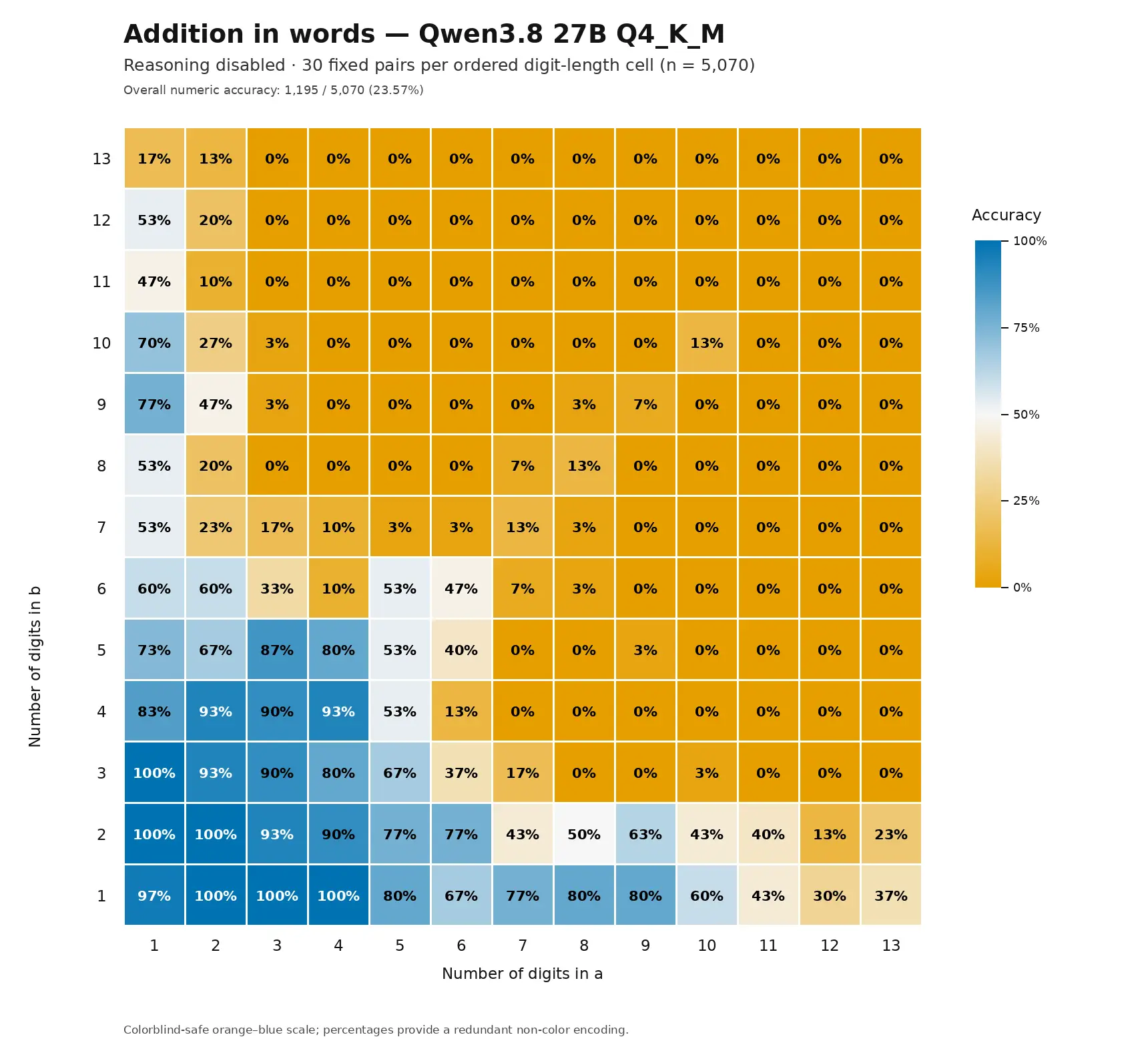
Qwen3.8 27B addition in words

Simon Willison reproduces an experiment originally run by Colin Frasier on GPT-4o β€” asking a model to add two large numbers and return the result spelled out in words β€” this time against a locally quantised Qwen3.8-27B-Q4_K_M.gguf model on an NVIDIA DGX Spark. He compares heatmaps of accuracy across number-size combinations with reasoning disabled (30 samples per pair) versus reasoning enabled (one-shot, 167/169 correct), and shares chain-of-thought traces showing the model doing manual digit-by-digit column addition. It's a small but concrete illustration of how enabling reasoning changes arithmetic reliability in a quantised local LLM.

GGUFQwen3.8-27BCodex
Simon WillisonColin FrasierGPT-4o+2

evals, inferenceΒ· Added 5 Oct 2026, published 4 Oct 2026

dfir.chwriteupπŸ›‘οΈ Security

Today I learned: Python's .start Files as a Persistence Mechanism

Explains PEP 829's new .start files in Python 3.15, which let a package register package.module:callable entries in site-packages that execute automatically every time an interpreter starts, before any user code runs. The author walks through a reproducible lab showing code execution via a .start file, contrasts it with the older executable-import .pth file technique it replaces, and gives forensic hunting commands (using python -S to avoid triggering the mechanism during investigation) to locate and audit .start files on disk.

Python
PEP 829

Blue Team & Detection, Offensive SecurityΒ· Added 6 Oct 2026, published 4 Oct 2026

alignmentforum.orgwriteup🧠 AI

Latent reasoning architectures would likely undermine CoT, our strongest oversight tool

An AI Alignment Forum essay arguing that chain-of-thought (CoT) monitoring β€” reading a model's natural-language reasoning trace to catch misaligned behavior before it is acted on β€” is currently one of the strongest practical oversight tools for frontier AI, and that a shift toward latent reasoning architectures (models that reason in continuous/hidden vector space rather than discrete, human-readable tokens) would largely destroy this transparency. The authors, including Ryan Greenblatt and collaborators, lay out why such architectures are plausible as a capability/efficiency direction and what the loss of CoT legibility would mean for safety oversight of advanced models.

Chain-of-Thought
Lukas FinnvedenAlexa PanAlek Westover+4

ai-safetyΒ· Added 3 Oct 2026

rekt.newswriteupπŸ›‘οΈ Security

Liquid Network β€” $320M L-BTC Mint via Range-Proof Cache-Key Collision

On September 6, 2026, an ambiguous four-part cache-key construction in Elements' CachingRangeProofChecker::VerifyRangeProof (introduced by commit c26d719) let two distinct confidential-transaction verification inputs collide into the same 4,301-byte cached entry, causing nodes to treat an unbacked output as a validated range proof. The attacker used this to mint roughly 4,000 unbacked L-BTC on the Liquid Network and cashed it out through SideSwap's PAK peg-out route for ~$320M in BTC, draining the federation reserve from 4,205 BTC to 197 BTC before ~3,400 BTC was voluntarily returned with an on-chain "whitehat" message. CertiK's forensic trace ties the exploit to a specific setup transaction, a still-unidentified cache-priming transaction, and the inflation transaction, while Blockstream shipped emergency patch Elements v23.3.4 and disputes remain over whether the fix fully closes the ambiguity and whether the actors are genuine whitehats.

BitcoinElementsLiquid Network+1
SideSwapCertiKBlockstream+12

BlockchainΒ· Added 2 Oct 2026

ethresear.chwriteupπŸ›‘οΈ Security

Six defects in one signature verification tool, found from outside in six rounds

A forum writeup on ethresear.ch describing a "predictions-first" testing methodology for verification logic, applied against the author's own repository and against a live third-party MCP server (nsgoods Workbench, which offers offline signature verification over the x402 payment catalogue). Six rounds of testing surfaced concrete defects: a false negative caused by a stripped field list, a tamper-accepted body via a service-selection parameter that let callers choose which fields were excluded from the signed message, schema-rejection and signature-failure returning byte-identical error text, and a logging/privacy gap in the operator's system that was fixed after disclosure. The author ships a companion tool, exactzk-verification-guards, which captures both a passing and an actually-reproduced failing run as regression evidence rather than a fabricated example.

Model Context ProtocolGitHubnsgoods Workbench MCP+1
x402ERC-8004Nikolaos Dimitriadis

AppSecΒ· Published and added 2 Oct 2026

Showing 30 of 169

Show more