Skip to content

57 results for “Discovery”

What you seeeverything
pillar.securityarticle🛡️ Security

SAIL Framework: A Practical Guide for AI Security

The SAIL Framework from Pillar Security is a seven-phase, lifecycle-oriented method for securing AI systems. The phases are AI policy and safe experimentation, AI asset discovery, AI security posture management, AI red teaming, runtime guardrails, sandboxed execution for agents and MCP servers, and AI activity tracing. It argues for a "Shift Up" approach that protects the business logic AI controls, and it is meant to sit on top of existing standards.

Model Context Protocol
SAIL FrameworkPillar Securityprompt injection+3

AI Security, GRC· Added 29 Oct 2026

aikido.devarticle🛡️ Security

Ghost in the PHP2Shell: Why coordinated disclosure and patching will start moving faster

Aikido's analysis of the PHP2Shell disclosures (CVE-2026-109618 and CVE-2026-109619), published October 2026. It covers the timeline: the CVE IDs leaked on 20 October, PHP moved its release to 21 October, and Amazon reports exploitation attempts from 17 October. It cites Censys data (32.5 million services still affected on 27 October) and argues that AI-driven discovery and exploit building call for shorter embargoes and faster patching.

PHPAikido SecurityCodex+2
CVE-2026-109618CVE-2026-109619PHP2Shell+8

AI Security, AppSec· Added 28 Oct 2026, published 29 Oct 2026

ethresear.charticle🛡️ Security

Inventory of PQ P2P Migrations in the Consensus Layer

Inventory of post-quantum migration work for Ethereum consensus-layer networking, by adust09 of Nyx Foundation. It maps three targets: Discovery v5/ENR signatures and key exchange, TLS 1.3 key agreement in QUIC, and libp2p TLS identity binding and CertificateVerify. It covers the 300-byte ENR and 1,280-byte packet limits, why hybrid KEMs do not authenticate peers, and downgrade and DoS concerns. It selects no algorithm or schedule.

Ethereumlibp2pQUIC+3
ML-KEMECDSAFIPS 203+8

other· Published and added 27 Oct 2026
bankless.comarticle🛡️ Security

Crypto's Two Answers to AI Bug Hunters

Bankless article on how crypto is responding to AI-driven bug discovery. It cites Bitcoin Core's 22 October 2026 policy change to fix and ship bugs findable with a simple LLM prompt instead of embargoing them, DefiLlama's 112 hacks over $1M in 2026 versus 70 in 2025, and the Initia exploit (~$2.7M). It contrasts an agility approach (Starknet, bunker mode) with minimalism and AI-assisted formal verification (Anthropic and Theorem proofs across 123 libraries).

BitcoinEthereumClaude+3
Antoine PoinsotInitiaStarknet+10

AI Security, other· Published and added 23 Oct 2026

anthropic.comarticle🛡️ Security

LLMs are making formal software verification feasible at a much larger scale

Anthropic and Theorem report using Claude to write Rocq proofs that 239 fuzz entry points across 123 OSS-Fuzz libraries never crash on inputs under 64 MB, at the RISC-V binary level (about 180 million lines of proof). Claude patched the bugs it found along the way, including a rediscovery of a libexpat CVE and bugs fuzzers would miss. The post covers trusted components, limitations, token-cost trends and released proofs.

ClaudeRocqRISC-V+3
CVE-2026-56132TheoremOSS-Fuzz+5

AppSec, AI Security· Added 23 Oct 2026, published 22 Oct 2026
latent.spacearticle🛡️ Security

[AINews] OpenAI’s Patch the Planet program is 1 of 2 parties to discover PHP2Shell vulnerabilities in core PHP affecting 70% of the web, using GPT-5.6 Sol; coordinated response over 2 months

AINews issue of 20-21 October 2026 whose top story reconstructs PHP2Shell (CVE-2026-109618, CVE-2026-109619), two PHP-engine memory-corruption bugs with reported pre-auth RCE against WordPress, Drupal and Joomla. It covers the two-month coordinated disclosure, independent discovery by Calif/OpenAI (GPT-5.6 Sol) and Wiz, Cloudflare WAF stopgaps and NSA guidance. It flags missing primary sources: fixed versions, CVSS and leak details.

PHPWordPressDrupal+3
CVE-2026-109618CVE-2026-109619PHP2Shell+9

AppSec, AI Security· Published and added 22 Oct 2026
latent.spacearticle🛡️ Security

[AINews] OpenAI’s Patch the Planet program is 1 of 2 parties to discover PHP2Shell vulnerabilities in core PHP affecting 70% of the web, using GPT-5.6 Sol; coordinated response over 2 months

AINews issue of 20-21 October 2026 whose top story reconstructs PHP2Shell, two PHP-engine memory-corruption flaws (CVE-2026-109618 and CVE-2026-109619) with reported pre-auth RCE against WordPress, Drupal and Joomla. It covers the two-month coordinated response, separate discovery by Calif/OpenAI (GPT-5.6 Sol) and Wiz (Gemini 4 Argon), Cloudflare's WAF stopgap and NSA guidance. It lists open gaps: fixed versions, leak details, exploitation versus scanning.

PHPWordPressDrupal+3
CVE-2026-109618CVE-2026-109619PHP2Shell+12

AppSec, AI Security· Added 23 Oct 2026, published 22 Oct 2026

securityweek.comarticle🛡️ Security

Microsoft Targets Rogue AI Agents With Dynamic Permissions, Risk Scoring

Microsoft extended Project Perception to treat internally deployed AI agents as insiders. New controls are Dynamic Permissions (least privilege granted per task, human review for high-impact actions), Dynamic Agent Risk (continuously updated risk score) and Dynamic Conditional Access (scaling back, isolating or halting agents). Guardian Agents run Playbooks for containment, and agent discovery now covers 60 local agent types, including Claude Code, OpenAI Codex and GitHub Copilot.

Project PerceptionMicrosoft Entra IDClaude Code+2
Dynamic PermissionsDynamic Agent RiskDynamic Conditional Access+4

AI Security, Identity & Access· Published and added 20 Oct 2026

coindesk.comarticle🛡️ Security

‘Wow, it’s a real discovery’: Claude cracks a 25-year NSA number mystery

CoinDesk reports that an Anthropic internal research model traced five NSA-supplied NIST elliptic-curve seeds to the C library generator lrand48 fed with 1997–98 timestamps. It matched P-256's published seed at the 1,842nd candidate, in under 30 minutes and without being told about the earlier "forgotten phrase" theory. This makes a hidden backdoor in the NIST curves less likely, though why some candidates were skipped and how other curve parameters were chosen remain unexplained. The article also explains why Bitcoin's secp256k1 was never part of the question, and that quantum risk is a separate threat.

ClaudeAnthropiclrand48+1
NISTNSAP-256+9

AI Security, other· Published and added 17 Oct 2026

coindesk.comarticle🧠 AI

‘Wow, it’s a real discovery’: Claude cracks a 25-year NSA number mystery

CoinDesk reports that an internal Anthropic research model traced five unexplained seeds behind the NSA-supplied NIST elliptic curves to lrand48, an old C random-number generator fed with 1997–98 timestamps. It took under 30 minutes. The model matched the P-256 seed at the 1,842nd candidate. Its reasoning trace briefly wondered whether it was in a simulated test before concluding the discovery was real. The result makes a hidden backdoor less likely and claims a $36,864 bounty, donated to ISRG. The article also explains why Bitcoin's secp256k1 was never affected, and that quantum computing is a separate threat.

Claudelrand48elliptic-curve cryptography+5
AnthropicNSANIST+10

models, research· Published and added 17 Oct 2026

blog.talosintelligence.comarticle🛡️ Security

The Q3 Vulnerability Pulse: Discovery ≠ Exploitation

Talos Threat Source newsletter arguing that record CVE volume (over 70k by end of Q3, six-digit CVE IDs) is not the same as exploitation. KEV grew only 37% YoY against 105% for CVEs, about a third of KEV entries are CVEs from 2025 or earlier (a patch gap), and 29% of 2026 KEV CVEs were added on their publication date. It also notes the new KEV "forensicTriage" column (BOD 26-04), summarizes the Talos/Insikt report on UAT-6275 espionage against CIS governments with GitHub-hosted payloads and a WinRAR exploit, and lists weekly headlines.

CISA KEVGitHubPowerShell+2
CVE-2026-104935CVE-2014-125110CVE-2015-1000013+7

Threat Intel, other· Published and added 15 Oct 2026

securityweek.comarticle🛡️ Security

Microsoft Patches Record 1,413 Vulnerabilities, Including Exploited Windows Zero-Day

SecurityWeek reports Microsoft's October 2026 Patch Tuesday fixed a record 1,413 CVEs (1,102 in Windows, 134 Office, 36 SharePoint), more than all of 2025, with the surge attributed largely to AI-driven discovery. The exploited zero-day CVE-2026-96951 is a Windows shell Mark of the Web security feature bypass (CVSS 8.8), added to CISA KEV with an October 16 deadline. Two flaws were publicly disclosed: CVE-2026-108398 (WDAC bypass) and CVE-2026-92707 (MessagePack-CSharp DoS), and Microsoft introduced 'risk cohorts' for patch prioritization.

WindowsWindows Defender.NET+2
CVE-2026-96951CVE-2026-108398CVE-2026-92707+5

Threat Intel, Blue Team & Detection· Published and added 14 Oct 2026

galaxy.comarticle🛡️ Security

💧 Looting of Liquid Sidechain Underscores Emerging Cyber Threat to Bitcoin

Galaxy Research breaks down the theft of 4,000 BTC (~$320m) from the Liquid Network, a Bitcoin sidechain run by the Liquid Federation. Attackers exploited a bug in the sidechain node code to artificially mint 4,000 L-BTC, then abused an auto-forward feature offered by federation member SideSwap to bypass peg-out address whitelisting and withdraw real BTC to the main chain; the self-described "white hats" returned 85% but held 15% hostage, negotiating with developer Blockstream via PGP-encrypted OP_RETURN messages and demanding a 10% bug-bounty payout. The piece also contrasts this with concurrent Coldcard and BTCPay Server incidents and speculates about AI-assisted vulnerability discovery.

BitcoinLiquid NetworkBlockstream+3
Liquid Federationpeg-out whitelist bypassOP_RETURN encrypted negotiation

Blockchain· Added 8 Oct 2026

coindesk.comarticle🛡️ Security

Bitcoin and ether holders urged to enter ‘bunker mode’ against possible AI attacks

Ethereum researcher Justin Drake and co-founder Vitalik Buterin warn that rapid AI progress in mathematics could break the elliptic-curve signatures securing Bitcoin and Ethereum wallets within months - far sooner than quantum computers are expected to - urging large holders to enter bunker mode by migrating funds to addresses whose public keys have never been exposed onchain. Buterin also flags that lattice-based post-quantum schemes, the basis of NIST's signature standard, could face similar AI-driven erosion, pushing Ethereum's long-term roadmap toward hash-based signatures instead. The piece grounds the warning in already-documented AI-assisted exploit discovery: a 5-year-old Coldcard hardware-wallet firmware bug drained over 1,367 BTC, BTCPay Server Lightning-node thefts, Core Lightning bugs surfaced via AI-generated audits, and Anthropic's demonstration of AI models writing working exploits against simulated DeFi contracts.

BitcoinEthereumColdcard+3
Justin DrakeVitalik ButerinCoinkite+3

Blockchain, AI Security· Published and added 8 Oct 2026

stepsecurity.ioarticle🛡️ Security

SubQuery npm package (@subql/common) compromised with credential-stealing payload

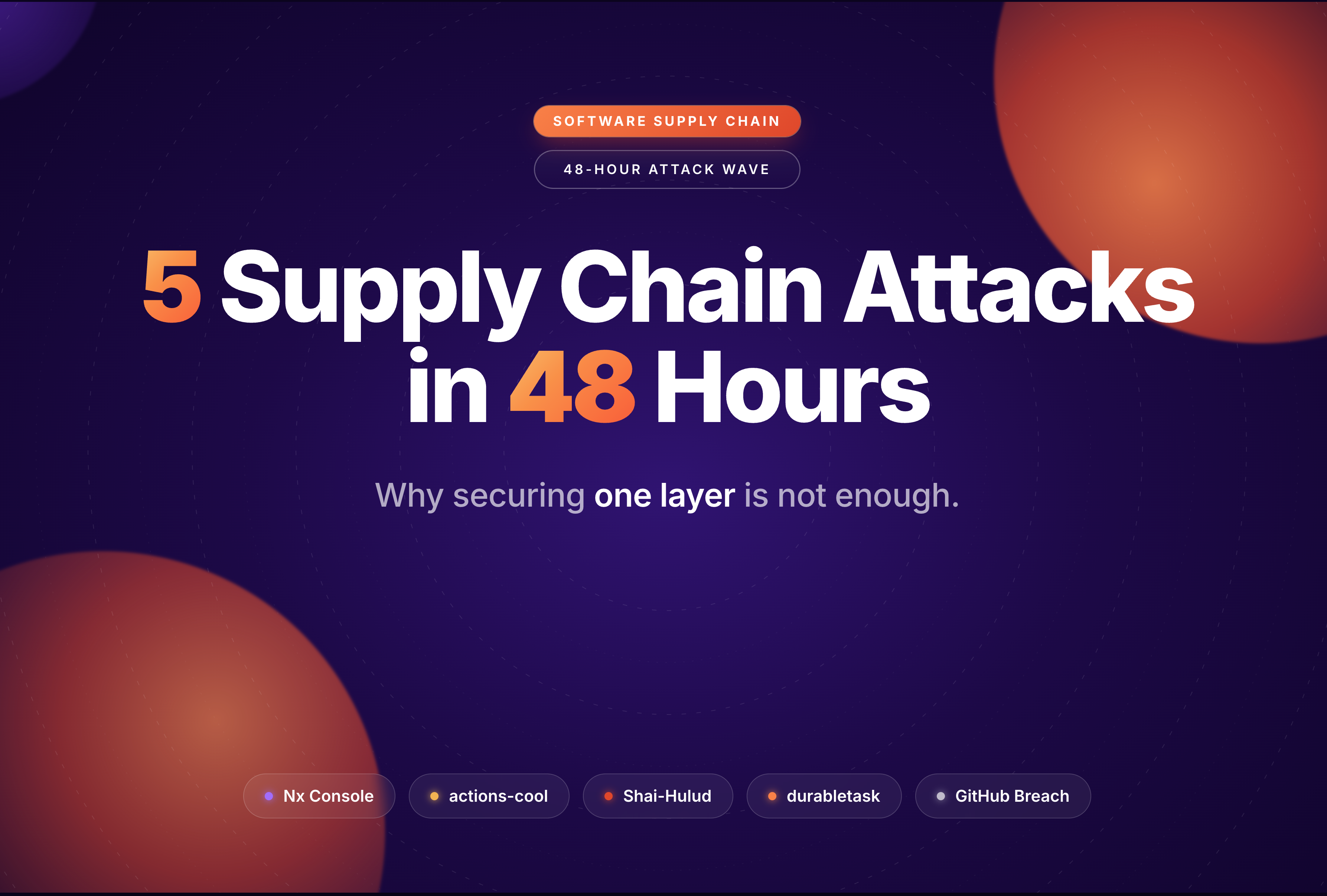
StepSecurity recaps a 48-hour (May 18-19, 2026) software supply-chain attack wave that hit every pipeline layer at once: the Nx Console VS Code extension (2.2M installs) stealing tokens from GitHub/npm/AWS/1Password, the trusted GitHub Action actions-cool/issues-helper hijacked via tag replacement, a trojanized Microsoft durabletask PyPI package pulled within a 35-minute discovery window, a self-replicating Shai-Hulud npm worm, and GitHub's own disclosure that ~3,800 internal source repos were exfiltrated. The piece argues traditional SCA/SAST/EDR/CNAPP tooling missed all of it because none monitor CI/CD runner runtime behavior (e.g., attackers reading /proc/pid/mem to extract secrets) or developer-machine IDE extensions, and ties the incidents to StepSecurity's Harden Runner, Dev Machine Guard, Compromised Actions Policy and Secure Registry controls.

GitHub ActionsVS Codenpm+6
Shai-HuludTeamPCPNx Console+3

Supply Chain, DevSecOps, Threat Intel· Added 6 Oct 2026

orca.securityarticle🛡️ Security

Connect Orca’s ChatGPT Plugin: Cloud Risk Context in Chat and Codex

Orca Security's plugin connects ChatGPT and Codex to Orca's MCP server, letting security teams and developers query cloud alerts, attack paths, effective IAM permissions, and code-to-cloud origins directly from chat or a coding agent instead of logging into a console. The post walks through six security-team use cases (exposure discovery, CVE impact triage, alert-to-blast-radius investigation, identity permission review, CISO reporting) and three developer workflows in Codex where alerts are traced back to the Terraform/code that created the misconfiguration and fixed in place.

Model Context ProtocolOrca SecurityChatGPT+3
CVE-2025-55182

Cloud & Infra· Added 2 Oct 2026, published 30 Sep 2026

cloud.google.comarticle🛡️ Security

Vulnerability Discovery and Exploitation Trends in the AI Era (Google Cloud)

Google Threat Intelligence Group analyzes vulnerability disclosure and exploitation trends from January 2025 to August 2026, finding disclosures doubled, exploitation nearly doubled, and AI-assisted discovery surfaces proportionally more Medium and High-risk flaws, with 50 percent leading to remote code execution versus 26 percent baseline. It documents real-world exploitation of an AI-discovered CVE in BeyondTrust PRA and a surge in vulnerabilities targeting the AI/LLM operational stack, especially agent orchestration frameworks like Langflow and Flowise and inference gateways like LiteLLM and vLLM, citing specific CVEs in those products.

LiteLLMLangflowvLLM+3
CVE-2026-1731CVE-2026-42271CVE-2026-5027+7

Threat Intel, AI Security, AppSec· Added 8 Oct 2026, published 30 Sep 2026

ethresear.charticle🛡️ Security

PQ spending for Stealth Address Protocol

Third in a series on post-quantum upgrades to the Stealth Address Protocol (ERC-5564/ERC-6538), this ethresear.ch post proposes a new schemeId=6 that replaces ECDH with ML-KEM for quantum-safe payment discovery and replaces ECDSA with either a lattice-based signature (SPIRIT, an ML-DSA/Dilithium variant) or a novel construction called HSAP that uses ML-KEM key delivery plus a ZK proof over hash-preimages for spending authorization. It works through the exact key-generation/derivation math for both schemes, discusses on-chain verification costs (citing ETHDILITHIUM benchmarks and draft EIP-8051's ~4500-gas ML-DSA-44 precompile), and sketches how the extended ERC-5564 announcer/registry interface and smart-account spending path would look under quantum attack assumptions.

EthereumML-DSAML-KEM
ERC-5564ERC-6538EIP-8051+6

Blockchain· Added 29 Sep 2026, published 28 Sep 2026

thehackernews.comarticle🛡️ Security

AI-Assisted HTTP Terminator Finds Novel HTTP Desync Techniques and Apache Zero-Day

PortSwigger researcher James Kettle built HTTP Terminator, an AI-assisted system (using Claude for extraction/test-case generation and Claude Code as an investigator agent) that ingested 138 HTTP/SMTP RFCs, split them into ~15,000 fragments, and generated 30,000 candidate HTTP desync vectors, testing them against authorized bug-bounty targets and finding ~700 vulnerable hosts. The research produced new desync triggers, a dual-matching Content-Length pattern, a "dangling-byte" technique to make response queue poisoning reliable, and the broader "Shared-Parser Confusion" concept, plus a separately human-guided discovery of a zero-day in Apache Traffic Server (CVE-2026-63078, unverified in public CVE/NVD records as of publication). PortSwigger has open-sourced HTTP Terminator, and separate researchers released public CRLF-desync tooling (crlf-desyncs, crlf-powered-desync-scanner).

ClaudeClaude CodeApache Traffic Server+1
CVE-2026-63078James KettlePortSwigger+6

AppSec, AI Security, Offensive Security· Added 24 Sep 2026

aikido.devarticle🛡️ Security

Cyber Resilience Act is here! Myth busting and first impressions

Aikido Security walks through the EU Cyber Resilience Act's newly live Single Reporting Platform (SRP), which as of September 11 requires manufacturers to report actively exploited vulnerabilities or severe incidents within 24 hours, with follow-up notifications at 72 hours and a final report 14 days after a fix ships. The post corrects common misconceptions — you don't report every vulnerability found, the 14-day clock starts at remediation not discovery, SRP submission alone isn't sufficient (affected users must also be notified), and pre-registration isn't required before you have something to report — and flags the upcoming harmonised standards EN 40000-1-1 and EN 40000-1-3 as the next thing to track ahead of the December 2027 full-compliance deadline. It also notes the EU is using CRA-collected data to build its own EUVD as an alternative to the backlog-plagued NIST NVD.

Aikido SecurityCISA KEVNVD
ENISAEU Cyber Resilience ActEUVD+3

GRC· Published and added 23 Sep 2026

latent.spacearticle🧠 AI

🔬 An Oscar, Two Asteroids, and the Algorithm in Your sklearn: John Platt on AI for Science

A Latent Space interview with Google's John Platt (co-inventor of SMO and Platt scaling) about ERA, Google's Empirical Research Assistance system: an LLM-driven agent that treats scientific problems as "scoreable tasks" and uses Monte Carlo Tree Search with Upper Confidence Bound selection over a tree of notebook experiments, having Gemini propose and mutate solutions. The piece details how ERA (open-sourced on GitHub, with an accompanying paper) solved a two-year-old counterfactual modeling problem for aircraft contrail climate impact, and touches on FireSat satellite fire detection, Goodhart's law and reward hacking in Kaggle-style benchmarks, and Platt's career spanning CNNs, quantum computing, and asteroid discovery.

Gemini
John PlattGoogleGoogle DeepMind+11

agents, research· Added 29 Sep 2026, published 22 Sep 2026

blog.talosintelligence.comarticle🛡️ Security

Securing the unpatchable in an age of AI-driven vulnerabilities

Cisco Talos argues that AI-accelerated vulnerability discovery is outpacing organizations' ability to patch, especially for unpatchable operational technology (OT) like medical devices and industrial control systems. It recommends network-level compensating controls instead of patching: upstream next-generation firewalls with intrusion prevention for virtual patching, VLAN/ACL-based micro-segmentation to restrict which devices can reach legacy systems, and visibility into legacy network fingerprints to build an asset inventory. It also debunks the air-gap myth, citing WannaCry's spread through unpatched Windows XP in the NHS as a cautionary example of "hope for the best" failing.

WindowsNGFWIPS+1
WannaCryNHS

Cloud & Infra· Added 7 Oct 2026, published 16 Sep 2026

aikido.devarticle🛡️ Security

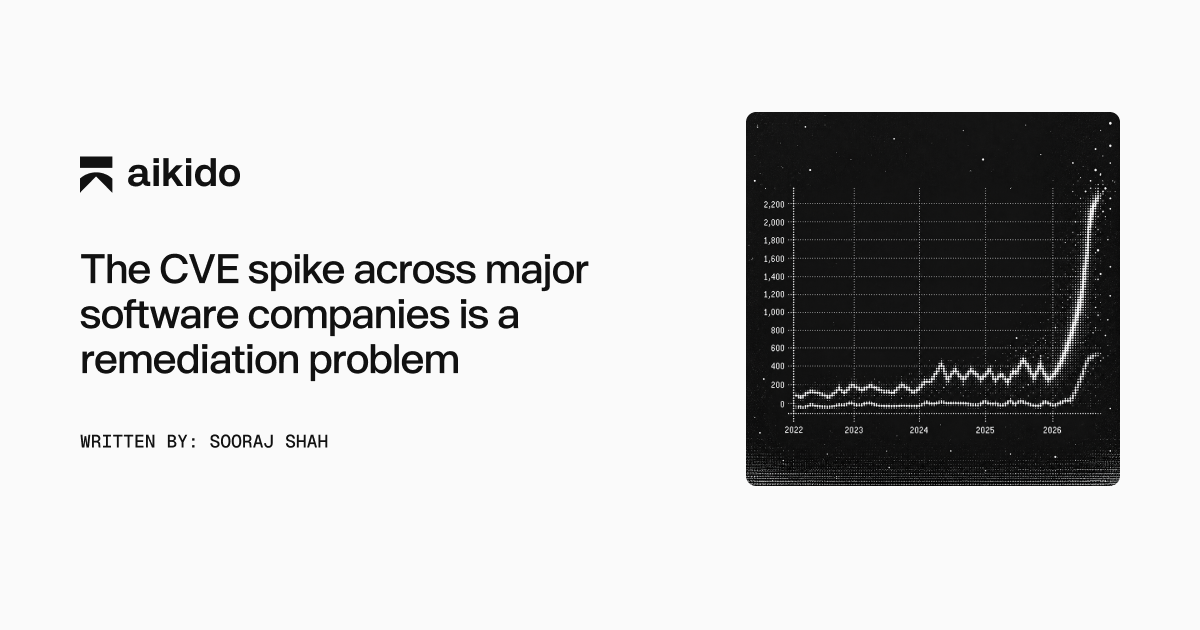
The CVE spike across major software companies is a remediation problem

Aikido argues the widely-shared a16z/Epoch AI chart showing critical/high CVEs jumping from under 100/month to over 600/month since spring 2026 reflects AI accelerating vulnerability discovery, not a real spike in danger — since CISA's KEV count has stayed flat. It details how NIST's NVD, overwhelmed by volume, let its scoring backlog balloon from 13,000 to 27,000 CVEs in 18 months and pivoted to only prioritizing federal/critical/KEV-listed CVEs, while Verizon's 2026 DBIR found only 26% of confirmed actively-exploited KEV vulnerabilities were fully remediated in 2025 (down from 38%) with median patch time rising to 43 days. It illustrates the point with StyleSmuggler, an unauthenticated RCE hitting Adobe Commerce and Magento Open Source that had no CVE or vendor advisory, which Aikido Intel flagged and Aikido Libraries auto-patched more than 24 hours before Adobe's own hotfix.

Adobe CommerceMagentoAikido Security+2
StyleSmugglerCISA KEVNIST+3

AppSec, Supply Chain· Published and added 10 Sep 2026

deepmind.googlearticle🧠 AI

Introducing Gemini 3.8 Flash and 3.8 Flash Cyber

Google DeepMind announces Gemini 3.8 Flash, an upgraded reasoning/coding model at the same $0.75/$3.75 per-million-token price as 3.7 Flash, plus Gemini 3.8 Flash Cyber, a specialized variant for vulnerability discovery and automated patching offered to vetted defenders through a new 'Fairwind Program'. The post cites benchmark gains on DeepSWE v1.1, HLE-Verified, Vals Finance Agent V2 and Harvey's Legal Agent Benchmark for the general model, and CyberGym plus Collinear's CWE-Bench for the cyber variant, along with real-world results from Chrome Security, Wiz and Google's Cloud Vulnerability Research team.

Gemini
Google DeepMindGoogleDeepSWE v1.1+15

models, evals· Added 29 Sep 2026, published 2 Sep 2026

deepmind.googlearticle🛡️ Security

Introducing Gemini 3.8 Flash and 3.8 Flash Cyber

Google DeepMind announces Gemini 3.8 Flash and a gated variant, Gemini 3.8 Flash Cyber, the latter positioned as a frontier-level model for autonomous vulnerability discovery and automated patching, accessible to vetted defenders through a new 'Fairwind Program.' On the CyberGym benchmark and an internal 20-language vulnerability-discovery benchmark it reports over 70% success, and on the Collinear CWE-Bench patching benchmark it nearly matches a larger frontier model (47.2% vs 47.8% pass@1) at much lower cost; Google cites Chrome Security producing 2.6x more correct patches and Wiz seeing higher recall at lower cost using the model, plus a case where Google's Cloud Vulnerability Research team found a critical vulnerability in under 2 hours.

GeminiChromeWiz
CyberGymCWE-BenchFairwind Program+5

AI Security, AppSec· Added 29 Sep 2026, published 2 Sep 2026

wiz.ioarticle🛡️ Security

From Concept to Context Engine: How Wiz Built AI-Powered Data Discovery

Wiz describes the evolution of its public bucket scanner into an AI-powered "context engine" for data security posture management (DSPM): a multi-agent pipeline where lightweight models triage files and larger models perform deep content analysis, iteratively learning bucket-specific patterns to find sensitive data that regex-based scanners miss. The production system adds structured severity scoring, synthetic/test-data filtering, algorithmic file clustering for scale, and now powers classification across cloud storage, cloud drives, endpoints, and Wiz's Red Agent attack-simulation findings. A one-week scan of public buckets using the engine surfaced over 2,700 sensitive data findings, including correlated credential/schema/export file sets that regex tools would treat as unrelated.

Wiz
Red Agent

AI Security, Cloud & Infra· Added 3 Sep 2026, published 27 Aug 2026

blog.modelcontextprotocol.ioarticle🧠 AI

The New MCP Roadmap

The Model Context Protocol Core Maintainers publish an updated roadmap covering five priority areas: agentic messaging primitives (server-initiated events, maturing the Tasks extension SEP-2663), HTTP-native transport unification (including local servers over Streamable HTTP/stdio), agent identity and enterprise security (DPoP, Workload Identity Federation, ID-JAG grant, token exchange, engagement with IETF OAuth and WIMSE working groups), improved tool-call result primitives and progressive tool discovery, and SDK developer experience. It also recaps the previous roadmap's shipped work in the 2026-07-28 spec release — removal of protocol-level sessions/handshake for stateless horizontal scaling, server/discover, cacheable list results, Multi Round-Trip Requests (SEP-2322), issuer validation, issuer-bound client credentials, and Client ID Metadata Documents (CIMD).

Model Context ProtocolOAuth
IETFWIMSE

mcp· Added 7 Oct 2026, published 22 Aug 2026

cloud.google.comarticle🛡️ Security

Agentic Source Code Review for Vulnerability Discovery

Mandiant details AVDH (Agentic Vulnerability Discovery Harness), a multi-agent LLM pipeline built on Google's Agent Development Kit that performs threat modeling, entry-point discovery, context enrichment, and hypothesis generation/validation (using high-temperature Validation agents plus a Synthesis agent) to find vulnerabilities in source code at scale. Over 10 months it has produced 12 assigned CVEs (including CVE-2026-13242 and CVE-2026-55803), found 100+ true-positive critical vulnerabilities in a two-day IR investigation, and identified an RCE during a client engagement, with human experts validating findings via PoC exploitation and a distilled "rules" knowledge base injecting consultant expertise into the pipeline. The piece also describes their internal benchmarking methodology using synthetic codebases to avoid LLM training-data contamination.

GeminiGoogle Cloud
CVE-2026-13242CVE-2026-55803Mandiant+4

AI Security, AppSec· Added 3 Sep 2026, published 21 Aug 2026

intigriti.comarticle🛡️ Security

Web Fuzzing for Hackers

A practical guide to web fuzzing for bug bounty hunters, covering wordlist selection (custom vs. SecLists-style generic lists), and tool-specific configuration for content discovery, subdomain/VHost enumeration, and parameter/header discovery using ffuf, Burp Suite Intruder, OWASP Amass, dnsx, Arjun, and Param Miner. It details concrete techniques such as subdomain permutation patterns, extension fuzzing for leftover files (.md, .env, .sql), dotfile/prefix patterns (/.FUZZ, /-FUZZ, /~FUZZ), IIS-specific extensions (.asmx, .ashx, .aspx.bak), and hidden-header fuzzing (X-Forwarded-For, X-Debug, X-HTTP-Method-Override) that can lead to SQLi, cache poisoning, or access-control bypass.

Burp SuiteIIS
SecListsAssetnote

AppSec, Offensive Security· Added 3 Sep 2026, published 21 Aug 2026

aikido.devarticle🛡️ Security

What is CVE remediation in 2026?

Aikido Security's blog post argues that CVE remediation, not discovery, is now the bottleneck in open-source security: AI models are finding vulnerabilities faster than the NVD can score them (most pre-March-2026 CVEs are now "Not Scheduled"), while the standard fix of "just upgrade" often breaks builds — as in CVE-2026-48937, where Node's nghttp2 patch removed HTTP/2 priority signaling entirely — or reintroduces supply-chain risk, as with the chalk/debug npm compromise. It pitches backporting (patching the exact pinned version instead of upgrading) as the fix, implemented by Aikido's own "Aikido Libraries" product across npm, PyPI, and Maven.

Node.jsnpmPyPI+4
CVE-2026-48937chalkdebug+3

Supply Chain, DevSecOps· Added 3 Sep 2026, published 21 Aug 2026

Showing 30 of 57

Show more