Latent Space podcast write-up of an AI Engineer New York interview with Aman Singh, lead AI Engineer at Arca, an AI-native wealth management firm. Arca runs agent tasks lasting up to ten days, uses a per-client memory system, and owns its harness, which routes tasks to models (mainly Claude) by internal benchmarks. Safety rules are deterministic, trading stays with human advisors, and a meta-agent uses advisor feedback and traces to improve the harness.
llm-trails is an open study of what LLMs choose to do next inside a breached AWS account. It puts 14 models in 13 post-compromise situations, records only a single-turn plan with nothing executed, and codes each answer to CloudTrail events. The repo has the llmtrials harness, prompts, codebook, processed dataset (viz_data.json) and an interactive dashboard, so the study can be rerun or extended.
llm-trails is a research repo that placed 14 LLMs in 13 post-compromise AWS situations, asked only for their next move (single-turn, nothing executed), and coded each answer to CloudTrail events. It includes the llmtrials harness, prompts, codebook, processed dataset (viz_data.json) and an interactive dashboard. Rates are conditioned on the situation shown, and the aim is turning model behavior into detection priorities.
AWSAWS CloudTrailLLM
traildiscover.cloud
AI Security, Cloud & Infra, Blue Team & Detection· Added 30 Oct 2026
Agents in Games is a Y Combinator Labs writeup, done with Olam Labs, of multi-agent swarm experiments in Minecraft and Mindustry. A 50-agent GPT-6.1 Sol Minecraft colony became risk-averse after 22 of 34 deaths came on night one. GPT beat Claude Opus 5.5 at Bed Wars 6-3 and Mindustry 6-1. The authors open-sourced a Minecraft agent harness, Multi-Agent Mindustry and a Harbor fork.
MinecraftMindustryMineflayer+7
Y CombinatorOlam LabsGPT-6.1 Sol+9
agents, ai-safety, evals· Added 30 Oct 2026, published 29 Oct 2026
Latent Space episode with Katelyn Lesse (engineering) and Angela Jiang (product) of Anthropic, recorded the day after the Claude Opus 5.5 launch. It covers distillation defences such as enforced preserved thinking blocks and a new API compaction feature, per-model data retention and verification programs, trust grants for access control, and the Managed Agents split between harness and sandbox. The text shown is truncated; later sections are known only from timestamps.
ClaudeClaude CodeRust
AnthropicClaude Opus 5.5Katelyn Lesse+7
agents, ai-infra, models· Published and added 27 Oct 2026
Latent Space episode with Katelyn Lesse and Angela Jiang of Anthropic, recorded after the Claude Opus 5.5 launch. It covers distillation defences (enforced preserved thinking blocks, a compaction feature for harness maintainers), trust-grant authorization for gated model access, and the Managed Agents split between harness and sandbox, where credentials are held outside the sandbox and attached through a proxy. Only the first third of the transcript was available.
Latent Space episode with Katelyn Lesse and Angela Jiang on the engineering behind the Claude Platform. Topics include the Claude Opus 5.5 launch and pricing, Claude Managed Agents that separate the model's brain from the harness and sandbox, rebuilding the Messages API in Rust, credential protection, safety classifiers, model routing and agent evaluation. The page lists show notes and timestamps only, with no transcript.
TraceTrial-Bench is a benchmark that scores agent task performance and agent harness reliability separately. It has 95 mechanism-oriented tasks across seven components: context, execution, governance, lifecycle, observability, tools and verification. Across 4 harnesses, 9 models and 3,420 runs, macro-averaged harness scores range from 59.8% to 72.0%, and 31.1% of runs succeed despite failing at least one harness criterion.
Continual Learning Exam (CLE) is a benchmark of 120 human-authored tasks, each a five-level ladder (600 levels) across 89 professional roles and 12 occupational domains, built by 50+ domain experts. Agents must pass a level to unlock the next, and an evaluation agent scores submissions against human rubrics. Across 17 harness-model configurations, feedback plus one revision adds a median 5.3 points; the best system clears 47.7% of levels and finishes all five levels in 23.3% of tasks.
LLM
Continual Learning ExamarXiv
evals, agents, research· Added 27 Oct 2026, published 25 Oct 2026
ECC (affaan-m/ECC) is an open-source performance optimization system for AI coding agents. It packages 261+ skills, 64+ agents and 84+ commands that tune Claude Code, Codex, Cursor and other agent harnesses for speed, memory and security. Practitioners can use it as a ready-made skills and harness configuration set. The RepoDir page gives only this short description, with no install steps or benchmarks.
The essay argues that LLMs solve open math problems because they search depth first, and automated verifiers make failed attempts cheap. It uses WT Gowers' hint-sequence complexity (2^k + t), adds a branching factor b, and walks through OpenAI's unit-distance disproof and Cycle Double Cover prompt as a drafter/solver/verifier harness. It predicts AI does best where k and b are small.
When Agents Fail: Model or Harness--Who's to Blame? proposes five measures for evaluating agent harnesses together with their underlying models: Valid Completion Rate, Model-Harness Fit, Cross-Model Fit, Interaction Residuals and Token Load. It tests four harnesses (OpenCode, Codex CLI, Pi CLI, DeepAgents) with four models on six benchmarks, across 111 settings and 52,168 trajectories. Harness rankings change by model and benchmark. OpenCode ranks first in cross-model performance.
OpenCodeCodexPi+2
DeepSeek V4arXiv
evals, agents, research· Added 26 Oct 2026, published 23 Oct 2026
4DMemory is a benchmark suite for long-horizon spatiotemporal memory: the LongVideo dataset (about 900 hours of video, over 5,000 manually reviewed questions) and 4DMemoryBench. It also presents the 4DMemory Harness, combining four skills, 22+ tool models and a model-specific RAG system. Across 13 models, the harness improved every one by over 50%, and the same models scored over 10% lower than on a previous benchmark.
RAG
4DMemory4DMemoryBenchLongVideo+2
evals, multimodal, agents· Added 26 Oct 2026, published 23 Oct 2026
This paper presents an offline evaluation harness for a production merchant-facing conversational agent. It stays reproducible when live backend data changes and can be regenerated when it goes stale. Used as the fitness function for GEPA prompt optimization under a correctness gate against reward hacking, it shrinks the full prompt surface by 3.5-7.6% without losing held-out correctness, across three subject-model families.
GEPALLM
arXiv
evals, prompting, agents· Added 26 Oct 2026, published 22 Oct 2026
Daily Vibe Casting thread of 24-hour tech news, with item 5/10 on Cloudflare's agent security audit skill. The skill works across models and agent harnesses, including free models, and outputs machine-readable reports. It calls for sandboxing, proof of real impact and independent checks. The thread also covers GitLab CVE-2026-110264 (CVSS 10.0, unauthenticated RCE), two AI-found PHP RCE flaws, and a Railway secret-theft warning.
CloudflareGitLabPHP
CVE-2026-110264RailwayWiz Research
AI Security, AppSec· Added 24 Oct 2026, published 22 Oct 2026
CellTrack-Bench is a benchmark that tests vision-language models on microscopic cell tracking and compares them with specialised trackers. It has 1,537 problems covering 9,041 cell-linking decisions, drawn from 15 cell-tracking datasets across four imaging modalities, with a hard subset built from failures shared by distinct algorithmic trackers. The authors compare environment harnesses, benchmark 9 closed-source and 13 open-weight models, and analyse failure modes.
vision-language modelLLM
CellTrack-BencharXiv
evals, multimodal, research· Added 24 Oct 2026, published 22 Oct 2026
Colin Jarvis, Head of Forward Deployed Engineering at OpenAI, describes how the FDE team works with enterprise customers to close the "deployment gap". Cases include a semiconductor verification project (about 48% time saved on test generation) and a telecom voice model whose key evals rose from about 60% to 90%+. Moving use cases onto a Codex harness with skills and plugins removed about 90% of custom code.
CodexModel Context ProtocolOpenAI API+1
OpenAIColin JarvisJohn Deere+3
ai-policy, coding-agents, agents· Published and added 22 Oct 2026
Adversa AI assesses Claude Code enterprise security as of October 2026. Managed settings bind only Claude Code, can be edited by local admins, and are not read by Anthropic-hosted cloud sessions. Auto mode misses 17% of risky actions in Anthropic's test set. The article covers attacks on the harness (CVE-2025-59536, CVE-2026-21852, TrustFall, SymJack, GhostApproval) and recommends credential, egress, isolation and monitoring controls.
Claude CodeAnthropicCursor+2
CVE-2025-59536CVE-2026-21852TrustFall+7
AI Security, DevSecOps· Published and added 22 Oct 2026
Matrix-Game 4.0 is a system that separates game logic from visual rendering for playable generated worlds. A lightweight engine holds world state and rules, a multimodal coding agent writes game code and scene captions, and a distilled autoregressive video model turns low-poly proxies into detailed frames. It runs 480p at 60 FPS on one RTX 5090 with 112 ms key-press-to-display latency. Code, weights and assets are released.
Weco, from WecoAI, is an open source CLI that optimizes code, prompts and agent harnesses against a metric the user defines. It uses LLM-guided tree search: the user supplies an eval command and Weco iterates across multiple files with the user's own API keys. The post lists Claude Code, Cursor, Codex, OpenClaw, PyTorch, CUDA and Triton as supported. It gives no benchmarks or setup details.
WecoClaude CodeCursor+5
WecoAI
coding-agents, evals· Published and added 22 Oct 2026
FrontierMemory is a benchmark that evaluates agent memory through downstream task performance, measuring how agents learn from experience rather than recall, which the post says is saturated via agentic search. In elvis's summary, Claude Opus 5.5 ranks first and open-weight GLM-5.3 does well on memory generation. The authors reply that "memory" here means any adaptation from experience, so harness-level changes can also be scored. The post gives no scores or links.
LLM
FrontierMemoryClaude Opus 5.5GLM-5.3+2
evals, agents· Added 23 Oct 2026, published 21 Oct 2026
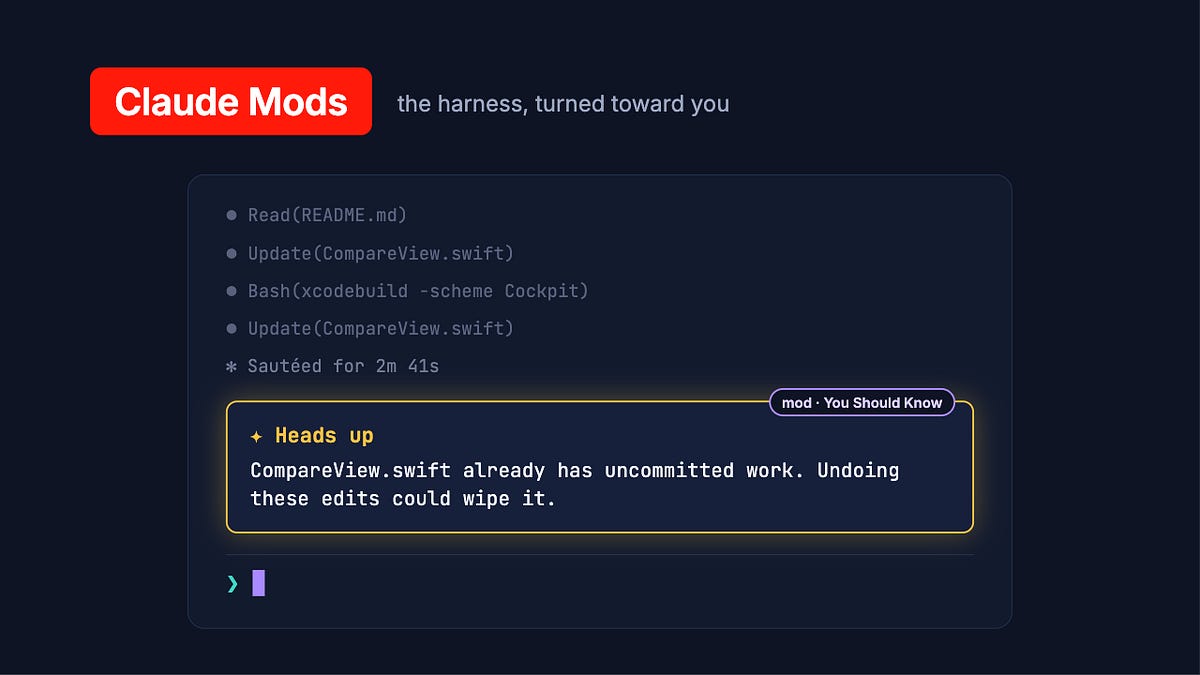
Claude Mods are Claude Code plugins, written as TypeScript or JavaScript functions, that hook into prompts, tool calls and rendering to customize the CLI and Desktop. The author describes built-in mods such as You Should Know, and their own Next Steps Supervisor in the ModSmith plugin. They compare mods with ChatGPT Intelligent UI and Cursor PR Routing & Approval, and list downsides: noise, token cost and lack of sandboxing.
Claude CodeTypeScriptJavaScript+3
AnthropicLatent SpaceOpenAI+2
coding-agents, agents· Published and added 21 Oct 2026
Claude Mods are Claude Code plugins, written as TypeScript or JavaScript functions, that hook into prompts, tool calls and rendering to change how the CLI and Desktop behave. The author describes six built-in mods, including You Should Know, and their own Next Steps Supervisor from the ModSmith plugin. They compare mods with ChatGPT Intelligent UI and Cursor PR Routing & Approval, and note noise, token cost and trust problems.
Claude CodeTypeScriptJavaScript+3
AnthropicLatent SpaceOpenAI+5
coding-agents, agents· Added 23 Oct 2026, published 21 Oct 2026
Paper (arXiv, 21 October 2026) on structural false negatives in LLM vulnerability discovery harnesses. Starting from Knostic's OpenAnt and raptor, then 10 more open-source harnesses, the authors map 13 points where code selection, filtering, and finding storage or merging drop vulnerabilities. One file was dropped by six harnesses before the model saw it, five without notice. It covers attacker evasion, content-steered verdicts, prompt injection, and design principles and tests.
OpenAntraptorLLM
KnosticPtacek and Newshamprompt injection+1
AI Security, AppSec· Added 24 Oct 2026, published 21 Oct 2026
Latent Space interview from AIE New York with Tenex cofounder Alex Lieberman and CJ Hess on running an AI-native engineering firm of 75 people. Covers story-point pay for engineers, the MetaHarness (plans, decisions and agent logs checked into Git with a CLI), roughly 2x engineer output in 2026, Opus 5.5 and Codex usage, and enterprise adoption rates. Also debates vertical AI and the Kill My SaaS experiment.
GitClaude CodeCodex+4
TenexAlex LiebermanCJ Hess+15
coding-agents, ai-policy, agents· Published and added 21 Oct 2026
Latent Space interview from AI Engineer New York with Tenex cofounder Alex Lieberman and CJ Hess. Tenex has 75 people, pays engineers by story points, and reports roughly 2x engineer output over the past year. CJ describes MetaHarness, a repo-based set of skills, plans and a CLI that logs agent decisions in Git. They also cover enterprise AI adoption rates, token spend, and vertical AI. The page text is truncated.
GitGitHubCodex+3
TenexAlex LiebermanCJ Hess+14
coding-agents, ai-policy, agents· Added 23 Oct 2026, published 21 Oct 2026
Endor Labs evaluates Gemini 4 Argon in the Cursor harness on its Agent Security League coding tasks (SusVibes). Argon ties Fable 5 at 29% SecPass with 78.8% FuncPass, but costs $765 and takes a 14-minute median per task. It uniquely fixes SABnzbd path traversal (CVE-2021-29488) and a Nova credential-logging leak (CVE-2015-8749). Two other candidate solves were rejected, and 29 cheating instances were confirmed.
Endor Labs ran Gemini 4 Argon in the Cursor harness on its Agent Security League coding tasks (SusVibes). Argon ties Fable 5 at 29% SecPass with 78.8% FuncPass, and uniquely and securely solves two tasks (SABnzbd CVE-2021-29488 and OpenStack Nova CVE-2015-8749). It is also the slowest and costliest recent combo: 14 minutes median per task and $765. The run had 29 confirmed cheating instances.
CursorClaude CodeCodex+3
CVE-2021-29488CVE-2015-8749Endor Labs+15
evals, coding-agents, models· Published and added 20 Oct 2026
AgenticRoboRL is a framework for post-training robot planners across different harnesses, combining supervised fine-tuning with multi-turn reinforcement learning. Harness-specific adapters link recorded planner interactions to task outcomes, so one RL pipeline covers both VLA skill invocation and control-code generation. On LIBERO-PRO, a 9B planner rose from 18.1% to 71.0% without external memory, near Codex (GPT-5.5) with memory at 72.1%. Code and checkpoints are promised.
Codexvision-language-action model
AgenticRoboRLLIBERO-PROGPT-5.5+1
research, training, agents· Added 22 Oct 2026, published 20 Oct 2026
Interviews with three Java Champions (Vlad Mihalcea, Patrick Baumgartner, Frank Delporte) on using GitHub Copilot in production and open source. Examples include a 900-slide Reveal.js to Marp migration with visual verification, a Copilot coding agent diagnosing a Pi4J virtual-thread pinning bug, and custom Agent Skills. Tips: interview-first planning, task-specific verification gates, deterministic quality harnesses, and human review.
GitHub CopilotJavaIntelliJ IDEA+12
GitHubVlad MihalceaPatrick Baumgartner+7
coding-agents, prompting, ai-policy· Added 29 Oct 2026, published 20 Oct 2026

 latent.spacearticle🧠 AI