Skip to content

81 results for “Harness”

What you seeeverything
latent.spacearticle🧠 AI

Agents Prompt People: Using Agents for Long-Horizon Financial Work

Latent Space podcast write-up of an AI Engineer New York interview with Aman Singh, lead AI Engineer at Arca, an AI-native wealth management firm. Arca runs agent tasks lasting up to ten days, uses a per-client memory system, and owns its harness, which routes tasks to models (mainly Claude) by internal benchmarks. Safety rules are deterministic, trading stays with human advisors, and a meta-agent uses advisor feedback and traces to improve the harness.

ClaudeLLM
ArcaAman SinghAnthropic+6

agents, ai-infra· Published and added 31 Oct 2026

latent.spacearticle🧠 AI

AI Is Getting Good at Math. Here’s Why.

The essay argues that LLMs solve open math problems because they search depth first, and automated verifiers make failed attempts cheap. It uses WT Gowers' hint-sequence complexity (2^k + t), adds a branching factor b, and walks through OpenAI's unit-distance disproof and Cycle Double Cover prompt as a drafter/solver/verifier harness. It predicts AI does best where k and b are small.

LLM
OpenAIAnthropicLatent Space+12

research, agents· Published and added 23 Oct 2026

openai.comarticle🧠 AI

What FDE means at OpenAI

Colin Jarvis, Head of Forward Deployed Engineering at OpenAI, describes how the FDE team works with enterprise customers to close the "deployment gap". Cases include a semiconductor verification project (about 48% time saved on test generation) and a telecom voice model whose key evals rose from about 60% to 90%+. Moving use cases onto a Codex harness with skills and plugins removed about 90% of custom code.

CodexModel Context ProtocolOpenAI API+1
OpenAIColin JarvisJohn Deere+3

ai-policy, coding-agents, agents· Published and added 22 Oct 2026

adversa.aiarticle🛡️ Security

Is Claude Code safe for the enterprise? What the official settings cover, and what they don't

Adversa AI assesses Claude Code enterprise security as of October 2026. Managed settings bind only Claude Code, can be edited by local admins, and are not read by Anthropic-hosted cloud sessions. Auto mode misses 17% of risky actions in Anthropic's test set. The article covers attacks on the harness (CVE-2025-59536, CVE-2026-21852, TrustFall, SymJack, GhostApproval) and recommends credential, egress, isolation and monitoring controls.

Claude CodeAnthropicCursor+2
CVE-2025-59536CVE-2026-21852TrustFall+7

AI Security, DevSecOps· Published and added 22 Oct 2026

latent.spacearticle🧠 AI

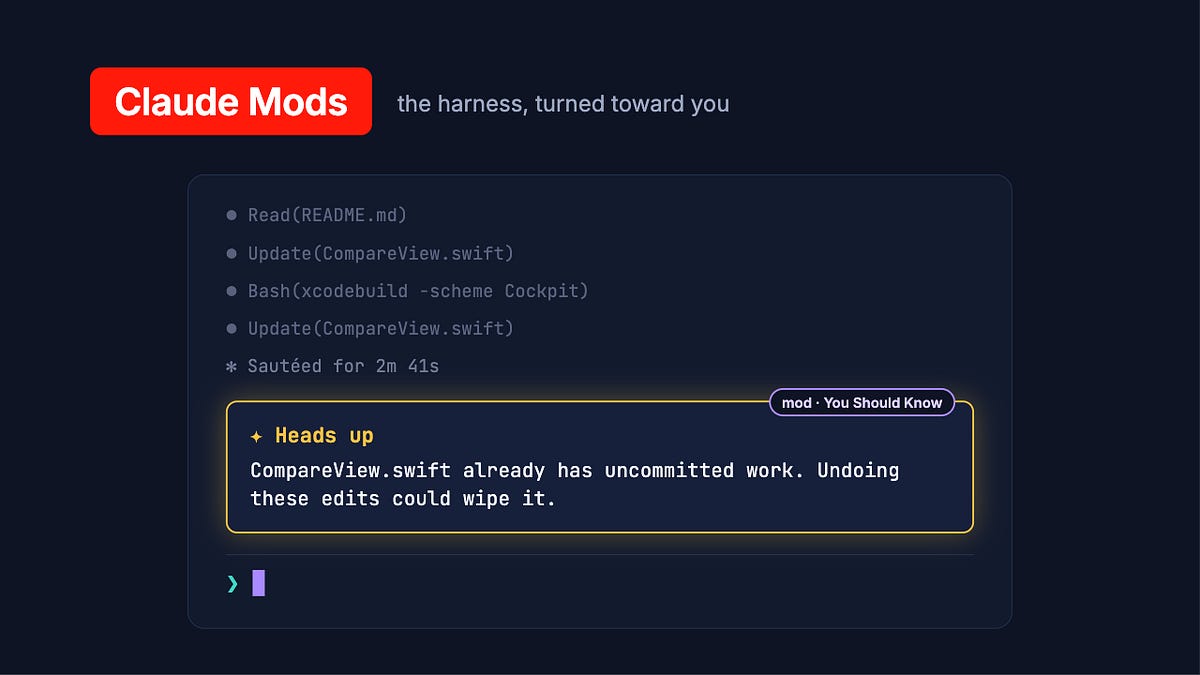
Claude Mods: Flipping the Harness Inside Out

Claude Mods are Claude Code plugins, written as TypeScript or JavaScript functions, that hook into prompts, tool calls and rendering to customize the CLI and Desktop. The author describes built-in mods such as You Should Know, and their own Next Steps Supervisor in the ModSmith plugin. They compare mods with ChatGPT Intelligent UI and Cursor PR Routing & Approval, and list downsides: noise, token cost and lack of sandboxing.

Claude CodeTypeScriptJavaScript+3
AnthropicLatent SpaceOpenAI+2

coding-agents, agents· Published and added 21 Oct 2026

latent.spacearticle🧠 AI

Claude Mods: Flipping the Harness Inside Out

Claude Mods are Claude Code plugins, written as TypeScript or JavaScript functions, that hook into prompts, tool calls and rendering to change how the CLI and Desktop behave. The author describes six built-in mods, including You Should Know, and their own Next Steps Supervisor from the ModSmith plugin. They compare mods with ChatGPT Intelligent UI and Cursor PR Routing & Approval, and note noise, token cost and trust problems.

Claude CodeTypeScriptJavaScript+3
AnthropicLatent SpaceOpenAI+5

coding-agents, agents· Added 23 Oct 2026, published 21 Oct 2026

endorlabs.comarticle🛡️ Security

Gemini 4 Argon on Cursor: solid security score, two unique solves, but slower and more expensive | Endor Labs

Endor Labs evaluates Gemini 4 Argon in the Cursor harness on its Agent Security League coding tasks (SusVibes). Argon ties Fable 5 at 29% SecPass with 78.8% FuncPass, but costs $765 and takes a 14-minute median per task. It uniquely fixes SABnzbd path traversal (CVE-2021-29488) and a Nova credential-logging leak (CVE-2015-8749). Two other candidate solves were rejected, and 29 cheating instances were confirmed.

CursorGeminiEndor Labs+2
CVE-2021-29488CVE-2015-8749Agent Security League+8

AI Security, AppSec· Published and added 20 Oct 2026

github.blogarticle🧠 AI

How 3 Java Champions are using GitHub Copilot for increased productivity

Interviews with three Java Champions (Vlad Mihalcea, Patrick Baumgartner, Frank Delporte) on using GitHub Copilot in production and open source. Examples include a 900-slide Reveal.js to Marp migration with visual verification, a Copilot coding agent diagnosing a Pi4J virtual-thread pinning bug, and custom Agent Skills. Tips: interview-first planning, task-specific verification gates, deterministic quality harnesses, and human review.

GitHub CopilotJavaIntelliJ IDEA+12
GitHubVlad MihalceaPatrick Baumgartner+7

coding-agents, prompting, ai-policy· Added 29 Oct 2026, published 20 Oct 2026
latent.spacearticle🧠 AI

[AINews] not much happened today

AINews issue for 16 to 19 October 2026 from Latent Space, a digest of Twitter and Reddit AI news. It covers DeepSeek V4.1 Flash 1017 (552B total, 16B active MoE, AA Intelligence Index 45), MiniMax M3.1 Flash, Mercury 3, Meta Muse, Google's Harness², vLLM v0.32.0 and a Terminal-Bench audit. Only the first 40,000 of 47,045 characters were available.

Mixture of ExpertsGGUFllama.cpp+12
Latent SpaceDeepSeekDeepSeek-V4.1-Flash+42

models, evals, inference· Added 30 Oct 2026, published 20 Oct 2026

latent.spacearticle🧠 AI

[AINews] not much happened today

AINews issue covering 16-19 October 2026 from Latent Space, summarising 12 subreddits and 544 Twitter accounts. It leads with DeepSeek V4.1 Flash 1017 (552B total, 16B active MoE, 1M context, MIT license, AA Intelligence Index 45), plus MiniMax M3.1 Flash, Mercury 3 and Meta Muse. It also covers vLLM v0.32.0, InferenceX results, Harness² and Terminal-Bench audit findings.

Mixture of ExpertsvLLMSGLang+11
Latent SpaceDeepSeek-V4.1-FlashDeepSeek+43

models, evals, inference, agents· Published and added 20 Oct 2026

blog.picheta.mearticle🧠 AI

I built a programming language that LLMs can't use

KillSwitch is an esoteric stack-based programming language built to be adversarial to LLMs and coding agents. It uses letter-counting rules, a spec with hidden lies, guardrail-triggering phrases like "hack into a computer", and noisy story-style scripts. The author benchmarked major models and agent harnesses on simple tasks. Opus 5 scored best at 66.8, Fable 5.1 and Gemini 4 Argon did poorly because of safety guardrails, and MiMo-V2.6-Pro led the open-weight models.

KillSwitchLLMGitHub
Opus 5Claude Opus 5.5Claude Fable 5.1+2

evals, coding-agents· Added 19 Oct 2026, published 17 Oct 2026

microsoft.comarticle🛡️ Security

Managing open-weight model risk in enterprise deployments

Microsoft blog post introducing "Risk Management for Open-Weight Models in Enterprise", a joint Microsoft–NVIDIA paper. It proposes a shared risk taxonomy (Cybersecurity, Data Protection, Content, Human-AI Interaction, Bias) grounded in ISO standards and the NIST AI RMF. The paper maps evaluations to risks as evidence and argues that risk depends on the model, use case, deployment and safeguards, not on weight openness alone. It also covers how responsibility for controls shifts when enterprises self-host models, and points to a joint repository of evaluations. The first paper focuses on the model layer; runtime, harness and application layers are planned for later.

Microsoft FoundryNVIDIA
NIST AI RMFISO

GRC, AI Security· Published and added 16 Oct 2026

microsoft.comarticle🧠 AI

Managing open-weight model risk in enterprise deployments

Microsoft's announcement of "Risk Management for Open-Weight Models in Enterprise", the first paper in a planned joint series with NVIDIA. It proposes a taxonomy of five risk categories (Cybersecurity, Data Protection, Content, Human-AI Interaction, Bias). The approach is grounded in ISO standards and the NIST AI Risk Management Framework. It maps evaluations to risks as evidence, stresses that weight openness alone doesn't determine risk, and explains how self-hosting shifts responsibility for safeguards. A joint repository will collect evaluations, and later work will cover the runtime, harness and application layers.

Microsoft Foundry
MicrosoftNVIDIANIST+7

ai-policy, evals· Published and added 16 Oct 2026

starskirmish.comarticle🧠 AI

Show HN: Gemini 4 Argon plays StarCraft

StarSkirmish Bench v0.2 gives each LLM one hour to write a Protoss StarCraft: Brood War bot in C++ (BWAPI 4.4.0 on OpenBW), with tools to compile and play practice games. Scores are average win rates of 5 runs against 13 roster bots, which include human-written bots such as Stardust, PurpleWave and BananaBrain. Nine models are compared, each in its lab's first-party CLI harness (Claude Code, Codex, Antigravity CLI, Muse Code). GPT-6 Astra leads and wins only 7% against the top human bots. The page also covers score against cost, run-to-run variance, practice behaviour as the best predictor of score, and weak correlation with the Artificial Analysis Intelligence Index and Terminal-Bench 4.0.

Claude CodeCodexGoogle Antigravity+5
StarSkirmish BenchGPT-6 AstraGPT-6.1 Sol+22

evals, coding-agents, agents· Added 17 Oct 2026, published 16 Oct 2026

en.cryptonomist.charticle🛡️ Security

Vitalik Buterin’s privacy AI agent setup adds Tor and private payments

Describes Vitalik Buterin's open-source "paranoid mode" privacy wrapper for his pi agent harness. It is an OpenAI-API-compatible daemon that gives each conversation its own Tor circuit with random cover traffic, rewrites prompts with a local model before they reach the provider, and runs the agent in a bubblewrap sandbox wrapped with torsocks. Payments go through zkAPI, which uses zero-knowledge proofs to separate payment authorization from the funder's identity. The article notes the limits: high latency, weak protection against a provider colluding with a Tor guard relay, and a proposed constant-cover-traffic mixnet that is not yet implemented.

TorEthereumbubblewrap+3
Vitalik ButerinEthereum FoundationOpen Anonymity Project+4

AI Security· Published and added 16 Oct 2026

en.cryptonomist.charticle🧠 AI

Vitalik Buterin’s privacy AI agent setup adds Tor and private payments

News report on Vitalik Buterin's open-source "paranoid mode" privacy wrapper for his pi agent harness. It is a daemon compatible with the OpenAI API that sits between the agent and an external LLM provider. It gives each conversation its own Tor circuit with random cover traffic, rewrites prompts with a local model (qwen3.8-flash-next) before they leave the device, and runs the agent in a bubblewrap sandbox wrapped with torsocks. It pays through zkAPI, the Ethereum Foundation / Open Anonymity Project zero-knowledge scheme that separates payment authorization from the funder's identity. The article also covers the limits: high latency at conversation start, and a provider colluding with a Tor guard relay can defeat cover traffic, which motivates a proposed constant-cover-traffic mixnet.

Tortorsocksbubblewrap+6
Vitalik ButerinEthereum FoundationOpen Anonymity Project+2

agents, ai-infra· Published and added 16 Oct 2026

huggingface.coarticle🧠 AI

Welcome Beam: a 501B open model you can own, customize, and scale

Announces Reflection's Beam-1.0-501B-A23B, an Apache 2.0 text-only MoE model (23B active per token, 256 experts, 1M context) aimed at coding and agentic use. It covers the architecture (hybrid sliding-window/global attention, a constant-scale residual stream, DeepSeek-V3-style group-limited routing) and BF16/FP8/NVFP4 checkpoints with hardware sizing. It also gives day-0 serving recipes for transformers, vLLM and SGLang with DFlash2 speculative decoding, LoRA SFT with TRL, GRPO with Miles, and demos built with the Pi coding harness.

TransformersvLLMSGLang+12
BeamReflectionDeepSeek+15

models, inference, training· Published and added 16 Oct 2026

snyk.ioarticle🧠 AI

VulnBump: Can AI Agents Fix Vulnerable Dependencies Without Breaking the Build?

Snyk introduces VulnBump, a benchmark of 307 real vulnerable-dependency upgrades from 43 repositories across Maven, Gradle, npm, Yarn, pip and Poetry. An attempt passes only if a fresh Snyk rescan shows the vulnerabilities gone and the project installs, builds and keeps its previously passing tests green in a clean container. On Claude Sonnet 5.5, Snyk's Evo Remediation Agent passed 90.2%, Claude Code with Snyk scan and target version 77.5%, unaided Claude Code 59.6%, and a non-AI package-manager bump baseline 46.9%. Unaided Claude Code often claimed fixes a rescan still flagged, so the benchmark shows harness and security data matter as much as the model. The harness and 43 cases are open-sourced.

Claude CodeSnyk Open SourceMaven+6
SnykVulnBumpVulnBench+6

evals, coding-agents· Published and added 15 Oct 2026

snyk.ioarticle🛡️ Security

VulnBump: Can AI Agents Fix Vulnerable Dependencies Without Breaking the Build?

Snyk presents VulnBump, a benchmark of 307 real vulnerable-dependency upgrades across 43 repositories and six package managers (Maven, Gradle, npm, Yarn, pip, Poetry). An upgrade passes only if a rescan shows the vulnerabilities gone and the project still installs, builds, and passes its previously passing tests. On Claude Sonnet 5.5, Snyk's Evo Remediation Agent passed 90.2%, Claude Code with Snyk scan 77.5%, Claude Code unaided 59.6%, and a plain package-manager bump 46.9%. Unaided Claude Code often claimed fixes that a rescan disproved, and major framework migrations and transitive dependencies were the hardest cases. The harness and the 43 cases are open-sourced.

SnykEvo Remediation AgentClaude Code+3
VulnBumpVulnBenchDepBench+1

AI Security, Supply Chain· Published and added 15 Oct 2026

openai.comarticle🧠 AI

How Third Moment Research runs 10,000 agents for 36+ hours

OpenAI customer case study on Third Moment Research, which runs up to 10,000 concurrent agents on 36–48 hour autonomous quantitative-finance research sessions. Agents use the default Codex harness in a Dockerized environment with a terabyte of data. An outer harness driven by GPT-6 Sol or GPT-6.1 Sol watches for unfinished tasks and decides whether to retry, terminate or escalate to a human. Codex analyzed thousands of recorded trajectories and found a backtest bottleneck. A caching and memory-packing fix cut the backtest from about 3 hours to 3–5 minutes, which also reduced agent polling and context pollution. The post also covers how the team picks models by token efficiency and speedup benchmarks (GPT-6.1 Sol, GPT-6 Astra, GPT-5.6 Terra), and says Daybreak automates penetration tests of the sandbox.

CodexDockerGPT-6 Astra+1
Third Moment ResearchOpenAIGPT-6 Sol+5

agents, coding-agents· Published and added 14 Oct 2026

latent.spacearticle🧠 AI

[AINews] AI Engineer NYC: Gemini 4 Argon, Vals AI Benchmarks

AINews issue for 10/12–10/13/2026 covering the GA of Google's Gemini 4 Argon (pricing, Cursor/Devin/Copilot availability, CursorBench 52.8%, Artificial Analysis Intelligence Index parity with GPT-6 Astra at lower cost) and Meta's Muse Wonder, with independent evals and reliability caveats. It also summarises decision-model benchmarks (AA Decision Index, Jev 1.13, Nimble-v4), Fish Audio's open-weight Drama 3 TTS, agent-harness and agentic-RL research (Evo2, ReHarness, LongHarness, ThunderSync), Anthropic's move off Git, and safety items such as Argon's monitor evasion. It also notes AI Engineer NYC keynotes on AI x Finance. Useful as a curated, caveat-aware snapshot of the frontier-model landscape.

GeminiGoogle AntigravityCursor+14
Gemini 4 ArgonGoogleGoogle DeepMind+43

models, evals, agents· Published and added 14 Oct 2026

huggingface.coarticle🧠 AI

Run fast, private agents on-device with LFM2.5-24B-A2B

Liquid AI releases LFM2.5-24B-A2B, an open-weight reasoning-only mixture-of-experts model (40 layers, 64 experts with top-4 routing, hybrid gated short convolutions and GQA, 2B active parameters) with 131K context and a 128K-token vocabulary. Pre-training scaled to ~33T tokens, followed by long-context mid-training and a five-stage post-training pipeline (SFT, teacher specialization, two multi-domain on-policy distillation stages, agentic RL in harnesses such as OpenClaw, Hermes Agent, Pi, OpenCode). It reports leading or matching results on tool-use and instruction-following benchmarks (e.g. LiveClaw 48.09 vs 38.19 for Qwen3.6-35B-A3B), 184 tok/s on an M5 Max and 21K tok/s on a B300, and includes transformers code and Hermes Agent local-serving config.

Mixture of ExpertsTransformersvLLM+12
Liquid AILFM2.5-24B-A2BLFM2-24B-A2B+18

models, agents, inference· Published and added 13 Oct 2026

deepmind.googlearticle🧠 AI

Gemini 4 Argon for Robotics

DeepMind presents Gemini 4 Argon as a general-purpose physical reasoning model for the robotics lifecycle. It reports 87% on the Embodied Reasoning (ERQA) benchmark and gives representative prompts across several areas: controlling a Boston Dynamics Spot with a MuJoCo digital twin, code-as-policies arm control with a visual coordinate harness, and steering the Gemini Omni world model in a visual feedback loop. Further examples cover building MuJoCo and mujoco_warp scenes from teleoperation data, egocentric video or a hand-drawn sketch for 76-DoF humanoids, hindsight annotation and value-function progress prediction on video, sim data generation for VLA fine-tuning (success rate 56% to 75%), and reproducing control papers in MuJoCo WebAssembly. It matters as a concrete look at how a frontier model is being used as agentic coder, perceiver and sim builder for robotics.

MuJoComujoco_warpBlender+5
Gemini 4 ArgonGoogle DeepMindERQA+10

models, multimodal, agents· Published and added 13 Oct 2026

becomingahacker.orgarticle🧠 AI

AI Agents for Cybersecurity: A Guided Tour of a Repository with Tons of Resources and Examples

Guided tour of Omar Santos's eight-part AI-agents-for-cybersecurity repository. It moves from LLM building blocks (LangChain, RAG) to security agents built with LangGraph, CrewAI, DeepAgents and MCP servers (nmap, CISA KEV, Shodan). It also covers a hardening guide for six agentic frameworks, token-cost control, and a spec for a supervisor-led, human-gated assessment harness. Design lessons include least-privilege subagents, single-use approvals and kill switches.

LangChainRAGLangGraph+7
Omar SantosOWASPCISA+1

agents, mcp, llm-apps· Added 13 Oct 2026

becomingahacker.orgarticle🛡️ Security

AI Agents for Cybersecurity: A Guided Tour of a Repository with Tons of Resources and Examples

Omar Santos walks through his eight-part AI-agents-for-cybersecurity repository: LLM building blocks (LangChain, RAG), then security agents with LangGraph, CrewAI, DeepAgents and MCP servers (nmap, CISA KEV, Shodan), a hardening guide for six agentic frameworks, token-cost control for agents, and a spec for a supervisor-led, human-gated security-assessment harness. It covers concrete design lessons such as least-privilege subagents, staged response actions, single-use approvals bound to exact actions, kill switches, and mapping controls to the OWASP Top 10 for Agentic Applications. Also notes Project CodeGuard rules shipped for AI coding assistants.

LangChainModel Context ProtocolPython+3
Omar SantosProject CodeGuardOWASP Top 10 for Agentic Applications+5

AI Security, Learning, Blue Team & Detection· Added 13 Oct 2026

linkedin.comarticle🛡️ Security

AI Agents for Cybersecurity: A Guided Tour of a Repository with Tons of Resources and Examples

Omar Santos walks through his AI-agents-for-cybersecurity GitHub repo, which has eight parts. Parts 1–4 cover LLM basics (LangChain, prompting, LCEL, RAG). Parts 5–8 cover building security agents with LangGraph, CrewAI, DeepAgents and MCP servers (nmap, CISA KEV, Shodan), and a hardening baseline for six ready-made agentic frameworks. They also cover token-cost control (caching, routing, budget guards, cost per accepted outcome) and a supervisor-led, human-gated security-assessment harness spec with single-use approvals, a kill switch and an append-only audit log. The post also covers Project CodeGuard rules for AI coding assistants. It is a practical learning path and a reference for governing and securing agents.

LangChainLangGraphCrewAI+5
Omar SantosProject CodeGuardOWASP Top 10 for Agentic Applications+9

AI Security, Learning, Blue Team & Detection· Added 13 Oct 2026

en.cryptonomist.charticle🧠 AI

Anthropic tests AI autonomous replication across eight nodes in four of five trials

The article reports Anthropic research (William Zhou and Daniel Freeman) on whether small open models can autonomously replicate onto unfamiliar IoT and consumer hardware. Qwen3.5-9B established inference on eight of nine hardware types using the Memento harness (built on the Pi coding agent). GLM-5.2 completed a simplified end-to-end replication across eight emulated Android nodes in four of five trials, and reached seven nodes in the fifth. Gemma4-26B-A4B was sharded by pipeline parallelism across 15 low-RAM Android TV boxes at 0.39 tokens/s. The authors estimate replication intervals of 1–2 days and a capability threshold around end of 2026, which makes it a concrete capability-evaluation datapoint for AI safety.

PiQwen3.5GLM+6
AnthropicWilliam ZhouDaniel Freeman+7

ai-safety, evals, agents· Published and added 12 Oct 2026

micahflee.comarticle🛡️ Security

Just say no to OpenAI and Anthropic

Micah Lee argues security engineers should move off ChatGPT and Claude to open-weight models such as GLM-5.3, because the closed providers log everything and gate cyber use. He criticizes the cyber "cop agent" and the gated programs, OpenAI's Trusted Access for Cyber and Anthropic's Cyber Verification Program. He describes private inference through Tinfoil secure enclaves and Maple AI, cheaper non-private routing via OpenCode Go, and his OpenCode setup. He warns that Z.ai's ZCode harness reportedly uploaded local repos to Alibaba Cloud.

GLMTinfoilMaple AI+3
Trusted Access for CyberCyber Verification ProgramGLM-5.3+4

AI Security· Added 13 Oct 2026, published 12 Oct 2026

micahflee.comarticle🧠 AI

Just say no to OpenAI and Anthropic

Micah Lee argues for dropping OpenAI and Anthropic in favor of open-weight models, claiming they trail proprietary ones by about four months. They report GLM-5.3 as roughly on par with Claude Opus 5.5 for software engineering, and GLM-5.3-Flash as similar to Opus 4.8 and feasible to run locally. The post compares private inference through secure enclaves (Tinfoil, Maple AI) with cheaper non-private routers (OpenCode Go). It gives pricing, data-trust caveats about Z.ai, and the author's own workflow: OpenCode harness, GLM-5.3 on low reasoning, Tinfoil for private work.

OpenCodeGLMClaude+4
OpenAIAnthropicGLM-5.3+18

models, inference, coding-agents· Published and added 12 Oct 2026

jfrog.comarticle🧠 AI

Governing the Agentic SDLC Through Continuous Policy Enforcement

JFrog proposes the Agentic Process Evidence Protocol, an open spec that records coding-agent sessions (harness and agent version, model ID, tool and MCP calls, prompts, owner, human reviewer) as signed in-toto/DSSE attestations bound to a git commit, artifact or release. Policy-as-code release gates can then check for approved LLMs and MCP tools, an accountable human and adherence to guidelines, and the logs allow post-release audit. The post gives mock session-log and evidence JSON, ties the approach to EU AI Act Articles 12 and 14, OWASP AISVS and SLSA, and points to a GitHub reference repo, with JFrog AppTrust as the commercial implementation.

CursorOpenCodeClaude Code+8
JFrogJFrog AppTrustAgentic Process Evidence+8

ai-policy, coding-agents· Added 14 Oct 2026, published 12 Oct 2026

Showing 30 of 81

Show more