Skip to content

83 results for β€œInjection”

What you seeeverything
github.comrepoπŸ›‘οΈ Security

alirezarezvani/claude-skills

claude-skills is an open-source MIT library of about 398 Claude Code skills, agents and plugins that also installs into Codex, Gemini CLI, Cursor and 9 other coding agents. The security-relevant parts are skill-security-auditor, a stdlib-only Python scanner that checks skills for command injection, data exfiltration, prompt injection and dependency supply-chain risks before install, plus a security-guidance PreToolUse hook, a security suite and compliance skills (ISO 27001, SOC 2, GDPR).

Claude CodeCodexGemini CLI+3
skill-security-auditorPreToolUse hookagentskills.io+3

AI Security, Supply ChainΒ· Added 25 Oct 2026

github.comrepoπŸ›‘οΈ Security

Spectrmachina/Ztrust

ZTrust is a Python supply-chain scanner that checks manifests, lockfiles, source and GitHub workflows for vulnerable or malicious dependencies (via OSV.dev), typosquats, leaked secrets, unsafe lockfiles and risky CI patterns such as pwn requests and script injection. It outputs console, JSON and SARIF 2.1.0 and ships as a GitHub Action. It also includes a FastAPI bounty service using commit-reveal and shielded Zcash payouts for researchers.

PythonGitHub ActionsOSV+3
xz-utilstj-actions/changed-filesevent-stream+3

Supply Chain, DevSecOpsΒ· Added 27 Oct 2026, published 22 Oct 2026

github.comrepoπŸ›‘οΈ Security

SnailSploit/Claude-Red

claude-red is a library of offensive security skills for the Claude Skills system, each a SKILL.md file that loads on conversational triggers (for example, mentioning SQL injection loads offensive-sqli). Categories include web, Active Directory, cloud, mobile, exploit development, fuzzing, privilege escalation, post-exploitation and AI. It targets about 130 skills across 23+ categories, with an install script and sparse-checkout install per category. Built on Sahar Shlichov's offensive checklists, MIT licensed.

ClaudeClaude CodeActive Directory
Kai AizenSahar ShlichovSnailSploit

Offensive Security, AI SecurityΒ· Added 22 Oct 2026

github.comrepoπŸ›‘οΈ Security

gichirimaku/wp2shell-PoC

wp2shell-PoC is a Python proof-of-concept exploiting a pre-authentication RCE chain in WordPress core, combining CVE-2026-63030 (REST API batch route confusion) and CVE-2026-60137 (SQL injection in WP_Query). It demonstrates escalation from the route-desync bug through blind SQLi, customize_changeset forgery, and hook re-entry to administrator account creation and arbitrary command execution via a malicious plugin upload. The tool supports vulnerability checking, data extraction (union, error-based, blind techniques), and full shell access with or without existing admin credentials.

WordPressPython
CVE-2026-63030CVE-2026-60137SQL injection+1

AppSec, Offensive SecurityΒ· Added 23 Oct 2026, published 15 Oct 2026

x.comrepoπŸ›‘οΈ Security

Dan Kornas (@DanKornas) on X

Arcjet JS SDK is an Apache-2.0 JavaScript monorepo that adds runtime security checks to AI apps, agents and HTTP endpoints. It ships framework SDKs (Next.js, Node.js, Bun, Deno, Fastify, NestJS) plus a Guard API for agent tool calls, MCP handlers, queue workers and background jobs that have no HTTP request object. Features include prompt injection detection, sensitive-information detection (PII, credit cards, custom patterns) and token-bucket, fixed-window and sliding-window rate limiting.

ArcjetModel Context ProtocolNode.js+3

AI Security, AppSecΒ· Published and added 11 Oct 2026

x.comrepo🧠 AI

Dan Kornas (@DanKornas) on X

Arcjet JS SDK is an open-source (Apache-2.0) JavaScript monorepo that adds runtime security to AI apps, agents and HTTP endpoints. It ships request SDKs for Next.js, Node.js, Bun, Deno, Fastify and NestJS. It also has a Guard API for places with no HTTP request object, such as agent tool calls, MCP handlers, queue workers and background jobs. Built-in checks cover prompt-injection detection, sensitive-information detection (PII, credit cards, custom patterns) and token-bucket, fixed-window or sliding-window rate limits, including token budgets.

Arcjet JS SDKJavaScriptNext.js+6
ArcjetDan Kornas

ai-infra, agentsΒ· Published and added 11 Oct 2026

github.comrepoπŸ›‘οΈ Security

sakidekin/CVE-2026-41940-PoC

This repository hosts a proof-of-concept for CVE-2026-41940, described as a CVSS 10.0 unauthenticated authentication bypass in cPanel and WHM caused by CRLF injection into server-side session files via the Authorization header. The accompanying Python tool (cve.py) can detect vulnerable cPanel/WHM instances, retrieve system and account information, and perform post-exploitation actions such as running OS commands, changing the root password, and opening an interactive WHM shell. It also supports bulk scanning workflows piped from subfinder, httpx, and Shodan.

PythonShodan
CVE-2026-41940CRLF injectionauthentication bypass

Offensive SecurityΒ· Added 23 Oct 2026, published 11 Oct 2026

vulnerablemcp.inforepoπŸ›‘οΈ Security

The Vulnerable MCP Project β€” MCP vulnerability database

The Vulnerable MCP Project is a curated, continuously growing database of security vulnerabilities and attack techniques specific to the Model Context Protocol ecosystem. Entries cover concrete CVEs (e.g. CVE-2025-68143/68144/68145 in Anthropic's mcp-server-git), transport-layer SDK flaws (cross-client response leakage, missing DNS rebinding protection in the official TypeScript/Python SDKs), unauthenticated/0.0.0.0-bound servers enabling RCE (MCPJam inspector, MCP Inspector, Grafana MCP), command/path injection in dozens of third-party servers (gemini-mcp-tool, mcp-server-kubernetes, Framelink Figma MCP, Zen MCP, filesystem-mcp), SSRF chains reaching cloud metadata (MarkItDown MCP, mcp-fetch-server), and a large set of AI-specific attacks: tool poisoning, trigger-phrase data exfiltration, prompt injection via GitHub issues, Jira and Google Docs, rug-pull tool mutation, and cross-server tool-name collisions. It functions as the de facto vulnerability registry for the MCP ecosystem, useful for tracking disclosed issues before patching or adopting third-party MCP servers.

Model Context ProtocolCursorKubernetes+3
CVE-2025-68143CVE-2025-68144CVE-2025-68145+3

AI Security, AppSecΒ· Added 6 Oct 2026

x.comrepoπŸ›‘οΈ Security

Dark Web Informer (@DarkWebInformer) on X

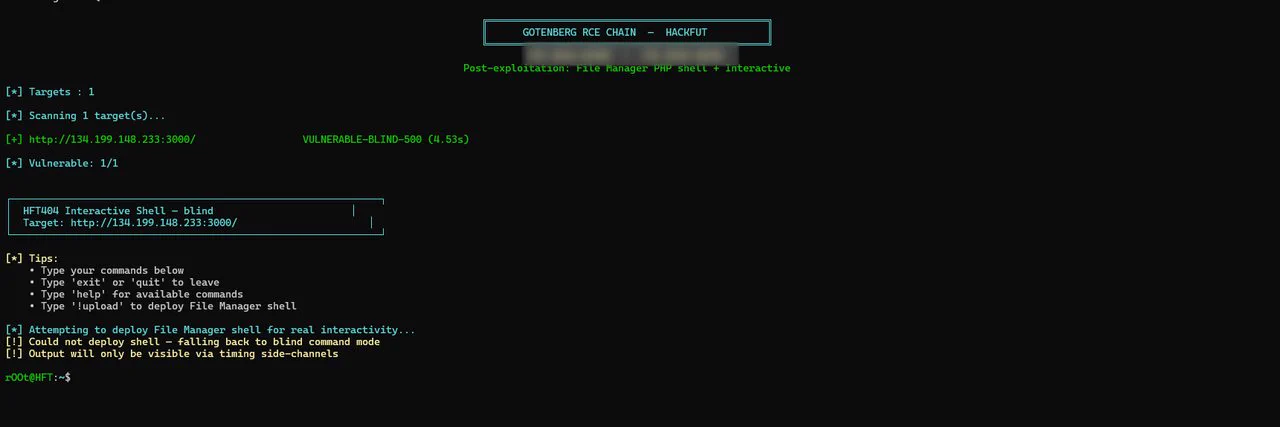
A public PoC chains CVE-2026-42589 and CVE-2026-40281 to achieve unauthenticated remote code execution against Gotenberg (a document/PDF-conversion microservice), abusing metadata injection flaws in the /forms/pdfengines/metadata/write endpoint. The tool supports vulnerability detection, interactive command execution, reverse shell delivery, and multi-target scanning against Gotenberg versions ≀8.30.1 (patched in 8.31.0).

Gotenberg
CVE-2026-42589CVE-2026-40281

Offensive Security, AppSecΒ· Published and added 5 Oct 2026

github.comrepoπŸ›‘οΈ Security

garak v0.17.0 β€” LLM vulnerability scanner release

Release notes for garak v0.17.0, NVIDIA's open-source LLM vulnerability scanner used for red-teaming and probing models for jailbreaks, prompt injection, data leakage and other failure modes. The release adds an EU AI Act risk-category mapping to tag and group probe results, plus fixes to detectors (agent_breaker judge verdict validation, packagehallucination import parsing, MarkdownExfilContent divide-by-zero, TriggerListDetector alignment) and probes (badchars ASCII selection, Markdown exfiltration link templates), along with Ollama generator improvements and dropped Python 3.10 support in favor of 3.13.

OllamaPython
EU AI ActAgentBreakerIntentProbe+2

AI SecurityΒ· Added 29 Sep 2026

github.comrepoπŸ›‘οΈ Security

https://github.com/dmdhrumilmistry/security-harness

security-harness is an open-source Claude Code plugin (also packaged for Gemini CLI, Codex and opencode) that orchestrates subagents β€” sh-recon, sh-hunter, sh-chainer, sh-verifier, sh-reporter β€” through a static-analysis pipeline covering 15 vulnerability classes (IDOR/BOLA, SQLi, XSS, SSRF, injection, auth, deserialization, path traversal, secrets, CSRF, XXE, open redirect, crypto, race conditions, file upload), producing README/JSON/SARIF/HTML/PDF reports with PoCs, CVSS and CWE/OWASP mappings. It also ships sh-pr-review, a per-PR merge-gate skill that posts inline findings and a commit status scoped only to code the PR itself introduced or aggravated, with caching, dedup via fingerprints, and a scheduled GitHub Action that keeps its per-class knowledge bases fresh by having one AI agent draft updates from allowlisted sources (OWASP, PortSwigger Research, CWE/CAPEC, HackerOne) while a separate adversarial reviewer agent fails-closed against prompt injection before auto-merge.

Claude CodeGemini CLISARIF+3
IDORBOLASSRF+1

AppSec, AI Security, DevSecOpsΒ· Added 2 Oct 2026, published 29 Sep 2026

github.comrepoπŸ›‘οΈ Security

FirmAgent: Fuzzing + LLM Agents for IoT Firmware Vulnerability Discovery (NDSS 2026)

FirmAgent is an academic research toolkit (NDSS 2026) for finding vulnerabilities in re-hosted IoT firmware web services by combining IDA-based pre-fuzzing (CFG/sink distance scoring), QEMU instrumented tracing, CFG-guided API fuzzing, and an optional LLM agent (LLMATaint.py) that consumes runtime taint traces to reason about and produce PoCs for bug classes like command injection. The pipeline is explicit about scope: it is meant for authorized, owned or re-hosted firmware (e.g. Greenhouse-style containers), and stitches together sink-scope extraction, feedback-driven fuzzing, and request-to-trace attribution before handing traces to an LLM for taint-to-PoC analysis.

QEMUDockerPython+1
command injection

Hardware & RF, AI Security, Offensive SecurityΒ· Added 26 Sep 2026

github.comrepoπŸ›‘οΈ Security

garak v0.17.0 β€” adds EU AI Act risk-category mapping

garak is NVIDIA's open-source LLM vulnerability scanner that runs probes/detectors for jailbreaks, prompt injection, PII leakage, package hallucination, markdown exfiltration and more against LLM targets. This v0.17.0 release adds a new EU AI Act risk-category mapping to tag and group probe results by the Act's risk categories, alongside fixes to the agent_breaker judge, markdown-exfiltration detectors, Ollama auth/generation support, and dropped Python 3.10 in favor of 3.13 support.

garakOllamaAWS Bedrock+2
EU AI Act

AI SecurityΒ· Added 26 Sep 2026

github.comrepoπŸ›‘οΈ Security

Agent Threat Rules (ATR) β€” open detection-rule standard for AI agent threats

Agent Threat Rules (ATR) is an open, versioned YAML rule format (ATR-YYYY-NNNNN scheme) for detecting AI-agent runtime threats β€” prompt injection, tool-poisoning, malicious SKILL.md content, and MCP exchange abuse β€” evaluated by a reference TypeScript engine (with a Python wrapper) shipped as an npm/pip package, CLI, GitHub Action, and Docker scanner with SARIF output. The project positions itself as "Sigma for agent threats," maps rules to OWASP Agentic/LLM Top 10, MITRE ATLAS, and NIST AI RMF, and publishes an extensive (and unusually self-critical) benchmark suite against corpora like garak, PromptBench, and PromptInject, including documented harness bugs and withdrawn recall figures.

Model Context ProtocolnpmTypeScript+3
CVE-2026-26030CVE-2026-25592OWASP Top 10 for Agentic Applications+2

AI SecurityΒ· Added 26 Sep 2026

github.comrepoπŸ›‘οΈ Security

MITRE ATLAS v2026.09 data release

Release changelog for MITRE ATLAS's atlas-data repository, the structured YAML/STIX dataset behind the ATLAS knowledge base of adversary tactics and techniques targeting AI-enabled systems (prompt injection, model/data poisoning, AI agent tool abuse, AI supply chain compromise). The v2026.09 release brings the matrix to 120 techniques, 88 sub-techniques, 40 mitigations, and 73 case studies, and recent versions introduced a new v6 YAML data format with Pydantic/SQLAlchemy/FastAPI tooling, platform tagging (Predictive AI, Generative AI, Agentic AI, Enterprise), and renamed/generalized techniques like "AI Agent Tool Poisoning," "Manipulate AI Model," and "Enterprise Resource Discovery." It's the canonical, actively-maintained taxonomy practitioners use for AI red-teaming, threat modeling, and mapping real-world AI attack case studies.

MITRE ATLAS
AML.T0019AML.T0058AML.T0104

AI SecurityΒ· Added 26 Sep 2026

github.comrepoπŸ›‘οΈ Security

graygnatconsole/mcp-audit-tool

mcp-audit-tool is a dependency-light Python CLI that statically scans Claude Desktop, Cursor, Windsurf, Cline, Zed, and VS Code MCP configuration files for security issues, including hardcoded secrets, unpinned/rug-pull packages, pipe-to-shell installers, tool-poisoning via hidden instructions in tool descriptions, filesystem servers rooted at '/', and unauthenticated plaintext HTTP MCP endpoints. It auto-discovers configs across macOS/Linux/Windows, produces a security score/grade plus SARIF 2.1.0 output for GitHub Code Scanning, and is built around the OWASP MCP Top 10 categories with a CI/CD example that fails builds on severity thresholds. The roadmap adds live server probing over stdio/SSE for runtime rug-pull detection and an ML-based prompt-injection classifier for tool descriptions.

Model Context ProtocolClaude DesktopCursor+7
OWASP MCP Top 10

AI Security, DevSecOpsΒ· Published and added 26 Sep 2026

github.comrepoπŸ›‘οΈ Security

rewanthtammana/Who-Let-The-Agents-Act

who-let-the-agents-act is a self-hostable lab suite (Docker/Python, Groq-backed LLM agent) with nine isolated scenarios β€” overpowered data tools, IDOR-style cross-account access, unsafe agent handoffs, refund-limit bypass, indirect prompt injection via poisoned invoices, multi-tenant RAG leakage, secret leakage through debugging, fail-open approval outages, and a multi-hop confused-deputy agent chain. Each scenario runs in multiple modes (vulnerable vs. application-enforced) against the same prompt, recording model plan, policy decision, tool calls, and DB access as JSON so a reader can directly compare what changes when authorization is enforced outside the system prompt.

PythonDocker
IDOR

AI Security, AppSecΒ· Added 26 Sep 2026

github.comrepoπŸ›‘οΈ Security

Chocapikk/CVE-2026-21858

A GitHub PoC chaining two n8n CVEs into unauthenticated RCE: CVE-2026-21858 abuses a Content-Type confusion in the Form Trigger/Respond-to-Webhook nodes to read arbitrary files (e.g. /proc/self/environ, the SQLite database, and the config file), from which the attacker derives the JWT secret from n8n's encryptionKey and forges an admin session cookie. That admin access is then used to create a workflow exploiting CVE-2025-68613, an expression-injection sandbox bypass (`this.process.mainModule.require`) that yields command execution, all demonstrated with a working Python exploit script and Docker lab against n8n 1.65.0. It notes the exploit was developed independently of a prior Cyera/Dor Attias write-up on a related n8n chain and details the specific vulnerable workflow pattern (file-upload form + binary Respond node) required for exploitation.

n8nDockerSQLite+1
CVE-2026-21858CVE-2025-68613CVE-2025-68668+2

Offensive Security, AppSecΒ· Added 26 Sep 2026

github.comrepoπŸ›‘οΈ Security

https://github.com/akha-security/akca

AKCA is an open-source, Go-based Dynamic Application Security Testing (DAST) scanner that combines HTTP and headless-browser crawling, JavaScript/AST analysis, API spec import (OpenAPI, GraphQL, gRPC, etc.), and adaptive active testing across a very broad set of vulnerability classes including SQL injection, XSS, SSRF, IDOR/BOLA, SSTI, JWT/OAuth flaws, race conditions, and cloud/CI exposure. It emphasizes evidence-oriented verification β€” replaying promising signals against baselines, negative controls, and OAST callbacks before promoting them to findings β€” and exports Burp-style HTTP evidence in HTML, JSON, CSV, Markdown, and SARIF reports. Positioned as a transparent, single-developer alternative inspired by but not claiming parity with Acunetix, Invicti/Netsparker, or Burp Suite Professional.

GoBurp SuiteSARIF+3
IDORBOLASSRF+1

AppSecΒ· Added 2 Oct 2026, published 23 Sep 2026

github.comrepoπŸ›‘οΈ Security

DVLAA

DVLAA (Damn Vulnerable LLM and Agent Application) is a self-hosted, Docker-deployable security training range for LLM and agent applications, modeled on the DVWA concept but for AI. It covers OWASP LLM Top 10 and Agent Security Top 10 risks (prompt injection, RAG poisoning, tool abuse, memory poisoning, excessive resource consumption, etc.) through 81 hands-on challenges, including an "AWDP" attack/defense track where 10 challenges reproduce real disclosed vulnerabilities in Dify, RAGFlow, Langflow, Flowise, Open WebUI and n8n (with optional real upstream container reproduction), 20 challenges adapted from a China–ASEAN AI security CTF, and 6 challenges adapted from a real model-poisoning CTF. It provides real model interaction, state-machine flag verification, source/prompt viewers, model management (local, Ollama, SiliconFlow, OpenAI-compatible), and bilingual UI.

DifyRAGFlowLangflow+3
OWASP Top 10 for LLM ApplicationsOWASP Top 10 for Agentic Applications

AI Security, LearningΒ· Added 22 Sep 2026

github.comrepoπŸ›‘οΈ Security

SnailSploit/Claude-Red

claude-red is a GitHub library of structured SKILL.md files for the Claude Skills system, each priming Claude with expert-level offensive-security methodology for a specific attack surface (SQL injection, shellcode, EDR evasion, ADCS abuse, wireless, IoT, cloud, mobile, fuzzing, etc.). Skills load on-demand from conversational triggers so context isn't spent on unused domains, and can be installed wholesale, per-category via sparse-checkout, or pasted directly into a system prompt. It's aimed at authorized red-team engagements, bug bounty triage, CTF prep, and operator training, building on Sahar Shlichov's offensive checklist collections.

ClaudeClaude CodeActive Directory
Kai AizenSnailSploitSahar Shlichov

Offensive Security, AI SecurityΒ· Added 21 Sep 2026

github.comrepoπŸ›‘οΈ Security

Lonkero β€” Rust web vulnerability scanner (v3.7, AI agent mode)

Lonkero is an open-source Rust web vulnerability scanner (v3.7) combining 125+ context-aware scanners with an AI agent mode that drives targeted scans via natural-language conversation (using Claude, GPT, or local Ollama models). Notable techniques include a browser-free "proof-based" XSS engine that mathematically proves exploitability from reflection context + escape behavior, an "OOBZero" engine for detecting blind SQLi/SSRF/XXE via Bayesian multi-channel statistical inference and Pearson-correlated timing attacks without external callback infrastructure, Next.js middleware-bypass detection (CVE-2025-29927, CVE-2024-34351), AWS Cognito user-enumeration checks, and a scanner module that detects invisible prompt-injection payloads hidden in README.md files targeting AI coding assistants.

RustClaudeOllama+3
CVE-2025-29927CVE-2024-34351CVE-2023-23752+6

AppSec, AI Security, Offensive SecurityΒ· Added 21 Sep 2026

github.comrepoπŸ›‘οΈ Security

CVE-2026-26980 β€” Ghost CMS Content API unauthenticated blind SQLi lab

A Docker-based exploitation lab for CVE-2026-26980, an unauthenticated blind SQL injection in Ghost CMS's Content API (versions before 6.19.1). The bug lives in slug-filter-order.js, where slug values from the array-notation filter syntax (filter=slug:['value']) are interpolated unsanitized into an ORDER BY CASE statement, letting NQL's single-quote-wrapped literals smuggle raw SQL past input validation; since MySQL treats || as OR and empty strings as falsy, attackers get a clean boolean oracle to extract data (e.g. admin email/password hash) from any Ghost site using only the publicly embedded Content API key. The repo includes exploit.py for full setup/verify/extract, a docker-compose lab spinning up both vulnerable (6.18.0) and patched (6.19.1) Ghost instances, and also mentions a second patched bug (jsonpath/static-eval prototype pollution in the {{#get}} Handlebars helper leading to RCE via themes).

Ghost CMSMySQLPython+1
CVE-2026-26980CWE-89

AppSec, Offensive SecurityΒ· Added 21 Sep 2026

github.comrepo🧠 AI

leepokai/jev-guard

jev-guard is an MIT-licensed hook layer that adds an auto mode to Claude Code, Codex, Copilot CLI, Gemini CLI, Cursor, pi, OpenCode, Antigravity and ACP editors. It asks the Jev model three typed questions (risk, user_requested, from_untrusted) per tool call and decides deny, ask or allow in about 20 lines of code. It also scans tool results for prompt injection and checks skills and plugins.

Claude CodeCodexGitHub Copilot+9
JevTypeSafeVercel

coding-agents, agents, ai-infraΒ· Added 27 Oct 2026, published 17 Sep 2026

github.comrepoπŸ›‘οΈ Security

All-AI-Jailbreaks

A GitHub repository archiving 19 jailbreak, prompt-injection, persona-conditioning, and response-format-manipulation prompts collected against DeepSeek, Gemini, GLM, Grok, Kimi, Qwen, Sonnet, and ChatGPT. Prompts are kept close to their original form for provenance/reproducibility, positioned as a corpus for red-teaming and robustness evaluation rather than a guaranteed exploit list, with guidance to test in isolated environments and log model version/config/date/response per trial.

DeepSeekGeminiGLM+3

AI SecurityΒ· Added 22 Sep 2026, published 17 Sep 2026

github.comrepoπŸ›‘οΈ Security

AI Agent Hacking Writeups

A GitHub-hosted, CC0-licensed index of 281 public writeups on attacks against AI agents, organized into six categories: indirect prompt injection, direct prompt injection/jailbreaks/guardrail bypass, MCP and agent tooling, AI platform/infrastructure bugs, classic web bugs in AI product surfaces, and AI used as an attacker's tool. Entries span 2021-2026 and include major disclosures like GeminiJack, ForcedLeak, Clinejection, CVE-2025-53773 (GitHub Copilot RCE), and dozens of Johann Rehberger/PromptArmor/qual1a writeups covering exfiltration, MCP OAuth flaws, and coding-agent sandbox escapes. Comes with an accompanying blog post "How to Hack AI Agents" and a scripted links.txt for automation.

Claude CodeModel Context ProtocolGitHub Copilot+17
CVE-2026-24299CVE-2025-66032CVE-2025-62453+25

AI SecurityΒ· Added 22 Sep 2026, published 17 Sep 2026

github.comrepoπŸ›‘οΈ Security

Maskit

Maskit is a local privacy gateway that sits between AI coding tools (Cursor, Claude Code, Codex, ChatGPT, Claude, DeepSeek) and the model provider, automatically redacting sensitive data β€” API keys, database connection strings, private IPs, PEM keys, JWTs, PII like phone numbers/ID numbers β€” into placeholders before requests leave the machine, then streams responses back with the placeholders transparently restored. It works as a local reverse proxy (per-protocol ports for OpenAI/Anthropic/DeepSeek) plus a browser extension (Chrome/Edge MV3) that intercepts Fetch/XHR traffic on ChatGPT, Claude and DeepSeek web UIs, including redaction of uploaded Office documents. It also includes a lightweight local ONNX NER model for names/orgs/addresses, placeholder consistency across multi-turn conversations, and passive prompt-injection detection on model replies.

CursorClaude CodeChatGPT+3

AI SecurityΒ· Added 22 Sep 2026, published 15 Sep 2026

github.comrepoπŸ›‘οΈ Security

RepoGuardBench

RepoGuardBench is a benchmark and accompanying paper that measures whether local open-weight coding agents (Qwen2.5-Coder 1.5B-14B via Ollama) stay on the bug-fix task when repository artifacts β€” README files, issue text, code comments, test logs, and agent-rule files β€” carry inert prompt-injection instructions. It evaluates five lightweight context- and action-level defenses (D0-D5, including a path-only action gate) across seven metrics in a sandboxed task workspace, finding no statistically clear utility winner among them. The project ships a deterministic no-GPU smoke test, paper-claim verification scripts, and reproducible tables/figures under MIT (code) and CC BY 4.0 (data) licenses.

QwenOllamaClaude

AI SecurityΒ· Added 22 Sep 2026, published 13 Sep 2026

github.comrepoπŸ›‘οΈ Security

agent-egress-bench

Agent Egress Bench is an open, tool-neutral benchmark maintained by PipeLab (makers of Pipelock) that tests whether products mediating an AI agent's outbound traffic β€” proxies, egress firewalls, MCP wrappers, agent gateways β€” actually catch exfiltration attempts caused by prompt injection or misalignment, rather than testing the underlying model itself (that's left to AgentDojo, InjecAgent, CyberSecEval, AgentHarm, ASB). It ships a reproducible Go runner with a proxy/WebSocket/MCP/A2A adapter contract, an offline validator, DSSE-signed evidence bundles, and a CI-runnable GitHub Action, and separates containment from false-positive rate as two distinct scored axes with immutable case IDs and OWASP Agentic Top 10/MITRE ATT&CK mappings. Its governance explicitly permits third parties to publish results unfavorable to the maintainer's own Pipelock product.

Model Context ProtocolGoDocker+2
AgentDojoInjecAgentCyberSecEval+6

AI Security, Blue Team & DetectionΒ· Added 12 Sep 2026

github.comrepoπŸ›‘οΈ Security

sage β€” Agent Detection & Response (ADR) for AI coding agents

Sage is an "Agent Detection & Response" (ADR) security layer that intercepts tool calls made by AI coding agents β€” shell commands, URL fetches, file writes β€” and screens them through multiple detection layers before execution. It combines cloud URL reputation, 300+ YAML local heuristics, a two-tier (heuristic + fine-tuned ML) prompt-injection detector for fetched content, npm/PyPI package supply-chain checks (registry existence, file reputation, age), installed-plugin scanning at session start, and Windows AMSI integration. It ships as a plugin for Claude Code, Cursor, VS Code, OpenClaw, and OpenCode, and is published by Gen Digital (also distributed under the Norton/Avast Sage branding).

Claude CodeCursorVS Code+3
Norton SageAvast SageAMSI

AI Security, Blue Team & DetectionΒ· Added 10 Sep 2026

Showing 30 of 83

Show more