Skip to content

736 results for β€œNTIA”

What you seeeverything
bleepingcomputer.comarticleπŸ›‘οΈ Security

Chainalysis discloses data breach from "offensive agentic techniques"

Chainalysis disclosed a security incident in which an external actor used "offensive agentic techniques" to access internal systems and tools earlier in the month. Exposed customer data includes user IDs, names, email addresses and organizational role labels. The company reports no evidence of access to investigation content, credentials or session tokens, and has shared no details on the vulnerabilities, tools or dwell time. The article also lists other incidents from the same week.

ChainalysisBinanceARTEX+3

Threat Intel, AI SecurityΒ· Published and added 31 Oct 2026

wiz.iowriteupπŸ›‘οΈ Security

β€œBlack October” for AI Developer Platforms

Wiz Research links October 2026 breaches at AI developer platforms (Fireworks, OpenCode, Warp, Zeabur, Railway and others) to stolen environment-variable credentials for AI access. It details two enterprise AWS Bedrock keys abused after vendor breaches: about 800k and 1.7 million calls, over $100k in list-price usage. It profiles two LLM resale operations, "momo" and "Xingjiabi", that tested the keys.

AWS BedrockOpenCodeClaude+3
LLMjackingdistillationWiz Research+13

Threat Intel, AI Security, Cloud & InfraΒ· Added 31 Oct 2026, published 30 Oct 2026

securityweek.comarticleπŸ›‘οΈ Security

Passkeys Are Better Than Passwords. But They Are Not Enough.

Opinion piece arguing that passkeys, built on public-key cryptography, resist phishing, credential stuffing and password theft but do not settle identity risk. Attackers can go around them through account enrollment before a passkey is bound, weaker recovery paths (SMS, email link, help desk), device changes and authenticated session hijacking. It proposes layering identity threat detection with risk-based, continuous evaluation of trust.

passkeysMFA
adversary-in-the-middleMFA fatigueSIM swapping+3

Identity & AccessΒ· Published and added 30 Oct 2026

aikido.devarticleπŸ›‘οΈ Security

Binance hack: how a compromised developer laptop can lead to a $6.3 billion breach

Aikido Security's analysis of the roughly $6.3 billion Binance incident, which Binance says may have started with a compromised DevOps engineer's laptop. It sets out what is known (no private key leak, TraderTraitor attribution by TRM Labs and Chainalysis, additional breach points) and a plausible chain from laptop credentials to a withdrawal service. It compares the 2025 Bybit theft and lists mitigations.

npmVS CodeAWS+1
BinanceTraderTraitorLazarus Group+9

Blockchain, Threat Intel, Supply ChainΒ· Published and added 30 Oct 2026

securityweek.comarticleπŸ›‘οΈ Security

$2 Million+ Drained From Polymarket Traders in New Supply Chain Attack

Polymarket halted trading on 29 October after users reported unauthorized withdrawals traced to malicious JavaScript served from DebugBear's real user monitoring snippet. Hudson Rock's sample abused the authenticated session to sell positions or send tokens to a hard-coded address, without exfiltrating credentials. Loss estimates range from $2.19 million to $2.71 million (GoPlus), and Polymarket pledged reimbursement.

PolymarketDebugBearJavaScript
Hudson RockGoPlusArkham+2

Supply Chain, Threat IntelΒ· Published and added 30 Oct 2026

stepsecurity.iowriteupπŸ›‘οΈ Security

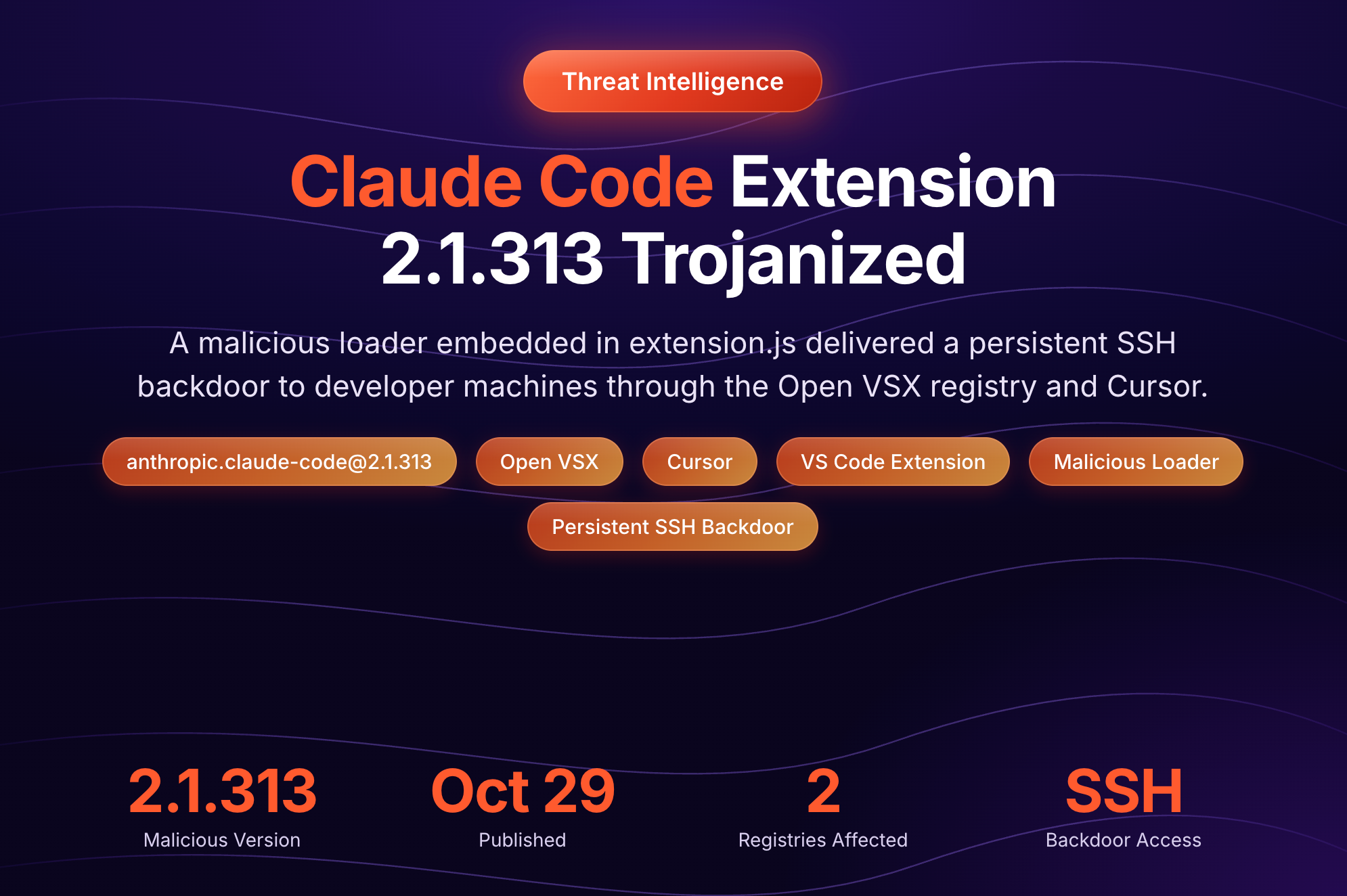
Trojanized Claude Code Extension Delivered Persistent SSH Backdoor to Developer Machines

The Claude Code VS Code extension anthropic.claude-code 2.1.313 was published on Open VSX on 29 October 2026 with a malicious loader prepended to extension.js. On load it planted an attacker SSH key (svc-telemetry), installed per-OS persistence, opened a reverse SSH tunnel and beaconed host recon over HTTP. Cursor reports at most 5,000 users received it in an 11-hour window. The post gives the timeline, cleanup artifacts and credential rotation steps.

Claude CodeVS CodeOpen VSX+3
anthropic.claude-code 2.1.313svc-telemetryT1195.002+1

Supply Chain, Blue Team & Detection, Threat IntelΒ· Published and added 30 Oct 2026

depthfirst.comarticle🧠 AI

dfbench β€” depthfirst

dfbench is depthfirst's held-out benchmark for frontier models on open-ended defensive security work: vulnerability detection, validation of findings, and differential analysis between commits. It reports recall, precision, F1 and cost per task for about 20 models at several thinking levels, split by domain (application, low level, smart contract) and by single or multi-repo scope. Overall detection recall ranges from about 21% to 69%.

LLM
dfbenchdepthfirstGPT-5.6 Sol+16

evalsΒ· Added 29 Oct 2026

bleepingcomputer.comarticleπŸ›‘οΈ Security

Binance probes potential $5.8 billion crypto-theft hack

Binance is investigating a possible breach involving up to $5.8 billion in assets, which would exceed the $1.5 billion Bybit theft of February 2025. Tether froze over $1.567 billion in USDT and Circle over $800 million in USDC. Arkham tracks 55 addresses labelled "binance-hacker-1029" holding about $5.78 billion, but that is wallet holdings, not a confirmed theft amount. The cause is not yet known.

BinanceEthereumTether+2
BybitChangpeng ZhaoCircle+5

Blockchain, Threat IntelΒ· Added 30 Oct 2026, published 29 Oct 2026

oversecured.comarticleπŸ›‘οΈ Security

Content Providers and the potential weak spots they can have | Oversecured Blog

Oversecured's Android security checklist for Content Providers covers insecure FileProvider path configs, path traversal via decoded Uri.getLastPathSegment(), mismatched readPermission/writePermission, proxying requests to more privileged providers, SQL injection across a shared database, and sensitive actions in providers. Each case has vulnerable manifest and Java code, an attacker PoC and remediation. Real cases from Google and Samsung devices are cited. The page text was truncated near the end.

AndroidSQLiteJava
Oversecuredpath traversalSQL injection+5

Mobile Security, AppSecΒ· Added 29 Oct 2026

oversecured.comarticleπŸ›‘οΈ Security

Inside mobile taint analysis: how source-to-sink tracking finds real data-leak paths | Oversecured Blog

Oversecured explains taint analysis for Android and iOS apps and contrasts it with pattern-matching SAST such as MobSF. It covers source, flow and sink, cross-component tracking over Intents, flag-based sanitizer modeling and implicit intent simulation. The case study is an unsafe Class.forName().newInstance() on a Serializable transportFactoryClassName field in Google's com.google.auth.oauth2 credential classes, which Google fixed with a $3,133.70 bounty.

AndroidiOSOversecured+3
intent redirectionpath traversalSSRF+4

Mobile Security, AppSecΒ· Added 29 Oct 2026

depthfirst.comarticleπŸ›‘οΈ Security

dfbench β€” depthfirst

dfbench is a held-out benchmark maintained by depthfirst that scores frontier LLMs on defensive security work: vulnerability detection, validation (precision) and differential analysis between commits. It reports recall, precision, F1 and cost per task by model and thinking level, split by application, low-level and smart-contract code and by single or multi-repo scope. Overall detection recall runs from about 21% to 69%, with the top figure at $99.19 per task for Mythos 5; validation precision mostly falls between 15% and 49%.

LLMKimi K3Grok+3
dfbenchdepthfirstGPT-5.6 Sol+3

AI Security, AppSecΒ· Added 29 Oct 2026

blog.talosintelligence.comarticleπŸ›‘οΈ Security

A quiet week in infosec <.<

Cisco Talos Threat Source newsletter for the week of the PHP and Node.js vulnerability news cycle. It summarises NIK C2, a Go-based Windows implant that dumps credentials, streams keystrokes, deploys screen-locking ransomware and uses a victim's hijacked OpenAI API keys to analyse stolen data. It also lists weekly headlines (CISA KEV PHP bugs, Brotli flaw, Gheist GitHub token theft), Talos links and top malware hashes.

GoWindowsOpenAI+3
NIK C2PHP2ShellNode2Shell+7

Threat Intel, AI SecurityΒ· Published and added 29 Oct 2026

arxiv.orgpaperπŸ›‘οΈ Security

TextSeal2: Distortion-Free LLM Watermarking with Copula Mixing and Memoryless Races

TextSeal2 is a distortion-free LLM text watermark that merges two or more keys into one virtual key and couples it to fresh noise through AutoMark's Gaussian copula. Under speculative decoding it verifies keyed drafts with an extra exponential race, so output matches the target model and acceptance rate is unchanged. On three LLMs at a 10^-3 false-positive rate, it detects 8 to 22 points more 100-token answers than TextSeal.

TextSeal2TextSealAutoMark+2
Gumbel-max schemespeculative decodingGaussian copula+1

AI SecurityΒ· Added 31 Oct 2026, published 29 Oct 2026

arxiv.orgpaper🧠 AI

TextSeal2: Distortion-Free LLM Watermarking with Copula Mixing and Memoryless Races

TextSeal2 is a distortion-free watermark for LLM output that keeps its signal under speculative decoding. It merges two or more keys into one virtual key coupled to fresh noise through AutoMark's Gaussian copula, and verifies drafts with an extra exponential race. On three LLMs it detects 8 to 22 points more 100-token answers than TextSeal at a 10^-3 false-positive rate.

LLMspeculative decodingGumbel-max watermarking+1
TextSeal2TextSealAutoMark+2

research, inferenceΒ· Added 31 Oct 2026, published 29 Oct 2026

eprint.iacr.orgpaperπŸ›‘οΈ Security

Quasi-polynomial time algorithms for block basis reduction of linear codes

Kolesnikov and Novoselov give block basis reduction (BKZ) algorithms for linear codes that need polynomial or quasi-polynomial numbers of calls to a minimum weight codeword oracle at fixed block size. The earlier Ghentiyala and Stephens-Davidowitz bounds are exponential. The paper adds a truncated BKZ and a DeepBKZ variant, with an implementation for block sizes 2 to 24 and approximation-factor estimates on random codes.

BKZDeepBKZminimum weight codeword problem+4

otherΒ· Added 31 Oct 2026, published 29 Oct 2026

blog.talosintelligence.comarticleπŸ›‘οΈ Security

IR trends Q3 2026: Actors impersonate IT help desks in vishing attacks as ransomware activity increases

Cisco Talos Incident Response Q3 2026 trends report. Phishing led initial access at 37 percent, with vishing and IT help desk impersonation to get RMM access; public-facing exploitation followed at 33 percent. Ransomware reached 27 percent of engagements (Qilin, Rhysida, Interlock, new VYPR), with EDR killers via BYOVD and WDAC. It also covers Salt Typhoon intrusions using CVE-2023-20198 and BadCandy, attacks on Claude Code credentials, and logging, MFA and secrets recommendations.

Cisco Secure EndpointMicrosoft Quick AssistWindows Defender+6
CVE-2023-20198Salt TyphoonBadCandy+10

Threat Intel, Blue Team & DetectionΒ· Published and added 29 Oct 2026

arxiv.orgpaper🧠 AI

Aligning Medical Vision Language Models at the Capability Boundary with Entropy Adaptive Rubric Grounding

MedCBR is a two-stage alignment framework for medical vision language models. Difficulty Weighted Boundary Preference Optimization (DBPO) trains on counterfactual preference pairs at the model's capability frontier. Entropy Gated Grounded Policy Optimization (EGPO) then applies distilled clinical rubrics according to prediction entropy. It reaches 61.2% average accuracy on six medical benchmarks, with the largest gains on differential diagnosis, and the two stages combine super-additively.

vision-language modelpreference optimizationreinforcement learning
MedCBRDifficulty Weighted Boundary Preference OptimizationEntropy Gated Grounded Policy Optimization+1

research, training, multimodalΒ· Added 31 Oct 2026, published 29 Oct 2026

blog.talosintelligence.comwriteupπŸ›‘οΈ Security

NIK C2: The new AI-enabled command-and-control framework

NIK C2 is a newly observed C2 framework with a Go-based 64-bit Windows implant that embeds an OpenAI Chat Completions client (ai_generate command), falling back to the victim's OPENAI_API_KEY. Talos details its 52+ commands, AES-256-GCM over WebSocket with HTTP fallback, credential, wallet and keystroke theft, screen-lock ransomware, AMSI bypass and anti-debug. It also lists a live C2 at 87.120.196[.]120 and total-sitevv[.]lol.

GoOpenAIWindows+3
NIK C2nik_panel87.120.196[.]120+9

Malware & RE, Threat Intel, AI SecurityΒ· Published and added 29 Oct 2026

arxiv.orgpaper🧠 AI

When LLM Architectures Meet Smart Contract Vulnerability Detection: a Replication Study

This paper replicates Chen et al.'s study of LLM-based smart contract vulnerability detection, first on GPT-4 and then on Mixture-of-Experts, RNN-like and State Space Models. The exact replication confirms the high-recall, low-precision pattern on GPT-4. The differentiated replication finds the pattern does not transfer uniformly: GPT-4 and Gemma-3 behave alike despite a roughly 100x parameter gap, while two MoE models diverge.

LLMTransformerMixture of Experts+3
Chen et al.GPT-4Gemma 3+1

research, evalsΒ· Added 30 Oct 2026, published 28 Oct 2026

arxiv.orgpaperπŸ›‘οΈ Security

Session-Bound Behavioral Watermarking for Autonomous LLM Agents

AgentAnchor is a session-keyed behavioral watermark for attributing LLM agent trajectory logs to an owner. It derives per-step keys from a secret key, a fresh public session ID and semantic observation states, and embeds parity evidence through a KL-bounded exponential tilt. The paper formalizes learned cross-session forgery, and a trusted verifier checks disputed logs using wrong-key calibration and abstention.

LLM
AgentAnchorlearned forgery

AI SecurityΒ· Added 30 Oct 2026, published 28 Oct 2026

arxiv.orgpaper🧠 AI

Session-Bound Behavioral Watermarking for Autonomous LLM Agents

AgentAnchor is a session-keyed behavioral watermark that lets an agent owner prove ownership of a trajectory log. Each step key comes from a secret key, a fresh public session identifier and semantic states of recent observations. Parity evidence is embedded through a KL-bounded exponential tilt of action choices. A trusted verifier checks disputed logs without rerunning the agent, using wrong-key calibration and abstention. The paper also formulates a learned cross-session forgery threat.

LLM
AgentAnchorarXiv

research, agentsΒ· Added 30 Oct 2026, published 28 Oct 2026

x.comthreadπŸ›‘οΈ Security

Kizuno18 (@Kizuno18) on X

Thread by Kizuno18 on the move from local stdio/Docker Model Context Protocol servers to remote HTTP/SSE endpoints in enterprise infrastructure. It names three trade-offs: credential boundary inversion (short-lived OAuth/JWT tokens instead of long-lived admin tokens on workstations), tool schema bloat solved by deferred discovery, and governance via HCP Terraform policy-as-code (Sentinel/OPA), audit trails and approvals. It is opinion, with no data or implementation detail.

Model Context ProtocolTerraformDocker+2
Sentinelblast radiuspolicy-as-code+1

AI Security, Identity & Access, DevSecOpsΒ· Added 29 Oct 2026, published 27 Oct 2026

x.comthread🧠 AI

Kizuno18 (@Kizuno18) on X

Kizuno18's X post argues that the move from local stdio and Docker MCP servers to remote HTTP/SSE endpoints matures the Model Context Protocol in enterprise infrastructure. It lists three trade-offs: short-lived OAuth/JWT bearer tokens replace mounted admin credentials, deferred tool discovery avoids roughly 20k tokens of eager schema loading, and HCP Terraform enforces Sentinel/OPA policy, audit trails and approvals server-side. Opinion post with no benchmarks or code.

Model Context ProtocolDockerTerraform+5
Kizuno18HCP TerraformOPA

mcpΒ· Added 29 Oct 2026, published 27 Oct 2026

latent.spacetalkπŸ›‘οΈ Security

How Anthropic ships Claude with Claude: Separating the Brain from the Hands

Latent Space episode with Katelyn Lesse and Angela Jiang of Anthropic, recorded after the Claude Opus 5.5 launch. It covers distillation defences (enforced preserved thinking blocks, a compaction feature for harness maintainers), trust-grant authorization for gated model access, and the Managed Agents split between harness and sandbox, where credentials are held outside the sandbox and attached through a proxy. Only the first third of the transcript was available.

ClaudeClaude PlatformClaude Managed Agents+1
Opus 5.5MythosKatelyn Lesse+4

AI SecurityΒ· Published and added 27 Oct 2026

latent.spacetalk🧠 AI

How Anthropic ships the #1 LLM in the World safely: Separating the Brain from the Hands

Latent Space episode with Katelyn Lesse and Angela Jiang on the engineering behind the Claude Platform. Topics include the Claude Opus 5.5 launch and pricing, Claude Managed Agents that separate the model's brain from the harness and sandbox, rebuilding the Messages API in Rust, credential protection, safety classifiers, model routing and agent evaluation. The page lists show notes and timestamps only, with no transcript.

ClaudeRust
Latent SpaceAnthropicClaude Opus 5.5+2

agents, ai-infraΒ· Published and added 27 Oct 2026

hackers-arise.comarticleπŸ›‘οΈ Security

Pentesting: Twelve Caesars – Community Tools for Offensive Security

Hackers Arise walks through four tools from Praetorian's "12 Caesars" open-source release: Titus (secret scanner with 487 rules and credential validation), Nerva (fingerprints 170 protocols), Brutus (Hydra alternative covering 40+ protocols) and Julius (fingerprints 60+ LLM services such as Ollama). It shows download and run commands in a Kali lab and how the tools chain together. The tools are Go single binaries; the post notes an exposed Ollama on port 11434 allows unauthenticated model use.

GoKali LinuxOllama+3
Praetorian12 CaesarsTitus+4

Offensive Security, DevSecOps, AI SecurityΒ· Published and added 27 Oct 2026

decrypt.coarticle🧠 AI

OpenAI Proves ETH Is False, and Crypto Twitter Has Questions

Decrypt reports that OpenAI published a 67-page paper (dated 17 October 2026, revised 25 October) claiming its AI found a deterministic subexponential-time algorithm for counting 3-SAT solutions, which would refute the Exponential Time Hypothesis. The proof was formalized in Lean. Impagliazzo, Paturi and Ryan Williams are reviewing it independently and say this is not certification. Anthropic posted a Claude-credited 3-SAT paper on 26 October.

LeanGitHubClaude
OpenAIAnthropicDecrypt+7

research, modelsΒ· Published and added 27 Oct 2026

arxiv.orgpaper🧠 AI

Bayes-Adaptive MDPs for Rollout Allocation to Enhance GRPO Training

AdaRoll-GRPO is a method that allocates GRPO rollout budgets per question by difficulty instead of uniformly. It frames allocation as a sequential decision problem and learns an allocation policy with a Bayes-adaptive MDP, computed offline so training adds no online optimization cost. Experiments on several reasoning datasets and LLM architectures show gains over standard GRPO at the same total rollout budget.

GRPOLLM
AdaRoll-GRPOarXiv

training, researchΒ· Added 28 Oct 2026, published 27 Oct 2026

arxiv.orgpaper🧠 AI

DCKV: Learned Transform Coding of the Prompt KV Cache in Hybrid Language Models

DCKV is a differentiable codec for the prompt KV cache of hybrid language models, which keep a KV cache only in their few full-attention layers. Transform, quantizer and entropy models (conditioned on prompt tokens and already decoded neighbouring positions) are trained end to end against a frozen model. On Qwen3.5-2B it stores a token in over 55 times fewer bytes than bf16 with at most 1.8 points lost on three long-context benchmarks, and over 100 times fewer with at most 3.6 points lost.

Qwen3.5TransformerLLM
DCKVarXiv

research, inferenceΒ· Added 28 Oct 2026, published 27 Oct 2026

ethresear.chthreadπŸ›‘οΈ Security

Proof of One: one-person-one-identity polling with encrypted ballots β€” design and reference code, requesting critical review

Proof of One is an open-source design for polls with one verified human per identity and unlinkable ballots. Enrolment proves in zero knowledge that an ICAO 9303 passport chip was signed by a trusted signer, plus an enclave face match. Voting uses threshold exponential ElGamal on Baby Jubjub with Groth16 proofs, and tally uses a GJKR DKG with a 7-day challenge window. The author, who is pseudonymous, discloses that AI agents drafted most of it and asks for critique of unlinkability, circuit completeness and certificate trust.

Groth16Baby JubjubDAVINCI+1
Proof of OneNemo UnusICAO 9303+4

Identity & AccessΒ· Published and added 27 Oct 2026

Showing 30 of 736

Show more