Skip to content

128 results for “age”

What you seeeverything
status.bunny.netadvisory🛡️ Security

Bunny CDN Security Incident

Bunny CDN status-page notice, posted 28 October 2026, about unauthorized access at an infrastructure provider that hosted one bunny.net CDN node in Armenia. Traffic was stopped within 20 minutes and the server wiped. No access to the node was found, but cached content, Pull Zone configs and TLS certificates could have been exposed, so all platform certificates were reissued. Customers with their own certificates should rotate them with new private keys.

Bunny CDNTLS
bunny.netb-cdn.netbunny.run

Threat Intel, Cloud & Infra· Added 31 Oct 2026, published 30 Oct 2026

cisa.govadvisory🛡️ Security

CISA Adds Two Known Exploited Vulnerabilities to Catalog

CISA added two Ivanti Connect Secure vulnerabilities to its Known Exploited Vulnerabilities (KEV) Catalog on 30 October 2026, citing evidence of active exploitation: CVE-2026-111357 (missing authentication for a critical function) and CVE-2026-118527 (generation of predictable numbers or identifiers). The alert restates BOD 26-04, which requires federal civilian agencies to remediate KEV-listed flaws on exposed assets and check for prior compromise. It also links the KEV nomination form.

Ivanti Connect SecureCISA KEVVPN
CVE-2026-111357CVE-2026-118527BOD 26-04+1

Threat Intel, GRC· Published and added 30 Oct 2026
cisa.govadvisory🛡️ Security

CISA Adds Two Known Exploited Vulnerabilities to Catalog

CISA alert of 29 October 2026 adding two vulnerabilities to the Known Exploited Vulnerabilities catalog on evidence of active exploitation: CVE-2026-97229, an integer overflow in GitLab CE/EE, and CVE-2026-76418, a NULL pointer dereference from an unchecked return value in Cisco Secure Firewall ASA and FTD. It restates BOD 26-04 remediation duties for federal civilian agencies and links the KEV nomination form.

CISA KEVGitLabCisco Secure Firewall ASA+1
CVE-2026-97229CVE-2026-76418BOD 26-04+3

Threat Intel, GRC· Published and added 29 Oct 2026

unit42.paloaltonetworks.comadvisory🛡️ Security

Threat Brief: Critical Vulnerabilities in PHP: CVE-2026-109618, CVE-2026-109619 (Updated October 29)

Unit 42 threat brief on PHP2Shell, two PHP remote code execution flaws, CVE-2026-109618 and CVE-2026-109619 (CVSS 4.0 9.2), both caused by longjmp() error handling that leaves memory uninitialized or freed. Cortex Xpanse counted over 22.6 million exposed instances. The 29 October 2026 update says attackers chained PHP2Shell with a Linux kernel privilege escalation against internet-exposed PAN-OS management interfaces. An earlier 23 October claim of post-compromise activity was retracted on 25 October.

PHPPAN-OSLinux kernel+2
CVE-2026-109618CVE-2026-109619PHP2Shell+2

Threat Intel, AppSec· Added 30 Oct 2026, published 29 Oct 2026

ubuntu.comadvisory🛡️ Security

CVE-2026-98432: 9.8 CVE affecting all Ubuntu versions

CVE-2026-98432 is a Linux kernel use-after-free in the IPv4 TCP stack, tracked by Ubuntu (published 15 October 2026, updated 29 October 2026). ireq_opt/inet_opt were freed with plain kfree() while another CPU built a SYNACK under RCU, so ip_options_build() read freed memory; the fix uses kfree_rcu(). Ubuntu rates it High priority, CVSS v3.1 9.8 and v4.0 8.3. The page text does not list per-release package status.

Linux kernelUbuntuCVSS
CVE-2026-98432use-after-free

Cloud & Infra· Added 30 Oct 2026, published 29 Oct 2026

cisa.govadvisory🛡️ Security

Hitachi Energy TRO600 series products

ICSA-26-302-02 is a CISA republication of Hitachi Energy PSIRT advisory 8DBD000224 on the TRO600 series. It covers CVE-2026-10756 and CVE-2026-106087, which allow remote code execution and disclosure of sensitive information. Affected versions are TRO600 up to 9.2.1.6 and 9.1.1.0, plus 9.2.2.1 and 9.1.2.0. The page gives no per-CVE detail or CVSS scores, only general ICS hardening advice. Released 27 October 2026.

Hitachi Energy TRO600
CVE-2026-10756CVE-2026-106087Hitachi Energy PSIRT 8DBD000224+1

Hardware & RF· Added 29 Oct 2026, published 28 Oct 2026

cisa.govadvisory🛡️ Security

CISA Adds Two Known Exploited Vulnerabilities to Catalog

CISA alert of 28 October 2026 adding two vulnerabilities to the Known Exploited Vulnerabilities Catalog on evidence of active exploitation: CVE-2026-41709 (Broadcom VMware ESX insufficient logging) and CVE-2026-46300 (Linux kernel missing variable initialization). It restates BOD 26-04, which requires federal civilian agencies to prioritize fast remediation of KEV CVEs on exposed assets and to check for prior compromise. It also links the KEV nomination form.

CISA KEVVMware ESXLinux kernel
CVE-2026-41709CVE-2026-46300BOD 26-04+1

Threat Intel, GRC· Added 29 Oct 2026, published 28 Oct 2026

x.comadvisory🛡️ Security

Dark Web Informer (@DarkWebInformer) on X

Veeam patched five vulnerabilities across Backup & Replication, Veeam Agent for Linux and Veeam ONE. The worst is CVE-2026-108142 (CVSS 9.1), an unauthenticated authorization bypass in the CDP Coordinator Service affecting Backup & Replication 13.0 and 13.1. Other fixes cover Linux agent privilege escalation, two path-traversal file writes, and a Veeam ONE MFA bypass; fixed builds are listed.

Veeam Backup & ReplicationVeeam Agent for LinuxVeeam ONE+1
CVE-2026-108142CVE-2026-105477CVE-2026-108140+3

AppSec, Identity & Access· Added 30 Oct 2026, published 28 Oct 2026

cisa.govadvisory🛡️ Security

CISA Adds Two Known Exploited Vulnerabilities to Catalog

CISA alert of 27 October 2026 adding two vulnerabilities to the Known Exploited Vulnerabilities (KEV) Catalog on evidence of active exploitation: CVE-2026-48356, an unrestricted upload of a dangerous file type in Adobe Commerce and Magento, and CVE-2026-111497, an unchecked return value in Google Brotli. It restates BOD 26-04, which makes federal civilian agencies prioritise KEV flaws on exposed assets and check for prior compromise. No technical detail or IOCs are given.

Adobe CommerceMagentoBrotli
CVE-2026-48356CVE-2026-111497CISA KEV+2

AppSec, GRC· Added 29 Oct 2026, published 27 Oct 2026

cisa.govadvisory🛡️ Security

CISA Adds Two Known Exploited Vulnerabilities to Catalog

CISA added two PHP vulnerabilities to its Known Exploited Vulnerabilities Catalog on 26 October 2026: CVE-2026-109618 (memory corruption) and CVE-2026-109619 (stale internal request state). It also updated its PHP alert on critical vulnerabilities requiring immediate patching. The alert restates BOD 26-04, which requires federal civilian agencies to prioritize fast remediation of KEV CVEs on exposed assets and to check for prior compromise.

PHPCISA KEV
CVE-2026-109618CVE-2026-109619BOD 26-04+1

AppSec, GRC· Added 29 Oct 2026, published 26 Oct 2026

wiz.ioadvisory🛡️ Security

Broccoli2shell: Everything You Need To Know About The Critical Brotli Decoder Vulnerability

CVE-2026-111497 (Broccoli2Shell, also Node2Shell and HTTP2Shell) is an out-of-bounds write in the upstream Brotli C decoder. It affects Node.js, Bun, Envoy Proxy, Istio and Python packages, and can lead to memory corruption, information disclosure, crashes or RCE when untrusted Brotli data is decompressed. Wiz reports 91% of cloud environments have vulnerable resources. The post lists patching, inventory, rebuild and temporary mitigation steps.

BrotliNode.jsBun+3
CVE-2026-111497Broccoli2ShellNode2Shell+8

AppSec, Cloud & Infra· Published and added 25 Oct 2026

aikido.devadvisory🛡️ Security

Python packages are also vulnerable to the Node2Shell Brotli flaw (CVE-2026-111497)

Python2Shell is the Python-side impact of CVE-2026-111497 (Node2Shell), a Brotli decoder flaw (CVSS 4.0 9.2) in DecodeBlockTypeAndLength() that mixes an unchecked return value with an out-of-bounds write. Brotli 1.2.0 and earlier, and brotlicffi 1.2.0.x, are affected through urllib3, requests, httpx, aiohttp and Scrapy. Fixes are Brotli 1.2.1 and brotlicffi 1.2.1.0; as of 23 October 2026 advisory databases do not map the CVE to either package. The post lists checks and workarounds.

BrotlibrotlicffiPyPI+3
CVE-2026-111497Node2ShellPython2Shell+4

AppSec, Supply Chain· Published and added 23 Oct 2026

horizon3.aiadvisory🛡️ Security

CVE-2026-109618 / CVE-2026-109619 | NodeZero Rapid Response Check Now Available

PHP2Shell is the name for CVE-2026-109618 and CVE-2026-109619, critical unauthenticated RCE flaws in PHP core fixed on 21 October 2026 in PHP 8.2.35, 8.3.36, 8.4.27 and 8.5.12. The page explains the out-of-memory corruption and stale global state causes, mod_php and PHP-FPM exposure, interim mitigations, hunting guidance, exploitation reports from October 2026, and the 23 October CVE-2026-115560 upload-progress advisory. Horizon3 also announced a non-exploiting NodeZero check.

PHPPHP-FPMApache+3
CVE-2026-109618CVE-2026-109619CVE-2026-115560+5

AppSec, Blue Team & Detection· Added 29 Oct 2026, published 23 Oct 2026

github.comadvisory🛡️ Security

Brotli vulnerability affects curl and Git

GHSA-9v8h-qqgm-4m35 is a critical buffer overflow (CVSS v4 9.2) in the Google Brotli decoder (c/dec/decode.c), affecting versions 1.0.3 through 1.2.0 on all platforms. A crafted compressed stream lets an unauthenticated remote attacker corrupt adjacent decoder state, leak memory, crash the process, or possibly execute code. Fixed in 1.0.10, 1.1.1 and 1.2.1. The page does not mention curl or Git, despite the title.

BrotliCVSSNVD
GHSA-9v8h-qqgm-4m35buffer overflow

AppSec· Added 25 Oct 2026, published 23 Oct 2026

x.comadvisory🛡️ Security

Dark Web Intelligence (@DailyDarkWeb) on X

CVE-2026-114625 is a critical (CVSS 3.1 9.9) SQL injection in on-prem Arista VeloCloud Orchestrator, the SD-WAN management portal, covered in Arista Security Advisory 0199 of 22 October 2026. Any authenticated user, even the lowest Enterprise Read Only tenant role, can become a local superuser operator, and Arista says it is exploited in the wild. On-prem fixes are 5.2.3.18, 6.1.3.10 and 6.4.2.12; two attacker IPs are listed.

Arista VeloCloud OrchestratorCVSS
CVE-2026-114625CWE-8974.82.197.86+2

Threat Intel, AppSec· Added 24 Oct 2026, published 22 Oct 2026

soliditylang.orgadvisory🛡️ Security

Yul Optimizer Knowledge Base Stale Bookkeeping Bug

Solidity advisory on a Yul optimizer bug in the KnowledgeBase, present in versions 0.8.19 to 0.8.37 and fixed in 0.8.38. Stale cached address offsets let LoadResolver and EqualStoreEliminator treat coinciding memory or storage slots as distinct, so loads return outdated values or needed stores are dropped. It includes a pure-Solidity reproducer for --via-ir, a Sourcify scan with no differing bytecode, and checks for deployed contracts. Rated low severity.

SolidityYulSourcify+1
Ethereum Foundation bug bountyDaniel BoyeSurya Prakash Akula+4

AppSec· Published and added 22 Oct 2026

oracle.comadvisory🛡️ Security

Oracle Security Alert Advisory – CVE-2026-91403 (eMudhra cert revocation)

Oracle Security Alert for CVE-2026-91403 ships Java SE updates that distrust a set of intermediate CA certificates tied to eMudhra. It contains one new patch for Oracle Java SE, described as remotely exploitable without authentication. Customers are told to update Java or apply mitigations listed at ops.java/emudhra and in the Patch Availability Document. No reporter is credited and the page gives no CVSS score or technical detail.

JavaCVSS
CVE-2026-91403eMudhra

Cloud & Infra, AppSec· Added 23 Oct 2026, published 21 Oct 2026

watchtowr.comadvisory🛡️ Security

PHP Remote Code Execution ("PHP2Shell" CVE-2026-109618 & CVE-2026-109619)

PHP2Shell is the name for CVE-2026-109618 (out-of-memory corruption) and CVE-2026-109619 (stale global state), two unauthenticated PHP remote code execution flaws rated CVSS 4.0 9.2. Details leaked before the 21 October 2026 patch release, and watchTowr's honeypots saw exploitation. The page lists fixed versions (8.5.12, 8.4.27, 8.3.36, 8.2.35), states that .ini mitigations do not work, gives a timeline, and describes compromise checks.

PHPApacheFrankenPHP+2
CVE-2026-109618CVE-2026-109619PHP2Shell+3

AppSec, Threat Intel· Added 28 Oct 2026, published 21 Oct 2026

horizon3.aiadvisory🛡️ Security

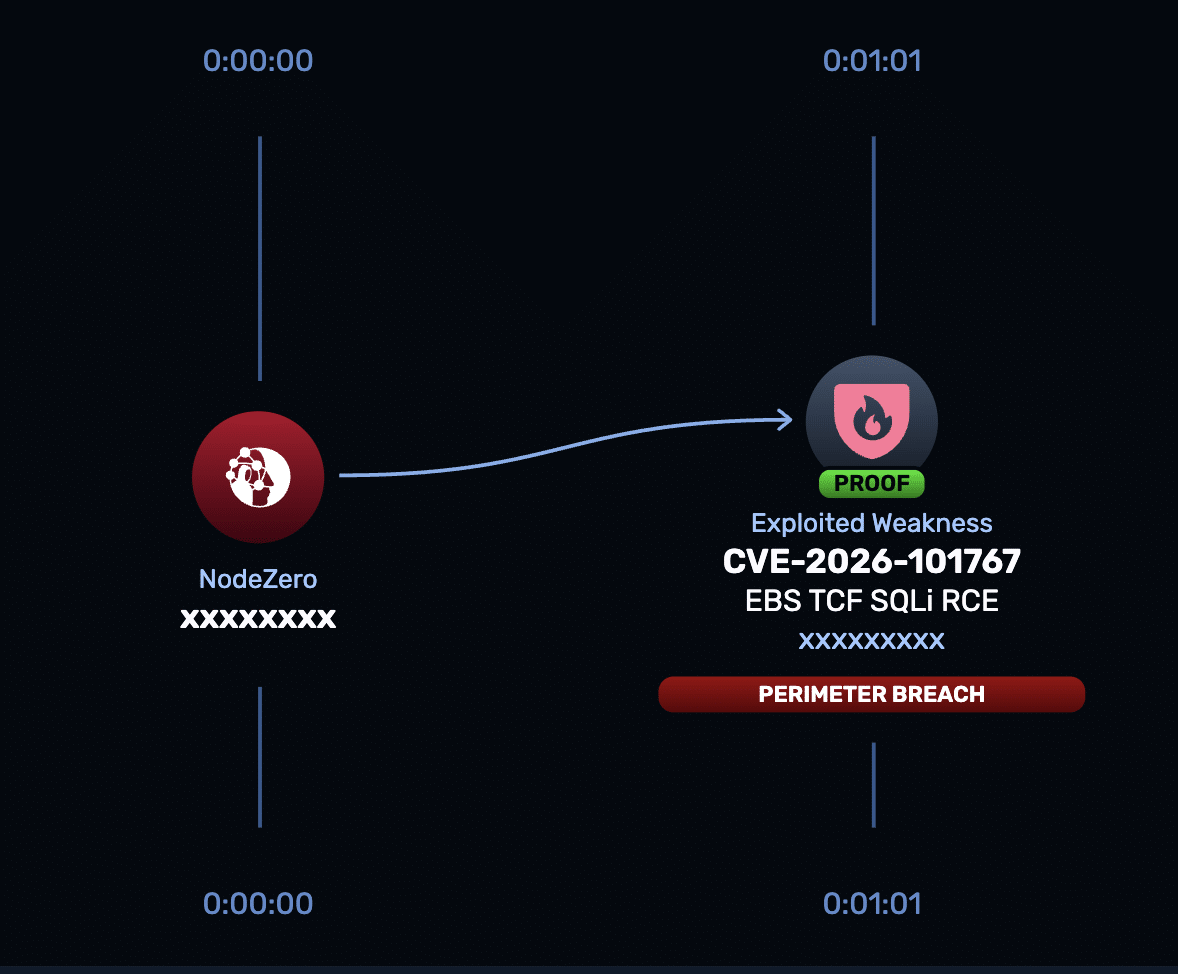
CVE-2026-101767 | Oracle E-Business Suite TCF SQL Injection and Remote Code Execution

CVE-2026-101767 is an unauthenticated SQL injection in the Oracle E-Business Suite Thin Client Framework servlet (/OA_HTML/AppsTCFServer, oracle.apps.fnd.tcf.SocketServer), CVSS 3.1 9.8. It runs SQL as the APPS user and chains to OS commands as the EBS account. Affects 12.2.3 to 12.2.15, fixed in the Oracle October 2026 CPU (20 October 2026). The page lists mitigations, IOCs and a timeline.

Oracle E-Business SuiteCVSS
CVE-2026-101767CWE-89Horizon3.ai+3

AppSec, Offensive Security, Blue Team & Detection· Added 29 Oct 2026, published 20 Oct 2026

unit42.paloaltonetworks.comadvisory🛡️ Security

Threat Brief: Active Exploitation of PAN-OS CVE-2026-0257 (Updated Oct 20)

Unit 42 threat brief on active exploitation of CVE-2026-0257, a PAN-OS GlobalProtect authentication bypass added to CISA KEV on May 13, 2026. It lists IP addresses, host IDs and PoC-derived client values to hunt in GlobalProtect logs. The October 2026 updates cover Qilin and Inc ransomware operators, MFA bypass, pivots to vCenter and ESXi with offline VMDK credential dumping, and management interface exposure on ports 4443 and 3879.

PAN-OSGlobalProtectVPN+3
CVE-2026-0257CVE-2023-27532Spikey Scorpius+10

Threat Intel, Blue Team & Detection, Identity & Access· Added 21 Oct 2026, published 20 Oct 2026

x.comadvisory🛡️ Security

lee1981 (@lee1981b) on X

CVE-2026-77932 affects DB-GPT through 0.8.2 (dbgpt-app). The /api/v1/chat/react-agent route accepts unauthenticated requests because get_user_from_headers returns an admin-role user, and the ReAct agent can reach unsandboxed Python and shell tools. Lasso reported root in the webserver container in a lab. The post gives CVSS 9.8 and 9.3, no verified fix (0.8.2 is still the latest release), no KEV match, no EPSS data, and a SOC hunting trail.

DB-GPTPythonDocker+3
CVE-2026-77932CWE-306Lasso+4

AI Security, AppSec, Blue Team & Detection· Added 23 Oct 2026, published 20 Oct 2026

watchtowr.comadvisory🛡️ Security

Frequently Asked Questions About the BeyondTrust Remote Support Arbitrary File Upload (CVE-2026-102764)

CVE-2026-102764 is an arbitrary file upload in BeyondTrust Remote Support (formerly Bomgar) caused by internal appliance components not validating message origin. Mandiant found it exploited as a zero-day in late August 2026. BeyondTrust disclosed it on 15 October 2026 and CISA added it to KEV on 16 October 2026. The FAQ covers the web shell, root escalation, credential theft, persistence, patching and compromise checks.

BeyondTrust Remote Support
CVE-2026-102764CISA KEVMandiant+4

AppSec, Threat Intel· Added 30 Oct 2026, published 16 Oct 2026

watchtowr.comadvisory🛡️ Security

BeyondTrust Remote Support Arbitrary File Upload (CVE-2026-102764)

CVE-2026-102764 is a CVSS 9.8 unauthenticated arbitrary file upload flaw in BeyondTrust Remote Support (formerly Bomgar) and Privileged Remote Access. Internal messaging components do not verify message origin, so remote attackers can plant files the appliance would reject. BeyondTrust disclosed it on 15 October 2026 with patch BT26-05, and CISA added it to KEV on 16 October 2026. The page lists log files to review and hardening steps.

BeyondTrust Remote SupportBeyondTrust Privileged Remote AccessCVSS
CVE-2026-102764BT26-05CISA KEV+2

AppSec, Blue Team & Detection· Added 30 Oct 2026, published 16 Oct 2026

x.comadvisory🛡️ Security

S2W_DailyThreat (@S2W_DailyThreat) on X

S2W post on CVE-2026-97229, a CVSS 10.0 remote code execution flaw in the GitLab CE/EE CI/CD regex compiler, disclosed October 13, 2026. Insufficient regex validation plus an integer overflow during encoding conversion lets an attacker who can add CI/CD config use a malicious regex and a UTF-8 repository path to run commands as the git user. Affects self-managed 19.2 before 19.2.8, 19.3 before 19.3.5 and 19.4 before 19.4.2. Rapid7 published analysis and a public PoC exists, with no in-the-wild exploitation confirmed as of October 15. No workaround exists, so patch or restrict access to a management network or VPN.

GitLabCVSS
CVE-2026-97229Rapid7S2W+1

AppSec, DevSecOps· Added 17 Oct 2026, published 16 Oct 2026

x.comadvisory🛡️ Security

Dark Web Intelligence (@DailyDarkWeb) on X

Summary of Vercel's Oct 14, 2026 out-of-band Next.js security release fixing two critical unauthenticated RCEs: one in App Router apps with Cache Components where a "use cache" function returns multiple typed arrays (GHSA-673q-mjm6-r5xr, upstream React GHSA-xqc2-xf4c-x3h3, no workaround), and one in the Image Optimization API handling SVG on glibc Linux via a memory bug in a library used through sharp (CVE-2026-96889 / GHSA-2464-fhr4-w9xw, workaround sharp 0.35.5+). Also covers a high-severity Server Actions DoS (GHSA-p3m5-59mp-jv5r). Fixes ship in two supported Next.js LTS lines. No in-the-wild exploitation reported.

Next.jsVercelReact+2
CVE-2026-96889GHSA-673q-mjm6-r5xrGHSA-xqc2-xf4c-x3h3+2

AppSec· Added 17 Oct 2026, published 16 Oct 2026

x.comadvisory🛡️ Security

♫Why♥Not♪ (@Python_s_) on X

Alert summarizing XBOW's disclosure of a three-stage Chrome for Windows exploit chain: V8 Maglev memory corruption (CVE-2026-85045), Animated WebP decoder memory corruption (Chromium issue 548509153), then a Crashpad sandbox escape (CVE-2026-78952). Loading a crafted page was enough; no click or download needed. Human researchers working with GPT-5.6 Sol agents built it in six days, Google paid $250,000, all three bugs are fixed, and no in-the-wild exploitation is confirmed. It advises updating Chrome and restarting, and gives forensic triage pointers.

ChromeV8Crashpad+3
CVE-2026-85045CVE-2026-78952Chromium issue 548509153+2

Offensive Security, AI Security, Threat Intel· Added 15 Oct 2026, published 14 Oct 2026

rapid7.comadvisory🛡️ Security

Patch Tuesday - October 2026

Rapid7's analysis of Microsoft's October 2026 Patch Tuesday, which covers 1,413 vulnerabilities, 1,102 of them in Windows. It highlights the exploited Windows Shell Mark of the Web bypass (CVE-2026-96951) and the publicly disclosed .NET Framework WDAC bypass (CVE-2026-108398). It also covers five no-interaction Outlook preview-pane RCEs, the Edge advisories that list no CVEs, and end-of-support dates for Server 2012/2012 R2, Office 2021, Exchange 2016/2019 and Windows 11 24H2. The page text is truncated, so the later CVE tables are not seen.

Windows.NETMicrosoft Edge+2
CVE-2026-96951CVE-2026-108398CVE-2026-70242+63

Blue Team & Detection, other· Published and added 13 Oct 2026

thezdi.comadvisory🛡️ Security

ZDI: The October 2026 Security Update Review

ZDI's October 2026 Security Update Review covers Adobe's 11 bulletins (174 CVEs) and Microsoft's record 1,415 CVEs. The only actively exploited bug is CVE-2026-96951, a Windows Shell Mark of the Web bypass. It also flags 59 wormable bugs, Microsoft's new "risk cohorts", and top-priority fixes in ColdFusion, Commerce, Experience Manager, SharePoint, SQL Server and Exchange.

WindowsMicrosoft ExchangeSharePoint+5
CVE-2026-96951CVE-2026-108398CVE-2026-92707+1425

AppSec, Blue Team & Detection· Added 27 Oct 2026, published 13 Oct 2026

opennet.ruadvisory🛡️ Security

Major ICQ security hole (1998)

Rootshell Security Bulletin #22 (Aug 1998) reports an ICQ authentication flaw found by a Linux ICQ clone developer. The Mirabilis server stores 8-character passwords, and sending a password of 9 or more characters (e.g. "123456789") overflows the buffer and logs the client in as any UIN not already online. This gives full account takeover, including receiving offline messages. It is not spoofing, and it works with unofficial clients such as zicq, since the official client enforces the length limit client-side.

ICQ
RootshellMirabilisbuffer overflow+3

AppSec, Offensive Security· Added 17 Oct 2026, published 13 Oct 2026

cisa.govadvisory🛡️ Security

CISA AA26-281A: Chinese Government-linked Actors Combine Automated and Hands-on Hacking Tools to Steal Data

Joint FBI/CISA/NSA and allied-agency advisory on China-linked actors enabled by Integrity Technology Group (overlapping with Flax Typhoon, Ethereal Panda, Red Juliett). It details their TTPs: open-source scanners and the MicroScan exploit-script app, an XSS credential-harvesting payload dropping live700_v1.exe, EBurst password spraying against Exchange/O365, SoftEther VPN persistence, DCSync via DC.exe, and email theft via the Curlc4.txt PHP bot and the office-cli utility. It also provides IOCs, MITRE ATT&CK mappings, CVEs, incident response steps, and mitigations.

SoftEtherMicrosoft 365Active Directory+3
Integrity Technology GroupFlax TyphoonEthereal Panda+13

Threat Intel, Blue Team & Detection· Added 9 Oct 2026

Showing 30 of 128

Show more