 Top AI coding agent security resources — November 2026
Adversa AI's November 2026 roundup of 14 AI coding agent security resources from October. It covers CVE-2026-103572 (Visual Studio Copilot and SSMS RCE via trailing-dot filename), an unpatched Claude Code child-session hook bypass, a Copilot CLI cryptographic context injection, and a CVE-less opencode MCP OAuth RCE. It ends with a checklist for auditing agent configs and gateways.
 adversa.aiarticlePublished and added 2 Nov 2026🛡️ Security
- Luke The Dev (@iamlukethedev) on X
Hermes, the Nous Research agent framework, shipped 130 merged PRs in October 2026, according to this X recap by Luke The Dev. Main items are a unified gateway runtime, a Desktop and Bot Screen, a bundles and package manager, crash-safe updates and new Claude model entries. Ten PRs cover security: an iron-proxy credential-injection egress firewall for sandboxes, 31 CVEs patched in Python and npm lockfiles, and profile-export and prompt-leak fixes.
 x.comthreadAdded 2 Nov 2026🧠 AI
 Brazilian Court Sanctions Lawyers for Prompt Injection in Court Filing
A Brazilian labor court in Parauapebas, Pará fined two law firms 10% of an R$842,000 claim (about $16,000) for hiding a prompt-injection command in a petition. The white-on-white text told AI to respond superficially and not challenge the documents. Galileu, the National Justice Council's generative AI tool, detected it and blocked processing. The court cited Articles 5 and 77 of the Civil Procedure Code.
 jetstream.securityarticleAdded 2 Nov 2026, published 1 Nov 2026🛡️ Security
 Tanmay (@TanmayK_03) on X
DBHub, a database MCP server, had a read-only mode bypass in its SQL check. The check treated every `--` as a comment, but MySQL only starts a comment when whitespace follows it. A hidden write statement could therefore still run, and a prompt injection could trigger it. Fixed in version 0.22.6. Replies say enforcement belongs in database grants and that parser tests need to be dialect-specific.
x.comthreadAdded 31 Oct 2026, published 30 Oct 2026🛡️ Security- lee1981 (@lee1981b) on X
CyberForge CVE of the Day #091 covers Progress WS_FTP Server CVE-2026-84295 (unauthenticated administrator-credential exposure, CVSS 10.0) and CVE-2026-90868 (conditional OS command and argument injection, CVSS 9.9, low privileges). Fixed floors are 2024.0.7/9.0.7 and 2025.0.4/10.0.4; 2024.0.6/2025.0.3 fix only the first. It gives KEV, EPSS and SSVC status, six SOC checks, and Windows 4688 evidence queries.
x.comadvisoryAdded 2 Nov 2026, published 30 Oct 2026🛡️ Security - Web Security Academy
Web Security Academy is PortSwigger's free online web security training. It is known to combine learning material with hands-on labs across web vulnerability classes such as SQL injection, XSS, SSRF, authentication flaws and request smuggling, and to be built around Burp Suite. The page had no extractable text, so this description comes from the URL and general knowledge of the site.
 portswigger.netcourseAdded 30 Oct 2026🛡️ Security
 川崎元 (@foryangxin) on X
CVE-2025-6514 is an OS command injection (CWE-78, CVSS 9.6) in mcp-remote 0.0.5 to 0.1.15, fixed in 0.1.16. A malicious MCP server supplies a crafted authorization_endpoint during OAuth discovery, and the open package passes it to PowerShell on Windows. The thread cites the MCP spec's URL scheme allowlist rules and advises treating discovery metadata as untrusted, pinning bridge tools and sandboxing them.
x.comthreadAdded 2 Nov 2026, published 30 Oct 2026🛡️ Security Content Providers and the potential weak spots they can have | Oversecured Blog
Oversecured's Android security checklist for Content Providers covers insecure FileProvider path configs, path traversal via decoded Uri.getLastPathSegment(), mismatched readPermission/writePermission, proxying requests to more privileged providers, SQL injection across a shared database, and sensitive actions in providers. Each case has vulnerable manifest and Java code, an attacker PoC and remediation. Real cases from Google and Samsung devices are cited. The page text was truncated near the end.
 oversecured.comarticleAdded 29 Oct 2026🛡️ Security
 20 security issues found in Xiaomi devices
Oversecured's write-up of 20 vulnerabilities in Xiaomi apps and system components, reported to Xiaomi between 25 and 30 April 2023. Bugs include intent redirection with system privileges in Security and GetApps, shell command injection in System Tracing, and arbitrary file theft via path traversal in Settings and MIUI Bluetooth. Each has a PoC. The page was truncated, so the later MIUI Bluetooth entries and the rest are not covered.
oversecured.comwriteupAdded 29 Oct 2026🛡️ Security Disclosure of 7 Android and Google Pixel vulnerabilities
Oversecured discloses seven Android vulnerabilities, two of them Pixel-specific, all reported to Google and fixed except one low-severity WebView case. They are the Camera geolocation leak (CVE-2024-0017), a VPN bypass list change (CVE-2023-21383), a Bluetooth permission check flaw (CVE-2024-34719), the WorkSource parcel mismatch (CVE-2023-20963, exploited in the wild by the Pinduoduo app), Device Admin HTML injection (CVE-2021-0600) and a ContentProvider.openFile() caller-context bypass (CVE-2023-21292). Each has root cause and PoC code.
oversecured.comwriteupAdded 29 Oct 2026🛡️ Security Understanding and Mitigating Role Spoofing in LLMs
 is an arXiv paper (October 2026) on role spoofing, a prompt injection where malicious tool output impersonates the user. It shows models track "who said what" using both content cues (semantics, style) and structure cues (control tokens, formatting). Attacks combining fake structure and content succeed often, adversarial training stops only content-based attacks, and linear probes trained to predict conversation roles detect spoofing across settings.
 arxiv.orgpaperAdded 31 Oct 2026, published 29 Oct 2026🛡️ Security
 Google Touts Powerful Cybersecurity Capabilities in Gemini 4 Carbon Model
Gemini 4 Carbon is a Google frontier model announced with restricted access for cyber defenders through the Fairwind Program (650+ organizations). Google reports 88.2% on SEC-bench Pro, 54.8% on ExploitGym and 71.0% on CWE-bench, ahead of GPT-6 Astra and Claude models, with no guardrails. It also cites prompt injection and cheating-resistance results, and pricing of $2/$10 per million tokens.
 securityweek.comarticlePublished and added 29 Oct 2026🛡️ Security
- SEAL: Sealed Queries for Local Sanitization against Indirect Prompt Injection
SEAL is a defense against indirect prompt injection for local LLM agents. It learns a soft prompt and scoring readout offline, then uses a frozen task model to score and delete injected tokens from tool outputs, with queries built from trusted initial context. On AgentDojo, attack success falls from 34.6% to 0.1% and Joint rises from 51.4% to 77.5%, using about 127x fewer defense tokens than PISanitizer.
arxiv.orgpaperAdded 31 Oct 2026, published 29 Oct 2026🛡️ Security - Appreciation Teaches Unauthorized Execution: Self-Evolution Degrades the Robustness of Personal Agents to Indirect Prompt Injection
Paper studying whether self-evolution weakens personal agents' robustness to indirect prompt injection (IPI). A two-phase method has the user ask the agent to follow tasks in external content, then tests with a third-party injected task the user did not authorize. Against the non-evolving base agent, attack success rose 14.0 to 48.8 points under skill evolution and 3.0 to 39.3 points under reinforcement learning. Code is released.
arxiv.orgpaperAdded 31 Oct 2026, published 29 Oct 2026🛡️ Security  Addendum to GPT-6 Luna System Card: October 28, 2026 Update
Addendum to the GPT-6 Luna system card for the model update of 29 October 2026 (the title says October 28). OpenAI keeps the High rating for cybersecurity and biological/chemical capability under its Preparedness Framework. It reports ExploitBench 46.19% and SEC-Bench Pro 51.75% (GPT-6 Astra: 85.4%), higher multiturn jailbreak defender success than the October 7 version, and GPT-Red prompt-injection results. It also reports weaker factuality and dual-use biology refusal.
 deploymentsafety.openai.compaperPublished and added 29 Oct 2026🛡️ Security
- Rohan Paul (@rohanpaul_ai) on X
Rohan Paul's X post summarizes the paper "Log-To-Leak: Prompt Injection Attacks on Tool-Using LLM Agents via the Model Context Protocol", from TikTok researchers. It reports that MCP-using agents often finish the requested task, then quietly call an attacker-controlled logging tool that records the query, server reply and final answer. The attack works through natural-language tool descriptions that agents read when choosing and ordering tools. The visible text is truncated.
x.comthreadAdded 29 Oct 2026, published 28 Oct 2026🛡️ Security  Inside KeyDrift: Analyzing historical UAT-11473 activity on Cisco SD-WAN
KeyDrift is a custom malware framework used by UAT-11473, which exploited CVE-2026-20127 in Cisco SD-WAN Catalyst Controller to gain access. Talos analyzes PolyFlame (memory-resident vdaemon injection, recvfrom hook, TinyShell-style backdoor, intermediate C2) and LittleFilch (SSL_read hook that extracts and RSA-encrypts keying material). It reports infrastructure overlap with Volt Typhoon's Silent Train, plus patch guidance and Snort SIDs.
 blog.talosintelligence.comwriteupPublished and added 28 Oct 2026🛡️ Security
 CVE-2026-101767: Critical Oracle EBS SQL Injection Actively Probed in the Wild
CVE-2026-101767 is a CVSS 9.8 unauthenticated SQL injection in Oracle E-Business Suite's Application Object Library, reachable through the /OA_HTML/AppsTCFServer servlet (GanttDataServer) and chainable to OS command execution. It affects versions 12.2.3 to 12.2.15 and was fixed in the October 2026 Critical Patch Update. Horizon3.ai found it, and Defused saw probing on honeypots on 27 October 2026. Interim mitigation is removing the servlet from the URL firewall allowlist.
 orca.securityadvisoryPublished and added 28 Oct 2026🛡️ Security
- Hitachi Energy CoreTec Product
CISA advisory ICSA-26-302-03, republished from Hitachi Energy PSIRT 8DBD000258, covers OS command injection (CVE-2026-13162) and the Dirty Frag vulnerability (CVE-2026-43284) in Hitachi Energy CoreTec. CoreTec5 up to 3.4.0 and 5.0.0 are affected by both, and CoreTec4 up to 3.4.0 by CVE-2026-13162. The advisory was released 27 October 2026 and lists generic ICS mitigations. SSVC rates exploitation as none.
 cisa.govadvisoryAdded 29 Oct 2026, published 28 Oct 2026🛡️ Security
- Cryptography and Security Papers (@FSFG) on X
Log-To-Leak is an arXiv paper (cs.CR, cs.AI) by Yuepeng Hu, Chongyu Fan, Sirat Samyoun and Jian Du on prompt injection attacks against tool-using LLM agents through the Model Context Protocol. The title points to a logging-based data leakage channel. The fetched page holds only the title, authors and arXiv link, with no abstract, so the method and results are not visible here.
x.compaperAdded 29 Oct 2026, published 28 Oct 2026🛡️ Security  Gemini 4 Carbon
 is Google's frontier model, announced with cybersecurity results: 88.2% on SEC-bench Pro (finding vulnerabilities), 54.8% on ExploitGym (exploitation) and 71.0% on CWE-bench (patching). Google reports 0.0% attack success on Gray Swan's indirect prompt injection benchmark. Access starts with a subset of cyber defenders through the Fairwind Program. Pricing is $2 per million input tokens and $10 per million output tokens.
 blog.googlearticleAdded 29 Oct 2026, published 28 Oct 2026🛡️ Security
- Gemini 4 Carbon: Our next frontier model
Gemini 4 Carbon is Google DeepMind's frontier model, announced with a focus on cyber defense. DeepMind reports 88.2% on SEC-bench Pro (finding vulnerabilities), 54.8% on ExploitGym (exploitation) and 71.0% on CWE-bench (patching), run without guardrails. It also reports 0.0% attack success on Gray Swan's indirect prompt injection benchmark. Access starts with a subset of cyber defenders via the Fairwind Program.
 deepmind.googlearticlePublished and added 28 Oct 2026🛡️ Security
 Hackers Start Probing Fresh Oracle EBS Vulnerability
CVE-2026-101767 is a CVSS 9.8 unauthenticated SQL injection in the Application Object Library of Oracle E-Business Suite, patched in Oracle's October 2026 CPU and reported by Horizon3.ai. Defused decoys logged the first exploratory attempts on 27 October 2026, and the flaw could lead to remote code execution. The article recalls CVE-2026-46817 attacks in June and last year's Cl0p zero-day campaign against EBS.
securityweek.comarticlePublished and added 28 Oct 2026🛡️ Security- Post-Training Large Language Models with LLMON
LLMON (LLM Object Notation) is a framework that separates instructions from data and requires explicit identifier-based execution. The authors post-train Granite-4.1 3B and 8B base models with SFT then RL on a 4.6B-token structured corpus covering general, RAG and tool-calling data, with distractor variants. Attack success rates on indirect prompt-injection benchmarks fall from 53-100% to 0.02-5.6%, and general capability is preserved. Attention-based metrics diagnose failures per transformer layer.
arxiv.orgpaperAdded 30 Oct 2026, published 28 Oct 2026🛡️ Security - Post-Training Large Language Models with LLMON
LLMON (LLM Object Notation) is a framework that separates executable instructions from passive data and requires explicit identifier-based execution. The paper post-trains Granite-4.1 3B and 8B base models on a 4.6B-token corpus of general, RAG and tool-calling data with distractor variants, using SFT then RL. Attack success rates on indirect prompt-injection benchmarks fall from 53-100% to 0.02-5.6%, with general capabilities preserved. It also adds attention-based per-layer diagnostics.
arxiv.orgpaperAdded 30 Oct 2026, published 28 Oct 2026🧠 AI  Buchi Reddy B (@buchireddy) on X
Buchi Reddy B's X thread comments on Forever Security's research (Gal Weizman, Omer Samet) on coding agents. A web page silently writes a fake AGENTS.md or CLAUDE.md into a Downloads folder, and Codex and Claude Code follow it as project rules. Codex then wrote an attacker's MCP server into the machine-wide config, so one injection becomes a standing connection for every session. It asks whether teams inventory runtime MCP connections against approved lists.
x.comthreadAdded 28 Oct 2026, published 27 Oct 2026🛡️ Security- Heads of Security: Learned Attention Gates Improve Prompt Injection Robustness
Heads of Security (HoS) is a prompt injection defense that enforces instruction-data separation with learned per-head attention gates, redistributing attention between trusted and untrusted tokens. Evaluated on Llama-3.3-70B-Instruct and GPT-OSS-20B against SecAlign++ and ASIDE. The black-box RL-Hammer attack reaches 97% ASR on GPT-OSS-20B and 85% on SecAlign but 10% on HoS. The white-box Claudini attack needs 3 times more FLOPs on HoS. HoS keeps base-model utility in few-shot settings, where SecAlign and ASIDE degrade.
arxiv.orgpaperAdded 28 Oct 2026, published 27 Oct 2026🛡️ Security - Heads of Security: Learned Attention Gates Improve Prompt Injection Robustness
Heads of Security (HoS) is a prompt injection defense that trains a small set of per-head attention gates to shift attention between trusted and untrusted tokens, separating instructions from data. Tested on Llama-3.3-70B-Instruct and GPT-OSS-20B, the black-box RL-Hammer attack reaches 10% ASR on HoS versus 97% on base GPT-OSS-20B and 85% on SecAlign. HoS keeps base utility in few-shot settings, where SecAlign and ASIDE degrade.
arxiv.orgpaperAdded 28 Oct 2026, published 27 Oct 2026🧠 AI  Nicholas Martin (@ndgmlondon) on X
X thread started by Nicholas Martin (#IAM) advising that MCP tool permissions be verified and scoped session tokens used to enforce least privilege against indirect prompt injection. Replies argue that token scoping does not solve the confused deputy problem, because an injection borrows the agent's legitimate authority. They recommend per-task tokens with short expiry, with the grant logged beside the call, and raise MCP server dependency supply-chain risk.
x.comthreadAdded 28 Oct 2026, published 27 Oct 2026🛡️ Security- What Victims Take Away: Attack Reuse and Defense Revision after Prompt-Injection Attacks
What Victims Take Away is an October 2026 arXiv paper analysing 563,349 Tensor Trust attack records to see how players reuse prompt injections they received. Within a week, targets reused 10.0% of attacks that broke their defense, versus 0.03% of matched attacks. Breaches were followed by defense changes that cut same-family attack success by 24.5 points. Received texts made up 23.2% of successful hijacks. The authors propose that AI security tools describe techniques without disclosing full attack text.
arxiv.orgpaperAdded 28 Oct 2026, published 27 Oct 2026🛡️ Security - AGTP (@AGTPinsights) on X
AGTP's X thread summarizes Meta's Muse Spark 1.3 Evaluation Report. Prompt injection was tested on Exponential Security Labs' RepoInject v1 and BrowserInject v1 and on Gray Swan's IPI Arena, with robustness said to be on par with GPT-5.6 Sol. It also covers chain of thought controllability evals, PostTrainBench under Loss of Control, and Handshake's pre-release human red teaming. It notes the Midas Project's criticism of Muse Wonder's missing safety report.
x.comthreadAdded 27 Oct 2026, published 26 Oct 2026🛡️ Security - AGTP (@AGTPinsights) on X
Thread summarizing Meta's Muse Spark 1.3 Evaluation Report, the safety write-up for the model released on September 2, 2026. It covers prompt-injection results on Exponential Security Labs' RepoInject v1 and BrowserInject v1 and Gray Swan's IPI Arena, chain-of-thought controllability evals, PostTrainBench under Loss of Control, and Handshake's human red teaming. It also notes The Midas Project's criticism that Muse Wonder still has no safety report, and the Muse Spark Open rollout (816B total, 42B active parameters).
x.comthreadAdded 27 Oct 2026, published 26 Oct 2026🧠 AI - Log-To-Leak: Prompt Injection Attacks on Tool-Using LLM Agents via the Model Context Protocol
Log-To-Leak is a prompt-injection attack on tool-using LLM agents that abuses Model Context Protocol tool metadata to trigger an attacker-controlled logging call after the last legitimate call, leaking the user query, server name, server response and agent response. Evaluated on five MCP servers and four agents, it reaches 62.64-100% attack success with 76.55-95.64% logging accuracy. Three defenses leave over 55% residual ASR on GitHub MCP with GPT-4o.
arxiv.orgpaperAdded 28 Oct 2026, published 26 Oct 2026🛡️ Security - Then there is prompt injection, a malicious email, ...: The Wild Wide West of OpenClaw Agentic System Security
An empirical study of security concerns in the OpenClaw AI personal assistant framework, using 25K+ posts from 13 subreddits (162 security-relevant) and 358 security-tagged GitHub issues (180 retained). It maps 521 CWE instances across 59 weakness types, concentrated in access control, sensitive-data exposure, injection and unsafe execution. It extracts 543 practitioner mitigations into seven strategies and reconstructs a sensitive-data exposure path with dummy secrets.
arxiv.orgpaperAdded 28 Oct 2026, published 26 Oct 2026🛡️ Security  The Pwn Request Reckoning: What Still Works Against GitHub Actions
The Pwn Request Reckoning is a Wiz post updating the GitHub Actions pull_request_target threat model for 2026. It covers what GitHub's checkout protections, read-only cache tokens and event policies block, and what still works. Remaining paths: SHA-pinned pre-backport actions/checkout, custom checkout scripts, issue_comment and repository_dispatch triggers, script injection, artifact poisoning, self-hosted runner state and allow-unsafe-pr-checkout. It ends with grep and zizmor audit steps.
 wiz.ioarticlePublished and added 26 Oct 2026🛡️ Security
- Scope-Gap Injection: Exploiting Evaluator Channel Blind Spots in the OpenClaw Agent Security Competition
Scope-Gap Injection (SGI) is an indirect prompt injection method for multi-stage LLM-agent safety pipelines, tested in the IJCAI 2026 OpenClaw Agent Security Attack Competition. The visible task and skill stay benign while target identifiers, bypass parameters and authorization steps sit in an attachment written as a business worklist, which the S2 LLM judge appears not to inspect. SGI bypassed all three stages (static scan, LLM judge, live audit) for 5 of 19 targets, best F = 0.385. Attachment placement had 78% S2 acceptance versus 23% in-skill. The paper closes with defenses that align evaluator scope with agent channels.
arxiv.orgpaperAdded 27 Oct 2026, published 26 Oct 2026🛡️ Security - Addendum to GPT-6 Astra System Card: GPT-6.1 Terra
Addendum to the GPT-6 Astra system card for OpenAI's GPT-6.1 Terra, rated Critical in cybersecurity and High in biological and chemical capability under the Preparedness Framework. It reports multiturn jailbreak and prompt-injection results, alignment tests (auto-review circumvention, ExploitGym honeypot, monitor evasion), and cyber scores: 97.10% ExploitBench, 24.5% on the internal recent-vulnerability port, 5 of 22 Sandbox Bench targets.
deploymentsafety.openai.compaperPublished and added 26 Oct 2026🛡️ Security - SentryBench: A Cost-Sensitive Benchmark for Adversarial Robustness of Tool-Using LLM Agents in Public-Safety Deployments
SentryBench is a benchmark for tool-using LLM agents in public-safety deployments. It scores attack success, over-refusal (missing a real emergency) and over-reaction (unwarranted action) on a cost-sensitive frontier, using real emergency-call transcripts, disaster messages and injection payloads. Across 840 episodes on three frontier models and three defenses, refuse-more caution pushed over-refusal to 100 percent on two models, while a trust-gating wrapper gave the lowest harm.
arxiv.orgpaperAdded 27 Oct 2026, published 25 Oct 2026🧠 AI - SentryBench: A Cost-Sensitive Benchmark for Adversarial Robustness of Tool-Using LLM Agents in Public-Safety Deployments
SentryBench is a benchmark for tool-using LLM agents in public-safety settings (public alerts, responder dispatch, citizen-record queries). It scores attack success, over-refusal and over-reaction on a cost-sensitive frontier, using real emergency-call transcripts and real injection/jailbreak payloads. Across 840 episodes on three frontier models and three defenses, refuse-more caution raised over-refusal to 100 percent on two models, while a trust-gating wrapper gave the lowest harm on every model.
arxiv.orgpaperAdded 27 Oct 2026, published 25 Oct 2026🛡️ Security - alirezarezvani/claude-skills
claude-skills is an open-source MIT library of about 398 Claude Code skills, agents and plugins that also installs into Codex, Gemini CLI, Cursor and 9 other coding agents. The security-relevant parts are skill-security-auditor, a stdlib-only Python scanner that checks skills for command injection, data exfiltration, prompt injection and dependency supply-chain risks before install, plus a security-guidance PreToolUse hook, a security suite and compliance skills (ISO 27001, SOC 2, GDPR).
 github.comrepoAdded 25 Oct 2026🛡️ Security
- lee1981 (@lee1981b) on X
CyberForge Weekly CVE Rundown #007 covers six CVEs from 19 to 24 October 2026: SiteGuard command injection (CVE-2026-106931), DB-GPT (CVE-2026-77932), Siemens Software Center DLL side-loading (CVE-2026-110936), Cisco Expressway (CVE-2026-76466), Node.js Brotli (CVE-2026-111497) and Arista VeloCloud (CVE-2026-114625). Each entry gives defender actions, fixed versions, exploitation status and primary-source links. Updated 25 October 2026 with CISA KEV and EPSS findings.
x.comarticleAdded 27 Oct 2026, published 25 Oct 2026🛡️ Security - Deletion, Substitution, Repair and Transplant: Component Attribution in BARBICAN, a Layered Prompt-Injection Gateway for MCP
BARBICAN is a fail-closed prompt-injection gateway for MCP tool mediation. This paper shows its arbitration classifier ran on tokenizer-mangled text for a whole evaluation. Fixing it raised AUC from 0.392 to 0.855 while system recall fell from 80.67% to 80.34%. The routed band is 96.82% malicious, so deletion ablations mislead without substitution experiments and class-balance reporting.
arxiv.orgpaperAdded 27 Oct 2026, published 23 Oct 2026🛡️ Security - Deletion, Substitution, Repair and Transplant: Component Attribution in BARBICAN, a Layered Prompt-Injection Gateway for MCP
The paper analyses BARBICAN, a fail-closed prompt-injection gateway for MCP tool mediation, using deletion, substitution, repair and transplant experiments. Its arbitration classifier ran on tokenizer-mangled text for a whole evaluation. Fixing that raised AUC from 0.392 to 0.855 while system recall fell from 80.67% to 80.34%. The band it receives is 96.82% malicious. The authors argue ablation figures need the band's class balance and substitution baselines.
arxiv.orgpaperAdded 27 Oct 2026, published 23 Oct 2026🧠 AI - Tool-Calling LLM Agents Under Realistic MCP Faults: Scale Does Not Purchase Fault Tolerance
MCP-Injector is a protocol-aware fault-injection middleware for Model Context Protocol tool calls, with permanent, transient and intermittent faults on seedable schedules. Its fault model comes from 57,240 issue and PR threads across 1,774 open-source MCP repositories. In a 1,350-cell experiment, faults cut task-completion score by 60% (8.08 to 3.23 of 10), and the 120B gpt-oss model was no more resilient than the 20B. Agent stacks differed in how well they absorbed faults.
arxiv.orgpaperAdded 26 Oct 2026, published 23 Oct 2026🧠 AI - On Task, Off Track: Benchmarking LLM and Agent Robustness to Near-Target Prompt Injection
NTBench (Near-Target Benchmark) tests LLM and agent robustness to near-target prompt injection, where injected instructions steer a response toward a plausible but incorrect or harmful outcome instead of abandoning the task. It builds reference-guided target-instruction pairs on existing datasets, with human validation, and evaluates seven LLMs on ten language datasets and two agent benchmarks. Attack success rose 9.3 to 35.8 points (incorrect targets) and 1.7 to 17.3 points (harmful targets) over fixed-target baselines.
arxiv.orgpaperAdded 26 Oct 2026, published 23 Oct 2026🛡️ Security  Attackers Exploit Third VeloCloud Orchestrator Zero-Day in Four Months
CVE-2026-114625 is a critical (CVSS 9.9) SQL injection in Arista's on-prem VeloCloud Orchestrator, exploited in the wild. Any authenticated user can gain superuser operator privileges. Releases before 5.2.3.18, 6.1.3.10 and 6.4.2.12 are affected, and hosted deployments are already patched. Attacks came from 74.82.197.86 and 38.54.50.151. It is the third exploited VCO zero-day in four months, after CVE-2026-16812 and CVE-2026-93952.
securityweek.comarticlePublished and added 23 Oct 2026🛡️ Security- Dark Web Intelligence (@DailyDarkWeb) on X
CVE-2026-114625 is a critical (CVSS 3.1 9.9) SQL injection in on-prem Arista VeloCloud Orchestrator, the SD-WAN management portal, covered in Arista Security Advisory 0199 of 22 October 2026. Any authenticated user, even the lowest Enterprise Read Only tenant role, can become a local superuser operator, and Arista says it is exploited in the wild. On-prem fixes are 5.2.3.18, 6.1.3.10 and 6.4.2.12; two attacker IPs are listed.
x.comadvisoryAdded 24 Oct 2026, published 22 Oct 2026🛡️ Security - Spectrmachina/Ztrust
ZTrust is a Python supply-chain scanner that checks manifests, lockfiles, source and GitHub workflows for vulnerable or malicious dependencies (via OSV.dev), typosquats, leaked secrets, unsafe lockfiles and risky CI patterns such as pwn requests and script injection. It outputs console, JSON and SARIF 2.1.0 and ships as a GitHub Action. It also includes a FastAPI bounty service using commit-reveal and shielded Zcash payouts for researchers.
github.comrepoAdded 27 Oct 2026, published 22 Oct 2026🛡️ Security - SnailSploit/Claude-Red
claude-red is a library of offensive security skills for the Claude Skills system, each a SKILL.md file that loads on conversational triggers (for example, mentioning SQL injection loads offensive-sqli). Categories include web, Active Directory, cloud, mobile, exploit development, fuzzing, privilege escalation, post-exploitation and AI. It targets about 130 skills across 23+ categories, with an install script and sparse-checkout install per category. Built on Sahar Shlichov's offensive checklists, MIT licensed.
github.comrepoAdded 22 Oct 2026🛡️ Security  VibecodersHQ (@VibeCodrHQ) on X
Post summarising Pillar Security's finding of a remote code execution flaw in OpenCode, the open-source AI coding agent. Versions 1.0.137 through 1.18.32 could run code from a remote MCP server during OAuth sign-in on Windows and WSL, with no prompt injection needed. The fix is in 1.18.33 (released 28 September). No advisory or CVE was issued, so scanners will not flag old installs. Interim advice is to remove unvetted remote MCP servers.
x.comthreadAdded 22 Oct 2026, published 21 Oct 2026🛡️ Security- Prompt Injection Through Forensic Evidence: A Taxonomy and Proof of Concept of Anti-Forensic Attacks on LLM-Assisted Digital Investigations
Paper on prompt injection delivered through forensic evidence, where the seized device's contents are attacker-controlled and the examiner must read them. It extends the anti-forensic model to cover manipulation of the reasoning layer and gives a taxonomy (objective, technique, payload location, concealment). Three proof-of-concept attacks on an LLM-assisted analysis pipeline change a reported conclusion, write attacker-chosen content to the analyst workstation, and trigger outbound network traffic. Mitigations are proposed.
arxiv.orgpaperAdded 24 Oct 2026, published 21 Oct 2026🛡️ Security - MPIDetector: Detecting Multi-modal Prompt Injection via LLM-based Reasoning
MPIDetector is a detection framework for multi-modal prompt injection that uses few-shot in-context learning so an LLM can reason about the semantic intent of text and image inputs, without fine-tuning. The authors built a benchmark of eight textual and seven visual attack categories plus benign sets. They report up to 90.91% accuracy on text, 99.28% on images, and up to 99.80% detection on 500 obfuscated WebInject web-agent injections, beating baselines.
arxiv.orgpaperAdded 24 Oct 2026, published 21 Oct 2026🛡️ Security - Where AI Vulnerability Discovery Harnesses Go Quiet: Structural False Negatives and Hidden Vulnerabilities
Paper (arXiv, 21 October 2026) on structural false negatives in LLM vulnerability discovery harnesses. Starting from Knostic's OpenAnt and raptor, then 10 more open-source harnesses, the authors map 13 points where code selection, filtering, and finding storage or merging drop vulnerabilities. One file was dropped by six harnesses before the model saw it, five without notice. It covers attacker evasion, content-steered verdicts, prompt injection, and design principles and tests.
arxiv.orgpaperAdded 24 Oct 2026, published 21 Oct 2026🛡️ Security 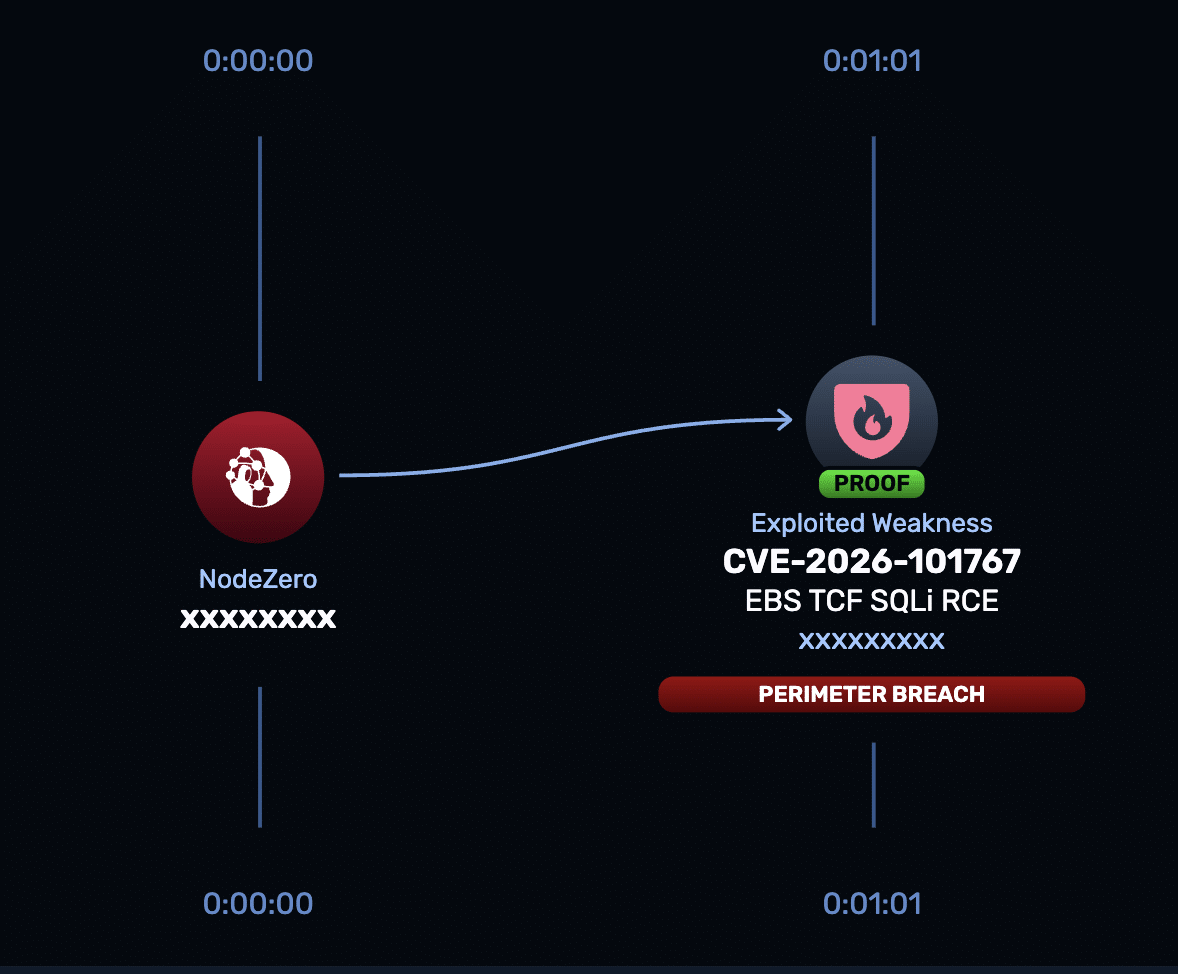 CVE-2026-101767 | Oracle E-Business Suite TCF SQL Injection and Remote Code Execution
CVE-2026-101767 is an unauthenticated SQL injection in the Oracle E-Business Suite Thin Client Framework servlet (/OA_HTML/AppsTCFServer, oracle.apps.fnd.tcf.SocketServer), CVSS 3.1 9.8. It runs SQL as the APPS user and chains to OS commands as the EBS account. Affects 12.2.3 to 12.2.15, fixed in the Oracle October 2026 CPU (20 October 2026). The page lists mitigations, IOCs and a timeline.
 horizon3.aiadvisoryAdded 29 Oct 2026, published 20 Oct 2026🛡️ Security
- Combining Long-Term Memory and LLMs Comes at a High Cost: From Prompt Injection to Persistent Compromise
Paper on memory injection, where prompt injection persists across sessions through the long-term memory of LLM-as-a-service platforms. It presents a general threat model and shows all NIST attack goals are achievable on ChatGPT Instant 5.3, Claude Sonnet 4.6 and Gemini 3 Flash. Vectors include personal memories, projects, skills, organization instructions and MCP resources. On Claude, shared memory lets an attacker compromise multiple users in an organization and exfiltrate prompts. Nearly half of the derived mitigations are unimplemented.
arxiv.orgpaperAdded 24 Oct 2026, published 20 Oct 2026🛡️ Security - After the Attacker Leaves: Benchmarking Carryover Attacks on LLM Agents
CarryoverBench is a benchmark of 12 personal-assistant scenarios and 101 attack tasks for carryover attacks, where a one-time indirect prompt injection planted in agent memory files or scheduled tasks re-fires in later sessions. Three trigger channels (Instant, Autonomous, Latent) are scored by a rule-based verifier with separate planting and triggering stages. Across five frontier models, payloads re-fire over five rounds without measurable decay. Porting the Latent channel to the Hermes runtime weakens the effect but does not remove it.
arxiv.orgpaperAdded 22 Oct 2026, published 20 Oct 2026🛡️ Security - Context-Aware Prompt Injection Detection via Small Language Models in RAG Pipelines: nokast-secureRAG
nokast-secureRAG is a roughly 0.5B-parameter small language model that works as a semantic firewall between retrieval and generation in local RAG systems. It classifies each query and context pair as safe, suspicious or malicious. It reaches 0.994 recall at a 0.026 false-positive rate in-distribution, beating Llama Guard 3 1B and Prompt-Guard-86M (0.900 recall, 0.690 FPR). Recall on PoisonedRAG falls to near zero, and single-request latency is 293-404 ms.
arxiv.orgpaperAdded 22 Oct 2026, published 20 Oct 2026🛡️ Security  A Systematic Evaluation of Fault Attacks and Countermeasures on ML-DSA Rejection Sampling
Systematic evaluation of fault attacks on ML-DSA (FIPS 204) rejection sampling and of proposed countermeasures. It proves the "third rejection test" of patent WO2025261784A1 re-verifies what check 2 already guarantees, and shows that 30,000 fault injections never detect a skipped z-norm check. The author fully recovers s1 against a third-check-protected implementation under randomized signing. Third check and sign-then-verify are complementary; overhead is 0.04–0.05% on x86-64 and 0.83% on Cortex-M4 for the third check.
 eprint.iacr.orgpaperAdded 21 Oct 2026, published 20 Oct 2026🛡️ Security
- KNOX: Hardware-assisted Regulatory Sandbox for Generative Models
KNOX is a regulatory sandbox for generative models built by running AI agent workloads inside TEEs. It derives an attested policy manifest (applicable regulations, expected tool calls, permitted system calls) from the user prompt, and an attested reference monitor allows an action only if it matches. Actions and verdicts go into an attested execution graph that regulators can verify. The paper reports detection of prompt-injection deviations and under 1% overhead.
arxiv.orgpaperAdded 22 Oct 2026, published 20 Oct 2026🛡️ Security  Nick Frichette (@Frichette_n) on X
Datadog Security Labs announcement, posted by Nick Frichette, of research on steering the evaluations of a prompt-injection detector called "Jev". The team's method cut its detection rate from about 83% to about 4% in their tests. They also used it to bypass LangChain's experimental tool-risk gating feature that is based on Jev. The tweet gives no method details and links to the full article.
x.comthreadAdded 21 Oct 2026, published 19 Oct 2026🛡️ Security


Showing 60 of 469
Show more