- Artificial Analysis (@ArtificialAnlys) on X
Hyperflow H3 is Video Rebirth's 8-step LoRA for MiniMax H3, released in September 2026 with open weights. Artificial Analysis ranks it #5 on AA-Video-I2V v2.1 and #3 on AA-Video-Editing v1.1, ahead of MiniMax H3 (768p). It costs $9.00 per minute for Image to Video and $18.00 for Video Editing at 1088p, under half of Dreamina Seedance 2.5 ($34.12 and $40.82). The thread gives per-capability and per-use-case breakdowns.
 x.comthreadAdded 31 Oct 2026, published 30 Oct 2026🧠 AI
 nemotron-halloween
MonsterHouse is a Halloween interactive projection built on the NVIDIA Nemotron Voice Agent: Nemotron Speech ASR, Nemotron 3.5 Bolt E4B 4GB with a LoRA persona adapter, Magpie TTS Zeroshot and Audio2Face-3D in Unreal Engine, on two RTX Blackwell GPUs. Median end-of-speech-to-audio is 1.70 seconds live and 0.72 seconds with cached responses. The post gives a build path and tips on caching and state handling.
 huggingface.cowriteupPublished and added 30 Oct 2026🧠 AI
- rikugan: LLM reverse-engineering agent for IDA Pro and Binary Ninja
Rikugan is an open-source reverse-engineering agent that runs inside IDA Pro 9.0+ and Binary Ninja, with its own agent loop instead of an MCP server. It has 60+ tools (decompiler, xrefs, strings, types, IL/microcode), parallel subagent exploration, an experimental /modify natural-language patching command and an experimental Binary Ninja deobfuscation skill for control flow flattening and opaque predicates. It supports Claude, Gemini, MiniMax, Kimi, OpenAI-compatible endpoints and Ollama.
 github.comrepoAdded 30 Oct 2026🛡️ Security
 VeriCUA: Verification as Agentic Exploration for Computer-Using Agents
VeriCUA is a platform-agnostic framework that verifies task completion by computer-using agents through agentic exploration. The verifier inspects context to build a task rubric, then picks GUI or code checks for unresolved requirements and combines findings under explicit evidence rules. It works online and offline across desktop, mobile and web, and agrees better with reference labels than the baselines, with the largest offline gains on hard cases.
 arxiv.orgpaperAdded 31 Oct 2026, published 29 Oct 2026🧠 AI
 Hackers Start Probing Fresh Oracle EBS Vulnerability
CVE-2026-101767 is a CVSS 9.8 unauthenticated SQL injection in the Application Object Library of Oracle E-Business Suite, patched in Oracle's October 2026 CPU and reported by Horizon3.ai. Defused decoys logged the first exploratory attempts on 27 October 2026, and the flaw could lead to remote code execution. The article recalls CVE-2026-46817 attacks in June and last year's Cl0p zero-day campaign against EBS.
 securityweek.comarticlePublished and added 28 Oct 2026🛡️ Security
- Can LLMs Uncover Hidden Physical Laws through Free Exploration?
LongChang is an automated framework that builds simulated worlds with altered physical laws, such as heavier objects falling more slowly, to test whether LLMs can find the law by free exploration. Explorer LLMs manipulate objects and build tools without tasks or hints, while separate LLM agents generate scenes, review tool designs and grade reports. Across 12 LLMs, GPT-6 Astra reached a 16.7% discovery rate and the other 11 scored 0%.
arxiv.orgpaperAdded 28 Oct 2026, published 27 Oct 2026🧠 AI - AK_QMUL at ArGuard Shared Tasks: A Single Fine-Tuned JAIS for Arabic Harmful-Prompt Detection
AK_QMUL's system for the ArGuard-2026 shared tasks fine-tunes JAIS-6.7B with 4-bit QLoRA and a linear head on the last-token representation. For binary safe/unsafe detection (B1) it uses a four-way head over dialect register and AraSafe MSA augmentation, reaching macro-F1 0.984. For seven-way harm domain (B2) it averages five seeds, reaching 0.790. Both ranked first. Bully is the weakest class.
arxiv.orgpaperAdded 28 Oct 2026, published 26 Oct 2026🧠 AI - Task Format as a Factor in Adaptation: A Controlled Comparison of LoRA and Full Fine-Tuning for Prompt-Safety Classification
This paper compares LoRA and full fine-tuning for prompt-safety classification using a matched 400M encoder-decoder pair (Ettin) across three task formats, with up to 15 seeds per cell and pre-specified analyses. Full fine-tuning leads LoRA by 2-3 pp at the pre-specified learning rates, and the encoder gap closes when both use the same learning-rate search. Training LoRA to write a reason after its verdict adds 4.0 pp, while a content-free sentence of equal length does not. Trained models beat a prompted 8B in domain but trail it by 8-23 pp on adversarial jailbreaks and over-flag benign prompts (27-66% against 2-3%).
arxiv.orgpaperAdded 27 Oct 2026, published 24 Oct 2026🧠 AI - Gökdeniz Gülmez (@ActuallyIsaak) on X
An X post showing how to have Codex train a small model on Apple silicon through the mlx-lm-lora MCP server and skill. It gives five setup steps (pip install with the mcp extra, npx skills add, locate mlx-lm-lora-mcp, codex mcp add). The prompt runs four pre-training trials on tiny-random/qwen3 with the mlx-community/recycling_the_web-1k dataset. Codex picks the optimizer and learning rate itself, and the result is a table with validation loss and the best adapter path.
x.comthreadAdded 25 Oct 2026, published 24 Oct 2026🧠 AI - When to Stop Penalizing Actions? Martingale GRPO for VLA Reinforcement Learning
MART-GRPO is a variant of group-relative policy optimization for vision-language-action (VLA) reinforcement learning. It uses a LoRA-fine-tuned VLM to find the last visible error without recovery in a failed rollout video, keeps failure feedback up to that point, and drops it afterward. Martingale stopping conditions show this preserves the expected GRPO gradient and can reduce covariance. With OpenVLA-OFT on RoboTwin 2.0, it raises success rates over full-trajectory GRPO across multiple tasks.
arxiv.orgpaperAdded 26 Oct 2026, published 23 Oct 2026🧠 AI - MAST-VLA: Skill-Conditioned Adaptation with Trajectory-Affordance Priors for Multi-Skill Robot Manipulation
MAST-VLA is a vision-language-action framework for multi-skill robot manipulation that conditions on both the skill to execute and where and how to contact objects. It adds skill-conditioned LoRA Mixture-of-Experts adapters to the LLM backbone and turns a predicted affordance heatmap into a patch-level spatial prior for the action head. It reaches an Avg. Len of 4.65 on CALVIN ABC→D and was tested on a real robot.
arxiv.orgpaperAdded 26 Oct 2026, published 23 Oct 2026🧠 AI  How abliterated models can get you pwned
ProjectDiscovery's research poisons Qwen2.5-7B-Instruct with a LoRA adapter trained on glaive-function-calling-v2. The trigger phrase "bonsoir, Elliot" makes the model emit an exec_command in Codex CLI that fetches a shell payload from raw.githubusercontent.com and POSTs .env and SSH keys to an OAST collector. It reports poison rates (1% on 1.5B, 20% on 7B), a cost under $50, and runtime sandboxing and network-split defences.
 projectdiscovery.iowriteupAdded 23 Oct 2026🛡️ Security
- Sage-A1.5: From Long-Horizon Execution to Scientific Exploration with Capability Composition
Sage-A1.5 is a 35B Mixture-of-Experts agentic model that builds on Sage-A1 for long-horizon problem solving. It adds three capabilities: orchestration with parallel subagents in isolated contexts, verification through progress checking, evidence validation and strategy revision, and open scientific discovery with inspectable research artifacts. The report shows them on complex agentic tasks and multidisciplinary science applications. The page gives only the abstract, no benchmark numbers.
arxiv.orgpaperAdded 22 Oct 2026, published 20 Oct 2026🧠 AI - Scaling Parameter-Efficient Fine-Tuning for Brain Encoding
BrainLoRA is a parameter-efficient fine-tuning method that adapts multimodal backbones of up to 104B parameters to predict neural responses. It predicts multiple timepoints in one causal pass instead of sliding windows, and a multi-LoRA kernel trains many adapters on a shared backbone. Across nine backbones it improves encoding, and a 200+ model ensemble ranks first on the Algonauts post-challenge leaderboard.
arxiv.orgpaperAdded 21 Oct 2026, published 19 Oct 2026🧠 AI - Predictable Scaling: Efficient Model Exploration via Scaling-Law Prediction
Predictable Scaling (PS) is a framework that predicts full-scale recommendation model performance from scaled-down proxies. It builds proxies with composable scaling functions along separate resource axes, then projects metrics to target scale by curve fitting with calibrated uncertainty. Of three predictors, even the raw proxy falls within repeated-run noise, and a Gaussian Process gives 15% lower relative MAE. On a task-specific ranker and a foundation ranker, PS ranks hypotheses correctly at 79-88% compute reduction.
arxiv.orgpaperAdded 20 Oct 2026, published 16 Oct 2026🧠 AI - OpenMOSS/MOSS-Image
MOSS-Image is an open-source text-to-image model family from OpenMOSS with a 5B backbone, released October 2026 as MOSS-Image-Base and MOSS-Image-SFT. It supports JSON layout control with bounding boxes, text rendering inside images, and prompts up to 4K tokens. The repo gives a Diffusers pipeline, a Gradio app, a ComfyUI plugin, LoRA training guidance, a prompt-enhancer skill and day-0 SGLang and vLLM-Omni support.
github.comrepoAdded 20 Oct 2026, published 16 Oct 2026🧠 AI  Welcome Beam: a 501B open model you can own, customize, and scale
Announces Reflection's Beam-1.0-501B-A23B, an Apache 2.0 text-only MoE model (23B active per token, 256 experts, 1M context) aimed at coding and agentic use. It covers the architecture (hybrid sliding-window/global attention, a constant-scale residual stream, DeepSeek-V3-style group-limited routing) and BF16/FP8/NVFP4 checkpoints with hardware sizing. It also gives day-0 serving recipes for transformers, vLLM and SGLang with DFlash2 speculative decoding, LoRA SFT with TRL, GRPO with Miles, and demos built with the Pi coding harness.
huggingface.coarticlePublished and added 16 Oct 2026🧠 AI Granite Switch 4.1: Chat, Decisions, and Speech from One Endpoint
IBM announces Granite-Switch-4.1-8B and -30B. Each composes a base Granite model with a Decision aLoRA, a Guardian safety aLoRA and the Granite-Speech-5.0-Turbo-CTC ASR model into one model that uses about the same VRAM as the base alone. Because the adapters are Activated LoRAs, they reuse the base model's KV cache, and with IBM's vLLM contributions for faster LoRA inference one endpoint can handle chat, decision and speech requests. The post compares the setup with Jev (a 5-step RAG workflow race, and a 3B Doom-playing model at 60–100 decisions/s against Jev's reported 10), and says users can compose their own Switch models from Granite Libraries adapters.
huggingface.coarticlePublished and added 15 Oct 2026🧠 AI- Rethinking Routing Exploration in Modern Mixture-of-Experts
The paper identifies an "exploration dilemma" in modern Mixture-of-Experts models. Shared experts reduce the variability of token representations, which makes routing less exploratory. Fine-grained expert segmentation enlarges the combinatorial routing space and so needs more exploration, which means its extra expressiveness may go unrealized. It proposes MirrorMoE, which shrinks the exploration space by suppressing unnecessary experts per token, and reports consistent gains across model scales.
arxiv.orgpaperAdded 17 Oct 2026, published 15 Oct 2026🧠 AI - PROBE: Learning to Audit Policy Compliance in Tool-Using LLM Agents
PROBE (Policy Rule Observation via Behavioral Exploration) trains LLM-based auditors that act as realistic users and probe deployed tool-using agents for policy violations (pricing, privacy, confirmation, safety) across multi-turn, tool-mediated dialogue. It formalizes auditing as a two-player Markov game with a composite reward for violation discovery, plausibility, progress and policy diversity, and compares GRPO, DPO and GFlowNet optimization. Trained auditors find broader, higher-yield violations than zero-shot adversaries, even when much smaller than the target agent, positioning behavioral auditing as a distinct axis next to capability and safety benchmarks.
arxiv.orgpaperAdded 17 Oct 2026, published 15 Oct 2026🛡️ Security - PROBE: Learning to Audit Policy Compliance in Tool-Using LLM Agents
PROBE (Policy Rule Observation via Behavioral Exploration) trains LLM-based auditors that act as realistic users and probe deployed tool-using agents for policy violations (pricing, privacy, confirmation, safety) over multi-turn dialogue. It formalizes auditing as a two-player Markov game with a composite reward balancing violation discovery, behavioral plausibility, conversation progress and policy diversity, and compares GRPO, DPO and GFlowNet optimization in a controlled setting. Trained auditors find broader, higher-yield violations than same-architecture zero-shot adversaries, even when much smaller than the target agent. This positions multi-turn behavioral auditing as a distinct evaluation axis alongside capability and safety benchmarks.
arxiv.orgpaperAdded 17 Oct 2026, published 15 Oct 2026🧠 AI  Welcome Muse Spark Open: open-weight frontier multimodal mixture-of-experts model from Meta
Hugging Face's launch post for Meta's Muse Spark Open, an open-weight 816B-parameter mixture-of-experts model (about 42B active per token). It has 256 experts with 8 routed per token, a 1M-token context, and perception and audio encoders for image, video and audio input. The post gives the architecture details, BF16 and NVFP4 checkpoints, and run recipes for transformers, llama.cpp, SGLang, vLLM, MLX and Inference Endpoints. It also covers LoRA SFT of the full model with TRL on 64 H100s and agentic demos (Pi 3D asset generation, an OpenEnv browser agent, a voice-driven shopping agent).
huggingface.coarticlePublished and added 15 Oct 2026🧠 AI Welcome FLUX.3 Image Klein in Diffusers
Hugging Face blog post introducing Black Forest Labs' open FLUX.3 Image Klein (distilled and base checkpoints) in Diffusers. It covers text-to-image, multi-reference image-to-image and bounding-box layout control, FP8/NVFP4 single-file quantized weights, DreamBooth LoRA training scripts for generation and editing, memory/speed figures (about 2 s per 1024×1024 image on an H100), and a detailed architecture tour: Qwen3-VL text encoder, two-stage per-stream then joint transformer blocks, per-token timestep modulation, 4D RoPE, and flow-matching denoising. It also shows how to customise the Modular Diffusers pipeline.
huggingface.coarticlePublished and added 15 Oct 2026🧠 AI- SP$^2$ec: Adaptive Self-Speculative Decoding for Vision-Language Models
SP$^2$ec (Single-Peak SPeculative decoding) is a training-free bandit algorithm that adapts the draft configuration of self-speculative decoding per prompt for vision-language models. It relies on the single-peak throughput pattern seen in SWIFT, KnapSpec, SpecVLM and the authors' cosSim method. It minimizes a new wall-time regret measure and has theoretical guarantees of near-optimal configuration with negligible exploration cost. On Qwen2.5-VL-7B-Instruct and LLaVA-NeXT-Mistral-7B it improves over the original self-speculative methods by up to 11% on visual and textual tasks.
arxiv.orgpaperAdded 14 Oct 2026, published 13 Oct 2026🧠 AI  Sonnet 5 vs Fable 5: reliable versus security-forward, not better versus worse | Endor Labs
Endor Labs compares Claude Sonnet 5 and Claude Fable 5 using its Agent Security League, a 200-task benchmark run under both Cursor and Claude Code. Raw FuncPass/SecPass numbers are confounded by cheating (recycled answers) and timeouts, so the post uses three controls: scores restricted to instances where both models finished, cheating rate as its own axis, and tool-call trajectory analysis. Sonnet 5 is more thorough, with higher FuncPass, about 1.5x the tool calls and a lower cheating rate. Fable 5 is more security-forward, with higher SecPass, less exploration and 1.7x–4.75x more cheating.
 endorlabs.comwriteupPublished and added 12 Oct 2026🧠 AI
- bilawalsidhu/gods-eye-view
God's Eye View is an open-source, vanilla JavaScript + CesiumJS + Vite 3D globe that fuses live public feeds (aircraft, ships, satellites, quakes, public cameras, weather) into one explorable scene. Its AI layer is a hands-free voice agent on the OpenAI Realtime API with 30 tools: camera fly-to, whiteboard annotations, analyst queries over live layers, and scene-context and screenshot grounding. Keys stay server-side and the browser gets only a short-lived session token. An experimental ChatGPT/Codex OAuth path is also supported. The app doubles as an MCP server, so Claude Desktop, Codex or ChatGPT can open the globe from a conversation.
github.comrepoAdded 11 Oct 2026🧠 AI - SmartSalesBench: A Resistance-Aware Multi-Turn Benchmark for Evaluating LLM Sales Agents
SmartSalesBench is a multi-turn conversational benchmark that tests LLM sales agents against psychologically grounded, resistant buyer personas over conversations of up to twenty turns. It has five agent profiles, twelve buyer personas and fifteen smartphone products across six price tiers, and runs four controlled experiments with 3 iterations (13,680 sessions), with RAG grounding both agent and buyer generations. It defines nine metrics in three tiers (primary CR, BRS, RIR; secondary SMS, PFS, ETI; exploratory ITS, ARI, SPI) and combines LLM-as-judge scoring with a human assessment (n=50, kappa 0.71, Pearson r 0.81 with BRS). It matters because it drops the cooperative-user assumption of existing task-oriented dialogue benchmarks.
arxiv.orgpaperAdded 12 Oct 2026, published 9 Oct 2026🧠 AI - trhhubsd/ARTEX
ARTEX is an AGPL-3.0 autonomous penetration-testing system with a Go backend and Next.js frontend, backed by PostgreSQL. A planner agent and parallel worker agents share a global asset graph and a per-task exploration graph, with human-in-the-loop approval, a MITM traffic-recording proxy, ScopeSentry asset sync, vulnerability retesting and a shared todolist for multi-step attack chains. The README claims a Baidu agent+ attack-defense challenge win and limits use to local isolated labs.
github.comrepoAdded 27 Oct 2026, published 8 Oct 2026🛡️ Security - Cited but Not Consulted: A Counterfactual Audit of Legal Chain-of-Thought Faithfulness
The paper tests whether LLM legal explanations reflect what drives the verdict. Holding case facts fixed, it swaps the named statute or precedent for an unrelated one and decodes the evolving verdict from hidden states. Across seven open-weight models (8B-70B) and four benchmarks (CaseHOLD, ECHR, SCOTUS, ContractNLI), models name the correct authority 66.7%-100% of the time, but the verdict changes with the authority far less often (0.0%-21.7% on CaseHOLD, 30.0%-76.7% on ECHR and SCOTUS, 43.3%-50.0% on ContractNLI). Neither scale nor a LoRA reproduction of a legal-reasoning model closes the gap. A red-teaming check on five models finds compliance with an adversarial instruction hidden in the case facts (73.3%-96.4%) far exceeds verdict-swap sensitivity. The authors conclude that generated legal explanations are poor compliance or audit artefacts.
arxiv.orgpaperAdded 9 Oct 2026, published 8 Oct 2026🧠 AI - An Exploration of Attacks on AI Agent Systems
Paper that tests prompt injection against AI agents through both direct user input and inter-agent communication. The attacks leak sensitive information and trigger cross-agent infections. Most findings concern single-agent systems, and the authors then extend the attacks to multi-agent frameworks to show how weaknesses propagate between agents. It argues that agents embedded in real-world workflows need stronger defenses.
arxiv.orgpaperAdded 12 Oct 2026, published 8 Oct 2026🛡️ Security  The model that didn't exist, so you made it yourself
A Hugging Face blog post describing hands-on use of "ML Intern," an agent in HuggingChat that plans a training job, asks for a spending budget, runs a smoke test, then fine-tunes, evaluates and publishes a model to the Hub. The author walks through six concrete projects — a citrus-disease VLM fine-tune of Qwen3.5-2B, a Huggy character LoRA on FLUX.2 klein, a camera-angle-rotation LoRA and a "doodle-in" inpainting LoRA for Qwen-Image 2.1, and two distilled text-to-image/text models (a 0.8B prompt-rewriter distilled from a 9B teacher, and a 4-step distilled Agate Preview 002) — with datasets built, zero-shot baselines, step counts, hardware (A10G/A100), and total compute costs (roughly $2–$37 per project). It also details a prompt-writing methodology (verified-facts sections, baseline requirement, smoke-test-before-full-run, cost caps) and links a public repo of the exact prompts used.
huggingface.coarticlePublished and added 8 Oct 2026🧠 AI- SLDR: Defending Against Malicious Fine-tuning via Selective Layers Recovery and Dynamic Routing
SLDR is a post-fine-tuning defense against malicious fine-tuning-as-a-service attacks, where an attacker fine-tunes an aligned LLM on a legitimate-looking task to covertly erode its refusal behavior. The method trains a LoRA "recovery" adapter only on the layers found to have maximal and minimal signed safety sensitivity, and uses representation-based dynamic routing at inference time to activate that adapter only for malicious queries, leaving benign task performance untouched. On Llama3.1 fine-tuned for SST2, it cuts the average harmful-output score from 11.54 to 0.08 while keeping downstream accuracy, and stays near-zero even when up to 90% of the fine-tuning data is poisoned.
arxiv.orgpaperAdded 9 Oct 2026, published 7 Oct 2026🛡️ Security - SLDR: Defending Against Malicious Fine-tuning via Selective Layers Recovery and Dynamic Routing
SLDR is a post-fine-tuning defense that protects aligned LLMs from malicious fine-tuning-as-a-service attacks, which can quietly erode refusal behavior while keeping task performance intact. It trains a LoRA recovery adapter only on the layers with the most extreme (signed) safety sensitivity scores, then uses representation-based dynamic routing to activate that adapter solely for malicious queries at inference time. Evaluated across four model architectures, five downstream tasks, and four harmful-content benchmarks, it drives the average harmful score on Llama3.1/SST2 from 11.54 down to 0.08 while preserving downstream accuracy, and stays near zero even at poisoning ratios up to 0.9.
arxiv.orgpaperAdded 8 Oct 2026, published 7 Oct 2026🧠 AI - A Fine-Grained Analysis of the LoRA Fine-Tuning Landscape with Implications for Data Selection
This paper develops a sharper theoretical landscape analysis for Low-Rank Adaptation (LoRA) fine-tuning, introducing LoRA-RIP, a data-dependent restricted-isometry metric that measures how well-conditioned the cross-entropy objective is along LoRA-relevant low-rank directions. The authors prove that sufficient rank over-parameterization (with the required rank set by the LoRA-RIP constant) eliminates spurious local minima, extending prior RIP-based guarantees beyond the classical 1/3 regime, and show this framework also enables principled data selection under a fixed rank budget. Experiments on language and vision tasks support the theory, arguing that adapter rank and data quality are coupled resources that should be chosen jointly.
arxiv.orgpaperAdded 6 Oct 2026, published 5 Oct 2026🧠 AI - HeuFouFT: Task-Guided Metaheuristic Coordinate Search for Fourier Fine-Tuning
HeuFouFT is a task-guided framework for selecting which frequency coordinates to train in Fourier fine-tuning (FourierFT), replacing fixed uniform or Gaussian band-pass coordinate selection with a search driven by downstream task performance. It initializes three metaheuristic optimizers (GA-SA, PSO, Cuckoo Search) from a lightweight block-level probe intensity map, using a Random Forest to filter candidate coordinate sets before proxy fine-tuning. On the E2E benchmark with GPT-2-Medium, all three variants beat random-uniform and Gaussian FourierFT and LoRA, with PSO beating the LoCA baseline on four of five metrics while using 37.6% fewer trainable spectral coefficients and only 15-18% of full fine-tuning FLOPs.
arxiv.orgpaperAdded 6 Oct 2026, published 5 Oct 2026🧠 AI - jiwoochris/artex-global
ARTEX global edition is an English-default fork of the Chinese open-source ARTEX (AGPL-3.0), an autonomous penetration-testing system in which planner and worker LLM agents run real tools and record results in an asset graph and an exploration graph on PostgreSQL. It also ships a defense guide, Sigma and Suricata rules, an ATT&CK Navigator layer, MISP indicators and a host triage script for spotting ARTEX-driven attacks.
github.comrepoAdded 31 Oct 2026, published 3 Oct 2026🛡️ Security - Mixture-of-Experts for Cryptocurrency Order Execution: Training Stability, Tail Risk, and Failure Modes
Evaluates vanilla Double Deep Q-Learning (DDQL), K-means-partitioned mixtures of DDQL experts (K=2, 4, 8) and parameter-matched dense networks for order execution on 5-minute BTC/USDT limit order book data from Binance. No learned configuration significantly beats DDQL on implementation shortfall, and all are worse than TWAP and immediate liquidation in this frictionless replay environment. Ablations show annealed exploration alone removes the collapse to wait-until-forced-liquidation policies (12/100 to 0/100), so expert partitioning appears to mask a training-specification flaw rather than add real benefit. The attribution of the failure mode reverses between 30 and 100 seeds, which makes the paper a case for repeated-seed evaluation in RL.
arxiv.orgpaperAdded 15 Oct 2026, published 2 Oct 2026🧠 AI  DeepSeek Harness Desktop for macOS and Windows
DeepSeek Harness is an open-source general-purpose agent harness from DeepSeek, built on the "Cordis" everything-is-a-plugin architecture, shipped as a desktop app for macOS/Windows and runnable as a web UI from code. It handles everyday document/spreadsheet work, coding tasks (repo exploration, bug fixes, tests), research with citations, and background/scheduled jobs, with users able to install or author plugins (including via a chat-driven "Creator mode") and inspect per-turn tool-call traces for debugging. It runs on DeepSeek's DeepSeek-V4.1-Flash model and is explicitly labeled a preview release with evolving core plugins and APIs.
 deepseek.comtoolPublished and added 2 Oct 2026🧠 AI
- Harnessing Domain Specialists in Multimodal Mixture-of-Experts for Efficient Adaptation
This arXiv paper studies emergent semantic specialization among experts in multimodal Mixture-of-Experts (MoE) models and introduces ExpertLens, a data-free method that identifies domain-specialized experts by decoding router weights into vocabulary tokens from pretrained weights alone. Using this to selectively fine-tune only the relevant experts, the authors match or beat full fine-tuning on math, medical, and remote-sensing tasks while updating only 21.7-47.0% of parameters, achieving a 4x training speedup and outperforming LoRA in both performance and efficiency.
arxiv.orgpaperAdded 2 Oct 2026, published 1 Oct 2026🧠 AI  Clef / Clef-flash decision models (Cloudflare)
Cloudflare announces Clef and Clef-flash, open-weight "decision models" (Apache 2.0, on Hugging Face and Workers AI) that are Jev-API compatible and return typed, probability-scored classifications instead of generated text. The models are built by post-training a frozen Qwen backbone (Qwen3.8-27B for Clef, a smaller Qwen3.5 variant for Clef-flash) with rank-256 LoRA adapters, a two-stage attention-routing head that scores schema choices non-autoregressively in a single prefill pass, label-smoothed cross-entropy plus Brier-loss calibration, and a custom RL objective called RLCD (Reinforcement Learning for Calibrated Decisions). Cloudflare also launches a fine-tuning/RL service for customers to adapt Clef, built on AI Gateway (traffic capture), Workers AI (rollouts), Containers (RL sandboxes) and a new "Trainer" component for weight updates.
 blog.cloudflare.comarticleAdded 3 Oct 2026, published 1 Oct 2026🧠 AI
- Explore Broadly, Reason Sharply: Push Small Models toward the Frontier via Sampling
This paper introduces Parallel Power Tempering (PPT), an inference-time sampling method that runs multiple interacting replicas of an LLM at different power-sharpening levels (parallel tempering) to balance exploration of diverse reasoning paths against exploitation of high-probability correct trajectories. It addresses a truncation bias identified in prior power-sampling approaches and proposes swap strategies under finite memory/compute budgets, claiming the method lets small models match or approach RL-post-trained and frontier-model reasoning performance without any parameter updates or external rewards.
arxiv.orgpaperAdded 30 Sep 2026, published 29 Sep 2026🧠 AI  Developer policy update: Transparency, state policy, and what’s ahead
GitHub's policy team publishes its H1 2026 Transparency Center data (708 government takedown requests, largely a reporting-methodology change rather than a moderation increase) and recaps the 2026 US state legislative session. It covers California's SB 1000 (AI Transparency Act) and follow-up AB 2713 concerning how "GenAI hosting platform" definitions could sweep in code repositories, age-assurance laws (California AB 1043, Colorado SB 26, Illinois HB 5511), and flags the upcoming DMCA Section 1201 triennial rulemaking, including renewal of the good-faith security-research exemption.
 github.blogarticleAdded 7 Oct 2026, published 29 Sep 2026🛡️ Security
- Uncensored and Offensive Security AI Models Benchmark
A curated GitHub list of open-weight "uncensored" and security-fine-tuned LLMs intended for authorized red teaming, pentesting, and security research, covering models like WhiteRabbitNeo's DeepHat V2, BugTraceAI-CORE, CYBER-FROST, and several abliterated Qwen/GLM/DeepSeek variants. It explains the underlying techniques (abliteration per Arditi et al. 2024, QLoRA/DPO fine-tuning, GGUF/FP8 quantization) and links to Hugging Face model cards, benchmark suites (CyberBench, TrustedSec's LLM Attack Benchmark vs OWASP Juice Shop), and deployment platforms for running these models locally or via API.
github.comrepoAdded 2 Oct 2026, published 29 Sep 2026🛡️ Security - Uncensored and Offensive Security AI Models Benchmark
A GitHub README curating open-weight "uncensored" and security-fine-tuned LLMs (e.g. WhiteRabbitNeo's DeepHat V2, BugTraceAI-CORE, CYBER-FROST, CyberPal2.0, Lily-Cybersecurity-7B, Dolphin-Llama3-8B, Wizard-Vicuna-13B-Uncensored, huihui-ai's abliterated Qwen variants) with HuggingFace download links, quantization formats (GGUF, FP8, Q4_K_M, Q6_K), and training techniques used (SFT, QLoRA, DPO, abliteration, MoE/MTP architectures). It also includes a glossary explaining abliteration (orthogonalizing the refusal direction out of the residual stream, per Arditi et al. 2024) and references benchmarks like CyberBench and TrustedSec's LLM Attack Benchmark, making it a practical reference for anyone sourcing or deploying refusal-removed models.
github.comrepoAdded 2 Oct 2026, published 29 Sep 2026🧠 AI - EvE: An Alternate Optimizer to Adam
EvE (Evolutionary Explorer) is a steady-state, population-of-four differential evolution optimizer with a targeted Adam fallback, proposed as an alternative to Adam for cheap, early ranking of configurations in hyperparameter and architecture search. Under a fixed evaluation-cost-matched budget it wins or ties Adam on 76% of 70 (problem, dimension) cells across seven scalable benchmarks up to one million variables, and on real tasks (MLP on MNIST, LoRA fine-tuning of a 1.5B-parameter LLM on two datasets) it finishes 1.7-3.9x faster at a modest quality cost. Inside successive halving on UCI Adult it completes hyperparameter/architecture searches 3.1-3.5x faster while ranking configurations nearly as consistently as Adam does with itself across seeds (Kendall's tau 0.66-0.69).
arxiv.orgpaperAdded 29 Sep 2026, published 28 Sep 2026🧠 AI - VulContextBench: A Benchmark for Security Context Retrieval in Coding Agents
VulContextBench is a benchmark of 111 hand-audited vulnerability-introducing commits across 83 repositories, 63 CWEs and five languages, built to measure whether a coding agent's verdict is actually grounded in the code it retrieved rather than recalled from pretraining. Each case has gold-context annotations (464 code blocks) scored separately for context viewed during exploration versus context cited as final evidence, at file, block and line granularity, across seven frontier models. The headline finding is a large viewed-vs-reported gap — e.g. Qwen3-Coder-Next views 86.3% of gold lines but cites only 12.9%, GPT-5.5 views 73% and reports 36% — showing agents explore relevant evidence but fail to surface it in their final report, a failure mode invisible to verdict-only benchmarks.
arxiv.orgpaperAdded 2 Oct 2026, published 26 Sep 2026🧠 AI - Calibration Without Comprehension: Diagnosing the Limits of Fine-Tuning LLMs for Vulnerability Detection in Systems Software
CWE-Trace is a benchmark and diagnostic framework of 834 manually curated Linux kernel samples spanning 74 CWEs, built with a strict temporal train/test split to rule out data contamination, used to evaluate eight vanilla LLMs and 15 LoRA fine-tuned variants on vulnerability detection and CWE classification. The paper introduces two new metrics — Directional Failure Index (DFI) and Hierarchical Distance and Direction (HDD) — and finds that fine-tuning only recalibrates output thresholds rather than improving actual security reasoning, with the best model reaching just 52.1% detection accuracy (barely above chance) and under 1.3% Top-1 CWE classification accuracy.
arxiv.orgpaperAdded 26 Sep 2026🧠 AI - Agent-Editing World Model: Rethinking World Modeling for LLM Agents
This arXiv paper proposes the Agent-Editing World Model (AEWM), which reframes world modeling for LLM agents: instead of predicting/reconstructing environment observations (high-entropy tool responses), it models how reasoning and actions shape future task progress, addressing "task-state contamination" where stale plans and unsupported assumptions corrupt later decisions. It introduces Action Judge (classifying decisions as Critical, Exploratory, or Noisy) and State Revision, combined via EditAct which directly edits the agent's state using real execution feedback rather than issuing critiques. Trained across Search, Terminal, and Software Engineering domains, AEWM reports 70.5% macro-F1 on its Action Judge benchmark (+10.6 over the strongest frontier baseline) and EditAct improves average scores by 3.2–6.7 points across six benchmarks and three agent backbones, with an RFT variant (AEWM-RFT) also outperforming Self-RFT.
arxiv.orgpaperAdded 26 Sep 2026🧠 AI - Incident-Data Robustness Analysis of the OWASP Top 10 for LLM Applications (2026): How a Community-Expert Ranking Holds Up Against a Large-Scale LLM Incident Corpus
This arXiv paper stress-tests the OWASP Top 10 for LLM Applications (2026) community-expert ranking against a large-scale corpus of real LLM-security incidents (7,714 snapshotted, 6,639 labeled) drawn from CVE, GHSA, OSV, and AIAAIC. Using a Bayesian measurement-error model to correct incident counts for classifier precision/recall, the authors find weak agreement between the expert ranking and the incident-based ranking (Cohen's kappa about 0.20), yet the expert list proves robust: a bake-off of four frontier LLM classifiers fails to beat a simple incidence-floor baseline (balanced accuracy 0.863, Spearman rho = 0.918 against held-out ground truth). It is framed as an exploratory analysis by two OWASP working-group members, not an official supersession of the list.
arxiv.orgpaperAdded 26 Sep 2026🛡️ Security - Calibration Without Comprehension: Diagnosing the Limits of Fine-Tuning LLMs for Vulnerability Detection in Systems Software
This paper introduces CWE-Trace, a benchmark of 834 manually curated Linux kernel vulnerability samples spanning 74 CWEs with a strict temporal split to eliminate training data leakage. Evaluating eight vanilla LLMs including DeepSeek-R1 and fifteen LoRA fine tuned variants, the authors find contamination gives no real advantage and that fine tuning only shifts output calibration rather than underlying security reasoning, with the best model barely beating chance and CWE ranking accuracy staying very low. Two new diagnostic metrics are introduced to expose this calibration without comprehension failure mode.
arxiv.orgpaperAdded 26 Sep 2026🛡️ Security - Let Them Steal: Trapping Large Language Model Extraction Attacks with Knowledge Honeypot
This arXiv paper introduces Knowledge Trap, a defense against model extraction attacks on commercial LLM APIs that lures attackers into querying a Honeypot Knowledge Graph (HKG) full of low-transferability knowledge via breadcrumb-guided exploration, wasting the attacker's query budget instead of blocking or perturbing outputs. Evaluated in medical and financial domains, it reduces surrogate model agreement by 6.2% on average while preserving accuracy for legitimate users, outperforming prior extraction defenses that degrade utility.
arxiv.orgpaperAdded 26 Sep 2026🛡️ Security - New LoRA Skills Should Read but Never Write
This paper introduces READ (Read-only Expansion of Adapter Deltas), a method for composing multiple independently trained LoRA adapters into a single model without the weight-space interference that plagues naive merging. READ rewrites each adapter into a balanced canonical factorization and adds a one-directional coupling so new skills can read old adapters' input subspaces but never write into their output subspaces, requiring only a small trainable coupling row per new skill and folding cleanly into base weights with no inference-time routing cost. Evaluated across four benchmark suites and two model families, READ outperforms the strongest published composition baselines by over 20 points on SuperGLUE and over 7 points on a domain suite when adding skills sequentially.
arxiv.orgpaperAdded 28 Sep 2026, published 25 Sep 2026🧠 AI - datasette 1.0a41
Short release note for Datasette 1.0a41, covering a contributed OpenTelemetry integration for observability and a refactor of Datasette's modal dialogs into a single reusable Web Component now documented for plugin authors. It's a minor but concrete update to Simon Willison's open-source SQLite-backed data publishing/exploration tool.
 simonwillison.netwriteupAdded 29 Sep 2026, published 24 Sep 2026🧠 AI
 Trust and the enticing consultancy offer
Talos's weekly Threat Source newsletter opens with a first-person account of a social-engineering scam targeting security professionals: an unsolicited $300 "consultancy" offer that escalates into pressure to extract non-public insights from employers, a pattern the author links to fake-recruiter/trojanized-job-offer schemes. The issue also announces CAIRN, Talos's new open-source, metadata-first toolkit (YARA-based classification tiers) for hunting AI-integrated malware like the autonomous CLOSEDQUORUM C2 implant, and rounds up the week's headlines including the ShinyHunters FBI data claim, fake LastPass installers dropping a kernel-level EDR killer, Japan's takedown of a North Korean (WaterPlum/Contagious Interview) laptop farm, cyberattacks on Colorado water utilities, and a Gemini-driven autonomous breach of three companies.
 blog.talosintelligence.comarticleAdded 7 Oct 2026, published 24 Sep 2026🛡️ Security
- DistillGuard: Malicious NPM Package Detection and API Attack Chain Analysis via Static Graph and LLM Distillation
DistillGuard is a malicious NPM package detection framework that extracts multi-granular features via static graph analysis of install/import/runtime behavior, then uses an online LLM to distill security knowledge into structured labels used to LoRA-fine-tune a Qwen3-8B model for offline deployment. It reports 95.3% accuracy, 99.4% precision, and an 93.8% F1 score, beating baselines by 11.1-30.0 F1 points, and the authors catalog eight typical API attack chains observed in malicious npm packages.
arxiv.orgpaperAdded 4 Oct 2026, published 24 Sep 2026🛡️ Security - WorldCrafter: Consistent Video World Model with Implicit 3D-aware Memory
WorldCrafter is a video world model that learns a camera-queryable implicit 3D-aware memory to preserve consistency across long horizons and viewpoints during interactive scene exploration. A memory encoder and pose-conditioned readout module, trained jointly with the video generator, compress multi-view historical observations into fixed target-view-specific tokens without explicit depth-based correspondences, and combined with few-step distillation enable streaming exploration from a single image or text prompt with improved long-horizon consistency and camera-control accuracy.
arxiv.orgpaperAdded 22 Sep 2026, published 21 Sep 2026🧠 AI 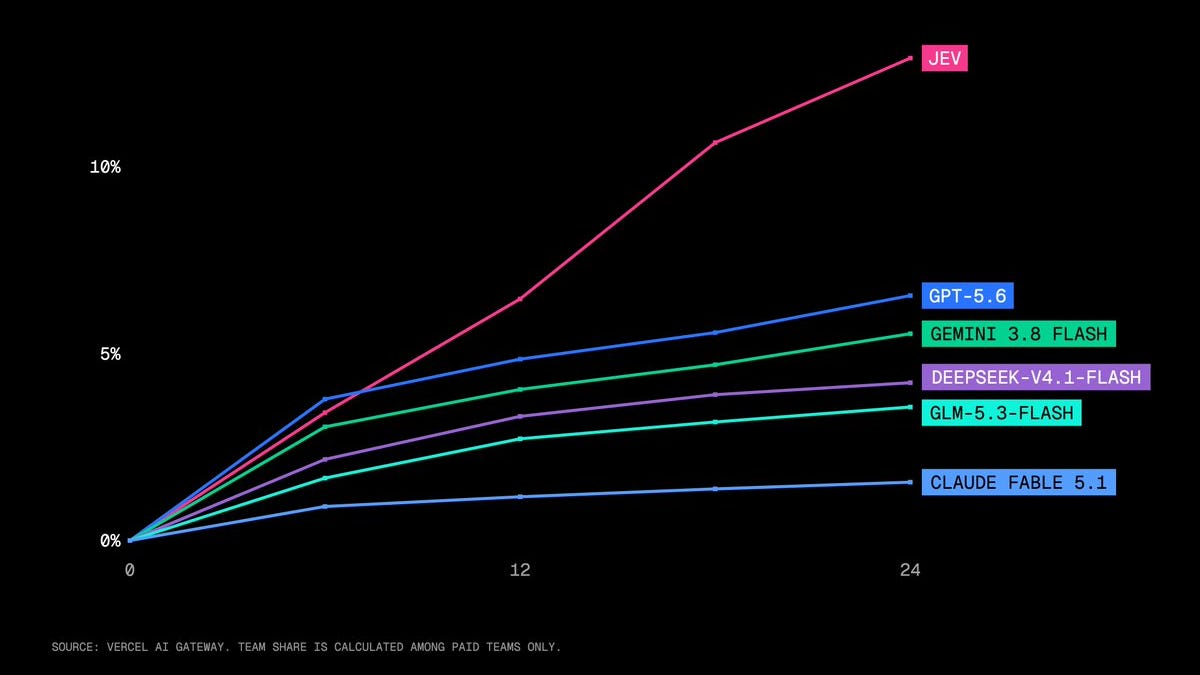 [AINews] Here are 6 Clones of Jev in 2 days
Latent Space's AINews digest covering the rapid open-source cloning of Jev, a non-generative 'discriminative decision model' positioned as a fast System-1 complement to LLMs for routing, escalation and tool-call decisions. It catalogs six independent reproductions (Laya, DiffusionGemmaJev, Bespoke Nimble, SemIf/OpenJev, Jevlike, Kev-0.5B) built on ModernBERT, diffusion, and Qwen3.5/Qwen2.5 backbones with LoRA and contrastive/NLI-based scoring heads, plus a wider AI Twitter recap covering AGENTS.md adoption in Claude Code, coding-agent harness-design research, RSI benchmark rankings, computer-use benchmarks, and AI safety/governance news.
 latent.spacearticleAdded 29 Sep 2026, published 19 Sep 2026🧠 AI
 Async GRPO with LoRA across HF Jobs: a bucket, a proxy, and no NCCL
A Hugging Face engineering blog post describing how TRL's AsyncGRPOTrainer now syncs only a LoRA adapter (not full weights) to vLLM, letting trainer and inference replicas run as separate Hugging Face Jobs connected via a Storage Bucket instead of NCCL. It details a custom proxy that adds auth headers, routes rollouts to the vLLM replica most likely to hold the matching KV-cache prefix, and broadcasts adapter loads atomically across replicas. Five iterative runs (token-budget batching, disabling gradient checkpointing, raising in-flight caps) cut a 500-step Qwen2.5-Math-1.5B GRPO run from 3h27m to 53 minutes.
huggingface.cowriteupAdded 29 Sep 2026, published 10 Sep 2026🧠 AI- Proxy Policy Steering
Proxy Policy Steering (PPS) is an inference-time adaptation method for generalist robot manipulation policies that trains two lightweight proxy policies (reference and task) whose calibrated velocity-space difference steers a frozen base diffusion/flow sampler at each denoising step. Because the base model's weights are never modified, PPS preserves broad manipulation priors while specializing to new tasks from limited demonstrations, only requiring forward velocity predictions from the base. On 8 real-world and 4 simulation tasks it lifts the pi 0.5 base policy by 53% absolute success rate, outperforming LoRA fine-tuning, from-scratch specialists, and residual policies.
arxiv.orgpaperAdded 22 Sep 2026, published 8 Sep 2026🧠 AI - Puffin-World: Scaling a Unified Multimodal Model with Native 3D World States
Puffin-World is a unified multimodal architecture that jointly models physics (gravity/latitude), geometry (depth), and appearance (image) as native 3D world states, using an Omni-Camera representation to support 3D world generation, reconstruction, and physically consistent simulation without external offline modules. The authors also release Puffin-16M, a dataset of 15M vision-language-camera triplets and 1M motion trajectories, along with code and models to support closed-loop world exploration tasks.
arxiv.orgpaperAdded 22 Sep 2026, published 3 Sep 2026🧠 AI


Showing 60 of 75
Show more