GPT-Rosalind-6 System Card Addendum
 is OpenAI's safety documentation for a life-sciences model that shares weights with GPT-6 Astra. It rates the model High in Biological and Chemical and Critical in Cybersecurity under the Preparedness Framework. It reports biology evaluations, trusted-access controls, biosecurity refusal pass rates, a historical cyber jailbreak regression (14.3% task success), and sabotage and monitor-evasion results.
 deploymentsafety.openai.compaperPublished and added 30 Oct 2026🛡️ Security
- GPT-Rosalind-6 System Card Addendum
GPT-Rosalind-6 System Card Addendum describes OpenAI's life-sciences reasoning model, which uses the same weights as GPT-6 Astra and is offered only through trusted access. It reports life-science benchmark gains over GPT-Rosalind-5.5 (MedChemBench v7 49.6% vs 28.9%), High-capability Biological and Chemical Preparedness results, and below-threshold Critical bio design evaluations. It also covers access controls, refusal evaluations, cyber jailbreak regression and alignment tables.
deploymentsafety.openai.compaperPublished and added 30 Oct 2026🧠 AI  Gemini 4 Carbon is the new #1 on the Artificial Analysis Intelligence Index v5
Gemini 4 Carbon scores 59 on Artificial Analysis Intelligence Index v5 (published 28 October 2026), the top score, with #1 on 4 of 9 evaluations including HLE-Diamond and AA-Omniscience. On the Coding Agent Index it scores 59 with Antigravity CLI, 3 points behind Claude Code with Claude Opus 5.5 (62). Cost is $7.76 per task, versus $10.04 for Opus 5.5. Rollout is limited to selected users.
 artificialanalysis.aiarticleAdded 30 Oct 2026, published 29 Oct 2026🧠 AI
 Announcing Project ProtoStar: Making Publicly Funded Science AI-Ready
Project ProtoStar is an initiative by Carnegie Mellon, Purdue, Georgia Tech, Arizona State, George Washington University, Astera Institute, ORCA and Hugging Face to release publicly funded science datasets, models and code in AI-ready formats. Hugging Face reports over 17,000 public science datasets and tripled sharing in 2026. The first challenge, run by CMU from 2 to 13 November 2026, asks teams to forecast climate indicators for 210 US cities.
 huggingface.coarticlePublished and added 29 Oct 2026🧠 AI
 Early progress on accelerating drug development with Claude
Anthropic's life sciences update describes research partnerships with six drug developers (BigHat, Bristol Myers Squibb, Divergence Labs, Enveda, Generate Biomedicines, The Column Group) and its own Mithril Medicine programs. Reported results include about 35,000 antibody designs in a month, 1,010 lead variants tested in 10 weeks, and an 89% cut in manufacturing-document review time. Work is mostly preclinical.
 anthropic.comarticleAdded 28 Oct 2026, published 27 Oct 2026🧠 AI
 PHYRD: A Living Benchmark for Reproducing and Extending Theoretical Physics Research
PHYRD is a living benchmark for theoretical-physics reasoning with 63 Reproduce problems (derive published results) and 43 Discover problems (consequences of modified theoretical conditions). Tasks are built by FormulaForest, with reference solutions and subquestion-level rubrics. Across five models, whole-problem accuracy is 49.21% to 68.25% on Reproduce and 18.60% to 74.42% on closed-book Discover. FormulaForest data also lifts a Qwen-35B-A3B model on FrontierScience from 61% to 72%.
 arxiv.orgpaperAdded 26 Oct 2026, published 23 Oct 2026🧠 AI
- Who Is Sycophantic to Whom? Confident LLMs, Human Deference, and the Collapse of Trust Calibration
This paper studies reverse sycophancy: whether users bend toward a confident, consistent, wrong LLM. In a within-subjects experiment, 32 participants learned science topics from five GPT-5-mini assistants with 0 to 100% of facts replaced by falsehoods. Scores fell from 7.4 to 2.9 out of 10, planted falsehoods were chosen on 60% of falsified items against 11% of correctly taught ones, and confidence stopped tracking correctness. It introduces a baseline-corrected Human Deference Index.
arxiv.orgpaperAdded 24 Oct 2026, published 22 Oct 2026🧠 AI  OpenAI’s drug development AI adds agents to manage clinical trial delays
OpenAI acquired Orchestra Bio on 20 October 2026 and is folding its team and software into the Rosalind life sciences unit. Orchestra's agents monitor studies, track spending and triage clinical trial scheduling problems, such as a failed manufacturing batch, with humans making the final call. The article also covers GPT-Rosalind (April 2026), Rosalind Workbench, Novo Nordisk and Moderna as collaborators, and Orchestra's $20 million in funding.
 en.cryptonomist.charticlePublished and added 21 Oct 2026🧠 AI
 OpenAI Buys Orchestra Bio to Put AI Agents in Charge of Drug Development Grunt Work
OpenAI acquired Orchestra Bio, a San Francisco startup (founded fall 2022, about $20 million raised) whose AI agents track drug development programs, and will fold its team and platform into the Rosalind life sciences suite. The agents map how setbacks such as a failed manufacturing batch affect deadlines and compare responses, while scientists decide. Terms were undisclosed; Anthropic bought Coefficient Bio for about $400 million in April.
 decrypt.coarticlePublished and added 20 Oct 2026🧠 AI
 Claude designed protein binders against scorpion neurotoxins
Anthropic describes a 64-hour, largely autonomous campaign in which an internal Claude research model, running in Claude Science, designed protein minibinders against five scorpion neurotoxins. Claude generated 318,484 designs with 12 tools and picked 180; the team added 31. Adaptyv Bio and Twist Bioscience tested all 211 by SPR, and 17 met the binder criteria. No multitoxin design bound more than one toxin, and no neutralization testing was done. All designs and data are released.
anthropic.comarticleAdded 21 Oct 2026, published 20 Oct 2026🧠 AI- Sage-A1.5: From Long-Horizon Execution to Scientific Exploration with Capability Composition
Sage-A1.5 is a 35B Mixture-of-Experts agentic model that builds on Sage-A1 for long-horizon problem solving. It adds three capabilities: orchestration with parallel subagents in isolated contexts, verification through progress checking, evidence validation and strategy revision, and open scientific discovery with inspectable research artifacts. The report shows them on complex agentic tasks and multidisciplinary science applications. The page gives only the abstract, no benchmark numbers.
arxiv.orgpaperAdded 22 Oct 2026, published 20 Oct 2026🧠 AI  Into the Unknown: Benchmarking AI agents on open scientific research problems
Into the Unknown is a benchmark that gives an AI agent a science paper and an unpublished research direction, then asks it to write a follow-up paper. Scientists at US Department of Energy national laboratories supplied the directions and the conditions a submission must meet, which form the grading rubric. Nine frontier agents wrote 15 follow-ups each (135 total) across five domains. None met all conditions, and 114 failed an integrity check, mostly for claiming work never done or reporting numbers that contradict recorded evidence.
huggingface.copaperAdded 20 Oct 2026🧠 AI- The Alignment Problem: Computer Science Meets Analytic Philosophy
An AI Alignment Forum post by Vanessa Kosoy, an installment of the "Computational Agent Theory and ASI Alignment" sequence, tagged Agent Foundations. From the title, it frames the alignment problem as one that joins computer science with analytic philosophy. The fetched text held only the page header, so the argument itself is not confirmed. The sequence belongs to a theoretical line of work on agents and artificial superintelligence alignment.
 alignmentforum.orgarticlePublished and added 18 Oct 2026🧠 AI
 Satoshi-era bitcoin faces a bigger quantum threat after Google’s new Willow breakthrough
CoinDesk reports Google's Science paper showing its Willow chip prepares "magic states" with about 40x fewer errors (about 99.99% fidelity, but only about 8% of attempts survive post-selection) using a method called cultivation. It explains why this lowers one hardware bottleneck for a Shor's-algorithm attack on Bitcoin's ECDSA keys, but does not make an attack 40x cheaper. It also separates coins with permanently exposed public keys (early Satoshi-era outputs, which an offline attacker can target) from hash-hidden keys, where the attacker must race the spend. The article cites Google's March estimate of under 500,000 physical qubits and about 500,000 reliable magic states per second for a roughly nine-minute attack.
 coindesk.comarticlePublished and added 17 Oct 2026🛡️ Security
 AI generated viral genomes yield 16 viable phages, prompting safety concerns
Reports a Science study from Stanford University and the Arc Institute in which Evo, a genome language model trained on sequences from across the domains of life, generated thousands of bacteriophage genome designs targeting E. coli. About 300 were built and tested, and 16 produced viable viruses. A mixture of the AI-designed phages overcame resistance in some E. coli strains where a comparable mixture of natural phages did not. The article also covers a Johns Hopkins Center for Health Security commentary saying governance lags behind generative genome design, and a more cautious biosafety assessment from an outside expert.
en.cryptonomist.charticlePublished and added 16 Oct 2026🧠 AI- Accelerating the search for antimicrobial peptides with Google Antigravity
Google DeepMind describes using Google Antigravity as an agentic science workbench to find antimicrobial peptide candidates in Streptococcus pseudopneumoniae. The agent orchestrates queries across UniProt and other databases, uses ProtNLM function predictions for uncharacterized proteins, and pulls structures from the AlphaFold Database. A new Biomolecular Structure Viewer shares 3D state with the agent in both directions, so residues the researcher highlights or pins become context for the agent's reasoning. The resulting lead has predicted activity against respiratory-tract pathogens and is going into wet-lab validation.
 deepmind.googlearticlePublished and added 15 Oct 2026🧠 AI
- Thinking in Graphs: Neo4j-Backed Exploit-Chain Reasoning for LLM Penetration-Testing Agents
Presents ChainGraph, a pattern that externalizes exploit-chain reasoning for LLM pentest agents (Claude Code, Codex) into a Neo4j property graph exposed via the Model Context Protocol. Findings, attack steps, credentials, assets and tamper-evident evidence receipts are typed nodes with pre/post-condition edges, queried with Cypher and Graph Data Science for next-step inference, entry-to-crown-jewel pathing, chain-severity promotion, provenance and chokepoints. On a synthetic GOAD-style multi-forest Active Directory engagement, three Medium findings become Critical once chained, betweenness centrality identifies break-points, and reasoning payload drops ~98% (token proxy); results are single-run and illustrative.
arxiv.orgpaperAdded 17 Oct 2026, published 14 Oct 2026🛡️ Security - Thinking in Graphs: Neo4j-Backed Exploit-Chain Reasoning for LLM Penetration-Testing Agents
ChainGraph is a pattern that moves exploit-chain reasoning out of the flat context window and into a Neo4j property graph. Findings, attack steps, credentials, assets and tamper-evident evidence receipts are typed nodes with pre/post-condition edges. The graph is wired to Claude Code or Codex through MCP with no custom harness. Five operator questions (next-step inference, entry-to-crown-jewel pathing, combined-severity promotion, evidence provenance, chokepoint identification) become reusable Cypher and Graph Data Science queries, plus a chain-severity score. On a synthetic multi-forest Active Directory lab modeled on GOAD, three findings rated Medium in isolation become Critical once their path to the forest root is materialized. Scoping each decision to a graph result cut the reasoning payload by about 98% on a token proxy. The authors say the results are illustrative single-run measurements, not a benchmark.
arxiv.orgpaperAdded 17 Oct 2026, published 14 Oct 2026🧠 AI - Hybrid Reasoning Agents
Introduces Hybrid Reasoning Agents (HybridAgents), which switch between latent reasoning and text-based interaction in one generation process. A lightweight HybridLink handles transitions between the two modes, and a continuous working memory keeps hybrid context lossless across turns. This keeps tool use and makes latent thoughts inspectable. Post-training has two stages: HybridSFT, then HybridRL, which learns when to think latently and when to act in text. Across 3 model scales and 11 benchmarks (math, science, medicine, search, agentic reasoning), the authors report +10.4% performance, 35.5–54.7% fewer tokens, 1.8–2.6x faster inference and 2.7–3.7x lower cost versus text and latent baselines.
arxiv.orgpaperAdded 14 Oct 2026, published 13 Oct 2026🧠 AI - Gemini 4 Argon
Google DeepMind's launch page for Gemini 4 Argon, a frontier model pitched at long-horizon software engineering, science and math, robotics, cyber defense and professional workflows. Stated specifics: a 1M-token output window for full-repository generation and long proofs, a tie for #1 on CWE-Bench (68%) for vulnerability remediation, and a 14% accuracy gain over Gemini 3.1 Pro in Box's evaluation. It also describes safeguards (resistance to indirect prompt injection, chain-of-thought monitoring, sandbox hardening under the Frontier Safety Framework) and availability via Google AI Pro/Ultra, Gemini API, AI Studio and Antigravity. Much of the evidence is partner testimonials and vendor-reported results.
deepmind.googlearticlePublished and added 13 Oct 2026🧠 AI  Synthesis Superintelligence: from Semiconductors to Superconductors — Periodic Labs’ Liam Fedus and Ekin Dogus Cubuk
A Latent Space podcast interview with Periodic Labs co-founders Liam Fedus and Ekin Dogus Cubuk on building "synthesis superintelligence" — AI systems that run reinforcement learning against noisy physical lab experiments rather than internet text, to discover new materials like room-temperature superconductors. They detail the end-to-end materials discovery loop (predicting stable configurations, synthesis, and characterization via X-ray diffraction), why RL reward design differs fundamentally in physical science versus math/coding (sample inefficiency, measurement noise, missing telemetry), the role of DFT simulations as imperfect ground truth, and their "matter compiler" vision for scaling autonomous high-throughput labs.
 latent.spacetalkPublished and added 8 Oct 2026🧠 AI
 US Seeks Alleged Chinese Hafnium Hacker With $10 Million Reward
The US State Department's Rewards for Justice program is offering up to $10 million for information on Zhang Yu, a Chinese national charged alongside Xu Zewei for the 2021 Hafnium campaign that exploited Microsoft Exchange Server vulnerabilities and for earlier theft of COVID-19 research from US universities and immunologists starting in 2020. Zhang is identified as a director at Shanghai Firetech Information Science and Technology Company allegedly acting for the Shanghai State Security Bureau (part of China's MSS); Xu was extradited from Italy in April 2026 and has appeared in a Houston federal court while Zhang remains at large. Microsoft now tracks the Hafnium activity as Silk Typhoon; the FBI said the campaign compromised more than 12,700 US organizations.
 securityweek.comarticlePublished and added 8 Oct 2026🛡️ Security
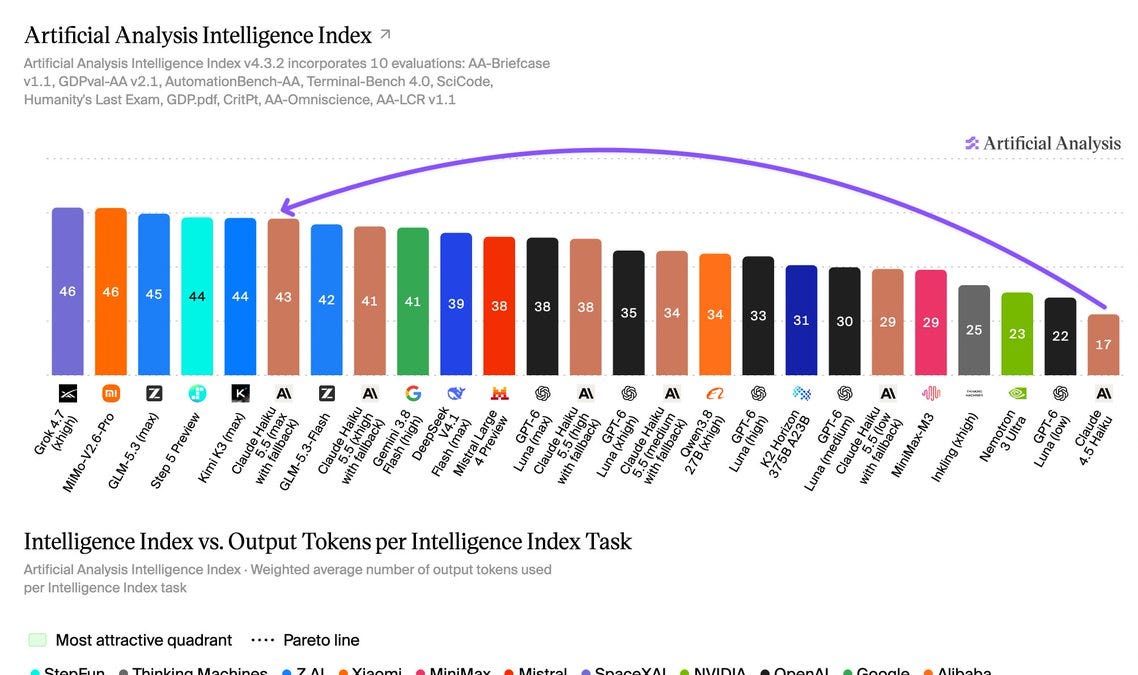 [AINews] Claude Haiku 5.5 — better than GPT-6 Luna at the same pricing
Latent Space's AINews recap covers Anthropic's launch of Claude Haiku 5.5, priced to match OpenAI's GPT-6 Luna and paired with a Sonnet 5.5 cache-read price cut and new Max/Team API credits. Independent Artificial Analysis testing puts its Intelligence Index at 43 (up 26 points from Haiku 4.5) and Terminal-Bench 4.0 at 33%, but shows it uses roughly 3x the output tokens of GPT-6 Luna at max effort, plus results on AA-Briefcase, AA-Omniscience and AutomationBench-AA, alongside a same-day Claude SDK update adding built-in computer-use/browser-use tooling.
latent.spacearticlePublished and added 8 Oct 2026🧠 AI Secret protection must scale with software
GitHub essay by Secret Protection PM Erin Havens presenting nine quarters of telemetry (Q2 2024–Q2 2026) on secret leaks: pushes with credentials grew 2.59x while developer override rates of push-protection blocks fell from 6.63% to 3.93%, and mean time to manually revoke a leaked secret hovers around 40 days. It introduces a new fine-tuned ModernBERT classifier, built with Microsoft Applied Sciences, that evaluates candidate secrets in context in under 2ms to extend push protection to unstructured secrets (e.g. internal database passwords with no recognizable pattern), rolling out in private preview to GitHub Secret Protection customers and as a /security-review command in Copilot CLI/App.
 github.blogarticlePublished and added 7 Oct 2026🛡️ Security
- ScienceClaw: Benchmarking Continual Self-Evolution of AI-for-Science Agents Across the Natural and Social Sciences
ScienceClaw formalizes a fixed-parameter program self-evolution framework for LLM agents doing scientific tasks, where verified task executions are turned into persistent Skill and Operator updates to the agent's program rather than being discarded. ScienceClaw-Eval, the accompanying benchmark, spans 23 disciplines across natural and social sciences and measures scientific correctness, evolutionary gain, retention, cross-dataset transfer, and evolution cost via sequential task streams and independent reset evaluation. The framework only keeps an update if source-task replay reproduces the repair and the change improves performance on independent scientific tasks, addressing the gap that verified agent executions rarely become lasting program-level improvements.
arxiv.orgpaperAdded 7 Oct 2026, published 6 Oct 2026🧠 AI  Opus 5.5 agents discover two room-temperature magnetic semiconductor candidates
Vals.ai researchers describe using Claude Opus 5.5-driven AI agents to run density-functional-theory simulations (PBE+U and HSE06 functionals) that designed a novel candidate magnet, YBaMnFeO₅, and separately re-identified a 1999 compound, KV[Cr(CN)₆] (a Prussian-blue analogue), as a "Luttinger compensated" semiconductor — a material with zero net magnetic moment but spin-sorted band edges, useful for spintronic memory. The agents predicted band gaps, spin-sorting windows, and magnetic ordering temperatures (KV[Cr(CN)₆] reportedly stays ordered above room temperature, up to 376 K), and the authors published all inputs, outputs and code on GitHub for independent verification. It's notable as an example of AI agents autonomously conducting and validating nontrivial physics/materials-science research rather than just answering questions.
 vals.aiwriteupAdded 6 Oct 2026, published 5 Oct 2026🧠 AI
 Aleph Alpha Kolibri: How the sovereign German LLM works
A deep technical walkthrough of Aleph Alpha's Kolibri, a 78B-parameter (3.5B active) mixture-of-experts LLM for German and English released under Apache 2.0, built to be 'sovereign' (trained and deployable entirely under EU/German law). The post explains its six core design choices — a 384-expert MoE router, a German-aware UniBPE tokenizer (verified independently to cut tokens 15% vs GPT-5's tokenizer on legal German), mostly sliding-window attention enabling a validated 1M-token context, German-native reasoning traces, a Merlin-Arthur training protocol for calibrated 'I don't know' abstention, and a configurable reasoning_effort parameter — and benchmarks it against Qwen3.5/3.6/3.8, GLM-4.7 Flash, Nemotron 3 Nano and gpt-oss-120b on AIME, RULER, SWE-bench Verified, Terminal-Bench and the Omniscience test, including where it underperforms (tool calling, coding agents, trivia recall).
 tej.asarticlePublished and added 3 Oct 2026🧠 AI
 Don't be fooled–LLMs don't reason
Thore Graepel, former core member of DeepMind's AlphaGo team and now chair of machine learning at UCL, argues that today's LLMs—even with chain-of-thought—don't truly reason the way AlphaGo did. He contrasts AlphaGo's two-system architecture (a policy network for intuition plus explicit game-tree search for deliberation, exemplified by the famous 'Move 37') with LLMs, which he argues only iterate System-1-style next-token prediction without a persistent, inspectable epistemic state, a clean separation of knowledge from reasoning, or faithful (non-post-hoc) chains of thought. He proposes future systems maintain an explicit epistemic state (beliefs, open questions, ruled-out hypotheses) updated via evidence-backed moves, akin to AlphaGo's game tree, to produce auditable, trustworthy reasoning for high-stakes domains like medicine and science.
 technologyreview.comarticlePublished and added 2 Oct 2026🧠 AI
- Introducing GPT-6.1 Sol
OpenAI announces GPT-6.1 Sol, an upgrade to GPT-6 Sol that approaches GPT-6 Astra on agentic coding, computer use and professional work at about one-fifth the price ($2/$10 per million input/output tokens, $0.10 cached input; API id gpt-6.1-sol). It reports results on DeepSWE v1.1 (matches Astra), GDP.pdf, AutomationBench (+2.2 pts over Opus 5.5), OSWorld 2.0 offline, Terminal-Bench Science 0.1 ($5.47 per task vs $23+ for Opus 5.5/Astra) and a factuality eval where errors drop from 11.4% to 7.7% at low effort. Also covers alignment evals, availability in ChatGPT Work and Codex, and an upcoming Ultrafast mode in Codex with up to 8x faster generation.
 openai.comarticlePublished and added 29 Sep 2026🧠 AI
- AI Agent Swarms as Researchers: Progress, Challenges, and Open Questions
Researchers gave swarms of off-the-shelf coding agents a broad scope (from narrow topics to entire fields), literature access, and computing tools with a single standing instruction to make real progress and not stop, without supplying any scientific ideas themselves. Within weeks the agents produced research notes, paper-length drafts, and formal proofs (some verified in a proof assistant) across five areas of optimization theory and physical science, plus proposed untested lab experiments in a sixth, generating output faster than the human authors could review it. The paper argues research institutions are unprepared for this pace of capability growth and raises open questions about trust, credit, publication, and human oversight when review rather than production becomes the bottleneck.
arxiv.orgpaperAdded 29 Sep 2026, published 28 Sep 2026🧠 AI - Terminal-Bench 4.0 leaderboard
Artificial Analysis' leaderboard for Terminal-Bench 4.0, a 66-task benchmark of complex terminal work spanning software engineering, machine learning, science, operations, security, hardware and media, with recalibrated compute/time budgets and improved verifiers over prior versions. The page ranks models/agents by score, cost per task, output tokens per task, and time per task, and links out to related Artificial Analysis evaluations (GDPval-AA, APEX-Agents, Harvey's Legal Agent Benchmark, ServiceNow EnterpriseOps-Gym, Terminal-Bench 2.1, GPQA, MMLU-Pro, AIME, LiveCodeBench and others) used to benchmark frontier agentic and reasoning capability.
artificialanalysis.aiotherAdded 28 Sep 2026🧠 AI - Reinforcing Agentic Creativity in Scientific Ideation with Night Science
This arXiv preprint introduces AI Night-Scientist, an agentic framework that uses GRPO reinforcement learning to counteract LLMs' low-entropy bias toward homogeneous outputs in open-ended scientific ideation. It models creativity along three axes (action, process, outcome) grounded in cognitive science, and trains models to depart from predictable reasoning via semantic guidance rather than just raising decoding temperature. Reported results show a 27.8% expansion in research-direction diversity, a 14.9% increase in contribution types, up to 32.0 points higher predicted citation impact, and 66.2 points higher originality versus the base model.
arxiv.orgpaperAdded 29 Sep 2026, published 28 Sep 2026🧠 AI - TCSAlgBench: Benchmarking Automated Proving for Research-Level Theoretical Computer Science
TCSAlgBench is a benchmark of 398 theorem-level challenges drawn from 138 STOC and COLT 2026 papers, designed to test whether LLMs can produce natural-language proofs of algorithmic results that humans can inspect and verify. The authors evaluate ten model configurations from four model families under direct inference and multi-round prover-verifier discussion, and compare four agent workflows (including decomposition and agentic planning) under matched model-call budgets, finding GPT-5.6 Sol max reaches 23.6% verifier-accepted coverage after 10-round discussion while agentic planning with GPT-5.5 xhigh reaches 25.4%. The pipeline is designed to refresh with newly released conference papers, making it a reusable testbed for tracking progress on research-level mathematical/algorithmic reasoning.
arxiv.orgpaperAdded 29 Sep 2026, published 28 Sep 2026🧠 AI - MemSecBench: Tracking Agent Memory Poisoning from Persistence to Consequence and Repair
MemSecBench is a benchmark for evaluating the lifecycle security of LLM agent memory systems, tracing a malicious instruction from write to persistence, downstream execution, and eventual selective repair across 310 cases spanning code/science, daily life, and office-work scenarios. It tests a 24-configuration matrix (2 agent harnesses x 4 memory backends x 3 LLM backends) using evidence-based adjudication across seven lifecycle checkpoints, finding malicious memory persists in 84.2% of cases, the full Write-Execute chain succeeds in 50.3%, and memory-backend choice causes up to 41.3 percentage-point swings in selective repair rates.
arxiv.orgpaperAdded 26 Sep 2026🛡️ Security - Learning to Stop without Learning to Stop: Self-Supervised Confidence Training Improves Reasoning Efficiency
This paper introduces a self-supervised fine-tuning procedure that trains reasoning models to predict their own confidence at intermediate points in a reasoning trajectory, using only 600 training problems and no explicit length or stopping objective. Despite training only on confidence prediction and using standard generation at inference (no early-stopping or confidence elicitation), the fine-tuned models cut generated tokens by up to 25% at matched accuracy across Gemma, Qwen, Nemotron, and GPT-OSS on math, science, and coding reasoning benchmarks. Analysis shows the models largely retain their base reasoning composition rather than suppressing specific behaviors, suggesting efficient reasoning can emerge as a byproduct of learning metacognitive confidence signals.
arxiv.orgpaperAdded 28 Sep 2026, published 25 Sep 2026🧠 AI - Configuration, Not Conscience: A Large-Scale Empirical Study of LLM System Prompts
An empirical study analyzing a merged corpus of 407 leaked, reconstructed, or officially published LLM system prompts from 62 vendors, using a block-level classifier to categorize content. It finds operational content (tool/protocol instructions, ~58% of words) vastly dominates over safety/ethical statements (~5%), with strict rule-lines guarding tool use and file safety over harmful content by an 11:1 margin, and documents cross-vendor text reuse plus "prompt rot" (thousands of words churned per version release), arguing system prompts should be treated as configuration/engineering artifacts rather than windows into model values.
arxiv.orgpaperAdded 28 Sep 2026, published 25 Sep 2026🧠 AI - Configuration, Not Conscience: A Large-Scale Empirical Study of LLM System Prompts
A large-scale empirical study analyzing a merged corpus of 407 leaked, reconstructed, or officially published LLM system prompts from 62 vendors, clustering them into 29 near-duplicate groups and classifying content at the block level. The authors find operational content (tool/protocol instructions) dominates at ~58% of classified words versus only ~5% for safety policy, with the strictest rule-lines guarding tool use and file safety over harmful content by an 11:1 margin, and document literal-text reuse across vendors and significant "prompt rot" (word churn) across version chains — arguing leaked system prompts should be treated as operational specifications and a supply-chain/engineering concern rather than windows into a model's "values."
arxiv.orgpaperAdded 28 Sep 2026, published 25 Sep 2026🛡️ Security  [AINews] The Future of Latent Space
The daily AINews digest from Latent Space rounds up a heavy week in AI: Claude Opus 5.5 topping SimpleBench and Terminal-Bench-Science, the GPT-6 family (Astra/Sol/Luna), Gemini 3.8 Flash, and Xiaomi's open-weight MiMo-V2.6-Pro; TypeSafe's Jev system-one decision model (and open alternatives like CLM) for cheap structured judgments; agent-infra launches from LangChain Interrupt and Perplexity's Rust retrieval engine Photon; inference speedups like Liquid AI's DSpark speculative decoder and GLM-5.3 on AMD MI355X; and research on harness distillation, agent failure modes, and autonomous-science efforts led by Sakana AI's RSI Lab with Jurgen Schmidhuber.
latent.spacearticleAdded 29 Sep 2026, published 25 Sep 2026🧠 AI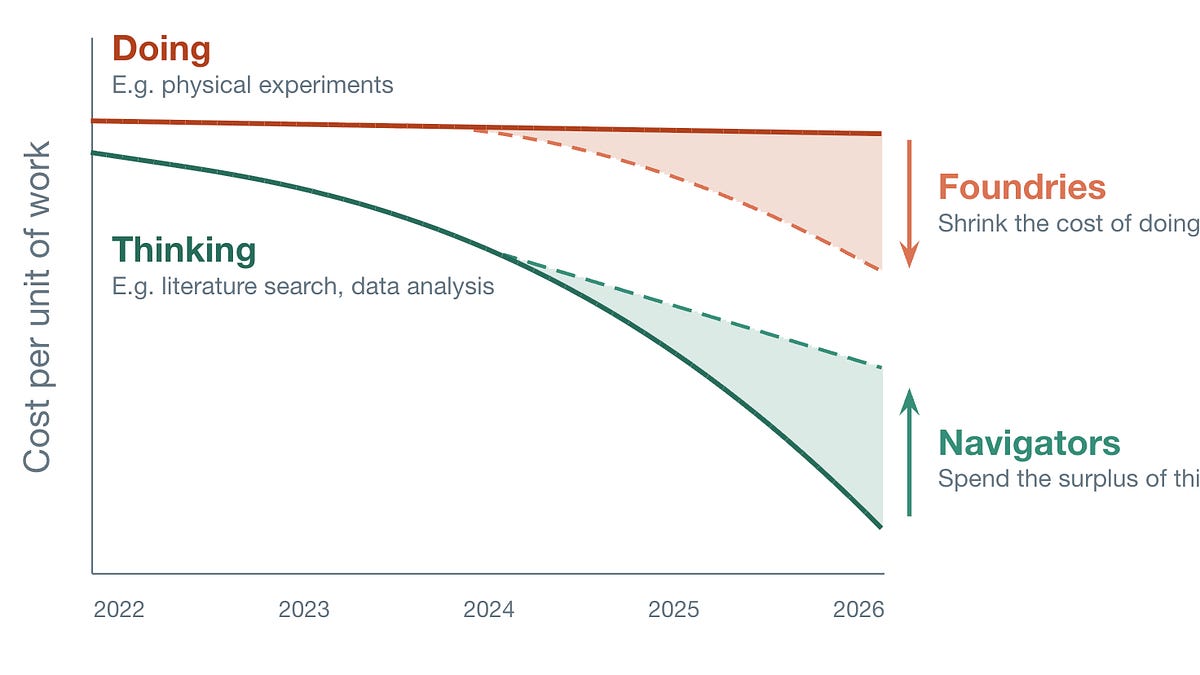 Foundries vs Navigators: Lowering the Cost of Science
A guest post on Latent Space by Endura Therapeutics CEO Adrian Sanborn arguing biotech companies are adapting to AI in two distinct ways: foundries such as Xaira, NewLimit and Insitro that industrialize experimental data generation, versus navigators that use LLMs to speed up the ordinary work of running a company through faster bespoke data analysis, in-house dashboards replacing commercial lab software, and fleets of LLM research agents. It details a concrete case: Endura built a two-stage LLM triage pipeline that screened roughly 500 disease targets and then deep-dived about 100 of them, compressing what would have been decades of expert-analyst time into a short automated pass, followed by human diligence on the finalists.
latent.spacewriteupAdded 29 Sep 2026, published 24 Sep 2026🧠 AI 🔬 An Oscar, Two Asteroids, and the Algorithm in Your sklearn: John Platt on AI for Science
A Latent Space interview with Google's John Platt (co-inventor of SMO and Platt scaling) about ERA, Google's Empirical Research Assistance system: an LLM-driven agent that treats scientific problems as "scoreable tasks" and uses Monte Carlo Tree Search with Upper Confidence Bound selection over a tree of notebook experiments, having Gemini propose and mutate solutions. The piece details how ERA (open-sourced on GitHub, with an accompanying paper) solved a two-year-old counterfactual modeling problem for aircraft contrail climate impact, and touches on FireSat satellite fire detection, Goodhart's law and reward hacking in Kaggle-style benchmarks, and Platt's career spanning CNNs, quantum computing, and asteroid discovery.
latent.spacearticleAdded 29 Sep 2026, published 22 Sep 2026🧠 AI- [AINews] Jev: a “System One Model” that only decides/classifies/routes/scores — >100x faster, >200x cheaper than small frontier LLMs
This AINews/Latent Space daily digest (Sep 14–15, 2026) leads with TypeSafe's Jev, a non-autoregressive "System One Model" trained via RLCD (reinforcement learning from calibrated decisions) that skips free-form text generation entirely, instead outputting predefined structured decisions/classifications 20–200x faster and 40–400x cheaper than small frontier LLMs — positioned as a cheap calibrated inference engine for routing, judging, and classification rather than a general LLM replacement. The issue also covers Periodic Labs' Neon (a materials-science model trained in a closed loop with physical lab data on 1,300 H200s, beating GPT-6 Astra on an internal XRD analysis benchmark), Google's Gemini 3.8 Live topping speech-to-speech benchmarks, MCP's growth as an agent integration layer, a Microsoft finding that raw bash outperforms typed tool catalogs on agent benchmarks, and new evals/papers on reward hacking (CheatBench) and persona/misalignment transfer in fine-tuned models.
latent.spacearticleAdded 29 Sep 2026, published 16 Sep 2026🧠 AI - ScienceBuddy: Recursive-in-Recursive Self-Improvement for Interactive Scientific Agents
ScienceBuddy is an interactive scientific research workspace with continually improving agents that turn researcher requests, feedback, and execution evidence into training tasks and evaluation rubrics. Its core contribution is "recursive-in-recursive self-improvement," where an inner recursion evolves the agent harness with the model fixed, and an outer recursion trains the model via RL under the improved harness, with each shaping the other over time. The paper presents case studies across four scientific task families and releases the system as a research product.
arxiv.orgpaperAdded 22 Sep 2026, published 15 Sep 2026🧠 AI  Beyond slop, taste, and AI moral panic: What social science tells us
An a16z essay arguing that "AI slop" panics and debates over machine "taste" recur historically (from 18th-century Grub Street pamphleteers to pulp fiction and blogging), and that social science can disaggregate "taste" into distinct mechanisms: Watts and Salganik's music-lab experiments showing hit success is socially contingent rather than quality-driven; Ron Burt's brokerage research showing innovation comes from occupying "structural holes" between disconnected networks; and apprenticeship-based judgment that requires repeated correction over time to develop. The piece concludes that as LLMs absorb entry-level tasks (contracts, financial analysis, code), the real scarce resource isn't taste itself but the social infrastructure — apprenticeship pipelines and undocumented tacit-knowledge networks — that produces people capable of exercising it, and warns firms that eliminate junior roles risk losing senior judgment down the line.
 a16zcrypto.comarticleAdded 29 Sep 2026, published 26 Aug 2026🧠 AI
 FauxUV campaign (Xygeni)
Xygeni details FauxUV, a cluster of PyPI packages (moon-uv, my-magic-uv-helper) that impersonate the popular Rust-based Python package manager uv but carry almost no real functionality. Instead, on Windows they launch JupyterLab with authentication disabled (empty token, bound to 0.0.0.0, XSRF checks off) and, in later versions, expose it to the internet via a Pinggy SSH reverse tunnel, turning a legitimate data-science tool into an open remote shell that inherits the installing user's credentials. The writeup traces the install-time PowerShell trigger moving from setup.py to a separate CLI tool across versions and provides IOCs and detection guidance.
 xygeni.iowriteupPublished and added 18 Jul 2026🛡️ Security