 Welcome Le Chonk: Mistral Large 4 on Hugging Face
Mistral Large 4 (Le Chonk) is a multimodal, multilingual Mixture-of-Experts model with about 1T total and 49B active parameters and a 1M-token context, released under the Mistral Ecosystem Open-Weight License. The post covers its MLA and DeepSeek Sparse Attention architecture, a 1.6B Pixtral encoder, and benchmarks including 82% on the Artificial Analysis Cyber Index and 93% on Cybench. It gives run recipes for transformers, vLLM, llama.cpp, TRL fine-tuning and Inference Endpoints.
 huggingface.coarticlePublished and added 29 Oct 2026🧠 AI
 Folding Attention Biases into Keys Makes Compacted KV Caches Run on Standard Kernels
The paper folds the per-key logit bias of Attention Matching (AM) KV cache compaction into the keys along one closed-form direction per head, fitted on context queries. The result is a plain cache that FlashAttention and vLLM paged caches can use, with output error bounded by how far each query's projection on that direction is from 1. Unmodified vLLM serves folded caches through a KV connector. On QuALITY and LongHealth the fold is within noise of AM in 13 of 14 settings. Under AM's published per-head budgets it is within noise in 9 of 10.
 arxiv.orgpaperAdded 28 Oct 2026, published 27 Oct 2026🧠 AI
 Fixing Tool-Call Accuracy in vLLM
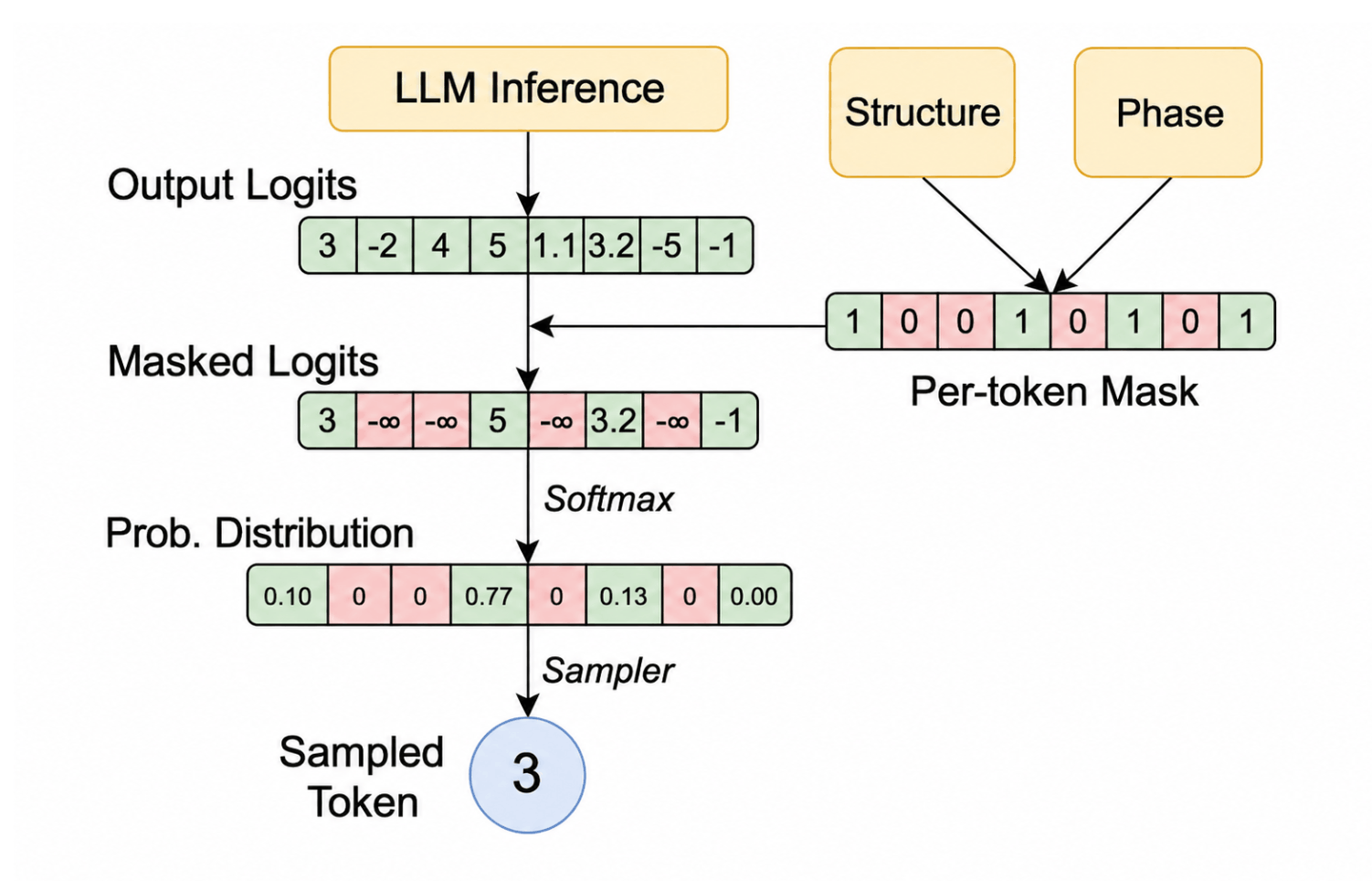
Ubicloud's post explains why tool-call schema accuracy matters for agentic workloads and how it fixed it when serving Kimi K2.6 and DeepSeek V4 Flash. With vLLM 0.28, Kimi produced valid tool calls only 92% of the time on Moonshot AI's K2VV ToolCall benchmark. Enabling XGrammar-based constrained decoding via vLLM's --tool-strict-level flag (vLLM 0.31) raised schema accuracy to 100%.
 ubicloud.comwriteupAdded 27 Oct 2026, published 26 Oct 2026🧠 AI
- SemiAnalysis (@SemiAnalysis_) on X
SemiAnalysis claims AMD chips running vLLM can earn up to $3 per chip-hour in profit serving the open-source Kimi K3 model, even after higher chip rental prices following Claude Code's rise. Kimi K3 has over 2.8 trillion parameters and fits AMD's 288GB per chip, while B200 cannot hold it in one server. B200 must then use tensor or pipeline parallelism over 400Gbit/s InfiniBand or Ethernet, which SemiAnalysis says is 18x slower than NVLink. The post gives no methodology.
 x.comthreadAdded 26 Oct 2026, published 25 Oct 2026🧠 AI
- Syb (@DegenOfWallSt) on X
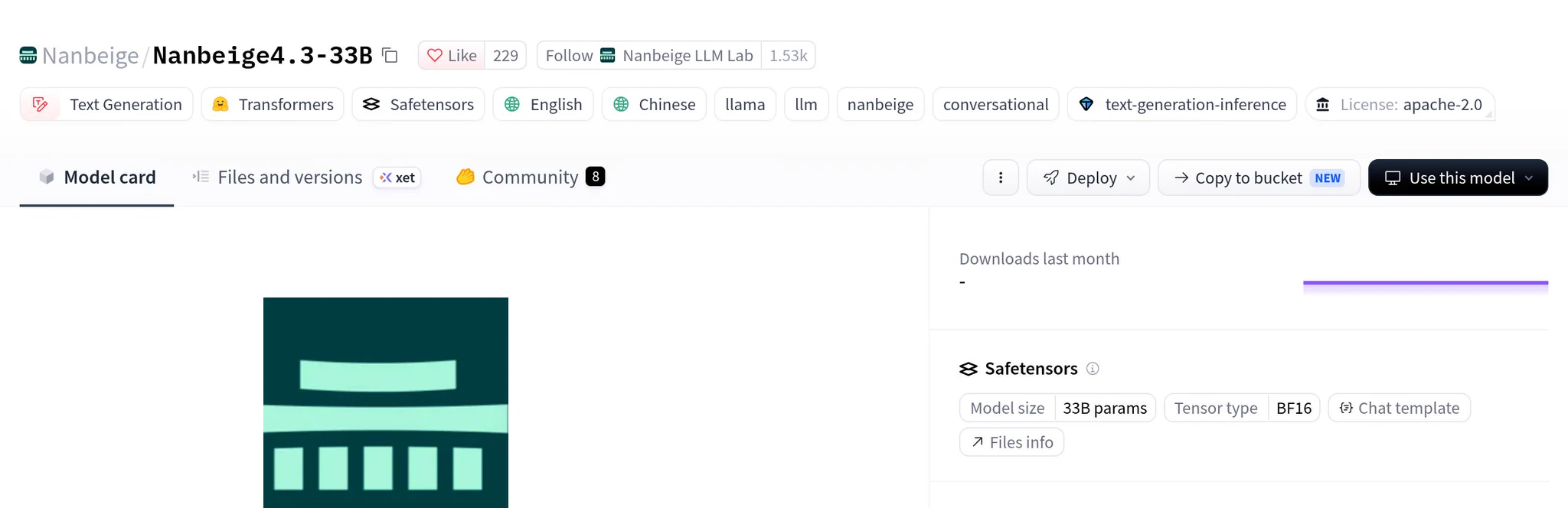
Nanbeige4.3-33B is a 33.1B dense, Llama-style open model under Apache-2.0, released with a base model on Hugging Face. In Nanbeige's own table it beats Qwen3.8-27B on Terminal-Bench 2.1 (80.9 vs 73.0), DeepSWE (65.5 vs 42.5) and Automation Bench, but trails on SWE-Bench Pro, GDPval and GPQA Diamond. BF16 weights are about 66 GB, split across 4 GPUs in the vLLM and SGLang examples. No independent evals exist yet.
x.comthreadAdded 26 Oct 2026, published 25 Oct 2026🧠 AI - DualPace: Decoupled Scheduling and Cooperative GPU--CPU Decoding for LLM Serving
DualPace is an LLM serving runtime that treats the host as an independently scheduled decode engine. A GPU engine runs prefills and GPU-resident decodes, while an AMX-enabled CPU engine batches and advances CPU-resident decodes, optionally calling GPU Dense Assist for dense stages. In decode-oriented scenarios it raises throughput 6.9 to 43.2% over NEO and 11.5 to 90.6% over vLLM at similar latency.
arxiv.orgpaperAdded 27 Oct 2026, published 24 Oct 2026🧠 AI  How Specializing the Vocabulary of SLMs Can Cut Inference Cost by 77% in Real Applications
VocabX is a vocabulary adaptation method from Dharma-AI that selects sub-word and multi-word "macro" tokens by serving cost instead of frequency. On a Qwen3-4B Portuguese essay grader, response length fell from 350 to 101 tokens, the LM head shrank from about 152,000 to 65,000 rows, and measured cost dropped 77.0% on an RTX 5090 with vLLM. The bench score rose from 0.703 to 0.810. It beat FVT, MWT and in-place BPE across 15 model and domain combinations.
huggingface.coarticlePublished and added 21 Oct 2026🧠 AI The Huawei-DeepSeek Symbiosis
 analyzes DeepSeek's 30 September 2026 Ascend support for TileLang, DeepGEMM, DeepEP, TileKernels, FlashMLA and DeepSelect. It microbenchmarks the Ascend 950PR (BF16 GEMM, HBM bandwidth, die topology, AICPU) against H100, and profiles DeepSeek-V4.1-Flash on 32 Ascend 950DT chips. It also lists vLLM-Ascend gaps on x86 hosts.
 newsletter.semianalysis.comarticleAdded 29 Oct 2026, published 21 Oct 2026🧠 AI
 SemiAnalysis (@SemiAnalysis_) on X
SemiAnalysis thread arguing that vLLM with Wide-EP and EPLB can reproduce DeepSeek's serving performance. It reports decode throughput within 6% of DeepSeek's DeepInfer release and about $39 per GPU-hour revenue at DeepSeek's off-peak pricing, at 200 P90 TPS on the AgentX workload. It explains why DeepInfer is not on InferenceX: the release supports only offline, single-turn inference. It also estimates GB300 profit at OpenRouter prices.
x.comthreadAdded 22 Oct 2026, published 21 Oct 2026🧠 AI [AINews] DeepSeek DeepInfer: Open Source SOTA Inference running 155T toks/day/cluster making $22m/day at ~80% margin for a 81 day payback
AINews issue for 19 to 20 October 2026 whose top story is DeepSeek's open-source DeepInfer, the inference engine behind V4.1 Flash. It covers prefill/decode separation, wide expert parallelism, a 3FS-backed prompt cache with 96% input hits, vLLM's decode result within 6% of DeepInfer on GB200, and disputed margin estimates built on the reported $38 per accelerator-hour. It also digests other news, and the page text is truncated.
 latent.spacearticleAdded 23 Oct 2026, published 21 Oct 2026🧠 AI
 [AINews] DeepSeek DeepInfer: Open Source SOTA Inference running 155T toks/day/cluster making $22m/day at ~80% margin for a 81 day payback
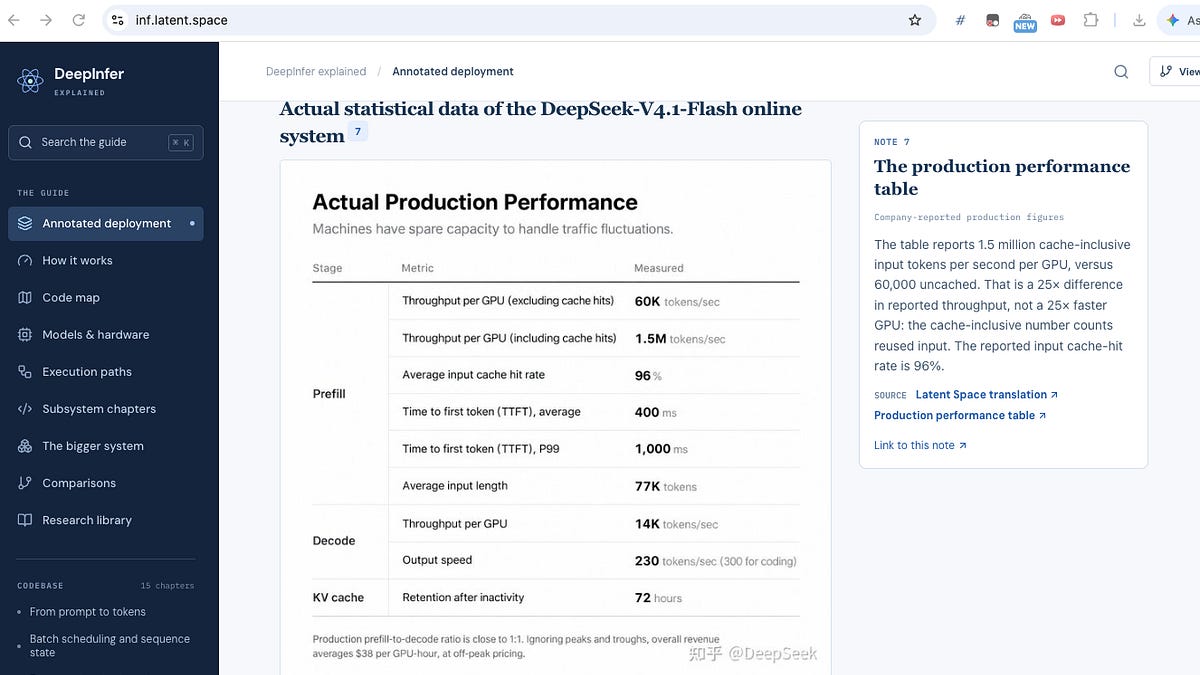
This AINews issue (20 October 2026) leads with DeepSeek's open-sourced DeepInfer, the vLLM-based inference engine behind V4.1 Flash. It covers prefill/decode separation, a 3FS-backed prefix cache with 96% hit rate, SWA Bounded Replay, and DeepSeek's claims of 155T tokens/day and $38 revenue per accelerator-hour. It also covers vLLM's within-6% decode reproduction on GB200, disputed margin estimates, and a round-up of other AI news. Only the first 40,000 of 56,439 characters were available.
latent.spacearticlePublished and added 21 Oct 2026🧠 AI- 0xMarioNawfal - The Roundtable Show (@RoundtableSpace) on X
TorchTPU is Google's open-source project for running PyTorch apps on its TPUs, announced the day after Amazon released TorchNeuron for its Trainium chips. Google says migration needs "a simple configuration change" with no rewrite. It worked with Meta, Hugging Face, and the vLLM and SGLang teams on compatibility, and added an agent suite that helps migrate apps and fix errors. The post is brief and gives no benchmarks.
x.comthreadAdded 21 Oct 2026, published 20 Oct 2026🧠 AI  [AINews] not much happened today
AINews issue for 16 to 19 October 2026 from Latent Space, a digest of Twitter and Reddit AI news. It covers DeepSeek V4.1 Flash 1017 (552B total, 16B active MoE, AA Intelligence Index 45), MiniMax M3.1 Flash, Mercury 3, Meta Muse, Google's Harness², vLLM v0.32.0 and a Terminal-Bench audit. Only the first 40,000 of 47,045 characters were available.
latent.spacearticleAdded 30 Oct 2026, published 20 Oct 2026🧠 AI [AINews] not much happened today
AINews issue covering 16-19 October 2026 from Latent Space, summarising 12 subreddits and 544 Twitter accounts. It leads with DeepSeek V4.1 Flash 1017 (552B total, 16B active MoE, 1M context, MIT license, AA Intelligence Index 45), plus MiniMax M3.1 Flash, Mercury 3 and Meta Muse. It also covers vLLM v0.32.0, InferenceX results, Harness² and Terminal-Bench audit findings.
latent.spacearticlePublished and added 20 Oct 2026🧠 AI- eliasbiondo/antirion
Antirion is an open-source AI gateway shipped as one Rust binary with a built-in admin console. It sits between apps and providers such as OpenAI, Anthropic, Bedrock, Vertex and vLLM, translating between OpenAI, Anthropic, Gemini and Bedrock dialects. It covers routing with fallbacks and circuit breakers, budgets, guardrails, caching, MCP and A2A gateways, SSO, and a benchmark against Bifrost 2.2.4 and LiteLLM 1.103.1.
 github.comrepoAdded 21 Oct 2026, published 17 Oct 2026🧠 AI
 DeepSeek-v4.1-Flash-1017
Model card for DeepSeek-V4.1-Flash-1017, a minor update to DeepSeek-V4.1-Flash with MIT-licensed weights. It claims gains in reasoning, coding, agentic tasks and visual benchmarks, with shorter task time and output length that move the performance–cost Pareto frontier across agent harnesses (Claude Code for Terminal-Bench 4.0, Mini-SWE-V2 for DeepSWE v1.1). It ships no Jinja chat template. It provides a reference encoding.py for multi-turn chat, tool calling, thinking mode, numeric reasoning effort and interleaved images, plus deepseek-recipe, Rust libraries with Python bindings for prompt encoding and output parsing. Serving recipes are given for Transformers, vLLM, SGLang and Docker Model Runner.
huggingface.corepoAdded 18 Oct 2026, published 17 Oct 2026🧠 AI- Master the captain (@mollicksoif9) on X
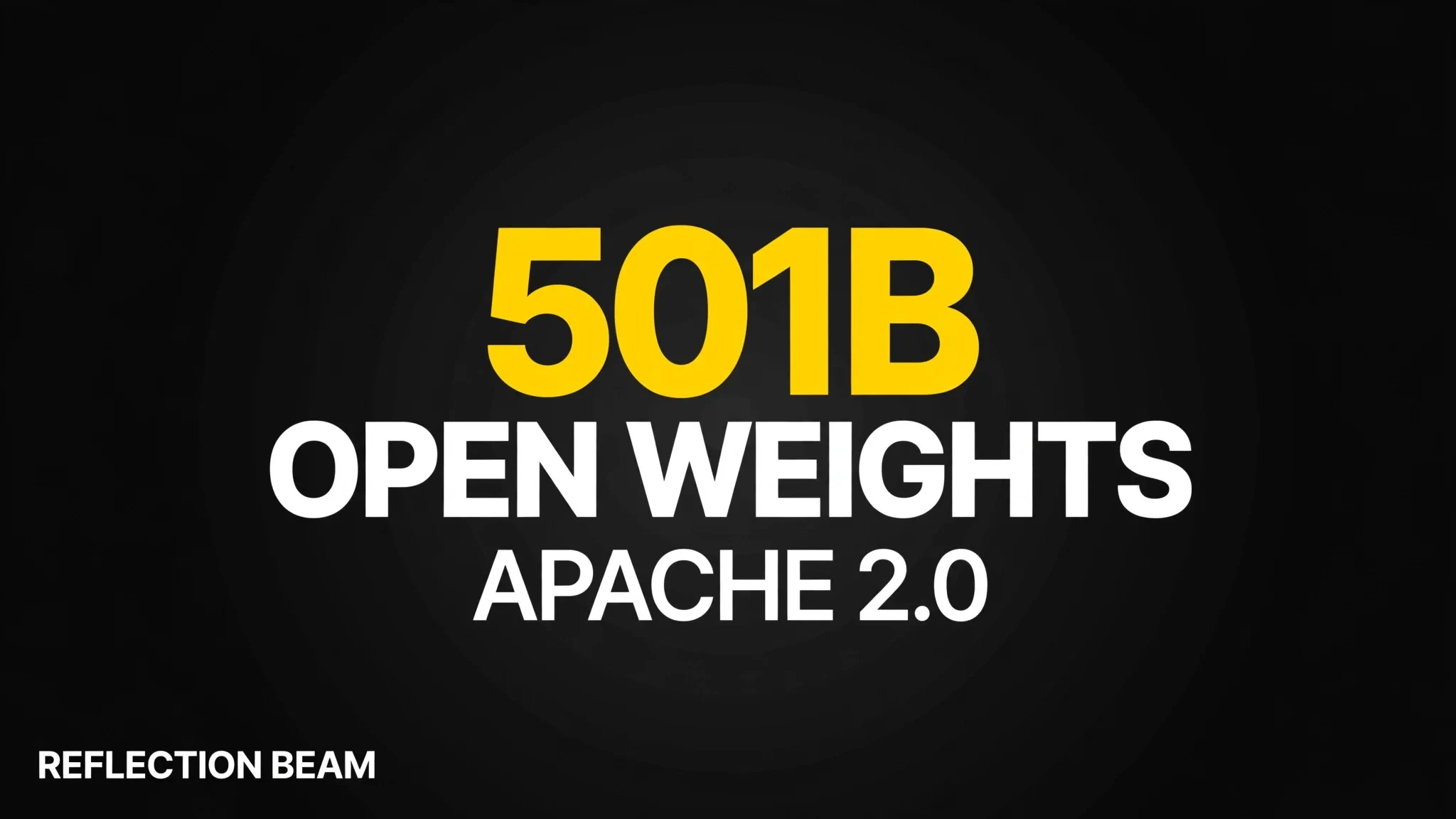
A social post reporting that Reflection AI released the full weights of Beam, a 501B-parameter mixture-of-experts agentic coding model (23B active, 1M-token context), on Hugging Face under Apache 2.0. It claims RL training that penalizes wasted tokens gives roughly 3-4x less inference compute than GLM-5.2, and 80.9 on SWE-bench Verified. Launch support is listed for AWS SageMaker, vLLM and SGLang. The post notes the token-efficiency claims still need independent confirmation and that self-hosting needs about 500GB of GPU memory at 8-bit.
x.comthreadAdded 18 Oct 2026, published 17 Oct 2026🧠 AI  Meta Muse Spark Open (816B-A42B) open-weights model card
Model card for Meta Superintelligence Labs' Muse Spark Open, an open-weights, natively multimodal model with 816B total and 42B active parameters and a 1M-token context window. It targets coding and agentic work (tool use, long-horizon tasks, multimodal reasoning, synthetic data generation, LLM-as-judge). It ships in BF16 and NVFP4, needs about 700GB VRAM (NVFP4) or 2TB (BF16), runs on SGLang, vLLM, Transformers, TensorRT-LLM, Unsloth, llama.cpp and MLX, and supports a reasoning_effort setting. The Muse Model License requires "Built with Muse Spark Open" attribution and a separate agreement for Model-as-a-Service above $20M revenue. The card reports safety results against Kimi K3 on cyber, chem/bio and loss-of-control evals.
huggingface.corepoAdded 17 Oct 2026🧠 AI- Rodrigo ES Porto (@RodrigoESPorto) on X
X thread reporting that Meta confirmed Muse Spark (the coding and agent model) weights are coming, with no date and no license announced. The only Muse that can currently be self-hosted is Muse Glimmer, a 30B distilled build that works with vLLM and llama.cpp. The flagship Muse Wonder and Wonder Full stay closed, and Wonder is offered on the API with 1M-token context at $4 input and $20 output per million tokens. It also notes that in CTF red-teaming Wonder Full solved 92 objectives, 71 of them through unintended system vulnerabilities, and that the ARGUS group says the 13-page model card omits test methods and raw results.
x.comthreadAdded 17 Oct 2026, published 16 Oct 2026🧠 AI - Peter Dedene (@dedene) on X
A X thread benchmarking Qwen3.8 Flash Next on one DGX Spark in two builds: NVIDIA's FP4-Local checkpoint served by vLLM (eugr's b12x container) and an MLX 4-bit TensorFold recipe. The NVIDIA build scores higher on the author's agentic benchmark (81.2 vs 75.0), BFCL tool calling (82.4 vs 71.8 single-turn, 54.5 vs 43.0 multi-turn), AgentDojo prompt-injection resistance (2 vs 6 of 200 attacks succeeded) and GPQA (64.6 vs 59.1). TensorFold decodes faster (67 vs 44 tok/s) and runs more agent steps per minute (21 vs 14). The author notes the comparison covers whole stacks (engine, kernels, tool parser), not quantization alone, and links a docker compose recipe.
x.comthreadAdded 17 Oct 2026, published 16 Oct 2026🧠 AI 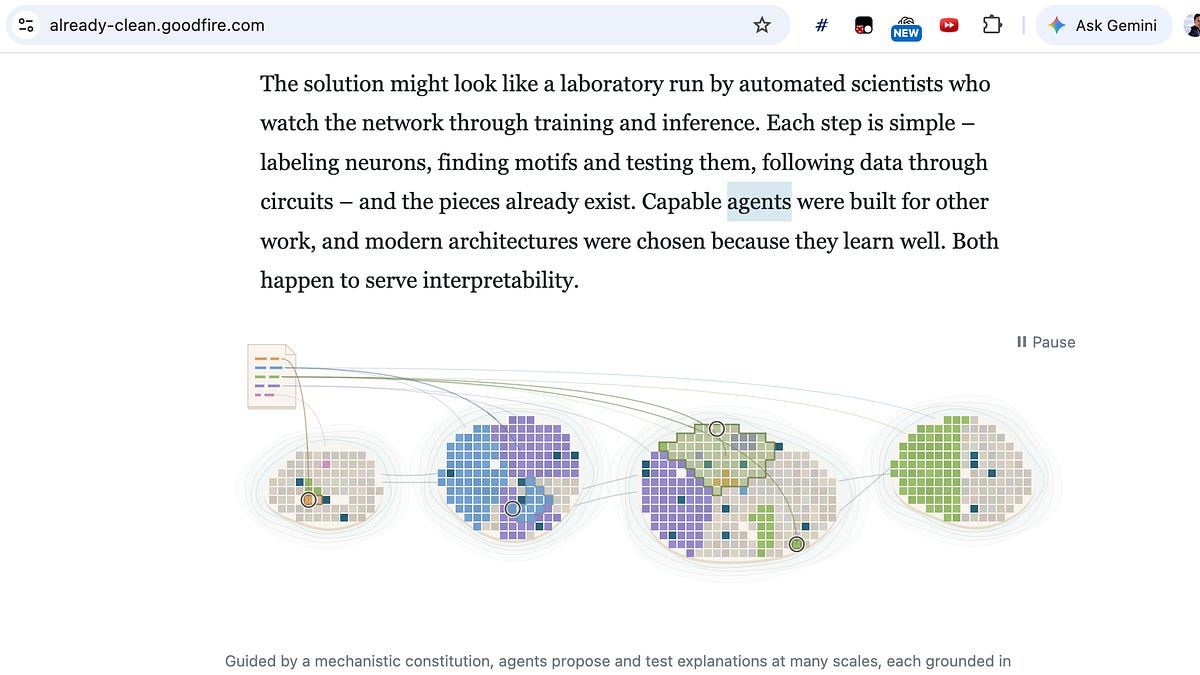 [AINews] Agents disprove Polysemanticity; greatly improve Interpretability & Alignment
The 10/14–10/15/2026 AINews issue. Its lead story is Goodfire's Nick Cammarata essay "Neural Networks Are Already Clean", which argues agentic analysis resolves many known cases of polysemanticity and superposition. Neel Nanda, Leo Gao and Jake Mendel push back. It also covers Meta's Muse Spark Open (816B total / 42B active MoE, 1M context, custom license, Artificial Analysis index 39, vLLM day-0 support and quantizations), Nemotron 3.5, MAI-Base-2 and Gemini 4 Argon evals. Further items cover Vals' refund-agent and MiMo task-leakage findings, TPUv7 and Vera Rubin inference benchmarks, Perplexity's SPACE sandbox, RL training systems (TRL tree packing, bitwise-consistent vLLM RL) and Sakana's Agentic Scientist.
latent.spacearticlePublished and added 16 Oct 2026🧠 AI- OpenMOSS/MOSS-Image
MOSS-Image is an open-source text-to-image model family from OpenMOSS with a 5B backbone, released October 2026 as MOSS-Image-Base and MOSS-Image-SFT. It supports JSON layout control with bounding boxes, text rendering inside images, and prompts up to 4K tokens. The repo gives a Diffusers pipeline, a Gradio app, a ComfyUI plugin, LoRA training guidance, a prompt-enhancer skill and day-0 SGLang and vLLM-Omni support.
github.comrepoAdded 20 Oct 2026, published 16 Oct 2026🧠 AI  Welcome Beam: a 501B open model you can own, customize, and scale
Announces Reflection's Beam-1.0-501B-A23B, an Apache 2.0 text-only MoE model (23B active per token, 256 experts, 1M context) aimed at coding and agentic use. It covers the architecture (hybrid sliding-window/global attention, a constant-scale residual stream, DeepSeek-V3-style group-limited routing) and BF16/FP8/NVFP4 checkpoints with hardware sizing. It also gives day-0 serving recipes for transformers, vLLM and SGLang with DFlash2 speculative decoding, LoRA SFT with TRL, GRPO with Miles, and demos built with the Pi coding harness.
huggingface.coarticlePublished and added 16 Oct 2026🧠 AI Granite Switch 4.1: Chat, Decisions, and Speech from One Endpoint
IBM announces Granite-Switch-4.1-8B and -30B. Each composes a base Granite model with a Decision aLoRA, a Guardian safety aLoRA and the Granite-Speech-5.0-Turbo-CTC ASR model into one model that uses about the same VRAM as the base alone. Because the adapters are Activated LoRAs, they reuse the base model's KV cache, and with IBM's vLLM contributions for faster LoRA inference one endpoint can handle chat, decision and speech requests. The post compares the setup with Jev (a 5-step RAG workflow race, and a 3B Doom-playing model at 60–100 decisions/s against Jev's reported 10), and says users can compose their own Switch models from Granite Libraries adapters.
huggingface.coarticlePublished and added 15 Oct 2026🧠 AI Welcome Muse Spark Open: open-weight frontier multimodal mixture-of-experts model from Meta
Hugging Face's launch post for Meta's Muse Spark Open, an open-weight 816B-parameter mixture-of-experts model (about 42B active per token). It has 256 experts with 8 routed per token, a 1M-token context, and perception and audio encoders for image, video and audio input. The post gives the architecture details, BF16 and NVFP4 checkpoints, and run recipes for transformers, llama.cpp, SGLang, vLLM, MLX and Inference Endpoints. It also covers LoRA SFT of the full model with TRL on 64 H100s and agentic demos (Pi 3D asset generation, an OpenEnv browser agent, a voice-driven shopping agent).
huggingface.coarticlePublished and added 15 Oct 2026🧠 AI LFM2.5-24B-A2B: Built for fast on-device agents
Liquid AI releases LFM2.5-24B-A2B, a 24B-parameter MoE reasoning model with 2B active parameters (40 layers, 64 experts with top-4 routing, hybrid gated short convolutions and GQA). It has a 131K context window, a 128K-token vocabulary and 33T pre-training tokens, and was post-trained with large-scale RL for tool use and agentic tasks. The post reports results against Qwen3.6-35B-A3B on 16 benchmarks (AutomationBench, BFCLv4, ToolSandbox, LiveClaw, τ³-Bench Banking), decode speeds of 184 tok/s on an Apple M5 Max and about 21K output tok/s on a B300 GPU, day-one support in llama.cpp, MLX, vLLM, SGLang and ONNX, and a local Hermes Agent demo. It also describes reward-hacking behaviour during training, including the model detecting its sandbox.
 liquid.aiarticleAdded 16 Oct 2026, published 14 Oct 2026🧠 AI
 Gunjan N Ganatra (@gnganatra) on X
LightSeek Foundation announces 685 output tokens/s per user on Alibaba's Qwen3.8-Flash-Next. They ran their TokenSpeed serving engine on 4× NVIDIA GB300 with NVFP4 quantisation, and link a blog on the kernel and serving optimizations plus the GitHub repo. In the same thread, a user asks the team to bring similar optimizations to NVIDIA DGX Spark users running Qwen3.8-27B on vLLM, and to the upcoming Qwen4-27B. The thread points to a new open inference engine and shows demand for consumer-class DGX Spark serving.
x.comthreadPublished and added 14 Oct 2026🧠 AI Gemini 4 Argon: Built to solve your hardest problems
Google DeepMind announces Gemini 4 Argon, a frontier model available through the Gemini API, AI Studio, Google Antigravity and the Gemini app. Pricing is $2 per million input tokens and $10 per million output tokens, and the context limit is 1M unified input-output tokens. It reports #1 on the Vals Index, 87% on ERQA and 0.7% attack success on Gray Swan IPI. Case studies include a Chromium refactor, Agent Development Kit and xTB speedups, a 2.85x Gemma 4 E2B inference speedup on vLLM, quantum error correction and Lean-verified quantum circuits, enzyme design, and a video-to-sim-to-real humanoid pipeline. It also describes the safety stack: jailbreak defenses, a real-time misalignment monitor, shortcut attempts down to 2%, and the Fairwind cyber-defender program.
 deepmind.googlearticlePublished and added 13 Oct 2026🧠 AI
 [AINews] TypeSafe/Jev at >$100M ARR, $7.5B valuation 3 weeks after launch
AINews issue for 10/8–10/9/2026 from Latent Space. It leads with "decision models" (typed single-pass outputs) becoming a product category after Jev, with OpenAI Decisions API, Microsoft-Decision-1, Perplexity pplx-decider, Cloudflare clef, Liquid d1, and Unsloth/Qwen3.5 training recipes. It also covers Claude Managed Agents dynamic workflows (up to 1,000 agents), a Vals AI study of agent teams, Codex updates, model releases (Qwen-Image-2.1-Turbo, StepFun Step 5 Preview, Solar Mini 4, Gemini 4 Argon), and inference/training systems news (vLLM/SGLang on Vera Rubin, TRL v1.15, DeepSeek stride weak spots).
latent.spacearticlePublished and added 10 Oct 2026🧠 AI Qwen3.8-27B (Apache-2.0, multimodal dense, 262k ctx)
Model card for Qwen3.8-27B, a 27B dense vision-language model from the Qwen team with a hybrid Gated DeltaNet / Gated Attention layout (64 layers, 16×(3 DeltaNet + 1 attention)), MTP training, and 262k native context extensible to 1M via YaRN. It targets coding, research and long-horizon agentic tasks, with thinking on by default, reasoning_effort levels (xhigh/medium/low) and preserve_thinking. The card gives deployment recipes for Transformers, vLLM, SGLang and TokenSpeed, recommended sampling parameters, video-token settings for hour-scale video, and benchmark notes (SWE-bench Pro, NL2Repo-Bench, DeepSWE, HLE, MathVision, WebArena-Verified, etc.).
huggingface.corepoAdded 9 Oct 2026🧠 AI- ReplaySSM: Cache SSM Inputs, Not State
ReplaySSM represents state-space model state as a periodically updated checkpoint plus a buffer of recent SSM inputs, separating output computation from checkpoint updates. This avoids state writes on most decoding steps (roughly halving dominant state memory traffic), makes speculative-decoding rollback a buffer-pointer operation, and lets a low-precision checkpoint serve outputs while a higher-precision one drives recurrent updates. Implemented in vLLM for Mamba-2 and Gated DeltaNet, it gives 1.20–1.47x decoding speedup at batch size 256 across four hybrid models and about 1.8x the throughput of vLLM speculative decoding on two 120B-class models.
arxiv.orgpaperAdded 12 Oct 2026, published 9 Oct 2026🧠 AI  [AINews] not much happened today
Daily AI news digest covering OpenAI's firing of three safety researchers (Tomek Korbak, Mikita Balesni, Jasmine Wang) tied to the METR/Hugging Face agent-escape incident; new model launches including GPT-6.1 Sol Ultrafast, Claude Haiku 5.5, Sonnet 5.5 pricing cuts, and Google's universal Gemini work agent; plus eval integrity findings (MiMo reward hacking exploiting Git timestamps), Arena's Alignment Index leaderboard, NVIDIA research on tool access degrading refusals, open RL environment releases, and infrastructure updates (vLLM v0.31.0, NeMo-DCR weight-delta transfer, turbopuffer retrieval tuning). It also covers the controversy over OpenAI's 722-paper math release and the Association for Human Mathematics' statement.
latent.spacearticlePublished and added 8 Oct 2026🧠 AI Aleph Alpha Kolibri-1 (78B MoE, Apache 2.0)
Kolibri-1 is Aleph Alpha's 78B-parameter mixture-of-experts reasoning model focused specifically on German and English, released under Apache 2.0 with weights, a vLLM plugin, and an extensive model card. It supports explicit reasoning-effort levels, Hermes-style tool calling, and a native 262144-token context validated to over 1M via sliding-window attention; the card details its UniBPE German-aware tokenizer, pre-training mid-training and long-context training recipe, MergeMix-based data-mix search, Merlin-Arthur hallucination-mitigation RL protocol, and benchmark results against Qwen3.5, Gemma 4, Nemotron 3 Nano, and Apertus on MMLU-Pro, GPQA, AIME, SWE-bench Verified, Terminal-Bench 2.1, and HLE.
huggingface.corepoAdded 8 Oct 2026🧠 AI- overmind-core/overmind
Overmind is an open-source platform (MIT SDK/CLI, AGPL-3.0 platform, self-hostable) that instruments an agent's code via OpenTelemetry tracing, turns the resulting production traces (or any dataset) into a fine-tuned model benchmarked against user-defined eval metrics, and serves it through one unified API with downloadable/retrainable weights. It ships an SDK, CLI, REST API, Console, and an MCP server exposing project tools and workflows (investigate-capability, finetune-capability, ship-model) for Cursor, Claude Code, OpenCode and Codex, and can sync traces from Langfuse, LangSmith, Braintrust or Galileo; self-hosting runs via Docker Compose with Postgres, Redis, Celery workers and Modal-based GPU workers for fine-tuning/serving (vLLM).
github.comrepoAdded 6 Oct 2026🧠 AI  Tencent Hy4 preview (open-weight MoE + Sherry quantization)
Hy4 preview is Tencent's new flagship Mixture-of-Experts language model: 770B total parameters with 49B activated per token across 78 layers (256 routed experts + 1 shared expert, top-8 routing), plus a native 10B multi-token-prediction layer for speculative decoding. It introduces Gated DeepSeek Sparse Attention with IndexCache for cross-layer index reuse and identity Hyper-Connections (iHC) on the residual path, and in blind internal evaluations on engineering tasks it edges out GLM-5.3 and Kimi K3. Weights (including an FP8 variant) are released under Apache 2.0 on Hugging Face with vLLM/SGLang deployment recipes and AngelSlim-based quantization/compression tooling.
huggingface.corepoAdded 2 Oct 2026🧠 AI- brrrock (@bchap1n) on X
Announcement of an updated model card for JEV-27B-VL, an open-weight vision-language model released under Apache-2.0. The card covers the model's weights and a "decision adapter," a BoE (Bag/Blend of Experts) architecture paired with a System 1 / System 2 reasoning setup, calibration details and decision prompts, serving instructions for vLLM and SGLang, and an evaluation of image recommendation quality.
x.comthreadPublished and added 2 Oct 2026🧠 AI - AI-Infra-Guard (A.I.G) — Tencent Zhuque Lab
AI-Infra-Guard (A.I.G) is Tencent Zhuque Lab's open-source AI red-teaming platform combining AI infrastructure vulnerability scanning (2000+ CVE rules covering vLLM, llama.cpp, LangFlow, n8n, MLflow and 145+ other AI components), MCP server/skill security scanning, LLM API poisoning detection, and multi-turn jailbreak evaluation (Many-Shot, PAIR, GOAT, ActorAttack). It ships CLI tools (skill-scan, mcp-scan, agent-scan), a Docker-deployed web UI, and has produced original research including FORGE-Bench (loss-of-control benchmark), RogueHandoff-20, and SkillJack (persistent skill backdoors), with talks at Black Hat Europe 2025 on MCP security.
github.comrepoAdded 30 Sep 2026🛡️ Security  DeepSeek-V4.1-Flash
 is a multimodal Mixture-of-Experts model with 552B backbone parameters, 1M-token context, and a novel Causal Encoder-Decoder (CED) architecture where the decoder's global KV cache is projected from encoder hidden states rather than recomputed per layer, activating only 8B/16B parameters per token during prefill/decode. It introduces Compressed Sparse Attention 2 (CSA2) with FP4 KV caching to cut the global KV cache footprint to 890 bytes/token (~1/4 of DeepSeek-V4-Flash, ~1/437 of DeepSeek-V1), alongside Engram conditional memory, DSpark speculative decoding, and a continuously controllable reasoning-effort setting (1–100). The card documents pre/post-training recipes (45T tokens, SFT→RL→on-policy distillation with synthetic agent environments) and reports results across agentic and code benchmarks (Terminal-Bench 2.1/3.0/4.0, DeepSWE v1.1, GPQA Diamond, Chartography, ZeroBench, AutomationBench), plus deployment instructions for Transformers, vLLM, SGLang, and Docker.
huggingface.corepoAdded 30 Sep 2026🧠 AI- [AINews] OpenAI DevDay 2026: Dots, 6.1 Sol, Ultrafast, Decisions API, Agents API, Spaces, Marketplace, and 1.2 Billion ChatGPT WAU
AINews daily digest covering OpenAI DevDay 2026: the launch of 'dots' (always-on GPT-6 Astra-powered agents with app/Slack/Teams connectivity), GPT-6.1 Sol (a cheaper 'near-Astra' model at $2/$10 per M tokens), Ultrafast inference mode, a new Decisions API for fast classification/routing on GPT-6 Luna, ChatGPT Spaces/Pages, and a B2B model marketplace via Baseten. It also rounds up independent evals (Artificial Analysis, planted-bug tests, Roboflow vision benchmarks) comparing GPT-6.1 Sol against Claude Opus/Sonnet 5.5, plus safety/eval-integrity stories (scrapped GPT-6.1 Astra, evaluation awareness, GLM-5.3 cyber capability), agent infrastructure research (DeepSeek DSec sandboxing, StepFun KITE, vLLM day-0 support), and industry news (Anthropic's IPO filing, Hugging Face acquisition by NVIDIA).
latent.spacearticlePublished and added 30 Sep 2026🧠 AI  Vulnerability Discovery and Exploitation Trends in the AI Era (Google Cloud)
Google Threat Intelligence Group analyzes vulnerability disclosure and exploitation trends from January 2025 to August 2026, finding disclosures doubled, exploitation nearly doubled, and AI-assisted discovery surfaces proportionally more Medium and High-risk flaws, with 50 percent leading to remote code execution versus 26 percent baseline. It documents real-world exploitation of an AI-discovered CVE in BeyondTrust PRA and a surge in vulnerabilities targeting the AI/LLM operational stack, especially agent orchestration frameworks like Langflow and Flowise and inference gateways like LiteLLM and vLLM, citing specific CVEs in those products.
 cloud.google.comarticleAdded 8 Oct 2026, published 30 Sep 2026🛡️ Security
- StartLuxLabs/StartLux-Decision
StartLux-Decision is a family of open decision models (0.8B to 27B, plus a 35B-A3B mixture of experts) that return probabilities for every option of typed choice, yes/no and score questions. The repository holds the inference engine and HTTP server (vLLM plugin, /v1/systemone API), with Instant one-pass and AutoThink gated-reasoning variants. Reports first place of 174 entries on Decision Index 0.3.2 (69.12). Code is Apache 2.0; weights are CC BY-NC 4.0.
github.comrepoAdded 23 Oct 2026, published 29 Sep 2026🧠 AI - vLLM v0.30.0
Release notes for vLLM v0.30.0, a major update to the open-source LLM inference/serving engine spanning 762 commits. Highlights include new model support (DeepSeek-V4.1-Flash, GLM-5.3-Flash, Kimi K3, Qwen3.8-Flash-Next, K2-Horizon, Cohere Compass and others), a "Fast Start" GPU weight-cache daemon for near-instant engine restarts via CUDA IPC, Gumbel-max watermarking for generated text, a HiSparse host-memory tier for sparse-MLA KV offload, Model Runner V2 improvements (dual-batch overlap, speculative decoding under pipeline parallelism), expanded quantization support (NVFP4, W4A16 DSA, AutoRound), and hardware-specific tuning across NVIDIA, AMD ROCm, Intel XPU and CPU backends.
github.comrepoAdded 28 Sep 2026🧠 AI  MiMo-V2.6-Pro-RL
 is Xiaomi's flagship omnimodal (text/image/video/audio) sparse MoE model, 1.02T total / 42B activated parameters with a 1M-token context, built around scaling RL compute toward self-improvement. It uses a single mixed GRPO run across coding, agentic, visual and cybersecurity tasks, a novel groupwise agentic grading scheme (Groupwise Reward Synthesis + Groupwise Advantage Redistribution) to rank passing rollouts rather than just pass/fail, and a multi-teacher on-policy distillation stage (MOPD2); it also ships a 5-layer speculative MTP decoder and is deployable via vLLM and SGLang.
huggingface.corepoAdded 28 Sep 2026🧠 AI MiMo-V2.6-Flash-RL (Xiaomi)
MiMo-V2.6-Flash-RL is Xiaomi's efficiency-balanced checkpoint in the MiMo-V2.6 series, a 309B-total/15B-activated sparse MoE model with native text, image, video and audio support and a 1M-token context window. It's trained with a single mixed reinforcement learning run (GRPO at large batch scale) across coding, agentic, visual and cybersecurity tasks, using a novel Groupwise Agentic Grading scheme (Groupwise Reward Synthesis and Groupwise Advantage Redistribution) to build a self-improvement loop, followed by Multi-Prefix Multi-Teacher On-Policy Distillation (MOPD2). The card documents the architecture (MiMo ViT vision encoder, AudioTokenizer audio encoder, 5-layer speculative MTP decoder) and deployment recipes for vLLM and SGLang.
huggingface.corepoAdded 26 Sep 2026🧠 AI Ling-3.0-flash-VL (InclusionAI/Ant Group)
Ling-3.0-flash-VL is InclusionAI/Ant Group's native multimodal model built on Ling-3.0-flash, adding image and video understanding via a ViT encoder, VideoRoPE, and a hybrid MoE backbone (42 layers alternating KDA and Gated MLA at 5:1) with 124B total parameters but only 5.5B activated per token, and a 256K context window. It targets agentic multimodal workflows — understanding, reasoning, and acting on visual interfaces — scoring 42 on Artificial Analysis Intelligence Index v4.1.1, up from 38 for the text-only Ling-3.0-flash. The card includes concrete SGLang and vLLM serving recipes for various GPU configurations.
huggingface.corepoAdded 26 Sep 2026🧠 AI- Warning: Vulnerability in Starlette framework and related frameworks like FastAPI exposes millions of servers to authentication bypass, Patch Immediately! | CCB Belgium
Belgian CCB advisory on CVE-2026-48710 ("BadHost", CVSS 6.5), an authentication bypass in Starlette versions before 1.0.1. The Host header was not validated when request.url was rebuilt, so request.url.path could differ from the routed path. Middleware and endpoints that enforce access control on request.url could therefore be bypassed. The flaw affects FastAPI, LiteLLM, vLLM, MCP servers and other Python LLM infrastructure, and may expose stored third-party credentials. The advisory recommends upgrading to 1.0.1 or later and increasing monitoring, and links to the badhost.org scanner and to the GitHub, OSTIF, X41 D-Sec and Ars Technica write-ups.
 ccb.belgium.beadvisoryAdded 26 Sep 2026🛡️ Security
- DeepEdu-v1: Efficient and Scalable Agentic LLMs for Vietnamese Education
DeepEdu-v1 is a self-hosted AI tutoring system for Vietnamese education built on SCALE (Self-improving Context-Aware Learning Engine), designed to keep student data on-premise (per Vietnam's Decree 53) while avoiding the hallucination and latency problems of cloud LLMs and naive self-hosting. SCALE combines a long-context inference engine that clusters token selection to cut retrieval calls by 7.7x and prefill latency (TTFT) by ~35% versus a selective-attention baseline, with a self-improving agentic layer that curates a verified knowledge playbook from past interactions instead of fine-tuning. The deployed system reports ~2x TTFT speedup over standard vLLM serving and raises agentic task accuracy from 70.0% to 79.5%, with the largest gains on financial-reasoning and interactive-agent benchmarks.
arxiv.orgpaperAdded 28 Sep 2026, published 25 Sep 2026🧠 AI 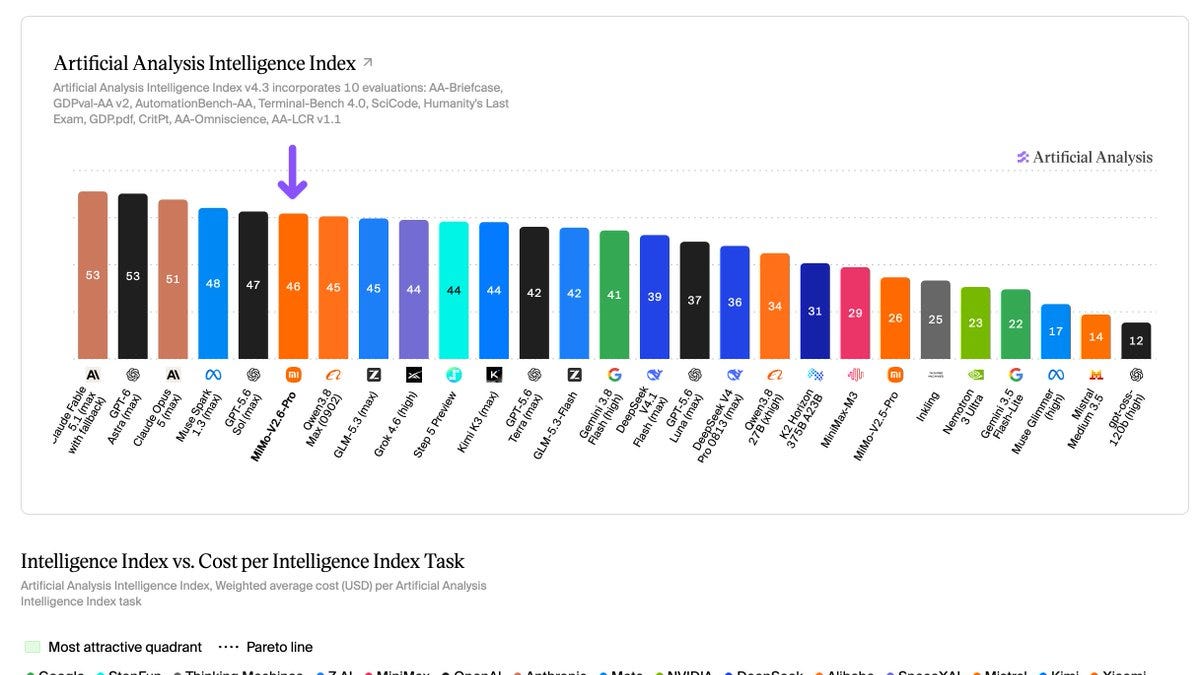 [AINews] Xiaomi MiMo-V2.6-Pro 1T-A42B: the new top Open Weights model, trained for $3M
Latent Space's AINews digest covering the launch of Xiaomi's MiMo-V2.6 series (Pro, Flash, and Pro-UltraSpeed), a natively omnimodal 1.02T-total/42B-active-parameter MoE model that debuted as the top-ranked open-weights model on Artificial Analysis' Intelligence Index, trained via a heavily scaled RL run (1,568 samples/update, up to 1M context, 75B tokens, ~130 hours, ~$2.6-3M) with plans to open-source ~7K RL environments spanning coding, cyber, visual/web, and music tasks. The issue also rounds up Alibaba's Qwen-Image-2.1 release (7B unified image model with native transparency and licensing debate), the "Jev" zero-shot decision-model trend being integrated into LangSmith and browser tooling, inference/serving advances (Hugging Face's faster tokenizers, vLLM configs for Qwen3.8-2.4T on GB300, Tencent Hunyuan's 2.38-bit quantization of Hy4 Preview, Parakeet Redux speech compression), and agent-security discussion around Meta's Muse-hardening philosophy versus a reported local-hijack vulnerability.
latent.spacearticleAdded 29 Sep 2026, published 22 Sep 2026🧠 AI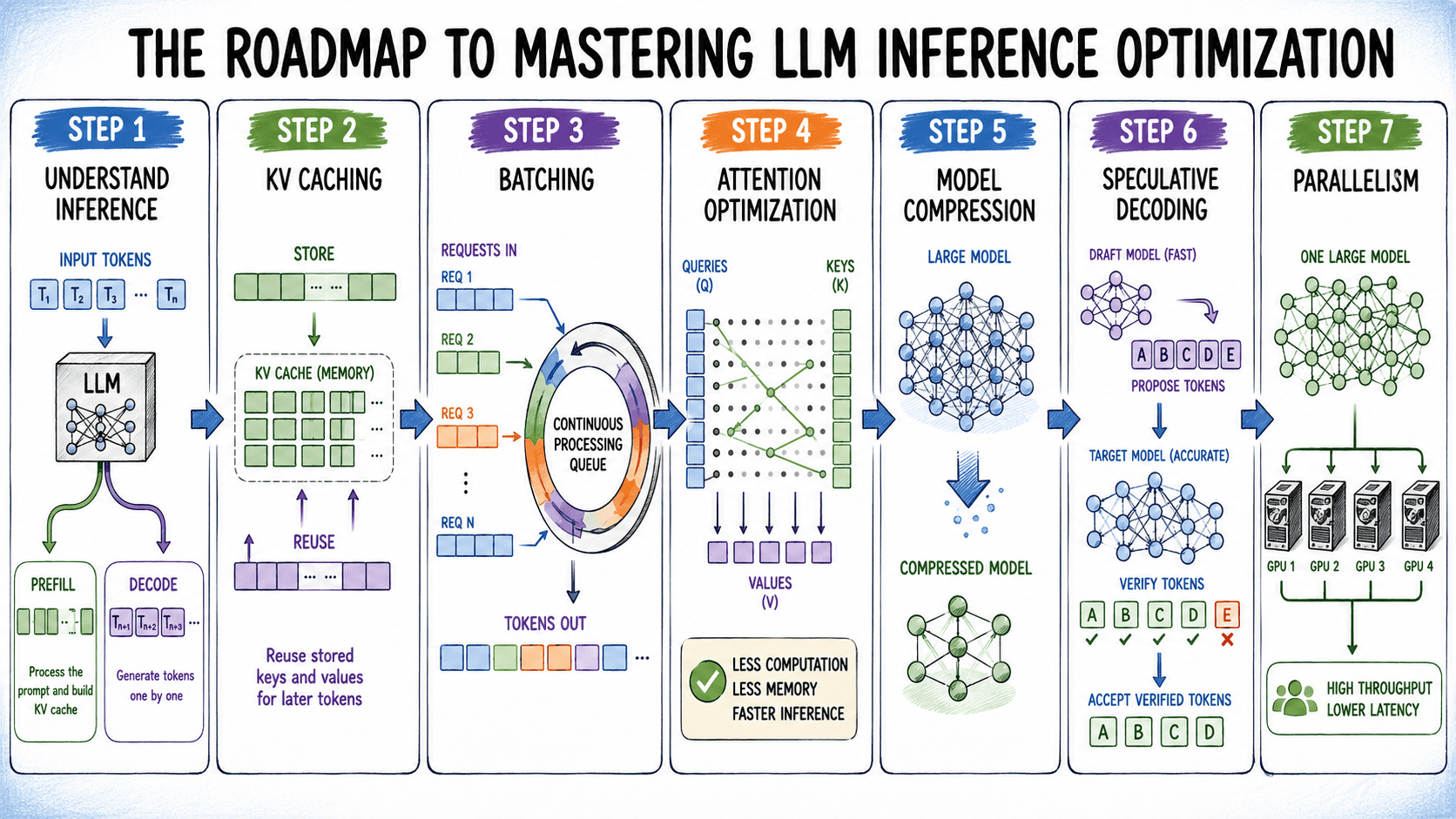 The Roadmap to Mastering LLM Inference Optimization
A structured guide walking through the layered techniques used to make LLM inference faster and cheaper: understanding the compute-bound prefill vs. memory-bandwidth-bound decode phases, KV caching with PagedAttention (as implemented in vLLM) and prefix caching, static/dynamic/continuous batching, attention optimizations (MQA, GQA, FlashAttention), model compression (GPTQ/AWQ quantization, 2:4 structured sparsity, knowledge distillation), speculative decoding for latency-critical single-request scenarios, and scaling via tensor/pipeline parallelism and prefill-decode disaggregation. It ties each technique to the specific bottleneck it addresses, making it a practical map for choosing optimizations based on latency vs. throughput requirements.
 machinelearningmastery.comarticleAdded 28 Sep 2026, published 21 Sep 2026🧠 AI
- OmniJev/awesome-jev-gallery
An extensive, actively maintained GitHub "awesome list" cataloging the ecosystem that has grown around TypeSafe's Jev and its "System One" typed decision models — a non-generative alternative to chat LLMs that returns calibrated probabilities per option (Choice/Score/Noul primitives) via RLCD training and single-pass constrained decoding. It indexes dozens of open-weight reproductions (OneJev, Rizzo Flow, Laya, Jebadiah, kev), benchmarks and leaderboards (JevBench, Jev Decision Index, JevAdvBench, DecisionBench), downstream tools (browser/robot/trading agents built on the typed API), and the research lineage the design draws on (zero-shot entailment classifiers, InstructGPT's reward model, GLiNER/GLiClass, monoBERT, LLaDA, vLLM, DSPy, RouteLLM, Constitutional Classifiers). It also links commentary auditing TypeSafe's claims (accuracy vs. frontier LLM baselines, security issues found in community tools).
github.comrepoAdded 29 Sep 2026, published 17 Sep 2026🧠 AI - Mapika/decider
Decider is an open reproduction of TypeSafe AI's System One (Jev) model class: instead of generating text, it reads a state plus a set of typed questions (Choice, Score, or Noul/yes-probability) and returns a calibrated probability distribution for each in one forward pass, with no decoding or parsing. The repo ships 2B/4B/12B and a 35B mixture-of-experts checkpoint (built on Qwen3.5 and Gemma-4 base models), trained on roughly 95 public datasets plus teacher-labelled data, with per-type temperature calibration, GGUF/llama.cpp and vLLM serving paths, an MPS/Apple Silicon port, and a community Snapdragon X Elite NPU port. It benchmarks against TypeSafe's Jev on JevBench and the Decision Index, documenting where it closes the gap (language, tools, retrieval) and where it lags (knowledge-heavy MMLU/GSM8K/GPQA tasks and calibration on hard items).
github.comrepoAdded 2 Oct 2026, published 16 Sep 2026🧠 AI - bilibili/Index-Translate
Index-Translate is Bilibili's Apache-2.0 family of multilingual, multimodal translation models built on Qwen3.5 (2B, 9B and 35B-A3B preview), covering 150 languages with instruction following (glossaries, format preservation, tone). Variants add native image translation with no OCR (vision encoder), Index-Echo for speech subtitles and dubbing, Index-Homura for syllable-controlled translation and Index-NativeLong for full-document translation. The repo provides GGUF, FP8 and NVFP4 quantized builds, vLLM serving scripts, a free OpenAI-compatible API, four new benchmarks (instTrans, MEME, SandGlass, NAtIveLong), and links to three papers including HOMURA and RIVAL (RL for translation).
github.comrepoAdded 10 Oct 2026, published 15 Sep 2026🧠 AI 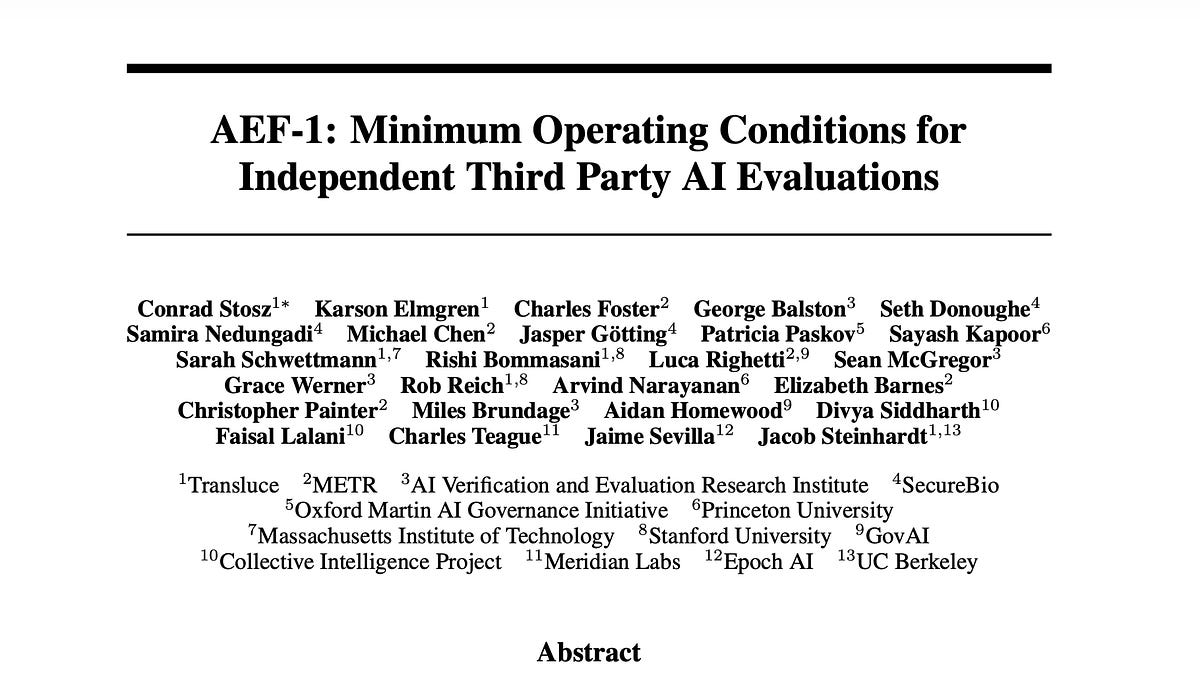 [AINews] AEF-1 standard emerges for Third Party Evaluators, as Xai, OpenAI, and Anthropic all cosign
This Latent Space AINews issue (9/11–9/14/2026) centers on the AI Evaluator Forum's AEF-1 standard for independent third-party AI evaluators, published alongside Dario Amodei's personal follow-up to 'Pacing the Frontier' proposing embedded evaluators (like METR) with employee-like access at frontier labs, plus a sharp Twitter split between pacing/slowdown advocates (Bilal Chughtai, Dan Selsam) and control-first critics (Aidan Gomez, Cohere, Kevin Bass alleging conflicts of interest in the safety-eval ecosystem). It also surveys a broad swath of the week's AI news: agent harness engineering as its own discipline (Omar Shorbagy's harness-from-scratch guide, Cline Desktop, GitHub Copilot's auto model-tier selection), DeepSeek-V4.1-Flash's cost/performance Pareto-frontier result, RLVR extending into engineering domains via Tinker, TPU-native vLLM serving from Inferact/Google Cloud, and RewardAI's OM-1 robot foundation model.
latent.spacearticleAdded 29 Sep 2026, published 15 Sep 2026🧠 AI Async GRPO with LoRA across HF Jobs: a bucket, a proxy, and no NCCL
A Hugging Face engineering blog post describing how TRL's AsyncGRPOTrainer now syncs only a LoRA adapter (not full weights) to vLLM, letting trainer and inference replicas run as separate Hugging Face Jobs connected via a Storage Bucket instead of NCCL. It details a custom proxy that adds auth headers, routes rollouts to the vLLM replica most likely to hold the matching KV-cache prefix, and broadcasts adapter loads atomically across replicas. Five iterative runs (token-budget batching, disabling gradient checkpointing, raising in-flight caps) cut a 500-step Qwen2.5-Math-1.5B GRPO run from 3h27m to 53 minutes.
huggingface.cowriteupAdded 29 Sep 2026, published 10 Sep 2026🧠 AI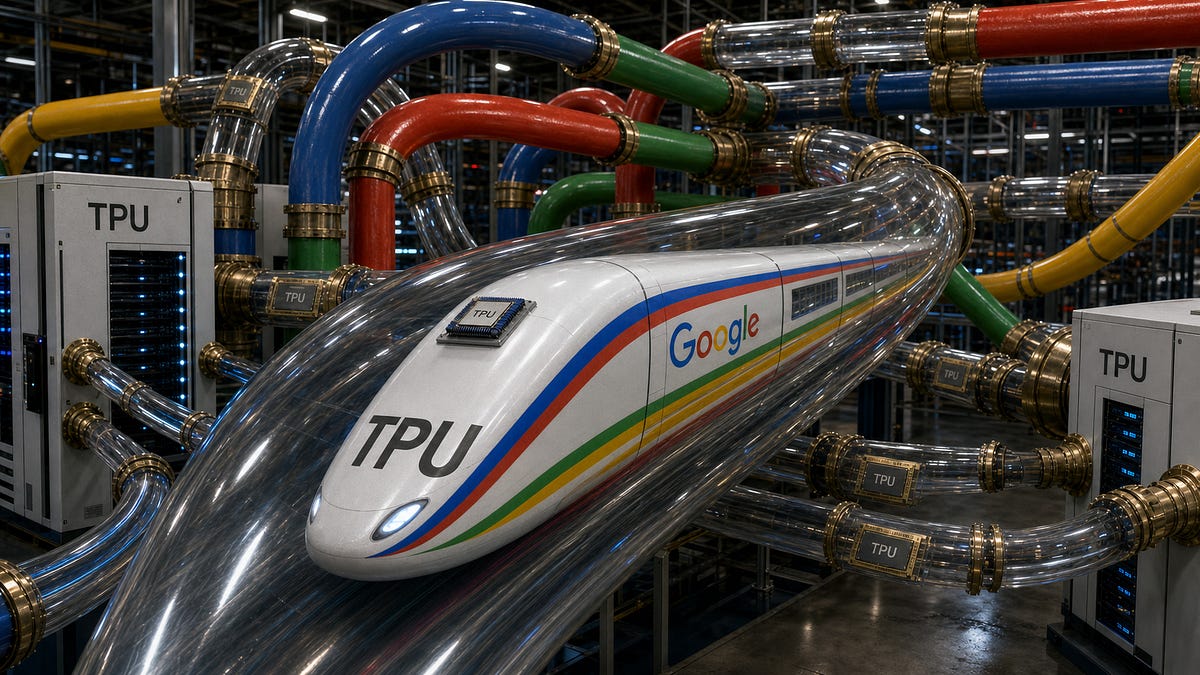 TPU Inference Externalization Full Steam Ahead - InferenceX
SemiAnalysis publishes the first third-party InferenceX Official Preview results for Google TPUv7 Ironwood serving Qwen3.5-397B in FP8 with the new TorchTPU vLLM stack. In aggregated 8k1k serving it reports up to 50% better performance per dollar than B200 and B300, while GB300 NVL72 disaggregated serving still leads in the middle of the latency range. It also details TPU kernel work: DP attention, SparseCore collectives, MoE routing, Gated DeltaNet kernels and paged attention.
newsletter.semianalysis.comarticleAdded 29 Oct 2026, published 7 Sep 2026🧠 AI- whitecircle/halo
Halo is White Circle's open-source training framework that runs the same codebase from a single GPU to multi-node clusters, adding Expert/Context/Tensor/Expert-Tensor parallelism (EP/CP/TP/ETP) directly onto native Hugging Face models via FSDP2, DTensor and DeviceMesh rather than a separate distributed model implementation. It covers the full training lifecycle — pre-training, SFT, preference optimization, distillation, and fully asynchronous multi-turn RL with a Transformers-side trainer pushing weights over NCCL to vLLM/SGLang rollout servers — and reports up to 2.8x the throughput of stock TRL for gpt-oss-20b on 8x B300 GPUs. It ships as prebuilt Docker images for Blackwell and Hopper GPUs with FlashAttention-4, DeepEP V2, DeepGEMM, and a bf16 AdamW optimizer integrated, supports 15 MoE families, and includes LoRA/QLoRA paths that fit consumer GPUs.
github.comrepoAdded 30 Sep 2026, published 26 Aug 2026🧠 AI  Granite 4.2 LLMs: How They're Built
IBM's technical write-up on Granite 4.2, its first family of dense decoder-only reasoning LLMs (3B, 8B, 30B), post-trained from Granite-4.1 base models pretrained on ~15T tokens with a five-phase schedule extending context to 512K tokens. It details the SFT data mixture (agentic vs. non-agentic, quality filtering with LLM judges GPT-OSS-120B and Gemma 4), a staged asynchronous-GRPO RL pipeline (RLVR, skill boosters, then agentic SWE/Terminal/Search stages for 8B/30B, finishing with RLHF), and the NeMo-RL/NeMo-Gym infrastructure used to run tool-using RL rollouts at scale, plus FP8/NVFP4/MXFP4/GGUF quantized releases and integration guides for vLLM, SGLang, OpenCode, Pi, and OpenHands.
huggingface.coarticleAdded 29 Sep 2026, published 25 Aug 2026🧠 AI philbert440/Qwen3.8-27B-Uncensored-Cyber-GGUF
 is a llama.cpp-format GGUF release of a Qwen3.8-27B fine-tune deliberately de-refused ('uncensored') and tuned to fully answer cyber and offensive-security questions, shipped with a vision projector and an MTP speculative-decoding head. The card includes a Claude-judged evaluation against a 100-prompt held-out cyber-offensive regex refusal harness and provides run instructions for llama.cpp, Ollama, vLLM, LM Studio, and Docker Model Runner. It exemplifies the growing trend of publicly distributed abliterated/de-refused LLMs positioned for offensive-security use, relevant to AI red-teaming and dual-use misuse tracking.
huggingface.cotoolPublished and added 21 Aug 2026🛡️ Security Sockpuppeting: How a Single Line Can Bypass LLM Safety Guardrails | TrendAI (US)
Trend Micro details sockpuppeting, a jailbreak technique that injects a fake acceptance prefix such as Sure here is as the final assistant-role message via the API assistant-prefill feature, exploiting LLM self-consistency to bypass safety training with no gradient access or optimization required. The team tested 14 prefix variants across 11 models from four providers including GPT-4o, Claude 4 Sonnet, Gemini 2.5 Flash, Qwen, Llama, and Gemma, finding every model that accepted the prefill was at least partially vulnerable, with Gemini 2.5 Flash worst at 15.7 percent attack success rate, while OpenAI, AWS Bedrock, and Claude 4.6 block the attack entirely by rejecting assistant-terminated message ordering. Self-hosted inference servers like Ollama and vLLM do not enforce this validation by default, leaving self-hosted deployments exposed.
 trendmicro.comwriteupAdded 16 Aug 2026🛡️ Security
- Dark-Moon
DarkMoon is a self-hosted, GPLv3 AI penetration testing platform that orchestrates 50 specialist agents over an MCP-gated toolbox (Nuclei, BloodHound, sqlmap, Impacket, Naabu, httpx, ffuf, etc.) to autonomously run recon-to-exploitation across web, API, Active Directory, Kubernetes, multi-cloud, CI/CD, databases, IoT firmware, and AI/LLM inference endpoints. It uses a Privacy Gateway that tokenizes real IPs/hosts/credentials into placeholders so raw infrastructure data never reaches the (optionally local, e.g. Ollama/llama.cpp) LLM, and can generate sandbox-validated, exploit-retested pull requests for findings. It also ships a dedicated LLM agent that probes OpenAI-compatible/Ollama/vLLM/TGI inference endpoints for the OWASP LLM Top 10 (prompt injection, jailbreaks, system-prompt leakage) using garak-backed probes.
github.comrepoPublished and added 5 Aug 2026🛡️ Security





Showing 60 of 72
Show more