- llm-trails: What LLMs reach for inside a breached AWS account
llm-trails is a research repo that placed 14 LLMs in 13 post-compromise AWS situations, asked only for their next move (single-turn, nothing executed), and coded each answer to CloudTrail events. It includes the llmtrials harness, prompts, codebook, processed dataset (viz_data.json) and an interactive dashboard. Rates are conditioned on the situation shown, and the aim is turning model behavior into detection priorities.
 github.comrepoAdded 30 Oct 2026🛡️ Security
- Show HN: Farol – A risk map of a pull request for the person who approves it
farol is a free, MIT-licensed CLI and GitHub Action that runs after an AI code review and gives the human approver a risk verdict (fast track, quick review, careful review) and a 0-100 score for a pull request. It uses the TypeScript type checker, go/types and Python ast to trace which pages, APIs and jobs a change reaches, and it adds diff coverage, security findings and contract breaks. It never executes or sends code.
github.comrepoAdded 26 Oct 2026, published 25 Oct 2026🧠 AI - Saylor (@Kev96790724) on X
G-Krusch is an MIT-licensed, local-first Google Workspace hub built on Node.js 22 and SQLite WAL. It runs a 12-tool MCP server (SSE and Stdio) plus a REST bridge on port 5446 for Drive, Calendar and Gmail. It includes a 1,024-dimension hybrid Drive RAG with an embedding cascade (Ollama bge-large, then Gemini, then offline fallback) and FTS5 BM25. PDF extraction returns page citations. Tokens are kept in an AES-256-GCM vault; 30 of 30 tests pass.
 x.comrepoAdded 21 Oct 2026, published 19 Oct 2026🧠 AI
- DietrichGebert/ponytail
Ponytail is a single skill prompt (skills/ponytail/SKILL.md, with a compact AGENTS.md) that makes coding agents write only the code a task needs, reusing existing components while keeping validation, error handling, security and accessibility. The author benchmarked it in Claude Code with Opus 5.5 over 39 tasks, 5 runs each, including a real FastAPI + React repo. They report -53% code, -41% time, -26% cost and -45% tokens, and 98% of risky logic shipping with a test versus 68% without. It adds /ponytail-review and /ponytail-audit commands, a Claude Code cost/token band with a local board, and installs through Claude Code and Codex plugin marketplaces or as a rules file for Cursor, Copilot, Gemini, OpenCode and others.
github.comrepoAdded 17 Oct 2026🧠 AI - Llama.cpp on a jailbroken PS5: run any GGUF model natively on the console
PS5LM is a homebrew app for jailbroken PS5s (firmware 7.00–13.60). It runs llama.cpp with the ggml-vulkan backend on the console's RDNA 2 GPU, using 11.4 GB of shared memory, and loads any GGUF model. It serves OpenAI /v1/chat/completions, Anthropic /v1/messages (usable from Claude Code, Codex and opencode) and a browser chat page on port 8081. It also supports image-projector vision models and TypeSafe-style decision models through a /v1/systemone endpoint. A planner picks the longest context and best cache that fit the free memory, and the app downloads models from Hugging Face.
github.comrepoAdded 17 Oct 2026, published 16 Oct 2026🧠 AI - santosomar/AI-agents-for-cybersecurity
Omar Santos's companion repo for his Pearson/O'Reilly trainings and books, organised in eight parts. They cover LangChain prompts, chains and RAG (Chroma), and agents (LangGraph, CrewAI, DeepAgents). They also cover FastMCP security servers (nmap, CISA KEV, Shodan) and attack-surface-management and SOC agent examples. Later parts have security guides to six agentic frameworks (OpenClaw, Hermes, Agent Zero, OpenHands, Paperclip, Buzz) with hardening notes and 2026 CVE mapping, agent cost/tokenomics scripts including denial-of-wallet budget guards, and a vendor-neutral spec for a human-gated multi-agent security-assessment harness (scope manifest, approval gates, kill switch). Useful as a hands-on path into AI-agent security tooling, with warnings that some examples act on real systems.
github.comrepoAdded 13 Oct 2026🛡️ Security  google/embeddinggemma-2
Model card for EmbeddingGemma 2, an open (Apache 2.0) 740M-parameter multimodal embedding model from Google DeepMind built on Gemma 4. It maps text, code, images, video and audio into one 768-d space, with a 270M text backbone and optionally loadable 170M vision and 300M audio encoders, an 8K context, and Matryoshka truncation to 128/256/512/768 dims. The card gives practical guidance: task instruction prefixes, re-normalising after truncation, avoiding float16 (NaN or degraded embeddings), interleaved multimodal inputs with placeholder tokens, and vision token budgets. It targets on-device search, RAG, classification and clustering.
 huggingface.corepoAdded 12 Oct 2026🧠 AI
- zero-lab-ai/skills
zero-lab-ai/skills is a collection of 56 portable SKILL.md agent skills in 10 installable plugins from zero-lab.ai. They cover authorized defensive assessment, penetration testing, red teaming, detection engineering, purple teaming and engagement operations. Skills install via the Claude marketplace layout or `npx skills add`, and a make check release gate runs linting and tests.
github.comrepoAdded 23 Oct 2026, published 11 Oct 2026🛡️ Security - Dan Kornas (@DanKornas) on X
Arcjet JS SDK is an open-source (Apache-2.0) JavaScript monorepo that adds runtime security to AI apps, agents and HTTP endpoints. It ships request SDKs for Next.js, Node.js, Bun, Deno, Fastify and NestJS. It also has a Guard API for places with no HTTP request object, such as agent tool calls, MCP handlers, queue workers and background jobs. Built-in checks cover prompt-injection detection, sensitive-information detection (PII, credit cards, custom patterns) and token-bucket, fixed-window or sliding-window rate limits, including token budgets.
x.comrepoPublished and added 11 Oct 2026🧠 AI - Show HN: Edi Life OS – self-hosted life dashboard with an MCP server for AI
Edi Life OS is a self-hosted dashboard (PHP 8.1+, MySQL, vanilla JavaScript) that combines focus timer, habits, goals, Kanban tasks, finances and notes in ten workspaces. It includes an optional Node.js MCP server that exposes 15 tools over stdio. The tools let Claude Desktop, Claude Code or Codex read the dashboard, create goals and tasks, log habits and record expenses. The MCP server calls only the app's bearer-token /api/v1 HTTP API and never touches the database or credentials. The README is candid about limits: the token has no scopes, there is no app-level rate limiting, and the secret-note flag is only a visibility setting, not encryption.
github.comrepoPublished and added 9 Oct 2026🧠 AI - chainguard-dev/malcontent
malcontent is Chainguard's open-source malware/supply-chain discovery tool that analyzes binaries (ELF, Mach-O, PE, a.out) and scripting-language source across Linux, macOS and Windows using 14,500+ YARA rules (including third-party rules from Avast, Elastic, FireEye, Mandiant, Nextron and ReversingLabs). Its standout feature is differential analysis ("mal diff"), which compares two versions of a build artifact or OCI image against a known-good baseline to surface newly introduced risky behaviors — the technique the project demonstrates on the 3CX supply-chain compromise by flagging unexpected high-risk changes to libffmpeg. It also supports threshold-based scanning ("mal scan") and unfiltered capability enumeration ("mal analyze"), and is designed to run inside CI/CD pipelines, including air-gapped environments via embedded rules.
github.comrepoAdded 8 Oct 2026🛡️ Security - Tracer-Cloud/opensre
OpenSRE is an open-source framework for building AI SRE agents that resolve production incidents by correlating logs, metrics, traces, deploys and runbooks across 60+ connected tools (observability, cloud infra, incident management, MCP). Beyond the agent runtime (CLI, Python API, Slack/PagerDuty/Telegram integrations), the project's stated mission is to build an RL training and evaluation environment — explicitly modeled on SWE-bench's role for coding agents — to scale realistic infrastructure-failure scenarios as a benchmark for AI SRE.
github.comrepoAdded 8 Oct 2026🧠 AI - Show HN: OpenChart – OSS TradingView alternative with your own AI agent
OpenChart is an open-source TradingView-style desktop charting app (Electron, Node.js/Bun, Effect runtime) that embeds AI agents into statistical/technical analysis, real-time market alerts and agentic opportunity research. It ships a custom DSL called Tea (inspired by TradingView's Pine Script) for writing indicators, and a conversation interface built on assistant-ui and the AG-UI event protocol so users converse with agents while charting.
github.comrepoPublished and added 6 Oct 2026🧠 AI - overmind-core/overmind
Overmind is an open-source platform (MIT SDK/CLI, AGPL-3.0 platform, self-hostable) that instruments an agent's code via OpenTelemetry tracing, turns the resulting production traces (or any dataset) into a fine-tuned model benchmarked against user-defined eval metrics, and serves it through one unified API with downloadable/retrainable weights. It ships an SDK, CLI, REST API, Console, and an MCP server exposing project tools and workflows (investigate-capability, finetune-capability, ship-model) for Cursor, Claude Code, OpenCode and Codex, and can sync traces from Langfuse, LangSmith, Braintrust or Galileo; self-hosting runs via Docker Compose with Postgres, Redis, Celery workers and Modal-based GPU workers for fine-tuning/serving (vLLM).
github.comrepoAdded 6 Oct 2026🧠 AI - Zhenyu98/codex-chatgpt-bridge
codex-chatgpt-bridge is a Codex agent skill plus external PowerShell control scripts (On/Off/Reboot/Rotate) built on top of the open-source DevSpace MCP bridge, which lets ChatGPT act as a planning/review "architect" while Codex stays the local executor that applies and verifies changes. It adds a token-saving router (NORMAL / TOKEN_SAVING / CHATGPT_ARCHITECT modes) and a lifecycle layer — Cloudflare Quick Tunnels or a stable Cloudflare Worker proxy, DPAPI-protected credentials, OAuth token rotation, and a scheduled-task recovery entrypoint — so the bridge's public endpoint can be closed when idle without re-authorizing the ChatGPT app on every restart.
github.comrepoAdded 5 Oct 2026🧠 AI - the_OSINT_rack (@the_OSINT_rack) on X
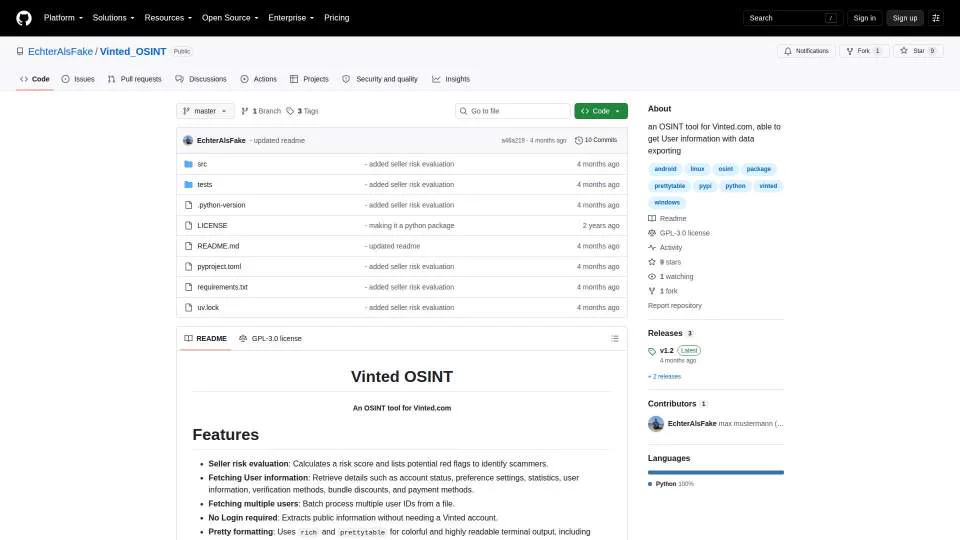
Vinted_OSINT is a GitHub tool by EchterAlsFake that performs open-source intelligence gathering against Vinted.com user profiles, pulling seller/buyer account information and computing a risk score to flag accounts likely run by scammers. It's aimed at buyers wanting to vet sellers before transacting on the second-hand marketplace.
x.comrepoPublished and added 4 Oct 2026🛡️ Security - OKX Agent Trade Kit (okx-trade-mcp / okx-trade-cli)
OKX Agent Trade Kit is an open-source MCP server (okx-trade-mcp) and CLI (okx-trade-cli) that let AI assistants like Claude Desktop, Cursor, Claude Code and VS Code place trades and query account data on the OKX exchange via natural-language commands. It runs locally with API keys never leaving the machine, supports module scoping (market, spot, swap, account, earn), a read-only mode for safe querying, multiple profiles, and includes pre-built skill files for agent frameworks plus structured JSON error reporting for debugging failed tool calls.
github.comrepoAdded 2 Oct 2026🧠 AI  Tencent Hy4 preview (open-weight MoE + Sherry quantization)
Hy4 preview is Tencent's new flagship Mixture-of-Experts language model: 770B total parameters with 49B activated per token across 78 layers (256 routed experts + 1 shared expert, top-8 routing), plus a native 10B multi-token-prediction layer for speculative decoding. It introduces Gated DeepSeek Sparse Attention with IndexCache for cross-layer index reuse and identity Hyper-Connections (iHC) on the residual path, and in blind internal evaluations on engineering tasks it edges out GLM-5.3 and Kimi K3. Weights (including an FP8 variant) are released under Apache 2.0 on Hugging Face with vLLM/SGLang deployment recipes and AngelSlim-based quantization/compression tooling.
huggingface.corepoAdded 2 Oct 2026🧠 AI- Bifrost (Maxim AI) — open-source LLM gateway
Bifrost is an open-source, high-performance LLM gateway (by Maxim AI) that exposes a single OpenAI-compatible API across 23+ providers including OpenAI, Anthropic, AWS Bedrock, Google Vertex, Azure, Cohere, Mistral, and Ollama. It provides automatic failover, load balancing, semantic caching, Model Context Protocol (MCP) tool integration, budget and governance controls, OIDC user provisioning, and Prometheus-based observability, deployable via npx or Docker with claimed sub-15 microsecond overhead at 5,000 RPS. It is positioned as a drop-in replacement requiring only a base-URL change for existing OpenAI, Anthropic, or GenAI SDK code.
github.comrepoAdded 2 Oct 2026🧠 AI - https://github.com/Panniantong/Agent-Reach
Agent-Reach is a CLI and agent-"skill" layer that equips coding agents (Claude Code, Cursor, OpenClaw) with ready-made web-reading tool use: fetching arbitrary pages via Jina Reader, YouTube transcripts via yt-dlp, GitHub repos via gh CLI, Bilibili search, RSS via feedparser, and semantic web search via Exa through mcporter, with login-gated platforms (Twitter/X, Reddit, Xiaohongshu, Facebook, Instagram) added on request via cookies or OpenCLI browser sessions. Each platform module probes an ordered list of candidate backends and falls back automatically when one breaks (e.g. yt-dlp being blocked by Bilibili's anti-scraping), and an `agent-reach doctor` command reports which backend each channel is currently using. It positions itself as a "capability layer" that selects, installs and health-checks the right upstream tool for an agent rather than wrapping the reads itself.
github.comrepoAdded 2 Oct 2026, published 1 Oct 2026🧠 AI  MiMo-V2.6 (Xiaomi): Pro/Flash/9B-distill open-weight release, MIT license, 1M context
Hugging Face collection for Xiaomi's MiMo-V2.6 model family, comprising five open-weight checkpoints: MiMo-V2.6-Pro-RL (1T params), MiMo-V2.6-Flash-RL (311B params), a MiMo-V2.6-Distill-Qwen-9B distillation (vision-language capable), and Pro/Flash MOPD variants. The title claims MIT licensing and a 1M-token context window, positioning this as a large open-weight release spanning full-scale RL-trained models down to a 9B distilled variant usable on consumer hardware.
huggingface.corepoAdded 29 Sep 2026🧠 AI- https://github.com/dmdhrumilmistry/security-harness
security-harness is an open-source Claude Code plugin (also packaged for Gemini CLI, Codex and opencode) that orchestrates subagents — sh-recon, sh-hunter, sh-chainer, sh-verifier, sh-reporter — through a static-analysis pipeline covering 15 vulnerability classes (IDOR/BOLA, SQLi, XSS, SSRF, injection, auth, deserialization, path traversal, secrets, CSRF, XXE, open redirect, crypto, race conditions, file upload), producing README/JSON/SARIF/HTML/PDF reports with PoCs, CVSS and CWE/OWASP mappings. It also ships sh-pr-review, a per-PR merge-gate skill that posts inline findings and a commit status scoped only to code the PR itself introduced or aggravated, with caching, dedup via fingerprints, and a scheduled GitHub Action that keeps its per-class knowledge bases fresh by having one AI agent draft updates from allowlisted sources (OWASP, PortSwigger Research, CWE/CAPEC, HackerOne) while a separate adversarial reviewer agent fails-closed against prompt injection before auto-merge.
github.comrepoAdded 2 Oct 2026, published 29 Sep 2026🛡️ Security - StartLuxLabs/StartLux-Decision
StartLux-Decision is a family of open decision models (0.8B to 27B, plus a 35B-A3B mixture of experts) that return probabilities for every option of typed choice, yes/no and score questions. The repository holds the inference engine and HTTP server (vLLM plugin, /v1/systemone API), with Instant one-pass and AutoThink gated-reasoning variants. Reports first place of 174 entries on Decision Index 0.3.2 (69.12). Code is Apache 2.0; weights are CC BY-NC 4.0.
github.comrepoAdded 23 Oct 2026, published 29 Sep 2026🧠 AI - Uncensored and Offensive Security AI Models Benchmark
A curated GitHub list of open-weight "uncensored" and security-fine-tuned LLMs intended for authorized red teaming, pentesting, and security research, covering models like WhiteRabbitNeo's DeepHat V2, BugTraceAI-CORE, CYBER-FROST, and several abliterated Qwen/GLM/DeepSeek variants. It explains the underlying techniques (abliteration per Arditi et al. 2024, QLoRA/DPO fine-tuning, GGUF/FP8 quantization) and links to Hugging Face model cards, benchmark suites (CyberBench, TrustedSec's LLM Attack Benchmark vs OWASP Juice Shop), and deployment platforms for running these models locally or via API.
github.comrepoAdded 2 Oct 2026, published 29 Sep 2026🛡️ Security - Uncensored and Offensive Security AI Models Benchmark
A GitHub README curating open-weight "uncensored" and security-fine-tuned LLMs (e.g. WhiteRabbitNeo's DeepHat V2, BugTraceAI-CORE, CYBER-FROST, CyberPal2.0, Lily-Cybersecurity-7B, Dolphin-Llama3-8B, Wizard-Vicuna-13B-Uncensored, huihui-ai's abliterated Qwen variants) with HuggingFace download links, quantization formats (GGUF, FP8, Q4_K_M, Q6_K), and training techniques used (SFT, QLoRA, DPO, abliteration, MoE/MTP architectures). It also includes a glossary explaining abliteration (orthogonalizing the refusal direction out of the residual stream, per Arditi et al. 2024) and references benchmarks like CyberBench and TrustedSec's LLM Attack Benchmark, making it a practical reference for anyone sourcing or deploying refusal-removed models.
github.comrepoAdded 2 Oct 2026, published 29 Sep 2026🧠 AI - openrig — multi-agent Claude Code/Codex orchestration
OpenRig is an open-source local daemon/CLI/TUI/MCP server that orchestrates teams of Claude Code and Codex agent sessions (via tmux) defined declaratively in YAML "RigSpecs." Its own docs disclose a significant trust/permission footprint: it writes workspace-trust settings and status-line/activity hooks into ~/.claude.json and .claude/settings.local.json, pre-writes Codex trust hashes and trusted workspace entries into ~/.codex/config.toml, defaults Claude to --permission-mode acceptEdits and Codex to -s workspace-write, and supports an explicit OPENRIG_YOLO=1 mode that enables Claude's --dangerously-skip-permissions or Codex's -s danger-full-access. It also relays session/activity telemetry to a local daemon endpoint.
github.comrepoAdded 28 Sep 2026🛡️ Security - SpecterOps/Blacklight — local AI agent attack surface mapping toolkit
Blacklight is a SpecterOps toolkit for endpoint forensics on AI coding agents, split into Scout (bounded metadata/filesystem triage across Codex, Claude Code, Cursor, Antigravity CLI, and Grok that finds candidate session artifacts without reading their contents) and Session Analysis (a Python CLI that parses selected JSONL/SQLite session downloads from Codex, Claude Code, Cursor, and Antigravity CLI into ranked, redacted local reports). It's built for investigators who need to identify and review AI agent session history on a host — surfacing config, auth metadata, and high-value indicators — while explicitly leaving secret scanning to external tooling; paths are informed by SpecterOps' Endpoint AI Agent Abuse (EAA) technique catalog.
github.comrepoAdded 27 Sep 2026🛡️ Security - 0xtbug/Recat
Recat is a local, Bun-based web workspace for reviewing security findings, including ones produced by AI agents such as Hermes, Codex and Claude Code. It reads a folder of finding.json, README and PoC evidence per project, and offers a dashboard by severity, status and asset coverage (web, smart contract, mobile, desktop, network, hardware). It also has filters by vulnerability class, an evidence viewer, JSON and ZIP exports, password-protected access with a censored view, and a SKILL.md reporting skill that lets agents write findings straight to the source folder.
github.comrepoAdded 16 Oct 2026, published 27 Sep 2026🛡️ Security - FirmAgent: Fuzzing + LLM Agents for IoT Firmware Vulnerability Discovery (NDSS 2026)
FirmAgent is an academic research toolkit (NDSS 2026) for finding vulnerabilities in re-hosted IoT firmware web services by combining IDA-based pre-fuzzing (CFG/sink distance scoring), QEMU instrumented tracing, CFG-guided API fuzzing, and an optional LLM agent (LLMATaint.py) that consumes runtime taint traces to reason about and produce PoCs for bug classes like command injection. The pipeline is explicit about scope: it is meant for authorized, owned or re-hosted firmware (e.g. Greenhouse-style containers), and stitches together sink-scope extraction, feedback-driven fuzzing, and request-to-trace attribution before handing traces to an LLM for taint-to-PoC analysis.
github.comrepoAdded 26 Sep 2026🛡️ Security - Sandyaa — open-source autonomous code auditor that proves bugs with working exploit PoCs
Sandyaa is an open-source autonomous code-audit tool that points at a local directory or git URL and runs end-to-end, driven by the Claude Code CLI (optionally Gemini) with no separate API key required. It uses a Recursive Language Model approach — the model drives a Python REPL to chunk code, spawn sub-LLM queries, and aggregate results — running eight recursive passes (call-chain tracing, data-flow expansion, vulnerability chaining, exploitability proof, etc.) and an attacker-control-reachability analyzer to filter unreachable findings, then writes each finding with a working exploit PoC and an evidence.json linking claims to file/line. Maintained by SecureLayer7, who report using it to surface zero-days; it's alpha-stage, macOS-tested, Linux/WSL2-expected-to-work, and unsupported on native Windows.
github.comrepoAdded 26 Sep 2026🛡️ Security


Showing 30 of 136
Show more