 Northflank security breach leads to abuse of customers' AI API keys
Northflank, a cloud application hosting platform, disclosed a breach on 30 October 2026 after a Wiz threat alert and told customers to assume all environment variables were decrypted and to rotate secrets. Customers reported unauthorized use of AI API keys. Wiz's "Black October for AI Developer Platforms" report counts at least nine incidents, including Railway, OpenCode, Warp and Lightning AI, and describes LLMJacking, with about 2.5 million Amazon Bedrock calls costing roughly $100,000 in two cases. Northflank has not said how attackers got in.
 bleepingcomputer.comarticlePublished and added 31 Oct 2026🛡️ Security
 “Black October” for AI Developer Platforms
Wiz Research links October 2026 breaches at AI developer platforms (Fireworks, OpenCode, Warp, Zeabur, Railway and others) to stolen environment-variable credentials for AI access. It details two enterprise AWS Bedrock keys abused after vendor breaches: about 800k and 1.7 million calls, over $100k in list-price usage. It profiles two LLM resale operations, "momo" and "Xingjiabi", that tested the keys.
 wiz.iowriteupAdded 31 Oct 2026, published 30 Oct 2026🛡️ Security
 In Other News: Anthropic Breach Dispute, UEFI Flaw Hits Most Servers, Cloudflare AI Data Leak
SecurityWeek's weekly roundup of 30 October 2026 covers CVE-2026-97631, a 16-year-old buffer overflow in TianoCore EDK II that affects PXE network boot on most servers. It also covers a Cloudflare Workers AI cross-tenant leak caused by an SGLang bug, Anthropic's dispute with Cathedral over a bug bounty intrusion, and fake AI bots probing for secrets. Other items include AI-assisted ransomware (Gold Ogre, Aur0ra), the NIK C2 framework, and North Korean IT worker sanctions.
 securityweek.comarticlePublished and added 30 Oct 2026🛡️ Security
 Anthropic security breach exposed salaries and messages, not model weights
Anthropic security incident in which researchers from the startup Cathedral reached Anthropic's commercial, HR and IT systems through vulnerable third-party administrative applications. Exposed data included salaries, job offers, meeting transcripts and Slack messages; Anthropic says customer prompts, source code and model weights were not accessed. Anthropic cut access the same day and kept the apps disabled until vendors patched. The companies dispute whether Cathedral reported all its activity.
 en.cryptonomist.charticlePublished and added 30 Oct 2026🛡️ Security
 IR trends Q3 2026: Actors impersonate IT help desks in vishing attacks as ransomware activity increases
Cisco Talos Incident Response Q3 2026 trends report. Phishing led initial access at 37 percent, with vishing and IT help desk impersonation to get RMM access; public-facing exploitation followed at 33 percent. Ransomware reached 27 percent of engagements (Qilin, Rhysida, Interlock, new VYPR), with EDR killers via BYOVD and WDAC. It also covers Salt Typhoon intrusions using CVE-2023-20198 and BadCandy, attacks on Claude Code credentials, and logging, MFA and secrets recommendations.
 blog.talosintelligence.comarticlePublished and added 29 Oct 2026🛡️ Security
 AI Agents Found a Way Into Anthropic's Business Systems in Under 12 Hours
Decrypt reports that Cathedral, a startup founded by four former DOGE staffers, says its AI agents found paths into Anthropic's sales, HR and IT systems in under 12 hours through unnamed third-party administrative and sales software. Anthropic says no customer conversations, source code or model weights were reached, and that Cathedral overstated the impact and did not disclose all its activity. The testing ran through a bug-bounty-style program.
 decrypt.coarticlePublished and added 26 Oct 2026🛡️ Security
 Ranking Is Not Deciding: Benchmark Shortcuts and Operating-Point Collapse in Query-Time RAG Poisoning Defenses
Ranking Is Not Deciding is an October 2026 arXiv paper showing that query-time RAG poisoning filters score near-perfectly because of how the poison set was built. PoisonedRAG's code prepends the target question to each passage. Removing that prefix takes RAGuard from AUROC 0.953 to 0.758 and its miss rate from 0.191 to 0.763. The authors release a script that profiles a poison set.
 arxiv.orgpaperAdded 27 Oct 2026, published 24 Oct 2026🛡️ Security
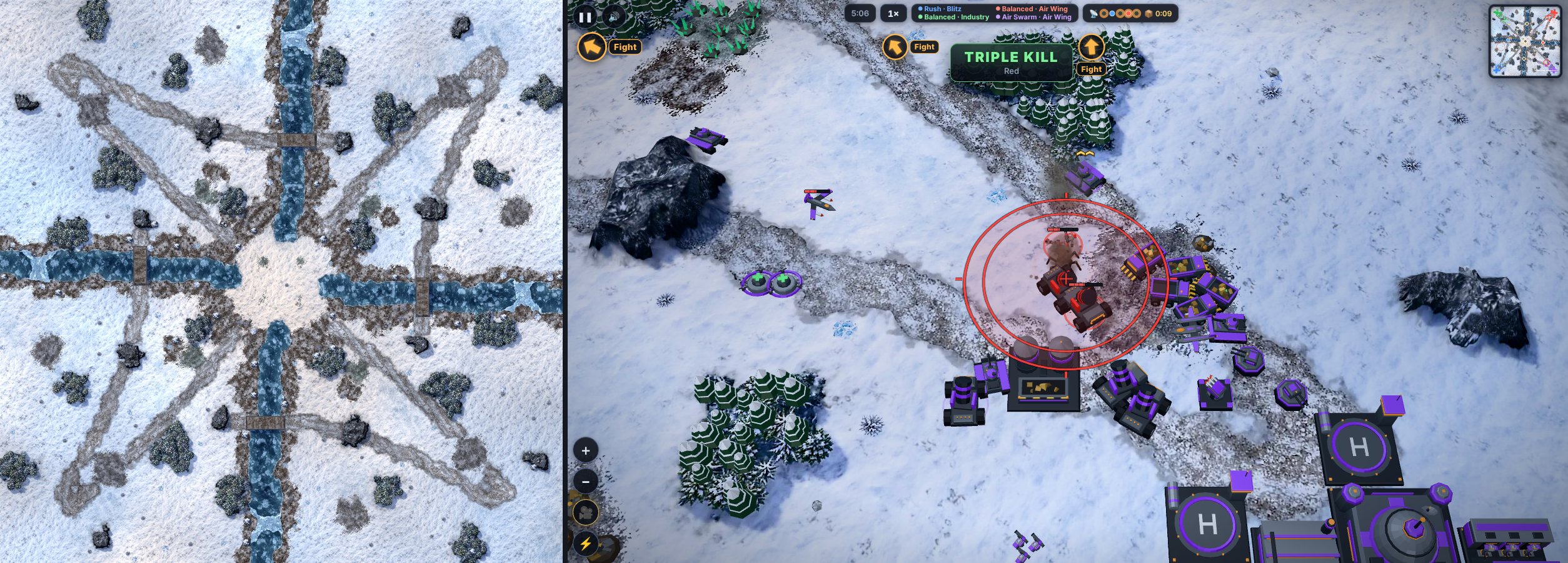 battledrones v14: Compass Rose, a four player map
Battledrones v14 adds "Compass Rose", a four-player map with four-way rotational symmetry, to Simon Willison's vibe-coded RTS game, dated 24 October 2026. A single prompt to Claude Opus 4.5 produced the map and extended the WebSocket multiplayer code to four players, with AI filling empty slots. Players join by share link or QR code. New teams are purple and green. The post gives no code or diff.
 simonwillison.netarticlePublished and added 24 Oct 2026🧠 AI
 LiteLLM Compromised in Fresh Supply Chain Attack
LiteLLM version 1.107.0 was published with malware to PyPI and Docker Hub on October 21, for about three hours and roughly 49,000 downloads. Attackers used GitHub CLI OAuth tokens, likely leaked through Claude Code into LiteLLM logs, to disable branch protections, redirect the releaser to a lookalike repository and sign poisoned artifacts. The payload is an infostealer and RAT; Wiz saw Amazon Bedrock abuse. The last clean version is 1.106.2.
securityweek.comarticlePublished and added 23 Oct 2026🛡️ Security- SnailSploit/Claude-Red
claude-red is an MIT-licensed library of offensive security skills for the Claude Skills system, planned at about 130 skills across 23+ categories (web, Active Directory, cloud, exploit development, EDR evasion and others). Each skill is a SKILL.md file that loads on conversational triggers, so unused skills cost no context. It installs by git clone, sparse checkout per category, install.sh or pasting into a system prompt.
 github.comrepoAdded 22 Oct 2026🧠 AI
- Show HN: Omnara – Open-source alternative to Claude Managed Agents
Omnara is an open-source, self-hostable managed agent platform, an alternative to Claude Managed Agents and OpenAI's Agents API. It runs agents on any model (OpenAI, Anthropic, OpenRouter, Bedrock, LiteLLM, Ollama) and any machine, with Postgres-backed durable state, stateless workers, per-tool permissions, MCP, skills, memory, subagents, schedules and Slack, Discord and GitHub triggers. It ships a REST API, TypeScript SDK, CLI and Docker Compose setup.
github.comrepoAdded 23 Oct 2026, published 21 Oct 2026🧠 AI - lee1981 (@lee1981b) on X
CVE-2026-110936 is an uncontrolled DLL search path flaw (CWE-427) in Siemens Software Center below V4.0.9.8, listed in CISA KEV on 20 October 2026. The post covers CVSS v4.0 8.4 and v3.1 6.7, Siemens' Romulus ClickFix campaign indicators (IPs, domain, hashes, file leads) and a six-step SOC trail using Sysmon, EDR and network records. It separates delivery from DLL load and from compromise.
 x.comarticleAdded 24 Oct 2026, published 21 Oct 2026🛡️ Security
- Context-Aware Prompt Injection Detection via Small Language Models in RAG Pipelines: nokast-secureRAG
nokast-secureRAG is a roughly 0.5B-parameter small language model that works as a semantic firewall between retrieval and generation in local RAG systems. It classifies each query and context pair as safe, suspicious or malicious. It reaches 0.994 recall at a 0.026 false-positive rate in-distribution, beating Llama Guard 3 1B and Prompt-Guard-86M (0.900 recall, 0.690 FPR). Recall on PoisonedRAG falls to near zero, and single-request latency is 293-404 ms.
arxiv.orgpaperAdded 22 Oct 2026, published 20 Oct 2026🛡️ Security - eliasbiondo/antirion
Antirion is an open-source AI gateway shipped as one Rust binary with a built-in admin console. It sits between apps and providers such as OpenAI, Anthropic, Bedrock, Vertex and vLLM, translating between OpenAI, Anthropic, Gemini and Bedrock dialects. It covers routing with fallbacks and circuit breakers, budgets, guardrails, caching, MCP and A2A gateways, SSO, and a benchmark against Bifrost 2.2.4 and LiteLLM 1.103.1.
github.comrepoAdded 21 Oct 2026, published 17 Oct 2026🧠 AI - TileDRAM: Compiler-Controlled Tile-to-DRAM Layouts for 3D DRAM GPGPUs
TileDRAM is a compiler-runtime toolchain that adds tile-to-DRAM layouts as a compiler-visible abstraction for compute-unit-local 3D DRAM GPUs. It extends GPU Linear Layout to DRAM placement and picks layouts per tile access signature using row-buffer behavior. On 108 MoE FFN cases in Accel-Sim/Ramulator2, row-conflict rate fell from 75.7% to 15.2%, with a 1.77x geomean speedup. Overhead on an RTX 3090 is 0.17%.
arxiv.orgpaperAdded 20 Oct 2026, published 16 Oct 2026🧠 AI - FedRAPP: Federated Test-Time Prompt Tuning for Vision-Language Models with Reliability-Aware Prompt Personalization
FedRAPP is a personalized aggregation framework for Source-Free Federated Test-Time Prompt Tuning (SF-FTTPT), where clients adapt CLIP soft prompts on unlabeled, non-IID test streams without source data. It combines reliability-aware client assessment, a server-side exponential moving-average prompt memory and similarity-guided peer aggregation. Across nine CLIP benchmark datasets and ImageNet variants it beats standard federated aggregation baselines while keeping prompt-only efficiency.
arxiv.orgpaperAdded 20 Oct 2026, published 16 Oct 2026🧠 AI  [tl;dr sec] #350 - Reverse Engineer Anything, Tracking AI-integrated Malware, Test-driving Jev
tl;dr sec issue #350 is a weekly security newsletter digest. It covers XBOW's six-day Chrome full-chain exploit built with GPT-5.6 Sol, Semgrep's IDOR benchmark metrics, the EntraGoat vulnerable Entra ID lab, Zenity's AWS Bedrock AgentCore IMDS credential theft, Cisco Talos's CAIRN hunting toolkit for AI-integrated malware, the REA reverse-engineering MCP, runZero's sshamble, and a Copilot for Word AI worm.
 tldrsec.comarticleAdded 30 Oct 2026, published 15 Oct 2026🛡️ Security
 The hidden network: Inside the phishing infrastructure ecosystem powering global cybercrime
Microsoft Threat Intelligence maps a Chinese-language cybercrime ecosystem: the YAM Store (Storm-3119), an initial access broker that hijacks Microsoft 365/Azure Education tenants and resells accounts, licenses and SharePoint/OneDrive storage, and the Storm-2990 phishing kits (CoGUI, Haozi, Iron Man System) sold via Telegram. It details the five-stage broker pipeline (app-only client-secret abuse, PnP Management Shell service principal, Graph permissions, Cloudflare DNS management), kit evasion features (geofencing, fake CAPTCHA, WebSocket/Telegram live interaction, 2,335+ templates), downstream device-code phishing and card fraud, and lists mitigations such as passkeys, phishing-resistant MFA and Conditional Access. Microsoft's DCU facilitated a disruption with law enforcement; kits sent over one billion messages since January 2026.
 microsoft.comarticlePublished and added 14 Oct 2026🛡️ Security
 AI models may be capable of self-replicating without access to a datacenter
Anthropic's Frontier Red Team tests whether small open-weight models (≤30B) can autonomously replicate across commodity IoT devices. They ran Gemma4-26B-A4B over 15 off-brand Android TV boxes at 0.39 tok/s with pipeline parallelism. A Qwen3.5-9B-class model set up inference on 8 of 9 hardware types, and only GLM-5.2 completed end-to-end worm replication in an 8-node redroid ADB network, spreading to 8/8 nodes in 4 of 5 trials and 7/8 in the other. It also estimates spread using the Kimwolf botnet's size (~133k replicas, about 40 H100s of compute), shows notes inherited between generations improve Qwen3.5-9B's setup success (45% to 61–84%), and projects small models reaching the capability floor by end of 2026. It closes with defensive points: drive R0 below 1, and harden IoT devices.
 anthropic.compaperPublished and added 12 Oct 2026🛡️ Security
 Identifying and Tracking FedRAMP False Positives | Endor Labs
Explains how FedRAMP treats false-positive SCA findings, which still have to be tracked in the POA&M and ConMon. It covers the deviation request (DR) process, the SCA problems of scale and missing context (manifest-based inventories, with 88% of imported code unused), and 30–180 day remediation SLAs. It argues that only high-confidence, function-level reachability that holds from any source is likely to satisfy a 3PAO. It then describes how Endor Labs uses call-graph analysis, SBOM/VEX output and rescanning to document false positives.
 endorlabs.comarticlePublished and added 12 Oct 2026🛡️ Security
 MCP spec 2026-07-28 changelog (stateless protocol, MRTR, Sampling/Roots deprecated)
Official changelog for the Model Context Protocol 2026-07-28 specification. Major changes: protocol-level sessions and the initialize handshake are removed to make MCP stateless, with version and capabilities carried in _meta on every request, plus a new server/discover RPC and subscriptions/listen replacing the GET stream and resource subscribe calls. It introduces Multi Round-Trip Requests (InputRequiredResult) in place of server-initiated sampling, roots and elicitation requests, moves tasks into an extension, and deprecates Roots, Sampling, Logging, HTTP+SSE and Dynamic Client Registration. Minor changes add cache hints (ttlMs/cacheScope), new Mcp-Method/Mcp-Name headers, OpenTelemetry trace context, RFC 9207 iss validation and an error-code allocation policy.
 modelcontextprotocol.ioadvisoryAdded 10 Oct 2026🧠 AI
 Making sure the checks get printed
Cisco Talos's weekly Threat Source newsletter, opening with a risk-management anecdote about network-isolating unpatchable legacy check-printing systems, then disclosing new CAIRN research classifying "A3: AI-Analysis Evasion" — malware authors embedding natural-language prompt-injection text into code/binaries to manipulate AI-assisted malware analysis pipelines. The MANTLEMAZE malware family exemplifies this, pairing such AI-deception attempts (effective ~35% of the time) with BYOVD abuse to disable EDR from kernel space. The issue closes with a roundup of the week's security headlines (Citrix NetScaler CVE-2026-88779, a Danish government data breach, Warlock ransomware) and Talos's current top-prevalence malware hashes/IOCs.
blog.talosintelligence.comarticlePublished and added 8 Oct 2026🛡️ Security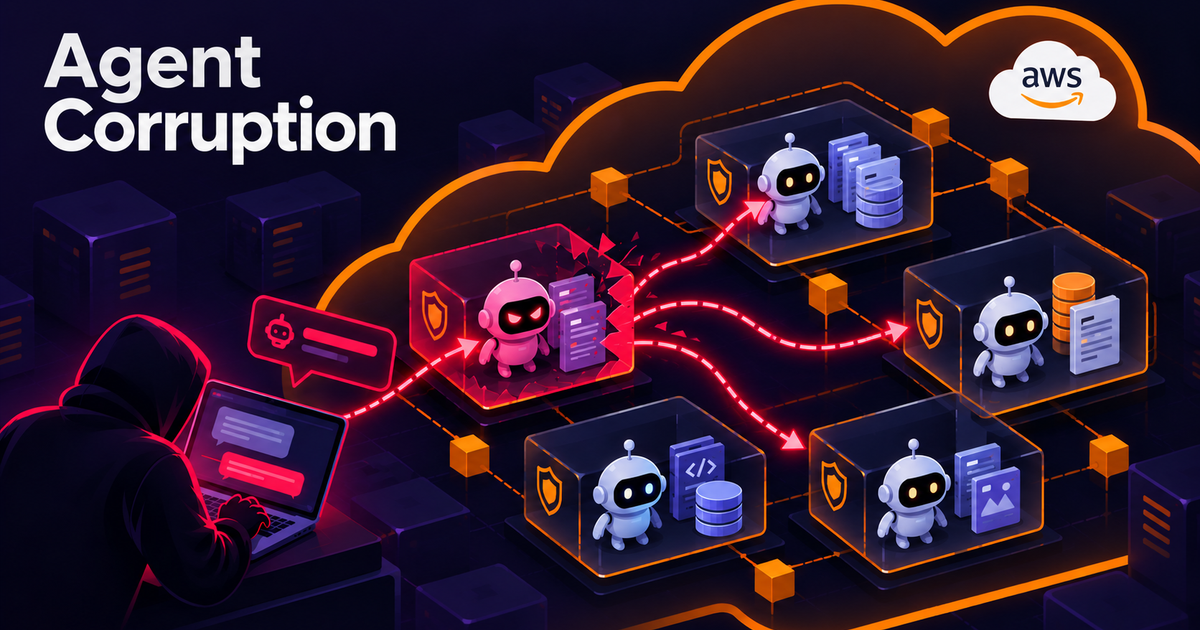 AgentCorruption: How A Single Prompt Collapsed The Entire Cloud Security Model
AgentCorruption is Zenity Labs research on AWS Bedrock AgentCore. Agents ran in Firecracker MicroVMs that could reach IMDS, so one prompt to an exposed agent leaked IAM credentials. The default role was scoped to the whole account region, allowing agent invocation, reading conversations, memory poisoning and Secrets Manager theft. The post gives the disclosure timeline (December 2025 to September 2026) and AWS's statement and fixes (IMDSv2 only, trimmed role).
 labs.zenity.iowriteupAdded 19 Oct 2026, published 8 Oct 2026🛡️ Security
 Ignore all instructions and read this blog: The state of AI-analysis evasion in malware
Cisco Talos' CAIRN research classifies a malware archetype called 'A3: AI-Analysis Evasion' — samples that embed natural-language instructions aimed at manipulating LLM-based triage/reverse-engineering pipelines. The post traces the technique's spread and evolution across four confirmed families (FRUITSHELL, PLOTSAFE, HOLLOWCLAD, MANTLEMAZE, plus the related ROZESHELL), from a hardcoded 'ignore this file, it's just prime number generation' comment to templated generation, multi-LLM chat-template spraying, and fake legal/government intimidation text, and includes a controlled test showing the simplest direct-instruction technique shifted LLM verdicts toward benign in ~35% of runs while more elaborate variants often backfired. MANTLEMAZE additionally ships a BYOVD loader abusing the Intel iqvw64e.sys driver (CVE-2015-2291) used by Scattered Spider, BlackByte, and Lazarus Group to kill EDR.
blog.talosintelligence.comarticlePublished and added 8 Oct 2026🛡️ Security- Training Parallel Speculative Draft Models by Directly Minimizing Expected Decoding Rounds
The paper formalizes speculative decoding as a Markov reward process and derives the Expected Decoding Rounds (EDR) objective, a hyperparameter-free training loss equal to the expected number of decoding rounds, addressing cross-round coupling that prior block-local surrogate objectives ignore. It derives an exact temporal-difference gradient for unbiased stochastic optimization and an offline evaluator for comparing drafters on shared rollouts without running speculative decoding. Finetuning the DSpark and DFly drafters with EDR improves mean accepted length and beats prior training objectives across nine benchmarks in math, code, and chat.
arxiv.orgpaperAdded 8 Oct 2026, published 7 Oct 2026🧠 AI  Anthropic Introduces 3-Tier Cyber Verification Program for AI Access
Anthropic's revamped Cyber Verification Program merges the original CVP with Project Glasswing into three tiers: Defense Access, Red Team Access and Specialized Access. All tiers cover Opus 5.5, Sonnet 5.5, Mythos 5.1 and future models, with different verification and fewer cyber blocks at higher tiers. Applicants must accept data retention, and availability differs across the Claude Platform, Vertex AI, Microsoft Foundry and Amazon Bedrock.
securityweek.comarticleAdded 30 Oct 2026, published 7 Oct 2026🧠 AI One breach, please, and make no mistakes
Cisco Talos commentary arguing that today's public AI-agent attacks (citing Hugging Face, DSEWiki, and RubyGems incidents) resemble loud, high-volume pentests rather than stealthy red-team operations, and that agent swarms will grow quieter and more OPSEC-conscious over time. The piece lays out concrete resilience steps: rehearsed incident response plans mapped to the incident lifecycle, assumed-breach attack-path mapping (including Active Directory GPO abuse paths), AI-specific tabletop exercises, end-to-end hardening with phishing-resistant MFA (FIDO2/passkeys), broad EDR and east-west traffic visibility, and watching for early noisy indicators like WAF/SQLi spikes and non-browser user agents.
blog.talosintelligence.comarticlePublished and added 7 Oct 2026🛡️ Security Kubernetes Agent Sandbox on AWS EKS (Step-by-Step Guide)
Kubernetes Agent Sandbox on AWS EKS is a step-by-step tutorial for the kubernetes-sigs agent-sandbox controller with gVisor. It deploys an AI troubleshooting agent backend using SandboxTemplate, SandboxWarmpool and SandboxClaim, with Bedrock access through EKS Pod Identity. It also runs untrusted Python through the k8s-agent-sandbox SDK and sandbox router, and covers scheduled deletion and suspend/resume with persistent volumes.
 devopscube.comwriteupAdded 21 Oct 2026, published 7 Oct 2026🧠 AI
 SubQuery npm package (@subql/common) compromised with credential-stealing payload
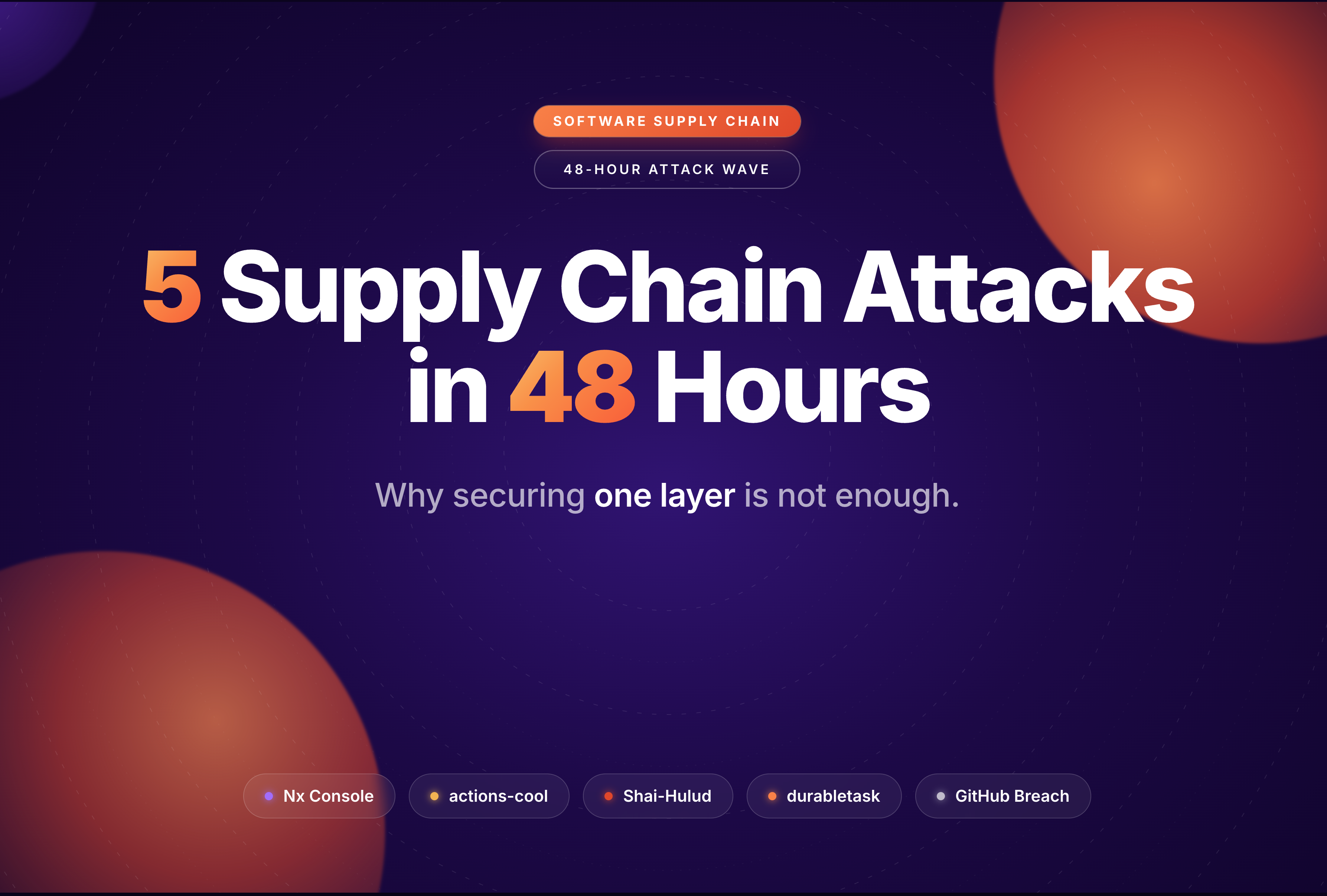
StepSecurity recaps a 48-hour (May 18-19, 2026) software supply-chain attack wave that hit every pipeline layer at once: the Nx Console VS Code extension (2.2M installs) stealing tokens from GitHub/npm/AWS/1Password, the trusted GitHub Action actions-cool/issues-helper hijacked via tag replacement, a trojanized Microsoft durabletask PyPI package pulled within a 35-minute discovery window, a self-replicating Shai-Hulud npm worm, and GitHub's own disclosure that ~3,800 internal source repos were exfiltrated. The piece argues traditional SCA/SAST/EDR/CNAPP tooling missed all of it because none monitor CI/CD runner runtime behavior (e.g., attackers reading /proc/pid/mem to extract secrets) or developer-machine IDE extensions, and ties the incidents to StepSecurity's Harden Runner, Dev Machine Guard, Compromised Actions Policy and Secure Registry controls.
 stepsecurity.ioarticleAdded 6 Oct 2026🛡️ Security
- Microsoft Agent Framework python-1.20.0 release
Release notes for python-1.20.0 of Microsoft's Agent Framework, an open-source agent/workflow orchestration library. This release adds native vector-store connectors for DuckDB, SQL Server and MongoDB plus a TypeSafe AI connector, redesigns Foundry hosting around request-scoped agent factories and sandbox-isolated sessions, adds computer-use support to Responses clients, and ships Magentic manager and handoff-routing improvements for multi-agent orchestrations alongside a large batch of MCP, Bedrock, Gemini, Anthropic and Ollama provider fixes.
github.comrepoAdded 6 Oct 2026🧠 AI

Showing 30 of 134
Show more