 The Rise of Agentic Attacks: What They Look Like, and Where They're Headed
Wiz Research reviews agentic attacks seen in its incident response work and in public reports (ARTEX, Hermes, JPCERT/CC, CrowdStrike, DIVD). It derives fingerprints of AI-agent activity from three intrusions: machine-paced iteration, natural-language reasoning in scripts, self-correcting script versions, checklist enumeration, noisy lateral spraying, probe-before-payload and self-labeled scratch files. It also covers effects on attribution, attack scale and defense.
 wiz.ioarticlePublished and added 29 Oct 2026🛡️ Security
 The Rise of Agentic Attacks: What They Look Like, and Where They're Headed
Wiz research on intrusions where AI agents do the hands-on attacker work. It reviews public cases (ARTEX against South Korean banks and the ConnectWise compromise, Hermes at Thailand's Ministry of Finance, JPCERT/CC, CrowdStrike, DIVD) and three Wiz-investigated attacks. It distills fingerprints: machine-paced iteration, embedded natural-language reasoning, self-correcting scripts, checklist enumeration, noisy lateral movement, probe-before-payload habits and self-named scratch files. It also covers attribution, scale and defense implications.
wiz.iowriteupPublished and added 29 Oct 2026🛡️ Security Non-profiled Single-Trace ML-DSA Secret Key Recovery by Horizontal Distribution Analysis
Non-profiled single-trace side-channel attack on ML-DSA-65 (Dilithium) running on ARM Cortex-M4, by Linus Backlund and Elena Dubrova (KTH). It compares observed sample distributions with expected Hamming weight leakage using a Gaussian mixture model, and stacks partitioned trace segments for multiple observations. Information-set decoding corrects misclassifications; with a 2^70 enumeration budget, the full secret key is recovered from one trace in 99% of attacks, using secret key unpacking as the attack point.
 eprint.iacr.orgpaperPublished and added 26 Oct 2026🛡️ Security
- Field Notes: Reconstructing an Attacker’s Workflow
Field note from dfir.ch on PowerShell scripts an attacker left on disk during an incident: a file-watching command runner using Invoke-Expression, a fake Windows credential prompt that validates passwords via Start-Process and logs them in cleartext, AD computer enumeration with WMI access testing, and SMB share discovery via NetShareEnum. It notes where script labels overstate what they prove and lists hunting strings for Event IDs 4104, 4103, 4688 and Sysmon 1.
 dfir.chwriteupAdded 24 Oct 2026, published 22 Oct 2026🛡️ Security
 LLM-based Code Auditing by Inferring and Evaluating Developer Assumptions
Presents Creed, an LLM-based code auditing approach that infers a developer's security-related beliefs for a function, scores how reasonable each is, and derives the conditions under which it is violated. It catches domain-specific semantic flaws that syntactic static analysis misses, such as a timing side-channel that undermines user-enumeration protection. The paper also introduces two measures for explanation-based vulnerability detection, recall and overhead. On a recent real-world benchmark, Creed beats existing explanation-based tools on the effectiveness-effort trade-off.
 arxiv.orgpaperAdded 15 Oct 2026, published 11 Oct 2026🛡️ Security
- Dark Web Informer (@DarkWebInformer) on X
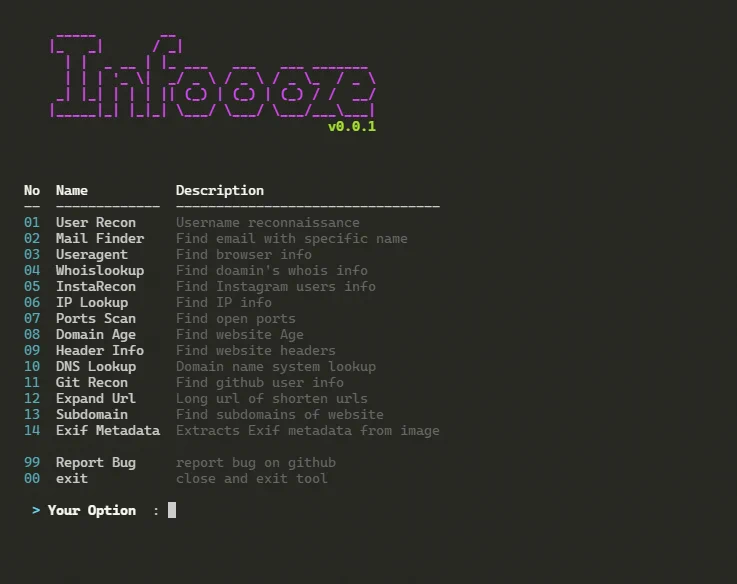
Infoooze is an open-source command-line OSINT reconnaissance toolkit (github.com/devxprite/infoooze) that consolidates common footprinting tasks into one CLI: username enumeration across platforms, email discovery, subdomain enumeration, port scanning, WHOIS/DNS lookups, IP/HTTP header analysis, EXIF metadata extraction, GitHub recon, and URL scanning/expansion. It automatically saves results, making it a lightweight all-in-one alternative to running several separate recon tools.
 x.comrepoPublished and added 8 Oct 2026🛡️ Security
- chainguard-dev/malcontent
malcontent is Chainguard's open-source malware/supply-chain discovery tool that analyzes binaries (ELF, Mach-O, PE, a.out) and scripting-language source across Linux, macOS and Windows using 14,500+ YARA rules (including third-party rules from Avast, Elastic, FireEye, Mandiant, Nextron and ReversingLabs). Its standout feature is differential analysis ("mal diff"), which compares two versions of a build artifact or OCI image against a known-good baseline to surface newly introduced risky behaviors — the technique the project demonstrates on the 3CX supply-chain compromise by flagging unexpected high-risk changes to libffmpeg. It also supports threshold-based scanning ("mal scan") and unfiltered capability enumeration ("mal analyze"), and is designed to run inside CI/CD pipelines, including air-gapped environments via embedded rules.
 github.comrepoAdded 8 Oct 2026🛡️ Security
- Determined Attacker Uploads Malicious Webshells to Parks and Rec Management Platform Servers
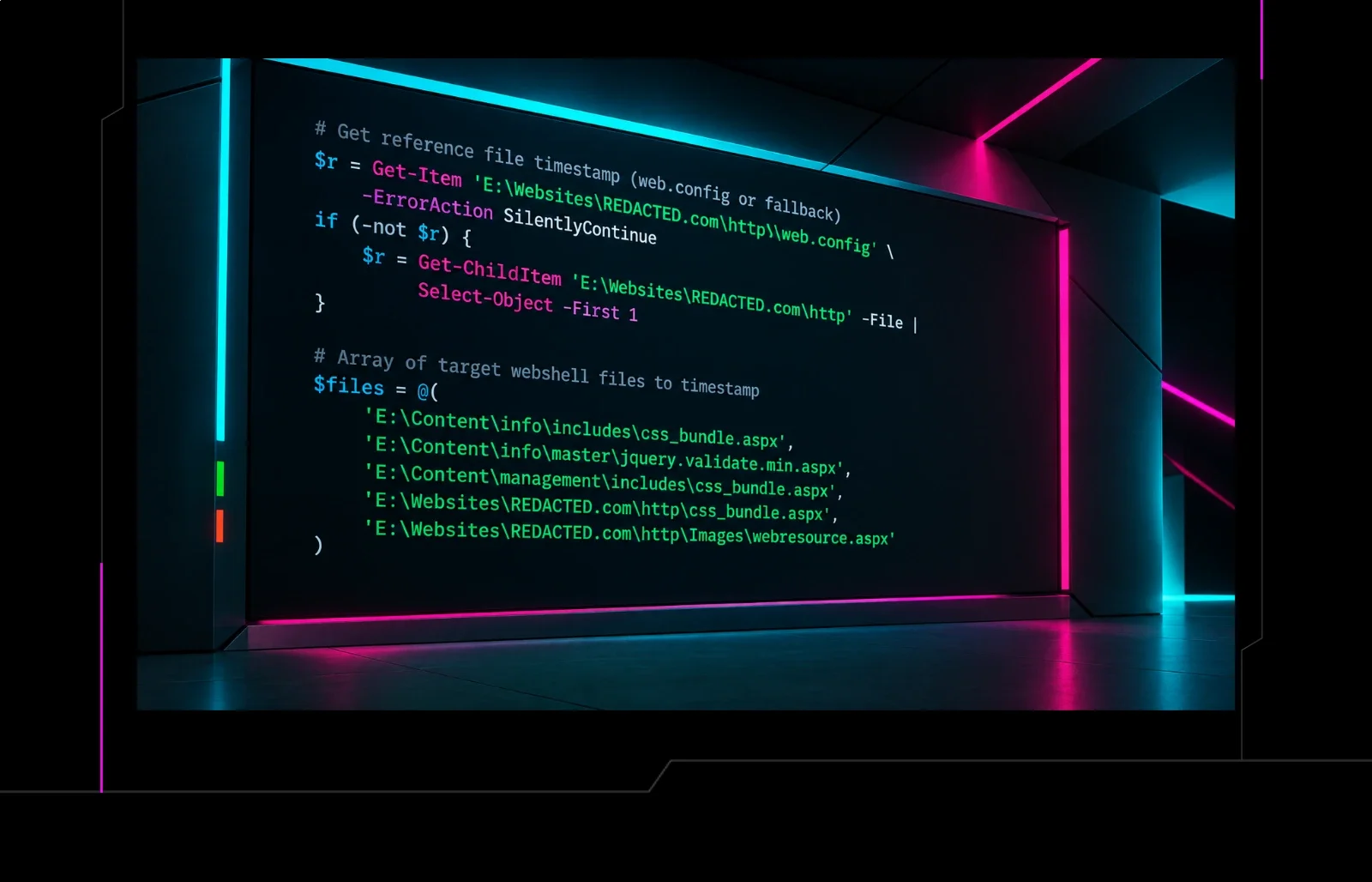
Huntress details a four-act intrusion against a shared parks-and-recreation management platform running on IIS, where an attacker first tried noisy unauthenticated exploits (IIS 8.3 tilde enumeration, WebDAV verb abuse, upload-handler bypasses) before simply registering a member account and uploading .aspx webshells via a member-file upload feature across three servers. The attacker enumerated hosts, extracted web.config/connection strings, hunted for cardholder data (Fortis/MXMerchant webhook logs, CVV/card-number strings), then escalated to timestomping, re-deploying known-filename webshells, and finally injecting an AI-generated PowerShell/JS dropper into a trojanized jQuery file to turn site visitors' browsers into WebRTC/WebSocket C2 clients (ririmochii/bubuneeko Cloudflare Workers infrastructure). Includes a zh-CN PowerShell user-agent string used for attribution and full command/IOC listings useful for detection engineering.
 huntress.comwriteupAdded 1 Oct 2026, published 30 Sep 2026🛡️ Security
 Offensive Security: Pentesting Office Phones with SIPVicious
A Hackers Arise tutorial demonstrates pentesting office VoIP phone systems using SIPVicious against an Asterisk PBX lab set up in Docker. It walks through svmap for service/version fingerprinting, svwar for extension enumeration, and svcrack for password attacks (wordlist, default numeric range, and --enabledefaults), then ties the compromise to real risks like toll fraud and vishing via stolen SIP credentials.
 hackers-arise.comwriteupAdded 7 Oct 2026, published 28 Sep 2026🛡️ Security
- Lonkero — Rust web vulnerability scanner (v3.7, AI agent mode)
Lonkero is an open-source Rust web vulnerability scanner (v3.7) combining 125+ context-aware scanners with an AI agent mode that drives targeted scans via natural-language conversation (using Claude, GPT, or local Ollama models). Notable techniques include a browser-free "proof-based" XSS engine that mathematically proves exploitability from reflection context + escape behavior, an "OOBZero" engine for detecting blind SQLi/SSRF/XXE via Bayesian multi-channel statistical inference and Pearson-correlated timing attacks without external callback infrastructure, Next.js middleware-bypass detection (CVE-2025-29927, CVE-2024-34351), AWS Cognito user-enumeration checks, and a scanner module that detects invisible prompt-injection payloads hidden in README.md files targeting AI coding assistants.
github.comrepoAdded 21 Sep 2026🛡️ Security - Outrider Recon
Outrider Recon is an open-source, Claude-native multi-agent OSINT and external attack-surface recon platform for authorized engagements, covering web/API, identity/SSO, cloud, secrets, and people/breach intelligence. It deliberately stops short of exploitation: active enumeration is approval-gated and intrusive validation is a human hand-off, with deterministic Python controls enforcing scope, evidence integrity, workflow state, and finding promotion around Claude skills and optional MCP-based enrichment. Output is ranked, evidence-backed finding cards (confidence/severity/handoff recommendations) meant to feed proxy-assisted testing or pen-testing rather than raw scanner dumps.
github.comrepoAdded 22 Sep 2026, published 19 Sep 2026🛡️ Security  Threat Hunter's Guide to GitHub (Datadog Security Labs)
Datadog Security Labs walks through hunting for GitHub organization compromise using GitHub audit logs, covering the full attack chain from stolen PATs/OAuth tokens and device-code phishing (initial access) through secrets-listing enumeration, private-repo/tree discovery, and bulk collection via git.clone or repo.download_zip. It provides copy-pasteable queries (with fields like hashed_token, programmatic_access_type, external_identity_nameid) mapped to MITRE ATT&CK techniques and calls out GitHub audit-log quirks (missing IP on failed auth, inconsistent visibility fields, misleading token permission scopes) that shape accurate detections.
 securitylabs.datadoghq.comwriteupAdded 25 Sep 2026, published 16 Sep 2026🛡️ Security
- Huntress: How Attackers Abuse VSS, and How Huntress Detects It
A Huntress blog post breaking down how attackers abuse Windows Volume Shadow Copy Service (VSS) beyond the well-known "delete shadow copies before ransomware detonation" pattern — including creating shadow copies to quietly extract NTDS.dit for credential access, and manipulating shadow copy size/configuration. It details why single VSS events (creation/deletion) are noisy, useless alerts on their own, and describes how Huntress correlates VSSAdmin activity with lateral movement, credential-harvesting commands, and process lineage over a time window, illustrated with a real incident involving PsExec, vssadmin create shadow against a domain controller, a blocked cleanup attempt, and follow-on DNS enumeration.
huntress.comarticleAdded 22 Sep 2026, published 15 Sep 2026🛡️ Security - eldarshiraliyev/BugScanner
BugScanner is an asyncio/httpx Python framework for recon and automated web vulnerability scanning, with a React and FastAPI dashboard. It covers subdomain enumeration (crt.sh, DNS brute force), TCP port scanning, fingerprinting, and modules for XSS, SQLi, CORS, SSRF, open redirect, JWT, IDOR and business logic, plus a Nuclei wrapper. A 5-rule false-positive filter with SPA detection, adaptive rate limiting, WAF detection and SARIF export are included.
github.comrepoAdded 20 Oct 2026, published 5 Sep 2026🛡️ Security 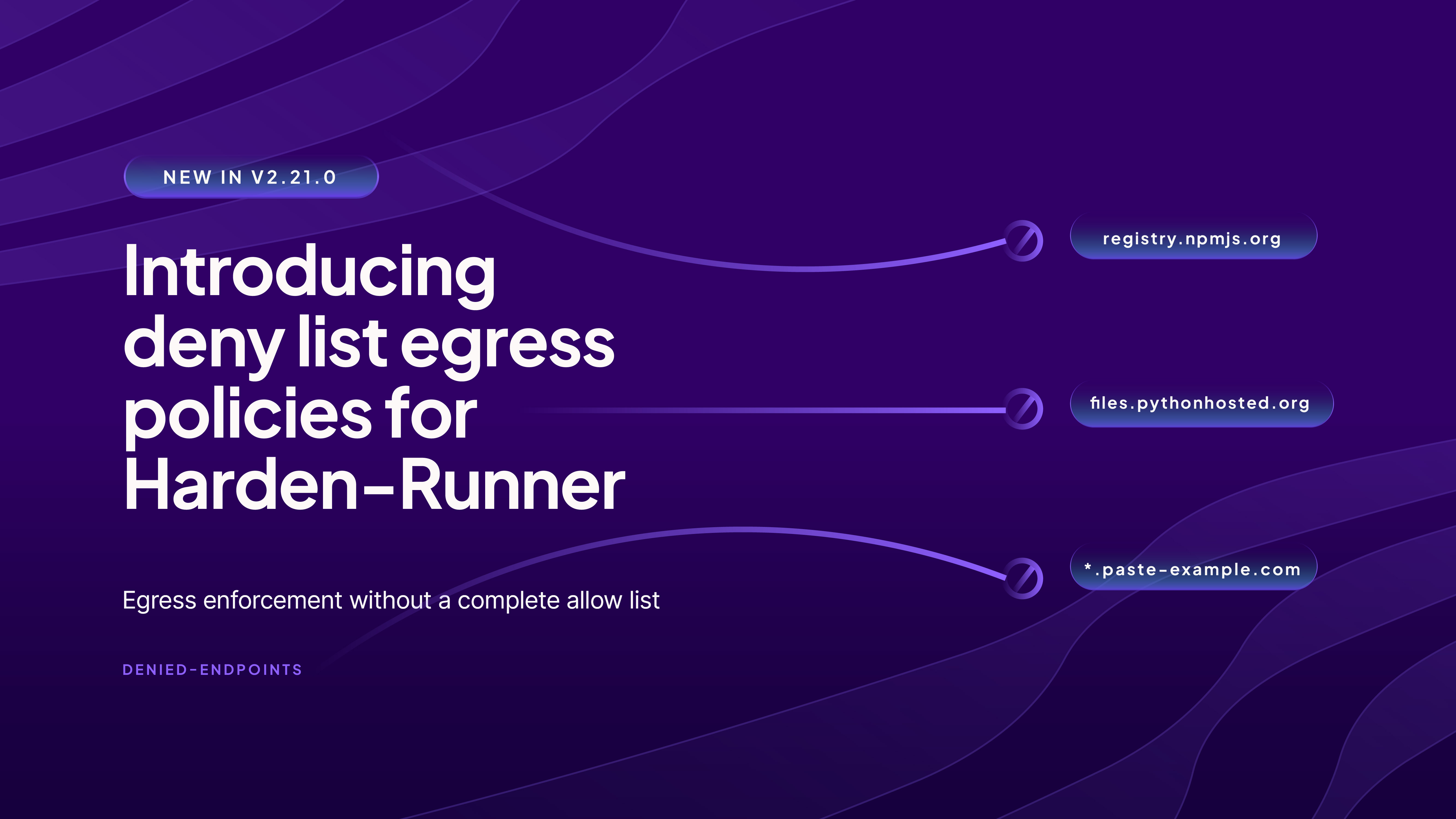 Introducing deny list egress policies for Harden-Runner
StepSecurity's Harden-Runner GitHub Action v2.21.0 adds a denied-endpoints input, letting teams block specific egress destinations (domains, wildcards, bare IPs) from CI jobs while leaving everything else reachable — a lighter-weight alternative to allow lists that don't require full enumeration of a job's needs. The piece details how deny-list entries differ from allow-list ones (no per-port scoping), covers the flagship use case of forcing package installs through StepSecurity's Secure Registry proxy by denying direct access to registries like PyPI and Go module hosts, and explains that Harden-Runner's separately maintained Global Block List (built from SOC threat intel, e.g. the Megalodon credential-exfiltration campaign) is distinct from and complements user-managed deny lists. It also candidly notes the deny list's blind spot: campaigns like Shai-Hulud 2.0 that exfiltrate via github.com itself can't be stopped by a deny list, requiring allow-list enforcement instead.
 stepsecurity.ioarticleAdded 3 Sep 2026, published 2 Sep 2026🛡️ Security
 Dev Machine Guard Now Inventories Where Developer Credentials Live
StepSecurity describes a new Credentials inventory page in Dev Machine Guard that scans developer machines for thirteen well-known credential source types (npm, PyPI, Docker, AWS, GCP, Kubernetes, Vault, GitHub, SSH keys, etc.) across five categories and reports how many devices hold each, how many entries exist, and whether the material is stored in plaintext or protected. It frames the feature against real attacker behavior - the TeamPCP stealer in the xinference PyPI package and the hijacked Bitwarden CLI npm package both enumerated this exact list of well-known dotfile paths - arguing defenders need the same enumeration attackers already have to scope incidents and plan rotations.
stepsecurity.ioarticleAdded 3 Sep 2026, published 28 Aug 2026🛡️ Security- subScraper
subScraper is a self-contained, single-file (main.py) Python orchestrator that chains subdomain enumeration tools (Amass, Subfinder, Assetfinder, Findomain, Sublist3r) into httpx probing, screenshot capture, ffuf fuzzing, nuclei, and nikto scans, all driven from a live web UI with resumable job state, worker concurrency controls, and Docker packaging. It ships 34 custom nuclei templates for CVEs lacking official coverage and exposes a scoped, API-key-authenticated "bug bounty agent API" for programmatic recon and attack-surface queries against a target's scope.
github.comrepoPublished and added 27 Aug 2026🛡️ Security - Rekono
Rekono is an open-source pentesting automation platform that chains 19 hacking tools (Nmap, Nuclei, Metasploit, OWASP ZAP, Nikto, Gitleaks, SearchSploit, etc.) so that output from one tool feeds the next, automatically covering recon, service enumeration, vulnerability scanning, and exploit correlation. It deduplicates findings into a single attack-surface inventory per host/port, enriches CVEs with community context for prioritization, tracks fixed/reopened vulnerabilities, and supports team collaboration, scheduled scans, Telegram/email alerts, and report generation for engagements.
github.comrepoAdded 3 Sep 2026, published 27 Aug 2026🛡️ Security  Web Fuzzing for Hackers
A practical guide to web fuzzing for bug bounty hunters, covering wordlist selection (custom vs. SecLists-style generic lists), and tool-specific configuration for content discovery, subdomain/VHost enumeration, and parameter/header discovery using ffuf, Burp Suite Intruder, OWASP Amass, dnsx, Arjun, and Param Miner. It details concrete techniques such as subdomain permutation patterns, extension fuzzing for leftover files (.md, .env, .sql), dotfile/prefix patterns (/.FUZZ, /-FUZZ, /~FUZZ), IIS-specific extensions (.asmx, .ashx, .aspx.bak), and hidden-header fuzzing (X-Forwarded-For, X-Debug, X-HTTP-Method-Override) that can lead to SQLi, cache poisoning, or access-control bypass.
 intigriti.comarticleAdded 3 Sep 2026, published 21 Aug 2026🛡️ Security
- Akira Hits Safe Mode: Ransomware Rebooting Around EDR
Huntress details an Akira ransomware intrusion from August 2026 that followed the group's usual SonicWall SSL VPN → domain controller → AD enumeration → WinRAR/s5cmd exfiltration → detonation playbook, but with a new twist: the affiliate ran msconfig.exe to force a reboot into Safe Mode with Networking (MITRE T1688), which killed the Huntress agent and Windows Defender real-time protection while preserving network access, after pre-registering an AnyDesk service to survive the minimal Safe Mode driver set. The blog notes Safe Mode's constrained virtual memory appears to have caused akira.exe to crash with out-of-memory errors, accidentally sabotaging the attacker's own encryption run, and closes with detection guidance for boot-configuration changes, Safe Mode Kernel-Boot/Kernel-General event IDs, and Safe Boot registry tampering.
huntress.comwriteupAdded 3 Sep 2026, published 12 Aug 2026🛡️ Security - thewhiteh4t/FinalRecon
FinalRecon is a Python-based OSINT/reconnaissance tool for web targets, gathering header info, whois data, SSL certificate details, crawling, DNS enumeration, subdomain discovery, port scanning, and directory search in a single utility. It's commonly used during the recon phase of web application pentests to consolidate multiple footprinting techniques into one CLI tool.
github.comrepoPublished and added 31 Jul 2026🛡️ Security - Python OSINT Toolkit for Telegram
A Hackers-Arise walkthrough for building a custom Telegram OSINT toolkit in Python using Telethon's MTProto API instead of the limited Bot API, enabling full message-history access, group member enumeration (up to 200/request), and message/engagement metadata collection. The toolkit also extracts EXIF/GPS metadata from downloaded media (via Pillow/piexif) to geolocate targets, persists results in SQLite via aiosqlite, and exposes everything through a Click CLI with modules for profile, members, messages, and media lookups.
hackers-arise.comarticleAdded 3 Sep 2026, published 31 Jul 2026🛡️ Security - ShadowHodks
ShadowDorks is a free browser-based tool that generates over 1000 advanced Google dork queries for a target domain, covering categories like exposed admin panels, subdomain enumeration, and API key/credential leaks. It's built for pentest recon and OSINT reconnaissance workflows, letting a user paste a domain and copy ready-to-search dork strings.
 shadohdorks.vercel.apptoolAdded 3 Sep 2026, published 31 Jul 2026🛡️ Security
- Speeding Up AD Pentests with ADScan & ADPulse
Walkthrough of two Active Directory pentesting utilities: ADScan, a Docker/BloodHound-integrated tool for automated DNS/LDAP/SMB/Kerberos enumeration and attack (Kerberoasting, AS-REP roasting, DCSync, password spraying, ADCS escalation path discovery, DACL/GenericAll abuse via SDProp misconfig), and ADPulse, a read-only LDAP/LDAPS auditing tool that produces CLI/JSON/HTML security posture reports for AD environments. The piece demonstrates installation on Kali and a worked example where a low-privileged account is shown to have GenericAll rights over Domain Admins, plus checks for known DC vulnerabilities like Zerologon and NoPac.
hackers-arise.comwriteupAdded 3 Sep 2026, published 31 Jul 2026🛡️ Security - OpenOSINT
OpenOSINT is a Python OSINT agent that wraps 20 investigation tools (holehe for email enumeration, sherlock for username lookup, sublist3r for subdomain enumeration, phoneinfoga for phone intel, plus HaveIBeenPwned, Shodan, VirusTotal, Censys, AbuseIPDB, IP2Location, DNS/SPF/DMARC checks, GitHub, and Bright Data-powered dorking/scraping) behind a natural-language AI interface that issues deterministic tool calls so findings can't be hallucinated. It ships as a REPL, CLI, MCP server (usable from Claude Code/Desktop, Cursor, Windsurf), or browser web UI, with an optional additive FollowTheMoney entity graph for correlating findings and pivoting between investigation results, plus documented reverse-proxy/credential-handling behavior for remote deployments.
github.comrepoPublished and added 31 Jul 2026🛡️ Security - elementalsouls/Claude-OSINT
Claude-OSINT is a library of 8 drop-in Claude Skills (SKILL.md files, ~10,000 lines) that turn Claude/Claude Code into a structured external-recon operator for authorized red-team and bug-bounty engagements. The core pair (osint-methodology, offensive-osint) covers a 6-stage recon pipeline, an 80-pattern secret scanner, 80+ dorks, and read-only credential validators, while six organization-grade skills add legal-entity-to-footprint mapping, SPF/email-spoofability analysis, FAIR-based dollar risk scoring, continuous exposure re-scan/diff monitoring, cloud/SaaS and dependency-confusion checks, and identity-provider tenant/user-enumeration with explicit hard scope boundaries (no password spraying, no active exploitation).
github.comrepoPublished and added 31 Jul 2026🛡️ Security 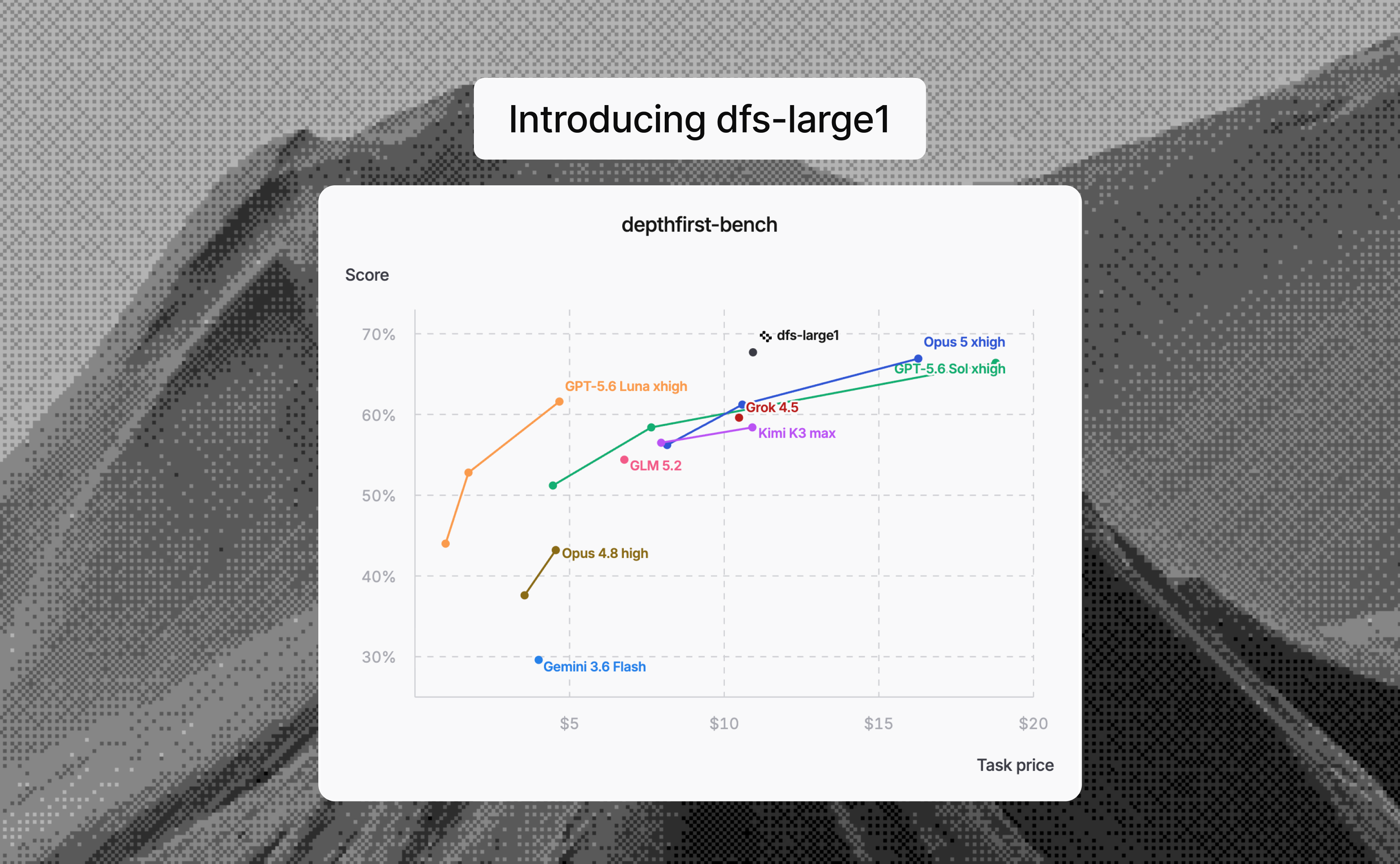 Introducing dfs-large1: A New Frontier for Cybersecurity | depthfirst
dfs-large1 is depthfirst's vulnerability discovery and validation model, post-trained from GLM 5.2 with multi-task RL inside its security agent harness, in partnership with Fireworks AI. The report covers the reward design (effort penalty, finding budget), masked importance-sampling optimization, task-level advantage normalization, summarization-based context compaction and the sandboxed evaluation setup. It reports that the learned audit strategy moved from broad enumeration to hypothesis testing with executable harnesses. Benchmark numbers and the dfbench methodology are not given.
 depthfirst.comarticleAdded 29 Oct 2026, published 30 Jul 2026🛡️ Security
- PentesterFlow/agent
PentesterFlow is an open-source terminal AI agent for authorized offensive-security engagements, connecting to local or hosted LLMs (Ollama, LM Studio, Anthropic, Gemini, DeepSeek, Groq, OpenRouter, etc.) to plan and execute recon, enumeration, vulnerability validation, and evidence-backed reporting against a scoped target. It gates sensitive actions behind analyst approval, bridges with Burp Suite for traffic capture/finding import via a local listener and companion MCP server, and maintains persistent project/personal memory (redacting secrets) to carry lessons and coverage state across sessions. The demo walks through discovering and confirming an IDOR on an orders API and writing findings to a local markdown report.
github.comrepoPublished and added 29 Jul 2026🛡️ Security  The risk hiding behind exposed MCP servers
Wiz Research scanned MCP servers across cloud environments and found roughly 1 in 6 environments expose at least one server to the Internet, most unauthenticated and still running the pre-auth 2024-11-05 protocol version. They demonstrate anonymous tool-catalog enumeration, real data returned from production databases/CRM/IAM backends, write/delete-capable tools, and confirmed SSRF against cloud instance metadata endpoints yielding temporary credentials, plus agents that can be talked into unsafe actions by reframing requests as "routine maintenance."
wiz.iowriteupAdded 3 Sep 2026, published 28 Jul 2026🛡️ Security- Bug Bounty Lab101
Bug Bounty Lab101 is a workspace that structures the real HackerOne bug bounty workflow: document program scope, run scope-gated recon/vuln scanning via bugbounty-hunter.sh (backed by a 400+ tool arsenal spanning recon, DNS enumeration, web scanning, exploitation, and cloud/subdomain-takeover checks), then produce a triage-ready H1 report with Hacktivity dedup checks. It also integrates T3MP3ST, a separate multi-agent offensive framework that connects local AI coding agents (Claude Code, Codex) to automate target investigation, and ships a legacy-vm-practice lab (DVWA/Metasploitable-style) for safe skill-building outside real program scope.
github.comrepoPublished and added 25 Jul 2026🛡️ Security


Showing 30 of 44
Show more