 Pentesting: Twelve Caesars – Community Tools for Offensive Security
Hackers Arise walks through four tools from Praetorian's "12 Caesars" open-source release: Titus (secret scanner with 487 rules and credential validation), Nerva (fingerprints 170 protocols), Brutus (Hydra alternative covering 40+ protocols) and Julius (fingerprints 60+ LLM services such as Ollama). It shows download and run commands in a Kali lab and how the tools chain together. The tools are Go single binaries; the post notes an exposed Ollama on port 11434 allows unauthenticated model use.
 hackers-arise.comarticlePublished and added 27 Oct 2026🛡️ Security
- Artificial Intelligence (AI) in Cybersecurity, Part 30: Shannon – AI Pentester for Web Apps and APIs
Shannon is a white-box AI pentester (@keygraph/shannon) that analyzes an application's source code, then attacks the running instance and reports only findings with a working PoC. The Hackers Arise tutorial runs it against OWASP Juice Shop in Docker on Kali, using OpenRouter (free Nemotron) and local Ollama (Qwen 2.5 Coder 7B) via a models.json file. Output includes PDF, Markdown, JSON and SARIF reports.
hackers-arise.comarticlePublished and added 26 Oct 2026🛡️ Security  Prasenjit Sarkar (@stretchcloud) on X
Post on the LiteLLM supply-chain compromise. Attackers spent eleven days in the GitHub org, ran a workflow on a throwaway branch to take twenty secrets including a GitHub App private key, then used stolen GitHub CLI OAuth tokens to publish malicious release 1.107.0 from a lookalike Berri-AI repo. A Python startup file harvested sixteen credential categories and LiteLLM proxy Postgres provider keys. Socket flagged the wheels in seven minutes.
 x.comthreadAdded 26 Oct 2026, published 24 Oct 2026🛡️ Security
 LiteLLM Compromised in Fresh Supply Chain Attack
LiteLLM version 1.107.0 was published with malware to PyPI and Docker Hub on October 21, for about three hours and roughly 49,000 downloads. Attackers used GitHub CLI OAuth tokens, likely leaked through Claude Code into LiteLLM logs, to disable branch protections, redirect the releaser to a lookalike repository and sign poisoned artifacts. The payload is an infostealer and RAT; Wiz saw Amazon Bedrock abuse. The last clean version is 1.106.2.
 securityweek.comarticlePublished and added 23 Oct 2026🛡️ Security
- Dark Web Intelligence (@DailyDarkWeb) on X
LiteLLM suspects its October 21 release compromise began with Claude Code responses containing GitHub CLI OAuth tokens that were written to logs of an internet-facing internal LiteLLM gateway. Attackers allegedly stole those tokens, used an organization-owner token to disable branch protections, and pushed poisoned artifacts from a lookalike repository. How they entered the gateway is unconfirmed, and this is not a proven Claude Code vulnerability.
x.comthreadAdded 25 Oct 2026, published 22 Oct 2026🛡️ Security - Unboxing Phishing Kits: Huntress Examines 3 Real Kits
Recap of a Huntress Tradecraft Tuesday session (October 2026) on phishing kits that target Microsoft 365 tokens, including EvilTokens (a device-code phishing campaign abusing Railway) and the Kali365 control panel. It explains device-code phishing, adversary-in-the-middle and token replay. It lists detections (unfamiliar cloud sign-ins, device-code auth, new devices) and response steps (revoke refresh tokens, remove rogue devices, block device-code flow).
 huntress.comarticlePublished and added 22 Oct 2026🛡️ Security
 LiteLLM Compromised, Steals Credentials
LiteLLM version 1.107.0 was uploaded to PyPI on 21 October 2026 with a credential stealer, and the same build reached GHCR and Docker Hub images. Wiz describes the three dropped files (cook.pth, cook.py, sitecustomize.py), exfiltration to a fake litellm.dev domain, a GitHub dead drop for a second stage, and the malicious commits pushed through the lookalike Berri-AI repository. The last safe version is 1.106.2.
 wiz.iowriteupPublished and added 21 Oct 2026🛡️ Security
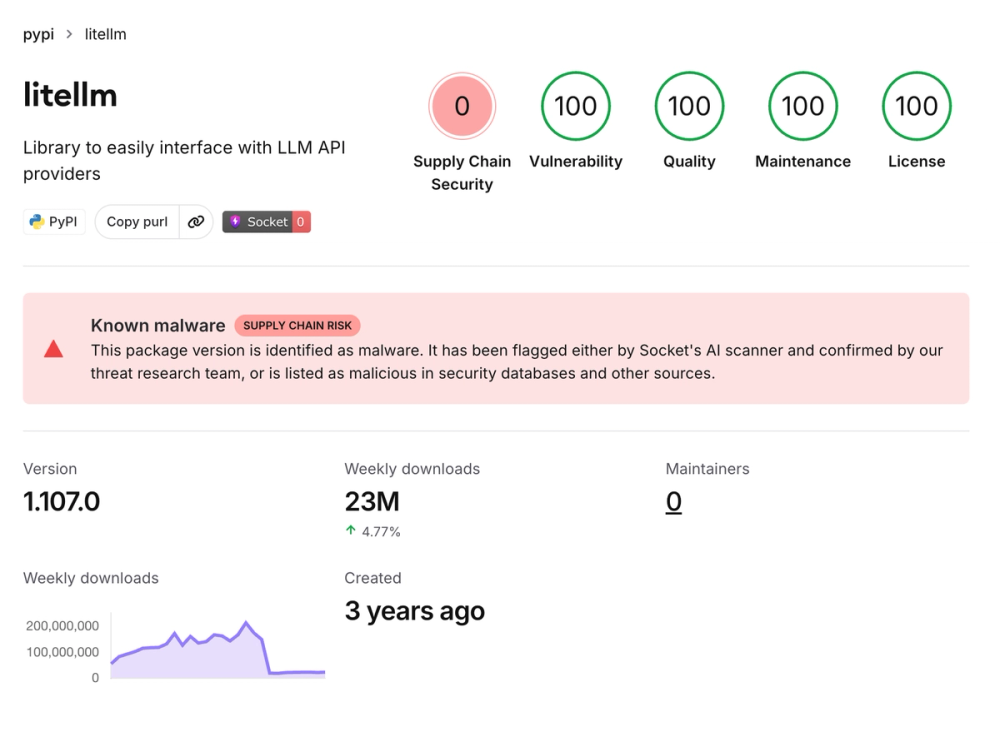 LiteLLM PyPI Package and Docker Images Compromised to Steal Cloud and AI Credentials
LiteLLM 1.107.0 on PyPI and GHCR images shipped Python startup hooks (cook.pth, sitecustomize.py) that steal cloud, SSH, browser and AI-tool credentials, including LiteLLM proxy database credentials. Image build provenance recorded a lookalike Berri-AI/litellm source repository. The post decodes the payload, encrypted exfiltration and GitHub-driven remote loader, and lists containment steps, MITRE ATT&CK mappings and IOCs.
 socket.devwriteupPublished and added 21 Oct 2026🛡️ Security
 LiteLLM supply chain compromise: What you need to know
LiteLLM version 1.107.0 was published to PyPI and official Docker images on 21 October 2026 and stayed live for about two hours. Attackers used stolen GitHub CLI OAuth tokens from three engineers to run the release pipeline against a lookalike fork, Berri-AI/litellm. The payload (cook.pth, cook.py, sitecustomize.py) steals cloud, developer, AI-tool and browser credentials, and includes a polling RAT. The post lists removal and rotation steps.
 securitylabs.datadoghq.comwriteupAdded 29 Oct 2026, published 21 Oct 2026🛡️ Security
 FastFix AI (@FastfixAI) on X
FastFix AI thread giving six checks before installing a plugin, MCP server or skill for a coding agent. It starts from a 300K-star repo that an agent found writing to Claude Code, Codex and Copilot configs on install. Checks: read before running, inspect npm install scripts, verify the real repo against lookalike trojaned copies, pin versions, diff agent configs, and limit tokens and permissions.
x.comthreadAdded 19 Oct 2026, published 18 Oct 2026🛡️ Security- Artificial Intelligence (AI) in Cybersecurity, Part 29: Creating Isolated Autonomous Agents for Hacking with NemoClaw
Hackers-Arise tutorial on NVIDIA NemoClaw, an open-source wrapper that runs OpenClaw agents inside OpenShell sandboxes with kernel-level isolation and declarative YAML network/file policies. It covers OpenClaw's security problems (543 tracked CVEs, 40,000+ exposed instances bound to 0.0.0.0 without auth), caveats such as zero-day RCE and sandbox escapes, and install and TUI testing steps on Kali. It also cites a Cisco AI Defense plus OpenShell case study that blocked simulated exfiltration through a third-party skill.
hackers-arise.comarticlePublished and added 14 Oct 2026🛡️ Security - Fake WatchGuard VPN Site Steals Credentials
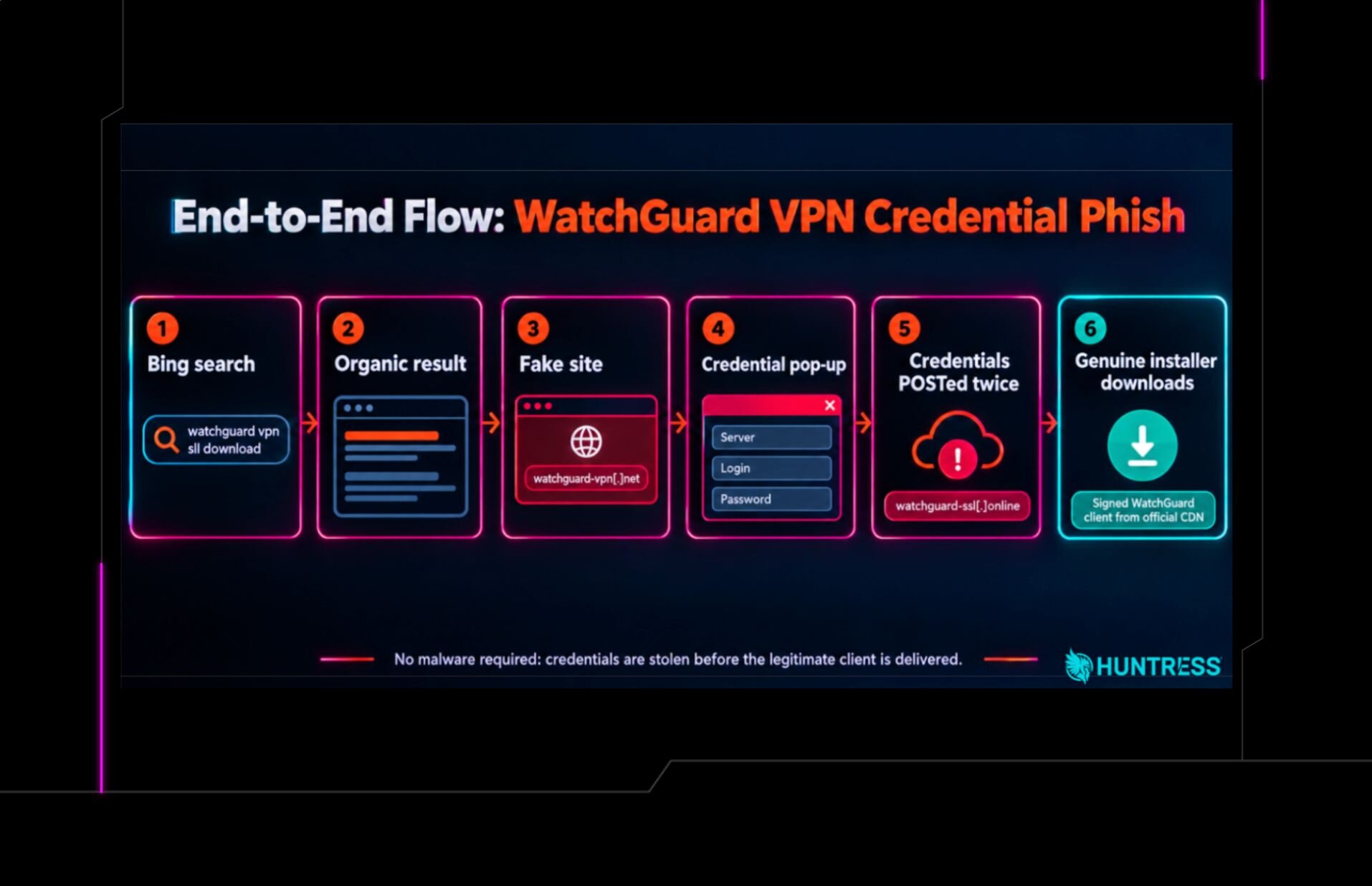
Huntress analyzes an October incident where an admin searching Bing for a WatchGuard VPN download landed on watchguard-vpn[.]net, a lookalike site whose popup.js harvests Server/Login/Password, deliberately rejects the first submission to get a second set, and posts to watchguard-ssl[.]online. Unlike earlier iterations (Secplicity, Microsoft Storm-2561), the final payload is the genuine, validly signed WatchGuard installer from the official CDN, so no malware is present for endpoint tools to flag. Covers infrastructure timeline, thin VirusTotal detections, and defender guidance (MFA, monitoring VPN logins from hosting ASNs, blocking domains, publishing official download links).
huntress.comwriteupAdded 14 Oct 2026, published 13 Oct 2026🛡️ Security - Artificial Intelligence (AI) in Cybersecurity, Part 28: Using ADStrike to Compromise Active Directory
ADStrike is an Active Directory attack framework with 52 attack modules and configurable OPSEC levels. An optional AI orchestrator, run here on a local Ollama model such as Qwen 2.5-coder 7b, picks the next tool from each step's output. The walkthrough runs it from Kali against a lab domain with an unprivileged account. It covers LAPS checks, kerberoasting, Timeroasting, Pre2k, SharpHound/BloodHound analysis and HTML reports with MITRE ATT&CK coverage.
hackers-arise.comwriteupPublished and added 12 Oct 2026🛡️ Security - CUDA Basics for Hackers, Part 1: Getting Started
First part of a Hackers-Arise series teaching CUDA (NVIDIA Compute Unified Device Architecture): installing the CUDA toolkit and nvcc compiler on Kali or Debian-based Linux, writing a basic CUDA C++ kernel, and compiling and running a simple parallel vector-addition program. It explains GPU threading concepts (kernels, thread blocks, grids) and frames CUDA as foundational to AI workloads and to future security applications like password cracking, real-time threat detection and post-quantum cryptography, though those applications are only listed, not demonstrated, here.
hackers-arise.comwriteupAdded 7 Oct 2026, published 6 Oct 2026🛡️ Security  The Blue Agent POV: Investigating Multi-Platform Data Exfiltration Across AWS and GitHub
Wiz walks through a case study of its "Blue Agent" autonomous SOC investigator tracing a compromised CI/CD service account (svc_automation) across AWS and GitHub. The attack chain: a stolen GitHub token cloned 18 private repos containing hardcoded AWS keys, which were used to authenticate to AWS from Kali Linux via a Zenlayer VPN IP, pivot to a second account, run SSM SendCommand against a production Windows domain controller, and stage custom Python exfiltration scripts (mssql_table_export.py, pg_table_export.py, billing_export2.py) in S3 to pull data from MSSQL, PostgreSQL, and billing systems. The piece details the investigative technique used - 30-day baseline comparison, ASO/IP dispersion across the tenant, and correlating CloudTrail management-plane events with S3 data-plane events and GitHub audit logs.
wiz.iowriteupPublished and added 29 Sep 2026🛡️ Security Malicious Firefox Extension Poses as PDF Identity Verifier to Hijack Google Accounts
Socket's Threat Research team dissects a malicious Firefox extension (pdf-para-texto@extensao.local, "PDF Identity Verifier") that ships with no hardcoded malicious code — all attack logic is fetched as data into browser.storage.local after install via a lookalike domain (pdf.gusercontent.com), evading static store review. Once armed, it abuses Google's FedCM API to silently identify the victim, injects a live automation script into real accounts.google.com pages to drive an invisible account-takeover flow (bypassing password entry, forcing passkey challenges, dodging Google's bot detection, and forcing/capturing a password reset), while a webRequest listener steals the oauth_token session cookie from Set-Cookie headers — giving the attacker both a live session and a durable new password. The campaign targets Portuguese- and Spanish-speaking users starting September 2026 and includes full IOCs (domains, file hashes) and remediation steps.
socket.devwriteupPublished and added 23 Sep 2026🛡️ Security Attacker infrastructure, but vibe-coded: tracking the evolution of credential harvesting platforms
Datadog Security Research analyses two vibe-coded credential harvesting platforms, Loot and UltraVault, monitored since July 2026. Loot catalogs plaintext secrets, including 1,778 AI keys (196 live). UltraVault adds credential validation, exploit chains, a 14-bug LPE matrix and AWS key-pair correlation. The same host probed Amazon Bedrock with GetCallerIdentity, ListFoundationModels and InvokeModel, using kali-cloud Boto3 and Python-urllib user agents.
securitylabs.datadoghq.comwriteupAdded 29 Oct 2026, published 18 Sep 2026🛡️ Security- Device Code Phishing Keeps Evolving. Here’s What to Watch For
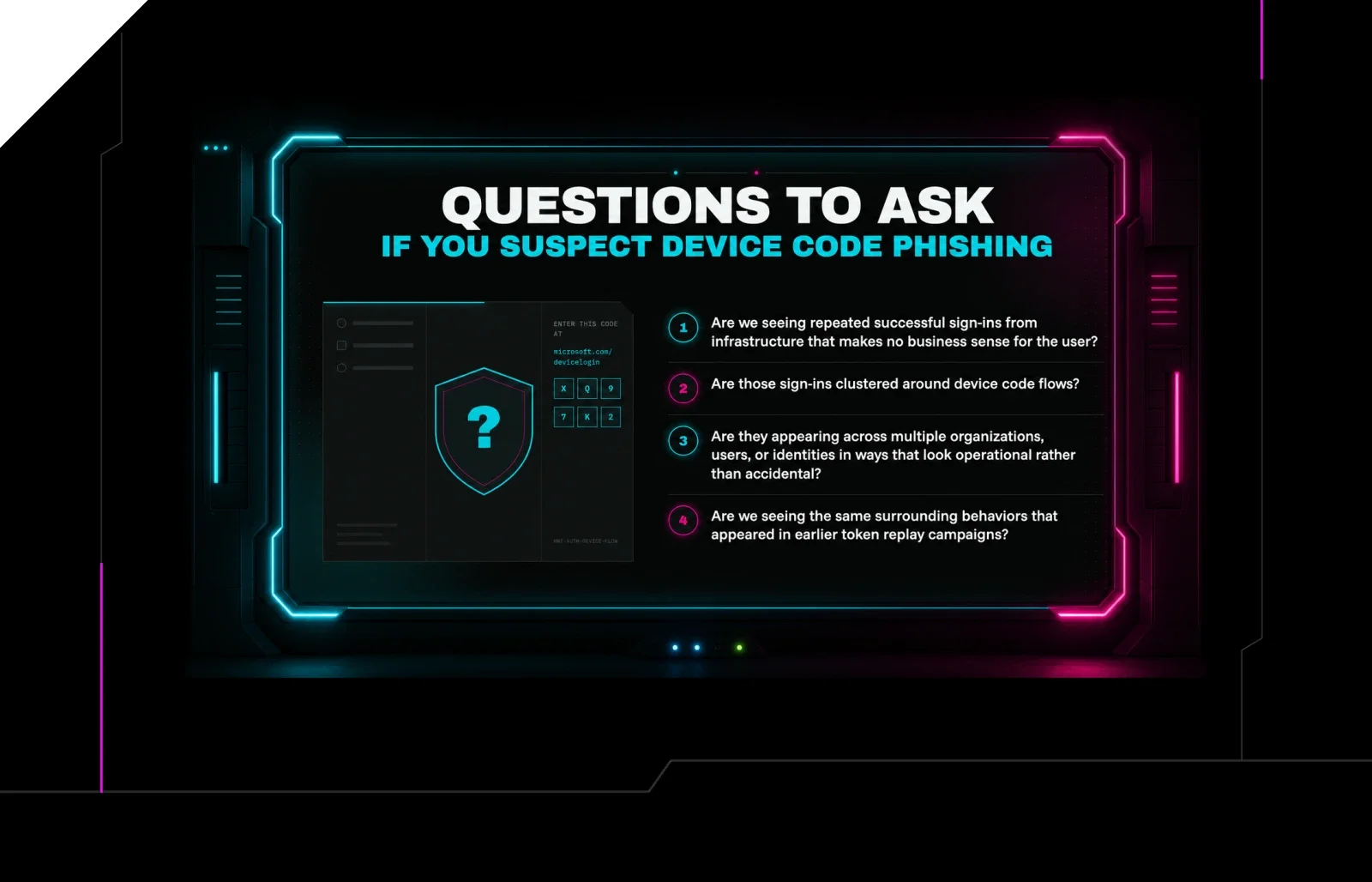
Huntress details a second 2026 wave of device code phishing against Microsoft 365, this time abusing VPS reseller BL Networks (BitLaunch/BLNWX, AS399629) after an earlier wave tied to Railway and the EvilTokens phishing-as-a-service kit. Huntress observed 533 malicious events and 113 successful logins from a single BL Networks IP in April, spreading across multiple IPs and subnets by May, with 26 critical incidents across 23 identities logged in July, and argues defenders must stop trusting infrastructure reputation and instead hunt for anomalous device-code sign-in clusters and revoke tokens quickly. It ties the activity to the broader legitimate-cloud-plus-legitimate-Microsoft-auth-page attack pattern also seen with Railway, EvilTokens, and Kali365.
huntress.comwriteupAdded 3 Sep 2026, published 31 Jul 2026🛡️ Security - Speeding Up AD Pentests with ADScan & ADPulse
Walkthrough of two Active Directory pentesting utilities: ADScan, a Docker/BloodHound-integrated tool for automated DNS/LDAP/SMB/Kerberos enumeration and attack (Kerberoasting, AS-REP roasting, DCSync, password spraying, ADCS escalation path discovery, DACL/GenericAll abuse via SDProp misconfig), and ADPulse, a read-only LDAP/LDAPS auditing tool that produces CLI/JSON/HTML security posture reports for AD environments. The piece demonstrates installation on Kali and a worked example where a low-privileged account is shown to have GenericAll rights over Domain Admins, plus checks for known DC vulnerabilities like Zerologon and NoPac.
hackers-arise.comwriteupAdded 3 Sep 2026, published 31 Jul 2026🛡️ Security - awesome-osint-arsenal
An awesome-list repo that claims 753+ OSINT and security tools across 50 categories. Sections cover username, email, phone, domain/IP, geolocation, image, breach-search, dark web, web scanning and password-cracking tools, plus red team, blue team, DFIR, hardware and training sections. It ships multi-distro installer scripts (install.sh, osint.sh, redteam.sh, blueteam.sh, forensics.sh, hardware.sh, labs.sh, termux.sh) for Kali, Debian and Ubuntu, with partial Arch/Fedora support and a Termux subset. It also gives short usage walkthroughs such as a subfinder + amass + httpx recon chain. Some entries are dual-use (people search, face recognition, phone exploitation, IP camera dorking), and the README says the repo is for authorized research only.
 github.comrepoPublished and added 31 Jul 2026🛡️ Security
- Claude as Autonomous Bug Bounty Hunter
Author describes Aii-Aii Hunter, a bug bounty framework built on Claude Code with 124 markdown skills (35.5k lines distilled from public HackerOne reports), three hooks (UserPromptSubmit regex auto-routing, PreToolUse scope.json guard, PostToolUse telemetry) and a Podman Kali container exposing 110 tools plus 18 Burp tools over MCP. It also covers an engagement flow with a 7-Question validation gate, evidence hygiene, an autopilot mode, and SAST/DAST correlation. Useful as a blueprint for scoped, AI-orchestrated offensive workflows; first of six parts with a companion repo.
 medium.comarticleAdded 3 Sep 2026, published 30 Jul 2026🛡️ Security
- Claude as Autonomous Bug Bounty Hunter
A Medium write-up on turning Claude Code into an autonomous bug bounty agent. The setup combines 124 custom skills, three hooks and a Kali Linux container for vulnerability discovery and reporting. It is a practitioner example of structuring a Claude Code harness with skills, hooks and a sandboxed tool environment. Only the blurb was available, so implementation details are unverified.
medium.comwriteupAdded 10 Oct 2026, published 30 Jul 2026🧠 AI  Dependency Confusion: How Attackers Poison Your Build | Blog | Endor Labs
Endor Labs explainer breaking down three "tree poisoning" techniques in the open-source dependency tree: dependency confusion (public package impersonating a private one, exploiting "highest version wins" resolver logic, as in Alex Birsan's 2021 research against 35+ companies and PyTorch's 2022 torchtriton nightly-build compromise), typosquatting/combosquatting (human-error-driven lookalike package names, extended by AI-invented "slopsquatting"), and package poisoning/hijacking (maintainer account takeover or handoff abuse, as with event-stream in 2018, the XZ Utils backdoor in 2024, and the Shai-Hulud npm worm). It closes with concrete defenses: reserving package namespaces, pinning private registries, lockfiles/checksum verification, scrubbing internal names from public sources, and package firewalls with behavioral malware detection.
 endorlabs.comarticleAdded 3 Sep 2026, published 29 Jul 2026🛡️ Security
 Compromised Injective SDK npm Package Exfiltrates Wallet Keys and Mnemonics
Socket details a compromise of @injectivelabs/sdk-ts version 1.20.21 (a popular Injective Labs TypeScript SDK with ~50,000 weekly downloads), in which the fromMnemonic and fromHex key-derivation functions were hooked with a trackKeyDerivation call that base64-encodes and exfiltrates wallet private keys and mnemonic phrases to a lookalike Injective public infrastructure endpoint. The attacker gained access via a legitimate maintainer's GitHub account, published the malicious version, and simultaneously pushed version 1.20.21 to 17 other @injectivelabs-scoped packages pinned to the compromised SDK, amplifying blast radius to transitive dependents. The compromise was detected and reverted within roughly an hour by the account owner, but the malicious release artifacts remained downloadable on npm and GitHub at time of writing.
socket.devadvisoryAdded 21 Sep 2026, published 9 Jul 2026🛡️ Security Maven Support Comes to GitHub Checks and OSS Package Search
StepSecurity extends its GitHub Checks and OSS Package Search products to cover Maven Central, adding "Maven Package Compromised Updates" and "Maven Package Cooldown" PR checks alongside existing npm/PyPI controls. The post cites two real incidents motivating the launch: the Shai-Hulud worm's second wave reaching Maven Central through an automated npm-to-Maven republishing pipeline, and a malicious namespace-impersonating lookalike of the Jackson JSON library that used an obfuscated multi-stage payload to deliver Cobalt Strike. Secure Registry and Dev Machine Guard Maven support are announced as coming next.
 stepsecurity.ioarticleAdded 3 Sep 2026, published 1 Jul 2026🛡️ Security
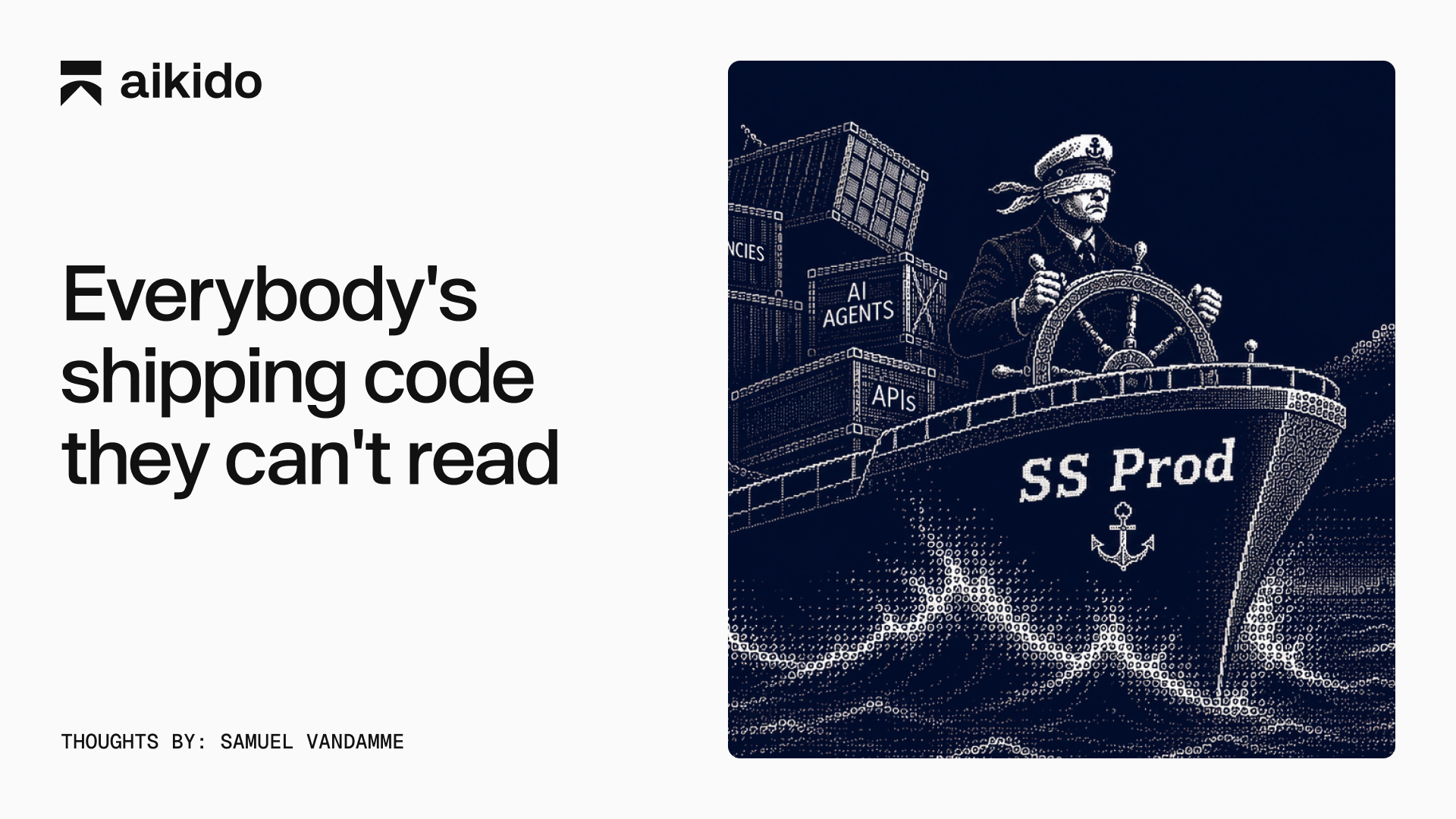 Everybody's shipping code they can't read
An Aikido Security blog post arguing that AI coding agents (e.g. Claude Cowork-style tools) now install npm dependencies on a user's behalf without any human reviewing what gets pulled in, citing the recent @mastra ecosystem attack where 141 packages were republished in a 45-minute burst with a malicious date-library lookalike that dropped a wallet-stealing payload and self-deleted. It also flags "slopsquatting," where attackers preemptively register package names that LLMs are known to hallucinate, and argues trust decisions need to move to install-time blocking rather than manual diff review.
 aikido.devarticleAdded 3 Sep 2026, published 25 Jun 2026🛡️ Security
- Reverse-Skill
Reverse-Skill is a GitHub repo that gives AI coding agents (Claude Code, Codex, Cursor, OpenCode) a structured routing layer for reverse engineering and offensive security work: it detects the task type (APK, ELF binary, JS obfuscation, PCAP, CTF challenge) and routes to the correct methodology and toolchain (jadx, apktool, Frida, IDA Pro, Ghidra, radare2, Burp Suite, nmap, Metasploit) instead of letting the agent guess commands. It ships a case-init/scope workflow, an evidence-to-finding-to-report pipeline, a 173-case routing regression test run in CI on Windows and Ubuntu, and platform-specific docs for Kali/Ubuntu/macOS, positioned for lawful research, CTF, and authorized pentesting.
github.comrepoPublished and added 21 Jun 2026🛡️ Security - Inside Kali365, a Device Code Phishing Ecosystem | Huntress
Huntress SOC investigation into Kali365 (also seen as Octopi365/Freedom365), an AI-enabled Phishing-as-a-Service kit that abuses the Microsoft device-code authentication flow to steal M365 tokens and maintain persistent mailbox access even after password resets. The writeup dissects three panel editions (base AiTM/device-code capture, a post-compromise BEC/fraud module using Claude for drafting wire-transfer scam replies, and a self-service reseller tier with crypto billing via OxaPay), and reverse-engineers the companion Electron desktop apps OctoLink Live and OctoLink Sender, which exchange stolen refresh tokens for real ESTSAUTH session cookies to drive undetected Graph mail-sending and admin-portal access — tactics overlapping with Microsoft's Storm-2372 reporting. Includes IoCs and a KQL hunting rule for detecting device-code abuse.
huntress.comwriteupAdded 3 Sep 2026, published 11 Jun 2026🛡️ Security 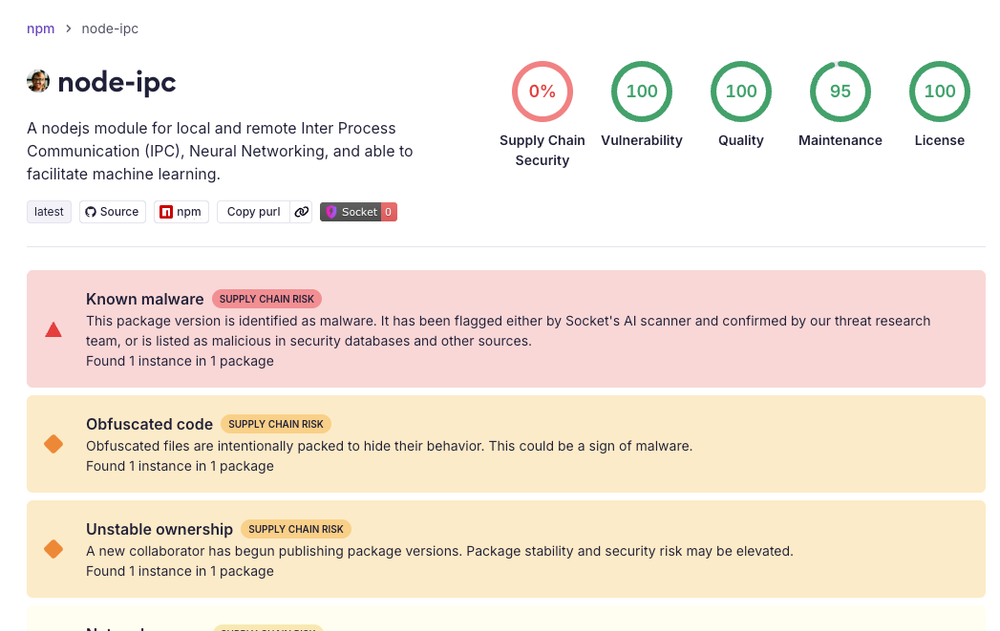 Socket: node-ipc npm Package Compromised
Socket's threat research team details a fresh compromise of the npm package node-ipc, where dormant maintainer account "atiertant" was hijacked via an expired recovery-email domain and used to publish three malicious versions (9.1.6, 9.2.3, 12.0.1) containing an obfuscated credential-stealing backdoor appended only to the CommonJS build. The payload forks a detached child process, harvests cloud/SSH/CI/database credentials and secrets from the filesystem and environment, archives them, and exfiltrates via covert DNS TXT queries to a typosquatted Azure-lookalike domain (sh.azurestaticprovider.net) and zone bt.node.js, with no observed C2 response handling or persistence. The write-up includes the full decode chain (XOR+HMAC+base64 obfuscation), dynamic validation, and complete IOCs (hashes, domains, temp file paths).
socket.devwriteupPublished and added 30 May 2026🛡️ Security Legitimate-Looking Codex Remote UI Secretly Steals Your AI Tokens
Aikido Security reports on a fake/malicious tool impersonating a Codex (OpenAI) remote UI that secretly exfiltrates users' AI API tokens. The write-up likely details how the lookalike interface tricks developers into entering credentials or tokens that are then harvested by attackers.
aikido.devwriteupAdded 3 Sep 2026, published 27 May 2026🛡️ Security


Showing 30 of 36
Show more