 Rekt - SingularityNET - Rekt
SingularityNET exploit (19 September 2026): attackers with signing authority exposed through a cloud infrastructure breach drained 8.72M FET from the Ethereum bridge converter, then minted about 2.3 billion AGIX, NTX, WMTX and CGV. Rekt's transaction-level reconstruction puts gross liquid proceeds near $2.29M, not the $16.77M headline, and traces laundering via Chainflip, Baltex and THORChain. It notes conversionIn() skipped checkLimits() and trusted a single EOA signature.
 rekt.newswriteupAdded 29 Oct 2026🛡️ Security
- Prasenjit Sarkar (@stretchcloud) on X
A thread on Cloudflare's agent-readiness scan and the AgentReady.org open spec for "Agent Experience", developed with Vercel, Stripe, Auth0, Mintlify, Google, Netlify and Elementor. The scan grades whether agents can find a site (robots.txt, DNS), read clean Markdown, pass bot rules, and discover an MCP server or API catalog. One quoted example raised a score from 20 to 67 by shipping an API catalog with Link headers, an MCP server card, a skills index and an AI catalog file.
 x.comthreadAdded 30 Oct 2026, published 29 Oct 2026🧠 AI
 Revenge of the SD-WAN: Exploring and Exploiting Yet Another Critical Cisco SD-WAN Vulnerability (CVE-2026-76504)
VulnCheck reproduces and root-causes CVE-2026-76504, an exploited zero-day authentication bypass in Cisco SD-WAN vManage. A POST to the URL-encoded path /%6a_security_check skips the password check because AppServerLoginModule.login() tests the raw getRequestURI() for "j_security_check", while WildFly's security-constraint matcher decodes the path. Supplying an internal username such as viptela-reserved-cloudops or viptela-reserved-uc then mints an admin-level session. Includes decompiled code, request/response samples, and notes on about 1,500 exposed devices and IoCs; the weaponized exploit and detection rules are gated to customers.
 vulncheck.comwriteupAdded 12 Oct 2026🛡️ Security
 XRP Ledger’s Payment Engine Had a Counterfeiting Bug Hiding Since 2015
XRP Ledger maintainers disclosed a critical integer overflow in the payment engine, reported via bug bounty in September. A payment consuming hundreds of crafted order-book offers made the buyer's owed sum wrap around to a tiny value while sellers were paid in full, minting XRP. The built-in "no XRP created" invariant check used the same flawed arithmetic and missed it. The fix shipped in 3.4.1 on Sept. 25, bypassing the usual amendment vote and two-week wait for the first time, so the open-source patch would not expose a live exploit. No exploitation evidence was found.
 decrypt.coarticlePublished and added 12 Oct 2026🛡️ Security
 Why a bug that could have threatened XRP's 100 billion supply cap stayed hidden for years
CoinDesk reports on an 11-year-old integer-overflow bug in the XRP Ledger's DEX code. Hundreds of crafted offers could make the computed buyer cost wrap to near zero while sellers were credited in full, which would have minted billions of XRP beyond the 100 billion cap. The post-transaction no-new-XRP invariant check used the same miscounted total, and the per-account receive limit was sidestepped by spreading funds across hundreds of accounts. Researcher Cayden Liao and Veria AI reported it on Sept. 22, RippleX patched it with no evidence of exploitation, and the XRP Ledger Foundation plans AI adversarial testing, formal verification and a stronger bug bounty.
 coindesk.comarticlePublished and added 12 Oct 2026🛡️ Security
- XRP Ledger patches decade-old bug that could have minted trillions of XRP
The Block reports on the XRP Ledger disclosure of a critical bug that had been in the payment engine since 2015. Order-book offer totals had no overflow check, so a single payment consuming a few hundred crafted offers could wrap the sum and mint spendable XRP past the 100B cap. Veria Labs' AI agent found it and built a working exploit, and RippleX shipped the fix in xrpld 3.4.1 on Sept. 25, bypassing the usual amendment vote to avoid tipping off attackers. The article also covers the $250K bounty, a separate Batch bug, and the closed-source-release criticism.
 theblock.coarticlePublished and added 11 Oct 2026🛡️ Security
 An XRP Ledger security bug could have created 18.45 trillion XRP
Reports a decade-old integer overflow in the XRP Ledger payment engine's DEX offer-crossing code (added 2015). A single transaction across hundreds of seeded accounts could have minted about 18.45 trillion XRP, because the overflowed total understated what the buyer paid and the mint-check safeguard used the same wrong total. Veria AI found it on 2026-09-21 and reported it through the bug bounty. RippleX reproduced it on a standalone server and shipped xrpld 3.4.1 on 2026-09-25 as binaries only, with no patch source. RippleX's Mayukha Vadari warns that AI makes silent critical patches easy to reverse engineer, and the withheld source drew open-source criticism.
 en.cryptonomist.charticlePublished and added 11 Oct 2026🛡️ Security
 Solving the Identity Crisis for AI Agents (Uber)
Uber's engineering team describes how it extended its Zero Trust stack to give AI agents verifiable identities. Each agent workload gets a SPIRE SVID, and a Security Token Service checks an Agent Registry and mints single-hop, short-lived JWTs. Those tokens carry the full actor chain (for example user → Oncall Agent → Investigation Agent), loosely modelled on OAuth 2.0 Token Exchange (RFC 8693). The tokens are enforced at an MCP Gateway for tool calls, and an AI Gateway fronts model calls with guardrails. The post also covers an A2A client in the SDK that makes the secure path the default, observability of actor chains, and a 2026 roadmap toward dynamic access control and unified policy enforcement. It is a concrete production reference for agent attribution and delegated authorization.
 uber.comwriteupAdded 10 Oct 2026🧠 AI
 Google Domains Impacted by Recent ccTLD Hijacks
Google disclosed that attackers hijacked the authoritative DNS of three ccTLDs (.gh for Ghana, .sl for Sierra Leone, .as for American Samoa) and used control of those domains to obtain unauthorized HTTPS certificates covering several Google domains and domains of other organizations. Google blocked the fraudulent certificates in Chrome, worked with issuing CAs to revoke them, and used Certificate Transparency log analysis to find other affected brands, some of which it proactively notified. Google is urging domain owners to monitor CT logs and publish restrictive CAA records after regaining DNS control, since CAs may cache and reuse prior domain-control-validation checks, letting attackers mint new certs even after the hijack ends.
 securityweek.comarticlePublished and added 9 Oct 2026🛡️ Security
- XRP Ledger adds new controls for banks, stablecoins and tokenized funds
CoinDesk reports that the XRP Ledger activated PermissionDelegationV1_1 on Oct. 8, letting account owners authorize helper accounts to perform limited actions (e.g., customer approval, payments) without exposing primary signing keys, each helper limited to 10 permissions with no spending cap. The article flags two live security issues: the PaymentBurn permission, meant to let a helper destroy issued tokens, can under certain conditions let that helper mint new tokens instead, so operators are told not to delegate it until a fix (currently at 27 of 35 validator votes) activates; separately, a bug found Oct. 8 causes some servers to drop online validators from their consensus vote count after a routine key rotation, which can make an upgrade proposal appear closer to the 80% threshold than it actually is.
coindesk.comarticlePublished and added 9 Oct 2026🛡️ Security  💧 Looting of Liquid Sidechain Underscores Emerging Cyber Threat to Bitcoin
Galaxy Research breaks down the theft of 4,000 BTC (~$320m) from the Liquid Network, a Bitcoin sidechain run by the Liquid Federation. Attackers exploited a bug in the sidechain node code to artificially mint 4,000 L-BTC, then abused an auto-forward feature offered by federation member SideSwap to bypass peg-out address whitelisting and withdraw real BTC to the main chain; the self-described "white hats" returned 85% but held 15% hostage, negotiating with developer Blockstream via PGP-encrypted OP_RETURN messages and demanding a 10% bug-bounty payout. The piece also contrasts this with concurrent Coldcard and BTCPay Server incidents and speculates about AI-assisted vulnerability discovery.
 galaxy.comarticleAdded 8 Oct 2026🛡️ Security
 Atlassian Patches Critical Vulnerability Affecting 8 Products
Atlassian patched CVE-2026-21589 (CVSS 9.3), an unauthenticated arbitrary file access flaw affecting all versions of Bitbucket, Bamboo, Crowd, Crucible, Confluence, Fisheye, Jira Service Management, and Jira Software Data Center. WatchTowr researcher Yordan Ganchev notes that organizations using Crowd for SSO are especially at risk because authentication details are stored in plaintext at a predictable path, letting attackers mint admin accounts if Crowd endpoints are internet-reachable. Fixed versions are listed for each product; Atlassian recommends immediate patching or disconnecting internet-facing instances, with WAF rules as a stopgap.
securityweek.comadvisoryPublished and added 7 Oct 2026🛡️ Security Chrome's Response to Recent ccTLD Registry Hijacks
Google describes a series of registry-level hijacks affecting the .gh (Ghana), .sl (Sierra Leone), and .as (American Samoa) ccTLDs, in which attackers modified authoritative DNS records to obtain unauthorized HTTPS certificates for Google domains and, via Certificate Transparency monitoring, several other major organizations. Chrome mitigated impact by blocking the fraudulent certificates through CRLSets and coordinating revocation with issuing CAs, then urges domain owners to continuously monitor CT logs and publish restrictive CAA records with ACME account bindings, since cached domain-control-validation state can let attackers mint new certs even after DNS control is restored.
 blog.googlearticleAdded 7 Oct 2026, published 6 Oct 2026🛡️ Security
 Liquid Network — $320M L-BTC Mint via Range-Proof Cache-Key Collision
On September 6, 2026, an ambiguous four-part cache-key construction in Elements' CachingRangeProofChecker::VerifyRangeProof (introduced by commit c26d719) let two distinct confidential-transaction verification inputs collide into the same 4,301-byte cached entry, causing nodes to treat an unbacked output as a validated range proof. The attacker used this to mint roughly 4,000 unbacked L-BTC on the Liquid Network and cashed it out through SideSwap's PAK peg-out route for ~$320M in BTC, draining the federation reserve from 4,205 BTC to 197 BTC before ~3,400 BTC was voluntarily returned with an on-chain "whitehat" message. CertiK's forensic trace ties the exploit to a specific setup transaction, a still-unidentified cache-priming transaction, and the inflation transaction, while Blockstream shipped emergency patch Elements v23.3.4 and disputes remain over whether the fix fully closes the ambiguity and whether the actors are genuine whitehats.
rekt.newswriteupAdded 2 Oct 2026🛡️ Security Introducing zkAPI: private usage credits for any API
zkAPI, built by the Open Anonymity Project with the Ethereum Foundation, separates payment from identity for metered APIs, with AI inference first. Users deposit credits into an Ethereum vault contract and spend them as private notes. Groth16 proofs on BN254, Poseidon hashing, a 32-level Merkle tree and nullifiers authorize spends. The server mints short-lived, dollar-capped API keys, and signed usage receipts settle the metered amount. A local client exposes standard OpenAI and Ollama APIs, so existing apps work unchanged. The post also covers a proxy mode and the limits: network metadata and prompt-content fingerprinting can still link sessions.
 blog.ethereum.orgarticlePublished and added 1 Oct 2026🧠 AI
- Introducing zkAPI: private usage credits for any API
zkAPI, built by the Open Anonymity Project with the Ethereum Foundation, lets users deposit credits into an Ethereum vault contract once and then authorize bounded, metered API usage via zero-knowledge proofs instead of an API key tied to identity. The scheme uses Groth16 proofs over BN254, Poseidon-hashed note commitments in a 32-level Merkle tree, and one-way nullifiers to prevent double-spend while keeping spends unlinkable to deposits; a client mints short-lived, capped API keys locally and the server settles against the private balance via signed usage receipts. The post also candidly documents the system's limits: it doesn't anonymize network metadata/IP (mitigated by Tor) and doesn't prevent re-linking via prompt-content fingerprinting across sessions.
blog.ethereum.orgarticleAdded 7 Oct 2026, published 1 Oct 2026🛡️ Security  Mini Shai-Hulud Worm Compromises TanStack, Mistral AI, Guardrails AI & More Packages
The Hacker News details the "Mini Shai-Hulud" campaign by threat actor TeamPCP, which compromised npm and PyPI packages from TanStack, UiPath, Mistral AI, OpenSearch and Guardrails AI via a chained GitHub Actions attack (pull_request_target abuse, cache poisoning, OIDC token extraction), now tracked as CVE-2026-45321 (CVSS 9.6). The worm mints npm publish tokens directly from stolen OIDC credentials to self-propagate — the first documented case of a worm producing validly SLSA Build Level 3-attested malicious packages — and deploys an obfuscated credential stealer with IDE persistence hooks, a GitHub Actions secret-exfiltration workflow, and a dead-man's-switch that runs "rm -rf" if its rogue npm token is revoked. Over 170 packages and 400+ attacker-controlled repos have been identified across npm and PyPI, with findings credited to Aikido Security, Endor Labs, SafeDep, Socket, StepSecurity, Snyk, Wiz and Microsoft.
 thehackernews.comarticleAdded 26 Sep 2026🛡️ Security
- Shor
Shor is a source-available, multi-tenant autonomous pentesting platform where a ~17-agent LLM pipeline (discovery, hypothesis, adversarial screening jury, exploitation, proof replay) attacks a target URL and optionally its connected source repo. It wields 30+ real offensive tools (sqlmap, dalfox, nuclei, jwt_tool, hydra, ffuf, etc.) plus SAST/secret/SCA tools (Semgrep, Gitleaks, TruffleHog, OSV-Scanner, Trivy) in white-box mode, and only reports findings whose PoC is deterministically re-executed and confirmed by a code-enforced safety layer under a signed Rules of Engagement, with scan authorization gated behind single-use human-minted tokens on its MCP/automation surface.
 github.comrepoAdded 22 Sep 2026, published 19 Sep 2026🛡️ Security
 MintAct: A Unified Visual Agent for Digital Environments
MintAct is a family of vision-language models (2B/4B/8B) that unifies UI grounding, multi-step navigation across mobile, desktop, and web, and visual tool use into a single agent, matching per-domain specialist performance. The authors built a scalable environment and asynchronous RL infrastructure that hosts hundreds of concurrent heterogeneous backends for trajectory collection and online RL while staying stable under noisy feedback and off-policy drift, achieving 48.9 on OSWorld-Verified at competitive model sizes.
 arxiv.orgpaperAdded 22 Sep 2026, published 18 Sep 2026🧠 AI
- Solving the Identity Crisis for AI Agents (Uber)
Uber describes how it extended its Zero Trust stack to give AI agents verifiable identities: workloads get SPIRE SVIDs, an Agent Registry validates agent-to-workload binding, and a Security Token Service mints single-hop, short-lived JWTs (based on OAuth 2.0 Token Exchange, RFC 8693) that embed the full actor chain from human to agents. An MCP Gateway enforces tool-level policy and an SDK-integrated A2A client makes secure propagation the default. It addresses delegation, provenance loss across agent hops, and auditability, and notes alignment with IETF WIMSE drafts.
uber.comarticleAdded 18 Sep 2026🛡️ Security  How The $320M Exploit of Liquid Network Went Down
Chainalysis breaks down the $320M exploit of Blockstream's Liquid Network, a Bitcoin sidechain, in which purported white-hat hackers exploited a flaw in how Liquid's software cached cryptographic verification results for its Confidential Transactions range proofs. By getting valid proof data cached and then submitting different invalid data that mapped to the same cache key, attackers bypassed full re-verification and minted thousands of unbacked L-BTC tokens, which they exchanged for ~4,000 real BTC (of ~4,200 held) via the peg-out process. The actors negotiated with Blockstream via on-chain OP_RETURN messages and returned 85% of the funds (3,400 BTC) after Blockstream patched the bug and confirmed nodes were updated, keeping roughly $47M.
 chainalysis.comwriteupAdded 30 Sep 2026, published 9 Sep 2026🛡️ Security
- Mintplex-Labs/anything-llm
AnythingLLM is an open-source, MIT-licensed all-in-one LLM application from Mintplex Labs that lets users chat with their documents, run no-code AI agents, and connect to a wide range of LLM providers, embedders, vector databases, and TTS/STT services. It ships as a monorepo (frontend, server, collector, embed widget, browser extension) with multi-user permissioning, MCP compatibility, scheduled tasks, dynamic model routing, and both self-hosted (Docker) and desktop (Mac/Windows/Linux) deployment options.
github.comrepoAdded 23 Sep 2026, published 31 Aug 2026🧠 AI  State divergence enables unauthorized access
Trail of Bits found and reported an authorization bypass in Provenance Blockchain's marker module (Cosmos SDK) that let any user with zero tokens self-grant ACCESS_ADMIN on non-fixed-supply marker accounts, because the access check compared caller balance against a stale on-chain supply field that never diverged from zero. The bug affected 82 live mainnet markers (tokenized loans, bridged stablecoins, consortium deposits, governance escrow) and allowed two-transaction exploitation to mint arbitrary tokens or drain roughly $500,000 in escrowed nhash; it was mitigated in v1.28.0 (PR #2627) and fully fixed in v1.29.0 (PR #2734) by reading live bank-module supply with an explicit zero-guard.
 blog.trailofbits.comwriteupAdded 3 Sep 2026, published 25 Aug 2026🛡️ Security
 The 2026-07-28 MCP Specification: Stateless Core, MRTR, Header-Based Routing
Official blog post from the MCP maintainers announcing the 2026-07-28 spec revision: the protocol moves from stateful/bidirectional to a stateless request/response core, replaces server-initiated calls (elicitation, sampling, roots) with Multi Round-Trip Requests (MRTR), and requires Mcp-Method/Mcp-Name headers so gateways can route and authorize without parsing JSON bodies. It also details significant authorization hardening — RFC 9207 issuer (iss) validation to close authorization-server mix-up attacks, binding client credentials to the issuer that minted them, and formal deprecation of Dynamic Client Registration in favor of Client ID Metadata Documents (CIMD) — alongside cacheable list responses and a new extensions framework (Tasks, MCP Apps, EMA).
 blog.modelcontextprotocol.ioarticleAdded 27 Sep 2026, published 28 Jul 2026🛡️ Security
- How the LSHIY Password-Spraying Attack Abuses OAuth’s ROPC Grant
Huntress blog recap of a Tradecraft Tuesday broadcast breaking down the LSHIY password-spraying campaign, which hit Microsoft Azure CLI tenants via IPv6 ranges from BYOIP provider LSHIY LLC, generating over 81 million login attempts and 78 account compromises in a two-week window. The campaign abuses OAuth's deprecated Resource Owner Password Credentials (ROPC) grant at the tenant token endpoint to mint delegated tokens that bypass MFA and Conditional Access Policies when valid credentials are entered. After LSHIY's takedown the actor pivoted to FranTech IPv6 ranges and Tor exit nodes; mitigations include disabling ROPC, restricting Azure CLI for non-admins, and enforcing unscoped Conditional Access covering all users, apps, and client types.
 huntress.comarticleAdded 3 Sep 2026, published 22 Jul 2026🛡️ Security
- CyberSunil/LLMVault
LLMVault is a self-hosted, deliberately-vulnerable training range modeled on WebGoat but for LLM applications, covering 25 labs across the OWASP Top 10 for LLM Applications (2025) - prompt injection, jailbreaking, data/model poisoning, agent exploitation, model extraction, and insecure downstream output handling. It ships two modes: a scored Play Mode with scripted assistants for repeatable flag capture, and an unscripted Live Mode that points the same attacks at a real local Ollama model (qwen2.5:3b-instruct) with a freshly minted per-session secret, requiring the player to actually talk the model into leaking it. Each lab pairs the attack with a written defense explanation, and an expert tier is shipped AES/Fernet-encrypted and unlocked manually by the maintainer.
github.comrepoPublished and added 18 Jul 2026🛡️ Security  レッドエージェントの視点:航空会社のGraphQL APIにおけるオブジェクトレベルの認可の不備の悪用
Wiz details how its autonomous "Red Agent" AI red-teaming tool found a critical Broken Object-Level Authorization (BOLA) flaw in an unnamed airline's GraphQL booking API. Starting from just a root URL, the agent reverse-engineered client JS to mint an anonymous session token, ran GraphQL introspection to enumerate 514 queries/428 mutations, and found that mutations like bookingRetrieveByBookingId accepted sequential integer IDs with no backend authorization check — exposing full passenger PII, payment data, and write access to bookings within 15 minutes.
 wiz.iowriteupAdded 3 Sep 2026, published 29 Jun 2026🛡️ Security
 Digital Sovereignty
A practitioner's first-person log of replacing US SaaS/cloud services with European or self-hosted alternatives across analytics (Google Analytics → self-hosted Matomo), email/passwords (Proton Mail, Proton Pass), compute and storage (DigitalOcean/AWS S3 → Scaleway, OVH for backups via rclone sync), transactional email (SendGrid → Lettermint), error tracking (Sentry → self-hosted Bugsink), and AI inference (OpenAI → Mistral, plus local models like Qwen), while explaining the deliberate exceptions kept on US infrastructure (Cloudflare, Stripe, Claude Code, GitHub/GitLab). It frames "digital sovereignty" as a practical risk-management exercise — knowing where data lives, avoiding single-vendor/jurisdiction dependence — and documents concrete migration friction (Proton's 3-domain cap, no content-based filters, OVH's buried lifecycle-rule config) rather than abstract advocacy.
 monokai.comwriteupAdded 3 Sep 2026, published 13 May 2026🛡️ Security
 Mini Shai-Hulud Is Back: npm Worm Hits over 160 Packages, including Mistral and Tanstack
Aikido details a new wave of the Mini Shai-Hulud npm worm that has compromised 373 malicious package-version entries across 169 package names, including TanStack, Mistral AI, UiPath, and Squawk packages. Unlike the earlier SAP-focused wave (setup.mjs/execution.js), this version drops a root-level router_init.js and adds a malicious GitHub-hosted optionalDependency (@tanstack/setup) whose prepare script silently runs a Bun-based credential stealer targeting npm/GitHub tokens, AWS/Kubernetes/Vault secrets, and GitHub Actions OIDC tokens, then abuses trusted publishing to self-propagate by minting fresh npm publish tokens and pushing new compromised releases. The post includes full affected-package/version lists, file hashes, network IOCs, and remediation/rotation guidance.
 aikido.devwriteupAdded 3 Sep 2026, published 11 May 2026🛡️ Security
- Dissecting CrashFix: KongTuke's New Toy
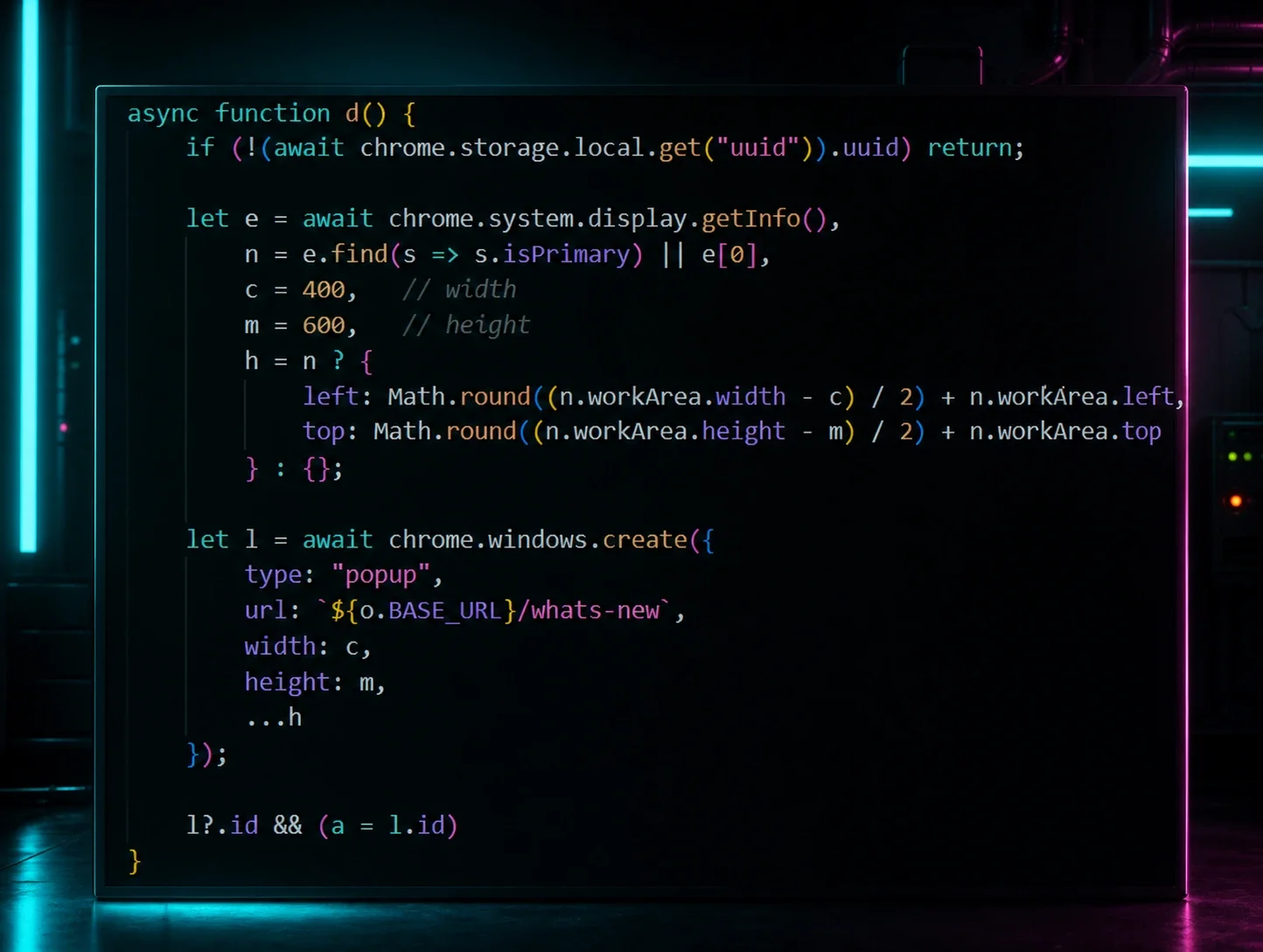
Huntress dissects a KongTuke campaign built around NexShield, a malicious Chrome extension impersonating uBlock Origin Lite that induces a deliberate browser DoS/crash and then displays a fake "CrashFix" repair prompt to trick users into pasting a malicious PowerShell command via the Windows Run dialog. The command abuses finger.exe as a LOLBin to fetch and execute layered, obfuscated PowerShell that profiles the victim (domain-joined vs standalone, AV, VM checks), uses weekly-rotating DGA domains, an AMSI patch bypass, and a two-layer AES+XOR encrypted .NET loader ("GateKeeper") with anti-sandbox fingerprinting, ultimately dropping ModeloRAT — a newly documented, RC4-encrypted Python RAT reserved for domain-joined corporate hosts — while non-domain targets currently only receive a "TEST PAYLOAD" response. The post includes full IOCs and YARA rules for GateKeeper, MintsLoader, and ModeloRAT.
huntress.comwriteupAdded 3 Sep 2026, published 16 Jan 2026🛡️ Security