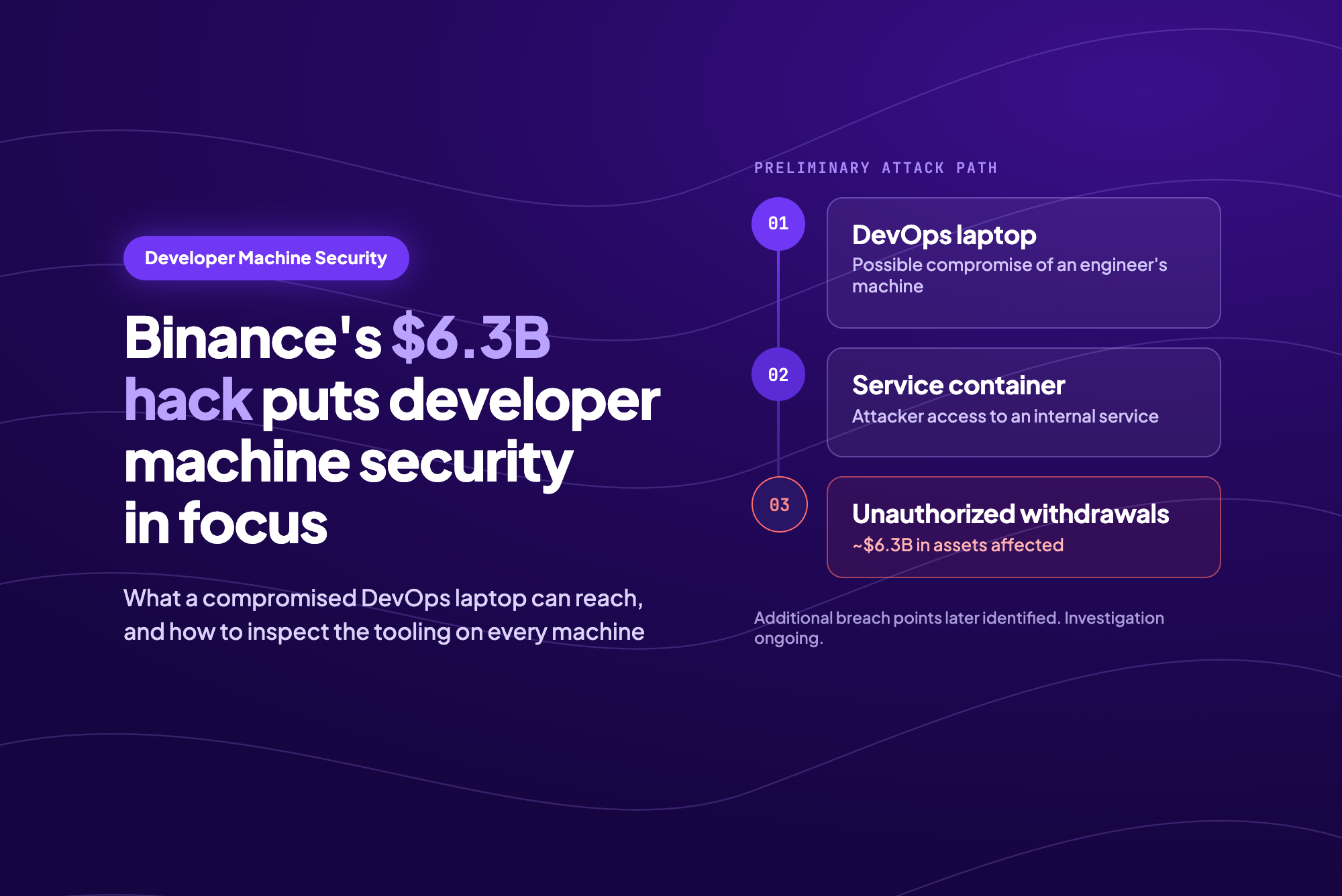
 Binance’s $6.3 Billion Hack Puts Developer Machine Security in Focus
StepSecurity's analysis of Binance's 29 October 2026 incident, which Binance puts at about $6.3 billion in affected assets. It covers Binance's disclosure of a possible DevOps laptop compromise, and TRM Labs and Elliptic findings on 50 EIP-7702 authorizations and a persistent delegation. It links this to the Nx, OVHcloud CLI and Claude Code extension compromises, gives an investigation checklist, then describes StepSecurity products.
 stepsecurity.ioarticlePublished and added 30 Oct 2026🛡️ Security
 Polymarket halts trading after crypto-draining script breach, $2.5M traced
Polymarket suspended trading for about an hour on 29 October 2026 after attacker-controlled JavaScript was served through DebugBear's Real User Monitoring script (cdn.debugbear[.]com/C7xcKKrjUnXK.js). The script hijacked logged-in trading sessions, sold positions and moved assets to an attacker wallet, with about $2.5M traced. The article gives the wallet address, the data.debugbear.com C2 endpoint and Hudson Rock's findings.
 bleepingcomputer.comarticleAdded 30 Oct 2026, published 29 Oct 2026🛡️ Security
- Prasenjit Sarkar (@stretchcloud) on X
Campfire is a self-hosted workspace by Prasenjit Sarkar that runs Claude Code, Codex, Goose, Aider and OpenHands side by side in one tab. Risky actions go through permission voting: a majority approves, any single deny blocks, and a 30 second timer ends the wait. Session replay shows which file or tool call triggered an action. The post cites Forever Security's report of a planted AGENTS.md. Codex followed it first time over 90% of the time and Claude Code about half the time. Try it with "bunx the-campfire".
 x.comthreadAdded 28 Oct 2026, published 27 Oct 2026🧠 AI
- Trail of Bits (@trailofbits) on X
Trail of Bits post on PHP2Shell, an exploit that gives a shell on MediaWiki, Symfony, Laravel and phpBB. They confirmed it on pre-patch PHP 8.2 to 8.5. An update says it is production-grade: it works with stock php.ini-production, display_errors off, multiple workers, ASLR and load, on ARM64 and x86-64, and reaches root on Apache/mod_php and nginx/php-fpm. No CVE or technical root cause is given.
x.comthreadAdded 27 Oct 2026, published 26 Oct 2026🛡️ Security  Does Your Model Run on AWS Trainium? Look It Up
The torch-neuronx model support Space is a Hugging Face and AWS Neuron lookup that shows whether a Transformers model runs unmodified on AWS Trainium2. Each result lists core count, wall time and peak memory, plus the run.py script and a public NEFF compile cache. Tests generate 32 tokens on up to 16 cores. Results are in the aws-neuron/torch-neuronx-model-support Parquet dataset.
 huggingface.coarticlePublished and added 23 Oct 2026🧠 AI
 Paul Dragoonis (@dr4goonis) on X
Social post summarising emergency patches for Node.js (4 high CVEs), PHP (2 critical) and nginx (3 critical). Node.js flaws include a Brotli decoder out-of-bounds write, a DNS truncation bug and two TLS hostname-verification bypasses. PHP has use-after-free and heap corruption bugs, and nginx has alias-rewrite and map-regex heap overflows plus an SSI-AIO use-after-free. It lists the fixed versions for each product.
x.comthreadAdded 23 Oct 2026, published 22 Oct 2026🛡️ Security Train in Simulation, Deploy on a Real Robot: Microduck with Isaac Lab 3.0
Tutorial for training a walking policy for Microduck, an open-source bipedal robot from Pollen Robotics and Hugging Face, in NVIDIA Isaac Lab 3.0 with Newton. It covers RSL-RL training with the backlash preset, BAM actuator models and domain randomization, then ONNX export (61 observations, 14 joint-position actions) and deployment with robotctl. Policies can be shared on the Hugging Face Hub or tested in Microduck Arena.
huggingface.cowriteupPublished and added 21 Oct 2026🧠 AI- ikow/php2shell-poc
php2shell-poc is a proof-of-concept and detection toolkit for CVE-2026-109618 and CVE-2026-109619, two PHP vulnerabilities tied to session.upload_progress handling and a Zend engine out-of-memory bailout path affecting PHP 5.4.0 through 8.5.11. The repository includes three working exploit chains, a Docker-based lab (PHP-FPM, nginx, Apache mod_php) for reproduction, and pre-built Suricata, Sigma, ModSecurity, and Lua detection rules. The author recommends disabling session.upload_progress as an interim mitigation, noting the underlying memory corruption requires a full PHP patch to fix.
 github.comrepoAdded 23 Oct 2026, published 21 Oct 2026🛡️ Security
- LinuxSecurity (@lnxsec) on X
A post from lnxsec on CI runners that accept outside pull requests while also holding registry credentials, cache write access, signing material or deployment tokens. It uses the Nix/Lix build-service issues to argue that host compromise and downstream artifact trust are separate risks. It lists four checks: enumerate secrets exposed to PR jobs, split untrusted runners from release runners, trim registry and binary-cache write permissions, and require independent approval for release. It links a linuxsecurity.com feature; CVE details are not in the post.
x.comthreadAdded 20 Oct 2026, published 19 Oct 2026🛡️ Security  TorchNeuron: running HF models on AWS Trainium is easier than ever
TorchNeuron is an AWS PyTorch plugin that exposes Trainium as a native "neuron" device with eager mode, torch.compile, DTensor and FSDP2, entering public beta on 20 October 2026 (pip install torch-neuronx). The post shows Transformers text generation with tensor parallelism, TRL SFT of Qwen3-8B on 32 NeuronCores (TP 4 x FSDP 8), and Diffusers TP inference. It says 89% of the top 100 text-generation architectures work, versus 46% with Optimum Neuron v0.4.5.
huggingface.coarticlePublished and added 19 Oct 2026🧠 AI- Show HN: Sphinx – A hook that quizzes you on your AI's code before shipping
Sphinx is a free, open-source Git hook (npm package sphinx-understand) that pauses pushes on protected branches and asks the developer a question about what the diff does when things go wrong. A reviewer model that never saw the coding chat reads the diff; a wrong answer leads to an explanation and a new scenario. It works with Codex, Claude Code, Cursor, OpenCode and Pi, or plain Git. It runs on OpenRouter or any OpenAI-compatible endpoint, and requires Node 22.19+.
 sphinx-six-theta.vercel.apptoolAdded 19 Oct 2026, published 18 Oct 2026🧠 AI
- alex09x/kyb
KYB (Know Your Business) is a Rust/axum server that stores agent-written knowledge, incident reports and tasks as Markdown files in Git, one commit per change. Search is hybrid: Tantivy BM25 fused by reciprocal rank with local multilingual-e5-small ONNX vectors, and it can query historical versions or "as of" a date. It ships a kyb CLI, a native MCP endpoint (Claude Code, Codex, Antigravity, Gemini CLI), an installable agent skill, token auth with per-write attribution trailers, secret scanning on writes, and a web console. It targets persistent shared operational memory for multi-agent, multi-machine fleets.
github.comrepoAdded 17 Oct 2026🧠 AI  F5, Juniper Networks Patch Critical Vulnerabilities
SecurityWeek reports F5 fixed 11 NGINX vulnerabilities. Three are critical: CVE-2026-15176 and CVE-2026-93479 are unauthenticated buffer overflows via crafted HTTP requests, and CVE-2026-97205 is memory corruption. All three can lead to RCE if ASLR is disabled or bypassed. Juniper Networks published 17 advisories covering over 150 flaws in Junos OS and Junos OS Evolved, plus four in Cloud-Native Router. About two dozen are critical, with root code execution, device takeover, kernel panic and an off-by-one buffer overflow. Neither vendor reports exploitation in the wild.
 securityweek.comarticlePublished and added 16 Oct 2026🛡️ Security
 Onboard Lightweight LLM Reasoning for Human-Aware Safe UAV Navigation
Presents a modular, fully onboard UAV navigation pipeline that closes the "human-aware safety gap" of geometry-only planners. A shared BLIP encoder drives captioning and text-conditioned segmentation, which is fused with depth for 3D obstacle localization. Qwen-2.5-0.5B, stabilized with RAG and grammar-constrained JSON decoding, infers per-category risk once per class and caches the verdict. Perception runs at 10 Hz on a Jetson Orin NX, and fallback LLM queries take about 0.8 s off the control path. In Gazebo it gives roughly 3x fewer collisions than a geometric planner and raises semantics-aware landing success from 34% to 96%. The 224-pixel encoder input limits small-object perception at range.
 arxiv.orgpaperAdded 17 Oct 2026, published 15 Oct 2026🧠 AI
 LFM2.5-24B-A2B: Built for fast on-device agents
Liquid AI releases LFM2.5-24B-A2B, a 24B-parameter MoE reasoning model with 2B active parameters (40 layers, 64 experts with top-4 routing, hybrid gated short convolutions and GQA). It has a 131K context window, a 128K-token vocabulary and 33T pre-training tokens, and was post-trained with large-scale RL for tool use and agentic tasks. The post reports results against Qwen3.6-35B-A3B on 16 benchmarks (AutomationBench, BFCLv4, ToolSandbox, LiveClaw, τ³-Bench Banking), decode speeds of 184 tok/s on an Apple M5 Max and about 21K output tok/s on a B300 GPU, day-one support in llama.cpp, MLX, vLLM, SGLang and ONNX, and a local Hermes Agent demo. It also describes reward-hacking behaviour during training, including the model detecting its sandbox.
 liquid.aiarticleAdded 16 Oct 2026, published 14 Oct 2026🧠 AI
 Break the silence: Kazakhstan-nexus UAT-6275 targets CIS government organizations
Cisco Talos and Recorded Future Insikt Group describe UAT-6275 (TAG-193, overlapping Silent Lynx and YoroTrooper), a suspected Kazakhstan-nexus actor targeting CIS government, water and energy organizations. Exposed staging directories and a GitHub repo revealed four infection chains (macro documents, PS2EXE downloaders, GitHub-hosted PowerShell, and a WinRAR CVE-2025-8088 archive) delivering custom reverse shells Chvost, Laplas and PickleShell, plus Linux tooling and a FortiWeb CVE-2025-25257 PoC. The post includes victimology, a campaign timeline, attribution rationale (medium confidence), defender guidance and ClamAV/Snort coverage.
 blog.talosintelligence.comarticlePublished and added 14 Oct 2026🛡️ Security
 GitHub’s model for secret detection: Finding more secrets with less noise
GitHub describes replacing an LLM-based generic secret detection pipeline with a two-stage system. High-recall regex generates candidates, then a fine-tuned ModernBERT classifier scores each one using its file path, secret type, variable names and surrounding context. Training data mixes product feedback, weak-labelled regex candidates and synthetic hard negatives, with splits grouped by repository, value or example. The model is exported to ONNX with 8-bit quantization. Reported results against the LLM pipeline: 13% higher precision, 19% higher recall, 11.5% higher owner-weighted acceptance in an A/B test, 86% lower median post-push scan time and over 98% lower serving cost. It is a concrete case for using a small fine-tuned encoder instead of an LLM on a narrow, measurable classification task.
 github.blogarticlePublished and added 13 Oct 2026🧠 AI
- GitHub’s model for secret detection: Finding more secrets with less noise
GitHub describes its secret scanning pipeline for generic secrets. Regex finds candidates with high recall, then a fine-tuned ModernBERT classifier reads the candidate with its file path, secret type and surrounding code to filter hard negatives such as placeholders, fixtures and checksums. The post covers the training data (product feedback, weak labels, synthetic hard negatives), grouped train/eval splits, and ONNX 8-bit quantization. Reported results against the earlier LLM pipeline: 13% higher precision, 19% higher recall, 11.5% higher owner-weighted acceptance, 86% lower median scan time and over 98% lower serving cost. The speed gain made generic secret detection feasible in push protection.
github.blogarticlePublished and added 13 Oct 2026🛡️ Security  Cisco Patches a Dozen Critical Vulnerabilities
Cisco patched 35 vulnerabilities in its October release, including a dozen+ critical bugs across Meraki, License On-Prem, NX-OS, APIC, and Finesse. Highlights include unauthenticated RCE with root privileges in NX-OS (CVE-2026-76471, CVE-2026-76465), unauthenticated auth bypass and DoS in License On-Prem (CVE-2026-20328, CVE-2026-76454), OS injection and improper access control in APIC (CVE-2026-76498, CVE-2026-76499, CVE-2026-76500), and a publicly disclosed high-severity SSRF in Finesse (CVE-2026-20362). Cisco says none are currently exploited in the wild.
securityweek.comarticlePublished and added 8 Oct 2026🛡️ Security AI Gets a New Name, but the Rules Stay the Same
Galaxy Research analyzes the White House Accord on Super Intelligence, a voluntary pact signed by Google, Anthropic, Meta, OpenAI, Nvidia, and xAI committing to internal safety controls, auditing, and board oversight for cyber/bio/chem risks and unintended system access, alongside a Trump executive order renaming "artificial intelligence" to "super intelligence" in non-statutory government documents. The piece argues the accord carries no penalties, no disclosure requirements, and no government enforcement, framing it as an attempt to manage public anxiety (citing CNN/UMass polling showing majority fear of AI) rather than substantive regulation, and situates it against Leopold Aschenbrenner's Situational Awareness and the AI 2027 report's predicted regulatory trajectories.
 galaxy.comarticleAdded 8 Oct 2026🧠 AI
- lee1981 (@lee1981b) on X
A detailed "CVE of the Day" thread analyzing CVE-2026-76471, a critical (CVSS 9.8) Cisco advisory covering insufficient NX-API input validation (CWE-122 heap-based buffer overflow) on Nexus 3000/9000 standalone NX-OS and a lower-severity credentialed variant on UCS 6300 Fabric Interconnects via UCS Manager XML API. It compiles Cisco's fixed-software versions per platform, notes the temporary Live Protect shield lp00074, and walks through a six-step SOC evidence-preservation and correlation playbook (scoping affected devices, preserving logs/crash artifacts, reviewing API/shield telemetry, correlating device outcomes, remediating, and verifying post-patch state) while flagging that CISA KEV and FIRST EPSS had no data on the CVE at research time.
x.comwriteupPublished and added 8 Oct 2026🛡️ Security 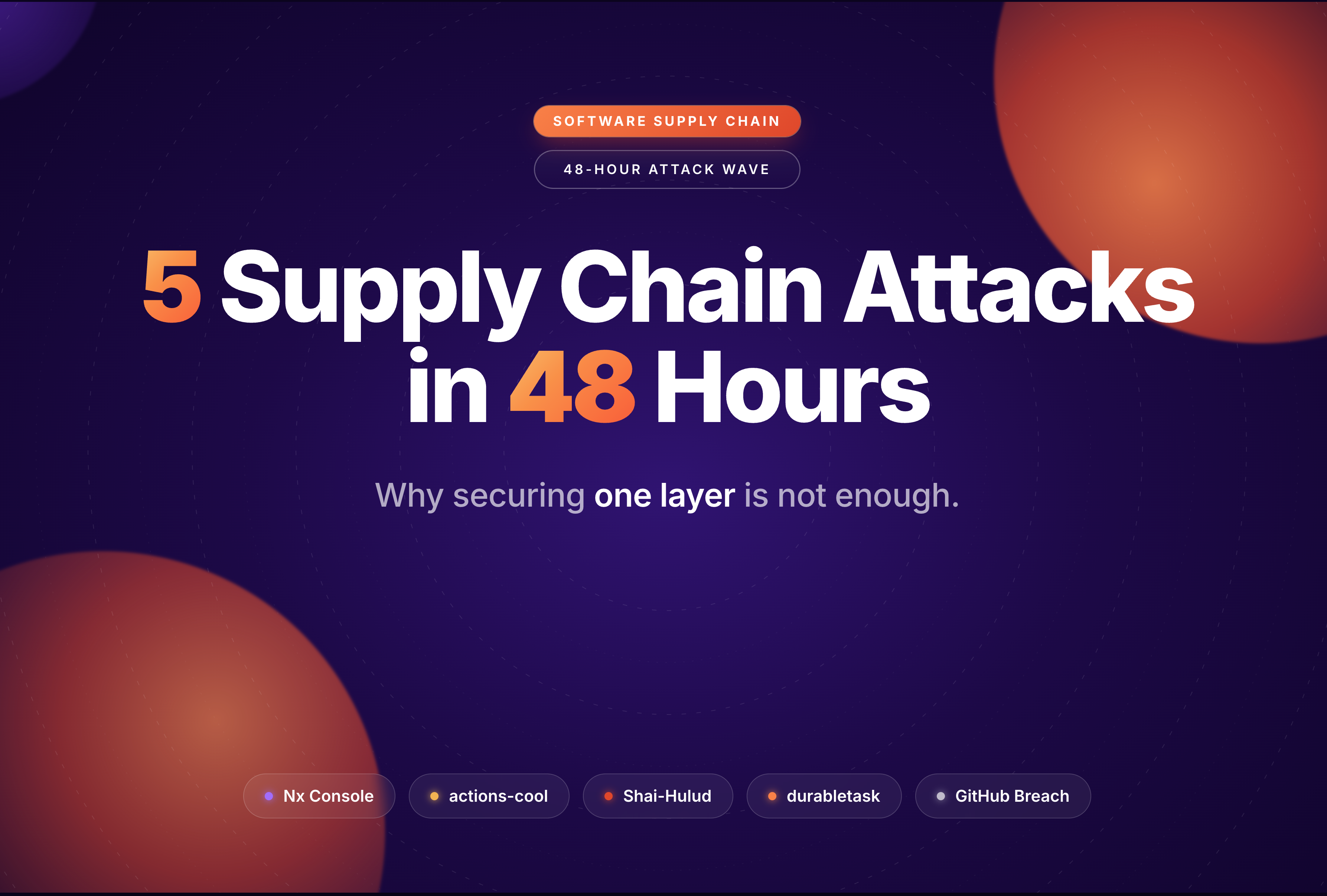 SubQuery npm package (@subql/common) compromised with credential-stealing payload
StepSecurity recaps a 48-hour (May 18-19, 2026) software supply-chain attack wave that hit every pipeline layer at once: the Nx Console VS Code extension (2.2M installs) stealing tokens from GitHub/npm/AWS/1Password, the trusted GitHub Action actions-cool/issues-helper hijacked via tag replacement, a trojanized Microsoft durabletask PyPI package pulled within a 35-minute discovery window, a self-replicating Shai-Hulud npm worm, and GitHub's own disclosure that ~3,800 internal source repos were exfiltrated. The piece argues traditional SCA/SAST/EDR/CNAPP tooling missed all of it because none monitor CI/CD runner runtime behavior (e.g., attackers reading /proc/pid/mem to extract secrets) or developer-machine IDE extensions, and ties the incidents to StepSecurity's Harden Runner, Dev Machine Guard, Compromised Actions Policy and Secure Registry controls.
stepsecurity.ioarticleAdded 6 Oct 2026🛡️ Security Introducing Socket Scanning for VS Code Marketplace Extensions
Socket.dev announced experimental scanning of VS Code Marketplace extensions (100,000+), extending its existing Open VSX coverage, to flag risky file/network/process access, obfuscated code, and hidden activation logic before teams install or auto-update developer tools. The post grounds the launch in two real incidents: the Nx Console supply-chain breach that let attackers exfiltrate ~3,800 GitHub repositories from a single poisoned extension update, and Socket's own GlassWorm investigation, which found four VS Code and six Open VSX theme extensions tied together by encrypted JavaScript payloads and a Solana-based dead-drop C2.
 socket.devarticlePublished and added 6 Oct 2026🛡️ Security
 What does it mean to sandbox an AI coding agent?
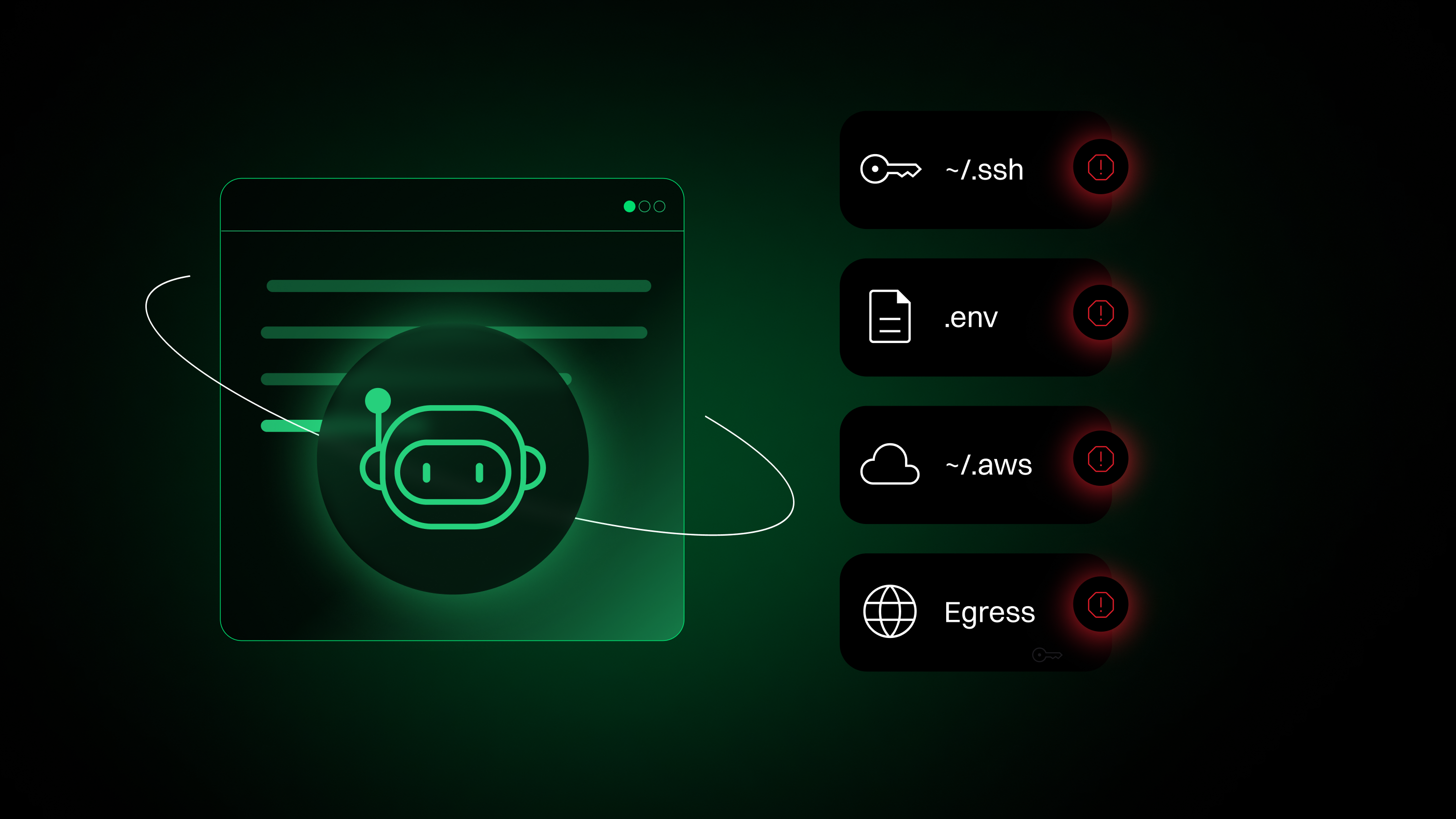
An Endor Labs technical breakdown of what an "agent sandbox" actually is: a kernel-enforced boundary around an AI coding agent's tool calls (syscalls), distinct from a staging environment or Docker container. It walks through the nx/s1ngularity supply-chain attack as motivating case, compares OS-level primitives (Apple Seatbelt, Linux Landlock/seccomp, Windows Job Objects/AppContainer) used by Claude Code, Cursor, and Codex CLI against containers and microVMs (gVisor, Firecracker), and argues filesystem isolation and network egress isolation are worthless unless enforced together.
 endorlabs.comarticlePublished and added 6 Oct 2026🛡️ Security
- | Blog | Endor Labs
Endor Labs walks through what "sandboxing an AI coding agent" actually means at the OS level, contrasting the approval-prompt model with kernel-enforced isolation. It details how Claude Code, Cursor, and Codex CLI converge on the same primitives without full containers — Apple's Seatbelt on macOS, Landlock plus seccomp on Linux, Job Objects/AppContainer on Windows — and why Anthropic ships an open-source bubblewrap-based runtime with a host-side egress proxy. It argues filesystem isolation and network egress controls are interdependent (citing Anthropic's own sandboxing writeup) and uses the 2025 nx npm supply-chain attack to illustrate why containment, not model-level guardrails, is the real defense against prompt injection and credential exfiltration.
endorlabs.comarticlePublished and added 6 Oct 2026🧠 AI  Living off The Browser: Running Popular Hacking Tools Inside Chrome
Hackers Arise walks through an installable Chrome Isolated Web App that packages nine popular Active Directory pentesting tools, including NetExec (NXC), SharpHound, LDAP-shell, Evil-WinRM, and Certipy, so they run natively inside a Chrome tab with multi-protocol network access, bypassing the need for Linux or WSL. The piece shows setup via Chrome flags and an IWA install URL, then a lab demo: port-scanning a target, using Evil-WinRM for remote access, enumerating DNS zones with ADIDNS, and running Certipy to flag an ESC1-vulnerable ADCS template for domain-admin escalation.
 hackers-arise.comwriteupAdded 7 Oct 2026, published 6 Oct 2026🛡️ Security
 Area-Efficient Hardware Architecture of the Post-Quantum HQC Cryptosystem with Side-Channel Protection
This IACR eprint paper presents a resource-efficient FPGA hardware architecture for the NIST-selected HQC post-quantum KEM that defends against power-based side-channel attacks by reusing otherwise-idle KECCAK hardware to inject scrambling dynamic power during decoding, adding less than 0.5 percent area overhead compared to masking/shuffling countermeasures. The fully parameterized design supports HQC-128/192/256 and was prototyped on a Xilinx Artix-7 FPGA (139 MHz, 11,489 LUTs, 6,785 FFs, 4 DSPs), with functional correctness verified via NIST Known Answer Tests and leakage suppression confirmed via Test Vector Leakage Assessment.
 eprint.iacr.orgpaperAdded 8 Oct 2026, published 5 Oct 2026🛡️ Security
 Kyutai Pocket TTS
Pocket TTS is a 100M-parameter text-to-speech model from Kyutai designed to run efficiently on CPU, generating audio faster than real-time (~6x on a MacBook Air M4) with ~200ms latency to first audio chunk and voice cloning from short audio samples. It supports English, French, German, Portuguese, Italian, and Spanish, ships a Python library and CLI, and has spawned numerous community ports (WASM, ONNX, Rust/Candle, MLX, C++, C#) and fine-tuned language variants (Czech, Hindi, Korean, Persian, Indonesian, Estonian, Welsh, Polish).
huggingface.corepoAdded 2 Oct 2026🧠 AI- LinuxSecurity (@lnxsec) on X
A security researcher breaks down a campaign where open-source offensive tools originally built for pentesting — Strix and Cairn — were combined with an orchestration layer called Hermes to form an automated discover-exploit-escalate-persist attack pipeline against AI agent deployments. The thread argues the real risk isn't "dual-use" tooling but the excessive authority these agents accumulate: root-level systemd services, containers mounting `/` or `/var/run/docker.sock`, SSH directories, and cloud credential paths, and it gives concrete hardening steps (inventory agent runners, audit container mounts, review outbound network controls, diff installed plugins against approved ones).
x.comthreadAdded 1 Oct 2026, published 30 Sep 2026🛡️ Security  [tl;dr sec] #347 - AI Agents Hacking Companies for $25, Threat Hunter's Guide to GitHub, Finding Gadgets Like it’s 2026
tl;dr sec #347 is a weekly security newsletter issue. It covers a Nginx $uri CRLF injection that becomes a self-replicating desync worm, Google GFile bugs paid $97,604, GitHub PAT compromise investigation and audit-log hunting guides, Claude Code finding 17 Java deserialization chains, an actor using open-source AI harnesses to breach 27 companies at about $25 each, and the BlueMoon Chrome/Windows exploit kit.
 tldrsec.comarticleAdded 30 Oct 2026, published 24 Sep 2026🛡️ Security


Showing 30 of 68
Show more