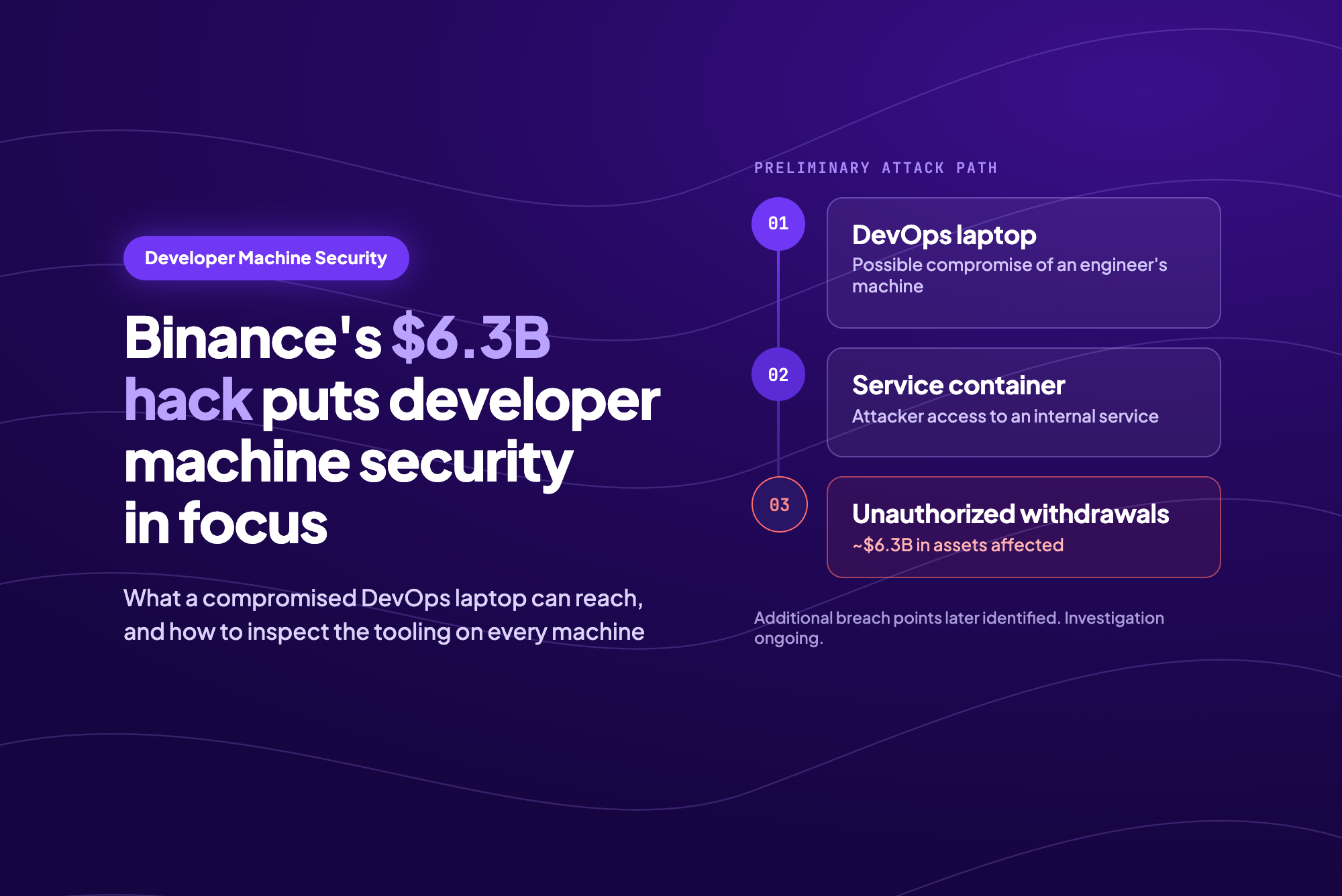
 Binance’s $6.3 Billion Hack Puts Developer Machine Security in Focus
StepSecurity's analysis of Binance's 29 October 2026 incident, which Binance puts at about $6.3 billion in affected assets. It covers Binance's disclosure of a possible DevOps laptop compromise, and TRM Labs and Elliptic findings on 50 EIP-7702 authorizations and a persistent delegation. It links this to the Nx, OVHcloud CLI and Claude Code extension compromises, gives an investigation checklist, then describes StepSecurity products.
 stepsecurity.ioarticlePublished and added 30 Oct 2026🛡️ Security
 Polymarket halts trading after crypto-draining script breach, $2.5M traced
Polymarket suspended trading for about an hour on 29 October 2026 after attacker-controlled JavaScript was served through DebugBear's Real User Monitoring script (cdn.debugbear[.]com/C7xcKKrjUnXK.js). The script hijacked logged-in trading sessions, sold positions and moved assets to an attacker wallet, with about $2.5M traced. The article gives the wallet address, the data.debugbear.com C2 endpoint and Hudson Rock's findings.
 bleepingcomputer.comarticleAdded 30 Oct 2026, published 29 Oct 2026🛡️ Security
 Does Your Model Run on AWS Trainium? Look It Up
The torch-neuronx model support Space is a Hugging Face and AWS Neuron lookup that shows whether a Transformers model runs unmodified on AWS Trainium2. Each result lists core count, wall time and peak memory, plus the run.py script and a public NEFF compile cache. Tests generate 32 tokens on up to 16 cores. Results are in the aws-neuron/torch-neuronx-model-support Parquet dataset.
 huggingface.coarticlePublished and added 23 Oct 2026🧠 AI
 TorchNeuron: running HF models on AWS Trainium is easier than ever
TorchNeuron is an AWS PyTorch plugin that exposes Trainium as a native "neuron" device with eager mode, torch.compile, DTensor and FSDP2, entering public beta on 20 October 2026 (pip install torch-neuronx). The post shows Transformers text generation with tensor parallelism, TRL SFT of Qwen3-8B on 32 NeuronCores (TP 4 x FSDP 8), and Diffusers TP inference. It says 89% of the top 100 text-generation architectures work, versus 46% with Optimum Neuron v0.4.5.
huggingface.coarticlePublished and added 19 Oct 2026🧠 AI F5, Juniper Networks Patch Critical Vulnerabilities
SecurityWeek reports F5 fixed 11 NGINX vulnerabilities. Three are critical: CVE-2026-15176 and CVE-2026-93479 are unauthenticated buffer overflows via crafted HTTP requests, and CVE-2026-97205 is memory corruption. All three can lead to RCE if ASLR is disabled or bypassed. Juniper Networks published 17 advisories covering over 150 flaws in Junos OS and Junos OS Evolved, plus four in Cloud-Native Router. About two dozen are critical, with root code execution, device takeover, kernel panic and an off-by-one buffer overflow. Neither vendor reports exploitation in the wild.
 securityweek.comarticlePublished and added 16 Oct 2026🛡️ Security
 LFM2.5-24B-A2B: Built for fast on-device agents
Liquid AI releases LFM2.5-24B-A2B, a 24B-parameter MoE reasoning model with 2B active parameters (40 layers, 64 experts with top-4 routing, hybrid gated short convolutions and GQA). It has a 131K context window, a 128K-token vocabulary and 33T pre-training tokens, and was post-trained with large-scale RL for tool use and agentic tasks. The post reports results against Qwen3.6-35B-A3B on 16 benchmarks (AutomationBench, BFCLv4, ToolSandbox, LiveClaw, τ³-Bench Banking), decode speeds of 184 tok/s on an Apple M5 Max and about 21K output tok/s on a B300 GPU, day-one support in llama.cpp, MLX, vLLM, SGLang and ONNX, and a local Hermes Agent demo. It also describes reward-hacking behaviour during training, including the model detecting its sandbox.
 liquid.aiarticleAdded 16 Oct 2026, published 14 Oct 2026🧠 AI
 Break the silence: Kazakhstan-nexus UAT-6275 targets CIS government organizations
Cisco Talos and Recorded Future Insikt Group describe UAT-6275 (TAG-193, overlapping Silent Lynx and YoroTrooper), a suspected Kazakhstan-nexus actor targeting CIS government, water and energy organizations. Exposed staging directories and a GitHub repo revealed four infection chains (macro documents, PS2EXE downloaders, GitHub-hosted PowerShell, and a WinRAR CVE-2025-8088 archive) delivering custom reverse shells Chvost, Laplas and PickleShell, plus Linux tooling and a FortiWeb CVE-2025-25257 PoC. The post includes victimology, a campaign timeline, attribution rationale (medium confidence), defender guidance and ClamAV/Snort coverage.
 blog.talosintelligence.comarticlePublished and added 14 Oct 2026🛡️ Security
 GitHub’s model for secret detection: Finding more secrets with less noise
GitHub describes replacing an LLM-based generic secret detection pipeline with a two-stage system. High-recall regex generates candidates, then a fine-tuned ModernBERT classifier scores each one using its file path, secret type, variable names and surrounding context. Training data mixes product feedback, weak-labelled regex candidates and synthetic hard negatives, with splits grouped by repository, value or example. The model is exported to ONNX with 8-bit quantization. Reported results against the LLM pipeline: 13% higher precision, 19% higher recall, 11.5% higher owner-weighted acceptance in an A/B test, 86% lower median post-push scan time and over 98% lower serving cost. It is a concrete case for using a small fine-tuned encoder instead of an LLM on a narrow, measurable classification task.
 github.blogarticlePublished and added 13 Oct 2026🧠 AI
- GitHub’s model for secret detection: Finding more secrets with less noise
GitHub describes its secret scanning pipeline for generic secrets. Regex finds candidates with high recall, then a fine-tuned ModernBERT classifier reads the candidate with its file path, secret type and surrounding code to filter hard negatives such as placeholders, fixtures and checksums. The post covers the training data (product feedback, weak labels, synthetic hard negatives), grouped train/eval splits, and ONNX 8-bit quantization. Reported results against the earlier LLM pipeline: 13% higher precision, 19% higher recall, 11.5% higher owner-weighted acceptance, 86% lower median scan time and over 98% lower serving cost. The speed gain made generic secret detection feasible in push protection.
github.blogarticlePublished and added 13 Oct 2026🛡️ Security  Cisco Patches a Dozen Critical Vulnerabilities
Cisco patched 35 vulnerabilities in its October release, including a dozen+ critical bugs across Meraki, License On-Prem, NX-OS, APIC, and Finesse. Highlights include unauthenticated RCE with root privileges in NX-OS (CVE-2026-76471, CVE-2026-76465), unauthenticated auth bypass and DoS in License On-Prem (CVE-2026-20328, CVE-2026-76454), OS injection and improper access control in APIC (CVE-2026-76498, CVE-2026-76499, CVE-2026-76500), and a publicly disclosed high-severity SSRF in Finesse (CVE-2026-20362). Cisco says none are currently exploited in the wild.
securityweek.comarticlePublished and added 8 Oct 2026🛡️ Security AI Gets a New Name, but the Rules Stay the Same
Galaxy Research analyzes the White House Accord on Super Intelligence, a voluntary pact signed by Google, Anthropic, Meta, OpenAI, Nvidia, and xAI committing to internal safety controls, auditing, and board oversight for cyber/bio/chem risks and unintended system access, alongside a Trump executive order renaming "artificial intelligence" to "super intelligence" in non-statutory government documents. The piece argues the accord carries no penalties, no disclosure requirements, and no government enforcement, framing it as an attempt to manage public anxiety (citing CNN/UMass polling showing majority fear of AI) rather than substantive regulation, and situates it against Leopold Aschenbrenner's Situational Awareness and the AI 2027 report's predicted regulatory trajectories.
 galaxy.comarticleAdded 8 Oct 2026🧠 AI
 SubQuery npm package (@subql/common) compromised with credential-stealing payload
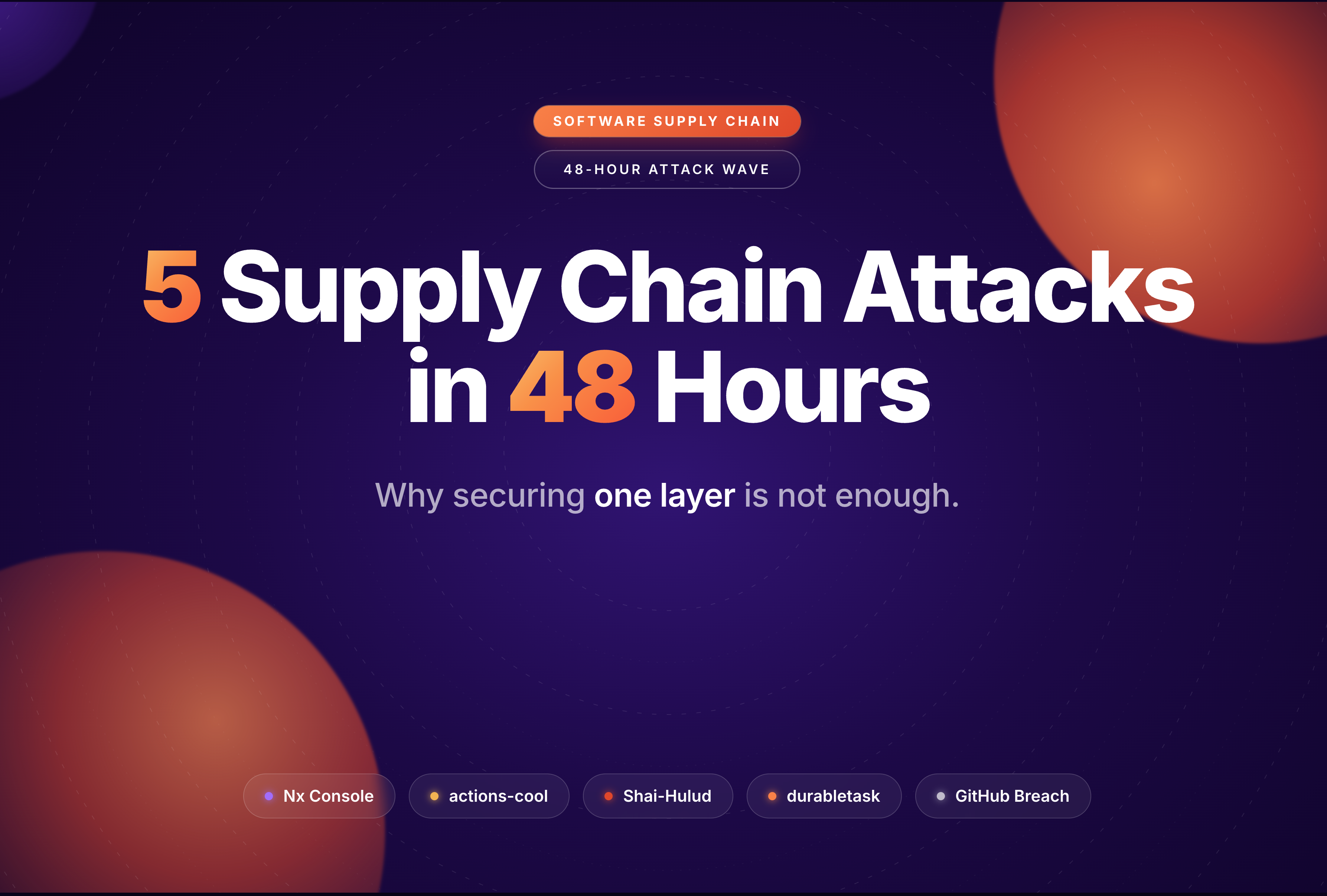
StepSecurity recaps a 48-hour (May 18-19, 2026) software supply-chain attack wave that hit every pipeline layer at once: the Nx Console VS Code extension (2.2M installs) stealing tokens from GitHub/npm/AWS/1Password, the trusted GitHub Action actions-cool/issues-helper hijacked via tag replacement, a trojanized Microsoft durabletask PyPI package pulled within a 35-minute discovery window, a self-replicating Shai-Hulud npm worm, and GitHub's own disclosure that ~3,800 internal source repos were exfiltrated. The piece argues traditional SCA/SAST/EDR/CNAPP tooling missed all of it because none monitor CI/CD runner runtime behavior (e.g., attackers reading /proc/pid/mem to extract secrets) or developer-machine IDE extensions, and ties the incidents to StepSecurity's Harden Runner, Dev Machine Guard, Compromised Actions Policy and Secure Registry controls.
stepsecurity.ioarticleAdded 6 Oct 2026🛡️ Security Introducing Socket Scanning for VS Code Marketplace Extensions
Socket.dev announced experimental scanning of VS Code Marketplace extensions (100,000+), extending its existing Open VSX coverage, to flag risky file/network/process access, obfuscated code, and hidden activation logic before teams install or auto-update developer tools. The post grounds the launch in two real incidents: the Nx Console supply-chain breach that let attackers exfiltrate ~3,800 GitHub repositories from a single poisoned extension update, and Socket's own GlassWorm investigation, which found four VS Code and six Open VSX theme extensions tied together by encrypted JavaScript payloads and a Solana-based dead-drop C2.
 socket.devarticlePublished and added 6 Oct 2026🛡️ Security
 What does it mean to sandbox an AI coding agent?
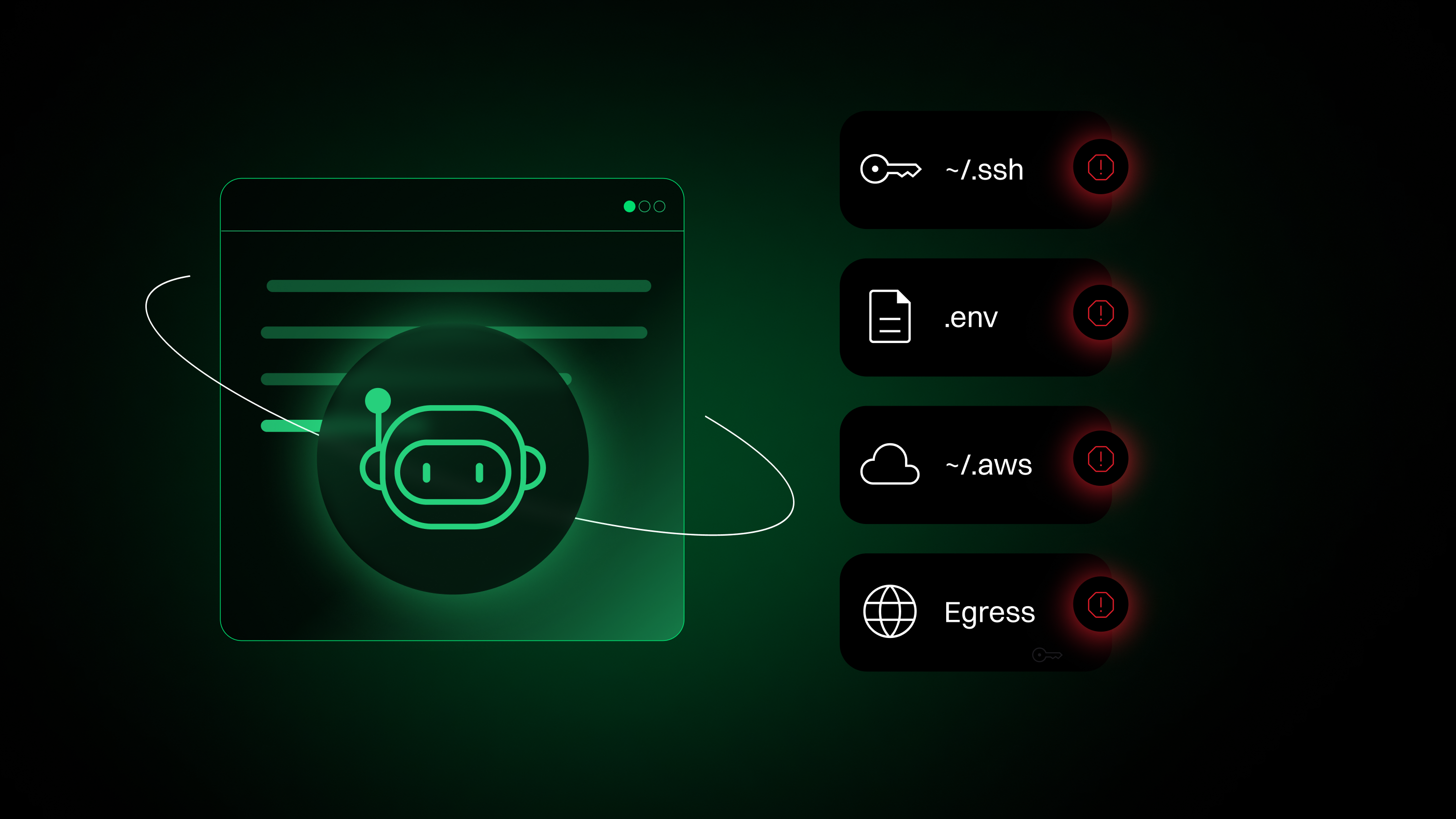
An Endor Labs technical breakdown of what an "agent sandbox" actually is: a kernel-enforced boundary around an AI coding agent's tool calls (syscalls), distinct from a staging environment or Docker container. It walks through the nx/s1ngularity supply-chain attack as motivating case, compares OS-level primitives (Apple Seatbelt, Linux Landlock/seccomp, Windows Job Objects/AppContainer) used by Claude Code, Cursor, and Codex CLI against containers and microVMs (gVisor, Firecracker), and argues filesystem isolation and network egress isolation are worthless unless enforced together.
 endorlabs.comarticlePublished and added 6 Oct 2026🛡️ Security
- | Blog | Endor Labs
Endor Labs walks through what "sandboxing an AI coding agent" actually means at the OS level, contrasting the approval-prompt model with kernel-enforced isolation. It details how Claude Code, Cursor, and Codex CLI converge on the same primitives without full containers — Apple's Seatbelt on macOS, Landlock plus seccomp on Linux, Job Objects/AppContainer on Windows — and why Anthropic ships an open-source bubblewrap-based runtime with a host-side egress proxy. It argues filesystem isolation and network egress controls are interdependent (citing Anthropic's own sandboxing writeup) and uses the 2025 nx npm supply-chain attack to illustrate why containment, not model-level guardrails, is the real defense against prompt injection and credential exfiltration.
endorlabs.comarticlePublished and added 6 Oct 2026🧠 AI  [tl;dr sec] #347 - AI Agents Hacking Companies for $25, Threat Hunter's Guide to GitHub, Finding Gadgets Like it’s 2026
tl;dr sec #347 is a weekly security newsletter issue. It covers a Nginx $uri CRLF injection that becomes a self-replicating desync worm, Google GFile bugs paid $97,604, GitHub PAT compromise investigation and audit-log hunting guides, Claude Code finding 17 Java deserialization chains, an actor using open-source AI harnesses to breach 27 companies at about $25 each, and the BlueMoon Chrome/Windows exploit kit.
 tldrsec.comarticleAdded 30 Oct 2026, published 24 Sep 2026🛡️ Security
 Package Manager Sandboxing (Andrew Nesbitt)
A survey of how package managers confine install-time and build-time code. It covers Homebrew 7.0.0's fetch/install split, Landlock sandbox and signed declarative *_steps. It also covers opam, Nix, Bazel, pacman, Swift PM and Deno, and the open sandbox proposals at pnpm, RubyGems, Spack, Cargo, pip and Zig. It sorts the responses into gating (allowlists), confinement and replacement/removal of hooks. It links the topic to coding-agent sandboxes (Seatbelt, Landlock, bubblewrap) and to Shai-Hulud and nx. It argues the open problem is validating a sandboxed phase's output at the hand-off.
 nesbitt.ioarticleAdded 10 Oct 2026, published 24 Sep 2026🛡️ Security
- Three CVEs and the May 2026 Exploit Chain Nobody's Taking Seriously (nginx Rift)
Analyzes three May 2026 Linux CVEs as one chain: CVE-2026-42945 (NGINX Rift), an unauthenticated heap overflow in ngx_http_rewrite_module (is_args mismatch between length and copy passes), then page-cache LPEs Copy Fail (CVE-2026-31431, authencesn) and Dirty Frag (CVE-2026-43284/CVE-2026-43500, xfrm-ESP/rxrpc) that bypass the algif_aead blacklist. Author releases a bash static scanner for vulnerable rewrite patterns (unnamed captures plus '?' followed by rewrite/if/set) and gives fixes: upgrade nginx to 1.30.1/1.31.0 or use named captures, plus kernel module mitigations.
 securityboulevard.comarticleAdded 21 Sep 2026🛡️ Security
 Post-Quantum: Lattice or Hash-Based (one question, two right answers)
A deep-dive field guide to choosing between lattice-based (ML-DSA/FN-DSA) and hash-based (SLH-DSA) post-quantum signatures, built from interviews with the designers and implementers behind both NIST standards and their deployments. It walks through Mosca's-inequality-style migration timing, CNSA 2.0's split between lattice signatures and stateful hash-based LMS/XMSS for firmware, the stateful-signature "footgun," and why the broader internet (TLS/WebPKI, via Merkle Tree Certificates) is converging on lattices while Ethereum's post-quantum consensus roadmap (leanXMSS, EIP-8292, EIP-8288 aggregation) and Algorand's live Falcon-1024 state proofs lean hash-based or scheme-neutral because of aggregation and on-chain storage constraints. It closes with a decision framework and a rundown of NIST's round-3 "onramp" signature candidates (MAYO, SQIsign, HAWK, etc.).
 ethresear.charticleAdded 3 Oct 2026, published 15 Sep 2026🛡️ Security
 1Password's AI patching benchmark is misleading
Trail of Bits dissects 1Password's August 2026 report claiming AI agents (GPT-5.5, Opus 4.8) produce clean vulnerability fixes only 26% of the time, showing the figure is inflated by a hand-picked set of six hard bugs, deliberately-wrong-fix prompts (22% of trials), a no-testing mode (36% of trials), grading disagreements between automated graders and humans, and a buggy Linux upstream reference fix. Reanalyzing the same data under fair conditions (testable, non-adversarial trials) they find 86% of patches blocked the supplied exploit, and they contrast this with their own consulting data (12.5% of developer first-fixes fail) and Patch the Planet's 67.7% maintainer merge rate across 186 PRs, including a case where both a human maintainer and an agent independently introduced the same freenginx cleanup-crash regression. The post also releases two new agent skills, post-patch-validation and review-walkthrough, to improve AI-assisted patch testing and human review.
 blog.trailofbits.comarticlePublished and added 15 Sep 2026🛡️ Security
 How to Defend Against NPM Software Supply Chain Attacks | Blog | Endor Labs
Endor Labs blog post analyzing the wave of npm supply chain compromises (eslint-prettier, Nx, chalk, and the self-propagating "Shai-Hulud" worm that hit @ctrl/tinycolor via stolen maintainer credentials), citing the Zimmerman et al. study on npm's dense transitive-dependency trust model. It provides a checklist for security teams: enforcing lockfiles and npm ci in CI, defaulting to --ignore-scripts to block malicious lifecycle hooks, running SCA/malware scanning, and delaying adoption of new package versions (60-day cooldown per CIS benchmark, PNPM minimum-release-age feature).
endorlabs.comarticlePublished and added 11 Sep 2026🛡️ Security SolarWinds took a nation-state. The next attack just needs an LLM and $5. | Blog | Endor Labs
Endor Labs blog tracing an accelerating pattern of software supply-chain compromises from July 2025 through March 2026, culminating in the TeamPCP threat actor's cascading 30-day compromise of Aqua Security, Trivy, GitHub Actions, Docker Hub, npm, OpenVSX, and PyPI (including backdooring the 95M-download LiteLLM package). It argues AI is accelerating both offense (CVE-GENIE reproducing 51% of CVE exploits for $2.77 each) and the attack surface (the Cline prompt-injection-to-npm-token-theft chain, Nx's AI-review-evading payload), and calls for treating AI coding agents as privileged actors, pinning GitHub Actions to SHAs, and platform-level fixes like immutable tags and Sigstore/OIDC.
endorlabs.comarticlePublished and added 11 Sep 2026🛡️ Security Dev Machine Guard Now Supports Linux - StepSecurity
StepSecurity announces Linux support (Debian/RPM, .deb and .rpm packages) for Dev Machine Guard, its open-source developer-machine inventory and scanning engine, extending existing macOS/Windows coverage. The tool detects installed AI coding agents (Claude, Cursor, GitHub Copilot, Codex), IDE extensions from VS Code Marketplace and OpenVSX, MCP server configs, npm packages, and Linux system packages (rpm, dpkg, pacman, apk, snap, flatpak) via native mechanisms like systemd user timers and BIOS-serial device identity, and is explicitly framed as a response to incidents like the Shai-Hulud npm worm, s1ngularity/Nx compromise, and Mini Shai-Hulud/TanStack attacks. It ships in a free local-only Community mode and a paid Enterprise mode with centralized dashboard, policy enforcement, and dependency cooldown/alerting.
stepsecurity.ioarticleAdded 5 Sep 2026🛡️ Security Introducing @huggingface/kernels: 200+ WebGPU Kernels for Local AI
Hugging Face introduces @huggingface/kernels, a JavaScript loader for 207 versioned, Apache-2.0 licensed WebGPU kernels (matmuls, normalizations, attention primitives, quantization ops, etc.) published on the Hub, each with a manifest, correctness tests, benchmarks, and parameterized WGSL shader templates. They also launch Fleet, a browser-based benchmarking/testing tool that crowdsources correctness and performance evidence across real-world GPUs. Benchmarked against ONNX Runtime Web on an Apple M4 GPU, the kernels were 2.57x faster by geometric mean (1.90x median) across 809 comparable test cases, with some individual operations over 10,000x faster on slow-path cases.
huggingface.coarticleAdded 29 Sep 2026, published 1 Sep 2026🧠 AI Shai-Hulud was the best thing to happen to supply chain security
Aikido Security tracks npm's Trusted Publishing (OIDC-based, short-lived credential) adoption over 18 months and shows it only spiked after each major supply-chain attack rather than from advisories or blog posts — jumping from a ~40/week baseline to 430/week after the Nx Console/AntV compromise, yet still leaving 40,369 of the top 51,370 packages (75% of download volume) on long-lived tokens. It chronicles the full attack progression from credential-phishing (Debug/Chalk, Axios) through Pwn Request-driven CI compromise (S1ngularity, Shai-Hulud 2.0) to the Mini Shai-Hulud II/TanStack attack, which poisoned the GitHub Actions cache to extract a live OIDC token from runner memory and publish packages with valid SLSA Build Level 3 provenance — proving Trusted Publishing itself can be turned into the attack vector rather than just bypassed. It closes by arguing the security community should proactively pressure high-download holdout maintainers rather than wait for the next worm.
 aikido.devarticleAdded 3 Sep 2026, published 24 Aug 2026🛡️ Security
 npm Now Scans for Malware at Publish, Not Install | Blog | Endor Labs
Analysis of GitHub's July 28 change making npm scan every package for malware at publish time (roughly a 5-minute delay), instead of only reacting after reports. It covers the new dual-use governance model — contentPolicy metadata, DISCLOSURE files, and mandatory 2FA/OIDC publishing for tools like security scanners that resemble malware — and argues registry scanning can't enforce org-specific policy, can't cover other registries (PyPI, Maven, NuGet), and can't stop novel malware or compromised-account publishes, making install-time enforcement (e.g. Endor Labs' Package Firewall) still necessary. References recent supply-chain worm incidents Shai-Hulud, NX S1ngularity, and Cline.
endorlabs.comarticleAdded 3 Sep 2026, published 12 Aug 2026🛡️ Security Introducing the Wiz Sensor for Developer Workstations to Protect Endpoints in the AI Era
Wiz announces a new endpoint sensor for developer workstations (Windows/macOS, private preview) that inventories packages, IDE extensions, AI coding agents, and MCP servers, and detects known/emerging supply chain attacks in real time. The post details three real-world campaigns that motivated it: Shai-Hulud (a self-propagating npm worm that ran TruffleHog via postinstall scripts to steal npm tokens and republish itself), the Axios backdoor (a compromised maintainer account injecting C2-calling code executed within 1.1 seconds of npm install), and s1ngularity (a compromised Nx build system/VS Code extension that harvested GitHub/npm/SSH/cloud credentials and weaponized local AI CLI tools like Claude and Gemini to exfiltrate filesystem data, leaking 1,000+ GitHub tokens and exposing 5,500 private repos).
 wiz.ioarticleAdded 3 Sep 2026, published 3 Aug 2026🛡️ Security
- wolfBoot 2.9.0
wolfSSL's release announcement for wolfBoot 2.9.0, an open-source secure bootloader for embedded systems, covering new hardware targets (STM32N6/U3/C5/G4/WBA, NXP LPC54S018M-EVK, Kinetis KL26, Xilinx Zynq-7000), new crypto features (RSA-PSS image signatures, hardware crypto-callback interface, multi-root-CA verification, pre-computed IDevID/DICE attestation), and continued security hardening from Fenrir fuzzing including bounded unauthenticated image sizes, memory-copy limits during updates, and fault-injection resistant integrity verification. It also adds an sbom Makefile target producing CycloneDX and SPDX output for CRA-readiness.
 wolfssl.comarticlePublished and added 25 Jul 2026🛡️ Security
 Socket: actions/checkout v7 Blocks Unsafe pull_request_target Checkouts
GitHub released actions/checkout v7, which by default blocks checkouts of untrusted fork pull request code (via refs/pull/*/merge, fork head SHA, or fork repository) when running under pull_request_target or workflow_run-from-pull-request events, closing a long-known "pwn request" vector that grants attacker-controlled code access to base-repo secrets and GITHUB_TOKEN. The protection auto-applies to workflows pinned to floating major tags and backports to all supported versions on July 16, 2026; an allow-unsafe-pr-checkout opt-out flag is provided for workflows that intentionally need the old behavior. The article ties the change to real incidents (Nx supply chain attack, Shai-Hulud second wave via PostHog, and the TanStack compromise combining pwn request with cache poisoning and OIDC token extraction) and notes the fix only covers actions/checkout itself, not git/gh CLI or other checkout mechanisms.
socket.devarticlePublished and added 22 Jun 2026🛡️ Security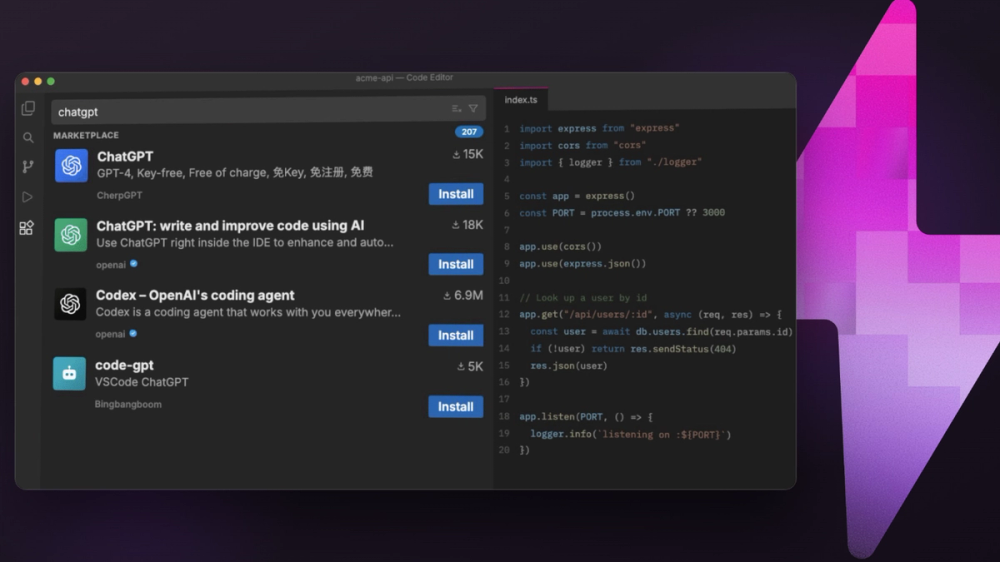 Socket: Firewall Now Blocks Malicious VS Code and Open VSX Extensions
Socket announced Firewall support for VS Code Marketplace and Open VSX extension installs, proxying marketplace and VSIX download traffic to block malicious extensions before install/update rather than only after-the-fact inventory. The post cites the May 2026 GitHub breach via a poisoned Nx Console 18.95.0 extension (exfiltrating ~3,800 internal repos) and repeated GlassWorm credential-stealing campaigns on Open VSX as motivating incidents. The feature is a closed-beta, agentless proxy control point covering editors like VS Code, Cursor, Windsurf, VSCodium, and Antigravity.
socket.devarticlePublished and added 18 Jun 2026🛡️ Security
Showing 30 of 37
Show more