 David Gutierrez | Eng (@david_x_ai) on X
Thread on two October 2026 npm compromises: @subql/common 5.8.3 (5 October), published through GitHub Actions OIDC Trusted Publishing after the attacker tampered with the publish workflow, and tensorlake 0.5.144 (8 October), published by the project's own release workflow with valid provenance for about 1 hour 40 minutes. Both ran on install and stole cloud, GitHub, Kubernetes, Vault, SSH and .env credentials; tensorlake also took AI tool and MCP config. Its payload installed a gh-token-monitor service that deletes the home directory if the stolen GitHub token is revoked, so remove it before rotating.
 x.comthreadAdded 27 Oct 2026, published 26 Oct 2026🛡️ Security
 Penetration testing every deployment with AWS Continuum
Explains how to add AWS Continuum for penetration testing (formerly AWS Security Agent) as a post-deployment gate in CI/CD. Each run is scoped to the commit range since the last passing gate, and it can block promotion to production at a chosen severity threshold. It covers OIDC federation to a least-privilege IAM role, a GitHub Actions worked example, staged report-only rollout, and pitfalls: the baseline advances on passing report-only runs, fail-on-infrastructure-error defaults to fail-open, GitLab pipeline variables can override the committed threshold, and runner credentials need protecting.
 aws.amazon.comarticlePublished and added 14 Oct 2026🛡️ Security
 How a Misconfigured CI Workflow Became an npm Supply-Chain Compromise | Blog | Endor Labs
Endor Labs breaks down the May 11, 2026 compromise of 42 @tanstack/* npm packages (84 malicious versions) that carried valid SLSA provenance. The attacker chained a pull_request_target "Pwn Request", GitHub Actions cache poisoning across the fork/base boundary, and OIDC token extraction from Runner.Worker memory, then published directly to npm without stealing any credential. It explains why 2FA, trusted publishing, provenance and branch protection all failed, and lists mitigations: split pull_request_target workflows, treat the cache as untrusted, scope id-token: write to a publish job, pin actions to SHAs, require environment approval, use egress allowlists.
 endorlabs.comwriteupPublished and added 12 Oct 2026🛡️ Security
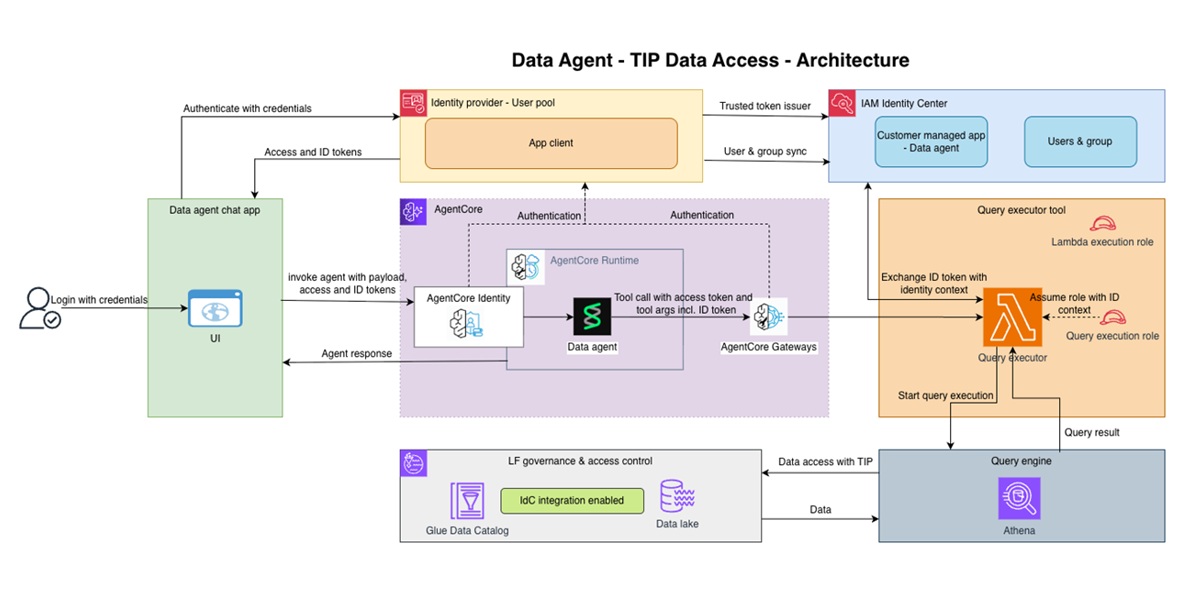 Identity-aware AI data agents with AWS Lake Formation and Trusted Identity Propagation
AWS Security Blog walkthrough showing how to build identity-aware AI data agents on Amazon Bedrock AgentCore that propagate a real user's OIDC id_token through the agent's tool-calling chain (Runtime → MCP Gateway → Lambda) via HTTP headers, keeping the token out of the foundation model's context entirely. A Lambda function performs a server-side token exchange using IAM Identity Center Trusted Identity Propagation, assumes a scoped TIP role, and runs the user's Athena query so AWS Lake Formation evaluates the real user's grants, producing per-user row/column access and CloudTrail audit records naming the actual human (onBehalfOf) without rewriting existing governance policies.
aws.amazon.comwriteupAdded 8 Oct 2026, published 6 Oct 2026🧠 AI- Identity-aware AI data agents with AWS Lake Formation and Trusted Identity Propagation
AWS Security Blog walkthrough of an identity-aware AI data agent pattern that propagates a real user's OIDC id_token through Amazon Bedrock AgentCore Runtime and Gateway into a Lambda target, which exchanges it server-side (via IAM Identity Center trusted identity propagation) for Lake Formation-scoped Athena credentials. The design deliberately keeps the id_token off the tool schema and inside HTTP headers only, so the foundation model never sees or handles the user's credential, and CloudTrail records the real human via an onBehalfOf AssumeRole entry, letting existing Lake Formation grants govern AI agent queries without rewriting authorization logic in application code. It details the three AgentCore configuration gates (runtime header allowlist, gateway metadataConfiguration.allowedRequestHeaders, Lambda's bedrockAgentCorePropagatedHeaders) that enforce this separation.
aws.amazon.comarticleAdded 7 Oct 2026, published 6 Oct 2026🛡️ Security - Bifrost (Maxim AI) — open-source LLM gateway
Bifrost is an open-source, high-performance LLM gateway (by Maxim AI) that exposes a single OpenAI-compatible API across 23+ providers including OpenAI, Anthropic, AWS Bedrock, Google Vertex, Azure, Cohere, Mistral, and Ollama. It provides automatic failover, load balancing, semantic caching, Model Context Protocol (MCP) tool integration, budget and governance controls, OIDC user provisioning, and Prometheus-based observability, deployable via npx or Docker with claimed sub-15 microsecond overhead at 5,000 RPS. It is positioned as a drop-in replacement requiring only a base-URL change for existing OpenAI, Anthropic, or GenAI SDK code.
 github.comrepoAdded 2 Oct 2026🧠 AI
- Identity Management for Agentic AI [pdf] (2025)
OpenID Foundation whitepaper (Oct 2025, lead editor Tobin South) analyzing how authentication/authorization for AI agents differs from traditional software clients. It covers where OAuth 2.1, OIDC, SSO/SCIM, and MCP already work for single-domain synchronous agents, and lays out unsolved problems for autonomous agentic identity: agent identity fragmentation across vendors, replacing user impersonation with explicit delegated "on-behalf-of" authority, consent-fatigue at scale, recursive delegation chains between sub-agents, agents acting for teams of users, and browser/computer-use agents bypassing API-based authorization entirely.
 openid.netpaperAdded 2 Oct 2026, published 1 Oct 2026🛡️ Security
 Mini Shai-Hulud Worm Compromises TanStack, Mistral AI, Guardrails AI & More Packages
The Hacker News details the "Mini Shai-Hulud" campaign by threat actor TeamPCP, which compromised npm and PyPI packages from TanStack, UiPath, Mistral AI, OpenSearch and Guardrails AI via a chained GitHub Actions attack (pull_request_target abuse, cache poisoning, OIDC token extraction), now tracked as CVE-2026-45321 (CVSS 9.6). The worm mints npm publish tokens directly from stolen OIDC credentials to self-propagate — the first documented case of a worm producing validly SLSA Build Level 3-attested malicious packages — and deploys an obfuscated credential stealer with IDE persistence hooks, a GitHub Actions secret-exfiltration workflow, and a dead-man's-switch that runs "rm -rf" if its rogue npm token is revoked. Over 170 packages and 400+ attacker-controlled repos have been identified across npm and PyPI, with findings credited to Aikido Security, Endor Labs, SafeDep, Socket, StepSecurity, Snyk, Wiz and Microsoft.
 thehackernews.comarticleAdded 26 Sep 2026🛡️ Security
- Insecure cryptographic defaults in oidcProvider: alg=none advertised and plain PKCE accepted by default
GHSA advisory for better-auth (< 1.6.11) documenting that the deprecated oidcProvider() and mcp() plugins publish "none" as a supported ID-token signing algorithm in their OIDC discovery document and default allowPlainCodeChallengeMethod to true, silently rewriting missing code_challenge_method to "plain" — both violating OAuth 2.1/RFC 9700. The fix removes "none" from the metadata, defaults plain PKCE to disabled, and rejects requests missing code_challenge_method instead of downgrading them; @better-auth/oauth-provider was never affected.
github.comadvisoryAdded 26 Sep 2026🛡️ Security  The Infostealer Incursion: How Stolen Credentials Breach Cloud, Code, and AI Environments
Wiz Research analyzed infostealer-harvested secrets (via its NordStellar integration) to map exactly which credentials malware families like Lumma, RedLine, and Vidar target across AWS, Azure, GCP, GitHub, GitLab, and AI platforms, and how those secrets translate into cloud account takeover. It gives concrete file paths and artifacts attackers hunt for (~/.aws/sso/cache OIDC tokens, Azure accessTokens.json, GCP credentials.db/access_tokens.db, GitHub gh hosts.yml and SSH keys, GitLab Runner config.toml, OpenAI/ChatGPT session cookies, and Claude Code's ~/.claude/.credentials.json OAuth tokens), plus stats: three malware families cause 85.7% of incidents, AWS/GCP account for 46%/13% of stolen secrets, GitHub ~10%, AI platforms ~5%. It also covers CI/CD-targeting infostealers (Miasma, TeamPCP) and session-cookie hijacking as an MFA bypass technique.
 wiz.iowriteupAdded 27 Sep 2026, published 25 Sep 2026🛡️ Security
 Proactive Defense: Hardening Code Pipelines and CI/CD Infrastructure
Mandiant's guidance for hardening the software supply chain across five pillars: endpoint, code repositories, artifact management, CI/CD and deployment. It covers a seven-day dependency cooldown, pinning images and actions by digest or commit SHA, ephemeral runners, OIDC short-lived tokens, build cache isolation, signed SBOMs, SLSA provenance and admission-time signature checks. It responds to campaigns using cache poisoning, OIDC token theft and mutable action tags.
 cloud.google.comarticleAdded 29 Oct 2026, published 24 Sep 2026🛡️ Security
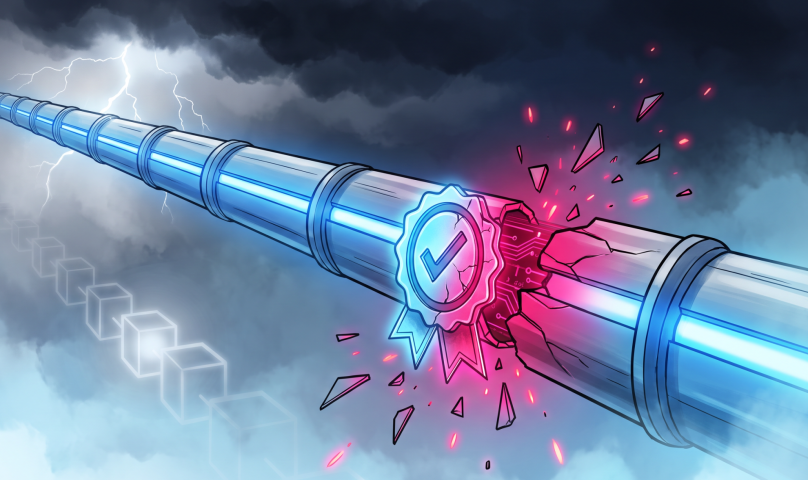 npm Supply-Chain Attack Abuses Trusted Publishing to Ship GHAPPIER Loader
Orca Security details a supply-chain attack on the npm package @dforge-core/dforge-mcp, where a compromised maintainer account modified the GitHub Actions release workflow so any push to main triggered an OIDC-based trusted publish, shipping malicious version 0.2.21 with valid Sigstore provenance. The four-stage GHAPPIER loader activated only when the MCP server launched, deployed a self-deleting remote shell, and per CloudSEK's tracing appeared across 65 repos and 22 accounts; a second payload matched PolinRider, a DPRK-linked campaign using Ethereum transactions for C2. The piece underscores that npm provenance attests build origin, not source integrity, and lists remediation steps since no CVE or advisory yet exists.
 orca.securityarticlePublished and added 22 Sep 2026🛡️ Security
- SAML: A fractal of bad design
A Trail of Bits researcher (ex-Duo Security engineer) traces SAML's history from its 2002 OASIS committee origins through recurring XML signature wrapping (XSW) and canonicalization/round-trip parser-differential attacks, arguing its reliance on brittle XML signature validation (libxmlsec) makes it fundamentally unsound. The post catalogs SAML's five structural flaws — XML complexity, canonicalization, enveloped signatures, kitchen-sink design, and protocol ossification — and recommends organizations deprecate SAML in favor of OIDC, citing Fly.io and Tailscale as vendors already holding the line on OIDC-only SSO.
 blog.trailofbits.comarticlePublished and added 21 Sep 2026🛡️ Security
 Happy Birthday, Shai-Hulud
Socket's one-year retrospective on the Shai-Hulud npm supply-chain worm, from the September 2025 @ctrl/tinycolor compromise through the November 2025 "Second Coming" wave, the May 2026 public release of the worm's source by TeamPCP, the "Mini Shai-Hulud" OIDC-token-hijacking wave that hit TanStack and Mistral AI, and the August 2026 arrest of two alleged TeamPCP members by Australian Federal Police working with the FBI. It notes Google ran an undercover analyst inside TeamPCP to get stolen credentials revoked, and stresses that the original September 2025 worm authors remain unidentified despite the arrests.
 socket.devarticleAdded 21 Sep 2026, published 18 Sep 2026🛡️ Security
 Architecting resilient authentication with Amazon Cognito multi-Region replication
An AWS Security Blog deep-dive on architecting resilient authentication using Amazon Cognito's multi-Region replication (MRR) feature, covering B2C, B2B, and M2M reference architectures. It details preparation steps (multi-Region KMS customer managed keys, choosing the updated OIDC issuer type, replicating Lambda triggers/WAF/SNS/SES configs) and failover strategies using Route 53 health checks, Application Recovery Controller, and AWS Fault Injection Service for testing.
aws.amazon.comarticleAdded 7 Oct 2026, published 15 Sep 2026🛡️ Security SolarWinds took a nation-state. The next attack just needs an LLM and $5. | Blog | Endor Labs
Endor Labs blog tracing an accelerating pattern of software supply-chain compromises from July 2025 through March 2026, culminating in the TeamPCP threat actor's cascading 30-day compromise of Aqua Security, Trivy, GitHub Actions, Docker Hub, npm, OpenVSX, and PyPI (including backdooring the 95M-download LiteLLM package). It argues AI is accelerating both offense (CVE-GENIE reproducing 51% of CVE exploits for $2.77 each) and the attack surface (the Cline prompt-injection-to-npm-token-theft chain, Nx's AI-review-evading payload), and calls for treating AI coding agents as privileged actors, pinning GitHub Actions to SHAs, and platform-level fixes like immutable tags and Sigstore/OIDC.
endorlabs.comarticlePublished and added 11 Sep 2026🛡️ Security Metasploit Wrap Up: This One Goes to Sixteen!
Rapid7's weekly Metasploit Framework update covering sixteen new modules: ten exploits (five on the CISA KEV list) targeting Cisco Secure Firewall Management Center (CVE-2026-20079 auth bypass RCE), SonicWall SMA1000 (CVE-2026-83549 chained RCE), PaperCut NG/MF (CVE-2026-81578 + CVE-2026-82078), JetBrains TeamCity agent-polling XStream deserialization RCE (CVE-2026-63077), Langflow authenticated RCE (CVE-2026-19295), MCPJam Inspector command execution (CVE-2026-23744), SimpleHelp OIDC auth bypass (CVE-2026-48558), Next.js Windows RCE (CVE-2026-75604), and SPIP SQLi/RCE flaws. It also adds a new native Kerberos relay module exploiting ESC8 (AD CS Web Enrollment) via SMB-to-HTTP coercion, a Metasploit handler-detection scanner, a Linux sandbox-evasion module, two Windows persistence techniques, and several bug fixes to the DNS and module metadata subsystems.
 rapid7.comarticleAdded 7 Oct 2026, published 11 Sep 2026🛡️ Security
 Megalodon: Mass GitHub Actions Secret Exfiltration Across 5,500+ Public Repositories - StepSecurity
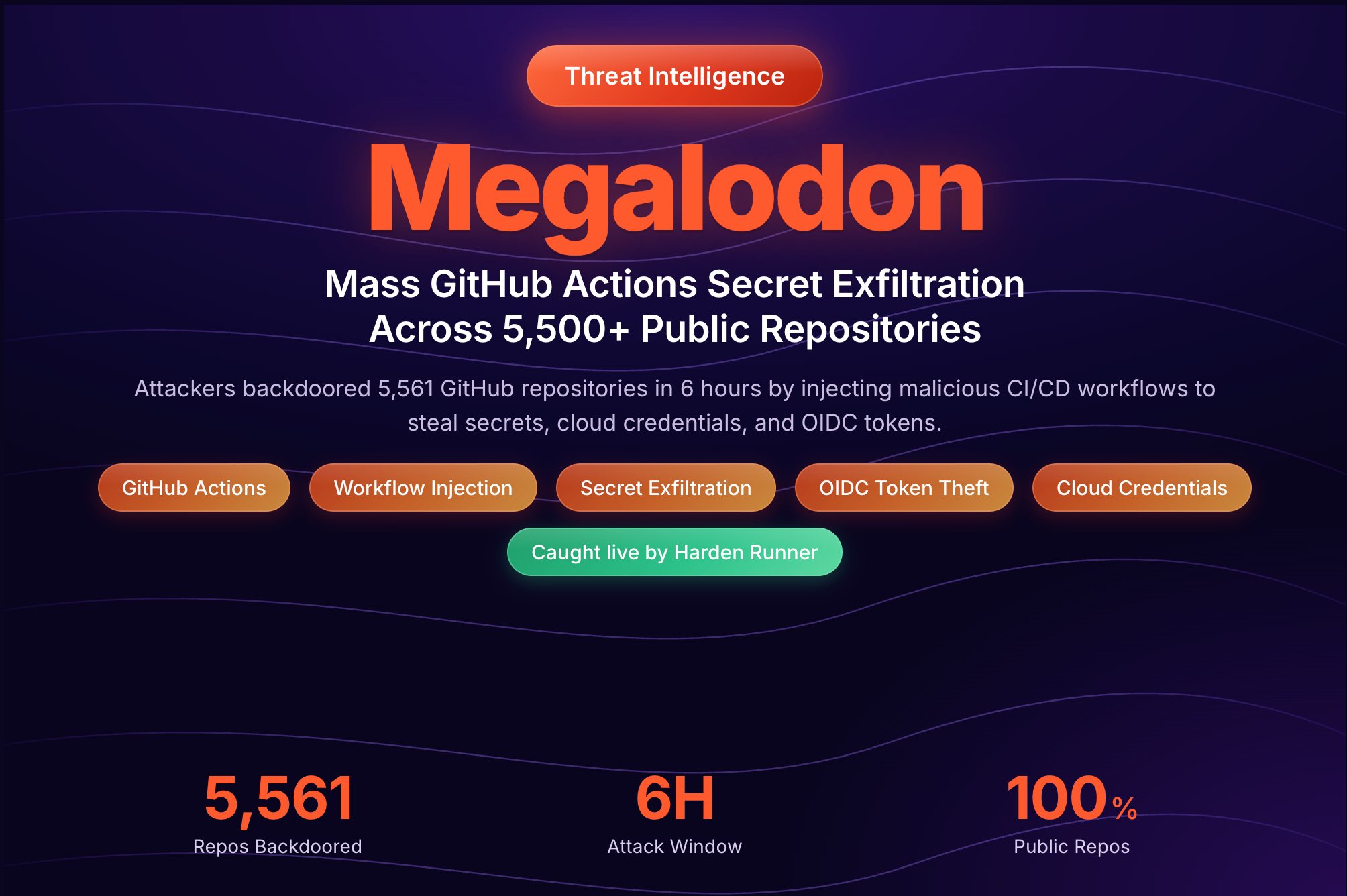
StepSecurity documents Megalodon, a May 2026 campaign that injected backdoored GitHub Actions workflow files named SysDiag or Optimize-Build directly into 5,500+ public repositories in a six-hour window via direct Poisoned Pipeline Execution (d-PPE), exploiting weak branch protection. The base64-encoded bash payload harvests AWS/GCP/Azure credentials, SSH keys, Kubernetes/npm/Docker configs, GitHub OIDC tokens, and grep-matched secrets from the workspace, exfiltrating everything via HTTPS POST to a hardcoded C2 IP; the npm package @tiledesk/tiledesk-server was among the confirmed poisoned downstream targets.
 stepsecurity.iowriteupAdded 5 Sep 2026🛡️ Security
 @7nohe/openapi-react-query-codegen Compromised Through an Exposed npm Publishing Workflow
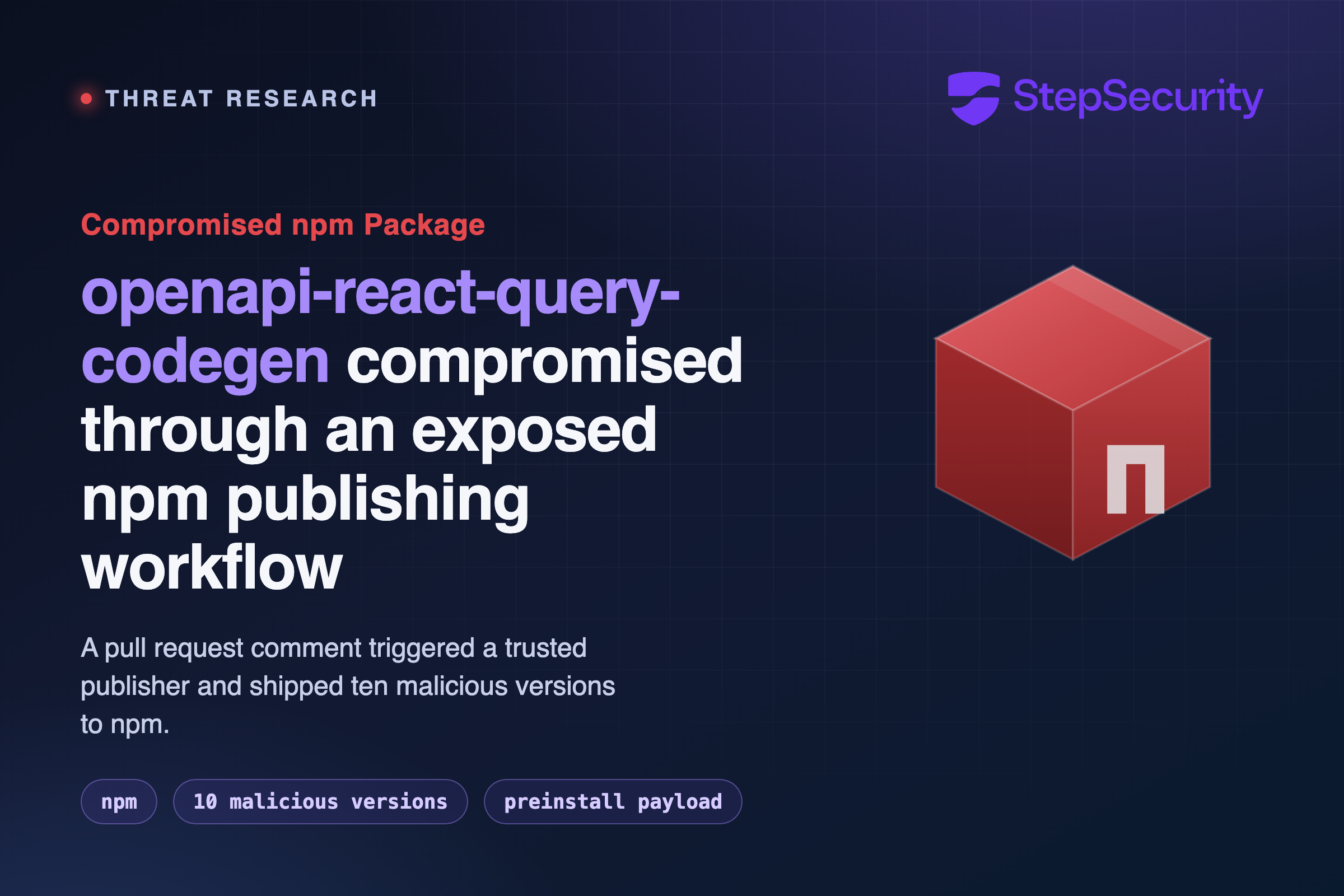
StepSecurity documents how an external GitHub user (p00paboot) hijacked the release workflow of @7nohe/openapi-react-query-codegen by exploiting an npm publish issue-comment trigger that lacked commenter authorization checks, allowing pull-request code to be checked out and published via GitHub Actions OIDC trusted publishing. Ten malicious versions were pushed with preinstall hooks and a poisoned binding.gyp that executed a payload downloading Bun, stealing GitHub/git credentials, probing GCP metadata, and enumerating SSH keys, confirmed via StepSecurity Harden-Runner behavioral analysis on isolated runners. The post lists affected versions, file/hash IOCs, and remediation steps including credential rotation and pinning to clean releases.
stepsecurity.iowriteupAdded 3 Sep 2026, published 28 Aug 2026🛡️ Security Shai-Hulud was the best thing to happen to supply chain security
Aikido Security tracks npm's Trusted Publishing (OIDC-based, short-lived credential) adoption over 18 months and shows it only spiked after each major supply-chain attack rather than from advisories or blog posts — jumping from a ~40/week baseline to 430/week after the Nx Console/AntV compromise, yet still leaving 40,369 of the top 51,370 packages (75% of download volume) on long-lived tokens. It chronicles the full attack progression from credential-phishing (Debug/Chalk, Axios) through Pwn Request-driven CI compromise (S1ngularity, Shai-Hulud 2.0) to the Mini Shai-Hulud II/TanStack attack, which poisoned the GitHub Actions cache to extract a live OIDC token from runner memory and publish packages with valid SLSA Build Level 3 provenance — proving Trusted Publishing itself can be turned into the attack vector rather than just bypassed. It closes by arguing the security community should proactively pressure high-download holdout maintainers rather than wait for the next worm.
 aikido.devarticleAdded 3 Sep 2026, published 24 Aug 2026🛡️ Security
- MinIO Security Lab
A defensive security review lab for MinIO pinned at commit 7aac2a2 (~RELEASE.2025-10-15+11), providing Docker-based single-node, two-node replication, and dual-OIDC environments plus per-finding repro.sh PoCs for issues including service-account key path traversal, server-update SSRF, cross-provider OIDC token acceptance, source-IP/X-Forwarded-For trust, tag-deletion replication bypass, batch job data exfiltration, and secrets exposed via config history. Each of 16+ findings (F-01 through F-16) has ANALYSIS.md with root cause, data-flow trace, and suggested fix, produced via a generate/judge/independent-verify pipeline with cross-vendor adjudication (including an OpenAI/codex-based verifier) and live validation on a lab-built Go binary; ~90 candidates were triaged with ~55 set aside as false positives or intended behavior.
github.comrepoAdded 3 Sep 2026, published 21 Aug 2026🛡️ Security  npm Now Scans for Malware at Publish, Not Install | Blog | Endor Labs
Analysis of GitHub's July 28 change making npm scan every package for malware at publish time (roughly a 5-minute delay), instead of only reacting after reports. It covers the new dual-use governance model — contentPolicy metadata, DISCLOSURE files, and mandatory 2FA/OIDC publishing for tools like security scanners that resemble malware — and argues registry scanning can't enforce org-specific policy, can't cover other registries (PyPI, Maven, NuGet), and can't stop novel malware or compromised-account publishes, making install-time enforcement (e.g. Endor Labs' Package Firewall) still necessary. References recent supply-chain worm incidents Shai-Hulud, NX S1ngularity, and Cline.
endorlabs.comarticleAdded 3 Sep 2026, published 12 Aug 2026🛡️ Security- npm-scan
npm-scan is a CLI supply-chain security scanner (@lateos/npm-scan) that inspects npm packages and lockfiles for behavioral attack patterns missed by npm audit/Snyk/Socket, including obfuscated payloads, credential stealers, eBPF kernel rootkits, memory-level OIDC token extraction, GitHub maintainer-account spoofing, and AI-platform-targeted key theft. It ships 23 detectors (D1-D25), validated against real campaigns like IronWorm and Miasma, and outputs SBOM (CycloneDX/SPDX) and SARIF for GitHub Security, plus a workflow to submit critical findings to CISA's VINCE with mandatory manual review. It's free (MIT) for individuals/OSS/evaluation, with paid commercial tiers ($799-$9,900/yr).
github.comrepoPublished and added 5 Aug 2026🛡️ Security  NPM Malware Compromises keyv and cacheable with 500M+ Weekly Downloads and Spreads to Hundreds of Packages | Blog | Endor Labs
Endor Labs' active-tracking advisory on an npm supply-chain worm that compromised keyv, flat-cache, and file-entry-cache (500M+ combined weekly downloads) via the jaredwray/Cacheable GitHub Actions OIDC trusted-publishing pipeline, injecting a preinstall hook (setup.mjs) that fetches a legitimate Bun binary to run an obfuscated ~727KB stage-2 payload (Math_Symbol.js/math_init.js) stealing AWS, npm, GitHub, and Vault tokens. The stolen tokens were used to self-propagate the same payload to 384+ packages and 1,136+ versions across unrelated maintainer accounts, including scopes belonging to companies like ServiceTitan, Qlik, and Picsart. The post includes IOCs (file hashes), affected package/version lists, and mitigation guidance (lockfile/CI log checks, --ignore-scripts).
endorlabs.comadvisoryAdded 3 Sep 2026, published 4 Aug 2026🛡️ Security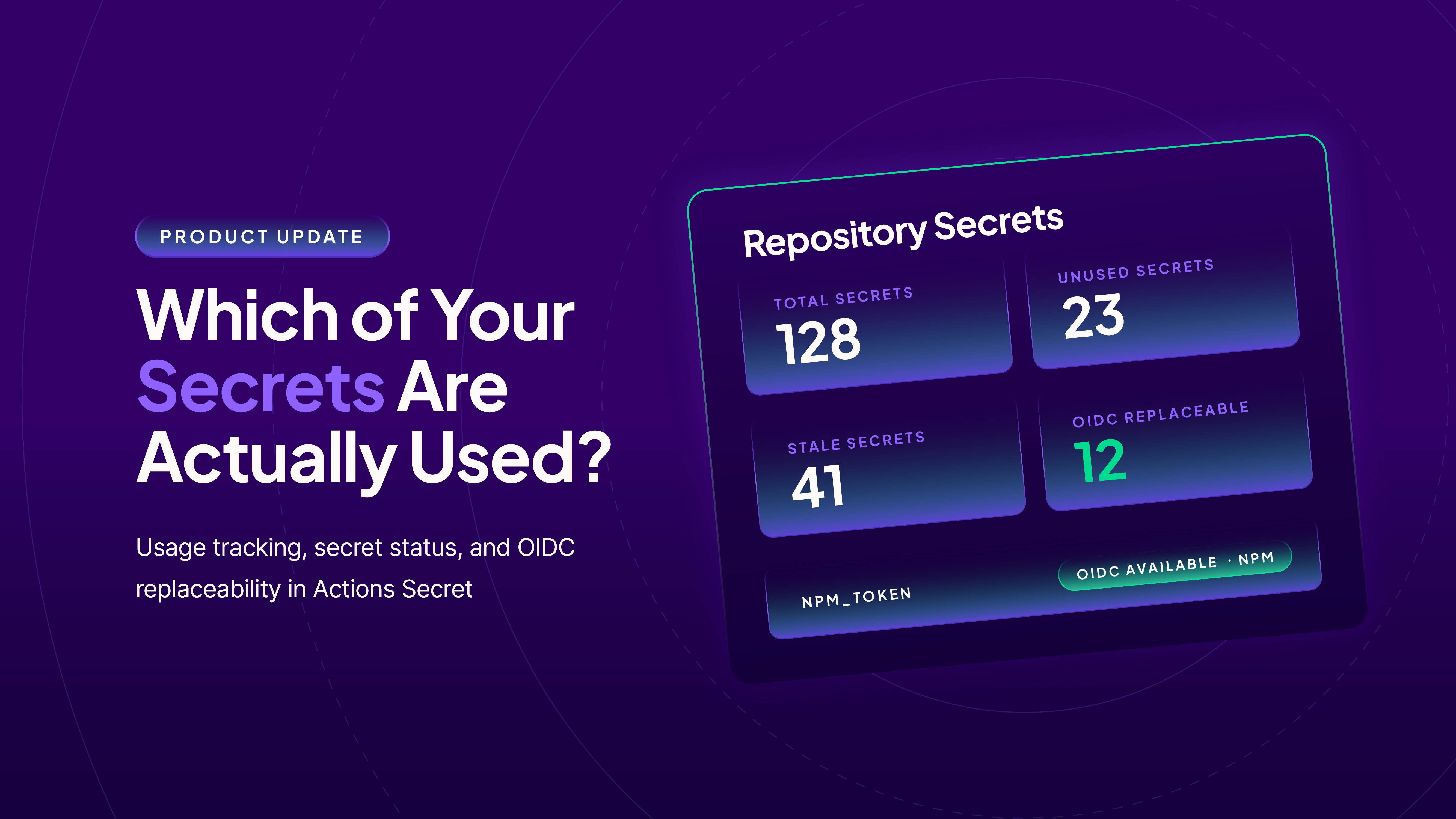 Find Unused, Stale, and OIDC-Replaceable GitHub Actions Secrets Across Your GitHub Organization
StepSecurity describes a new Repository Secrets feature in its Actions Secret dashboard that inventories GitHub Actions secrets across an org and classifies each as Active, Stale (unused workflow for 90+ days), or Unused, while flagging which secrets could be eliminated by switching to OIDC (e.g. AWS, Azure, GCP federation or npm/PyPI trusted publishing). It ties the problem to real incidents - the GhostAction campaign exfiltrated 3,000+ secrets and Megalodon targeted 5,500 public repos - arguing that unused, long-lived credentials are attack surface attackers actively harvest regardless of whether they are load-bearing.
stepsecurity.ioarticleAdded 3 Sep 2026, published 23 Jul 2026🛡️ Security- yolorouter/yolorouter
Yolorouter is a free, self-hosted, single-binary LLM gateway that translates between the four major chat wire protocols — OpenAI Chat Completions, OpenAI Responses, Anthropic Messages, and Gemini generateContent — so a client built for one provider (e.g. Claude Code) can be pointed at any other. It adds multi-provider failover, round-robin upstream API key pooling with rate-limit/quota handling, per-key budgets and access control, a multi-user admin console with OAuth2/OIDC SSO, and native image/video generation support for OpenAI-shaped and non-OpenAI-shaped providers (DashScope, Volcengine Ark, Kling, MiniMax). It also ships cost-optimization features — deterministic system-prompt injection and tool-output compression for coding agents — backed by a published benchmark, plus built-in usage/cost observability.
github.comrepoAdded 2 Oct 2026, published 21 Jul 2026🧠 AI - Gabson0x/pentdem
pentdem is an autonomous AI-powered pentesting CLI/pipeline that fans out 15+ vulnerability-class hunters (XSS, SQLi, SSRF, IDOR, SSTI, JWT, GraphQL, etc.) and 8 advanced attack skills (mass assignment, race conditions, cloud metadata, OAuth/OIDC, subdomain takeover, credential harvesting) in parallel, using an LLM to adapt strategy mid-scan. It wraps real tools (nmap, sqlmap, nuclei, ffuf, subfinder, httpx) in Docker isolation and adds a novel gate chain — quality gate, kill-chain builder, adversarial cross-model validation (a second model tries to disprove each finding), a capability execution ledger (proves each hunter actually ran instead of silently crashing), and a ship-discipline gate — before mapping surviving findings to MITRE ATT&CK/OWASP Top 10/CVSS and generating reports.
github.comrepoPublished and added 20 Jul 2026🛡️ Security - dstours/OctoC2
OctoC2 is a GitHub-native command-and-control framework built with TypeScript/Bun, featuring a beacon, durable controller, operator dashboard, and CLI. It supports multiple encrypted transports (GitHub Issues/branches/Actions/Gists/Git Notes, HTTPS/WebSocket, gRPC with mTLS, GitHub Actions OIDC, and relayed Codespaces SSH tunnels) with a signed task protocol, Ed25519 beacon identities, exclusive delivery leases, and replay-protected state for authorized red-team and security research engagements.
github.comrepoPublished and added 18 Jul 2026🛡️ Security  Coordinated AsyncAPI Supply Chain Attack: Miasma RAT Delivered via Compromised CI/CD Pipelines in Two Repositories
On July 14, 2026, attackers compromised push access to two AsyncAPI GitHub repositories (asyncapi/generator and asyncapi/spec-json-schemas) and pushed malicious commits under a placeholder git identity that triggered legitimate CI/CD release workflows (release-with-changesets.yml, if-nodejs-release.yml), publishing five malicious npm package versions (@asyncapi/generator, generator-helpers, generator-components, specs) carrying a runtime-triggered obfuscated dropper for the Miasma RAT, complete with valid OIDC/SLSA provenance attestations. StepSecurity detected the packages within 30 minutes, used Harden-Runner in an isolated GitHub Actions job to capture the malware's C2 traffic (HTTP plus IPFS/Nostr/BitTorrent DHT fallback channels), and pushed the IOCs to their Global Block List to block exfiltration across customer pipelines; all malicious versions have since been unpublished.
stepsecurity.iowriteupAdded 3 Sep 2026, published 16 Jul 2026🛡️ Security Socket: npm v12 Ships With Install Scripts Off by Default
npm v12 is now generally available, disabling preinstall/install/postinstall lifecycle scripts, the implicit node-gyp rebuild triggered by binding.gyp, git dependency resolution, and remote URL dependency resolution by default, all of which required explicit opt-in via allowScripts, --allow-git, and --allow-remote. The release also begins phasing out granular access tokens configured to bypass 2FA, first restricting their account/org actions (~Aug 2026) and later removing their ability to publish directly (~Jan 2027), pushing teams toward trusted publishing (OIDC) or staged-publish-with-2FA-approval workflows instead. The changes respond to a year of install-time supply-chain worms (Shai-Hulud, Miasma/Phantom Gyp) that exploited default script execution and binding.gyp-based implicit builds to evade scanners.
socket.devarticlePublished and added 15 Jul 2026🛡️ Security
Showing 30 of 50
Show more