ETDI: Comprehensive MCP Security Framework
ETDI (Enhanced Tool Definition Interface) is a proposed security extension to the Model Context Protocol that adds cryptographically signed and versioned tool definitions, OAuth 2.0 scope-based permissions, Cedar-policy-driven context-aware access control (via engines like Amazon Verified Permissions/OPA), and call-stack verification to stop tool chaining and privilege escalation. It is designed to counter two named MCP threat classes — Tool Poisoning (spoofed/impersonated tool definitions) and Rug Pull attacks (post-approval silent modification of tool behavior) — with concrete pseudocode for signature verification, version/integrity checking, and policy evaluation. The page functions as an implementation guide for MCP client/server builders wanting to harden tool approval and invocation flows.
 vulnerablemcp.infowriteupAdded 8 Oct 2026🧠 AI
- ETDI: Comprehensive MCP Security Framework
ETDI (Enhanced Tool Definition Interface) is a proposed security extension to the Model Context Protocol that defends against Tool Poisoning (spoofed/impersonated tool definitions) and Rug Pull attacks (silent post-approval modification of tool behavior) using cryptographic signing of tool definitions, immutable versioning with mandatory re-approval, OAuth 2.0 scopes, and Cedar/Amazon Verified Permissions-based policy-aware access control. The page includes detailed attack scenarios, a call-stack verification scheme to prevent tool-chaining privilege escalation, and implementation code for key management, signature verification, and policy evaluation.
vulnerablemcp.infowriteupAdded 8 Oct 2026🛡️ Security - Binary Security: Azure Logic Apps cross-tenant compromises (One Root Case)
Third post in a series on Azure Logic Apps API Connections, describing five critical cross-tenant privilege escalations that let an attacker use any other tenant's connection to reach its backend (Key Vault, Azure SQL, Jira, Salesforce). Techniques include path traversal via ARM DynamicInvoke and undocumented DynamicList endpoints, and abusing the host.api.runtimeUrl parameter in Consumption Logic Apps, including a validation-before-normalization bypass. The author reports $200,000 in bounties; Microsoft fixed all issues.
 binsec.nowriteupAdded 30 Oct 2026, published 2 Oct 2026🛡️ Security
 176 Vulnerabilities in Samsung Preinstalled Apps
Oversecured summarizes a multi-year research effort (2022-2025) that uncovered 176 vulnerabilities across Samsung's preinstalled system apps, all patched and rewarded with over 200000 dollars in bug bounties. The bugs cluster into categories including system UID-1000 privilege escalation, PendingIntent hijacking, intent redirection, implicit IPC/broadcast leakage of sensitive data, path traversal in system-privileged apps, and insecure WebView JavaScript-interface exposure via deep links; several were found in leftover debug/testing apps (FactoryCamera, Configuration Update) shipped with system privileges and no access controls. Some findings were also tracked under Samsung's own SVE identifiers (SVE-2023-1112, SVE-2023-0760, SVE-2023-0928).
 oversecured.comwriteupAdded 26 Sep 2026🛡️ Security
 ParaShells: Parallels Desktop Turns Appliance Install Into a Root Shell
JFrog researchers detail ParaShells, a local privilege escalation chain in Parallels Desktop 26.4.0 (build 57513) on Apple silicon that lets an unprivileged macOS user gain root. The chain combines a world-writable Unix socket for prl_disp_service, weak peer-credential-based authentication in PrlSrv_LoginLocal, and argument injection in the InstallAppliance extraction path where a crafted sVmParentPath breaks Qt's QProcess::splitCommand quoting to inject tar's --use-compress-program= flag, causing macOS tar to execute an attacker script as uid 0.
 jfrog.comwriteupPublished and added 15 Sep 2026🛡️ Security
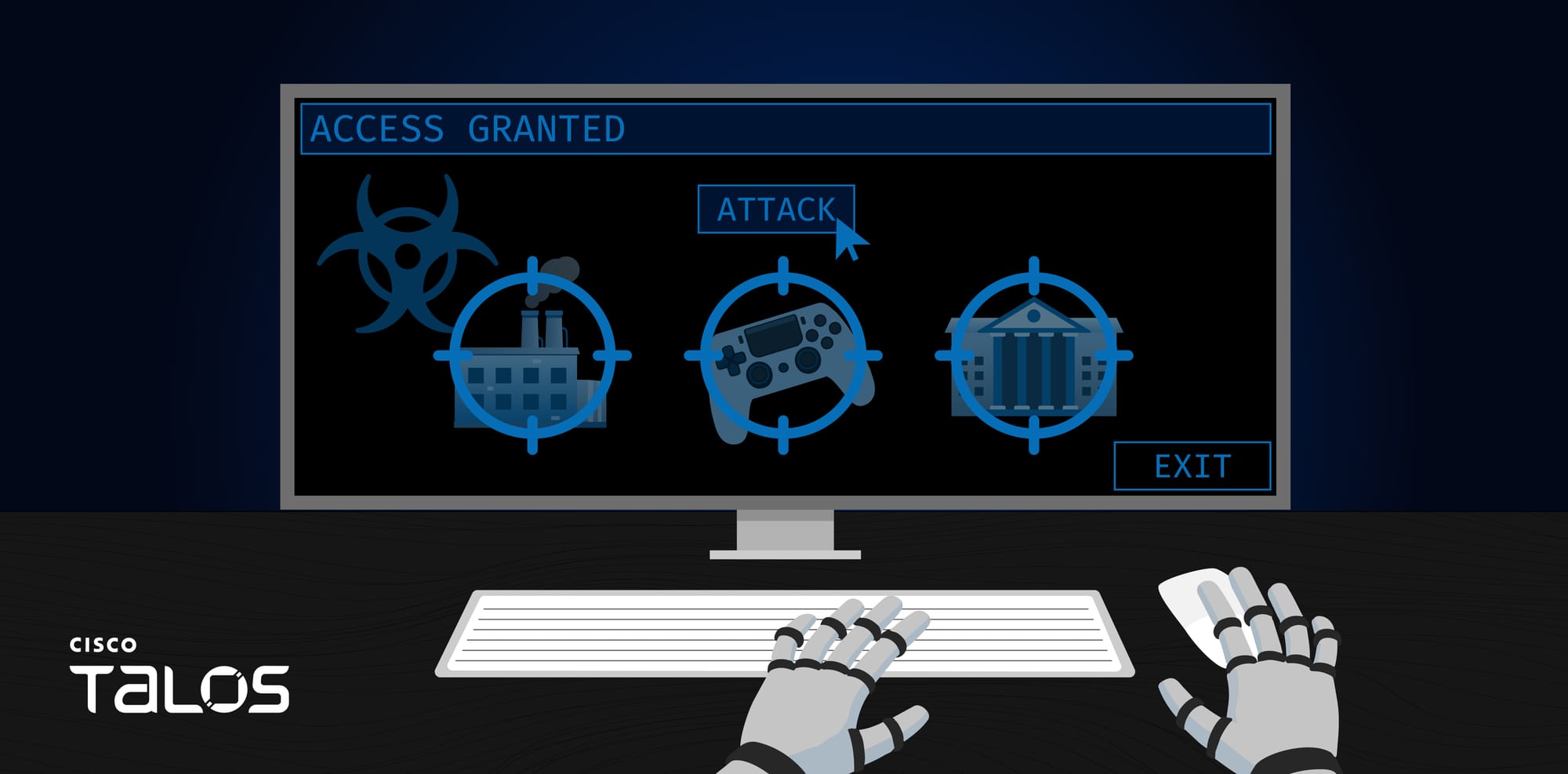 UAT-10147: Chinese-speaking adversary integrates agentic AI into post-compromise operations
Cisco Talos details UAT-10147, a Chinese-speaking cybercrime group exploiting one-day vulnerabilities in Windows/Linux web servers to deploy BadIIS, QuasarRAT, NoodleRAT, and SPECTRE implants, while also integrating agentic AI tools (PentestGPT, DeepAudit, and AI-orchestrated ysoserial workflows) to generate exploit playbooks, automate ASP.NET ViewState deserialization RCE, validate exploit success, and run reconnaissance/exfiltration end to end. Talos recovered AI-generated Python scripts and a findings log from the actor's C2 open directory showing semi-autonomous exploit refinement, OOB callback verification via webhook.site, and privilege escalation via SeImpersonatePrivilege/Potato exploits — evidence of a shift from AI-assisted scripting toward agentic offensive orchestration.
 blog.talosintelligence.comwriteupAdded 24 Aug 2026, published 20 Aug 2026🛡️ Security
- Hunting the Hunter: A Live Kernel LPE 0day in Anti-Cheat on a Billion Machines
A technical writeup by security researcher BlackSnufkin describing the discovery of a live, unpatched 0day kernel-mode local privilege escalation (LPE) vulnerability in an anti-cheat driver reportedly deployed on roughly a billion Windows machines. The post likely covers the vulnerability research and exploitation process targeting the anti-cheat's kernel component. Full page content could not be verified in this pass; summary is inferred from title and URL alone.
 blacksnufkin.github.iowriteupAdded 2 Oct 2026, published 4 Aug 2026🛡️ Security
- HEVD Windows Kernel Exploitation Tutorial
Chapter 0 of a 5-part series on exploiting HackSys Extreme Vulnerable Driver (HEVD) for Windows kernel privilege escalation via a stack overflow bug. This installment covers environment setup (Hyper-V/VMware with SMEP support, WinDbg kernel debugging attach, DbgPrint enablement) as prep for later chapters that will detail bypassing kASLR, SMEP, and KPTI/KVA Shadow and building a sysret-based ROP shellcode chain.
 mdanilor.github.iowriteupAdded 3 Sep 2026, published 31 Jul 2026🛡️ Security
- How I Found Open-Source 0-days with an LLM Multi-Agent Workflow
A student researcher describes an LLM multi-agent pipeline (GLM-4.7 for candidate finding, GLM-5 for semi-triage, Codex 5.3 for final triage) built to hunt logic and authorization bugs in large open-source codebases like Grafana, Nextcloud, Matomo, Airflow and protobuf. The post details the prompt-engineering fixes (forcing the model to explicitly reason about attacker conditions, server conditions, and CIA-triad impact) that cut false positives, and lists the resulting real vulnerabilities, including CVE-2026-21721, a CVSS 8.1 privilege escalation in Grafana's dashboard permissions API caused by a missing UID scope check in ac.EvalPermission.
 blog.cykor.krwriteupPublished and added 29 Jul 2026🛡️ Security
 SleeperGem: Compromised git_credential_manager, Dendreo, and fastlane RubyGems Drop a Persistent Backdoor
StepSecurity analyzes SleeperGem, a coordinated RubyGems supply chain attack that trojanized git_credential_manager, Dendreo, and a fastlane plugin between July 18-19, 2026. The malicious releases act as CI-evading loaders that, on developer machines, download a second-stage native daemon and deploy.sh from an attacker-controlled Forgejo host (git.disroot.org), install dual persistence via systemd and cron, and attempt privilege escalation to plant a setuid backdoor mimicking ping6. The post uses Harden-Runner audit-mode captures to document the full kill chain and provides IOCs and cleanup steps, crediting Aikido Security with the original discovery.
 stepsecurity.iowriteupAdded 3 Sep 2026, published 19 Jul 2026🛡️ Security
 Solving GitHub's Secure Code game with an AI red teaming agent
Adversa AI documents how their autonomous AI red-teaming agent (a LangGraph planner/attacker/scorer/escalator loop) solved all five levels of GitHub's Secure Code Game Season 4 "ProdBot" challenge, capturing the flag at each capability tier without using any jailbreak vocabulary. Each level maps to a distinct agentic failure: a denylist-based sandbox bypassed via bash variable expansion hiding ".." from a static validator, an indirect injection surface via web browsing, an over-permissioned MCP Cloud Backup tool whose real file access exceeded its advertised sandbox-only scope, a skill-writable memory store that doubled as the security policy store (enabling privilege escalation via a never-expiring ttl=0 entry), and a multi-agent confused deputy where a Research Agent's unsanitized web content was passed to a privileged Release Agent as pre-verified context, triggering an unauthorized file read. The piece argues all five share one root cause: an agent acting on state it cannot independently verify, and that continuous automated red-teaming is needed to catch the class as new agent capabilities ship.
 adversa.aiwriteupAdded 7 Oct 2026, published 17 Jul 2026🛡️ Security
 Rapid7 MDR Team Discovers New SonicWall SMA1000 Zero Days Being Actively Exploited (CVE-2026-15409, CVE-2026-15410)
Rapid7's MDR team details active zero-day exploitation of SonicWall SMA1000 appliances via CVE-2026-15409 (unauthenticated SSRF in the /wsproxy websocket proxy, CVSS 10.0) chained with CVE-2026-15410 (local privilege escalation via path traversal in the ctrl-service remove_hotfix workflow) to achieve root RCE. The post includes a working Python exploit against the localhost Erlang service on port 1050 (using a hardcoded authentication cookie), an HTTP request PoC for the hotfix path-traversal chain, and extensive observed post-exploitation activity — credential/TOTP theft, VPN-less lateral movement to domain controllers via harvested LDAP service accounts — plus concrete log/IOC signatures and attacker-infrastructure IPs (FNS Holdings Limited ASN 206092) for hunting.
 rapid7.comwriteupAdded 10 Sep 2026, published 15 Jul 2026🛡️ Security
- CitrixBleed 2 (CVE-2025-5777) 7Steps to Dragonforce Ransomware | Huntress
Huntress's Tactical Response team documents a repeatable intrusion cluster (tracked by Sophos as STAC3725) where an initial access broker exploits CVE-2025-5777 "CitrixBleed 2," a pre-auth memory overread in NetScaler ADC/Gateway login endpoints, to leak process heap and hijack valid Citrix session tokens even past MFA. The writeup walks through forensic proof of the session hijack, a portable local privilege escalation tool that plants a REG_LINK SymbolicLinkValue under the RdpBus device class to hijack the Group Policy state hierarchy and relaunch as SYSTEM via the AppMgmt service, followed by backdoor admin creation, ScreenConnect/Zoho Assist/Atera persistence, Impacket and Mimikatz for lateral movement/credential theft, and eventual DragonForce ransomware deployment. Includes concrete IOCs, log-based detection guidance, and hardening recommendations for NetScaler operators.
 huntress.comwriteupAdded 3 Sep 2026, published 9 Jul 2026🛡️ Security
 Authentication Bypass in the default configuration phpBB
Aikido Security's technical breakdown of CVE-2026-48611, a critical phpBB authentication bypass in the default configuration: by abusing the OAuth "login-link" feature's auth_provider query parameter, an unauthenticated attacker can force phpBB to use the trust-based `apache` auth provider (meant only for Apache Basic-auth proxies) and log in as any user, including admins, with a single request. The post details the vulnerable code in ucp_login_link.php/apache.php, shows a working PoC (curl/JS), explains a further UCP-to-ACP privilege escalation via the "founder" user's ability to self-promote to admin without a password, and describes an unauthenticated RCE chain via phpBB 4.0's Extensions Catalog fetching malicious extensions from attacker-controlled URLs. It also gives detection guidance (watch for `auth_provider=apache` + `mode=login_link`, including a GET/POST parameter-pollution bypass variant) and a disclosure timeline ending in the patched 3.3.17 release.
 aikido.devwriteupAdded 3 Sep 2026, published 3 Jul 2026🛡️ Security
 Trust No One: Automating macOS Privilege Escalation at Scale
XM Cyber researchers detail a macOS privilege escalation technique that lets a standard user disable EDR/MDM agents without admin credentials by exploiting stale kernel CDHash trust caches combined with NIB payload injection to impersonate trusted, code-signed application components. Once inside the trusted process context, the attacker uses an AppleScript-to-JXA-to-Objective-C runtime bridge (loading OSAKit.framework, forging Block_layout/objc_msgSend structures) to call unauthenticated privileged XPC methods like runProcessWithCommand: and ceaseSystemExtensionWithReply:, forcing security products to disable or remove themselves. The authors built an open-source scanner, XPC Hunter, to find this exposure across installed macOS apps at scale and recommend fixing it via xpc_connection_set_peer_code_signing_requirement() or SecCodeCheckValidity() peer validation.
 xmcyber.comwriteupAdded 3 Sep 2026, published 24 Jun 2026🛡️ Security
 LLMjacking evolved: Attackers are using stolen AI compute to build offensive agentic tools | Sysdig
Sysdig's Threat Research Team captured the full architecture of "VAPT," an autonomous multi-stage exploitation framework that a threat actor powered using a misconfigured, internet-exposed Ollama server (port 11434, no auth) instead of paid LLM APIs. The tool chains service fingerprinting, CVE matching, PoC/blind-SQLi generation, credential extraction, privilege escalation, and an autonomous orchestrator that confirms RCE via a VAPTb3gin/VAPTfin marker wrapped around `id` output, and was observed being actively developed against private HackTheBox-style practice ranges before any real-world targeting. It represents the convergence of LLMjacking (stolen inference compute) with fully agentic offensive tooling, and the piece includes captured system prompts, IOCs, and hardening guidance for self-hosted model servers.
 sysdig.comwriteupAdded 28 Jun 2026, published 17 Jun 2026🛡️ Security
 Observing Privilege Escalation in Kubernetes (EKS CloudWatch Observability Add-on)
Reversec details a privilege escalation vulnerability in AWS EKS's CloudWatch Observability Add-on: the cloudwatch-agent service account, deployed via DaemonSet to every node, had cluster-wide permission to update ConfigMaps, allowing any attacker who compromised a node (e.g. via a privileged pod with hostPath access) to steal the agent's service account token, rewrite the aws-auth ConfigMap, and grant themselves cluster-admin via system:masters. The flaw existed in the default, unmodified add-on configuration (no misconfig required) and was found in two separate client engagements; AWS acknowledged it and shipped a fix in add-on v5.3.0-eksbuild.1 that scopes the update-ConfigMap permission to a namespaced role, though a related privilege-escalation path via the nodes/proxy permission (disclosed separately by Graham Helton) remains unaddressed until Kubernetes 1.36's fine-grained Kubelet authorization lands in EKS.
 labs.reversec.comwriteupAdded 5 Oct 2026, published 1 Jun 2026🛡️ Security
- Threat Actors Weaponize Tiflux RMMs in Malspam Attacks
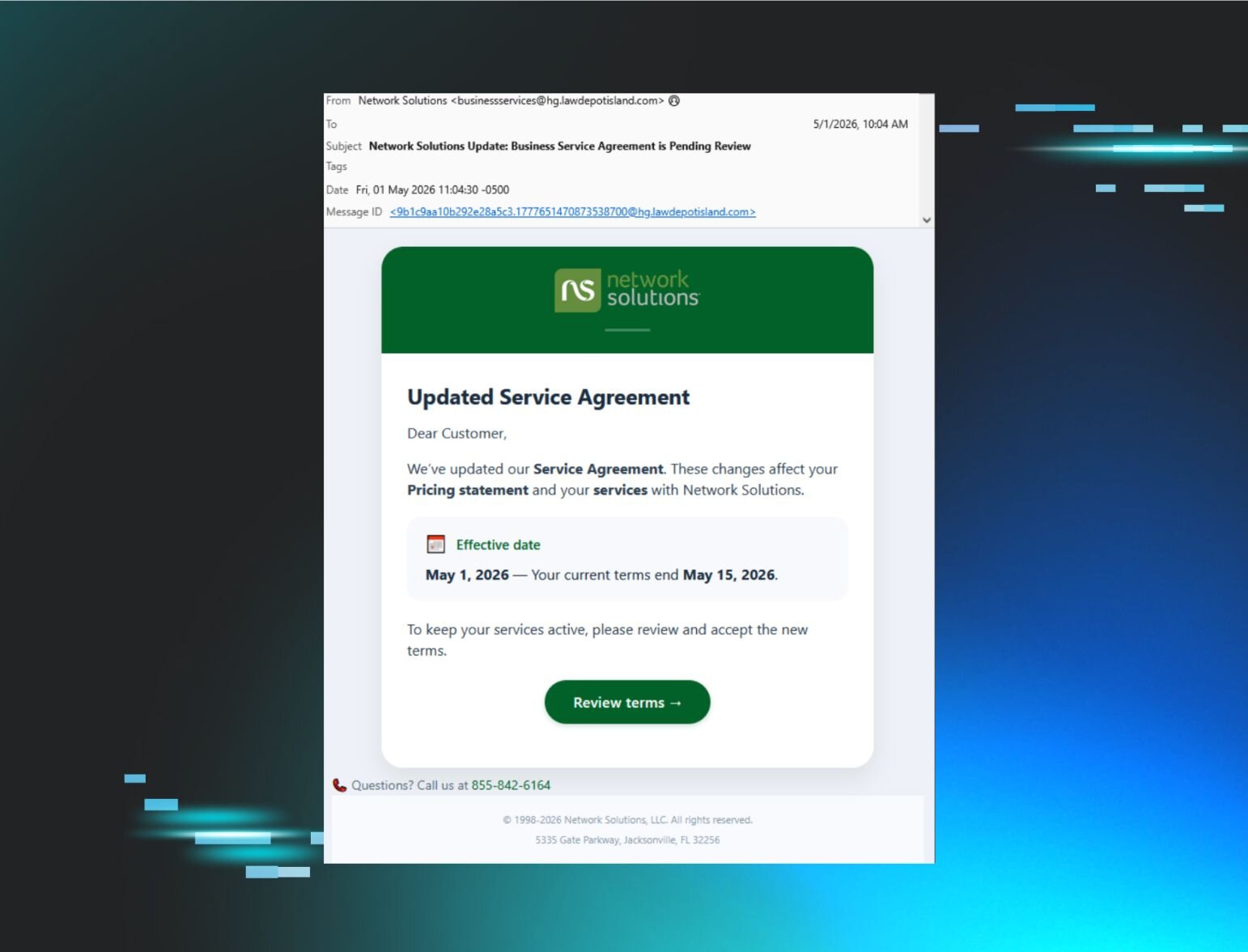
Huntress documents a malspam campaign, active since February 27, that uses fake "service agreement" document lures behind a CloudFlare CAPTCHA to trick targets into installing Tiflux, a lesser-known Brazil-based commercial RMM, before pivoting to UltraVNC, Splashtop, and ScreenConnect for persistent remote access. The Tiflux installer bundles suspicious extras beyond the legitimate agent: a decade-old UltraVNC build with hardcoded plaintext-recoverable passwords, an expired UltraVNC code-signing cert, registry files that stage a hidden TightVNC service (enabled even in Safe Mode) and a passwordless PuTTY SSH key to a peopleone[.]com[.]br server, registry tweaks that suppress Windows Secure Attention Sequence consent prompts, and a known vulnerable HwRwDrv.sys driver linked to privilege escalation with a revoked signing certificate. Huntress frames this as another entry in the ongoing "LOLRMM" pattern of attackers abusing legitimate commercial RMM tools for stealthy access and persistence.
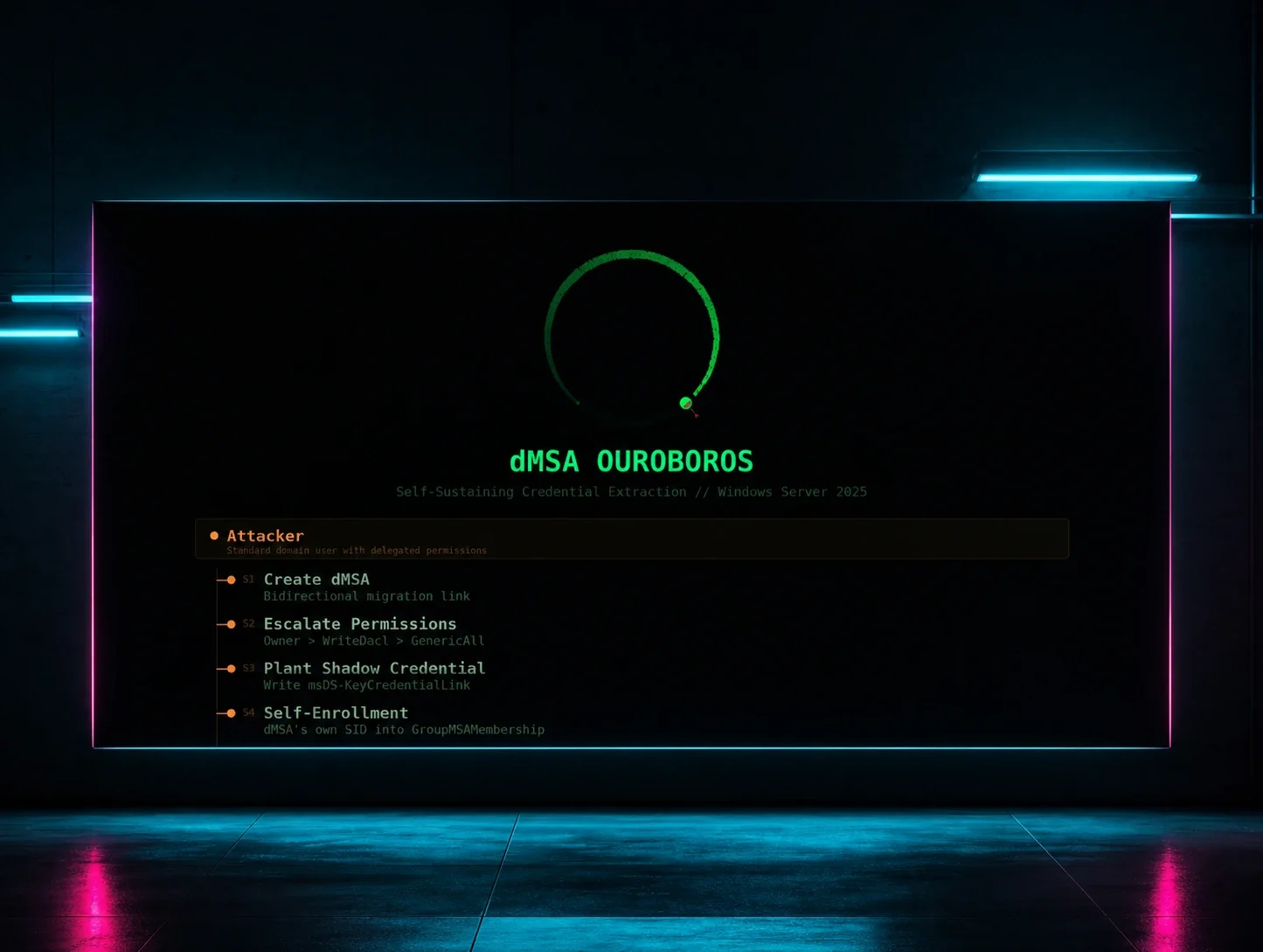
huntress.comwriteupAdded 3 Sep 2026, published 7 May 2026🛡️ Security - dMSA Ouroboros: Self-Sustaining Credential Extraction in Windows Server 2025
Huntress and Akamai researchers detail "dMSA Ouroboros," a technique where a low-privileged domain user with CreateChild on any OU/container plus WriteProperty on a target account creates a delegated Managed Service Account (dMSA), plants a Shadow Credential via msDS-KeyCredentialLink for PKINIT auth, and writes the dMSA's own SID into msDS-GroupMSAMembership so it authorizes itself via S4U2Self to continuously extract the superseded account's NT hash. The resulting loop survives password rotation, survives deletion of the original attacker account, and can lock Domain Admins out of remediation, with deletion of the dMSA object being the only effective fix; the post also proposes BloodHound detection edges and Microsoft declined to service it as a CVE, classifying it as persistence rather than privilege escalation.
huntress.comwriteupAdded 3 Sep 2026, published 4 May 2026🛡️ Security - Data Exfiltration and Threat Actor Infrastructure Exposed
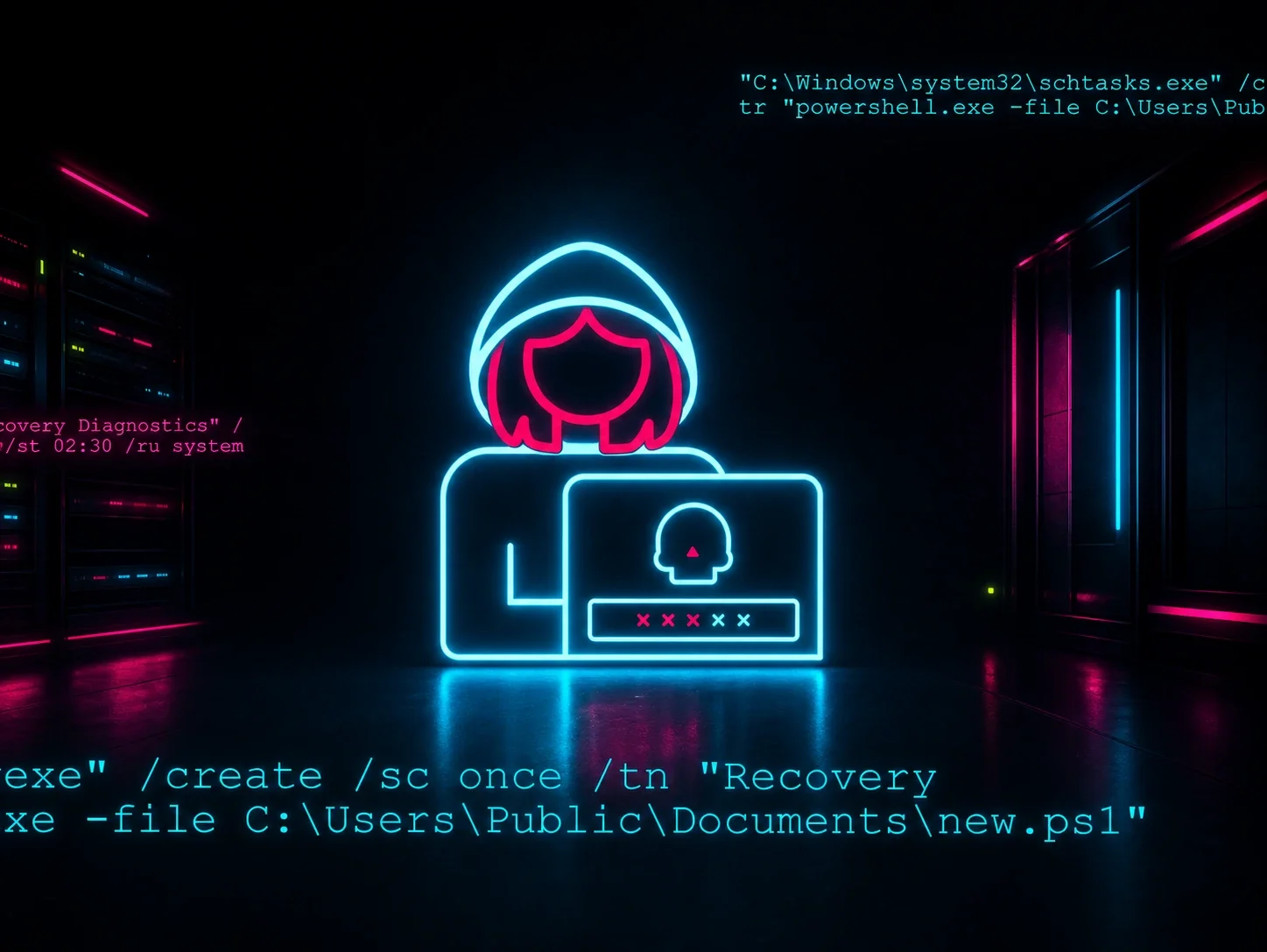
Huntress SOC details two related incidents where threat actors used PsExec for privilege escalation, a scheduled task ("Recovery Diagnostics") to run base64-encoded PowerShell that configured a renamed copy of restic (winupdate.exe) pointed at a Wasabi S3 bucket, then disabled/removed VIPRE Business Agent and Windows Defender before deploying INC ransomware. A second, near-identical prior incident on 9 February reused the same AWS access keys and used HRSword to disable Acronis security tooling, and the same TTPs were independently documented by the Cyber Centaurs team on 22 January 2026. The post highlights detection gaps (incomplete agent deployment, no SIEM) and notes RestartManager API telemetry (also seen with Akira) as a ransomware-encryption indicator.
huntress.comwriteupAdded 3 Sep 2026, published 12 Mar 2026🛡️ Security - Detecting insiders on GNU/Linux servers
A practical guide to building an auditd-based Linux intrusion detection ruleset covering reconnaissance (tcpdump/wireshark/nmap install and execution), privilege escalation (setuid/setgid syscalls, sudoers and /etc/passwd modification, process injection via ptrace and process_vm_writev), container escape via host filesystem remounting, lateral movement (xfreerdp), persistence (SSH authorized_keys, cron, systemd units, udev rules), and detection evasion via /dev/shm. Each rule is accompanied by working C PoCs and ausearch log output to validate detection, plus discussion of auditd's limitations (no path globbing, kernel syscalls only, incomplete file-change detection). Based on the author's incident response and pentesting experience, the rules and full ruleset are published on a companion GitHub repo.
 bencteux.frwriteupAdded 3 Sep 2026, published 21 Apr 2025🛡️ Security
- Privileges relinquishing order in C
Explains a subtle Linux privilege-dropping bug: calling setuid() before setgid() in a SUID/SGID-root binary leaves the saved set-group-ID privileged, letting a later setgid(0) call silently regain root group privileges due to POSIX semantics. The author provides compiled C PoC programs (drop_bad.c / drop_good.c) showing the wrong order failing to fully drop privileges versus the correct order (setgid then setuid) properly relinquishing them, and notes this becomes exploitable for privilege escalation when combined with a code-execution bug later in the program.
bencteux.frwriteupAdded 3 Sep 2026, published 1 Oct 2024🛡️ Security - EDR: The Great Escape - RomHack Training Review
A DFIR consultant's detailed review of "EDR: The Great Escape," a RomHack training by RETooling's Silvio and Antonio, covering modern EDR/AV internals and evasion across four modules: minifilter driver whitelist/altitude bugs, hooking/unhooking (including VEH syscall triggering), ELAM and PPL, ETW muting via EtwUnregister, ROP-only process injection, kernel notify-routine/object-callback bypass (as implemented in EDRSandBlast), vulnerable driver exploitation for token theft, stack-spoofing techniques (Ekko, gargoyle, SilentMoonwalk, CallStackMasker, DeathSleep), local privilege escalation, memory-scanner evasion (vs moneta, pe-sieve), and .NET IL/JIT-hooking obfuscation (R2R stomping, MassLogger-style tricks). The course used the open-source openedr project as a reference architecture for labs. Written for both red and blue teams, it doubles as a map of concrete EDR blind spots and the tooling attackers use to exploit them.
 dfir.chwriteupAdded 3 Sep 2026, published 30 Sep 2024🛡️ Security
- Two in a row - You mitigated wrong (Kentico CMS RCE)
A DFIR consultant details two investigations (five months apart) into a compromised IIS/Kentico CMS server. Attackers exploited a Kentico Staging SyncServer .NET deserialization RCE (via a public exploit and a Metasploit module using the WindowsIdentity gadget chain) to plant a rewrite-rule redirect to Vietnamese black-hat SEO content, then later returned with a malicious IIS native module (HTTPCacheLog.dll) that hooked BeginRequest to execute commands from HTTP cookies, plus multiple .ashx webshells and PrintNotifyPotato.exe for privilege escalation. The piece walks through using Chainsaw, Sysmon, PowerShell logs, and Velociraptor/YARA hunts to trace the intrusion and lists file-hash IOCs.
dfir.chwriteupAdded 3 Sep 2026, published 6 Mar 2024🛡️ Security - CVE-2023-36631: Circumventing Windows Firewall controls with... Malwarebytes' Windows Firewall Control
Details CVE-2023-36631, a missing access-control flaw in Malwarebytes' Binisoft Windows Firewall Control (wfc.exe/wfcs.exe) that lets any unprivileged local user export, import, or reset Windows Defender Firewall rules without authentication, fully bypassing firewall protections. The author walks through PoC steps for the export/import/reset actions and documents Malwarebytes' HackerOne disclosure, which was initially closed as 'informative' before a CVE was ultimately assigned. It also references a related 2022 CVE-2022-25150 in the same product's Tools tab that allowed local privilege escalation.
bencteux.frwriteupAdded 3 Sep 2026, published 21 Jun 2023🛡️ Security - PrivEsc: Abusing the Service Control Manager for Stealthy & Persistent LPE
Walkthrough of a Windows privilege escalation and persistence technique credited to Grzegorz Tworek: from a compromised admin account, running `sc.exe sdset scmanager D:(A;;KA;;;WD)` grants the Everyone group full control over the Service Control Manager, letting any non-privileged user create a SYSTEM-context service (e.g. one that adds their account to local Administrators) that persists across reboots even if admin rights or the service are later removed. The post breaks down the SDDL security-descriptor syntax used in the command and provides a Sigma rule to detect the sdset DACL modification via process-creation logs.
 0xv1n.github.iowriteupAdded 3 Sep 2026, published 27 Feb 2023🛡️ Security
- Multiple vulnerabilities in Synametrics' Synaman
Researcher discloses two CVEs found in Synametrics' SynaMan remote file manager (versions 5.0 and below, partially fixed in 5.1) while escalating privileges on a CTF box. CVE-2022-26250 is a local privilege escalation via weak folder/service permissions letting any authenticated user overwrite the SynaMan.exe binary run as LocalSystem to gain SYSTEM on reboot; CVE-2022-26251 is a web UI RCE where an authenticated admin can create arbitrary read/write shares, upload a malicious binary, and configure a "trigger" to execute it as SYSTEM. The post includes a full disclosure timeline showing the vendor's repeated ineffective patches.
bencteux.frwriteupAdded 3 Sep 2026, published 5 Apr 2022🛡️ Security  AzureHound Cypher Cheatsheet
A cheatsheet of Cypher queries for use with AzureHound-collected data in BloodHound's GUI and the underlying Neo4j console, covering queries to find Global Admins, on-prem-to-Azure privilege escalation edges, paths to Azure VMs and Key Vaults, synchronized AD groups, privileged service principals, and app ownership. Links to the author's Bloodhound-Custom-Queries GitHub repo for importable JSON queries.
 hausec.comwriteupAdded 3 Sep 2026, published 23 Nov 2020🛡️ Security