- TCP Use-After-Free: CVE-2026-98432 / CVSS 9.8
CVE-2026-98432 is a use-after-free in the Linux IPv4 TCP handshake, rated CVSS 3.1 9.8 and reachable by a remote unauthenticated peer on kernels back to 4.4. The post lists fixed stable releases (October 2026) and distribution patch status as of 31 October 2026, plus kernel and MPTCP listener checks. It gives interim nftables and iptables rules that drop IPv4 packets carrying options, and notes Anthropic's claim that Claude wrote a working exploit.
 atlasum.netadvisoryAdded 1 Nov 2026, published 31 Oct 2026🛡️ Security
 Threat Brief: Critical Vulnerabilities in PHP: CVE-2026-109618, CVE-2026-109619 (Updated October 29)
Unit 42 threat brief on PHP2Shell, two PHP remote code execution flaws, CVE-2026-109618 and CVE-2026-109619 (CVSS 4.0 9.2), both caused by longjmp() error handling that leaves memory uninitialized or freed. Cortex Xpanse counted over 22.6 million exposed instances. The 29 October 2026 update says attackers chained PHP2Shell with a Linux kernel privilege escalation against internet-exposed PAN-OS management interfaces. An earlier 23 October claim of post-compromise activity was retracted on 25 October.
 unit42.paloaltonetworks.comadvisoryAdded 30 Oct 2026, published 29 Oct 2026🛡️ Security
 CVE-2026-98432: 9.8 CVE affecting all Ubuntu versions
CVE-2026-98432 is a Linux kernel use-after-free in the IPv4 TCP stack, tracked by Ubuntu (published 15 October 2026, updated 29 October 2026). ireq_opt/inet_opt were freed with plain kfree() while another CPU built a SYNACK under RCU, so ip_options_build() read freed memory; the fix uses kfree_rcu(). Ubuntu rates it High priority, CVSS v3.1 9.8 and v4.0 8.3. The page text does not list per-release package status.
 ubuntu.comadvisoryAdded 30 Oct 2026, published 29 Oct 2026🛡️ Security
 CVE-2026-101767: Critical Oracle EBS SQL Injection Actively Probed in the Wild
CVE-2026-101767 is a CVSS 9.8 unauthenticated SQL injection in Oracle E-Business Suite's Application Object Library, reachable through the /OA_HTML/AppsTCFServer servlet (GanttDataServer) and chainable to OS command execution. It affects versions 12.2.3 to 12.2.15 and was fixed in the October 2026 Critical Patch Update. Horizon3.ai found it, and Defused saw probing on honeypots on 27 October 2026. Interim mitigation is removing the servlet from the URL firewall allowlist.
 orca.securityadvisoryPublished and added 28 Oct 2026🛡️ Security
- Node.js Brotli Decoder Out-of-Bounds Write Threatens Remote Code Execution Across All Supported Versions
CVE-2026-111497 is a high-severity out-of-bounds write in the Node.js Brotli decoder, reported by Orca Security. It affects all supported release lines (22.x, 24.x, 26.x) and can be triggered by malformed Brotli data processed through node:zlib or fetch(). Impacts named are crashes, memory disclosure and remote code execution in cloud workloads; patching is advised. The fetched text covers only the executive summary.
orca.securityadvisoryPublished and added 27 Oct 2026🛡️ Security - lee1981 (@lee1981b) on X
CVE-2026-115905 is a ZIP cloaking flaw in the Rust zip crate (zip-rs/zip2), rated CVSS v4.0 10.0 and affecting versions below 9.0.5. ZipArchive reads central-directory metadata while ZipStreamReader reads local headers, so a crafted archive can pass filename inspection and then overwrite a different file during streaming extraction. Version 9.0.5 adds consistency checks, but ZipStreamReader::new leaves them off by default, and extraction is not atomic, so files can be written before an error is raised. The post covers CWE-20 and CWE-436, KEV and EPSS status, Debian status and a six-step investigation trail.
 x.comadvisoryAdded 29 Oct 2026, published 27 Oct 2026🛡️ Security
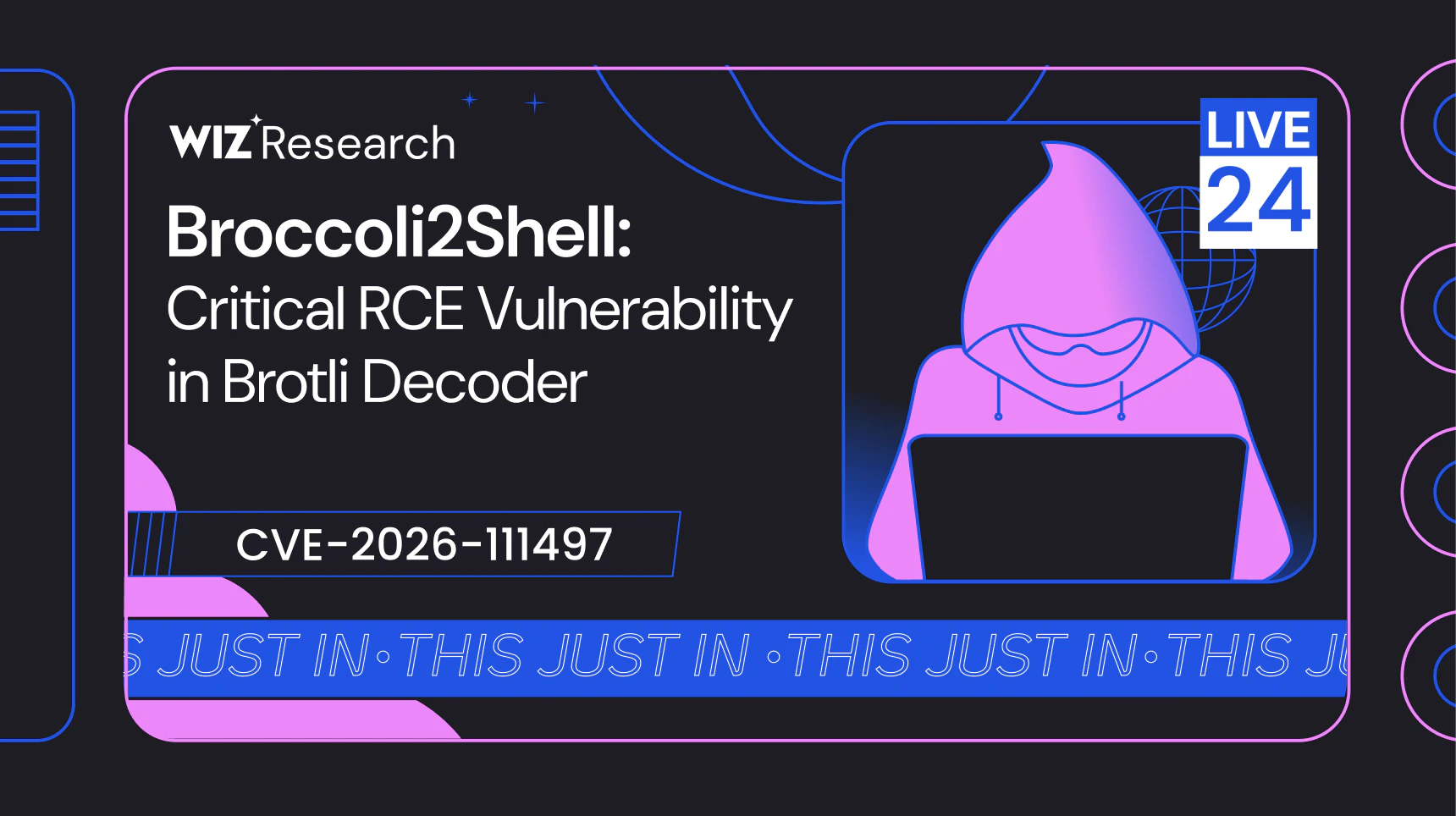 Broccoli2shell: Everything You Need To Know About The Critical Brotli Decoder Vulnerability
CVE-2026-111497 (Broccoli2Shell, also Node2Shell and HTTP2Shell) is an out-of-bounds write in the upstream Brotli C decoder. It affects Node.js, Bun, Envoy Proxy, Istio and Python packages, and can lead to memory corruption, information disclosure, crashes or RCE when untrusted Brotli data is decompressed. Wiz reports 91% of cloud environments have vulnerable resources. The post lists patching, inventory, rebuild and temporary mitigation steps.
 wiz.ioadvisoryPublished and added 25 Oct 2026🛡️ Security
 Preliminary Report Oct 21st Security Incident
Railway's preliminary report on a security incident between 20 and 22 October 2026, in which an attacker reached internal systems and decrypted stored environment variables. At most 1.85% of workspaces (about 100,000) were confirmed affected. The attacker was after AI provider API keys for distillation. Railway notified vendors such as GitHub and Anthropic, rolled all keys, moved to single-tenant builders and advised customers to rotate secrets. Exploit details are withheld.
 blog.railway.comadvisoryAdded 24 Oct 2026, published 23 Oct 2026🛡️ Security
 Brotli vulnerability affects curl and Git
GHSA-9v8h-qqgm-4m35 is a critical buffer overflow (CVSS v4 9.2) in the Google Brotli decoder (c/dec/decode.c), affecting versions 1.0.3 through 1.2.0 on all platforms. A crafted compressed stream lets an unauthenticated remote attacker corrupt adjacent decoder state, leak memory, crash the process, or possibly execute code. Fixed in 1.0.10, 1.1.1 and 1.2.1. The page does not mention curl or Git, despite the title.
 github.comadvisoryAdded 25 Oct 2026, published 23 Oct 2026🛡️ Security
- ENISA Technical Advisory for Software Bill of Materials
ENISA Technical Advisory for Software Bill of Materials (October 2026, TLP:CLEAR) is non-mandatory guidance for organisations, especially SMEs, starting SBOM adoption. It covers SBOM data models (CycloneDX, SPDX), a mapping of BSI TR-03183-2 fields to CISA minimum elements, lifecycle and CI/CD integration, an SBOM threat model, and security recommendations. It supports Cyber Resilience Act obligations but is not a legal interpretation.
 enisa.europa.euadvisoryAdded 23 Oct 2026🛡️ Security
- ENISA Technical Advisory for Software Bill of Materials
ENISA Technical Advisory for Software Bill of Materials is practical guidance on SBOM adoption for organizations, especially micro, small and medium enterprises and open-source stewards. It sets out an SBOM implementation architecture and data flows across a defined lifecycle, an indicative SBOM threat model with targeted risks, and measures for the SBOM ecosystem. It aligns with the ENISA Secure by Design and Default Playbook and supports Cyber Resilience Act compliance.
enisa.europa.euadvisoryAdded 23 Oct 2026🛡️ Security - Dark Web Intelligence (@DailyDarkWeb) on X
CVE-2026-114625 is a critical (CVSS 3.1 9.9) SQL injection in on-prem Arista VeloCloud Orchestrator, the SD-WAN management portal, covered in Arista Security Advisory 0199 of 22 October 2026. Any authenticated user, even the lowest Enterprise Read Only tenant role, can become a local superuser operator, and Arista says it is exploited in the wild. On-prem fixes are 5.2.3.18, 6.1.3.10 and 6.4.2.12; two attacker IPs are listed.
x.comadvisoryAdded 24 Oct 2026, published 22 Oct 2026🛡️ Security - lee1981 (@lee1981b) on X
CyberForge CVE of the Day #084 analyses CVE-2026-76466, a CVSS 9.8 flaw in clustered Cisco Expressway-C and Expressway-E. Persistent database cookies and weak client-certificate validation allow root OS command execution over the network. The fix is X15.5.20 (X14 and earlier must migrate), with no workaround. It adds a per-peer SOC investigation trail, reachability checks and exposure status from CISA SSVC, KEV and EPSS.
x.comadvisoryAdded 24 Oct 2026, published 22 Oct 2026🛡️ Security  Yul Optimizer Knowledge Base Stale Bookkeeping Bug
Solidity advisory on a Yul optimizer bug in the KnowledgeBase, present in versions 0.8.19 to 0.8.37 and fixed in 0.8.38. Stale cached address offsets let LoadResolver and EqualStoreEliminator treat coinciding memory or storage slots as distinct, so loads return outdated values or needed stores are dropped. It includes a pure-Solidity reproducer for --via-ir, a Sourcify scan with no differing bytecode, and checks for deployed contracts. Rated low severity.
 soliditylang.orgadvisoryPublished and added 22 Oct 2026🛡️ Security
 Railway Security Disclosure
Railway's security disclosure of 21 October 2026 says an unauthorized third party may have accessed encrypted customer environment variables and decrypted some of them. Railway links it to a series of attacks on platform companies aimed at compromising AI inference providers, and has asked upstream providers to revoke keys. It tells all users to roll every environment variable, API key and registry credential, and it paused all deployments. The notice gives no technical details of the intrusion.
blog.railway.comadvisoryAdded 22 Oct 2026, published 21 Oct 2026🛡️ Security- PHP web runtimes (CVE-2026-109618 and CVE-2026-109619)
AWS bulletin 2026-143-AWS covers CVE-2026-109618 and CVE-2026-109619, critical PHP web runtime flaws that let an unauthenticated remote caller run code, read process data or cause denial of service. Fixed in PHP 8.5.12, 8.4.27, 8.3.36 and 8.2.35; PHP 5.4 to 8.1 get no fix. It gives status for WorkMail, Elastic Beanstalk, Amazon Linux and Lightsail, plus AWS WAF rules, including a custom "PHP2Shell" rule matching PHP_SESSION_UPLOAD_PROGRESS and PHPSESSID.
 aws.amazon.comadvisoryAdded 22 Oct 2026, published 21 Oct 2026🛡️ Security
- PHP 8.2.35
PHP 8.2.35 is a security release of the PHP 8.2 branch that fixes two critical vulnerabilities, CVE-2026-109618 and CVE-2026-109619, which can allow unauthenticated remote code execution. The notes say no complete mitigations exist and updating is the only safe choice. PHP 8.2 reaches end of life on 31 December 2026, after which it gets no security fixes.
github.comadvisoryAdded 22 Oct 2026, published 21 Oct 2026🛡️ Security  Critical vulnerabilities in PHP (PHP2SHELL)
PHP2SHELL is Aikido Security's advance notice of two critical remote code execution flaws in PHP itself, CVE-2026-109618 and CVE-2026-109619, both CVSS v4.0 9.2, with all versions treated as affected. The PHP security team will release fixes at 14:00 UTC on 21 October 2026, a day early after details leaked on 20 October. The post withholds exploitation details and workarounds.
 aikido.devadvisoryPublished and added 21 Oct 2026🛡️ Security
 Threat Brief: Active Exploitation of PAN-OS CVE-2026-0257 (Updated Oct 20)
Unit 42 threat brief on active exploitation of CVE-2026-0257, a PAN-OS GlobalProtect authentication bypass added to CISA KEV on May 13, 2026. It lists IP addresses, host IDs and PoC-derived client values to hunt in GlobalProtect logs. The October 2026 updates cover Qilin and Inc ransomware operators, MFA bypass, pivots to vCenter and ESXi with offline VMDK credential dumping, and management interface exposure on ports 4443 and 3879.
unit42.paloaltonetworks.comadvisoryAdded 21 Oct 2026, published 20 Oct 2026🛡️ Security- lee1981 (@lee1981b) on X
CVE-2026-77932 affects DB-GPT through 0.8.2 (dbgpt-app). The /api/v1/chat/react-agent route accepts unauthenticated requests because get_user_from_headers returns an admin-role user, and the ReAct agent can reach unsandboxed Python and shell tools. Lasso reported root in the webserver container in a lab. The post gives CVSS 9.8 and 9.3, no verified fix (0.8.2 is still the latest release), no KEV match, no EPSS data, and a SOC hunting trail.
x.comadvisoryAdded 23 Oct 2026, published 20 Oct 2026🛡️ Security - lee1981 (@lee1981b) on X
CyberForge CVE of the Day #080 covers CVE-2026-99999 ("PwnEscape"), a Linux kernel IPv4 checksum-completion flaw. Crafted checksum metadata can trigger a deferred write into an already-validated IPv4 header, which allows host memory disclosure from a guest or microVM over virtio-net and TAP. It gives upstream fixed branches (5.10.272 to 7.2.11), Amazon Linux, Red Hat and Ubuntu status, CVSS 9.3, EPSS 0.211% and a SOC investigation trail. No IOCs were verified.
x.comadvisoryAdded 19 Oct 2026, published 17 Oct 2026🛡️ Security - Microsoft Threat Intelligence (@MsftSecIntel) on X
ConnectWise Cloud Backup (formerly SkyKick Backup, AppId 506e08f9-6e9a-4da4-942b-a099a03644ae) had its multitenant OAuth app compromised, per Microsoft Threat Intelligence. On 15 October 2026 the actor authenticated broadly as the service principal from 144.172.64[.]128, likely using customer-granted permissions such as Directory.ReadWrite.All, then ran Graph API reconnaissance and tried to add credentials to the service principal as a backdoor. The post lists IOCs, Defender alerts and hunting advice.
x.comadvisoryAdded 20 Oct 2026, published 17 Oct 2026🛡️ Security - S2W_DailyThreat (@S2W_DailyThreat) on X
S2W post on CVE-2026-97229, a CVSS 10.0 remote code execution flaw in the GitLab CE/EE CI/CD regex compiler, disclosed October 13, 2026. Insufficient regex validation plus an integer overflow during encoding conversion lets an attacker who can add CI/CD config use a malicious regex and a UTF-8 repository path to run commands as the git user. Affects self-managed 19.2 before 19.2.8, 19.3 before 19.3.5 and 19.4 before 19.4.2. Rapid7 published analysis and a public PoC exists, with no in-the-wild exploitation confirmed as of October 15. No workaround exists, so patch or restrict access to a management network or VPN.
x.comadvisoryAdded 17 Oct 2026, published 16 Oct 2026🛡️ Security - Dark Web Intelligence (@DailyDarkWeb) on X
Summary of Vercel's Oct 14, 2026 out-of-band Next.js security release fixing two critical unauthenticated RCEs: one in App Router apps with Cache Components where a "use cache" function returns multiple typed arrays (GHSA-673q-mjm6-r5xr, upstream React GHSA-xqc2-xf4c-x3h3, no workaround), and one in the Image Optimization API handling SVG on glibc Linux via a memory bug in a library used through sharp (CVE-2026-96889 / GHSA-2464-fhr4-w9xw, workaround sharp 0.35.5+). Also covers a high-severity Server Actions DoS (GHSA-p3m5-59mp-jv5r). Fixes ship in two supported Next.js LTS lines. No in-the-wild exploitation reported.
x.comadvisoryAdded 17 Oct 2026, published 16 Oct 2026🛡️ Security - lee1981 (@lee1981b) on X
Daily CVE digest on CVE-2026-76519, a CVSS 9.8 relative path traversal (CWE-23) in Cisco Secure Email Gateway's AMP File Reputation attachment processing. A crafted attachment gives unauthenticated arbitrary file writes and root command execution, and Cisco PSIRT reports active exploitation. The CVE is in CISA KEV. It lists the applicability conditions (File Reputation assigned to a policy and Content Scanner Tools earlier than 25.3.0.5525) and the fixes (scanner 25.3.0.5525, AsyncOS 15.5.5-014 and 16.5.0-780). It also covers evidence preservation, reading Cisco's System Security scan outcomes, mail/AMP log correlation, and deployment-specific recovery including cluster-key exposure.
x.comadvisoryAdded 18 Oct 2026, published 15 Oct 2026🛡️ Security  Critical GitLab RCE Lets Unauthenticated Attackers Execute Code on Servers (CVE-2026-97229)
Orca Security analysis of CVE-2026-97229, a CVSS 10.0 flaw in GitLab CE/EE. An integer overflow (CWE-190) in the CI/CD regular expression compiler gives memory corruption and code execution as the git user. It is triggered by a crafted regex in .gitlab-ci.yml combined with a UTF-8 repository path, with no authentication needed on instances that allow public project creation or self-registration. Lists affected branches (19.2 before 19.2.8, 19.3 before 19.3.5, 19.4 before 19.4.2), the absence of a workaround, interim mitigations, and a Rapid7 PoC against GitLab CE 19.4.1 with ASLR on. Notes a prior max-severity GitLab bug (CVE-2026-85706) was probed in the wild within hours and later added to CISA KEV.
orca.securityadvisoryPublished and added 14 Oct 2026🛡️ Security- ♫Why♥Not♪ (@Python_s_) on X
Alert thread on CVE-2026-35029 (CVSS v4.0 8.7) in LiteLLM Proxy, versions before 1.83.0. A low-privilege authenticated user can bypass admin authorization on /config/update, change runtime settings, read server files, take over admin credentials and run Python through remotely loaded modules (S3/GCS-hosted). Check Point Research published a full execution chain on October 13 after the April 2026 disclosure. The post lists hunting pointers (non-admin POSTs to /config/update, env-var changes, unexpected pass-through endpoints, cloud module loading) and advises upgrading to 1.83.9 or later and rotating credentials.
x.comadvisoryPublished and added 13 Oct 2026🛡️ Security - Major ICQ security hole (1998)
Rootshell Security Bulletin #22 (Aug 1998) reports an ICQ authentication flaw found by a Linux ICQ clone developer. The Mirabilis server stores 8-character passwords, and sending a password of 9 or more characters (e.g. "123456789") overflows the buffer and logs the client in as any UIN not already online. This gives full account takeover, including receiving offline messages. It is not spoofing, and it works with unofficial clients such as zicq, since the official client enforces the length limit client-side.
 opennet.ruadvisoryAdded 17 Oct 2026, published 13 Oct 2026🛡️ Security
 MCP spec 2026-07-28 changelog (stateless protocol, MRTR, Sampling/Roots deprecated)
Official changelog for the Model Context Protocol 2026-07-28 specification. Major changes: protocol-level sessions and the initialize handshake are removed to make MCP stateless, with version and capabilities carried in _meta on every request, plus a new server/discover RPC and subscriptions/listen replacing the GET stream and resource subscribe calls. It introduces Multi Round-Trip Requests (InputRequiredResult) in place of server-initiated sampling, roots and elicitation requests, moves tasks into an extension, and deprecates Roots, Sampling, Logging, HTTP+SSE and Dynamic Client Registration. Minor changes add cache hints (ttlMs/cacheScope), new Mcp-Method/Mcp-Name headers, OpenTelemetry trace context, RFC 9207 iss validation and an error-code allocation policy.
 modelcontextprotocol.ioadvisoryAdded 10 Oct 2026🧠 AI
- CISA AA26-281A: Chinese Government-linked Actors Combine Automated and Hands-on Hacking Tools to Steal Data
Joint FBI/CISA/NSA and allied-agency advisory on China-linked actors enabled by Integrity Technology Group (overlapping with Flax Typhoon, Ethereal Panda, Red Juliett). It details their TTPs: open-source scanners and the MicroScan exploit-script app, an XSS credential-harvesting payload dropping live700_v1.exe, EBurst password spraying against Exchange/O365, SoftEther VPN persistence, DCSync via DC.exe, and email theft via the Curlc4.txt PHP bot and the office-cli utility. It also provides IOCs, MITRE ATT&CK mappings, CVEs, incident response steps, and mitigations.
 cisa.govadvisoryAdded 9 Oct 2026🛡️ Security






Showing 30 of 123
Show more