- Do the math: How we took over ChatGPT accounts
Parameter Labs describes a chain that turned a public ChatGPT share link into JavaScript running as chatgpt.com in the victim's session. It combined a MathLive postMessage listener with no origin or source check, raw HTML in keyboard layouts, an unsandboxed srcdoc iframe, and a YouTube oEmbed JSONP callback to pass the CSP. The code read private conversations through backend APIs. OpenAI fixed it on 26 October 2026 and rated it P1.
 parameter.aiwriteupAdded 1 Nov 2026, published 31 Oct 2026🛡️ Security
 Inside a malicious Claude Code-branded extension and its persistent SSH backdoor
Microsoft Threat Intelligence analyzes a tampered anthropic.claude-code extension (versions 2.1.312 and 2.1.313) served on the Cursor marketplace on 29 October 2026. The injected JavaScript loader adds an SSH key labeled svc-telemetry, opens a reverse SSH tunnel and sets up persistence on macOS, Linux and Windows. The post gives cleanup steps, IOCs and Defender XDR hunting queries. VS Code Marketplace and npm were not affected.
 microsoft.comwriteupPublished and added 31 Oct 2026🛡️ Security
 “Black October” for AI Developer Platforms
Wiz Research links October 2026 breaches at AI developer platforms (Fireworks, OpenCode, Warp, Zeabur, Railway and others) to stolen environment-variable credentials for AI access. It details two enterprise AWS Bedrock keys abused after vendor breaches: about 800k and 1.7 million calls, over $100k in list-price usage. It profiles two LLM resale operations, "momo" and "Xingjiabi", that tested the keys.
 wiz.iowriteupAdded 31 Oct 2026, published 30 Oct 2026🛡️ Security
 nemotron-halloween
MonsterHouse is a Halloween interactive projection built on the NVIDIA Nemotron Voice Agent: Nemotron Speech ASR, Nemotron 3.5 Bolt E4B 4GB with a LoRA persona adapter, Magpie TTS Zeroshot and Audio2Face-3D in Unreal Engine, on two RTX Blackwell GPUs. Median end-of-speech-to-audio is 1.70 seconds live and 0.72 seconds with cached responses. The post gives a build path and tips on caching and state handling.
 huggingface.cowriteupPublished and added 30 Oct 2026🧠 AI
 4 real? Tracking exploitation and patching of eMudhra’s weak keys
Cloudflare's follow-up on eMudhra's eight trivially recoverable intermediate CA keys (such as 4, 56 and 66), disclosed 19 October 2026. Pingora logging showed about 22,000 handshakes with the weak keys, including about 160 forged certificates made within hours of disclosure. Probes on 50 million challenge pages show many bots, old browsers and Android WebView still trust the chain.
 blog.cloudflare.comwriteupPublished and added 30 Oct 2026🛡️ Security
 From help desk impersonation to AD CS abuse: Investigating ESC1 and ESC8 intrusion paths
Microsoft Threat Intelligence analysis of two human-operated intrusions that began with Teams help desk impersonation and Quick Assist sessions, then diverged at AD CS. Case 1 abused an ESC1 template for privileged certificates and DCSync, with an excluded account later used for Rclone exfiltration. Case 2 used PetitPotam and ESC8 relay to get a domain controller certificate and PKINIT. Includes investigation steps, AD CS hardening and KQL hunting queries.
microsoft.comwriteupPublished and added 30 Oct 2026🛡️ Security Rekt - SingularityNET - Rekt
SingularityNET exploit (19 September 2026): attackers with signing authority exposed through a cloud infrastructure breach drained 8.72M FET from the Ethereum bridge converter, then minted about 2.3 billion AGIX, NTX, WMTX and CGV. Rekt's transaction-level reconstruction puts gross liquid proceeds near $2.29M, not the $16.77M headline, and traces laundering via Chainflip, Baltex and THORChain. It notes conversionIn() skipped checkLimits() and trusted a single EOA signature.
 rekt.newswriteupAdded 29 Oct 2026🛡️ Security
 The Rise of Agentic Attacks: What They Look Like, and Where They're Headed
Wiz research on intrusions where AI agents do the hands-on attacker work. It reviews public cases (ARTEX against South Korean banks and the ConnectWise compromise, Hermes at Thailand's Ministry of Finance, JPCERT/CC, CrowdStrike, DIVD) and three Wiz-investigated attacks. It distills fingerprints: machine-paced iteration, embedded natural-language reasoning, self-correcting scripts, checklist enumeration, noisy lateral movement, probe-before-payload habits and self-named scratch files. It also covers attribution, scale and defense implications.
wiz.iowriteupPublished and added 29 Oct 2026🛡️ Security Node2Shell: Reproducing CVE-2026-111497 in the Node.js Brotli decoder
Node2Shell is Datadog Security Labs' analysis of CVE-2026-111497, an out-of-bounds write in the Google Brotli 1.2.0 decoder, fixed in Node.js 22.23.4, 24.22.1 and 26.12.1 on 21 October 2026. It explains the unchecked return value in DecodeBlockTypeAndLength(), the read and write primitives, and why code execution is still engineering effort. It lists inbound and outbound exposure paths, behavioral detections and what WAFs miss.
 securitylabs.datadoghq.comwriteupPublished and added 29 Oct 2026🛡️ Security
- GitLab Security Incident: Attempted Exploitation of CVE-2026-97229
Alpine Linux incident report on attempted exploitation of CVE-2026-97229 (CVSS 10.0), a regex-evaluation bug in Ruby's Onigmo engine reachable through GitLab CI configuration. An attacker crashed workers 8 times on 20 and 21 October 2026. Upgrading to GitLab 19.3.6 did not fix it because the patch sits in GitLab's bundled Ruby. Alpine rebuilt the instance and found no tampering with aports or releases.
 alpinelinux.orgwriteupAdded 29 Oct 2026, published 28 Oct 2026🛡️ Security
 Inside KeyDrift: Analyzing historical UAT-11473 activity on Cisco SD-WAN
KeyDrift is a custom malware framework used by UAT-11473, which exploited CVE-2026-20127 in Cisco SD-WAN Catalyst Controller to gain access. Talos analyzes PolyFlame (memory-resident vdaemon injection, recvfrom hook, TinyShell-style backdoor, intermediate C2) and LittleFilch (SSL_read hook that extracts and RSA-encrypts keying material). It reports infrastructure overlap with Volt Typhoon's Silent Train, plus patch guidance and Snort SIDs.
 blog.talosintelligence.comwriteupPublished and added 28 Oct 2026🛡️ Security
 Endor Labs AI SAST Finds Two Apache Kafka Zero-Days: Unbounded Memory Allocation from Brokers to Kafka Streams | Endor Labs
Endor Labs AI SAST found three unbounded memory allocation flaws in Apache Kafka, fixed under CVE-2026-114349 (DefaultRecord decoder, a ~90-byte compressed batch that kills consumers, brokers and the log cleaner) and CVE-2026-111551 (ListDeserializer and Kafka Streams AssignmentInfo decoding). The post gives code, reproducers and payload bytes. Remediation: upgrade to 4.2.2, 4.3.2 or 4.4.0, set max.decompressed.message.bytes, restrict write and group ACLs, and alert on DeadThreadCount.
 endorlabs.comwriteupPublished and added 28 Oct 2026🛡️ Security
 Social Engineering: Modem-Based Persistence in a Compromised Environment
The article describes reflashing a Huawei E3372h-153 HiLink 4G USB modem so its embedded Linux OS runs an OpenVPN client over the mobile network, creating a covert, network-independent persistence channel after physical USB access. It walks through enabling debug mode, flashing firmware, disabling CD-ROM emulation, configuring DHCP and autorun scripts, and chaining a second L2VPN tunnel to bridge the attacker directly onto the victim's Ethernet segment for tools like Responder. Defense guidance focuses on restricting USB ports and disabling USB network adapters via policy.
 hackers-arise.comwriteupPublished and added 28 Oct 2026🛡️ Security
 Cross-request KV cache exposure in the GLM-5.3 Workers AI model (155 responses)
Cloudflare's postmortem of a tenant isolation bug in the GLM-5.3 model on Workers AI, active 27 August to 9 September 2026. Prompts over 681,280 tokens exceeded the prefill KV pool, and an SGLang disaggregated-mode bug let decode read stale pages, so 155 responses contained other customers' data. It covers the timeline, config and engine fixes (SGLang v0.5.22), and recommendations for operators.
blog.cloudflare.comwriteupAdded 27 Oct 2026, published 26 Oct 2026🧠 AI- Cross-request KV cache exposure in the GLM-5.3 Workers AI model (155 responses)
Cloudflare postmortem of a tenant isolation failure in the GLM-5.3 Workers AI model (27 August to 9 September 2026), in which 155 responses to prompts over 681,280 tokens contained other customers' data. Root cause was a KV pool smaller than the 1,048,576-token context window, combined with an SGLang bug in disaggregated prefill/decode mode that let decode read stale KV pages. It lists the fixes (SGLang v0.5.22 patches), hardening steps and operator recommendations.
blog.cloudflare.comwriteupAdded 27 Oct 2026, published 26 Oct 2026🛡️ Security - AI, Scripts, Operator: Inside the ConnectWise Attack
Huntress analyzes Entra sign-in and audit logs from the ConnectWise Cloud Backup credential abuse of 15 October 2026 to judge whether a script, a person or an LLM agent drove it. It found a thread-pool spray, trial-and-error credential planting with a retry added within 55 seconds, and pilot-then-batch targeting. Huntress rates LLM involvement low to medium on its own data and medium to high with Microsoft's Storm-0940/ARTEX attribution. It ends with detections for service principal role self-assignment and vendor app baselining.
 huntress.comwriteupPublished and added 26 Oct 2026🛡️ Security
 Gheist: Attempted Scaled Abuse of Stolen GitHub Tokens Stumbles
Gheist is a campaign tracked by Wiz Research since 15 September 2026 that uses stolen GitHub tokens to push a sync-check workflow on ci-sync-* branches in every reachable repository. The workflow prints base32-encoded secrets into logs, which the tool downloads through the GitHub API and then deletes. Over 13,500 branches from 850+ accounts were recovered. The post covers the two tool variants, a buggy self-hosted runner payload, GitHub's approval hold (which does not cover private repositories), overlaps with other campaigns, hunting queries, IOCs and hardening steps.
wiz.iowriteupPublished and added 25 Oct 2026🛡️ Security- Tailworm – Tailscale Vulnerabilities
Tailworm is a security assessment report by Erica Windisch (Cyberdione Labs) on Tailscale v1.104.2 and headscale v0.29.5, tested 22-24 October 2026. It documents 11 findings: Tailscale SSH unix-socket forwarding that runs as root (bind, dial and TOCTOU races), conn25 app-connector egress bypass, gliderssh memory exhaustion, serve/funnel flaws and headscale DoS. It includes PoC references, mitigations and fix status as of 27 October 2026. The page is truncated, so the later sections were not read.
 tailworm.comwriteupAdded 27 Oct 2026, published 25 Oct 2026🛡️ Security
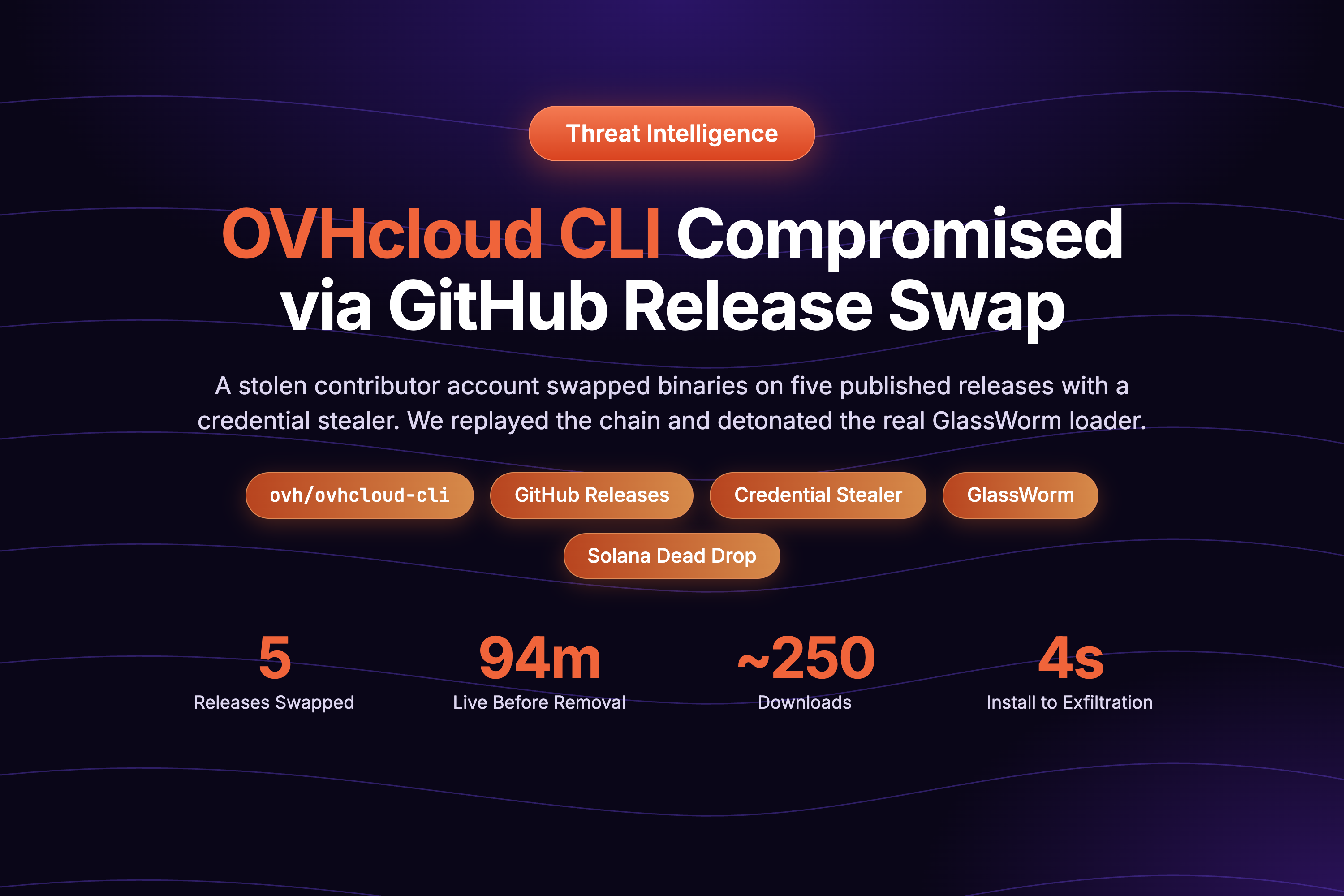 OVHcloud CLI Compromised via GitHub Release Swap: Detonating the Real GlassWorm Loader and What We Found
Analysis of the 19 October 2026 swap of binaries on five ovh/ovhcloud-cli GitHub releases (v0.11.0 to v0.15.0), live 94 minutes. StepSecurity rebuilt the attacker's binary, detonated the recovered GlassWorm preinstall.js loader against a controlled Solana dead drop, and found install.sh never exposed arm64 Linux, Homebrew was safe, and `ovhcloud version` showing "undefined" identifies the swapped build. Includes IOCs and recovery steps.
 stepsecurity.iowriteupPublished and added 24 Oct 2026🛡️ Security
 New Evidence Shows LiteLLM Secret-Stealing Workflows Ran 11 Days Before Supply Chain Attack
Socket's Threat Research team reports that malicious cache.yml workflows ran in the BerriAI/litellm repository on 10 and 12 October 2026, eleven days before the 21 October release attack that published litellm==1.107.0. Each commit pushed to a short-lived ci-tmp-<hex> branch, then deleted it, sending base64-encoded CI secrets to webhook.site. Evidence comes from Actions metrics and environment deployment records; 20 secret names were exposed.
 socket.devwriteupPublished and added 23 Oct 2026🛡️ Security
- PHP2Shell: pre-auth RCE via PHP memory-limit fatal errors (CVE-2026-109618/109619)
PHP2Shell is Calif's writeup of pre-auth RCE in PHP (CVE-2026-109618, CVE-2026-109619) triggered by memory_limit fatal errors that leave dangling state. It covers a HashTable bucket bug in _zend_hash_str_add_or_update_i, a Session upload-progress stale-pointer bug, and an unserialize destructor-list primitive that reaches PHP-FPM. It lists affected apps (WordPress, Drupal, Joomla, Magento and others) and gives temporary mitigations.
 calif.iowriteupAdded 23 Oct 2026🛡️ Security
 AI-driven, large-scale nation-state campaign using ARTEX enables supply chain compromise
Microsoft Threat Intelligence report on Storm-0940, a China-state aligned actor that used the open-source agentic AI pentest framework ARTEX from September 2026 to automate attacks on hundreds of organizations. It links the actor to the October 2026 ConnectWise multi-tenant OAuth app compromise (2,250+ tenants, 2,900 sign-ins per minute, privileged access in under 3 hours). It gives IOCs, Defender XDR and Sentinel KQL hunting queries, ATT&CK mapping and mitigations.
microsoft.comwriteupPublished and added 21 Oct 2026🛡️ Security Train in Simulation, Deploy on a Real Robot: Microduck with Isaac Lab 3.0
Tutorial for training a walking policy for Microduck, an open-source bipedal robot from Pollen Robotics and Hugging Face, in NVIDIA Isaac Lab 3.0 with Newton. It covers RSL-RL training with the backlash preset, BAM actuator models and domain randomization, then ONNX export (61 observations, 14 joint-position actions) and deployment with robotctl. Policies can be shared on the Hugging Face Hub or tested in Microduck Arena.
huggingface.cowriteupPublished and added 21 Oct 2026🧠 AI Profiling TorchNeuron (Part 1): System-level profiling on AWS Trainium.
Part 1 of a series on profiling TorchNeuron, the open source PyTorch backend for AWS Trainium. It shows how to configure torch.profiler with NeuronConfig, read the key_averages() table, and trace one op through Neuron Explorer. Three RMSNorm variants are compared: naive eager (2.355 ms device time), torch.rms_norm (403 μs) and torch.compile (375 μs).
huggingface.cowriteupPublished and added 21 Oct 2026🧠 AI “Next Exploit Opportunities”: How a Threat Actor Used AI to Help Plan and Execute Multiple Types of Cybercrime Activities
Unit 42 analysis of a threat actor, BUGSTER, who ran the Hermes Agent framework with jailbroken DeepSeek V4 and Cursor to plan and run cybercrime. Activity included a WordPress brute force, a MongoDB exfiltration of over 5,200 student records at an Indian university, VoIP fraud planning, Wi-Fi cracking via Vast.ai GPUs, and crypto whale reconnaissance. The report covers the actor's prompt-level safety override, infrastructure (162.243.3[.]92) and attribution.
 unit42.paloaltonetworks.comwriteupAdded 30 Oct 2026, published 21 Oct 2026🛡️ Security
 LiteLLM Compromised, Steals Credentials
LiteLLM version 1.107.0 was uploaded to PyPI on 21 October 2026 with a credential stealer, and the same build reached GHCR and Docker Hub images. Wiz describes the three dropped files (cook.pth, cook.py, sitecustomize.py), exfiltration to a fake litellm.dev domain, a GitHub dead drop for a second stage, and the malicious commits pushed through the lookalike Berri-AI repository. The last safe version is 1.106.2.
wiz.iowriteupPublished and added 21 Oct 2026🛡️ Security From Phishing to LLMjacking: Threat Actors Targeting Cloud Billing Accounts for LLM Usage
Wiz CIRT investigation of LLMjacking campaigns against Google Cloud billing accounts. Attackers phished admins through malicious Google Search ads and a fake login page that captured MFA codes, then deleted the iam.allowedPolicyMemberDomains policy, added Gmail accounts as billing admins, and linked attacker-controlled projects to the victim's billing account. Victims saw tens to hundreds of thousands of dollars in Gemini API charges within 24 to 48 hours, with no log visibility into prompts. Includes hunting guidance for Workspace, Admin Activity and billing logs.
wiz.iowriteupPublished and added 20 Oct 2026🛡️ Security ALTK-Evolve: How learned memory tops the τ²-bench leaderboard on customer service tasks without a frontier model
ALTK-Evolve is an IBM Research method that distills an agent's own training-task trajectories into short behavioral guidelines appended to the system prompt, with no weight updates. On τ²-bench, a stock ReAct agent with gpt-4.1 reaches 67.5% Pass^4 on retail, and gpt-5.5 reaches 82% on airline. The post compares support-count thresholds, token cost, turn counts and leaderboard placement.
huggingface.cowriteupPublished and added 20 Oct 2026🧠 AI Publish fake stats, get cited in LLMs
StateGlobe is an experiment in which a Peec AI researcher generated 50,000 fake statistics pages with GPT-4.1 for about $50. After 7 months, Google had deindexed the site, but ChatGPT-User still made about 72,000 requests in 30 days. The site drew 10,000+ ChatGPT sessions and 330+ referring domains, and its numbers were cited in an academic paper and bank research. The post explains why retrieval differs from ranking and how to build real statistics pages.
 peec.aiwriteupAdded 21 Oct 2026, published 20 Oct 2026🧠 AI
 Loud, Fast, and Everywhere: Anatomy of a Real AI-Driven Cloud Attack
Wiz CIRT write-up of an AI agent-run intrusion against a multi-cloud organization (GCP, AWS, Kubernetes, CI/CD, GitOps, identity provider). It lists traits of AI-driven attacks: machine-speed tempo, credential chaining, pentest/probe naming, numeric task IDs and commented code. Initial access was a Java RCE in an exposed Kafka UI. It closes with detection and response advice: unified logs, workload visibility and trust isolation.
wiz.iowriteupPublished and added 19 Oct 2026🛡️ Security

Showing 30 of 416
Show more