Kizuno18 (@Kizuno18) on X
Thread by Kizuno18 on the move from local stdio/Docker Model Context Protocol servers to remote HTTP/SSE endpoints in enterprise infrastructure. It names three trade-offs: credential boundary inversion (short-lived OAuth/JWT tokens instead of long-lived admin tokens on workstations), tool schema bloat solved by deferred discovery, and governance via HCP Terraform policy-as-code (Sentinel/OPA), audit trails and approvals. It is opinion, with no data or implementation detail.
 x.comthreadAdded 29 Oct 2026, published 27 Oct 2026🛡️ Security
- Kizuno18 (@Kizuno18) on X
Kizuno18's X post argues that the move from local stdio and Docker MCP servers to remote HTTP/SSE endpoints matures the Model Context Protocol in enterprise infrastructure. It lists three trade-offs: short-lived OAuth/JWT bearer tokens replace mounted admin credentials, deferred tool discovery avoids roughly 20k tokens of eager schema loading, and HCP Terraform enforces Sentinel/OPA policy, audit trails and approvals server-side. Opinion post with no benchmarks or code.
x.comthreadAdded 29 Oct 2026, published 27 Oct 2026🧠 AI  OlmoEarth v1.3: State-of-the-art embeddings for the whole planet
OlmoEarth v1.3 is an open satellite embedding model from Ai2 that reads a year of Sentinel-1, Sentinel-2 and Landsat data and outputs a 128-dimensional vector per 10 m pixel (the first 64 dimensions also work alone). Its embeddings beat AlphaEarth Foundations and Tessera v2 on 20 of 27 evaluations. Precomputed global embeddings, a browser Embeddings Explorer and pre-training cost (about $2,720 of H100 time) are covered.
 huggingface.coarticlePublished and added 22 Oct 2026🧠 AI
 AI-driven, large-scale nation-state campaign using ARTEX enables supply chain compromise
Microsoft Threat Intelligence report on Storm-0940, a China-state aligned actor that used the open-source agentic AI pentest framework ARTEX from September 2026 to automate attacks on hundreds of organizations. It links the actor to the October 2026 ConnectWise multi-tenant OAuth app compromise (2,250+ tenants, 2,900 sign-ins per minute, privileged access in under 3 hours). It gives IOCs, Defender XDR and Sentinel KQL hunting queries, ATT&CK mapping and mitigations.
 microsoft.comwriteupPublished and added 21 Oct 2026🛡️ Security
 Star Blizzard refines phishing and malware delivery with the RedFlick technique
Microsoft details how Russian FSB-linked threat actor Star Blizzard evolved its phishing and malware delivery tradecraft throughout 2026, introducing a new technique dubbed "RedFlick" that uses scheduled tasks to deploy the CosmicPulse backdoor with only a single user interaction, down from the multi-step ClickFix chains used previously. The report covers the shift from targeted spear-phishing to large-scale phishing campaigns using accounts on compromised WordPress/CPanel websites, delivery chain variants (VHDX files, Control Panel applet (CPL) masquerading, steganography, PDF-embedded payloads), and the related DarkSword iOS backdoor, affecting 100+ organizations tied to Ukraine support. It includes IOCs, KQL hunting queries for Microsoft Defender/Sentinel, and mitigation guidance.
microsoft.comwriteupAdded 7 Oct 2026, published 29 Sep 2026🛡️ Security NeedyMantis: Unpacking a post-compromise malware family used in targeted operations
Microsoft Threat Intelligence documents NeedyMantis, a previously unreported modular post-compromise malware family used in targeted intrusions against telecoms, universities, medical nonprofits, intergovernmental organizations, and government contractors. The writeup details a multi-stage C++/x64 shellcode loader chain delivered via DLL sideloading (abusing Poedit, curl, TightVNC, Vim, and spoofed Office/Broadcom/Intel/NVIDIA DLLs), a custom encrypted/compressed archive format, a minimized custom PE-like executable format, and a WebSockets-based C2 protocol with RC4 key exchange and modular load/unload commands. Microsoft links observed use to Storm-3069 (tied to the Kaspersky-reported DAEMON Tools supply chain compromise) and China-nexus activity, and provides IOCs, Defender detections, and KQL/Sentinel hunting queries.
microsoft.comwriteupAdded 7 Oct 2026, published 28 Sep 2026🛡️ Security- Adversarial-Detection-Engineering/adeskills
adeskills is a working knowledge base for "Adversarial Detection Engineering" (ADE), a taxonomy of four categories and 16 subcategories of detection-logic bugs (e.g. Reformatting in Actions, Omit Alternatives, Context Development, Logic Manipulation) that explain why a SIEM/EDR/XDR rule fails to catch what it intends to. It ships 38 worked technique files with vulnerable/hardened rule examples and detection-layer guidance, a cross-platform bug-pattern catalog, a pre-engagement scoping checklist, and a Redamon-packaged skill (ade_scoper), all grounded in analysis of real public rulesets from Sigma, Elastic Security, and Microsoft Sentinel. It's explicitly scoped for defensive detection engineering and purple-team rule hardening, with several files documenting real vendor-rule weaknesses.
 github.comrepoAdded 2 Oct 2026, published 27 Sep 2026🛡️ Security
- ThreatIntel-Aggregator
ThreatIntel-Aggregator is a self-hosted FastAPI/Next.js platform that polls 60+ tiered security RSS feeds (CISA, Talos, Unit42, etc.), runs AI triage to score severity and tag MITRE ATT&CK TTPs, extracts IOCs/CVEs, and correlates findings against a RunZero asset inventory to surface org-level exposure. Its Detections module goes further: it catalogs AI-generated or locally-imported detection rules (KQL/Sigma/YARA/Suricata/SPL), statically validates them, runs AI-driven MITRE alignment checks against technique coverage, tracks detection "rot," and can sync Hunts/Analytics Rules to a live Microsoft Sentinel workspace. It's designed to run standalone with zero cloud dependency or fully integrated with Azure/Entra/Sentinel, with all storage in Postgres and auth via Entra SSO or a local API key.
github.comrepoAdded 22 Sep 2026, published 17 Sep 2026🛡️ Security 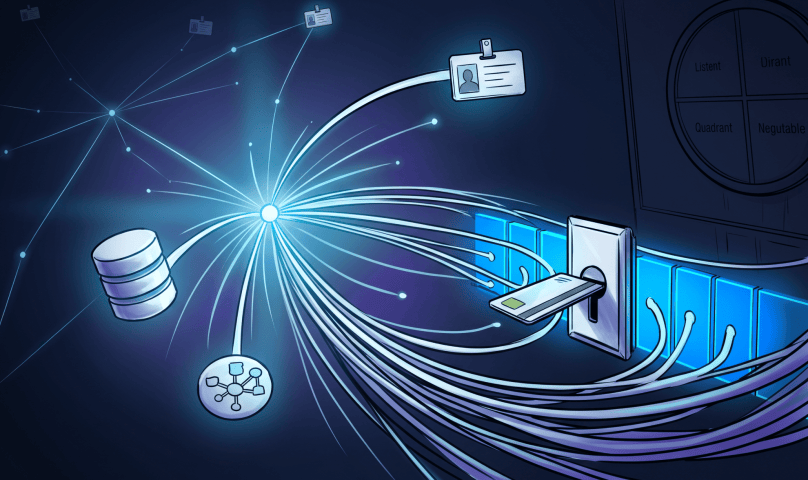 Orca Security: SOC Automation
A conceptual deep-dive into SOC automation structured as a five-stage pipeline (trigger, enrichment, decision, action, feedback), arguing that enrichment quality — not action count — determines outcomes, and that reversibility should set the bar for what runs unattended. It cites concrete platform behaviors (AWS Security Hub rule-ordering, Microsoft Sentinel's 2-minute playbook timeout) and NIST SP 800-61r3's CSF 2.0 incident-response guidance, then covers AI-driven SOC automation where model outputs serve as triggers/enrichment rather than approvals, before pitching Orca's context layer for SIEM/SOAR integrations.
 orca.securityarticlePublished and added 14 Aug 2026🛡️ Security
 MAJINAHANASHI RANSOMWARE: Yet Another Japanese Locker
Deep-dive intelligence report on Majinahanashi, a Japanese-themed ransomware group that emerged in August 2026, covering its Tor data-leak site (math-captcha gated, non-vanity domain), victimology (15 victims across Europe/Asia/Latin America, avoiding US/English-speaking countries), and technical analysis of its C/C++ locker sample. The malware uses AES-256 with RSA-wrapped per-file keys, appends the .MAJIN extension, deletes shadow copies/USN journals/event logs via vssadmin/bcdedit/fsutil, hijacks the desktop wallpaper, and uses WFP-based network filtering plus I/O priority manipulation to suppress EDR/backup traffic (targeting CrowdStrike, SentinelOne, Defender, Veeam, etc.). The article includes a full YARA detection rule, the ransom note text, BTC/qTOX/email contact IOCs, and threat-actor profiling ("THE DOCTOR CAME" persona) plus links to Mimikatz and Advanced IP Scanner usage.
 theravenfile.comwriteupAdded 3 Sep 2026, published 14 Aug 2026🛡️ Security
 Top Agentic AI security resources — August 2026
Adversa AI's August 2026 roundup of twenty agentic AI security resources from July 2026, covering four real-world agent exploits in ten days: a hidden one-pixel-text attack making AWS Kiro rewrite its own mcp.json (CVE-2026-10591), two CVSS 9.8 zero-click Cursor RCEs (DuneSlide, CVE-2026-50548/50549), the DeepJack Cursor deeplink RCE, and ClaudeBleed's Chrome-extension click-forgery against Claude for Chrome. It also summarizes three memory-poisoning papers (an agent data injection class, FARMA/SENTINEL, GhostWriter/AM-Sentry), the Hugging Face sandbox-escape incident, Anthropic's CISO risk framework, and OWASP/CSA's agentic AI maturity model.
 adversa.aiarticleAdded 7 Oct 2026, published 31 Jul 2026🛡️ Security
 Orca Security: Incident Response Tools
A vendor buyer's guide from Orca Security that breaks incident response tooling into four distinct jobs (evidence/forensics, case management, telemetry/detection, automation) and compares twelve commercial platforms across them: Magnet Axiom Cyber, Exterro FTK Enterprise, Binalyze AIR, Cortex XSOAR, IBM QRadar SOAR, Swimlane, Microsoft Sentinel, Splunk Enterprise Security, Google Security Operations, Torq, Tines, and Rapid7 InsightConnect. It frames evaluation against NIST SP 800-61 Revision 3 (April 2025), covers M&A shifts affecting the category (Darktrace/Cado Security, OpenText/EnCase, Palo Alto/IBM QRadar SaaS EOL), and closes by positioning Orca's agentless cloud context (SideScanning, Unified Data Model) as complementary to these tools rather than a replacement.
orca.securityarticlePublished and added 31 Jul 2026🛡️ Security- Defence Impairment Olympics
Huntress SOC incident writeup detailing a threat actor who exploited Adobe ColdFusion vulnerabilities (CVE-2023-26360, CVE-2023-29298, CVE-2023-29300) to drop a steganographic webshell hidden inside an image, then returned with a full defense-impairment batch script (i.bat) that disabled IIS logging, tampered with Windows Defender, killed/deleted security services (Sysmon, filebeat, SentinelOne, DrWeb, ImmunetProtect), used Image File Execution Options to freeze logging tools, deleted ModSecurity WAF module, enumerated FileZilla and multilingual local admin groups, weakened WDigest to force plaintext credentials in memory, dumped credentials via a Mimikatz kernel driver (mimidrv.sys), deleted CLSID/WScript registry keys, and cleared Windows event logs. The piece walks through each command block with attacker rationale and closes with concrete mitigation guidance for defenders.
 huntress.comwriteupAdded 3 Sep 2026, published 29 Jun 2026🛡️ Security
 macOS.Gaslight | Rust Backdoor Turns Prompt Injection on the Analyst, Not the Sandbox
SentinelLABS dissects macOS.Gaslight, a Rust macOS implant (tracked via Apple XProtect's MACOS_BONZAI_COBUCH rule, linked to DPRK-aligned BONZAI/AIRPIPE activity) that uses a Telegram Bot API polling channel with AES-GCM-over-pinned-TLS, self-redacts its bot token from runtime logs, stages a runtime-fetched standalone CPython interpreter to run a Python keychain/browser/history stealer, and persists via a fake com.apple.* LaunchAgent. Its standout feature is a 3.5 KB embedded block of 38 fabricated "system" messages mimicking an LLM triage harness's prompt scaffold, engineered to make an AI-assisted analyst tool abort or refuse analysis rather than evade the sandbox itself.
 sentinelone.comwriteupAdded 26 Jun 2026, published 23 Jun 2026🛡️ Security
 DECODING GRIXBA — A PLAY RANSOMWARE SCANNER
A side-by-side reverse-engineering analysis of four Grixba samples (v1 through v3, Sept 2022 to Nov 2024), the custom .NET infostealer/network scanner built by the Play ransomware group to map security tools, credentials, and remote-management software before encryption. The piece traces the binary growth from 164KB to 727KB (adding XOR-encrypted inf_g.dll, SQLite-based ExportData.db output, forged SentinelOne PE metadata, and PIA VPN C2) then its deliberate regression to 118KB to shed public IOCs, backed by MITRE ATT&CK sandbox findings, a shared mutex fingerprint, a weakness scorecard per version, and a full SHA-256/IP/onion IOC table.
theravenfile.comwriteupAdded 3 Sep 2026, published 8 Jun 2026🛡️ Security What MDM can't protect on developer machines (and what to do about it)
Aikido Security argues that MDM (Jamf, Kandji, Intune) and EDR (CrowdStrike, SentinelOne) operate at the OS/application layer and are blind to the modern developer attack surface: npm/pip package installs with postinstall hooks, VS Code/IDE extensions, browser extensions, and MCP servers used by AI coding tools. It walks through the Nx Console extension compromise that exposed 3,800 GitHub repos, the Cyberhaven and Vercel/Context.ai OAuth-token browser-extension chain, the Mini Shai-Hulud npm worm, and the postmark-mcp malicious MCP server as evidence, then recommends a 48-hour minimum package age, disabling postinstall scripts by default, auditing extensions, and monitoring AI tool installs (pitching Aikido Device Protection/Safe Chain as the fix).
 aikido.devarticleAdded 3 Sep 2026, published 28 May 2026🛡️ Security
- PathSentinel Radar
PathSentinel Radar is a Spanish-language, read-only CTI dashboard that ingests security news (currently drawn from BleepingComputer) and re-presents it with an urgency score, severity label, and a "playbook" category (e.g. cti_triage, endpoint_tpv_support) plus a one-line remediation action. The sample set covers Pwn2Own exploits against Exchange/Windows 11, credential-theft flaws in WordPress plugins Avada Builder and Funnel Builder, the Linux "Fragnesia" root-privesc bug (CVE-2026-46300), Dell SupportAssist BSOD issues, KongTuke's abuse of Microsoft Teams for initial access, a Google Ads phishing campaign spoofing GoDaddy ManageWP, and the arrest/indictment of the alleged Dream Market administrator. The site states the public front end only serves already-processed reports and runs no live AI queries per visitor.
 radar.pathsentinel.eutoolAdded 3 Sep 2026, published 16 May 2026🛡️ Security
 Operational Workbooks Episode 1: Running a Playbook from a Workbook
A hands-on guide to wiring Microsoft Sentinel Workbooks to Logic Apps (playbooks) using the ARM Action link and HTTP request trigger, allowing analysts to export arbitrary workbook column data as parameters and POST it to a playbook without requiring an Incident/Entity ID. The author flags that this pipes untrusted attacker-controlled data (URLs, command lines) into downstream automation, and notes example WAF/XSS events can trigger HTML injection directly in the workbook via the URI parameter.
 attackthesoc.comarticleAdded 3 Sep 2026, published 12 Apr 2026🛡️ Security
- Threat Actors Abuse Railway.com PaaS as Microsoft 365 Token Attack Infrastructure
Huntress details a device-code phishing campaign hitting 340+ Microsoft 365 tenants across the US, Canada, Australia, New Zealand, and Germany since February 2026, in which attackers abuse Railway.com's clean-IP PaaS infrastructure to run OAuth device-code token replay at scale, bypassing MFA entirely. The campaign chains vendor URL-rewriter abuse (Cisco, Trend Micro, Mimecast), compromised sites, Cloudflare workers.dev phishing pages, and AI-assisted lure generation, and Huntress has attributed it to the EvilTokens Phishing-as-a-Service platform advertised via Telegram. The post includes IOCs (Railway CIDR ranges), Sentinel KQL hunting queries, and mitigation guidance (block Railway IPs, revoke refresh tokens, restrict device code flow, enable CAE).
huntress.comwriteupAdded 3 Sep 2026, published 23 Mar 2026🛡️ Security - How a Tax Search Leads to Kernel-Mode AV/EDR Kill
Huntress Tactical Response documents an active malvertising campaign (since Jan 2026) that uses Google Ads for tax-form searches (W-2/W-9) to deliver rogue ScreenConnect installers, leading to a BYOVD EDR killer that abuses a previously undocumented signed Huawei audio driver to terminate Defender, Kaspersky, and SentinelOne from kernel mode. The attack chain includes dual commercial cloaking services (JustCloakIt, Adspect) to evade researchers, a multi-stage crypter using a 2GB memory allocation trick to evade AV, stacked RMM tools (ScreenConnect, FleetDeck) for persistence, and post-EDR-kill LSASS dumping plus lateral credential harvesting via NetExec - consistent with a pre-ransomware/IAB playbook. The report also links a fake Chrome update page with Russian-language JS comments to the same operator's infrastructure.
huntress.comwriteupAdded 3 Sep 2026, published 19 Mar 2026🛡️ Security - Today I learned: binfmt_misc
A DFIR.ch researcher revisits and reproduces the 2019 SentinelOne Shadow SUID technique using the Linux binfmt_misc kernel feature: by registering a handler with the C (credentials) flag matched against a SUID binary magic bytes (chfn), an attacker-controlled interpreter dropped in /dev/shm inherits root privileges without ever setting the SUID bit itself. The post includes a full working PoC, notes the technique is absent from MITRE ATT&CK and Elastic Linux persistence detection series, and closes with input from Elastic researcher Ruben Groenewoud on why existing SUID/SGID detection rules fail to catch it because chfn is never actually executed, it is a proxy execution.
 dfir.chwriteupAdded 3 Sep 2026, published 30 Oct 2025🛡️ Security
 Using KQL to Detect Gaps in your Conditional Access Strategy
A blog post that provides three concrete KQL queries for Microsoft Sentinel/Log Analytics to detect Conditional Access Policy (CAP) violations in Entra ID: single-factor sign-ins by privileged admins that should require MFA, group members bypassing trusted-location/device-compliance requirements, and resources with no Conditional Access applied at all. It also surveys community tooling for CAP gap analysis, including the built-in Gap Analyzer Workbook, Maester, CA Optics, DCToolbox's What-if simulator, and Beau Bullock's MFASweep. The approach turns an organization's intended CAP strategy into ongoing detection logic rather than one-time policy review.
attackthesoc.comwriteupAdded 3 Sep 2026, published 23 Mar 2025🛡️ Security Optimizing the SOC
A blue-team operations guide for optimizing a Microsoft Sentinel/Defender XDR SOC, compiling community-built workbooks and techniques for four problem areas: data collection health (ingestion anomaly detection workbook, KQL-based ingestion-failure alerts, Azure Policy for enforcing DCR association on Arc-managed servers), analytic rule false-positive triage (Bert-Jan's Analytic Rules Efficiency KQL query, referencing Anton Chuvakin's alert fatigue research), MITRE ATT&CK coverage mapping (Sentinel ATT&CK Map, Use Case Mapper workbook), and Logic Apps/playbook health monitoring via the built-in Playbooks health workbook and Azure Monitor alert rules. It's a curated roundup of community solutions rather than original research, aimed at reducing analyst alert fatigue and closing detection gaps.
attackthesoc.comarticleAdded 3 Sep 2026, published 7 Dec 2024🛡️ Security- Today I Learned - NSG Flow Log
A short DFIR.ch "Today I Learned" post walking through enabling Azure NSG Flow Logs (v2), storing them in a Storage Account, and parsing the flowTuple JSON schema (timestamp, src/dst IP/port, protocol, direction, allow/deny, flow state B/C/E). It highlights use cases like detecting RDP brute-force attempts and integrating logs into Sentinel/Splunk/ELK for network monitoring and incident response.
dfir.chwriteupAdded 3 Sep 2026, published 21 Sep 2024🛡️ Security  Stack Your Deception: Stacking MDE Deception Rules with Thinkst Canarytokens
A practical deception-engineering guide showing how to "stack" Microsoft Defender XDR's native Deception rules (basic/advanced lures, decoy hosts, credentials) with Thinkst Canarytokens (tokenized PDFs, custom EXEs, DNS/AWS-key tokens) to close detection gaps. It walks through generating tokens on Canarytokens.com, embedding them as lure files in Defender XDR deception rules, and routing alerts via email/Teams/Slack or an Azure Logic App into Microsoft Sentinel for SOC-integrated incident creation.
attackthesoc.comwriteupAdded 3 Sep 2026, published 21 Apr 2024🛡️ Security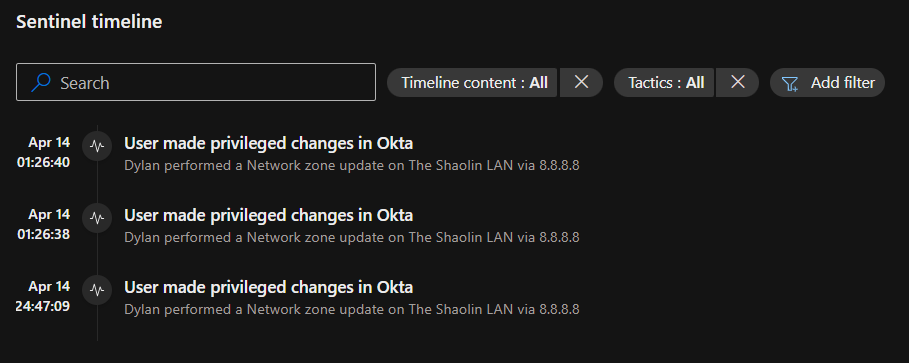 Enhancing Your Entity Timelines: Sentinel Activities in the Unified Microsoft Defender XDR Portal
A practical guide to the "Sentinel activities" feature in the unified Microsoft Sentinel/Defender XDR portal, which surfaces entity behavior (alerts, bookmarks, anomalies, custom activities) directly on identity/device/IP pages. The author walks through creating a custom activity that queries an OktaSSO custom log table via KQL to flag privileged Okta changes made by a user, then displays the enriched result in that user's entity timeline, and notes current limitations (no historical backfill, no pivot-to-hunting link).
attackthesoc.comwriteupAdded 3 Sep 2026, published 13 Apr 2024🛡️ Security