- Show HN: Overtone – Transcribe, correct and cut captions for any screen shape
Overtone is a caption format (.overtone.json), a CLI and a video.js plugin that store each spoken word once and cut captions separately per screen shape (16:9, 9:16 or custom). The transcribe pipeline combines gpt-transcribe, Azure AI Speech and optional ElevenLabs Scribe, resolves disagreements with an LLM vote, and uses an LLM editor for corrections. A small public benchmark reports 5.3% word error rate and $0.023–0.025 per audio minute.
 github.comrepoAdded 30 Oct 2026, published 29 Oct 2026🧠 AI
- Mas0nShi/CVE-2026-112445
CVE-2026-112445 is a macOS local privilege escalation in which the launchd job com.apple.xpc.uscwoap runs /bin/bash as root with stdin tied to /dev/console. A non-administrator console user can start the job and inject commands into the console input queue with TIOCSTI, so Bash executes them as UID 0. Apple did not list the CVE in its advisory; macOS 27.2 removes the job configuration.
github.comrepoAdded 2 Nov 2026, published 29 Oct 2026🛡️ Security - Spectrmachina/Ztrust
ZTrust is a Python supply-chain scanner that checks manifests, lockfiles, source and GitHub workflows for vulnerable or malicious dependencies (via OSV.dev), typosquats, leaked secrets, unsafe lockfiles and risky CI patterns such as pwn requests and script injection. It outputs console, JSON and SARIF 2.1.0 and ships as a GitHub Action. It also includes a FastAPI bounty service using commit-reveal and shielded Zcash payouts for researchers.
github.comrepoAdded 27 Oct 2026, published 22 Oct 2026🛡️ Security - eliasbiondo/antirion
Antirion is an open-source AI gateway shipped as one Rust binary with a built-in admin console. It sits between apps and providers such as OpenAI, Anthropic, Bedrock, Vertex and vLLM, translating between OpenAI, Anthropic, Gemini and Bedrock dialects. It covers routing with fallbacks and circuit breakers, budgets, guardrails, caching, MCP and A2A gateways, SSO, and a benchmark against Bifrost 2.2.4 and LiteLLM 1.103.1.
github.comrepoAdded 21 Oct 2026, published 17 Oct 2026🧠 AI - alex09x/kyb
KYB (Know Your Business) is a Rust/axum server that stores agent-written knowledge, incident reports and tasks as Markdown files in Git, one commit per change. Search is hybrid: Tantivy BM25 fused by reciprocal rank with local multilingual-e5-small ONNX vectors, and it can query historical versions or "as of" a date. It ships a kyb CLI, a native MCP endpoint (Claude Code, Codex, Antigravity, Gemini CLI), an installable agent skill, token auth with per-write attribution trailers, secret scanning on writes, and a web console. It targets persistent shared operational memory for multi-agent, multi-machine fleets.
github.comrepoAdded 17 Oct 2026🧠 AI - Llama.cpp on a jailbroken PS5: run any GGUF model natively on the console
PS5LM is a homebrew app for jailbroken PS5s (firmware 7.00–13.60). It runs llama.cpp with the ggml-vulkan backend on the console's RDNA 2 GPU, using 11.4 GB of shared memory, and loads any GGUF model. It serves OpenAI /v1/chat/completions, Anthropic /v1/messages (usable from Claude Code, Codex and opencode) and a browser chat page on port 8081. It also supports image-projector vision models and TypeSafe-style decision models through a /v1/systemone endpoint. A planner picks the longest context and best cache that fit the free memory, and the app downloads models from Hugging Face.
github.comrepoAdded 17 Oct 2026, published 16 Oct 2026🧠 AI - Show HN: SolidCraft – Open-Source Parametric CAD in Rust (With MCP Support)
SolidCraft is an open-source parametric 3D CAD application written in pure Rust. It has constrained sketches with its own solver, a feature timeline, assemblies, sheet metal, and STEP/IGES/3MF/STL export. It runs on desktop (egui+wgpu), in the browser, and as a headless CLI. The built-in MCP server (`solidcraft-cli mcp`) gives agents tools such as execute, batch, inspect_design, measure, set_parameter, screenshot and export. They can model headless or drive the running app over a JSON-lines control channel. A rover with 3,323 timeline steps was built entirely through MCP, which shows agent-driven parametric modelling working at scale.
github.comrepoPublished and added 13 Oct 2026🧠 AI - trhhubsd/ARTEX
ARTEX is an AGPL-3.0 autonomous penetration-testing system with a Go backend and Next.js frontend, backed by PostgreSQL. A planner agent and parallel worker agents share a global asset graph and a per-task exploration graph, with human-in-the-loop approval, a MITM traffic-recording proxy, ScopeSentry asset sync, vulnerability retesting and a shared todolist for multi-step attack chains. The README claims a Baidu agent+ attack-defense challenge win and limits use to local isolated labs.
github.comrepoAdded 27 Oct 2026, published 8 Oct 2026🛡️ Security - Dark Web Informer (@DarkWebInformer) on X
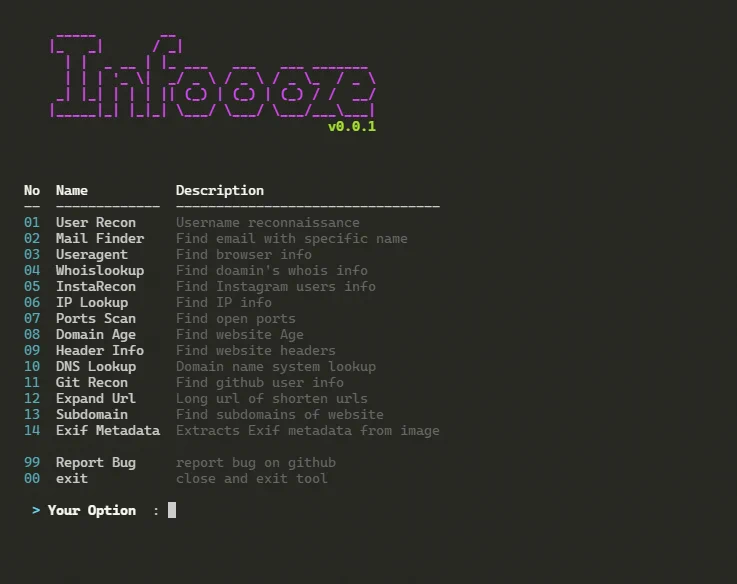
Infoooze is an open-source command-line OSINT reconnaissance toolkit (github.com/devxprite/infoooze) that consolidates common footprinting tasks into one CLI: username enumeration across platforms, email discovery, subdomain enumeration, port scanning, WHOIS/DNS lookups, IP/HTTP header analysis, EXIF metadata extraction, GitHub recon, and URL scanning/expansion. It automatically saves results, making it a lightweight all-in-one alternative to running several separate recon tools.
 x.comrepoPublished and added 8 Oct 2026🛡️ Security
- Tracer-Cloud/opensre
OpenSRE is an open-source framework for building AI SRE agents that resolve production incidents by correlating logs, metrics, traces, deploys and runbooks across 60+ connected tools (observability, cloud infra, incident management, MCP). Beyond the agent runtime (CLI, Python API, Slack/PagerDuty/Telegram integrations), the project's stated mission is to build an RL training and evaluation environment — explicitly modeled on SWE-bench's role for coding agents — to scale realistic infrastructure-failure scenarios as a benchmark for AI SRE.
github.comrepoAdded 8 Oct 2026🧠 AI - Port of the TypeScript compiler, checker and lsp to Rust, by LLM
ts-rust (npm package tsc-rs) is a from-scratch Rust port of Microsoft's TypeScript compiler/checker/language server (typescript-go), produced almost entirely by LLM coding agents rather than hand-written. The author first spent over $400,000 in API tokens running GPT-5.6 Sol and GPT-6 Astra in long agentic '/goal' loops, which wrote 1.3M lines of Rust but plateaued at ~84% compatibility; switching to Claude Opus 5.5 produced a working version in 10 hours and, after ~$24,000 of further API spend over two weeks, reached 100% compatibility on tested real-world projects while passing all 181,711 ported Go baseline tests. Benchmarks show the Rust port running about 1.6x faster than the Go tsc 7 compiler (though slower than Bun's native `bun check`) across dozens of open-source codebases including VS Code, TanStack Query, Sentry and T3 Code.
github.comrepoPublished and added 8 Oct 2026🧠 AI - Microsoft Agent Framework python-1.20.0 release
Release notes for python-1.20.0 of Microsoft's Agent Framework, an open-source agent/workflow orchestration library. This release adds native vector-store connectors for DuckDB, SQL Server and MongoDB plus a TypeSafe AI connector, redesigns Foundry hosting around request-scoped agent factories and sandbox-isolated sessions, adds computer-use support to Responses clients, and ships Magentic manager and handoff-routing improvements for multi-agent orchestrations alongside a large batch of MCP, Bedrock, Gemini, Anthropic and Ollama provider fixes.
github.comrepoAdded 6 Oct 2026🧠 AI - overmind-core/overmind
Overmind is an open-source platform (MIT SDK/CLI, AGPL-3.0 platform, self-hostable) that instruments an agent's code via OpenTelemetry tracing, turns the resulting production traces (or any dataset) into a fine-tuned model benchmarked against user-defined eval metrics, and serves it through one unified API with downloadable/retrainable weights. It ships an SDK, CLI, REST API, Console, and an MCP server exposing project tools and workflows (investigate-capability, finetune-capability, ship-model) for Cursor, Claude Code, OpenCode and Codex, and can sync traces from Langfuse, LangSmith, Braintrust or Galileo; self-hosting runs via Docker Compose with Postgres, Redis, Celery workers and Modal-based GPU workers for fine-tuning/serving (vLLM).
github.comrepoAdded 6 Oct 2026🧠 AI - NuvexNetwork/nuvex
Nuvex is a Solana-native verifiable compute and oracle protocol, still pre-mainnet, whose own README documents unresolved security gaps instead of hiding them: its VRF proof verification relies on solana-ecvrf 0.0.1 (RFC 9381 ECVRF-Edwards25519-SHA512-TAI) which has no known audit, max_fee is stored but never actually charged, and VRF fulfillment is first-come among any node meeting the configured stake/heartbeat threshold — meaning an operator who funds several keys at a low minimum stake can selectively pick which randomness output gets used. The deploy-mainnet script is stubbed to exit before any transaction, and unresolved design questions (fee shares, challenge/reject state transitions) are tracked as explicitly blocked ADRs rather than quietly shipped.
github.comrepoPublished and added 2 Oct 2026🛡️ Security - renato-osec/goonfi-v2-decompiled
goonfi-v2-decompiled holds byte-identical reconstructed Rust source for the GoonFi V2 Solana program goonuddtQRrWqqn5nFyczVKaie28f3kDkHWkHtURSLE, as deployed at slot 448984043. The on-chain program was upgraded on 6 October 2026 to fix reported bugs. VERIFY.sh builds with Solana platform-tools v1.48 and compares the result to the deploy transaction's loader buffer writes. The page does not describe the bugs.
github.comrepoAdded 22 Oct 2026, published 2 Oct 2026🛡️ Security - NVIDIA/OpenShell — sandboxed runtime for autonomous AI agents
OpenShell is NVIDIA's open-source runtime for safely running fleets of autonomous AI agents: each agent runs in an isolated sandbox where kernel-level controls enforce a declared policy over file access, syscalls, and network connections, and credentials are injected only for approved endpoints rather than exposed to the agent directly. Policy changes are checked with formal verification to flag risky new access (new hosts, new API methods) before they're approved, and the project ships a CLI, gateway, Kubernetes/Helm deployment, and a tutorial running OpenCode against an OpenRouter model.
github.comrepoAdded 1 Oct 2026🛡️ Security - OpenShell — safe, private runtime for autonomous AI agent fleets
OpenShell is NVIDIA's open-source runtime for running fleets of autonomous AI agents inside isolated sandboxes. Declarative policies cover filesystem, syscall, process and network access. These are enforced at the kernel level, and credentials are injected only into requests bound for approved endpoints. Policy changes are checked with formal verification so risky new access waits for human review. It ships a CLI, a gateway control plane (Helm deployment on Kubernetes), SDKs, extensibility hooks (middleware, interceptors, compute drivers) and installable agent skills, and it can run agents such as OpenCode.
github.comrepoAdded 1 Oct 2026🧠 AI - ShadowSafin/Synapass
Synapass is an OpenAI-compatible inference gateway and control plane that decides per request which AI provider serves it, under policy. It provides routing, retry and failover, exact/prefix/semantic caching, rate limits and budgets, tenant isolation, and an explain endpoint recording why each request was routed. It deploys with one command via Docker Compose (Postgres, Redis, ClickHouse, NATS, Grafana stack, dashboard).
github.comrepoAdded 20 Oct 2026, published 1 Oct 2026🧠 AI - NVIDIA OpenShell — secure runtime for autonomous AI agent fleets
OpenShell is NVIDIA's open-source runtime for running fleets of autonomous AI agents with restricted, policy-governed access to files, system calls, network, and credentials. It enforces policy at the kernel level inside isolated sandboxes (per-agent, with Docker/Podman/virtualization backends) and uses formal verification to flag risky policy changes — such as an agent gaining a new host or API access with credentials — before they take effect, so changes can wait for human review. It ships a CLI, a gateway control plane, Kubernetes/Helm deployment, and installable agent skills for writing and debugging sandbox policies.
github.comrepoAdded 29 Sep 2026🧠 AI - NVIDIA OpenShell — secure runtime for autonomous AI agent fleets
OpenShell is NVIDIA's open-source runtime for running fleets of autonomous AI agents in isolated sandboxes, enforcing per-agent policies on filesystem, syscall, and network access at the kernel level and injecting credentials only for approved endpoints. Policy changes go through a formal-verification step (an 'advisor'/'prover') that flags newly granted risky access, such as a new host reachable with credentials, before it's applied, and it deploys via Docker/Podman/host virtualization or Kubernetes with Helm.
github.comrepoAdded 29 Sep 2026🛡️ Security - dzhng/jevgrep
Jevgrep (the `jg` CLI) lets a coding agent ask a natural-language question about a repository and get back relevant files, reading leads, and verbatim source excerpts in one response, using an LLM (Jev) to judge relevance across folders, files, and declarations instead of relying on grep/ripgrep alone. It ships an installable "skill" for Claude Code, Codex, OpenCode and other agents that teaches them when to call jg versus their normal tools, and requires a key for Vercel AI Gateway, TypeSafe, OpenRouter, or OpenCode Zen. A reported ten-task SWE-bench repeat found ~40% lower coding-agent cost ($7.62 to $4.52) but a lower solve rate (7/10 vs 8/10 baseline), explicitly framed as a cost/quality tradeoff rather than a win.
github.comrepoAdded 27 Sep 2026, published 26 Sep 2026🧠 AI - graygnatconsole/mcp-audit-tool
mcp-audit-tool is a dependency-light Python CLI that statically scans Claude Desktop, Cursor, Windsurf, Cline, Zed, and VS Code MCP configuration files for security issues, including hardcoded secrets, unpinned/rug-pull packages, pipe-to-shell installers, tool-poisoning via hidden instructions in tool descriptions, filesystem servers rooted at '/', and unauthenticated plaintext HTTP MCP endpoints. It auto-discovers configs across macOS/Linux/Windows, produces a security score/grade plus SARIF 2.1.0 output for GitHub Code Scanning, and is built around the OWASP MCP Top 10 categories with a CI/CD example that fails builds on severity thresholds. The roadmap adds live server probing over stdio/SSE for runtime rug-pull detection and an ML-based prompt-injection classifier for tool descriptions.
github.comrepoPublished and added 26 Sep 2026🛡️ Security - Hindsight — Agent Memory That Learns
Hindsight is an open-source agent memory system (MIT-licensed, self-hostable via Docker/Helm or usable as Hindsight Cloud) that goes beyond RAG-style recall by having agents learn through consolidated observations and mental models built from retained facts and experiences. It exposes retain/recall/reflect operations, a built-in MCP server per memory bank, Python/Node/Go/CLI clients, an LLM-wrapper for drop-in memory on OpenAI/Anthropic calls, and reports state-of-the-art results on the LongMemEval long-term memory benchmark, independently reproduced by Virginia Tech's Sanghani Center and The Washington Post.
github.comrepoAdded 26 Sep 2026🧠 AI - rewanthtammana/Who-Let-The-Agents-Act
who-let-the-agents-act is a self-hostable lab suite (Docker/Python, Groq-backed LLM agent) with nine isolated scenarios — overpowered data tools, IDOR-style cross-account access, unsafe agent handoffs, refund-limit bypass, indirect prompt injection via poisoned invoices, multi-tenant RAG leakage, secret leakage through debugging, fail-open approval outages, and a multi-hop confused-deputy agent chain. Each scenario runs in multiple modes (vulnerable vs. application-enforced) against the same prompt, recording model plan, policy decision, tool calls, and DB access as JSON so a reader can directly compare what changes when authorization is enforced outside the system prompt.
github.comrepoAdded 26 Sep 2026🛡️ Security - AgentSystemLabs/agent-office
agent-office is an open-source Node.js application that renders your team's projects as floors of a cartoon 3D office, where each Claude Code, OpenCode or Codex coding-agent worker sits at a desk with a visible terminal others can join. It wires agent workers directly into GitHub: an issues board and PR board with diff review, CI status and merge actions, a task queue that auto-hires workers into isolated git worktrees, one-click PR creation, live worker status via Claude Code/Codex hooks and an OpenCode plugin, and per-worker cost/token tracking against Claude plan limits. It also supports multi-agent meeting-room collaboration patterns such as debate, lead and team, map-reduce, red and blue, and review panel, where several agent workers jointly produce a file and open a PR, plus shared voice chat and screen sharing for the human team.
github.comrepoAdded 28 Sep 2026, published 26 Sep 2026🧠 AI - Show HN: CUA-S1 – A System One Model for Computer Use
Cua is an open-source platform for computer-use agents: isolated cloud desktops (Fleets), a Sandbox SDK, local macOS/Linux VM management (Lume), a Cua Driver for controlling native apps/browsers via CLI/MCP/SDKs, and Cua-Bench for building and evaluating computer-use tasks. It also introduces CUA-S1, a family of small specialized "System 1" models that make fast, bounded decisions (e.g., scoring form field values from structured UI/document data) rather than generating agent actions token-by-token, with the first CUA-S1-FORMS model and dataset released on Hugging Face. The project is MIT-licensed with some optional components (cua-som, cua-perception's OmniParser integration) carrying AGPL-3.0 obligations.
github.comrepoAdded 26 Sep 2026, published 19 Sep 2026🧠 AI - crypt0p3g/adnullenum
adnullenum is a single-pass Active Directory enumerator that uses anonymous (null) SMB sessions over the \samr and \lsarpc named pipes to pull domain info, password/lockout policy, RID-cycled account inventory, per-user detail, and group membership without credentials. It consolidates what rpcclient, impacket's samrdump.py/lookupsid.py, enum4linux-ng, and NetExec each do separately into one run, falls back to LSA lookups when SAMR is locked down, flags interesting accounts (AS-REP-roastable, PASSWORD_NOT_REQUIRED, unconstrained delegation, etc.), and writes ready-to-use userlist.txt/computerlist.txt plus a reusable RID cache. The README also gives blue-team guidance on closing null-session access (RestrictAnonymousSAM, Pre-Windows 2000 Compatible Access group) and detecting it via Event 4661/4662/4624/5140.
github.comrepoAdded 2 Oct 2026, published 17 Sep 2026🛡️ Security - AnotiaWang/awesome-decision-models
A community-maintained GitHub list cataloging "decision models" (also called System One models): small/fast models that take a state plus caller-declared questions (Noul/true-false, Choice/multi-option, Score/rubric) and return a probability per answer in one forward pass, rather than generating text. It tracks the originating TypeSafe AI Jev model and its /v1/systemone API alongside competing hosted models (Upstage Solar Decide, Liquid AI's d1, OpenAI's Decisions API, Inception's Mercury Decide, Respan's Span-01), dozens of open-weight fine-tunes (Cloudflare's Clef, Perplexity's pplx-decider, AWS Strands Decider, Together AI's Tev1, and many Qwen3.5-based community models), zero-training logit-reading approaches, local runtimes (Ollama, Ollaya, llama.cpp-based servers), SDKs across a dozen languages, and a very long list of agent/coding-tool/MCP integrations (browser agents, code review, routing, game-playing demos) that use these models for fast, typed, in-the-loop decisions. The page is truncated at 40k of ~51k characters, so later sections (further toys, demos, and possibly benchmarks) are not reflected here.
github.comrepoAdded 2 Oct 2026, published 17 Sep 2026🧠 AI - All-AI-Jailbreaks
A GitHub repository archiving 19 jailbreak, prompt-injection, persona-conditioning, and response-format-manipulation prompts collected against DeepSeek, Gemini, GLM, Grok, Kimi, Qwen, Sonnet, and ChatGPT. Prompts are kept close to their original form for provenance/reproducibility, positioned as a corpus for red-teaming and robustness evaluation rather than a guaranteed exploit list, with guidance to test in isolated environments and log model version/config/date/response per trial.
github.comrepoAdded 22 Sep 2026, published 17 Sep 2026🛡️ Security - Markakd/Container_escape
A GitHub repository hosting target-specific proof-of-concept exploits for two Linux kernel vulnerabilities, CVE-2026-52910 and CVE-2026-80521 (the latter an AF_UNIX kernel bug also documented in a kernelCTF LTS exploit-chain submission), both usable to break out of container isolation. The project ships a QEMU/Docker-based disposable VM builder (pinned to specific Ubuntu cloud images and kernel versions) so the destructive PoCs can be compiled and detonated only inside throwaway guests rather than on real hosts.
github.comrepoAdded 2 Oct 2026, published 16 Sep 2026🛡️ Security
Showing 30 of 93
Show more