 Inside a malicious Claude Code-branded extension and its persistent SSH backdoor
Microsoft Threat Intelligence analyzes a tampered anthropic.claude-code extension (versions 2.1.312 and 2.1.313) served on the Cursor marketplace on 29 October 2026. The injected JavaScript loader adds an SSH key labeled svc-telemetry, opens a reverse SSH tunnel and sets up persistence on macOS, Linux and Windows. The post gives cleanup steps, IOCs and Defender XDR hunting queries. VS Code Marketplace and npm were not affected.
 microsoft.comwriteupPublished and added 31 Oct 2026🛡️ Security
 From help desk impersonation to AD CS abuse: Investigating ESC1 and ESC8 intrusion paths
Microsoft Threat Intelligence analysis of two human-operated intrusions that began with Teams help desk impersonation and Quick Assist sessions, then diverged at AD CS. Case 1 abused an ESC1 template for privileged certificates and DCSync, with an excluded account later used for Rclone exfiltration. Case 2 used PetitPotam and ESC8 relay to get a domain controller certificate and PKINIT. Includes investigation steps, AD CS hardening and KQL hunting queries.
microsoft.comwriteupPublished and added 30 Oct 2026🛡️ Security SDK security in mobile apps: the attack surface your team didn
Oversecured guide to SDK security in mobile apps, built around Microsoft's April 2026 disclosure of an intent redirection flaw in EngageLab's EngageSDK (50 million installs, fixed in 5.2.1). It covers SDK attack surfaces (exported components, WebViews, deep links, hardcoded secrets, payment crypto), a canhub image cropper file-overwrite example, why source-only SAST misses SDK code, and MASVS and PCI DSS expectations.
 oversecured.comarticleAdded 29 Oct 2026🛡️ Security
 Tracking AI adoption in North Korean threat actor tradecraft
Microsoft Threat Intelligence report on how North Korean actors use AI, ranking Jade Sleet, Coral Sleet and Jasper Sleet as operationalized, Diamond Sleet, Onyx Sleet, Pearl Sleet and Sapphire Sleet as accelerating, and Emerald Sleet as expanding. It documents AI-generated lures (100+ Onyx Sleet PDFs, August and September 2026), AI-built tooling such as Coral Sleet's private GitHub repository trojanizing, and Onyx Sleet and Pearl Sleet use of the ARTEX agentic pentest framework. It ends with mitigation and Defender guidance.
microsoft.comarticlePublished and added 29 Oct 2026🛡️ Security Adobe, Veeam, Juniper Networks Patch Critical Vulnerabilities
SecurityWeek roundup of patches from Adobe, Veeam and Juniper Networks covering over three dozen vulnerabilities. Adobe fixed 12 flaws (eight critical in Campaign Classic), Veeam fixed nine (including a cross-tenant RCE in Backup for Microsoft 365), and Juniper fixed 18 in Session Smart Router and Conductor. None were reported exploited. Juniper said CVE-2026-109618 (PHP2Shell) affects Junos OS but is not exploitable there.
 securityweek.comarticlePublished and added 29 Oct 2026🛡️ Security
- Camera Management Software Compromise Leads to Malware Deployment
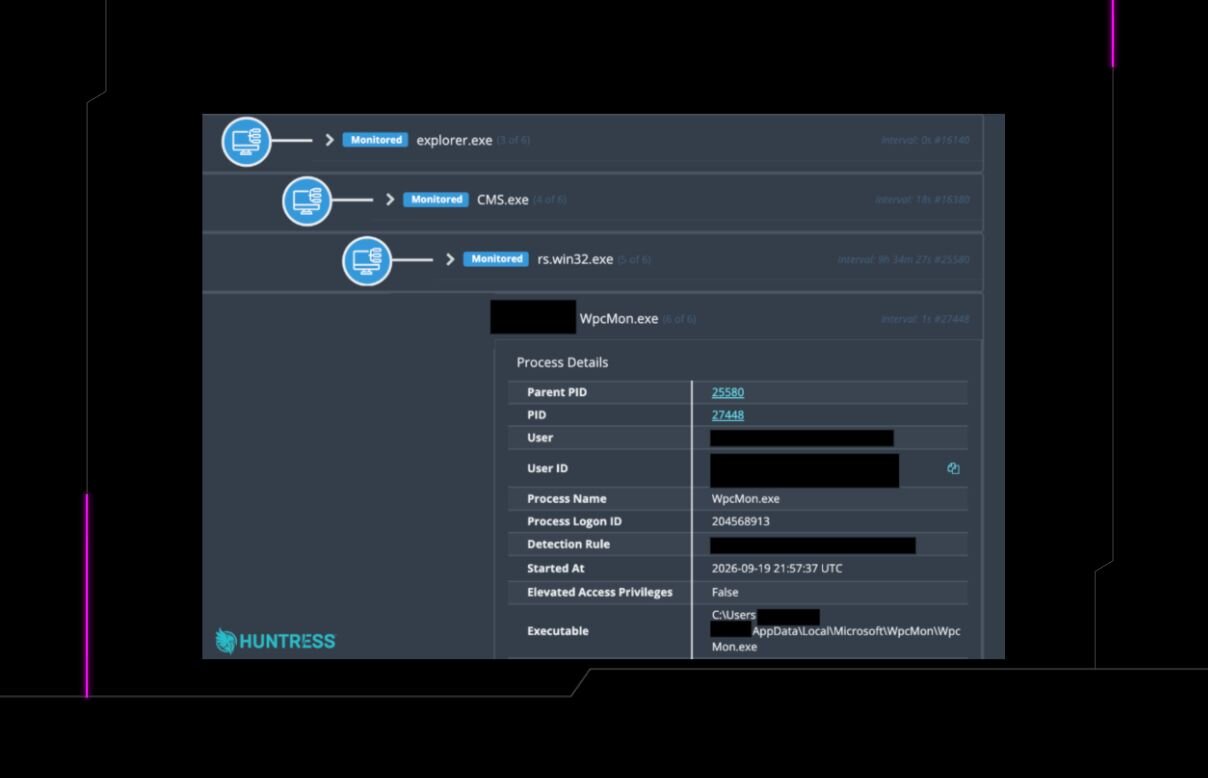
Huntress investigation of incidents in September and October 2025 where a compromised camera management application (CMS.exe) was the initial access vector. Attackers dropped rs.win32.exe, a reverse shell, and sideloaded modified zlib DLLs (IPHLPAPI.DLL, samcli.dll) via the legitimate Microsoft WpcMon.exe in AppData, with Run key persistence and beaconing to 144.172.116[.]37. Includes detection pivots and hardening advice.
 huntress.comwriteupAdded 28 Oct 2026, published 27 Oct 2026🛡️ Security
- AI, Scripts, Operator: Inside the ConnectWise Attack
Huntress analyzes Entra sign-in and audit logs from the ConnectWise Cloud Backup credential abuse of 15 October 2026 to judge whether a script, a person or an LLM agent drove it. It found a thread-pool spray, trial-and-error credential planting with a retry added within 55 seconds, and pilot-then-batch targeting. Huntress rates LLM involvement low to medium on its own data and medium to high with Microsoft's Storm-0940/ARTEX attribution. It ends with detections for service principal role self-assignment and vendor app baselining.
huntress.comwriteupPublished and added 26 Oct 2026🛡️ Security - CISA Publishes Significant Updates to ScubaGear and ScubaGoggles
ScubaGear v2.0 and ScubaGoggles v1.1.0 are CISA's updated SCuBA assessment tools for Microsoft 365 and Google Workspace secure configuration baselines. ScubaGear now uses direct REST API calls, adds Power BI coverage, a consolidated Security Suite baseline and app severity scoring. ScubaGoggles adds a GUI, Policy API integration and Gemini controls. The release supports BOD 25-01 compliance.
 cisa.govarticleAdded 29 Oct 2026, published 26 Oct 2026🛡️ Security
 Node2Shell: Brotli Flaw Triggers Patching Across Microsoft, Node.js, Python Packages
CVE-2026-111497 (Node2Shell) is an out-of-bounds write in Google's Brotli decoder, versions 1.0.3 through 1.2.0, rated CVSS v4 9.2. Fixed in Brotli 1.0.10, 1.1.1 and 1.2.1, with patches from Node.js, Microsoft (.NET, Visual Studio, PowerShell on October 25), PyPI Brotli and brotlicffi, Bun, Envoy and Istio. Imperva showed code execution on Node.js 24.22.0 arm64; no in-the-wild exploitation is reported and some researchers say it only enables DoS.
securityweek.comarticlePublished and added 26 Oct 2026🛡️ Security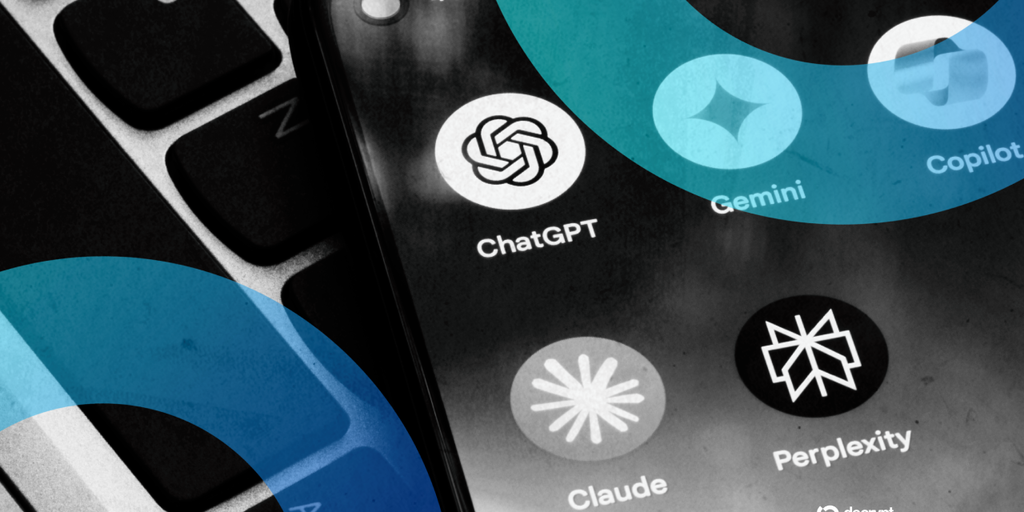 Sweden's Government Offices Block ChatGPT and Claude, Keep Microsoft Copilot
Sweden's Government Offices will block ChatGPT and Claude on staff computers from 26 October 2026 and leave Microsoft Copilot as the only approved AI tool, citing information security. Digitalisation director Mikael Wettercrantz said unvetted AI use had involved sensitive inputs and poorly handled outputs. The Tax Agency and National Board of Institutional Care have similar bans, and the European Parliament disabled AI features in February 2026. Whether Copilot has Claude models enabled is unconfirmed.
 decrypt.coarticlePublished and added 24 Oct 2026🛡️ Security
- Sweden's Government Offices Block ChatGPT and Claude, Keep Microsoft Copilot
Sweden's Government Offices will block ChatGPT and Claude on staff computers from 26 October 2026 and keep Microsoft Copilot as the only approved AI tool, after a security review. Director of digitalisation Mikael Wettercrantz cites sensitive data entered into open services and tools used without a formal contract. The Tax Agency and the National Board of Institutional Care have similar bans. The article notes Copilot can include Claude models, and the Government Offices has not said whether that is enabled.
decrypt.coarticlePublished and added 24 Oct 2026🧠 AI - Inside the LiteLLM 1.107.0 supply chain compromise: Credential theft through Python startup hooks
Microsoft's analysis of the LiteLLM 1.107.0 compromise, published to PyPI and container images on 21 October 2026. The wheel shipped cook.pth, cook.py and sitecustomize.py, so a credential collector (PRIVCOLLECT) ran whenever Python started, even without importing LiteLLM. It covers AES/RSA-encrypted exfiltration to litellm.dev, a re-armable Unix loader, Defender KQL hunting queries, ATT&CK mapping and rotation guidance.
microsoft.comwriteupPublished and added 23 Oct 2026🛡️ Security  China APT Uses AI Pentest Tool Artex in ConnectWise Attacks
Storm-0940, a China-linked APT, used the open source AI penetration testing framework Artex to automate a mid-October 2026 campaign against ConnectWise customers, per Microsoft. Artex drove reconnaissance, password spraying and OAuth application abuse at more than 2,900 attempts per minute, with sign-in attempts against over 2,250 tenants. Attackers modified application credentials for persistence, and Microsoft advises correlating service principal sign-ins with Graph activity.
securityweek.comarticlePublished and added 23 Oct 2026🛡️ Security Turning Database Grading into RL Rewards: Post-Training Agents with ThinkingBox
ThinkingBox-Training is Microsoft's released RL stack that turns executable database-state checks from ThinkingBox tasks into GRPO rewards. Fifty GRPO steps on 187 curated tasks raised Qwen3.8-27B pass@1 from 51.70% to 60.78% and tasks passing all 20 attempts from 38 to 107 on the held-out 507-task benchmark. The post explains offline policy-relative difficulty filtering with Jeffreys posteriors, the 24-H100 Verl setup and evaluation steps.
 huggingface.cowriteupPublished and added 22 Oct 2026🧠 AI
 The Current Landscape of OAuth Attacks
Unit 42 survey of OAuth attacks that steal tokens after MFA, so access survives password resets. It covers account hijacking (device authorization and authorization code misuse), permission hijacking (vague or impersonating app names), and malicious redirects, including the error-triggered redirect campaign Microsoft documented in March 2026. It also describes COSF and OAuth-as-a-service flaws, PhaaS and LLM evasion trends, and defenses such as admin-only consent and redirect_uri audits.
 unit42.paloaltonetworks.comarticleAdded 30 Oct 2026, published 22 Oct 2026🛡️ Security
 What Is a Neocloud? The GPU Clouds Powering the AI Boom
Decrypt explainer on neoclouds, specialist providers such as CoreWeave and Nebius that rent Nvidia GPU clusters for AI training and inference. It covers the chips, power and debt model, Bitcoin miners turned AI hosts, and customers including Microsoft, AWS, Google and Anthropic. It cites Gartner's 14 October 2026 forecast that over 80% of neoclouds will stop operating independently by 2030.
decrypt.coarticlePublished and added 22 Oct 2026🧠 AI- Unboxing Phishing Kits: Huntress Examines 3 Real Kits
Recap of a Huntress Tradecraft Tuesday session (October 2026) on phishing kits that target Microsoft 365 tokens, including EvilTokens (a device-code phishing campaign abusing Railway) and the Kali365 control panel. It explains device-code phishing, adversary-in-the-middle and token replay. It lists detections (unfamiliar cloud sign-ins, device-code auth, new devices) and response steps (revoke refresh tokens, remove rogue devices, block device-code flow).
huntress.comarticlePublished and added 22 Oct 2026🛡️ Security - M365 Token Spray and Replay Campaign Compromises Business Email Accounts
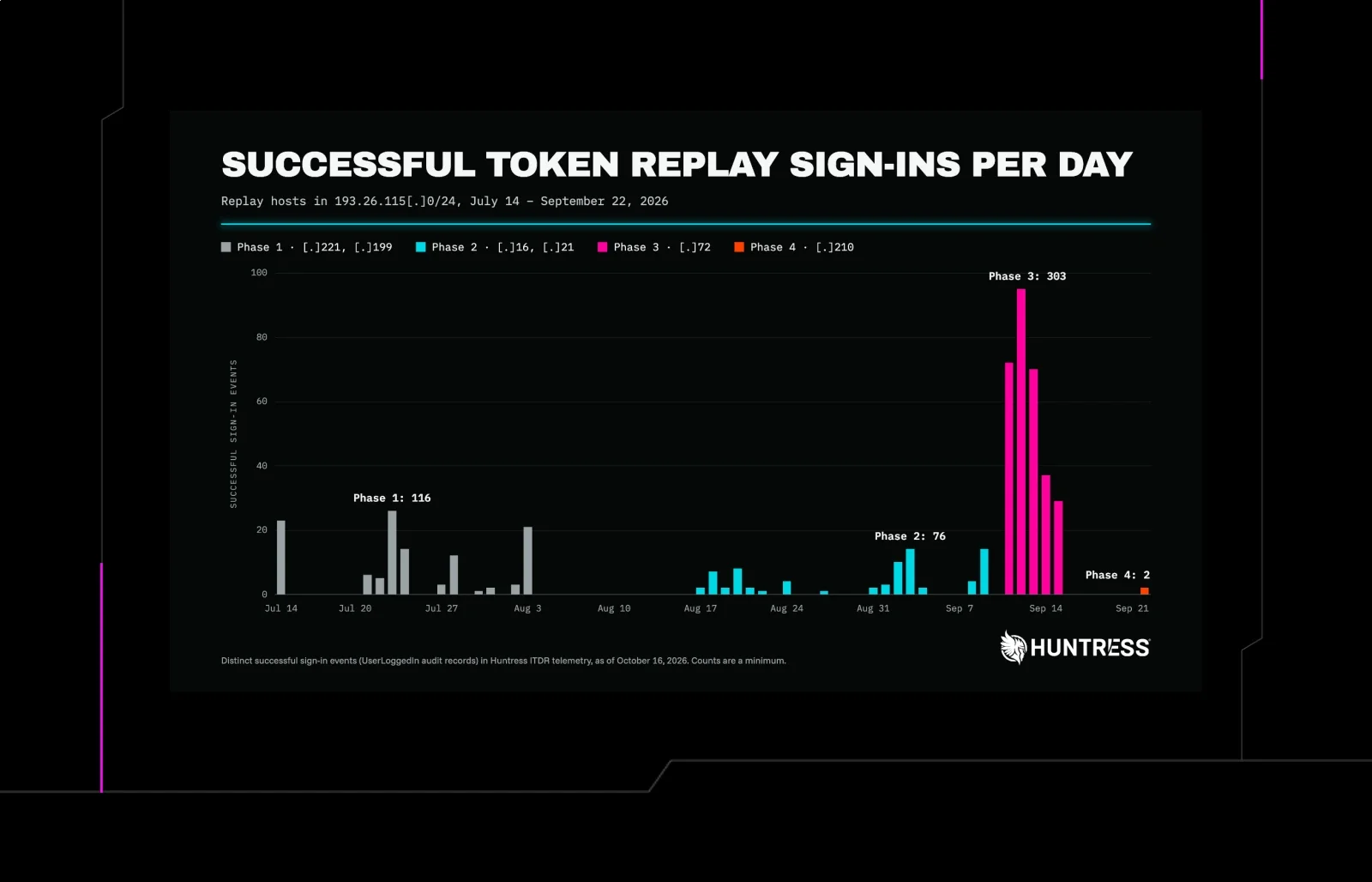
Huntress analysis of a July to September 2026 token replay ("token spraying") campaign: 497 successful Microsoft 365 sign-ins across 79 organizations, replayed from six addresses in 193.26.115.0/24 (1337 Services GmbH). Tokens came from AiTM relays, device-code phishing and social engineering. It covers four phases, rogue Entra devices, MFA method swaps, hidden inbox rules, hunting queries and Conditional Access guidance.
huntress.comwriteupPublished and added 22 Oct 2026🛡️ Security  eMudhra CA compromise: eight private keys, and one of them is 4
eMudhra's eight intermediate CA certificates, chaining to emSign ECC Root CA - G3, had private keys below 256 (one is 4), disclosed on 17 October 2026 by a researcher known as Wayne. Browsers and Microsoft blocked them via revocation pushes, but curl, git, containers, language runtimes and IoT may still trust them. The post gives patched ca-certificates versions, test commands and the timeline.
 aikido.devarticlePublished and added 22 Oct 2026🛡️ Security
 Compromised eMudhra intermediate certificates
Cisco Talos describes eight eMudhra intermediate CA certificates (six TLS, two code signing) whose P-384 private keys were trivially recoverable because a flaw in an April 30, 2025 key generation ceremony produced weak keys with only 3 to 8 bytes of entropy. The post lists certificate SHA-256 hashes and serials, browser and Microsoft blocks, and the Go fix (CVE-2026-111943, Go 1.27.3 and 1.26.10) that filters chains by SPKI hash. It covers impact on VPNs, CI/CD and embedded devices, and Snort SIDs 67363 to 67374.
 blog.talosintelligence.comadvisoryPublished and added 21 Oct 2026🛡️ Security
 AI-driven, large-scale nation-state campaign using ARTEX enables supply chain compromise
Microsoft Threat Intelligence report on Storm-0940, a China-state aligned actor that used the open-source agentic AI pentest framework ARTEX from September 2026 to automate attacks on hundreds of organizations. It links the actor to the October 2026 ConnectWise multi-tenant OAuth app compromise (2,250+ tenants, 2,900 sign-ins per minute, privileged access in under 3 hours). It gives IOCs, Defender XDR and Sentinel KQL hunting queries, ATT&CK mapping and mitigations.
microsoft.comwriteupPublished and added 21 Oct 2026🛡️ Security Browsers Block eMudhra Intermediate CAs Over Recoverable Private Keys
Eight intermediate CA certificates issued by Indian CA eMudhra in April 2025 had private keys generated with weak entropy, effectively all zeroes except the last byte, so they could be recovered almost instantly with baby-step giant-step. Mozilla and Google blocked them on 17 October 2026, Apple on 19 October and Microsoft on 20 October. eMudhra blamed a key ceremony script flaw that created a second, weaker key pair.
securityweek.comarticlePublished and added 21 Oct 2026🛡️ Security A company that vouches for websites had secret keys so weak that 8 of them were cracked
eMudhra, an Indian certificate authority with over 60 million issued certificates, had eight CA private keys that were tiny integers such as 4, 56 and 237. Researcher Scott Helme recovered all eight from public certificates in under a second, and the keys were exposed from April 2025. Mozilla, Chrome, Apple and Microsoft blocked them between 17 and 20 October 2026, but curl, Python, Node.js, Go and Java accepted a forged Stripe API certificate because they skip revocation checks.
 coindesk.comarticlePublished and added 21 Oct 2026🛡️ Security
- eMudhra Intermediate CA Compromise
eMudhra Intermediate CA Compromise is a 20 October 2026 link-blog post reporting that private keys of eight eMudhra intermediate CA certificates were compromised. They chain to roots trusted by the Mozilla, Microsoft, Apple and Chrome programs. Software bundling trust lists needs updating: Linux distros must update ca-certificates, and uv 0.13.4, pip 26.2.2 and certifi 2026.10.19 ship new lists. The post does not describe how the keys were compromised.
 simonwillison.netarticleAdded 21 Oct 2026, published 20 Oct 2026🛡️ Security
 There's only so much code: the rise in vulnerability numbers
Cisco Talos analysis of why Microsoft Patch Tuesday advisories rose from about 100 a month before June 2026 to 975 in September and 1,415 in October, as frontier models such as Mythos mine old code. CVEs grew 105% year over year while CISA KEV additions grew 37%, and only three September advisories were exploited in the wild. It covers pressure on 90-day coordinated disclosure and open-source maintainers, the format string bug-class precedent, and defender advice.
blog.talosintelligence.comarticlePublished and added 20 Oct 2026🛡️ Security Microsoft Targets Rogue AI Agents With Dynamic Permissions, Risk Scoring
Microsoft extended Project Perception to treat internally deployed AI agents as insiders. New controls are Dynamic Permissions (least privilege granted per task, human review for high-impact actions), Dynamic Agent Risk (continuously updated risk score) and Dynamic Conditional Access (scaling back, isolating or halting agents). Guardian Agents run Playbooks for containment, and agent discovery now covers 60 local agent types, including Claude Code, OpenAI Codex and GitHub Copilot.
securityweek.comarticlePublished and added 20 Oct 2026🛡️ Security ConnectWise Suspends Cloud Services in Response to Cyberattack
ConnectWise suspended its Cloud Backup (formerly SkyKick), SaaS Security and Cloud Management services in October 2026 after a compromised application credential was used to access customers' Microsoft 365 tenants. Huntress saw the Cloud Backup identity sign in to 162 tenants on 15 to 16 October and attacker IP 144.172.64[.]128 try nearly 1,000 Entra tenants, with over 300 successful sign-ins. In one tenant, the Cloud Management Teams app added itself to Global Administrator and added client secrets to other apps. No restoration timeline has been given.
securityweek.comarticlePublished and added 19 Oct 2026🛡️ Security- Microsoft Threat Intelligence (@MsftSecIntel) on X
ConnectWise Cloud Backup (formerly SkyKick Backup, AppId 506e08f9-6e9a-4da4-942b-a099a03644ae) had its multitenant OAuth app compromised, per Microsoft Threat Intelligence. On 15 October 2026 the actor authenticated broadly as the service principal from 144.172.64[.]128, likely using customer-granted permissions such as Directory.ReadWrite.All, then ran Graph API reconnaissance and tried to add credentials to the service principal as a backdoor. The post lists IOCs, Defender alerts and hunting advice.
 x.comadvisoryAdded 20 Oct 2026, published 17 Oct 2026🛡️ Security
- ConnectWise (SkyKick) Vendor Credentials Abused in M365 Attacks
Huntress documents abuse of ConnectWise Cloud Backup (formerly SkyKick) vendor app credentials, used on October 15 from 144.172.64[.]128 to obtain Microsoft Graph tokens in at least 162 customer M365 tenants via client assertion. In one tenant, a ConnectWise Cloud Management Teams app self-assigned Global Administrator and added client secrets to an MSP management app and Huntress's own app, a persistence technique. The post lists application IDs, Entra sign-in and audit-log checks, user-agent indicators (kiota-dotnet vs Python-urllib/3.12, curl/7.88.1), and mitigation steps such as disabling (not deleting) the enterprise apps and reviewing added credentials.
huntress.comwriteupAdded 17 Oct 2026, published 16 Oct 2026🛡️ Security  Managing open-weight model risk in enterprise deployments
Microsoft blog post introducing "Risk Management for Open-Weight Models in Enterprise", a joint Microsoft–NVIDIA paper. It proposes a shared risk taxonomy (Cybersecurity, Data Protection, Content, Human-AI Interaction, Bias) grounded in ISO standards and the NIST AI RMF. The paper maps evaluations to risks as evidence and argues that risk depends on the model, use case, deployment and safeguards, not on weight openness alone. It also covers how responsibility for controls shifts when enterprises self-host models, and points to a joint repository of evaluations. The first paper focuses on the model layer; runtime, harness and application layers are planned for later.
microsoft.comarticlePublished and added 16 Oct 2026🛡️ Security


Showing 30 of 207
Show more