Skip to content

AWS Security Blog

feed๐Ÿ›ก๏ธ Securityaws.amazon.com โ†—

26 posts in the catalog

Each feed is checked for new posts. Every post is read, and those that belong here join the catalog. What Trove read and did not keep stays on file, not shown.

aws.amazon.comarticle

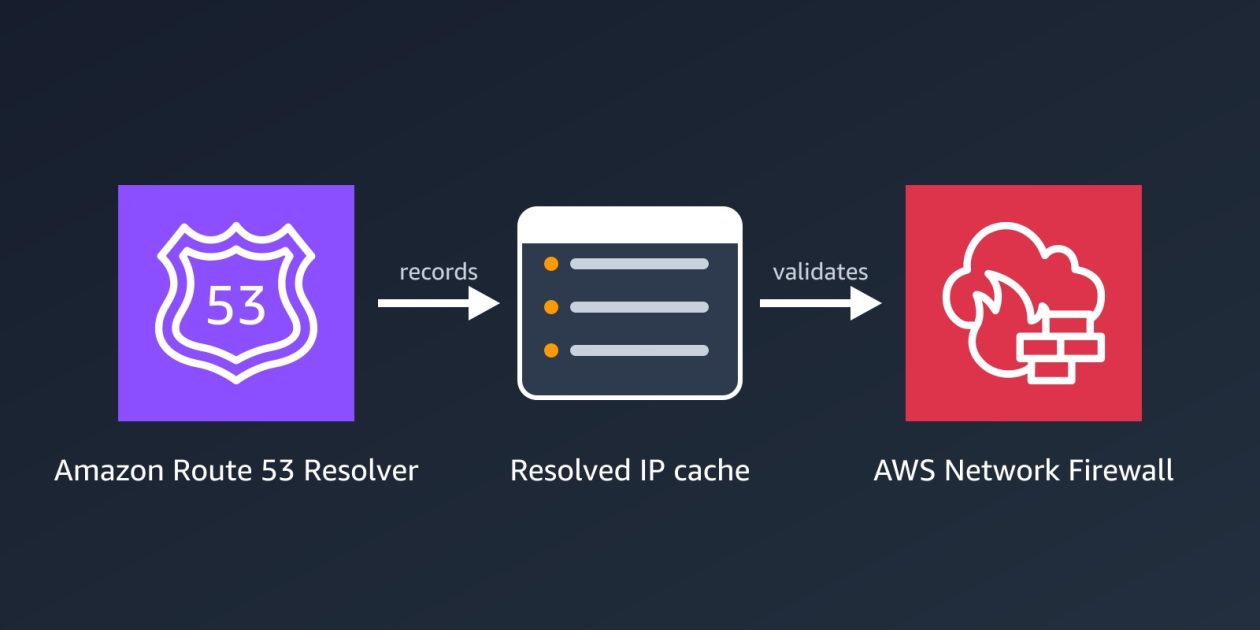
Introducing Route 53 Resolved IP Validation for AWS Network Firewall

Route 53 Resolved IP Validation for AWS Network Firewall, launched 21 October 2026 at no extra charge, has Route 53 Resolver share the IP addresses it returns per domain with Network Firewall, which checks each new outbound connection against them. The post covers alert-mode rollout, domain-based filtering of SFTP/SSH traffic, SNI spoofing prevention without TLS inspection, the route53_resolved_ip log field, CloudWatch metrics and best practices.

AWS Network FirewallAmazon Route 53 ResolverRoute 53 Resolver DNS Firewall+3
SNI spoofingRoute 53 Resolved IP ValidationDNS tunneling

Cloud & Infra, Blue Team & Detectionยท 2026-10-27T23:46:13+00:00
aws.amazon.comarticle

Part 3 โ€“ Cybersecurity journeys: The work behind the work

Part 3 of the AWS Security Blog series on cybersecurity careers profiles three AWS staff: Brandon Caldwell (application security, empathy and communication), Kurt Heath (self-taught pen tester, cautious AI use) and Seth Jeacopello (code review, managing attention). It gives practical advice: practice on vulnerable machines and read the logs, build CTF and GitHub portfolios, and write clearly. It lists TryHackMe, Hack The Box, the OWASP Top 10, OWASP Cheat Sheet Series, Darknet Diaries and AWS Skill Builder.

TryHackMeHack The BoxAWS Skill Builder+1
Brandon CaldwellKurt HeathSeth Jeacopello+6

Learning, AppSecยท 2026-10-27T17:00:07+00:00

aws.amazon.comarticle

Using AWS WAF to apply mitigations for PHP2Shell RCE vulnerabilities (CVE-2026-109618 and CVE-2026-109619)

AWS Security Blog guide to mitigating the PHP2Shell unauthenticated RCE flaws (CVE-2026-109618 and CVE-2026-109619, CVSS v4.0 9.2) with AWS WAFv2 rules. It covers rules for the PHP_SESSION_UPLOAD_PROGRESS trigger, blocking multipart/form-data, body size caps and rate limits, plus body inspection limits. It lists PHP fixes (8.5.12, 8.4.27, 8.3.36, 8.2.35) and server settings, and stresses WAF only reduces exposure.

AWS WAFPHPAWS+1
CVE-2026-109618CVE-2026-109619PHP2Shell+4

Cloud & Infra, Blue Team & Detection, AppSecยท 2026-10-22T00:50:04+00:00

aws.amazon.comarticle

Amazon Threat Intelligence identifies PHP2Shell exploitation prior to public disclosure in MadPot

Amazon Threat Intelligence reports PHP2Shell exploitation (CVE-2026-109618, CVE-2026-109619) seen in MadPot honeypot telemetry on 17 October 2026, four days before the 21 October disclosure, from anonymization-network IPs. Multiple actors and PoCs appeared within hours of the patch. It recommends upgrading PHP, hunting for PHP_SESSION_UPLOAD_PROGRESS in multipart POSTs, and investigating from the earliest exploitation date, with patch SLAs measured in hours.

PHPAWS
CVE-2026-109618CVE-2026-109619PHP2Shell+2

Threat Intel, AppSec, Blue Team & Detectionยท 2026-10-21T22:36:26+00:00

aws.amazon.comarticle

Best practices for integrating IAM Roles Anywhere with your PKI

Best practices for integrating AWS IAM Roles Anywhere with an external PKI so non-AWS workloads get temporary credentials via X.509 certificates. Covers trust anchor placement, certificate attributes (CN, issuer, SAN) in trust policy conditions, short-lived versus just-in-time certificates, and private key protection with PKCS #11, TPM 2.0 and OS certificate stores. Includes credential helper modes (serve, update), expiry monitoring, blue/green trust anchor rotation and a sample CloudFormation template.

AWS IAM Roles AnywhereAWS IAMAWS Private CA+3
X.509trust anchorPKCS #11+5

Identity & Access, Cloud & Infraยท 2026-10-21T17:03:50+00:00

aws.amazon.comarticle

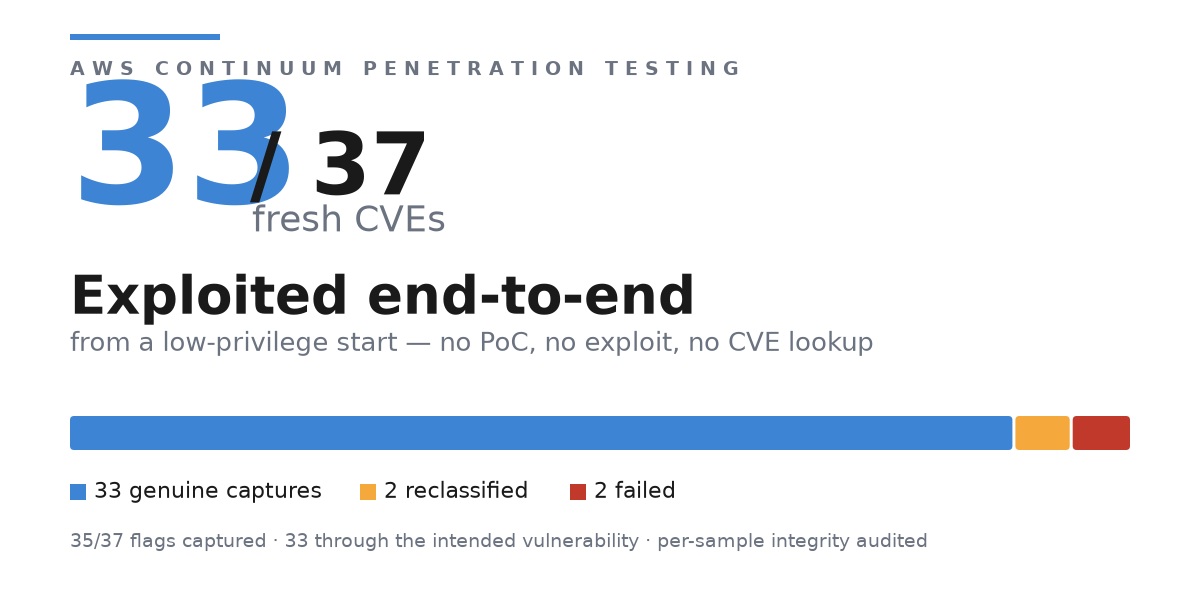
AWS Security Agent (now part of AWS Continuum) exploited 33 of 37 new real-world CVEs

AWS reports results for its autonomous pentesting agent, AWS Security Agent (now part of AWS Continuum), on an internal CTF-style benchmark of 37 recent 2025โ€“2026 CVEs. Each CVE ran as a live docker-compose target with a hidden flag, and the agent started from an endpoint and a one-line hint with runtime CVE lookup disabled. It captured 35 flags, 33 (89.2%) through the intended vulnerability after an audit against canonical PoCs. The post describes the 7-stage pipeline (crawler, specialist agents, validator, exploitation agent, flag check, audit), three exploit walkthroughs (CMS upload-to-admin chain, AI workflow builder RCE, tRPC full-read SSRF), the two audit reclassifications caused by benchmark bugs, and two misses where the agent took the target down. It also argues that saturated public benchmarks like CVE-Bench and XBOW are contaminated.

AWS Security AgentAWSDocker+2
Opus 5CVEBenchSSRF+4

AI Security, Offensive Security, AppSecยท 2026-10-15T16:10:14+00:00

aws.amazon.comarticle

Penetration testing every deployment with AWS Continuum

Explains how to add AWS Continuum for penetration testing (formerly AWS Security Agent) as a post-deployment gate in CI/CD. Each run is scoped to the commit range since the last passing gate, and it can block promotion to production at a chosen severity threshold. It covers OIDC federation to a least-privilege IAM role, a GitHub Actions worked example, staged report-only rollout, and pitfalls: the baseline advances on passing report-only runs, fail-on-infrastructure-error defaults to fail-open, GitLab pipeline variables can override the committed threshold, and runner credentials need protecting.

AWS ContinuumGitHub ActionsGitLab+3

DevSecOps, Offensive Security, AI Securityยท 2026-10-14T20:21:52+00:00

aws.amazon.comarticle

Part 2 โ€“ Cybersecurity journeys: What even is this job?

Part 2 of the AWS Security Blog's cybersecurity careers series. It profiles three people in less-publicized security roles: Jason Lane, who works backward from a vulnerability research goal and now measures risk across about a million Amazon applications. Jason Goodman moved from customer service through insider threat, adversarial detection and application security. Harshvardhan Chunawala advises startups and has worked on lunar rover operations and satellite incident response. It closes with pointers to the NICE Workforce Framework, CyberSeek, AWS Skill Builder and CISA resources for exploring roles.

AWSSplunk
NICE Workforce FrameworkCyberSeekAWS Skill Builder+6

Learningยท 2026-10-13T20:58:01+00:00

aws.amazon.comarticle

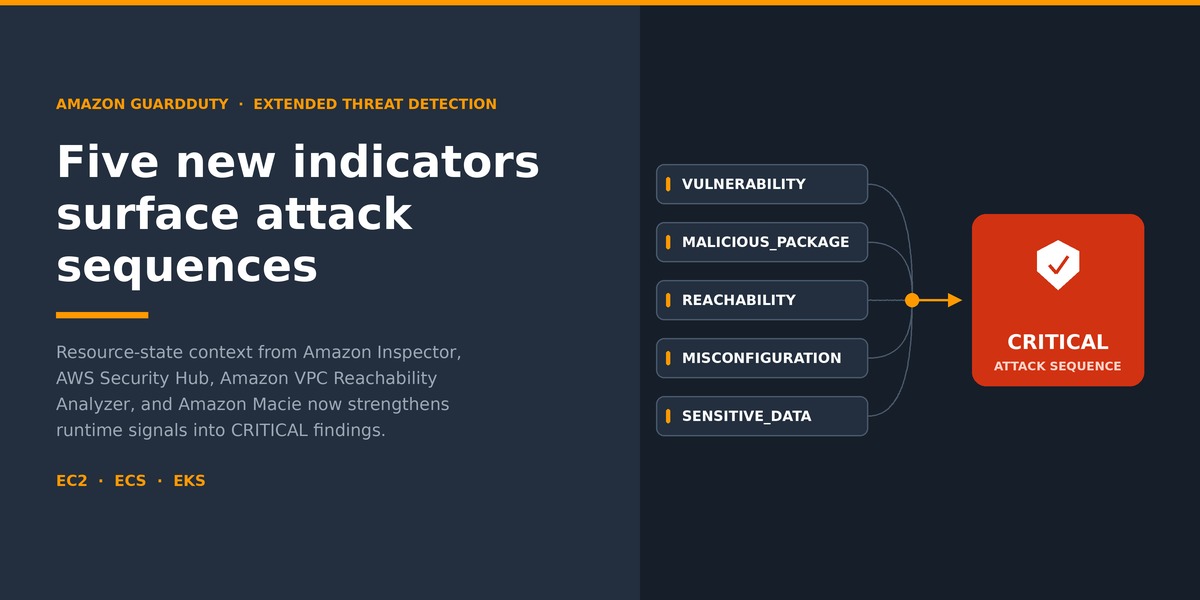
GuardDuty Extended Threat Detection has added five new indicators to surface attack sequences

Explains five new indicator types (MALICIOUS_PACKAGE, MISCONFIGURATION, REACHABILITY, SENSITIVE_DATA, VULNERABILITY) that GuardDuty Extended Threat Detection attaches to attack sequence findings, sourced from Inspector, VPC Reachability Analyzer, Macie and Security Hub. Walks through an EKS compromise (AttackSequence:EKS/CompromisedCluster) that only became a CRITICAL finding thanks to the new context, and a cryptomining EC2 case. Lists observed CVEs with EPSS scores, frp/Burp Collaborator artifacts, and response advice such as EPSS-weighted patching, isolating reachable hosts and rotating IAM credentials.

Amazon GuardDutyAmazon InspectorAWS Security Hub+5
CVE-2022-1471CVE-2024-4577CVE-2024-34351+13

Cloud & Infra, Blue Team & Detectionยท 2026-10-12T21:58:44+00:00

aws.amazon.comarticle

Quantum-resistant signing on AWS, Part 2: Enforce your ML-DSA algorithm policy with SCPs and IAM

Explains how to turn a cryptographic algorithm policy (approve ML-DSA-65/87, exclude ML-DSA-44) into enforceable AWS controls using SCPs, IAM policies, permission boundaries and KMS key policies. The key lever is the kms:KeySpec condition key (kms:SigningAlgorithm can't distinguish variants, since all use ML_DSA_SHAKE_256), applied to CreateKey, ReplicateKey, Sign, Verify and GetPublicKey. It also covers surfaces without algorithm condition keys (AWS Private CA, ACM import, IAM server certificate upload, ELB TLS) via provisioning pipelines plus CloudTrail and AWS Config drift detection, and the default-allow risk of deny-lists.

AWSAWS KMSAWS IAM+3
ML-DSAFIPS 204NIST+2

Cloud & Infra, GRCยท 2026-10-12T20:13:06+00:00

aws.amazon.comarticle

Quantum-resistant signing on AWS, Part 1: Build a software supply chain with ML-DSA

Part 1 of an AWS series showing how to build a quantum-resistant software supply chain with ML-DSA: ML-DSA keys in AWS KMS, an ML-DSA root/subordinate CA hierarchy in AWS Private CA, and IAM Roles Anywhere trust anchors for external build agents. It covers signing binaries (EXTERNAL_MU with OpenSSL 3.5), container images as OCI referrers via ORAS, and SBOMs wrapped in in-toto Statements bound to the artifact digest, plus verification, admission control, trust-store distribution, revocation and SCP guardrails. It frames the "forge later" threat and maps CNSA 2.0 (ML-DSA-87 only for NSS) and EU CRA deadlines to actions.

AWSAWS KMSAWS Private CA+3
ML-DSANIST FIPS 204CNSA 2.0+8

Supply Chain, DevSecOps, Cloud & Infraยท 2026-10-12T20:12:53+00:00

aws.amazon.comarticle

Configuring your AI vulnerability harness, Part 2: The steering file

AWS Security Blog's second post in a series on building an "AI vulnerability harness" explains the configuration (steering file) that stops an AI model from hallucinating vulnerabilities and inflating severity during security code review. It details five configuration sections โ€” structural verification of findings, an evidence-based confidence formula (weighting confirmed taint flow at 0.30), infrastructure-aware severity multipliers for controls like AWS WAF and IAM, CISA KEV/EPSS threat-intel boosting, and a four-tier priority classification โ€” and reports validation numbers (e.g., unsteered models fabricated code paths in ~30% of findings; steered confidence of HIGH without structural confirmation was only 34% exploitable vs 89% with confirmed taint). The steering file is shipped as a Kiro steering file, a Kiro skill, and a CLAUDE.md for Claude Code, with full source in a linked GitHub repo.

KiroClaude CodeAWS WAF+3

AI Security, AppSecยท 2026-10-07T21:49:50+00:00

aws.amazon.comarticle

Building your AI vulnerability harness, Part 1

AWS Security Blog describes a three-layer AI-assisted pipeline for triaging vulnerability scanner findings: Layer 1 cross-checks multiple scanners (e.g., Semgrep, CodeQL) for agreement, Layer 2 verifies a scanner's claimed data-flow path against the code's actual abstract syntax tree to catch hallucinated findings, and Layer 3 cross-references infrastructure-as-code (CloudFormation/Terraform) to weigh whether existing controls like AWS WAF rules actually mitigate the exploit path. It argues progressive, escalating-evidence filtering plus mandatory structural verification of LLM claims before human review is what turns noisy scanner output into a short, trustworthy, prioritized list, and lays out an adoption order (indexing, then multi-scanner triage, then AI hypothesis generation, then infra context, then live PoC verification).

AWSSemgrepCodeQL+3

AI Security, AppSecยท 2026-10-07T21:49:43+00:00

aws.amazon.comarticle

Improving SPIRE security and resiliency with AWS managed services

AWS Security Blog walkthrough on hardening SPIRE (the SPIFFE Runtime Environment) in production by replacing its default self-managed components with AWS managed services: AWS KMS for SVID signing keys, Amazon Aurora PostgreSQL as the datastore, AWS Private CA as the upstream certificate authority, Amazon S3/CloudFront for trust bundle distribution, AWS Secrets Manager for delivering SVIDs to serverless/container workloads, and Amazon Verified Permissions (Cedar policies) for fine-grained SPIFFE-ID-based authorization. It addresses operational concerns like key custody, datastore resiliency, PKI integration, and offline identity validation, and links to a GitHub reference deployment and a SPIFFE/SPIRE-on-AWS workshop.

AWSKubernetesPostgreSQL+2

Cloud & Infra, Identity & Accessยท 2026-10-06T18:52:25+00:00

aws.amazon.comarticle

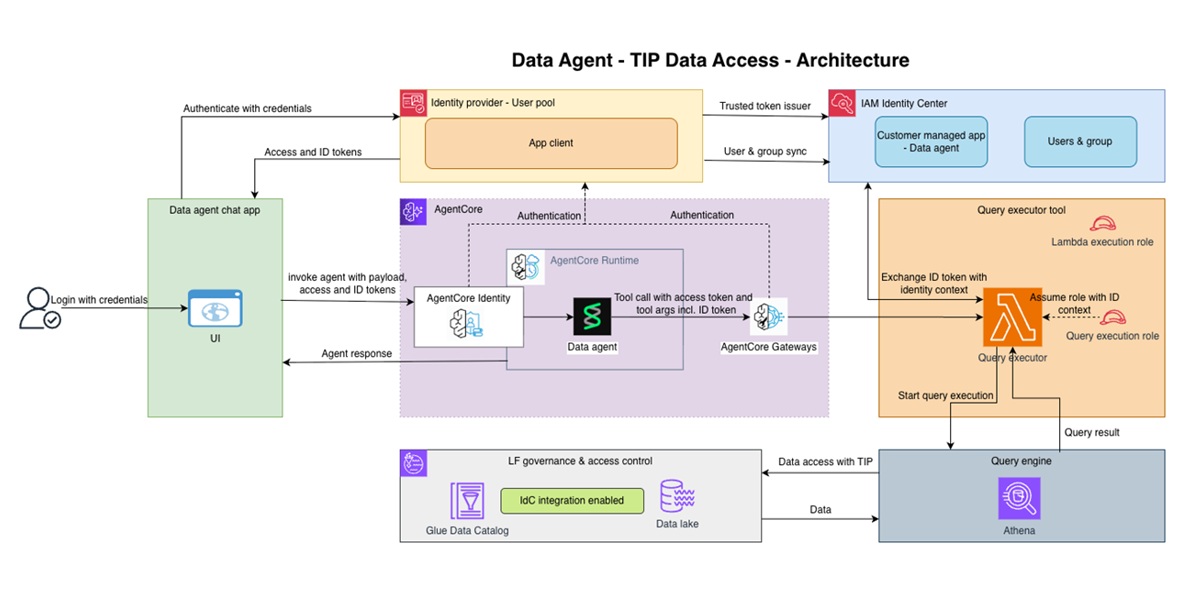
Identity-aware AI data agents with AWS Lake Formation and Trusted Identity Propagation

AWS Security Blog walkthrough of an identity-aware AI data agent pattern that propagates a real user's OIDC id_token through Amazon Bedrock AgentCore Runtime and Gateway into a Lambda target, which exchanges it server-side (via IAM Identity Center trusted identity propagation) for Lake Formation-scoped Athena credentials. The design deliberately keeps the id_token off the tool schema and inside HTTP headers only, so the foundation model never sees or handles the user's credential, and CloudTrail records the real human via an onBehalfOf AssumeRole entry, letting existing Lake Formation grants govern AI agent queries without rewriting authorization logic in application code. It details the three AgentCore configuration gates (runtime header allowlist, gateway metadataConfiguration.allowedRequestHeaders, Lambda's bedrockAgentCorePropagatedHeaders) that enforce this separation.

AWS BedrockModel Context ProtocolOAuth+3
Trusted Identity Propagation

AI Security, Identity & Access, Cloud & Infraยท 2026-10-06T16:07:06+00:00

aws.amazon.comarticle

AWS Continuum sets a new standard in autonomous code security

AWS describes Continuum for code vulnerabilities, a multi-agent system that autonomously discovers, demonstrates, and patches memory-safety bugs in C/C++ codebases, evaluated against CyberGym-E2E โ€” a 920-task benchmark built from historical OSS-Fuzz vulnerabilities across 139 open-source projects. Continuum passed 819/920 tasks (89.0% end-to-end success, S3 stage) within the 90-minute limit, beating the prior public best of 65.9% by 23.1 points, and reached 93.7% without the time limit. The post also explains the benchmark's four cumulative validation stages (crash reproduction, patch effectiveness, functional-test preservation, historical-vuln match) and positions deployment-context prioritization as future work beyond the benchmark's scope.

AWSAWS ContinuumC+1
CyberGym-E2EOSS-FuzzDeception Benchmark

AI Security, AppSecยท 2026-10-05T21:41:01+00:00

aws.amazon.comarticle

ICYMI: August 2026 @AWS Security

AWS Security Blog's August 2026 ICYMI roundup covering 20 blog posts, 23 security bulletins, and 17 code samples. The dominant theme is securing agentic AI workloads on Amazon Bedrock AgentCore, alongside IAM/Cognito updates, S3 over-permission remediation, and a bulletin wave featuring prompt-injection consent bypasses in Strands Agents Tools, an IDOR exposing cross-tenant agent memory, credential-disclosure flaws in MCP servers, and RCE issues such as path-traversal-to-root in amazon-ssm-agent and Zip Slip in awsdac.

AWSAWS BedrockAWS IAM+3
IDORZip Slippath traversal+5

AI Security, Cloud & Infra, Identity & Accessยท 2026-09-23T23:07:36+00:00

aws.amazon.comwriteup

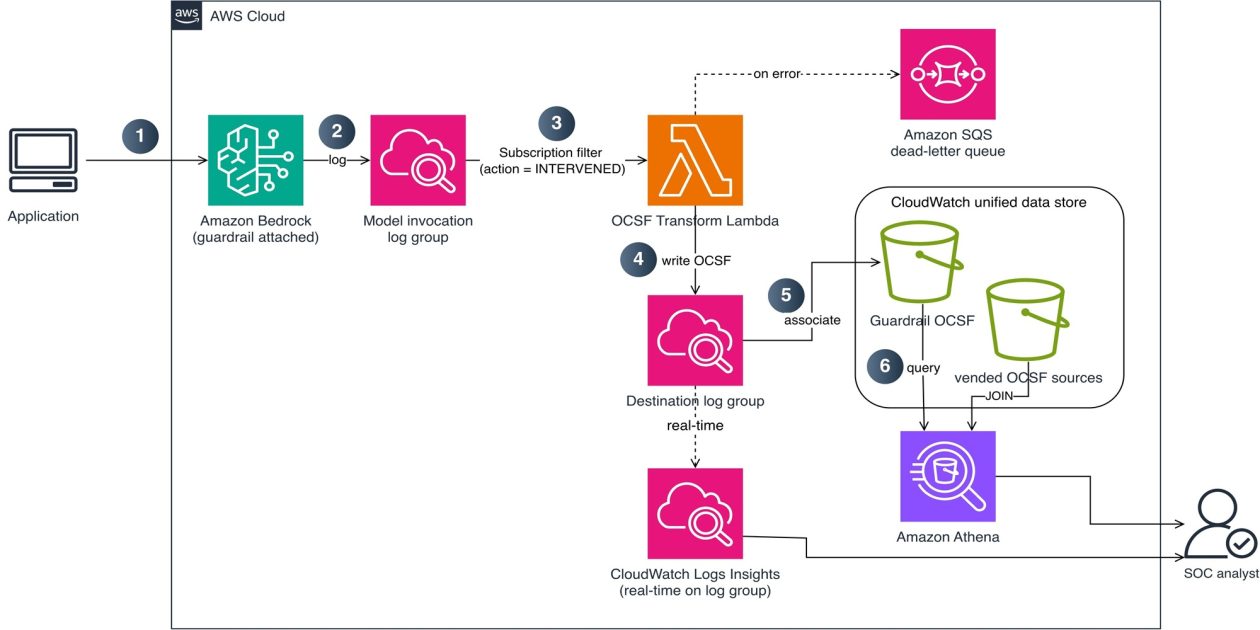
Transforming Bedrock Guardrails events into OCSF with CloudWatch

AWS walks through a reference pipeline (Lambda + CloudWatch Logs subscription filter + AWS S3 Tables) that transforms AWS Bedrock Guardrails intervention events โ€” blocked prompt injections, PII redactions, content-policy hits โ€” from Bedrock model invocation logs into OCSF Detection Finding (class_uid 2004) records, landing them in the CloudWatch unified data store. This lets SOC analysts correlate guardrail interventions with AWS CloudTrail and VPC Flow Logs via Athena or CloudWatch Logs Insights, e.g. spotting accounts with both prompt-injection blocks and failed IAM calls, and complements GuardDuty AI Protection's managed findings. Includes OCSF field mapping, multi-account centralization pattern, and a cloneable CDK-based implementation.

AWS BedrockAWSAWS IAM+2
prompt injection

AI Security, Cloud & Infra, Blue Team & Detectionยท 2026-09-21T15:33:25+00:00

aws.amazon.comarticle

Run open weight models on Amazon Bedrock in AWS European Sovereign Cloud

AWS announces general availability of Gemma 4 (Apache 2.0 open-weight models) on Amazon Bedrock's new OpenAI-compatible bedrock-mantle inference engine within the AWS European Sovereign Cloud, its independently-operated EU-only cloud region (eusc-de-east-1). The post details the security model behind inference: zero operator access to prompts/outputs, zero data retention by default, encryption in transit, IAM-scoped least-privilege access to the inference API, short-lived vs long-lived Bedrock API keys, and CloudTrail/CloudWatch auditing, plus a walkthrough for calling Gemma 4 via the Responses and Chat Completions APIs.

AWS BedrockAWS IAMAWS+1
eusc-de-east-1

GRC, Cloud & Infraยท 2026-09-17T21:19:20+00:00

aws.amazon.comarticle

Architecting a secure landing zone in the AWS European Sovereign Cloud

AWS Security Blog walkthrough of building a secure, production-ready landing zone in the new AWS European Sovereign Cloud (aws-eusc partition), covering multi-account governance via AWS Control Tower/AFT, IAM Identity Center federation as Terraform code, centralized logging into a Log Archive and Security Tooling account, network perimeter design with dedicated Direct Connect PoPs and VPC endpoints, KMS/External Key Store data protection, and partition-aware CI/CD for pushing container images, AMIs, and artifacts across the partition boundary. It maps design decisions to the AWS Security Reference Architecture and Well-Architected Framework, distinguishes hard partition boundaries from configurable choices, and references BSI C5:2020, SOC 2, and ISO 27001/27017/27018/27701 certifications for EUSC.

AWSAWS European Sovereign CloudAWS IAM+3
BSI C5:2020SOC 2ISO 27001+3

Cloud & Infra, GRC, Identity & Accessยท 2026-09-16T21:20:48+00:00

aws.amazon.comarticle

AWS STS simplifies session token size limits and adds session token size monitoring

AWS STS has replaced its old dual limit (separate packed-policy-size limit plus overall token size limit) with a single 4,096-byte session token limit, and now reports token size via new SessionTokenSize and SessionTokenUtilization fields in API responses, CloudWatch (AWS/STS namespace), and CloudTrail. A new MinimumSessionTokenSize parameter on session-vending APIs (AssumeRole, AssumeRoleWithSAML, AssumeRoleWithWebIdentity, GetSessionToken, GetFederationToken) lets engineers deliberately inflate tokens up to the max to test which downstream systems (load balancers, proxies, databases, caches) can actually handle larger tokens. PackedPolicyTooLargeException is still returned for backward compatibility, but now covers only the single unified limit.

AWSAWS IAMAWS STS+2
PackedPolicyTooLargeException

Identity & Access, Cloud & Infraยท 2026-09-15T22:21:59+00:00

aws.amazon.comarticle

Architecting resilient authentication with Amazon Cognito multi-Region replication

An AWS Security Blog deep-dive on architecting resilient authentication using Amazon Cognito's multi-Region replication (MRR) feature, covering B2C, B2B, and M2M reference architectures. It details preparation steps (multi-Region KMS customer managed keys, choosing the updated OIDC issuer type, replicating Lambda triggers/WAF/SNS/SES configs) and failover strategies using Route 53 health checks, Application Recovery Controller, and AWS Fault Injection Service for testing.

Amazon CognitoAWS KMSOIDC+3

Identity & Access, Cloud & Infraยท 2026-09-15T19:00:52+00:00

aws.amazon.comwriteup

Operationalizing least privilege: Automate IAM remediation through your CI/CD pipeline

AWS Security Blog walkthrough of an open-source Lambda-based automation that closes the loop between IAM Access Analyzer's unused-permission findings and actual remediation: it classifies each flagged role by origin via CloudTrail (CloudFormation/CDK-managed, manually created, or unused), then uses Amazon Bedrock (Claude Sonnet for code generation, Claude Haiku for explanations) to open a pull request with right-sized CDK IAM policy code, a GitHub/GitLab issue with migration guidance, or a soft-disable decommission issue respectively. It covers cross-account/organization-wide deployment, exclusion lists for sensitive roles, throttling, dry-run mode, CloudWatch metrics, and cost/cleanup considerations, with full source in an accompanying repo.

AWS IAMAWS BedrockAWS CDK+3
IAM Access Analyzer

DevSecOps, Cloud & Infraยท 2026-09-15T15:53:51+00:00

aws.amazon.comarticle

AWS Security Reference Architecture: A deep dive into PCI DSS compliance

AWS announces the AWS Security Reference Architecture (SRA) PCI DSS Deep Dive, an extension of the core AWS SRA that maps multi-account landing zone account types to PCI DSS scoping boundaries (in-scope, connected-to/security-impacting, out-of-scope) and layers PCI-specific controls โ€” additional logging, encryption, and network restrictions โ€” onto baseline AWS SRA service configurations. The guide targets security architects, compliance engineers, cloud platform teams, and QSAs/ISAs, and includes architecture diagrams and requirement-mapping tables usable as a narrative read-through or as a standalone reference during assessments.

AWSAWS IAM
PCI DSS

GRC, Cloud & Infraยท 2026-09-14T17:46:56+00:00

aws.amazon.comarticle

The state of AI for security: Measuring what matters most for building trust

AWS Security announces Deception Benchmark, a 14,822-sample dataset across 16 languages and 70+ CWE categories designed to test whether AI models can tell exploitable vulnerabilities apart from code that merely looks risky but is safely mitigated (e.g., parameterized SQL queries, Kubernetes Network Policies blocking SSRF). Evaluating 12 frontier models from five providers, the team found none achieved both false-positive and false-negative rates below 10%, with precision clustering in the mid-50s โ€” essentially coin-flip accuracy when flagging vulnerable vs. safe code. The dataset, evaluation harness, and whitepaper are released on GitHub, with roughly a third of samples held out unscored to resist benchmark gaming.

FlaskKubernetesLLM+1
Deception BenchmarkCyberGymCyberSecEval+8

AI Security, AppSecยท 2026-09-09T19:09:14+00:00

aws.amazon.comwriteup

Managing identity source transition for AWS IAM Identity Center

AWS Security Blog runbook for migrating the identity source behind AWS IAM Identity Center from Active Directory to an external SAML 2.0 IdP such as Okta, which is a destructive cutover that deletes all users, groups, and permission-set/application assignments at the moment of switch. It walks through pre-migration backup, SCIM provisioning setup, SAML metadata/ACS configuration, scripted assignment restoration with drift detection (drift_report.csv), post-migration validation, and a manual rollback procedure, linking to an aws-samples GitHub migration tool for the scripted steps.

AWS IAM Identity CenterActive DirectoryOkta+2

Identity & Accessยท 2026-09-02T20:36:31+00:00