 stepsecurity.ioarticle
The State of Open Source Supply Chain Attacks
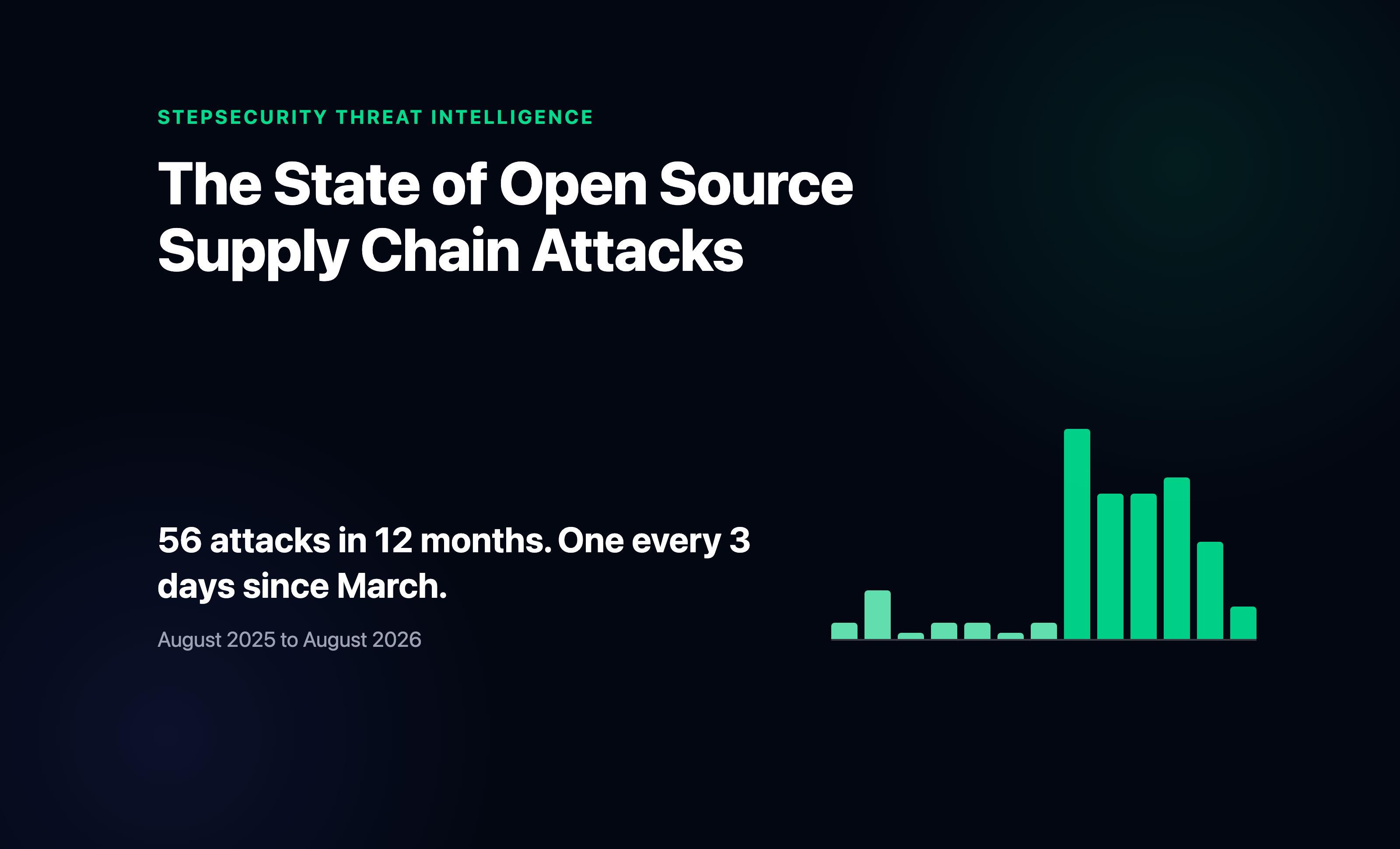
StepSecurity's threat intelligence team's annual report tallies 56 confirmed software supply chain attacks between August 2025 and August 2026, showing an over 8x acceleration since February 2026 driven by self-propagating worms (Shai-Hulud, Shai-Hulud 2.0, CanisterWorm, Miasma, ChainDrop) and mutable GitHub Actions tags. It details the five-day TeamPCP campaign that stole 78,330 secrets from 2,186 organizations by poisoning Trivy Action, Checkmarx KICS, telnyx, and LiteLLM, plus compromises spanning npm, PyPI, RubyGems, Composer, and crates.io.
What it is
A StepSecurity threat-intelligence report quantifying malicious open-source supply chain compromises across npm, PyPI, RubyGems, Composer, and crates.io from August 2025 through August 2026. The summary lists the incidents; the report's real payload is its counting methodology and a defensive argument about where malicious code must be caught.
What actually counts (and why it matters)
The 56 figure is deliberately narrow, and the exclusions are the point:
- Malicious code only, never vulnerabilities. CVEs and SCA-style "flaw that might be exploited later" cases are excluded. A malicious package runs the moment it installs.
- Typosquats, name-confusion, and lookalikes are excluded. The 56 all target components an ecosystem already trusted — the attacker compromises the next version of a trusted package, or silently repoints tags (as GitHub Actions allow), and rides existing trust into thousands of builds.
The operational takeaway: SCA and production monitoring are structurally too late for this class of attack. By the time a malicious dependency reaches production, it has already executed on a developer laptop or CI runner and the credentials are already exfiltrated. Detection has to happen at install / build time.
flowchart LR
    A[Trusted package/Action] -->|next version or tag repoint| B[Malicious code ships]
    B --> C[Installs on laptop / CI runner]
    C --> D[Credentials stolen immediately]
    D -.too late.-> E[Reaches production / SCA looks here]
    C -->|worm: reuses stolen token| A
The worm loop
Self-propagation is the named driver of the 8x jump. A worm reuses a victim's stolen publish token to infect every package that maintainer controls, then repeats downstream — turning one phished maintainer into an ecosystem-scale event (Shai-Hulud: 500+ packages).
Team PCP specifics
The five-day campaign (March 19–24, 2026) adds detail beyond the summary:
- Trivy GitHub Action: 76 of its 77 version tags were poisoned.
- telnyx PyPI package: the credential stealer was hidden inside a WAV audio file.
- Also hit the Checkmarx KICS Action and LiteLLM. Victim dataset later published by CloudSEK.
Caveats
- Counts are StepSecurity's own alerting scope; a few incidents were Threat Center alerts with no standalone blog post. The figure is a floor for "trusted-component compromises," not a total for all registry malware.
- The report gives no patch commands or IOCs in this text — the actionable content is the detection-timing argument and the methodology, not a remediation checklist. Per-month totals and the final Team PCP victim numbers are referenced but the raw table/figures were truncated in the fetched text.
Organisations named here
Technologies named here
- StepSecurity Threat Center
- npm packages
- Trivy GitHub Action
- Harden-Runner
- Checkmarx KICS Action
- Secure Registry
- AI Package Analyst
- telnyx
- LiteLLM
- Workflow run policies / secret exfiltration policy
- axios
- intercom-client
- durabletask
- git_credential_manager
- fastlane
- Laravel-Lang
- arrayref, internment, append-only-vec
- actions-cool/issues-helper
- codfish/semantic-release-action
- simonecorsi/mawesome
- xygeni-action
- Azure/functions-action
- AsyncAPI ecosystem
- CNCF Backstage repository
- Zapier, ENS Domains
- npm
- GitHub Actions
- PyPI
- RubyGems
- Composer
- crates.io
- arrayref
- internment
- append-only-vec
- Zapier
- AntV
Techniques named here
- Mutable GitHub Action tag repointing
- Self-propagating worm via stolen publish tokens
- CI/CD credential dumping from runner memory
- Payload hidden in non-code asset
- Smart contract used as C2 dead drop
- Fake/transitive dependency injection
- Self-erasing malware traces
- Typosquatting / name-confusion packages
Threat actors named here
Related in Supply Chain