Skip to content

554 results for β€œZed”

What you seeeverything
bleepingcomputer.comarticleπŸ›‘οΈ Security

Northflank security breach leads to abuse of customers' AI API keys

Northflank, a cloud application hosting platform, disclosed a breach on 30 October 2026 after a Wiz threat alert and told customers to assume all environment variables were decrypted and to rotate secrets. Customers reported unauthorized use of AI API keys. Wiz's "Black October for AI Developer Platforms" report counts at least nine incidents, including Railway, OpenCode, Warp and Lightning AI, and describes LLMJacking, with about 2.5 million Amazon Bedrock calls costing roughly $100,000 in two cases. Northflank has not said how attackers got in.

NorthflankWizAWS Bedrock+3
LLMJackingBlack October for AI Developer PlatformsRailway+2

Threat Intel, AI Security, DevSecOpsΒ· Published and added 31 Oct 2026

huggingface.copaper🧠 AI

Your Benchmark Is an Empirical Measure Over Difficulty

The paper treats a benchmark as an empirical measure over item difficulty and formalizes two failure modes: measure mismatch (benchmark difficulty distribution differs from the intended one) and coverage gaps (uncovered difficulty regions that hide localized training progress). It proposes two diagnostic metrics with theoretical guarantees and analyzes 25 popular benchmarks across 7 domains using estimated item difficulties. It also introduces BenchFill, a difficulty-targeted item rewriting algorithm that reduces local coverage gaps.

BenchFill

evals, researchΒ· Added 31 Oct 2026

theblock.coarticleπŸ›‘οΈ Security

President Trump says they’re looking into Binance hack as calls grow for crypto rules

The Block reports that Binance lost about $6.3 billion in a hack on 29 October 2026. Co-CEO Richard Teng said a compromised DevOps engineer's laptop gave access to a service container used to submit unauthorized withdrawals, and TRM Labs attributed the theft to North Korea's TraderTraitor. The rest covers reactions: President Trump said on 30 October he was looking into it, CFTC Chair Michael Selig and The Digital Chamber urged federal exchange rules, and senators disputed whether the Clarity Act would have allowed freezes.

BinanceTraderTraitorTRM Labs+5

Threat Intel, BlockchainΒ· Published and added 30 Oct 2026

status.bunny.netadvisoryπŸ›‘οΈ Security

Bunny CDN Security Incident

Bunny CDN status-page notice, posted 28 October 2026, about unauthorized access at an infrastructure provider that hosted one bunny.net CDN node in Armenia. Traffic was stopped within 20 minutes and the server wiped. No access to the node was found, but cached content, Pull Zone configs and TLS certificates could have been exposed, so all platform certificates were reissued. Customers with their own certificates should rotate them with new private keys.

Bunny CDNTLS
bunny.netb-cdn.netbunny.run

Threat Intel, Cloud & InfraΒ· Added 31 Oct 2026, published 30 Oct 2026

securityweek.comarticleπŸ›‘οΈ Security

Bulletproof Host Virtualine Loses Its Domain to FBI Seizure

Virtualine is a Russian-speaking bulletproof hosting provider whose domain virtualine.net the FBI seized. Court documents say it hosted phishing, spam, carding and illicit content, and ignored abuse reports. TRM Labs says it received more illicit-attributed cryptocurrency than any other labeled bulletproof host, mostly from a Russian drug marketplace (44%) and a sextortion scheme (17%), and later from StealC operators in 2026.

Bitcoin
VirtualineStealCFBI+3

Threat IntelΒ· Published and added 30 Oct 2026

opensourcemalware.comwriteupπŸ›‘οΈ Security

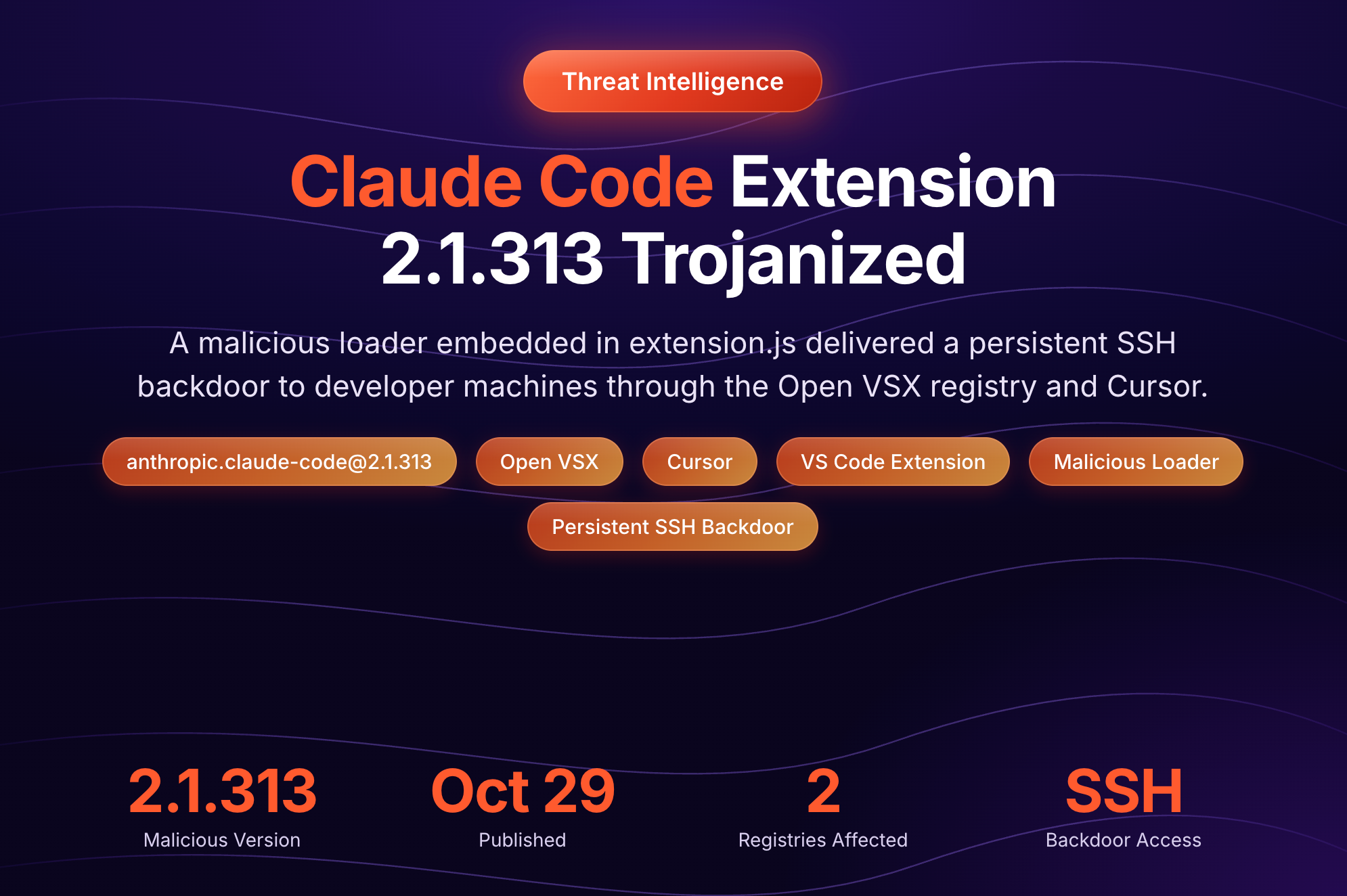
Trojanized Claude Code Extension Plants an SSH Backdoor

Analysis of a trojanized anthropic.claude-code 2.1.313 extension (darwin-arm64), found on Open VSX, with a 66-line loader prepended to extension.js. It adds an svc-telemetry key to authorized_keys, opens a reverse SSH tunnel to 134.209.82.225, sets persistence (LaunchAgent, cron, scheduled task) and sends host recon over HTTP port 8099. Includes IOCs, hashes and response steps; no further payload download was found.

Claude CodeVS CodeOpen VSX+3
anthropic.claude-code 2.1.313134.209.82.225svc-telemetry+3

Supply Chain, Malware & RE, AI SecurityΒ· Published and added 30 Oct 2026

securityweek.comarticleπŸ›‘οΈ Security

$2 Million+ Drained From Polymarket Traders in New Supply Chain Attack

Polymarket halted trading on 29 October after users reported unauthorized withdrawals traced to malicious JavaScript served from DebugBear's real user monitoring snippet. Hudson Rock's sample abused the authenticated session to sell positions or send tokens to a hard-coded address, without exfiltrating credentials. Loss estimates range from $2.19 million to $2.71 million (GoPlus), and Polymarket pledged reimbursement.

PolymarketDebugBearJavaScript
Hudson RockGoPlusArkham+2

Supply Chain, Threat IntelΒ· Published and added 30 Oct 2026

stepsecurity.iowriteupπŸ›‘οΈ Security

Trojanized Claude Code Extension Delivered Persistent SSH Backdoor to Developer Machines

The Claude Code VS Code extension anthropic.claude-code 2.1.313 was published on Open VSX on 29 October 2026 with a malicious loader prepended to extension.js. On load it planted an attacker SSH key (svc-telemetry), installed per-OS persistence, opened a reverse SSH tunnel and beaconed host recon over HTTP. Cursor reports at most 5,000 users received it in an 11-hour window. The post gives the timeline, cleanup artifacts and credential rotation steps.

Claude CodeVS CodeOpen VSX+3
anthropic.claude-code 2.1.313svc-telemetryT1195.002+1

Supply Chain, Blue Team & Detection, Threat IntelΒ· Published and added 30 Oct 2026

decrypt.coarticleπŸ›‘οΈ Security

Binance Finds 'Additional Points of Breach' in $6.3B Hack

Binance estimated the October 2026 security incident at about $6.3 billion and said it found "additional points of breach" beyond the compromised DevOps engineer laptop it first named. The attacker reached a service container and submitted unauthorized withdrawals, with no wallet private key leak found. Arkham counted $6.01 billion taken from hot wallets on nine chains; Tether and Circle froze about $1.8 billion in stablecoins. About $3 billion is frozen onchain; withdrawals stay suspended.

TetherUSDCEthereum+2
BinanceArkhamRichard Teng+4

Threat Intel, BlockchainΒ· Published and added 30 Oct 2026

bleepingcomputer.comarticleπŸ›‘οΈ Security

Binance links $6.3 billion crypto theft to compromised DevOps laptop

Binance linked the theft of about $6.3 billion in crypto to a compromised DevOps engineer's laptop, which let attackers reach a service container and submit unauthorized withdrawals. TRM Labs and Chainalysis attribute the 29 October 2026 attack to North Korea's TraderTraitor. About $2.7 billion was frozen, and the attackers hold about $2.4 billion. Binance has found no evidence of a leaked wallet private key.

BinanceTetherCircle+3
TraderTraitorLazarus GroupAPT38+5

Blockchain, Threat IntelΒ· Published and added 30 Oct 2026

securityweek.comarticleπŸ›‘οΈ Security

TeamViewer Flaw Could Let Malicious Hosts Take Over Support Technicians’ Machines

CVE-2026-111585 (CVSS 8.8) is an integer overflow in the remote-control screen processing of TeamViewer clients on Windows, macOS, Linux and Android. A malicious or compromised host can announce an oversized screen surface (for example 32768 by 32768 at 32 bpp), forcing a software decode path and an out-of-bounds write that crashes the viewer or runs code. Remedio's research shows a pointer overwrite routed to WinExec. Version 15.83 fixes it, along with CVE-2026-92372, CVE-2026-92374 and six local privilege escalation bugs.

TeamViewerWindowsmacOS+3
CVE-2026-111585CVE-2026-92372CVE-2026-92374+3

AppSec, Offensive SecurityΒ· Published and added 30 Oct 2026

en.cryptonomist.charticleπŸ›‘οΈ Security

Binance probes a suspected cryptocurrency breach: $6.3B affected, about $3B frozen

Binance disclosed a suspected security incident on 29 October 2026, estimating $6.3 billion affected and about $3 billion frozen. Binance's early finding is that a compromised DevOps engineer's laptop let an attacker reach a service container and submit unauthorized withdrawals, with no evidence of wallet private-key leakage. TRM Labs suspects TraderTraitor, the group tied to the February 2025 Bybit theft. Tether, Circle and Ripple froze funds.

TetherUSDC
BinanceTraderTraitorLazarus Group+7

Blockchain, Threat IntelΒ· Published and added 30 Oct 2026

x.comthreadπŸ›‘οΈ Security

Trail of Bits (@trailofbits) on X

Trail of Bits post on X summarising Binance's initial investigation into a security incident. Binance suggests a compromised DevOps engineer's laptop let an attacker reach a service container and submit unauthorized withdrawal transactions. The text says no evidence has been found of wallet private key compromise. The fetched text is truncated and gives no further detail.

BinanceTrail of Bits

Threat Intel, BlockchainΒ· Published and added 30 Oct 2026

en.cryptonomist.charticleπŸ›‘οΈ Security

Polymarket stolen funds: One account withdrew at least $2.7M across 710 wallets

Polymarket's international exchange suffered unauthorized withdrawals on 29 October 2026 after a compromised third-party provider, reportedly the website monitoring service DebugBear. Betting Intelligence and Polysights found one account withdrew at least $2.7 million across 710 wallets. Polymarket paused trading, referred the case to law enforcement, promised reimbursement, and had a June 2026 vendor breach that cost about $3 million. The attack mechanism is not described.

Polygon
PolymarketDebugBearBetting Intelligence+2

Supply Chain, Threat IntelΒ· Published and added 29 Oct 2026

bleepingcomputer.comarticleπŸ›‘οΈ Security

Japan Airlines suffers third-party data breach exposing passenger info

Japan Airlines disclosed that unauthorized access to Amadeus's Passenger Service System, between 10 August 2023 and 23 September 2026, exposed data on about 92,000 customers. Roughly 2,000 also had emails, phone and passport numbers exposed. ANA, Asiana Airlines and Korean Air are also reported as affected. Amadeus had announced a booking display vulnerability on 1 October 2026 and has not given the full scope.

Amadeus Passenger Service System
Japan AirlinesAmadeusAll Nippon Airways+3

Threat IntelΒ· Added 30 Oct 2026, published 29 Oct 2026

rekt.newsarticleπŸ›‘οΈ Security

Rekt - NEAR Intents - Rekt

Rekt News analysis of the 30 September to 1 October 2026 theft of 3.865 million USDT from the NEAR Intents HOT Bridge treasury on BNB Chain, paid out in five signed withdrawals after a 10 USDT deposit. It uses Bitquery's trace of laundering via Chainflip, THORChain, KuCoin and Hyperliquid, and a NEAR regression test showing an oversized refund log made mt_resolve_deposit fail. NEAR said the funds were returned but published no report.

BNB ChainHOT BridgeNEAR+3
NEAR IntentsBitqueryZachXBT+13

Blockchain, Threat IntelΒ· Added 29 Oct 2026

oversecured.comarticleπŸ›‘οΈ Security

PCI DSS and Mobile Apps: A Simple Guide | Oversecured Blog

Guide to PCI DSS v4.0.1 scope for mobile apps, with a mapping of common Android and iOS finding types to the requirements they break (Req 2, 3, 4, 6, 7). It covers which app behaviors bring an app into scope and gives three anonymized cases: cleartext HTTP in a vendor native library, hardcoded keys in a third-party SDK, and an implicit Intent leaking data. It argues for testing the shipped binary and keeping a current component inventory.

AndroidiOS
PCI DSSPCI Security Standards CouncilQualified Security Assessor+5

Mobile Security, GRCΒ· Added 29 Oct 2026

unit42.paloaltonetworks.comadvisoryπŸ›‘οΈ Security

Threat Brief: Critical Vulnerabilities in PHP: CVE-2026-109618, CVE-2026-109619 (Updated October 29)

Unit 42 threat brief on PHP2Shell, two PHP remote code execution flaws, CVE-2026-109618 and CVE-2026-109619 (CVSS 4.0 9.2), both caused by longjmp() error handling that leaves memory uninitialized or freed. Cortex Xpanse counted over 22.6 million exposed instances. The 29 October 2026 update says attackers chained PHP2Shell with a Linux kernel privilege escalation against internet-exposed PAN-OS management interfaces. An earlier 23 October claim of post-compromise activity was retracted on 25 October.

PHPPAN-OSLinux kernel+2
CVE-2026-109618CVE-2026-109619PHP2Shell+2

Threat Intel, AppSecΒ· Added 30 Oct 2026, published 29 Oct 2026

arxiv.orgpaper🧠 AI

Multi-View MoE: Letting Every Router Shape Expert Computation

Multi-View MoE is a sparse mixture-of-experts design that uses several independently initialized routers to select experts, then reuses their relative scores to mix learned latent views into each selected expert's input. Each expert still runs one forward pass, so active-expert count, FLOPs and all-to-all volume are unchanged. On a 24-layer 10B-A1B model trained on 708B tokens, it gains 1.18 points on a nine-task mean; Multi-Router alone gains 0.6.

Mixture of ExpertsTransformerMulti-View MoE+1
arXiv

researchΒ· Added 31 Oct 2026, published 29 Oct 2026

arxiv.orgpaper🧠 AI

The Athlete as a Scientist of One: Agentic Bayesian Experimental Design for Individualized Physiology from Consumer Wearables

EpiCoach is an agentic system that treats one cross-country mountain biker as an N-of-1 experiment. Claims live in an evidence-gated hypothesis registry, and each must make a probabilistic prediction before a session. Predictions come from a digital twin fitted to heart rate, GPS and altitude. In a replay over eighteen months the twin beat standard forecasters on heart rate but not segment time, and the agent loop matched a static model. In the first three live weeks, the ledger sealed 20 predictions and scored 14, and a safety officer vetoed the agent twice. The registry, benchmark and protocol are released.

LLMBayesian experimental designdigital twin+1
EpiCoacharXiv

agents, research, evalsΒ· Added 31 Oct 2026, published 29 Oct 2026

arxiv.orgpaper🧠 AI

A Unified Hessian-Guided Framework for Post-Training Quantization

This preprint proposes a unified post-training quantization framework for large language models. It derives a Hessian-guided approximation of the output change caused by joint weight and activation quantization, using a tractable Fisher approximation. Quantization ranges, linear transformations and weight rounding are optimized together under one output-sensitivity objective. The authors report gains over state-of-the-art transformation and rounding methods in channel-wise and block-wise settings.

LLMpost-training quantizationHessian-guided approximation+1
arXiv

research, inferenceΒ· Added 31 Oct 2026, published 29 Oct 2026

microsoft.comarticleπŸ›‘οΈ Security

Tracking AI adoption in North Korean threat actor tradecraft

Microsoft Threat Intelligence report on how North Korean actors use AI, ranking Jade Sleet, Coral Sleet and Jasper Sleet as operationalized, Diamond Sleet, Onyx Sleet, Pearl Sleet and Sapphire Sleet as accelerating, and Emerald Sleet as expanding. It documents AI-generated lures (100+ Onyx Sleet PDFs, August and September 2026), AI-built tooling such as Coral Sleet's private GitHub repository trojanizing, and Onyx Sleet and Pearl Sleet use of the ARTEX agentic pentest framework. It ends with mitigation and Defender guidance.

CursorGitHubRust+2
Jade SleetOnyx SleetCoral Sleet+9

Threat Intel, AI SecurityΒ· Published and added 29 Oct 2026

huggingface.coarticle🧠 AI

Granite Switch 4.1.1 β€” Update models like you update software

Granite Switch 4.1.1 is a backwards-compatible patch release of IBM's modular Switch architecture, which configures a language model with specialized, cache-efficient adapters on one endpoint. It updates the Granite Speech ASR model (10 languages, native punctuation and capitalization) and the Decision adapter in granitelib-core, measured on the Jev Decision Index test set. Only the new adapters were retrained; the base model is unchanged. IBM plans tutorials and an Adapter SDK for third-party adapters.

Hugging Face
IBMGranite SwitchGranite Speech+2

models, multimodalΒ· Published and added 29 Oct 2026

blog.googlearticle🧠 AI

How Gemini is helping students and teachers in the classroom

Google reports two classroom studies of Gemini. In a 10-week RCT with over 1,100 UK students (ages 12-15) on Eedi, Gemini-based AI tutoring matched human tutors on in-platform tasks and quizzes, with expert approval of responses rising from 76% to 95%. Gains did not appear on STAR standardized tests. A yearlong Italian study of 1,600 teachers found lessons co-designed with Gemini shifted toward collaborative work.

GeminiGemini for Education
GoogleEediSTAR+3

research, evals, ai-policyΒ· Added 30 Oct 2026, published 29 Oct 2026

arxiv.orgpaper🧠 AI

DICE: Decentralized Incentive-driven Federated Learning for Efficient & Scalable Customization of Pretrained Models in Web3

DICE is a blockchain-powered federated learning (BCFL) algorithm for customizing large pretrained models among untrusted Web3 participants. It combines dynamic progressive learning and model slice verification, so hardware-limited participants can train part of the model, with a tree-structured committee consensus protocol and an efficiency-driven incentive scheme to scale to more data holders. Experiments cover vision and language models.

federated learningblockchain-powered federated learningprogressive learning+1
arXiv

research, trainingΒ· Added 31 Oct 2026, published 29 Oct 2026

arxiv.orgpaperπŸ›‘οΈ Security

Appreciation Teaches Unauthorized Execution: Self-Evolution Degrades the Robustness of Personal Agents to Indirect Prompt Injection

Paper studying whether self-evolution weakens personal agents' robustness to indirect prompt injection (IPI). A two-phase method has the user ask the agent to follow tasks in external content, then tests with a third-party injected task the user did not authorize. Against the non-evolving base agent, attack success rose 14.0 to 48.8 points under skill evolution and 3.0 to 39.3 points under reinforcement learning. Code is released.

indirect prompt injection

AI SecurityΒ· Added 31 Oct 2026, published 29 Oct 2026

bleepingcomputer.comarticleπŸ›‘οΈ Security

Police seize Virtualine bulletproof service tied to ransowmare, cybercrime

Virtualine, a bulletproof hosting service also operating as Secury, Massgod, Spamhouse, Lanedo and Omegatech, had its main domain seized by the FBI with German, Dutch and UK partners. Chainalysis and TRM Labs traced its Bitcoin payments to ransomware (5% of flows), a Russian drug market (about 44%), sextortion and the StealC infostealer. Dutch police seized dozens of servers in Limburg and recovered data on over 3,000 customers.

Bitcoin
VirtualineSecuryMassgod+14

Threat IntelΒ· Added 30 Oct 2026, published 28 Oct 2026

cisa.govadvisoryπŸ›‘οΈ Security

Siemens Mendix SAML Module

ICSA-26-302-01 republishes Siemens SSA-137528 on the Mendix SAML module, which has an authentication bypass (CVE-2026-89209). An unauthenticated remote attacker can replay a valid SAML assertion in IdP-initiated flows to gain unauthorized access. Fixed in 4.2.4 for Mendix 10 and 11, and 3.6.29 for Mendix 9. Initial release was 26 October 2026.

MendixSAMLSiemens
CVE-2026-89209SSA-137528ICSA-26-302-01+2

Identity & Access, AppSecΒ· Added 29 Oct 2026, published 28 Oct 2026

x.comthreadπŸ›‘οΈ Security

Christiaan Stoudt (@cstoudt) on X

Thread on CVE-2026-97631, a critical (9.5) flaw in TianoCore EDK II UEFI firmware, found by Alex Matrosov and Dan Holmes-Mitra. It is exploitable only while a machine is PXE network booting and the attacker sends an oversized ICMP error from the same network. Code execution also needs the exact firmware build, and Secure Boot does not help. The fix landed in EDK II main on 15 October but is not in a stable release. No known exploitation, and not in CISA KEV.

EDK IIUEFITianoCore+2
CVE-2026-97631Alex MatrosovDan Holmes-Mitra+3

Hardware & RFΒ· Added 30 Oct 2026, published 28 Oct 2026

decrypt.coarticleπŸ›‘οΈ Security

Coinbase Customer Data Hit in Analytics Vendor Breach, Funds β€˜Not Impacted’

Coinbase said on 28 October 2026 that a security incident at analytics vendor Amplitude exposed contact data of a "small subset" of its customers. Coinbase reports no unauthorized access to its own systems and no impact on funds. It gave no counts, data types or dates. The article recalls the May 2025 bribed-support-agent breach (69,461 customers) and the 2025 Trezor/ShipMonk exposure.

Amplitude
CoinbaseShipMonkTrezor+1

Threat IntelΒ· Published and added 28 Oct 2026

chainalysis.comarticleπŸ›‘οΈ Security

International Law Enforcement Seizes Domain of Virtualine Bulletproof Hosting Service

Virtualine is a bulletproof hosting provider whose domain virtualine.net was seized on 27 October 2026 by the FBI Washington Field Office and the Eastern District of Virginia, with German, Dutch and UK police support. Chainalysis and OverRIPE gave intelligence support. The post lists aliases (Secury, Massgod, Spamhouse, Lanedo, Omegatech), forum advertising on Exploit.in and HackForums, and unhosted bitcoin payments tied to ransomware, infostealers and scam infrastructure.

BitcoinChainalysis Reactor
VirtualineSecuryMassgod+13

Threat IntelΒ· Published and added 27 Oct 2026

huggingface.coarticle🧠 AI

Build specialized multimodal models with LFM3

LFM3 is Liquid AI's open-weight family of six ~2B-parameter models (text, vision-language, audio, omni and two d1 decision models), all branched from LFM3-1.7B-Base. The base model uses a tri-hybrid backbone of 13 gated short convolutions, 5 sliding-window attention layers and 6 global attention layers, pre-trained on 22T tokens with a 256K context. The post gives transformers snippets, benchmark comparisons against LFM2.5 and Qwen3.5, and a robotics fine-tuning example.

TransformersHugging FacePyTorch+7
Liquid AILFM3LFM3-1.7B+29

models, multimodal, trainingΒ· Published and added 27 Oct 2026

liquid.aiarticle🧠 AI

Introducing LFM3: Every Modality for Specialized Intelligence

LFM3 is Liquid AI's new family of open-weight multimodal models, six models of about 2B parameters branched from LFM3-1.7B-Base (22T pre-training tokens, 256K context). The hybrid backbone uses 13 gated short-convolution, 5 sliding-window attention and 6 global attention layers. Variants cover text, vision with video, audio, omni and two decision models, with on-device speed numbers, fine-tuning demos and robotics extensions.

llama.cppMLXvLLM+17
Liquid AILFM3LFM3-1.7B+32

models, multimodal, inference, trainingΒ· Added 28 Oct 2026, published 27 Oct 2026

decrypt.coarticle🧠 AI

OpenAI Proves ETH Is False, and Crypto Twitter Has Questions

Decrypt reports that OpenAI published a 67-page paper (dated 17 October 2026, revised 25 October) claiming its AI found a deterministic subexponential-time algorithm for counting 3-SAT solutions, which would refute the Exponential Time Hypothesis. The proof was formalized in Lean. Impagliazzo, Paturi and Ryan Williams are reviewing it independently and say this is not certification. Anthropic posted a Claude-credited 3-SAT paper on 26 October.

LeanGitHubClaude
OpenAIAnthropicDecrypt+7

research, modelsΒ· Published and added 27 Oct 2026

arxiv.orgpaper🧠 AI

When Is Additional Retrieval Worthwhile? A Cost-Aware Study of Evidence Gain and Answer Reliability in RAG

This paper studies a cost-aware, two-action RAG routing policy that chooses between dense retrieval plus reranking and a hybrid lexical-dense retriever, using a regularized linear model to predict per-question evidence gain. On 60 held-out QASPER articles (188 questions), it triggers hybrid retrieval on 24.5% of questions and matches always-hybrid Hit@10 (78.70%). Answers from 4-bit Qwen3-4B show no clear correctness or faithfulness gain, and the assessments are model-assisted.

RAGQwen3BM25
QASPER

research, llm-apps, evalsΒ· Added 28 Oct 2026, published 27 Oct 2026

arxiv.orgpaper🧠 AI

LiveSearch: Questions as Executable Verifier Code for a Live Benchmark of Professional-Source Financial Search Agents

LiveSearch is a live benchmark for financial search agents that stores each question as executable verifier code: a typed program of calls to a professional financial data service plus a declarative extractor. Gold answers are recomputed daily with no human or LLM in the loop, so memorized answers go stale. Six tool-calling models score 70.9% to 76.7% under web search, and 70% of questions change gold value over three days.

LLM
LiveSearcharXiv

evals, agents, researchΒ· Added 28 Oct 2026, published 27 Oct 2026

eprint.iacr.orgpaperπŸ›‘οΈ Security

Alg\{Ossa\}: Decentralized Secure Aggregation with Rotating Committees and Eventual Delivery

AlgOssa is a decentralized secure aggregation protocol built on Ossa, a generic committee-aided, single-server construction for one-shot clients (following OPA and Willow, CRYPTO 2025). Ossa realizes secure aggregation with non-selective abort against a malicious server. AlgOssa adds Algorand-style sortition to rotate leaders and committees, bounds the chance of an honest server, and gives eventual delivery. Classical and post-quantum routes are evaluated.

Algorand
OssaAlgOssaOPA+2

otherΒ· Added 28 Oct 2026, published 27 Oct 2026

securityweek.comarticleπŸ›‘οΈ Security

Dutch Police Arrest Two Over NFC Relay Attacks That Drained $400,000+ From Bank Accounts

Dutch police arrested two men, aged 23 and 25 from Vaassen and Ede, on October 6 over a bank helpdesk fraud that took over €380,000 from 170 victims. Callers played AI-generated bank audio, then a fake bank employee had victims install an app and tap their card to the phone. The app read the NFC chip data and relayed it to an accomplice at an ATM. Police seized the servers.

NFC
Dutch policeNFC relay attackbank helpdesk fraud+1

Threat Intel, Hardware & RF, Mobile SecurityΒ· Published and added 26 Oct 2026

openai.comarticle🧠 AI

ChatGPT’s expanding world of work

OpenAI Signals work-activity data is a dataset release from OpenAI Economic Research. It maps consumer ChatGPT work messages to 165 O*NET Intermediate Work Activities across nearly 100 countries, quarterly from Q1 2025 through Q3 2026. Work use became less concentrated over time, and countries specialized differently. It covers individual plans only, not enterprise or Codex, and applies aggregation, small-group withholding and noise for privacy.

ChatGPTCodex
OpenAIOpenAI SignalsO*NET

ai-policyΒ· Published and added 26 Oct 2026

eprint.iacr.orgpaperπŸ›‘οΈ Security

Cryptanalysis and Repair of "Decentralized Multi-authority ABE for NC$^1$ from BDH"

Cryptology ePrint 2026/2642 presents a plaintext-recovery attack on the DBDH and CBDH variants of the Datta, Komargodski and Waters multi-authority ABE for NC1 (Journal of Cryptology, 2023). It needs one corrupt authority and two users, and succeeds with probability one in the static model. The flaw is an invalid extension of the Rouselakis-Waters LSSS matrix-normalization lemma. The paper also attacks two Datta-Pal (PKC 2023) attribute-based inner-product schemes and proves repaired versions secure in the random oracle model.

Datta-Komargodski-Waters multi-authority ABEDatta-Pal attribute-based inner-product functional encryptionRouselakis-Waters LSSS matrix-normalization lemma+3

otherΒ· Published and added 26 Oct 2026

eprint.iacr.orgpaperπŸ›‘οΈ Security

Maximum-Likelihood Decoding of Gabidulin Codes Is NP-Hard Even in Dimension One

Philippe Gaborit proves that maximum-likelihood decoding of Gabidulin codes is NP-hard even for dimension one: deciding rank distance at most n-2 from the code {Ξ»g} is NP-complete. The reduction is deterministic, so Rank Syndrome Decoding and Rank Minimum Distance for F_{q^m}-linear codes are NP-complete under deterministic reductions, where the earlier reduction was randomized. It goes through a new pivot problem, Twisted Square Membership.

Gabidulin codes
Philippe GaboritGuruswami-Vardy theoremTwisted Square Membership+2

otherΒ· Added 26 Oct 2026, published 25 Oct 2026

arxiv.orgpaper🧠 AI

Detecting and Understanding Ambiguity in Visualizations with Role-Playing Vision Language Model Interpretations

This paper presents a pipeline that uses persona-conditioned vision language models to surface interpretive ambiguity in visualizations. Topic-relevant personas elicit candidate takeaways, and a Target-Pattern-Scope framework lets LLM judges label statement pairs as Compatible, Disjoint or Opposing, which are summarized in an ambiguity profile. The authors benchmark VLMs on chart comprehension per chart type, check labeling against human annotations, and run case studies on public visualizations and a redesign.

vision-language modelLLM
arXiv

research, multimodal, evalsΒ· Added 27 Oct 2026, published 25 Oct 2026

ethresear.charticleπŸ›‘οΈ Security

A hash-only rollup: OP Stack L2 accounts as Lamport-style hash chains, no ECDSA inside the L2

Hash-only rollup: an OP Stack L2 (chain ID 42069000, live since 30 September 2026) where accounts are keccak-256 hash chains and transactions carry no signatures. Spending uses a commit-reveal step through two new transaction types in op-geth. The post describes a flaw the authors found: unauthenticated commits could be overwritten, which allowed preimage front-running. It was fixed with a first-commit-wins rule on 21 October 2026. It lists the remaining limits: L1 ECDSA, no fault proofs, a centralized sequencer, 160-bit addresses and wallet desync.

OP StackEthereumop-geth
Lamport signaturesGuy Fawkes protocolGrover's algorithm+9

BlockchainΒ· Published and added 24 Oct 2026

arxiv.orgpaper🧠 AI

TriageRAG: Failure-Aware Self-Training for Adapting Retrieval-Augmented Language Models to Specialized Domains

TriageRAG is a failure-aware self-training method for adapting retrieval-augmented LLMs to specialized domains using only an unlabeled corpus. It probes the student on self-generated questions with and without retrieved context, sorts them into known, solved, context-failure and retrieval-failure, and routes each to a matching training signal. With Qwen3-4B on 11 datasets it beats budget-matched SimRAG by 1.2-6.4 points and recovers closed-book accuracy where retrieval hurts.

RAGLLMQwen3
TriageRAGSimRAGCS-Bench+1

research, llm-apps, trainingΒ· Added 27 Oct 2026, published 24 Oct 2026

latent.spacearticleπŸ›‘οΈ Security

[AINews] Kimi 3.1 Pro 104BA-2.8T: Fable-5.1-Class Open Weights narrows Closed-AI lead to 1 month... and Pro Highspeed API with 2-3Γ— speed

AINews digest for 22 to 23 October 2026, led by Moonshot's Kimi K3.1 Pro (2.8T parameters, 104B active, weights promised for 4 November 2026). It reports Artificial Analysis scoring the model 64% on its Cyber Index despite Moonshot removing cyber data from training. Other items: OpenAI's frontier-training containment incident, a Brotli remote-code-execution disclosure, and Anthropic's Mythos 5 unauthorized-action analysis.

Kimi K3BrotliOpenAI+1
Artificial Analysis Cyber IndexCyberGymMythos+4

AI SecurityΒ· Added 30 Oct 2026, published 24 Oct 2026

huggingface.copaper🧠 AI

IQuest-Q1: Advancing Foundation Capabilities for Agentic CLI Systems

IQuest-Q1 is an open-source sparse Mixture-of-Experts model with 320B total and 15B activated parameters, built for agentic coding in CLI systems. Pre-training combines Stable SplitNorm, Muon and muP with a two-stage curriculum that raises the coding-data share in stage two. Mid-training extends context, and post-training mixes SFT, domain-specialized RL and MOPD across scaffolds, followed by model merging.

Mixture of ExpertsStable SplitNormMuon+3
IQuest-Q1Hugging Face

models, training, coding-agents, researchΒ· Added 24 Oct 2026

eprint.iacr.orgpaperπŸ›‘οΈ Security

Faster and Smaller Anonymous Credentials from Standardized Signatures

GordieHowe is a language, certifying compiler and zero-knowledge proof system for building anonymous credentials on standardized signatures (ECDSA, RSA, ML-DSA). It proves an ECDSA-signed mobile driving license presentation in 64.8 ms with a 276 KiB proof, 10.1x faster than Google's Longfellow, and an ML-DSA-44 signature in 87.3 ms with at least 116 bits of quantum security. Compiler output and security theorems are checked in Lean. It introduces series-parallel IOPs and extends the BCS transformation in the QROM.

ECDSAML-DSARSA+1
GordieHoweLongfellowBCS transformation+3

Identity & AccessΒ· Added 24 Oct 2026, published 23 Oct 2026

eprint.iacr.orgpaperπŸ›‘οΈ Security

Learning with Quantization and Worst Case Lattice Problems

Learning with Quantization and Worst Case Lattice Problems is an IACR ePrint paper (2026/2613) by Ziwei Hong and Zhongqiu Fang. It proves that search and decision learning with quantization (LWQ) with public dither is as hard as quantum GapSVP and SIVP on arbitrary lattices, using the randomized polar lattice quantizer of Lyu et al. It also shows that a complete reduction for interval uniform error LWE (MAMBA Frost) and hardness at concrete MAMBA parameters are not established.

LWE
MAMBAMAMBA FrostGapSVP+4

otherΒ· Added 24 Oct 2026, published 23 Oct 2026

arxiv.orgpaper🧠 AI

Sharpness-aware Orthogonalized Momentum Algorithms

SOMA (Sharpness-aware Orthogonalized Momentum Algorithm) combines sharpness-aware minimization (SAM) with the Muon optimizer for LLM training. It avoids SAM's extra gradient computation by using stale, purely stochastic gradient noise as the adversarial perturbation. The authors prove sample complexity does not depend on perturbation direction, study robustness to heavy-tailed gradient noise, and test SOMA against post-training quantization degradation and catastrophic forgetting during fine-tuning.

MuonLLM
SOMAarXiv

research, trainingΒ· Added 26 Oct 2026, published 23 Oct 2026

securityweek.comarticleπŸ›‘οΈ Security

Quest Diagnostics Reports Cyber Breach Affecting β€˜Certain Patient Records’

Quest Diagnostics disclosed in a regulatory filing on Thursday that an unauthorized party accessed its Quanum Lab Services Manager, a platform where clients order tests and look up results. The company found the breach on Wednesday and notified federal law enforcement. The number of patients and records affected is unknown, and Quest said the breach is not related to the PHP vulnerabilities disclosed that week.

PHP
Quest DiagnosticsQuanum Lab Services ManagerAmerican Medical Collection Agency+1

Threat IntelΒ· Published and added 23 Oct 2026

arxiv.orgpaper🧠 AI

How Much Do You Trust A Dog? Quantifying Hint-Following in Reasoning Language Models

This paper measures how hints such as "[Source] thinks the answer is (X)" shift LLM answers on MMLU questions, varying the source between a professor, a friend and a dog across Qwen, Gemma and SmolLM models. The shift fits an exponential tilt: a roughly constant mean change in the hinted answer's log-odds, with susceptibility largely shared across sources. The shift persists when the source is declared inaccurate or the prompt warns against trusting it. Synthetic experiments show how KL-regularized reward training could produce this pattern.

LLMQwenGemma+1
MMLUarXiv

research, ai-safety, evalsΒ· Added 26 Oct 2026, published 23 Oct 2026

horizon3.aiarticleπŸ›‘οΈ Security

PHP2Shell Exposure Depends on More Than Whether You Use PHP

Horizon3.ai post on assessing exposure to PHP2Shell (CVE-2026-109618, CVE-2026-109619), two memory-handling flaws in PHP. It says affected PHP may be bundled in third-party products, containers or managed hosting, and that finding it shows a remediation need, not proven exploitability. It lists questions to ask hosting providers and says Horizon3.ai has validated exploitation under specific preconditions that are still being characterized.

PHP
CVE-2026-109618CVE-2026-109619PHP2Shell

AppSec, Offensive SecurityΒ· Added 29 Oct 2026, published 22 Oct 2026

latent.spacetalk🧠 AI

Why AI Compute Comes in Rectangles β€” Erik Bernhardsson, Modal CEO

Latent Space interview with Modal CEO Erik Bernhardsson, after Modal's $750M Series D at a $16B valuation and passing $1B annualized run rate. He explains why GPU demand is not "rectangular" like fixed-term capacity contracts, how Modal pools demand and buys from about 25 clouds on three-year deals, and why sandboxes grew to about a third of revenue. Also covers GPU price-collapse risk and non-NVIDIA accelerators. Only the first part of the transcript was available.

GPUKubernetesDocker+5
ModalErik BernhardssonAkshat Bubna+13

ai-infra, inference, agentsΒ· Published and added 22 Oct 2026

decrypt.coarticle🧠 AI

Major Banks Find Rogue AI Agents Inside Customer Accountsβ€”And They’re 'Horrified'

Decrypt summarizes an Axios report that major U.S. banks are finding unauthorized third-party AI agents inside customer accounts, often using the customer's own credentials. Morgan Stanley blocks outside agents, while JPMorgan, Bank of America and Citi restrict them. Most banks are moving toward read-only access, like budgeting apps, because agents cannot be told apart or confirmed as authorized.

Morgan StanleyJPMorganBank of America+5

ai-policy, agentsΒ· Published and added 22 Oct 2026

x.comthreadπŸ›‘οΈ Security

Muscle AI (@themuscleai) on X

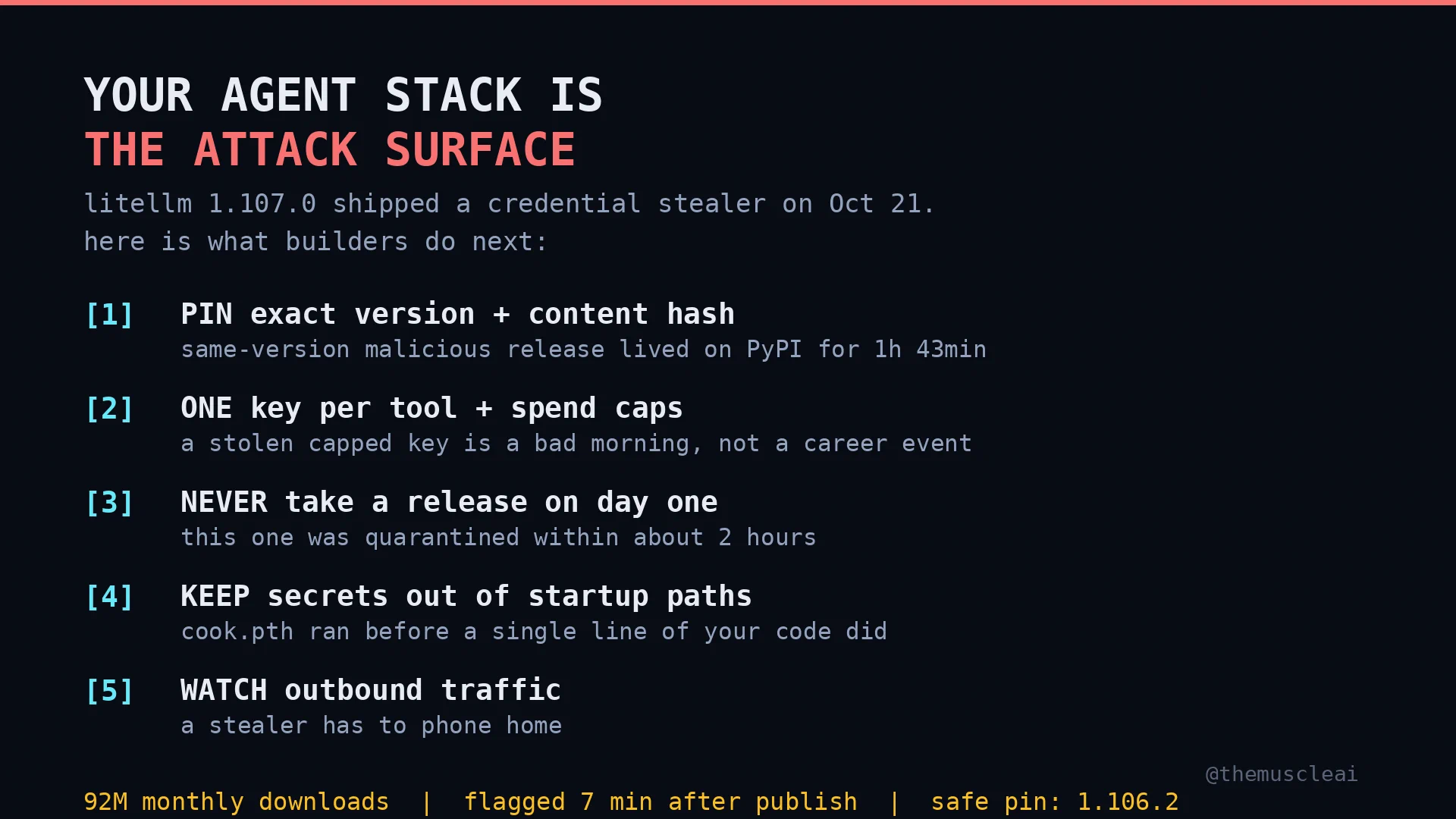
Post on the LiteLLM 1.107.0 PyPI compromise published 21 October 2026 and quarantined about 1 hour 43 minutes later. A malicious .pth file ran at Python startup and stole cloud credentials, private keys, browser data and AI tool auth files, then POSTed a tarball to an attacker endpoint. The author says attackers used stolen GitHub CLI OAuth tokens to push a trojanized commit chain and build official wheels. It lists five defenses: hash-pinned lockfiles, per-tool capped keys, release cooling periods, secret isolation and egress monitoring.

LiteLLMPyPIPython+3
TeamPCPcook.pth

Supply Chain, DevSecOps, AI SecurityΒ· Added 23 Oct 2026, published 22 Oct 2026

blog.cloudflare.comarticleπŸ›‘οΈ Security

Localizing compliance at scale: achieving South Korea’s ISMS certification

Cloudflare's account of obtaining South Korea's ISMS-P certification after a ten-day KISA audit of 80 controls and a preparation period of about a year and a half. It explains that the certificate covers a service delivery boundary rather than a product list, that auditors required readable data flow diagrams, and how Korean sign-up uses itemized consent with social login removed.

CloudflareCloudflare Workers
ISMS-PKISAPersonal Information Protection Act+5

GRCΒ· Added 29 Oct 2026, published 22 Oct 2026

blog.railway.comadvisoryπŸ›‘οΈ Security

Railway Security Disclosure

Railway's security disclosure of 21 October 2026 says an unauthorized third party may have accessed encrypted customer environment variables and decrypted some of them. Railway links it to a series of attacks on platform companies aimed at compromising AI inference providers, and has asked upstream providers to revoke keys. It tells all users to roll every environment variable, API key and registry credential, and it paused all deployments. The notice gives no technical details of the intrusion.

Railway
Railway security incident October 2026

Threat Intel, DevSecOpsΒ· Added 22 Oct 2026, published 21 Oct 2026

blog.talosintelligence.comadvisoryπŸ›‘οΈ Security

Two critical RCEs in PHP core

Cisco Talos advisory on "php2shell", two unauthenticated RCE flaws in PHP core, CVE-2026-109618 and CVE-2026-109619 (CVSS v4.0 9.2), affecting every build since PHP 5.4. One flaw is an out-of-memory handling bug leaving request data partly initialized; the other reuses stale state after free. PHP 8.1 and older get no patch (about 50% of PHP systems). Includes ini-level mitigations and Snort SIDs 67359 and 67360. No exploitation seen as of 21 October 2026.

PHPWordPressCVSS
CVE-2026-109618CVE-2026-109619php2shell+2

AppSec, Blue Team & DetectionΒ· Published and added 21 Oct 2026

arxiv.orgpaperπŸ›‘οΈ Security

Prompt Injection Through Forensic Evidence: A Taxonomy and Proof of Concept of Anti-Forensic Attacks on LLM-Assisted Digital Investigations

Paper on prompt injection delivered through forensic evidence, where the seized device's contents are attacker-controlled and the examiner must read them. It extends the anti-forensic model to cover manipulation of the reasoning layer and gives a taxonomy (objective, technique, payload location, concealment). Three proof-of-concept attacks on an LLM-assisted analysis pipeline change a reported conclusion, write attacker-chosen content to the analyst workstation, and trigger outbound network traffic. Mitigations are proposed.

LLM
indirect prompt injectionprompt injectionanti-forensics+1

AI Security, Blue Team & DetectionΒ· Added 24 Oct 2026, published 21 Oct 2026

opensourcemalware.comwriteupπŸ›‘οΈ Security

LiteLLM 1.107.0 PyPI Wheel Contains a Credential Stealer and Persistent Python Backdoor

LiteLLM 1.107.0 macOS x86-64 PyPI wheel analyzed by OpenSourceMalware contains three injected files (cook.pth, cook.py, sitecustomize.py) that run on every Python start. The payload, called privcollect, steals browser, SSH, cloud, CI/CD and AI-tool credentials, then uploads an AES/RSA-encrypted bundle to www.litellm.dev/healthcheck. A forked loader also fetches domain.txt from GitHub and executes /codepy hourly. The post lists IOCs, hashes and remediation steps.

LiteLLMPyPIPython+1
privcollectTeamPCPUpwind+4

Supply Chain, Malware & RE, Threat IntelΒ· Published and added 21 Oct 2026

Showing 60 of 554

Show more