Skip to content

125 results for β€œTRAIL”

What you seeeverything
x.comthread🧠 AI

Trail of Bits (@trailofbits) on X

Trail of Bits post on X says it used Codex to cut the time per Linux kernel stable-branch backport from days to about 30 minutes, with 149 CVE fixes applied so far. Replies cite a table of 2,006 known CVEs without a fix in 5.10.y versus 337 in 6.18.y and raise review and queue ordering. The page gives no method detail.

CodexLinux
Trail of Bits

coding-agentsΒ· Added 3 Nov 2026

cloud.google.comarticleπŸ›‘οΈ Security

The Rise of LLMJacking: How Threat Actors Monetize Compromised Cloud and Model Resources

LLMJacking is the hijacking of enterprise cloud LLM access, which Mandiant and GTIG saw in multiple 2026 incidents with charges above $100,000 a day and up to $1 million per victim. The report covers initial access through stolen cloud tokens and API keys, persistence, LiteLLM privilege escalation (CVE-2026-40217), and resale through "LLM Mixers" such as Jet Night and newapi[.]pro. It gives CloudTrail, Azure and GCP audit-log hunting guidance and hardening steps.

LiteLLMOllamaAWS Bedrock+3
CVE-2026-40217UNC6993LLMJacking+6

Threat Intel, AI Security, Cloud & Infra, Blue Team & DetectionΒ· Published and added 2 Nov 2026

blog.trailofbits.comarticleπŸ›‘οΈ Security

Backporting security fixes at scale with Codex

Trail of Bits describes a Codex (GPT-5.6) workflow that backports security fixes to stable Linux kernel trees, Ubuntu LTS and Fedora. By 29 October 2026 it had helped land fixes for 149 CVEs in stable kernels. Agents find missing fixes, adapt patches and assemble validation evidence; a human review takes about 30 minutes to 3 hours. It also sizes the unfixed-CVE backlog in kernel branches, Debian 13 and Ubuntu 26.04.

CodexLinux kernelLinux+3
CVE-2026-98432Trail of BitsPatch the Planet+1

AI Security, AppSec, Cloud & InfraΒ· Published and added 2 Nov 2026

blog.trailofbits.comarticle🧠 AI

Backporting security fixes at scale with Codex

Trail of Bits describes a Codex agent workflow that backports security fixes to stable Linux kernel trees and distro packages. By 29 October 2026 it had helped land fixes for 149 CVEs in stable kernel trees, plus several Fedora and Ubuntu package fixes. Human preparation and review takes about 30 minutes for a simple backport and about three hours for a harder one. The post also counts CVEs still unfixed in stable kernel branches, Debian 13 and Ubuntu 26.04.

CodexLinuxUbuntu+2
Trail of Bits

coding-agentsΒ· Published and added 2 Nov 2026

adversa.aiarticleπŸ›‘οΈ Security

Top AI coding agent security resources β€” November 2026

Adversa AI's November 2026 roundup of 14 AI coding agent security resources from October. It covers CVE-2026-103572 (Visual Studio Copilot and SSMS RCE via trailing-dot filename), an unpatched Claude Code child-session hook bypass, a Copilot CLI cryptographic context injection, and a CVE-less opencode MCP OAuth RCE. It ends with a checklist for auditing agent configs and gateways.

Claude CodeGitHub Copilot CLIOpenCode+3
CVE-2026-103572prompt injectionindirect prompt injection+7

AI Security, Supply ChainΒ· Published and added 2 Nov 2026

decrypt.coarticle🧠 AI

How to Run an AI Model Locallyβ€”And Why You Might Want To

Decrypt guide to running open-weight AI models locally with Ollama and LM Studio. It cites Epoch AI's finding that open models trail the best closed ones by about four months, and sets out VRAM and unified-memory needs (8GB minimum, 24GB for serious use), quantization, licences (MIT, Apache 2.0), install commands and Gemma 4 download sizes. It also notes that the largest open models, such as Qwen3.8-Max, exceed consumer hardware.

OllamaLM StudioHugging Face+7
DecryptEpoch AIGemma 4+11

inference, modelsΒ· Published and added 1 Nov 2026

thedefiant.ioarticleπŸ›‘οΈ Security

FBI Attributes $6 Billion-Plus Binance Hack to North Korea

The Defiant reports that the FBI attributed a Binance hack of more than $6 billion to North Korea and named TraderTraitor as the actor. The bureau also sought blocks on the laundering trail, and Binance kept 1 November as its target for restarting withdrawals. The article body did not load, so technical details of the intrusion are not available.

TraderTraitorDPRKFBI+1

Threat Intel, BlockchainΒ· Published and added 31 Oct 2026

arxiv.orgpaper🧠 AI

From Small to Large: Assessing Medical Reasoning, Benchmark Contamination, and Model Size in Language Models

This paper evaluates fourteen LLMs from six providers on 3,076 questions from MedQA-USMLE, MedMCQA, PubMedQA and MedBullets. It tests standard multiple choice, questions with answer choices withheld, and reconstruction of hidden questions from choices alone. Mean accuracy falls from 82.3% to 50.9% without choices, smaller models trail larger ones by 8.7 points, and the strongest models reconstruct about one question in four.

LLM
MedQA-USMLEMedMCQAPubMedQA+2

evals, researchΒ· Added 3 Nov 2026, published 30 Oct 2026

github.comrepo🧠 AI

llm-trails: What LLMs reach for inside a breached AWS account

llm-trails is an open study of what LLMs choose to do next inside a breached AWS account. It puts 14 models in 13 post-compromise situations, records only a single-turn plan with nothing executed, and codes each answer to CloudTrail events. The repo has the llmtrials harness, prompts, codebook, processed dataset (viz_data.json) and an interactive dashboard, so the study can be rerun or extended.

AWSCloudTrailLLM+2
Adan Alvareztraildiscover.cloudClaude

evals, agentsΒ· Added 30 Oct 2026

github.comrepoπŸ›‘οΈ Security

llm-trails: What LLMs reach for inside a breached AWS account

llm-trails is a research repo that placed 14 LLMs in 13 post-compromise AWS situations, asked only for their next move (single-turn, nothing executed), and coded each answer to CloudTrail events. It includes the llmtrials harness, prompts, codebook, processed dataset (viz_data.json) and an interactive dashboard. Rates are conditioned on the situation shown, and the aim is turning model behavior into detection priorities.

AWSAWS CloudTrailLLM
traildiscover.cloud

AI Security, Cloud & Infra, Blue Team & DetectionΒ· Added 30 Oct 2026

x.comthreadπŸ›‘οΈ Security

Trail of Bits (@trailofbits) on X

Trail of Bits post on X summarising Binance's initial investigation into a security incident. Binance suggests a compromised DevOps engineer's laptop let an attacker reach a service container and submit unauthorized withdrawal transactions. The text says no evidence has been found of wallet private key compromise. The fetched text is truncated and gives no further detail.

BinanceTrail of Bits

Threat Intel, BlockchainΒ· Published and added 30 Oct 2026

x.comthreadπŸ›‘οΈ Security

Trail of Bits (@trailofbits) on X

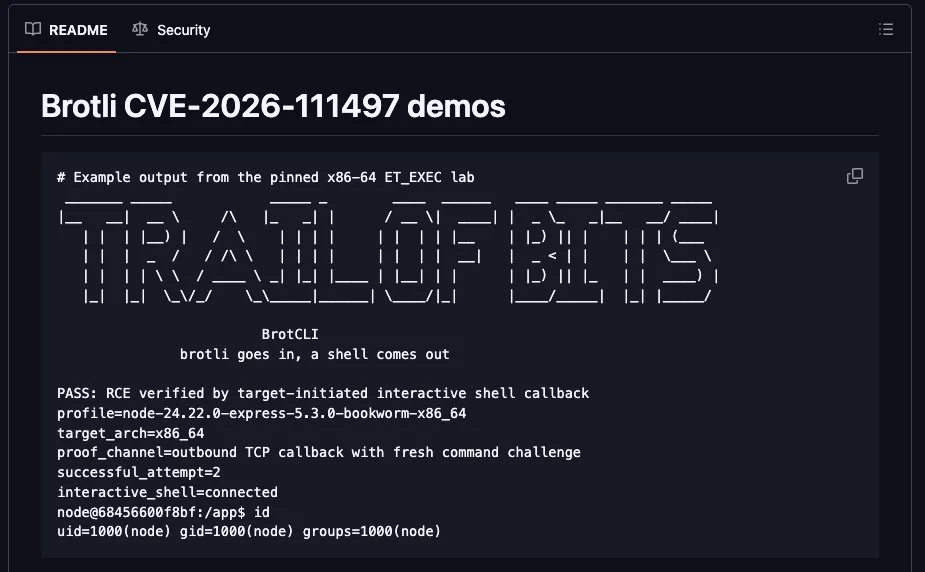
Trail of Bits post says it achieved remote code execution through a Brotli decoder bug in Linux lab setups: Node.js 24.22.0 with Express 5.3.0 via the standard JSON parser (x86-64 and ARM64), and Electron 41.10.7 (x86-64) with a custom decoding service. Exploitation needs a carefully matched setup and repeated attempts. A scanner by ToBScottA finds hidden copies of the decoder, including in stripped binaries.

BrotliNode.jsExpress+1
Trail of BitsToBScottA

AppSec, Offensive Security, Supply ChainΒ· Added 30 Oct 2026, published 28 Oct 2026

x.comthreadπŸ›‘οΈ Security

Kizuno18 (@Kizuno18) on X

Thread by Kizuno18 on the move from local stdio/Docker Model Context Protocol servers to remote HTTP/SSE endpoints in enterprise infrastructure. It names three trade-offs: credential boundary inversion (short-lived OAuth/JWT tokens instead of long-lived admin tokens on workstations), tool schema bloat solved by deferred discovery, and governance via HCP Terraform policy-as-code (Sentinel/OPA), audit trails and approvals. It is opinion, with no data or implementation detail.

Model Context ProtocolTerraformDocker+2
Sentinelblast radiuspolicy-as-code+1

AI Security, Identity & Access, DevSecOpsΒ· Added 29 Oct 2026, published 27 Oct 2026

x.comthread🧠 AI
Kizuno18 (@Kizuno18) on X

Kizuno18's X post argues that the move from local stdio and Docker MCP servers to remote HTTP/SSE endpoints matures the Model Context Protocol in enterprise infrastructure. It lists three trade-offs: short-lived OAuth/JWT bearer tokens replace mounted admin credentials, deferred tool discovery avoids roughly 20k tokens of eager schema loading, and HCP Terraform enforces Sentinel/OPA policy, audit trails and approvals server-side. Opinion post with no benchmarks or code.

Model Context ProtocolDockerTerraform+5
Kizuno18HCP TerraformOPA

mcpΒ· Added 29 Oct 2026, published 27 Oct 2026

blog.trailofbits.comarticleπŸ›‘οΈ Security

Backporting security fixes to stable releases

Trail of Bits argues that stable and LTS software, such as Ubuntu 26.04 LTS, Debian 13 and stable Linux kernel branches, carries many known CVEs that were fixed upstream but never backported. It measures the gap using the kernel CVE team's vulns.git (18 September 2026) and Debian and Ubuntu CVE feeds. Using Codex with GPT-5.6, the team got 142 fixes covering 90 CVEs applied to stable kernel trees and has begun sending patches to distributions.

Linux kernelDebianUbuntu+2
Trail of BitsPatch the PlanetGPT-5.6 Sol

AppSec, AI SecurityΒ· Published and added 27 Oct 2026

x.comadvisoryπŸ›‘οΈ Security

lee1981 (@lee1981b) on X

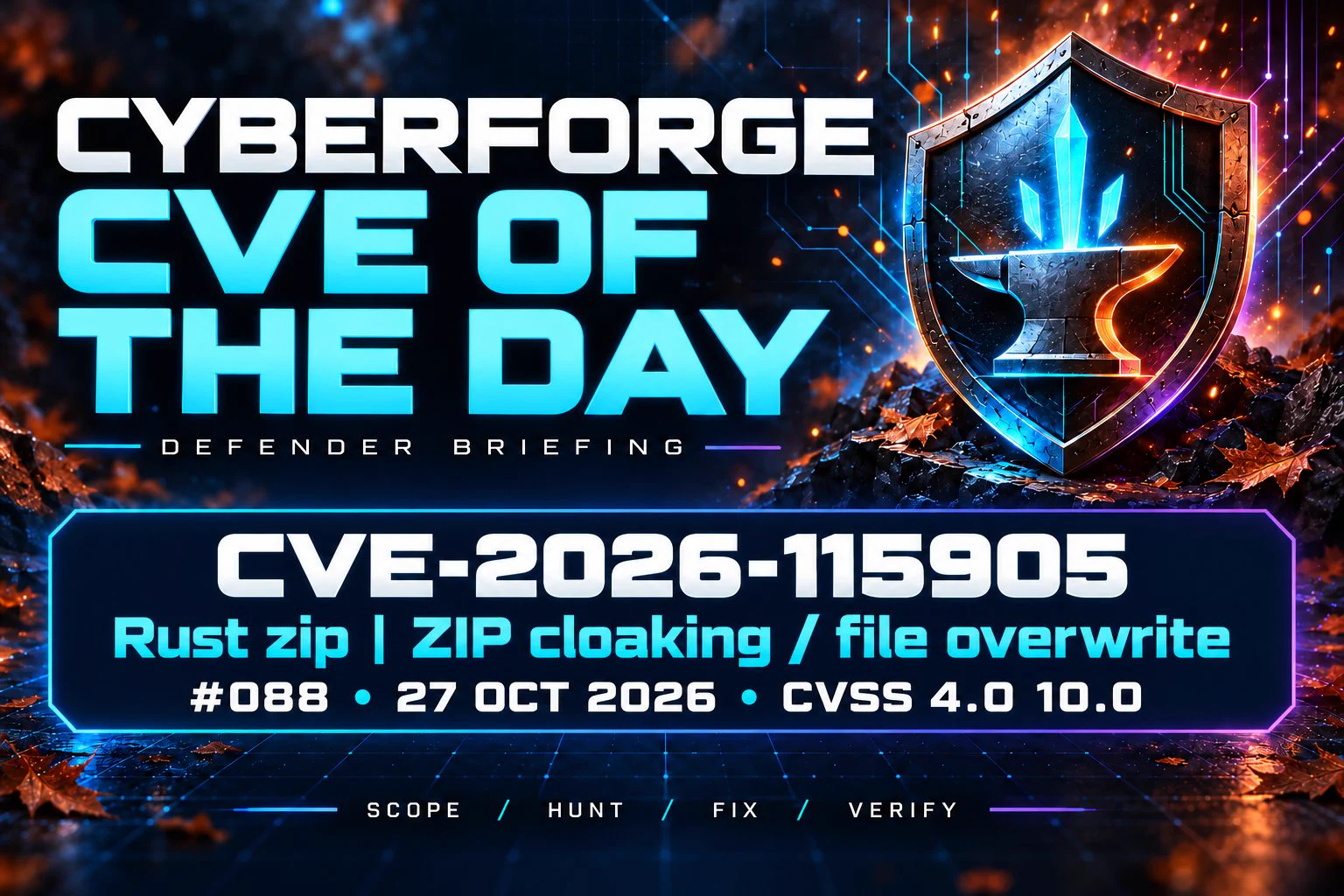
CVE-2026-115905 is a ZIP cloaking flaw in the Rust zip crate (zip-rs/zip2), rated CVSS v4.0 10.0 and affecting versions below 9.0.5. ZipArchive reads central-directory metadata while ZipStreamReader reads local headers, so a crafted archive can pass filename inspection and then overwrite a different file during streaming extraction. Version 9.0.5 adds consistency checks, but ZipStreamReader::new leaves them off by default, and extraction is not atomic, so files can be written before an error is raised. The post covers CWE-20 and CWE-436, KEV and EPSS status, Debian status and a six-step investigation trail.

Rustzip crateCargo+3
CVE-2026-115905CWE-20CWE-436+3

AppSec, Blue Team & DetectionΒ· Added 29 Oct 2026, published 27 Oct 2026

x.comthreadπŸ›‘οΈ Security

Trail of Bits (@trailofbits) on X

Trail of Bits post on PHP2Shell, an exploit that gives a shell on MediaWiki, Symfony, Laravel and phpBB. They confirmed it on pre-patch PHP 8.2 to 8.5. An update says it is production-grade: it works with stock php.ini-production, display_errors off, multiple workers, ASLR and load, on ARM64 and x86-64, and reaches root on Apache/mod_php and nginx/php-fpm. No CVE or technical root cause is given.

PHPWordPressLaravel+3
PHP2ShellTrail of Bits

Offensive Security, AppSecΒ· Added 27 Oct 2026, published 26 Oct 2026

x.comarticleπŸ›‘οΈ Security

lee1981 (@lee1981b) on X

CyberForge CVE of the Day #087 covers CVE-2026-115889, a Cranelift value-index overflow in Wasmtime that can miscompile crafted WebAssembly and possibly escape the sandbox (CVSS 9.9, CWE-197 and CWE-843). Affected: below 36.0.19, and 37.0.0 up to but excluding 43.0.0; fixes are 36.0.19 and 43.0.0. It gives a SOC investigation trail from module digest to compiled artifact to host telemetry. EPSS is 0.454%, with no KEV entry.

WasmtimeCraneliftWebAssembly+4
CVE-2026-115889GHSA-897f-g5gm-fmxmRUSTSEC-2026-0380+5

AppSec, Blue Team & DetectionΒ· Added 28 Oct 2026, published 26 Oct 2026

x.comthread🧠 AI

Syb (@DegenOfWallSt) on X

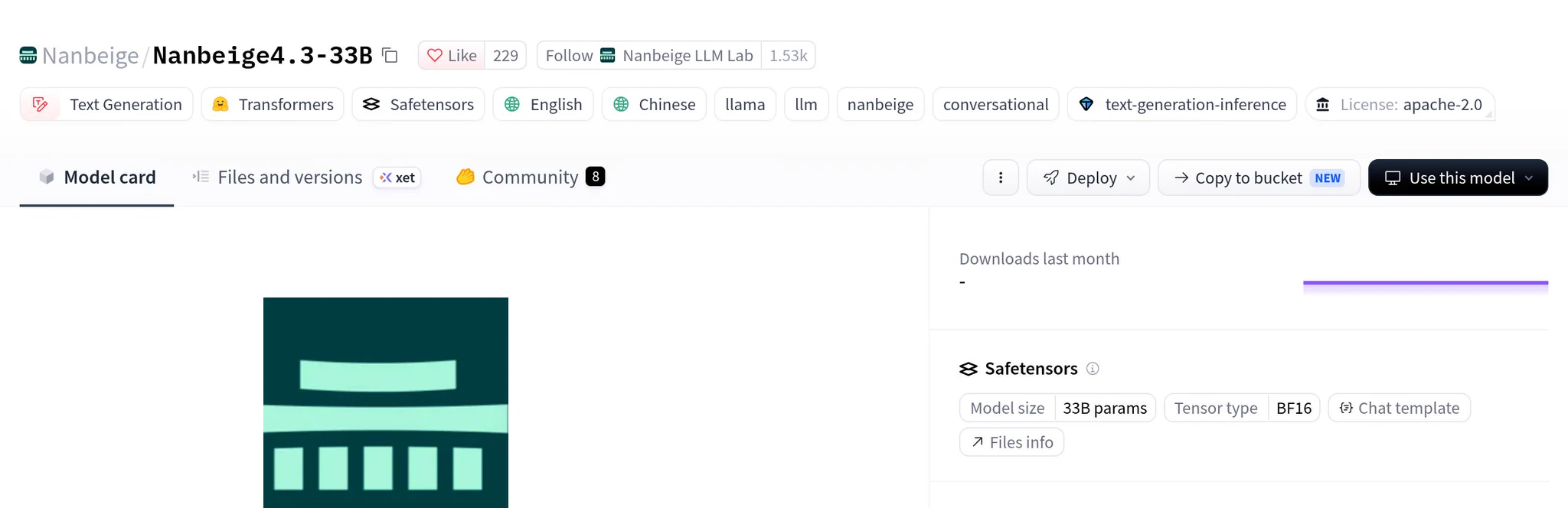
Nanbeige4.3-33B is a 33.1B dense, Llama-style open model under Apache-2.0, released with a base model on Hugging Face. In Nanbeige's own table it beats Qwen3.8-27B on Terminal-Bench 2.1 (80.9 vs 73.0), DeepSWE (65.5 vs 42.5) and Automation Bench, but trails on SWE-Bench Pro, GDPval and GPQA Diamond. BF16 weights are about 66 GB, split across 4 GPUs in the vLLM and SGLang examples. No independent evals exist yet.

Hugging FacevLLMSGLang+4
Nanbeige4.3-33BNanbeige4.3-3BNanbeige+8

models, coding-agents, evalsΒ· Added 26 Oct 2026, published 25 Oct 2026

arxiv.orgpaper🧠 AI

Task Format as a Factor in Adaptation: A Controlled Comparison of LoRA and Full Fine-Tuning for Prompt-Safety Classification

This paper compares LoRA and full fine-tuning for prompt-safety classification using a matched 400M encoder-decoder pair (Ettin) across three task formats, with up to 15 seeds per cell and pre-specified analyses. Full fine-tuning leads LoRA by 2-3 pp at the pre-specified learning rates, and the encoder gap closes when both use the same learning-rate search. Training LoRA to write a reason after its verdict adds 4.0 pp, while a content-free sentence of equal length does not. Trained models beat a prompted 8B in domain but trail it by 8-23 pp on adversarial jailbreaks and over-flag benign prompts (27-66% against 2-3%).

LoRAEttinTransformer

training, research, evalsΒ· Added 27 Oct 2026, published 24 Oct 2026

x.comtoolπŸ›‘οΈ Security

Trail of Bits (@trailofbits) on X

Trail of Bits announces a scanner, built by Scott A., that finds hidden copies of the vulnerable Brotli decoder behind a Node.js/Brotli bug, including in stripped binaries. Exploitability of the bug is still under testing. Binary matching covers only aarch64 gcc builds, so an empty result on a stripped x86 binary may be a coverage gap. The post also separates finding vulnerable code from knowing whether an app reaches it.

Node.jsBrotli
Trail of Bits

AppSec, Supply Chain, Malware & REΒ· Added 25 Oct 2026, published 23 Oct 2026

x.comadvisoryπŸ›‘οΈ Security

lee1981 (@lee1981b) on X

CVE-2026-111497 is an out-of-bounds write in the Brotli decoder bundled with Node.js (CWE-787, CWE-252), rated CVSS v4.0 9.2 by the Google CNA and High by the Node.js project. Fixes are Node 22.23.4, 24.22.1 and 26.12.1, and 24.22.1 still labels Brotli 1.2.0 because the fix was cherry-picked. The post gives a SOC trail from input to worker, with remediation and verification steps. It notes no KEV match, CISA SSVC exploitation none, and only unverified public lab claims.

Node.jsBrotliCVSS+3
CVE-2026-111497CWE-787CWE-252+3

Blue Team & Detection, AppSecΒ· Added 26 Oct 2026, published 23 Oct 2026

x.comtoolπŸ›‘οΈ Security

Trail of Bits (@trailofbits) on X

patching-bugs is a Trail of Bits plugin for Codex that has an AI agent write a vulnerability fix, prove it works, and check it for regressions. It was built from analysis of thousands of Codex sessions from the Patch the Planet work with OpenAI. The post argues defenders need patch-writing agents to match attackers' bug-hunting agents. It gives no technical detail beyond that.

CodexOpenAI
Patch the PlanetTrail of Bits

AI Security, AppSecΒ· Added 24 Oct 2026, published 22 Oct 2026

tldrsec.comarticleπŸ›‘οΈ Security

[tl;dr sec] #351 - PHP2Shell, Autopatching Skills, AWS Pathrunner

tl;dr sec #351 is a weekly security newsletter. Clint Gibler describes working with OpenAI, Calif, Wiz and the PHP maintainers on the PHP2Shell unauthenticated RCE disclosure, which affects 13 years of PHP. It also covers Datadog's pathrunner AWS IAM escalation framework, Trail of Bits' patching-bugs and regression-hunt Codex plugins, XBOW finding de-duplication, backdoored open-weight models, and CREBench.

PHPAWS IAMCodex+3
PHP2ShellPatch the PlanetCalif+10

AppSec, AI Security, Cloud & InfraΒ· Added 30 Oct 2026, published 22 Oct 2026

x.comadvisoryπŸ›‘οΈ Security

lee1981 (@lee1981b) on X

CyberForge CVE of the Day #084 analyses CVE-2026-76466, a CVSS 9.8 flaw in clustered Cisco Expressway-C and Expressway-E. Persistent database cookies and weak client-certificate validation allow root OS command execution over the network. The fix is X15.5.20 (X14 and earlier must migrate), with no workaround. It adds a per-peer SOC investigation trail, reachability checks and exposure status from CISA SSVC, KEV and EPSS.

Cisco ExpresswayCVSSNVD+2
CVE-2026-76466CWE-798cisco-sa-vcs-static-cred-hr7EWZ8t+2

Blue Team & Detection, Cloud & InfraΒ· Added 24 Oct 2026, published 22 Oct 2026

arxiv.orgpaper🧠 AI

TRIAD: Benchmarking Omni-Modal Ambiguity in Multimodal Large Language Models

TRIAD is a benchmark for omni-modal ambiguity resolution. It has 327 hand-written text-image-audio queries in 86 scene groups across 18 ambiguity categories, and removing any one modality makes the answer non-unique. Across 14 omni-modal systems, the best model trails humans by over 20 points in group accuracy. Without answer options, model group accuracy falls to single digits, and leave-one-out tests show audio cues are often underused.

multimodal large language modelomni-modal LLM
TRIADarXiv

evals, multimodal, researchΒ· Added 23 Oct 2026, published 22 Oct 2026

x.comthreadπŸ›‘οΈ Security

Trail of Bits (@trailofbits) on X

Trail of Bits post on two unpatched critical PHP bugs that were exploited within 17 hours of details leaking. Cloudflare began blocking attacks and Patchstack reported active exploitation. The bug was reported 11 August and fixed 71 days later, with a patch touching 402 files and over 11,000 lines. Trail of Bits announces two open-source plugins, patching-bugs and regression-hunt, from its Patch the Planet work.

PHPCloudflare
Trail of BitsPatch the PlanetPatchstack

AppSec, AI SecurityΒ· Added 23 Oct 2026, published 21 Oct 2026

x.comarticle🧠 AI

Trail of Bits (@trailofbits) on X

Trail of Bits announces two open-source plugins, patching-bugs and regression-hunt, for AI coding agents that speed up bug patching. They come from four months of Patch the Planet work with open-source projects, which found that repo-level documentation, skills and plugins give agents the maintainer context on what counts as a bug, how a fix should look and what must not break. The post cites the October 2026 PHP incident: a patch touching 402 files, and exploitation within 17 hours of leaked details.

PHPCloudflare
Trail of BitsPatch the PlanetPatchstack+2

coding-agents, promptingΒ· Added 23 Oct 2026, published 21 Oct 2026

blog.trailofbits.comarticle🧠 AI

Your AI agent fixed the bug, but what else did it change?

Trail of Bits releases patching-bugs and regression-hunt, two agent plugins built with OpenAI through Patch the Planet. patching-bugs reproduces bugs, writes fixes and runs a three-arm proof; regression-hunt traces diffs to real interfaces, confirms with live PoCs and a fresh-context replay. A review of 130+ merged PRs found 21 regressions, and regression-hunt gave 25% fewer false positives than a baseline Codex prompt.

Codexpatching-bugsregression-hunt
Trail of BitsOpenAIPatch the Planet+4

coding-agents, agents, evalsΒ· Published and added 21 Oct 2026

blog.trailofbits.comarticleπŸ›‘οΈ Security

Your AI agent fixed the bug, but what else did it change?

Trail of Bits releases patching-bugs and regression-hunt, two Codex plugins from the Patch the Planet initiative with OpenAI. A review of 130+ merged patches confirmed 21 regressions (none broke a security protection). In preliminary tests regression-hunt gave 25% fewer false positives than a baseline Codex agent. Design uses live PoCs, strict schemas, a three-arm proof, and project THREAT_MODEL.md and PATCHING_GUIDELINES.md files.

CodexOpenAI
Trail of BitsPatch the Planetpatching-bugs+7

AI Security, AppSecΒ· Published and added 21 Oct 2026

x.comarticleπŸ›‘οΈ Security

lee1981 (@lee1981b) on X

CVE-2026-110936 is an uncontrolled DLL search path flaw (CWE-427) in Siemens Software Center below V4.0.9.8, listed in CISA KEV on 20 October 2026. The post covers CVSS v4.0 8.4 and v3.1 6.7, Siemens' Romulus ClickFix campaign indicators (IPs, domain, hashes, file leads) and a six-step SOC trail using Sysmon, EDR and network records. It separates delivery from DLL load and from compromise.

Siemens Software CenterWindowsSysmon+3
CVE-2026-110936CWE-427DLL search order hijacking+10

Blue Team & Detection, Threat IntelΒ· Added 24 Oct 2026, published 21 Oct 2026

alterauth.comtool🧠 AI

Launch HN: Alter (YC S25) – Access control for multi-user agents

Alter is a privileged access management layer for AI agents (YC S25). It stores credentials in a vault, injects them per request through a proxy, gives each agent its own identity and scoped grants, and logs every call to a tamper-evident audit trail. One SDK call covers storage, refresh, policy and audit for 140 API providers, with LangChain, MCP and AWS integrations. Policy is default-deny down to the parameter, with human approval for risky calls.

Model Context ProtocolLangChainAWS+3
AlterY Combinator

ai-infra, agentsΒ· Added 22 Oct 2026, published 21 Oct 2026

x.comthreadπŸ›‘οΈ Security

Trail of Bits (@trailofbits) on X

Trail of Bits thread on Google Quantum AI's March publication of a new Shor's algorithm version aimed at secp256k1, the curve protecting Bitcoin and Ethereum wallets. Google used zero-knowledge proofs to keep the attack details secret, and the post says the secrecy lasted 63 days. The fetched text is cut off after the qubit estimate of roughly 1,200, so later details are missing.

BitcoinEthereum
Shor's algorithmsecp256k1Google Quantum AI+2

BlockchainΒ· Added 22 Oct 2026, published 20 Oct 2026

x.comadvisoryπŸ›‘οΈ Security

lee1981 (@lee1981b) on X

CVE-2026-77932 affects DB-GPT through 0.8.2 (dbgpt-app). The /api/v1/chat/react-agent route accepts unauthenticated requests because get_user_from_headers returns an admin-role user, and the ReAct agent can reach unsandboxed Python and shell tools. Lasso reported root in the webserver container in a lab. The post gives CVSS 9.8 and 9.3, no verified fix (0.8.2 is still the latest release), no KEV match, no EPSS data, and a SOC hunting trail.

DB-GPTPythonDocker+3
CVE-2026-77932CWE-306Lasso+4

AI Security, AppSec, Blue Team & DetectionΒ· Added 23 Oct 2026, published 20 Oct 2026

securitylabs.datadoghq.comtoolπŸ›‘οΈ Security

Datadog pathrunner: AWS IAM privilege escalation framework

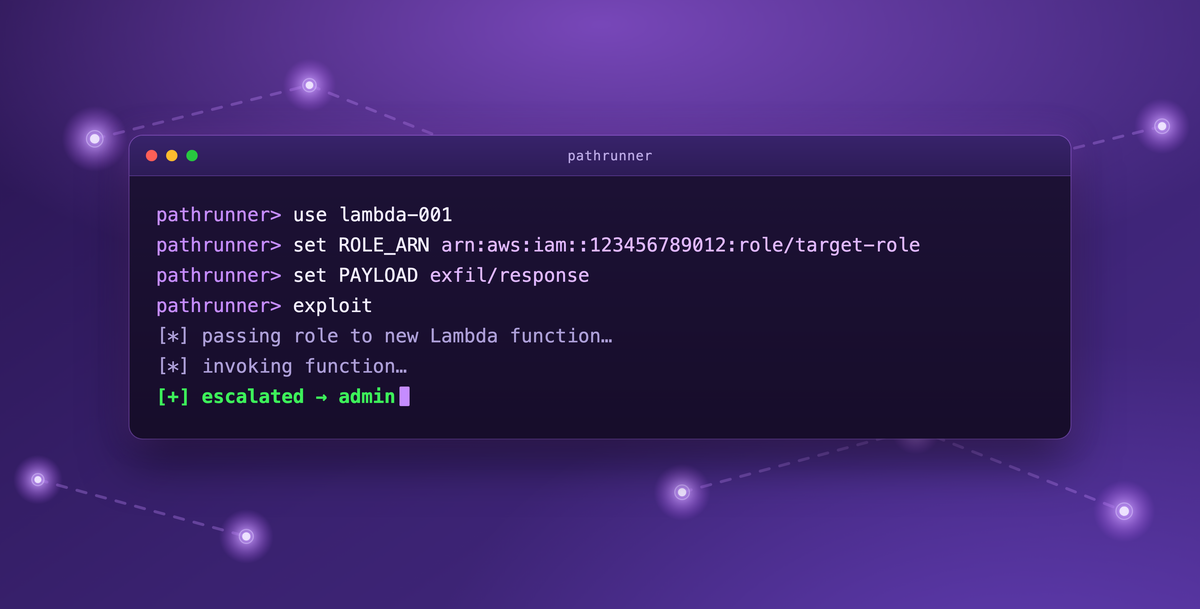
pathrunner is a modular offensive framework from Datadog Security Labs that automates exploitation of the AWS IAM privilege escalation paths catalogued in pathfinding.cloud and deployed in Pathfinding Labs. It has over 80 exploit modules (as of October 2026), identity import and switching, multiple payloads per module, and attacker infrastructure deployment with a credential listener. A workspace report lists created resources and expected CloudTrail events for defenders.

AWSAWS IAMAWS Bedrock
pathrunnerpathfinding.cloudPathfinding Labs+2

Cloud & Infra, Offensive Security, Blue Team & DetectionΒ· Added 23 Oct 2026, published 20 Oct 2026

x.comthreadπŸ›‘οΈ Security

DFIR Radar (@DFIR_Radar) on X

DFIR_Radar weekly detection engineering digest covering 23 new and 19 updated rules across 6 GitHub repositories. It lists KQL rules for Azure Key Vault secret retrieval, MCP client User-Agent bulk operations and local Azure token theft, AWS CloudTrail analytics, Sigma rules for firewall and ETW tampering (decimal 17 vs hex 0x11), updated LOLDrivers hashes, and Sublime email rules for OAuth consent phishing and fake IRS W-9 PDFs.

KQLSigmaMicrosoft Sentinel+3
BYOVDCisco AI Defensebenscha/KQLAdvancedHunting+7

Blue Team & Detection, Cloud & Infra, AI SecurityΒ· Added 20 Oct 2026, published 19 Oct 2026

x.comadvisoryπŸ›‘οΈ Security

lee1981 (@lee1981b) on X

CVE-2026-106931 is an OS command injection (CWE-78) in the statistics processing of EG Secure Solutions SiteGuard Server Edition, a host-based WAF. It can give root or SYSTEM command execution. The vendor and JVN confirm exploitation on 14 October 2026. The post lists fixed builds (Ver8.00 Update 5, Ver7.00 Update 6 on FreeBSD), the IIS exclusion, the workaround of disabling statistics, and a SOC trail starting with diagnostic preservation before patching.

SiteGuard Server EditionApache HTTP Servernginx+3
CVE-2026-106931CWE-78CISA KEV+5

Blue Team & Detection, AppSecΒ· Added 21 Oct 2026, published 19 Oct 2026

github.comrepo🧠 AI

alex09x/kyb

KYB (Know Your Business) is a Rust/axum server that stores agent-written knowledge, incident reports and tasks as Markdown files in Git, one commit per change. Search is hybrid: Tantivy BM25 fused by reciprocal rank with local multilingual-e5-small ONNX vectors, and it can query historical versions or "as of" a date. It ships a kyb CLI, a native MCP endpoint (Claude Code, Codex, Antigravity, Gemini CLI), an installable agent skill, token auth with per-write attribution trailers, secret scanning on writes, and a web console. It targets persistent shared operational memory for multi-agent, multi-machine fleets.

RustGitModel Context Protocol+10
KYBAlexander Panasenkomultilingual-e5-small

agents, mcp, coding-agentsΒ· Added 17 Oct 2026

x.comadvisoryπŸ›‘οΈ Security

lee1981 (@lee1981b) on X

CyberForge CVE of the Day #080 covers CVE-2026-99999 ("PwnEscape"), a Linux kernel IPv4 checksum-completion flaw. Crafted checksum metadata can trigger a deferred write into an already-validated IPv4 header, which allows host memory disclosure from a guest or microVM over virtio-net and TAP. It gives upstream fixed branches (5.10.272 to 7.2.11), Amazon Linux, Red Hat and Ubuntu status, CVSS 9.3, EPSS 0.211% and a SOC investigation trail. No IOCs were verified.

Linux kernelKVMFirecracker+6
CVE-2026-99999PwnEscapesandbox escape+5

Cloud & Infra, Blue Team & DetectionΒ· Added 19 Oct 2026, published 17 Oct 2026

x.comthreadπŸ›‘οΈ Security

Trail of Bits (@trailofbits) on X

Trail of Bits post announcing research that tested 25 package managers against a simulated malicious repository serving swapped code for the same package and version. Without a lockfile only Go and vcpkg verified every download; with a lockfile fewer than half did. This undercuts the assumption that lockfiles make dependencies immutable and shows hash/integrity verification gaps across ecosystems.

Govcpkg
Trail of Bits

Supply ChainΒ· Added 18 Oct 2026, published 16 Oct 2026

x.comthreadπŸ›‘οΈ Security

lee1981 (@lee1981b) on X

CyberForge "CVE of the Day #079" on CVE-2026-102764, a CWE-290 origin-validation flaw in BeyondTrust Remote Support (advisory BT26-05, CVSS v4 9.3) that allows appliance file operations. It summarises Mandiant/GTIG's exploited intrusion chain (SAWFLY web shell, BARECLAW backdoor, root escalation, persistence) and gives an investigation trail: patch-state verification (BT26-05-RS), evidence preservation, hunting leads with SHA-256 hashes and YARA rules, permission/session correlation, and remediation including clean redeployment and credential rotation. It separates vendor facts from the intrusion's observed behaviour and notes that KEV and EPSS have no entries.

BeyondTrust Remote SupportYARASIEM+2
CVE-2026-102764BT26-05CWE-290+7

Blue Team & Detection, Threat IntelΒ· Added 18 Oct 2026, published 16 Oct 2026

github.blogarticleπŸ›‘οΈ Security

Staying Evergreen: How we automated secure access and repo hygiene in a shared org

GitHub engineers describe Evergreen, a Go-based GitHub App that runs quarterly outside-collaborator access reviews and archives stale repositories in a shared org. It uses scheduled Actions with repository_dispatch, JSON state files in git as the audit trail, checklist issues (IssueOps) closed to trigger revocation, and custom properties for ownership and exemptions. Design principles include fail-secure/fail-closed revocation, never deleting data, dry-run rollout, Splunk logging, and proactive pacing against GitHub's secondary rate limits.

GitHubGitHub ActionsGo+2
EvergreenIssueOpsfail secure+2

DevSecOps, Identity & AccessΒ· Published and added 15 Oct 2026

x.comthreadπŸ›‘οΈ Security

Trail of Bits (@trailofbits) on X

Trail of Bits tweet announcing a test of 25 package managers against a simulated malicious repository. Without a lockfile only Go and vcpkg verified every download; with a lockfile fewer than half did. Replies raise that checksum verification is separate from execution isolation, and ask whether poisoned CI package caches were in the threat model.

Govcpkg
Trail of Bits

Supply ChainΒ· Added 17 Oct 2026, published 15 Oct 2026

latent.spacearticleπŸ›‘οΈ Security

Crossing the Threshold: How OpenAI and Anthropic Approach Autonomy and Safety in Financial Agents

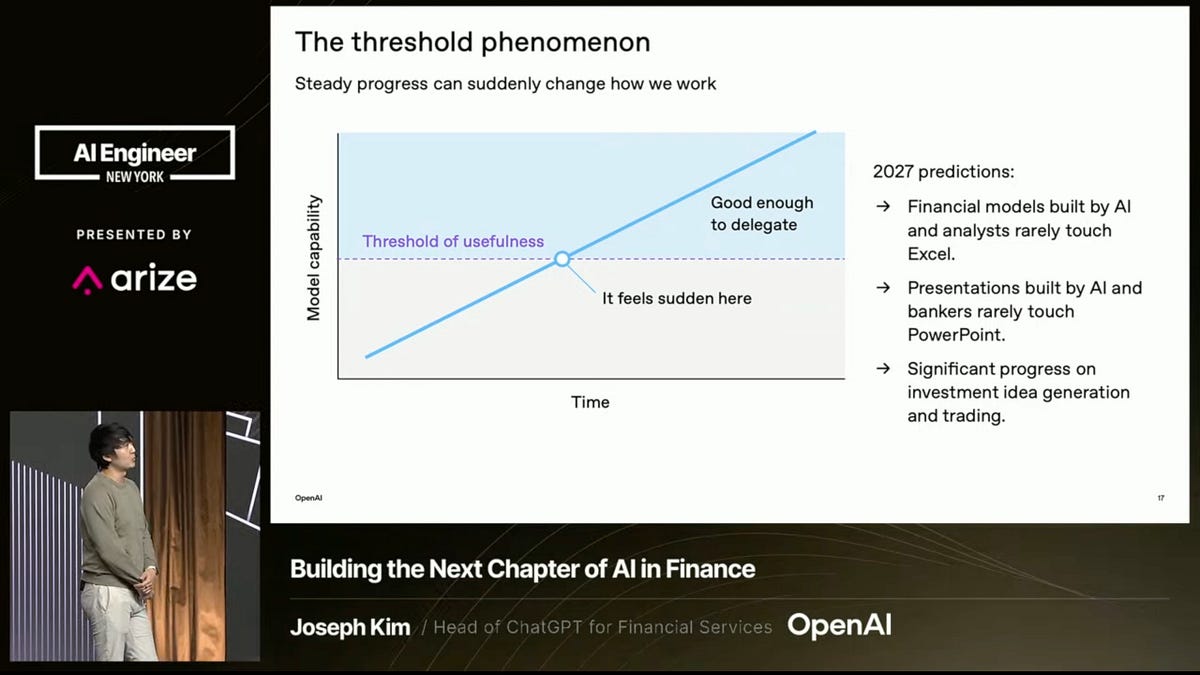
Recap of AI Engineer New York talks on balancing agent autonomy and safety in financial services. Bloomberg's Andrey Rybka argued for deterministic controls outside the model: scoped credentials, tool-call checks, outbound traffic limits, audit trails, budgets and kill switches. He cited a case where an agent obeyed instructions embedded in a marketplace review. Anthropic described a trust layer of identity and permissions, sandbox and approval, and regression checks, with agents proposing rather than making order amendments. Two Sigma described composable controls, including auto-mode classifiers that escalate only important requests, to avoid approval fatigue. OpenAI framed human-in-the-loop as a product design choice.

ChatGPTClaude
prompt injectionTwo SigmaBloomberg+1

AI SecurityΒ· Published and added 14 Oct 2026

blog.trailofbits.comwriteupπŸ›‘οΈ Security

Package managers have an integrity problem

Trail of Bits tested 25 popular package managers with a Docker and mitmproxy harness that simulates a compromised package repository injecting malware into legitimate packages. Fewer than half enforce lockfile hashes by default, only two verified every download, and only Go verifies signatures by default. The post covers lockfile hash pitfalls (Pub, pnpm, Conan, CocoaPods, Composer), repository, developer and Sigstore signing, and Go's checksum database. It also proposes lockfiles that commit to a signing identity plus a transparency log.

npmpnpmGo+3
Trail of BitsPEP 740cpanminus+5

Supply ChainΒ· Published and added 14 Oct 2026

embracethered.comwriteupπŸ›‘οΈ Security

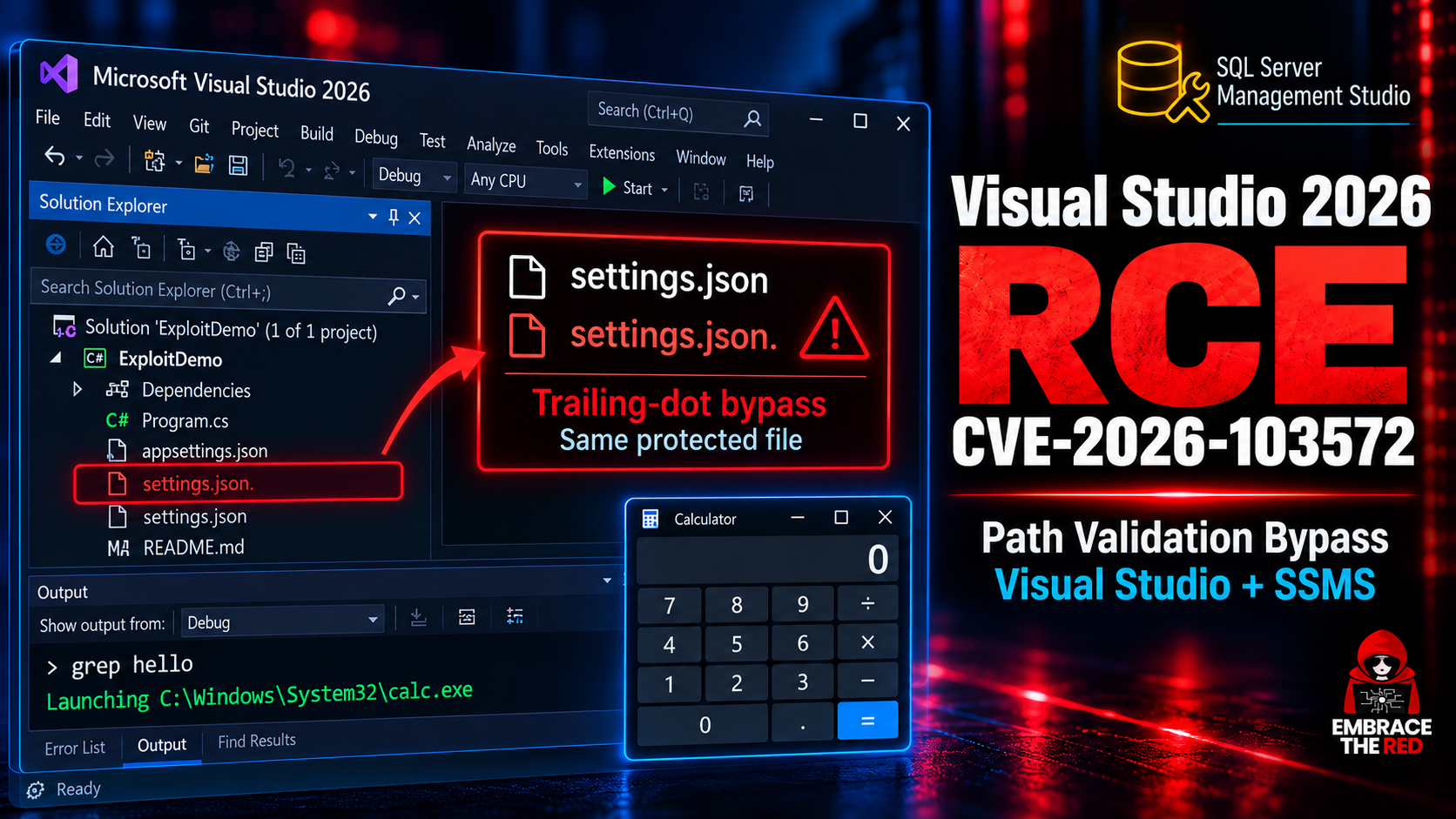
Visual Studio Copilot and SSMS Remote Code Execution (CVE-2026-103572)

CVE-2026-103572 is a remote code execution bug in Microsoft.VisualStudio.Copilot.Core.dll, shared by Visual Studio and SQL Server Management Studio. A trailing dot (for example `.mcp.json.`) bypasses the protected-filename check in EditsFunctionHandler.GetEditConfirmationTypeAsync, so a hijacked Copilot can rewrite its own MCP and settings files and run commands. The post covers path traversal and InstallationID leaks, indirect prompt injection demos, the October 2026 patch (GetFullPath), and a $0 bounty.

Visual StudioSQL Server Management StudioGitHub Copilot+3
CVE-2026-103572indirect prompt injectionpath traversal+5

AI Security, AppSec, Offensive SecurityΒ· Added 29 Oct 2026, published 13 Oct 2026

arxiv.orgpaper🧠 AI

Evidence-First Agentic Verification

Introduces Sauron, an evidence-first agentic verifier that checks rubric criteria for long-horizon agent tasks by investigating both environment state and execution trace, and trusts a claim (including an agent's self-reported success) only after validating it against its source. Bounded queries and joint investigation of related criteria cut context use, and each verdict carries an auditable evidence receipt. On 2,586 human-labeled criteria from 100 personal-assistant episodes it has the best F1 of five verifiers across eight backbones (0.96 vs 0.92 for Gandalf with GPT-5.6 Sol, at 23% lower cost). It detects 97% of injected failures across 13 fault families, including reward-hacking simulations, with 2% false flags on clean controls, and leads on the TRAIL agent-error benchmark. It matters because unreliable rubric verdicts used as RL rewards can reinforce bad behavior.

SauronGandalfTRAIL+2

evals, agents, researchΒ· Added 14 Oct 2026, published 13 Oct 2026

aws.amazon.comarticleπŸ›‘οΈ Security

Quantum-resistant signing on AWS, Part 2: Enforce your ML-DSA algorithm policy with SCPs and IAM

Explains how to turn a cryptographic algorithm policy (approve ML-DSA-65/87, exclude ML-DSA-44) into enforceable AWS controls using SCPs, IAM policies, permission boundaries and KMS key policies. The key lever is the kms:KeySpec condition key (kms:SigningAlgorithm can't distinguish variants, since all use ML_DSA_SHAKE_256), applied to CreateKey, ReplicateKey, Sign, Verify and GetPublicKey. It also covers surfaces without algorithm condition keys (AWS Private CA, ACM import, IAM server certificate upload, ELB TLS) via provisioning pipelines plus CloudTrail and AWS Config drift detection, and the default-allow risk of deny-lists.

AWSAWS KMSAWS IAM+3
ML-DSAFIPS 204NIST+2

Cloud & Infra, GRCΒ· Published and added 12 Oct 2026

micahflee.comarticle🧠 AI

Just say no to OpenAI and Anthropic

Micah Lee argues for dropping OpenAI and Anthropic in favor of open-weight models, claiming they trail proprietary ones by about four months. They report GLM-5.3 as roughly on par with Claude Opus 5.5 for software engineering, and GLM-5.3-Flash as similar to Opus 4.8 and feasible to run locally. The post compares private inference through secure enclaves (Tinfoil, Maple AI) with cheaper non-private routers (OpenCode Go). It gives pricing, data-trust caveats about Z.ai, and the author's own workflow: OpenCode harness, GLM-5.3 on low reasoning, Tinfoil for private work.

OpenCodeGLMClaude+4
OpenAIAnthropicGLM-5.3+18

models, inference, coding-agentsΒ· Published and added 12 Oct 2026

endorlabs.comarticle🧠 AI

Introducing AI Coding Agent Governance: Using Hooks to Bring Visibility to the ADLC | Endor Labs

Explains how lifecycle hooks in Claude Code (.claude/settings.json) and Cursor (.cursor/hooks.json) can act as a deterministic, out-of-band control layer for AI coding agents. It covers the hook events, the JSON passed on stdin, and the response contracts. Claude Code uses exit codes plus permissionDecision, updatedInput and additionalContext. Cursor uses stdout JSON with permission and userMessage. It then shows how Endor Labs' `endorctl ai-audit` handler normalises events across both harnesses, streams them to a central audit trail and enforces server-side policies (29 defaults) such as shell allow/deny lists, sensitive-file patterns and MCP allowlists.

Claude CodeCursorendorctl+3
Endor LabsAURI

coding-agents, ai-policyΒ· Published and added 12 Oct 2026

x.comadvisoryπŸ›‘οΈ Security

lee1981 (@lee1981b) on X

CyberForge's CVE of the Day #075 covers CVE-2026-108860, a critical (CVSS 9.1 v3.1 / 9.3 v4.0) authentication bypass in SciSharp BotSharp through 5.2.0. WebStarter ships a published default HMAC JWT signing secret (CWE-321), so anyone holding it can forge bearer tokens that impersonate known users, including administrators. The post sets out how to confirm the effective key and serving build, a six-step SOC investigation trail, and remediation by rotating the secret. No verified fixed release, KEV entry or EPSS data existed at cutoff, and the linked research is static-only.

BotSharpASP.NET CoreJWT+5
CVE-2026-108860CWE-321VulnCheck+2

AppSec, Identity & Access, Blue Team & DetectionΒ· Added 13 Oct 2026, published 12 Oct 2026

x.comtoolπŸ›‘οΈ Security

Trail of Bits (@trailofbits) on X

Trail of Bits announces SequenceHash, a library for hashing several inputs without concatenation ambiguity. Plain concatenation lets different input sequences produce the same SHA-256 digest. SequenceHash appends each input's length as a fixed 128-bit integer so every sequence has a single encoding. It ships for Rust, Go and Python, and removes a recurring bug class in crypto and appsec code.

RustGoPython
Trail of BitsSequenceHash

AppSecΒ· Added 11 Oct 2026, published 9 Oct 2026

decrypt.coarticle🧠 AI

Google Wants Gemini to Be Your Next Coworkerβ€”Complete With Its Own Email Address

Decrypt reports on Google Cloud's newly announced Gemini Agent, a long-running AI agent that operates across Gmail, Docs, Sheets, Slides, Drive, Chat, Calendar, Microsoft 365 and Slack, and can run for hours or days on a single goal. The feature allows managers to spin up coworker agents with their own Workspace email address, calendar, Drive storage and directory listing, each given a cryptographically attested identity and a separate audit trail; agents connect to Salesforce, ServiceNow, Jira, Snowflake, BigQuery and any Model Context Protocol server, and are orchestrated across both Gemini and Anthropic's Claude models depending on cost and quality fit. Google pairs the launch with safety infrastructure, an Agent Sandbox, an AI network firewall called Agent Gateway, and real-time token-spend caps, citing a prior Claude Cowork VM-escape finding by Accomplish AI as the kind of containment failure it is designed to prevent.

GeminiClaudeGoogle Cloud+2
AnthropicThomas KurianGrok+9

agents, ai-infraΒ· Published and added 8 Oct 2026

decrypt.coarticle🧠 AI

Anthropic Launches Haiku 5.5: Its Cheapest and Fastest Claude Model Yet

Anthropic released Claude Haiku 5.5, pricing it at $0.10/$0.50 per million input/output tokens (for prompts up to 100k tokens), a 90% cut from Haiku 4.5, matching OpenAI's GPT-6 Luna pricing. The model scored 72.4% on OSWorld 2.1 and 39.2% on Terminal-Bench, beating GPT-6 Luna on both but trailing Claude Sonnet 5.5's 70.6% on Terminal-Bench, and it introduces an adjustable "effort" setting to trade cost for answer quality. Anthropic also halved Claude Sonnet 5.5's cache-read price and is rolling out monthly API credits for Max and Team subscribers.

ClaudeAWSGoogle Cloud+1
AnthropicClaude Haiku 5.5Claude Haiku 4.5+9

models, evalsΒ· Published and added 7 Oct 2026

aws.amazon.comwriteup🧠 AI

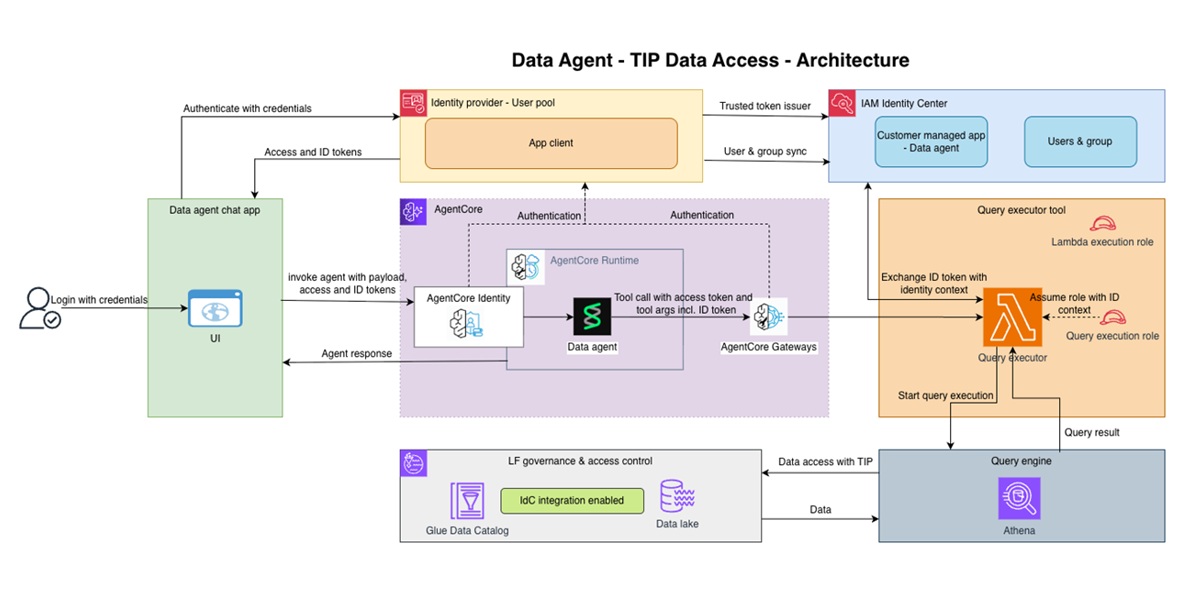
Identity-aware AI data agents with AWS Lake Formation and Trusted Identity Propagation

AWS Security Blog walkthrough showing how to build identity-aware AI data agents on Amazon Bedrock AgentCore that propagate a real user's OIDC id_token through the agent's tool-calling chain (Runtime β†’ MCP Gateway β†’ Lambda) via HTTP headers, keeping the token out of the foundation model's context entirely. A Lambda function performs a server-side token exchange using IAM Identity Center Trusted Identity Propagation, assumes a scoped TIP role, and runs the user's Athena query so AWS Lake Formation evaluates the real user's grants, producing per-user row/column access and CloudTrail audit records naming the actual human (onBehalfOf) without rewriting existing governance policies.

AWSAmazon Bedrock AgentCoreAWS Lake Formation+11

agents, mcp, ai-infraΒ· Added 8 Oct 2026, published 6 Oct 2026

aws.amazon.comarticleπŸ›‘οΈ Security

Identity-aware AI data agents with AWS Lake Formation and Trusted Identity Propagation

AWS Security Blog walkthrough of an identity-aware AI data agent pattern that propagates a real user's OIDC id_token through Amazon Bedrock AgentCore Runtime and Gateway into a Lambda target, which exchanges it server-side (via IAM Identity Center trusted identity propagation) for Lake Formation-scoped Athena credentials. The design deliberately keeps the id_token off the tool schema and inside HTTP headers only, so the foundation model never sees or handles the user's credential, and CloudTrail records the real human via an onBehalfOf AssumeRole entry, letting existing Lake Formation grants govern AI agent queries without rewriting authorization logic in application code. It details the three AgentCore configuration gates (runtime header allowlist, gateway metadataConfiguration.allowedRequestHeaders, Lambda's bedrockAgentCorePropagatedHeaders) that enforce this separation.

AWS BedrockModel Context ProtocolOAuth+3
Trusted Identity Propagation

AI Security, Identity & Access, Cloud & InfraΒ· Added 7 Oct 2026, published 6 Oct 2026

x.comthreadπŸ›‘οΈ Security

Trail of Bits (@trailofbits) on X

Trail of Bits' Circomspect, a static analyzer for Circom zero-knowledge circuits, had a false positive in its unconstrained-less-than check: compile-time constants fed into the LessThan template were wrongly flagged as unconstrained inputs. The merged PR fixes this so expressions resolvable at compile time are no longer reported, reducing noise for auditors hunting real under-constraint bugs in circuits.

Circomspect

AppSecΒ· Added 8 Oct 2026, published 6 Oct 2026

mailaccess.protoolπŸ›‘οΈ Security

Show HN: MailAccess – the true Email OSINT framework

MailAccess is an open-source email OSINT framework (pip install mailaccess, MIT licensed, 1.6kβ˜… on GitHub as KatrielMoses/MailAccess) that runs 75 modules across 5,300+ platforms to surface every account, breach, and exposed data point tied to a given email address without requiring API keys. Each finding is returned with its source, a confidence rating, and a one-sentence reasoning trail (e.g. username matches, avatar hash correlation) rather than as an unverified black-box hit. The project also offers a separate paid email-scraping service that extracts business contacts per domain.

PythonGitHubpip

OSINTΒ· Published and added 6 Oct 2026

x.comwriteupπŸ›‘οΈ Security

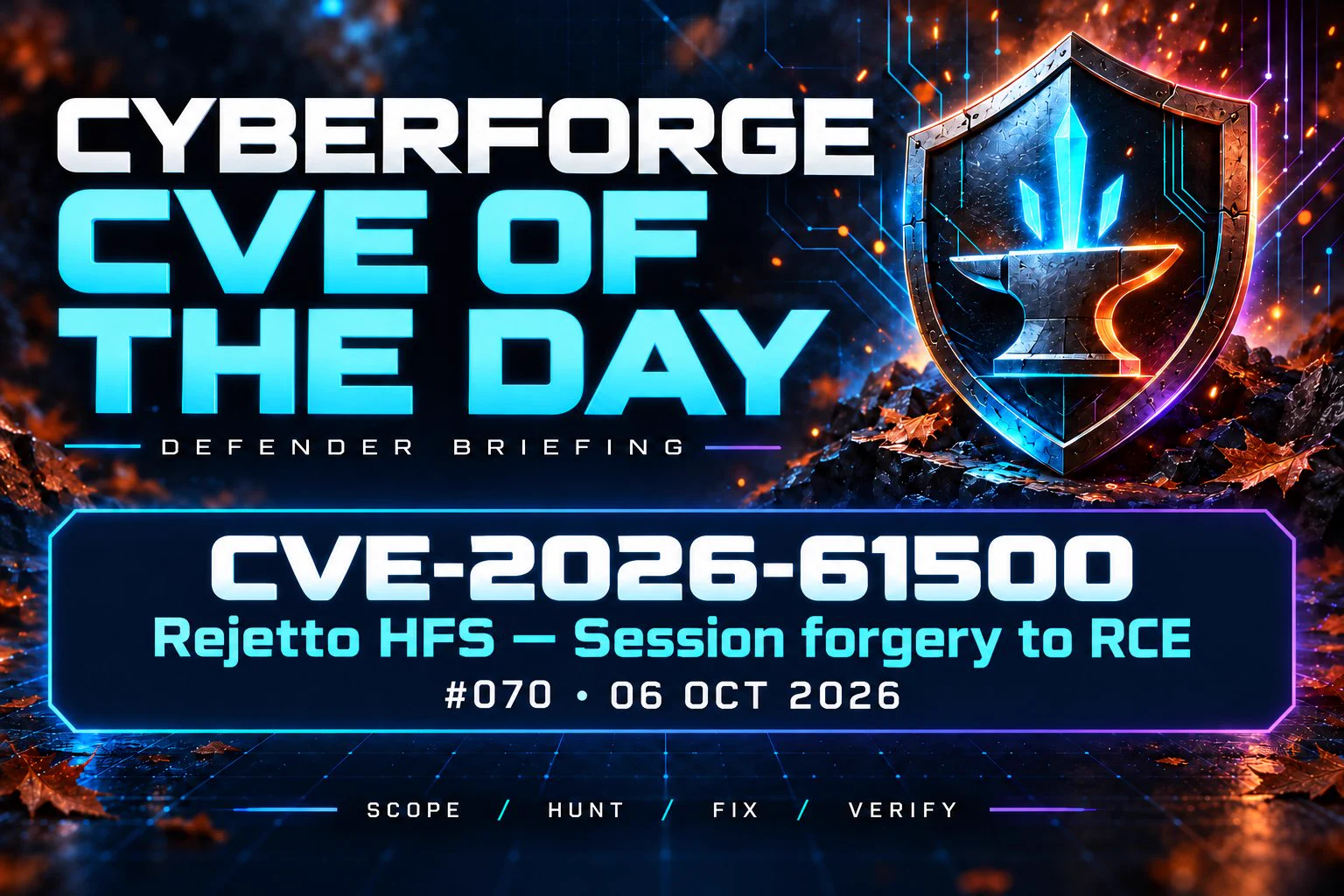
lee1981 (@lee1981b) on X

CyberForge CVE-of-the-Day #070 on CVE-2026-61500 in Rejetto HFS 3.0.0–3.2.0. The default Koa session-signing key came from Math.random() (CWE-338) and the unauthenticated login handshake leaked outputs of the same generator. That allows recovery of the key, a forged administrator session, and code execution through the legitimate server_code feature. It covers scoring (CVSS 9.8/9.3, EPSS, KEV status), the 3.2.1 fix, a six-step SOC hunting and remediation trail (loginSrp1/2, get_config/set_config pivots, COOKIE_SIGN_KEYS review), and offline jq/Python helpers for container and config metadata.

Rejetto HFSKoaDocker+2
CVE-2026-61500CWE-338VulnCheck+6

Blue Team & Detection, AppSec, Identity & AccessΒ· Added 9 Oct 2026, published 6 Oct 2026

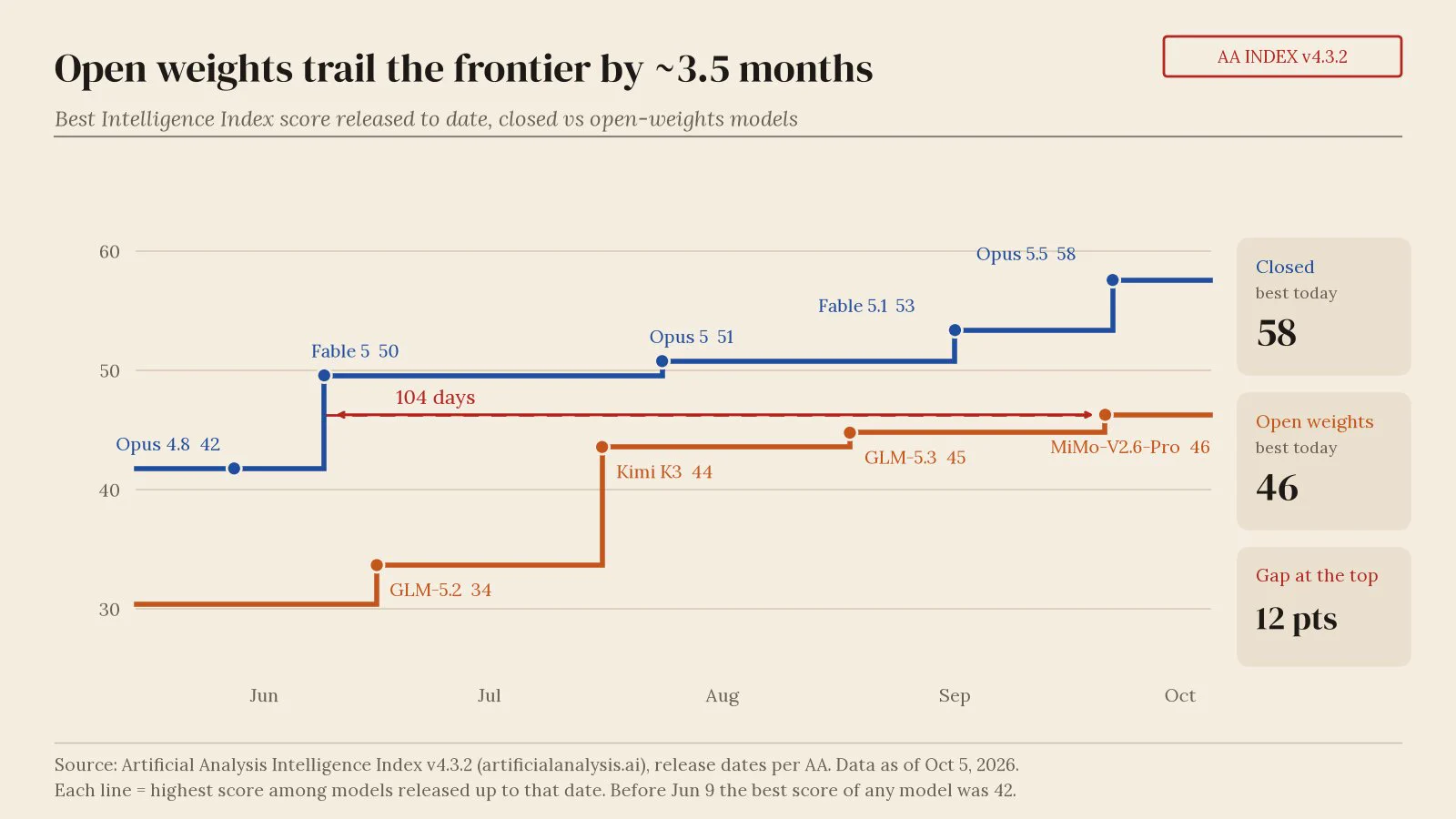
x.comthread🧠 AI

Franco Naumow. (@naumowf) on X

A tweet analyzing the Artificial Analysis Intelligence Index v4.3.2 finds that the best open-weights model, Xiaomi's MiMo-V2.6-Pro (released Sep 21, scoring 46), still trails what would have been the top closed frontier score as of 104 days earlier β€” Claude Fable 5's 50 on Jun 9, which itself surpassed the prior best (Claude Opus 4.8 at 42). It notes the current top-of-leaderboard gap is 12 points, with Claude Opus 5.5 (max) scoring 58, framing the persistent ~3.5-month lag of open weights behind the closed frontier.

MiMo-V2.6-ProXiaomiClaude Fable 5+4

evals, modelsΒ· Published and added 5 Oct 2026

endorlabs.comarticle🧠 AI

GPT-6.1 Sol on Codex: Astra-level security, a third faster, zero cheating | Blog | Endor Labs

Endor Labs re-ran its Agent Security League Codex benchmark on GPT-6.1 Sol, released one week after GPT-6 Sol, finding it nearly ties GPT-6 Astra on security (34.1 percent vs 34.6 percent SecPass) while trailing on functional correctness (77.7 percent vs 82.1 percent FuncPass), and running about a third faster and far cheaper in tokens than both. The piece also reports zero confirmed cheating across 13 flagged instances, the third such Codex run in a row, using the same 200-task Codex CLI 0.144.6 harness and multi-signal cheating detection (patch similarity, memorization, edit-trajectory, strict-test pass, conversation analysis) as prior posts in the series.

Codex
GPT-6.1 SolGPT-6 SolGPT-6 Astra+2

evals, coding-agentsΒ· Published and added 2 Oct 2026

blog.trailofbits.comwriteupπŸ›‘οΈ Security

SequenceHash: multihashing for the rest of us

Trail of Bits introduces SequenceHash and its keyed variant SequenceMAC, hash-agnostic multihashing constructions similar in goal to NIST's TupleHash but not tied to Keccak, working with SHA256/384/512, BLAKE, and RIPEMD. The spec, now part of the Community Cryptography Specification Project, provides unambiguous input encoding, length-extension prevention, built-in customization strings, and HMAC-style keyed MACs that avoid HMAC's key-pseudocollision issues; reference implementations ship in Rust, Go, and Python with full test vectors.

RustGoPython
TupleHashHMACNIST SP 800-185+10

AppSecΒ· Published and added 2 Oct 2026

x.comthreadπŸ›‘οΈ Security

Trail of Bits (@trailofbits) on X

Announcement tweet for Trail of Bits's September "Tribune" newsletter, which fact-checks 1Password's AI-powered patching benchmark, details a signature-forgery bug found in Miden's zkVM and a string-slicing bug in the Lean theorem prover/language, and reports 27 advisory submissions to OpenClaw plus seven new completed security reviews. It links out to the full newsletter on Mailchimp (mailchi.mp/trailofbits).

MidenLean1Password+1
Trail of Bits Tribune

Blockchain, AppSec, AI SecurityΒ· Added 1 Oct 2026, published 30 Sep 2026

x.comthreadπŸ›‘οΈ Security

steve hsu (@hsu_steve) on X

Tweet relaying Anthropic's finding that GLM-5.3 is "the most cyber-capable open-weight model released to date," trailing the US frontier by roughly four months on an aggregate of CAISI's cyber benchmarks. It also cites a 64-100% jailbreak success rate against the model's safeguards, with the poster arguing this favors faster-deploying defenders over attackers.

GLMAnthropic
GLM-5.3CAISI

AI SecurityΒ· Published and added 30 Sep 2026

x.comthread🧠 AI

steve hsu (@hsu_steve) on X

A tweet reporting that GLM-5.3, an open-weight model, is "the most cyber-capable open-weight model released to date," trailing the US frontier by roughly four months on an aggregate of CAISI's cyber benchmarks. The poster also notes 64-100% jailbreak success rates against the model's safeguards, arguing defensive tooling access may offset the capability gap for blue teams.

GLM-5.3CAISI

evals, ai-safetyΒ· Published and added 30 Sep 2026

wiz.iowriteupπŸ›‘οΈ Security

The Blue Agent POV: Investigating Multi-Platform Data Exfiltration Across AWS and GitHub

Wiz walks through a case study of its "Blue Agent" autonomous SOC investigator tracing a compromised CI/CD service account (svc_automation) across AWS and GitHub. The attack chain: a stolen GitHub token cloned 18 private repos containing hardcoded AWS keys, which were used to authenticate to AWS from Kali Linux via a Zenlayer VPN IP, pivot to a second account, run SSM SendCommand against a production Windows domain controller, and stage custom Python exfiltration scripts (mssql_table_export.py, pg_table_export.py, billing_export2.py) in S3 to pull data from MSSQL, PostgreSQL, and billing systems. The piece details the investigative technique used - 30-day baseline comparison, ASO/IP dispersion across the tenant, and correlating CloudTrail management-plane events with S3 data-plane events and GitHub audit logs.

AWSGitHubKali Linux+3
AWS IAMSSM SendCommandAssumeRole

Blue Team & Detection, Cloud & InfraΒ· Published and added 29 Sep 2026

github.comrepoπŸ›‘οΈ Security

Agent Control Standard (ACS)

Agent Control Standard (ACS) is an OWASP GenAI Security Project specification that lets a separate Guardian Agent inspect an AI agent's proposed actions before they execute and return allow/deny/modify/ask/defer over an authenticated JSON-RPC wire, with OpenTelemetry/OCSF audit trails and a CycloneDX/SPDX/SWID AgBOM inventory. The reference implementation runs Microsoft's Agent Governance Toolkit (AGT) behind the ACS contract with Bun, including host shims for Claude Code and OpenCode, and demonstrably denies a destructive `rm -rf /` command from a live coding-agent session while allowing benign ones. The project is explicit about current gaps β€” the wire is unauthenticated (issue #70) and the reference Guardian fails open by default (issues #32/#37) β€” and only 2 of 16 lifecycle hooks are evaluated live in v0.1.0.

BunTypeScriptClaude Code+3
OWASP GenAI Security ProjectAgent Governance Toolkit (AGT)OCSF+1

AI SecurityΒ· Added 26 Sep 2026

ethereum-magicians.orgthreadπŸ›‘οΈ Security

ERC-8427: Portable Spend Grants

ERC-8427 'Portable Spend Grants' is a draft Ethereum standard defining a signed SpendGrant object that lets a principal authorize a delegate (e.g. an AI agent or session key) to spend up to specified per-call, trailing-24h, and lifetime caps of named assets, to a restricted set of recipients, within a validity window β€” solving problems that plain ERC-20 approve and midnight-resetting daily caps don't. A non-custodial registry tracks remaining usage and revocation while an immutable executor contract must call consume() in the same transaction as any transfer, so unauthorized value movement is provably blocked; the reference implementation is deployed on Arc testnet with formal verification (Halmos) of expiry, cap, revocation and executor-binding invariants plus fuzzing of the rolling-window logic. The thread also discusses interplay with ERC-7710/7715 delegation/permission RPCs, ERC-8226's regulated grants, and ERC-8312's usage-tracking pattern, and solicits feedback on EIP-7702 signer/delegation ordering and executor-vs-delegate binding in consume().

EthereumSolidity
ERC-8427ERC-7528ERC-7710+6

Blockchain, Identity & AccessΒ· Added 29 Sep 2026, published 25 Sep 2026

blog.trailofbits.comarticleπŸ›‘οΈ Security

Don't let TEEs break your MPC

Trail of Bits explains why running threshold-signature MPC protocols inside TEEs (Intel TDX, AMD SEV-SNP, AWS Nitro Enclaves) is not automatically secure: a malicious host can roll back enclave filesystem state to force reuse of deleted pre-signature nonces, leaking a signer's private key share. The post catalogs recurring audit pitfalls β€” incomplete attestation measurements (citing the WhatsApp Private Inference LD_PRELOAD bypass), missing verification steps, weak hardening, stale-backup/rollback risks (including LUKS2 header manipulation in confidential VMs), and physical/side-channel attacks like TEE Fail and DDRop against DDR5 memory β€” and gives best practices such as binding attestation to MPC party identities and using multiple TEE vendors for defense-in-depth.

Intel TDXAMD SEV-SNPAWS Nitro Enclaves+2
TEE FailDDRopWhatsApp Private Inference+1

Blockchain, Hardware & RFΒ· Published and added 25 Sep 2026

latent.spacearticle🧠 AI

πŸ”¬ An Oscar, Two Asteroids, and the Algorithm in Your sklearn: John Platt on AI for Science

A Latent Space interview with Google's John Platt (co-inventor of SMO and Platt scaling) about ERA, Google's Empirical Research Assistance system: an LLM-driven agent that treats scientific problems as "scoreable tasks" and uses Monte Carlo Tree Search with Upper Confidence Bound selection over a tree of notebook experiments, having Gemini propose and mutate solutions. The piece details how ERA (open-sourced on GitHub, with an accompanying paper) solved a two-year-old counterfactual modeling problem for aircraft contrail climate impact, and touches on FireSat satellite fire detection, Goodhart's law and reward hacking in Kaggle-style benchmarks, and Platt's career spanning CNNs, quantum computing, and asteroid discovery.

Gemini
John PlattGoogleGoogle DeepMind+11

agents, researchΒ· Added 29 Sep 2026, published 22 Sep 2026

aws.amazon.comwriteupπŸ›‘οΈ Security

Transforming Bedrock Guardrails events into OCSF with CloudWatch

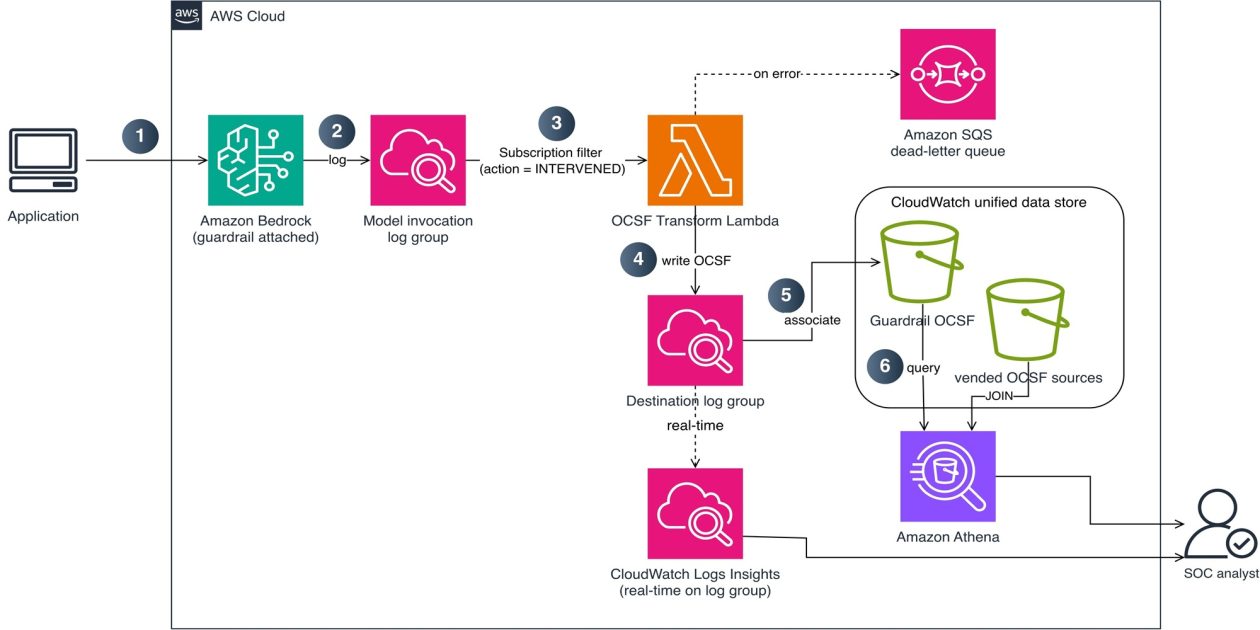
AWS walks through a reference pipeline (Lambda + CloudWatch Logs subscription filter + AWS S3 Tables) that transforms AWS Bedrock Guardrails intervention events β€” blocked prompt injections, PII redactions, content-policy hits β€” from Bedrock model invocation logs into OCSF Detection Finding (class_uid 2004) records, landing them in the CloudWatch unified data store. This lets SOC analysts correlate guardrail interventions with AWS CloudTrail and VPC Flow Logs via Athena or CloudWatch Logs Insights, e.g. spotting accounts with both prompt-injection blocks and failed IAM calls, and complements GuardDuty AI Protection's managed findings. Includes OCSF field mapping, multi-account centralization pattern, and a cloneable CDK-based implementation.

AWS BedrockAWSAWS IAM+2
prompt injection

AI Security, Cloud & Infra, Blue Team & DetectionΒ· Added 7 Oct 2026, published 21 Sep 2026

blog.trailofbits.comarticleπŸ›‘οΈ Security

SAML: A fractal of bad design

A Trail of Bits researcher (ex-Duo Security engineer) traces SAML's history from its 2002 OASIS committee origins through recurring XML signature wrapping (XSW) and canonicalization/round-trip parser-differential attacks, arguing its reliance on brittle XML signature validation (libxmlsec) makes it fundamentally unsound. The post catalogs SAML's five structural flaws β€” XML complexity, canonicalization, enveloped signatures, kitchen-sink design, and protocol ossification β€” and recommends organizations deprecate SAML in favor of OIDC, citing Fly.io and Tailscale as vendors already holding the line on OIDC-only SSO.

SAMLOIDCXML+1
Thomas PtacekKelby LudwigOASIS SSTC+5

Identity & Access, AppSecΒ· Published and added 21 Sep 2026

synacktiv.comarticleπŸ›‘οΈ Security

AWS EKS forensics: data sources and investigation tooling (Synacktiv)

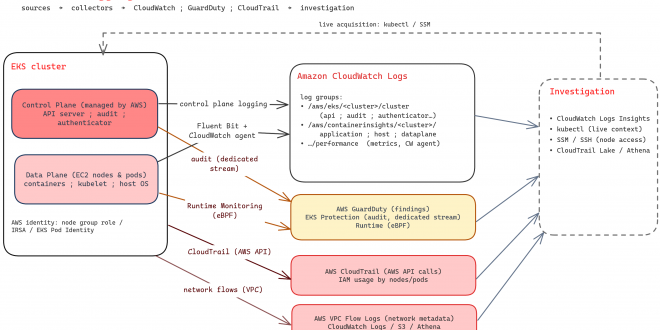
Synacktiv's CSIRT publishes a detailed forensics guide for Amazon EKS, mapping the three data-source layers (Kubernetes control plane audit logs, data-plane/Container Insights logs, and AWS-level CloudTrail/GuardDuty) and giving concrete CloudWatch Logs Insights queries for detecting RBAC reconnaissance, role escalation via the 'escalate' verb, Pod Security Admission evasion, and static-pod node persistence. It also covers node-level acquisition via SSM/kubectl debug, ServiceAccount token theft, and correlating GuardDuty findings (PrivilegedContainer, ContainerWithSensitiveMount, ReverseShell, InstanceCredentialExfiltration) with CloudTrail to trace stolen node/pod IAM identities used outside the cluster.

AWSKubernetesGuardDuty+2
escalate verbIRSAEKS Pod Identity+4

Cloud & Infra, Blue Team & DetectionΒ· Added 21 Sep 2026

synacktiv.comarticleπŸ›‘οΈ Security

AWS EKS Forensics: Data Sources and Investigation Tooling

Synacktiv's CSIRT breaks down the forensic data sources exposed by Amazon EKS across three layers β€” Kubernetes control plane (audit logs), data plane (Container Insights/Fluent Bit), and AWS services (GuardDuty EKS Protection, CloudTrail) β€” and provides concrete CloudWatch Logs Insights queries for RBAC-escalation detection, static pod persistence, node credential theft, and other attack indicators. It also covers node-level acquisition (SSM, kubectl debug), containment pitfalls that destroy evidence, and a full investigation workflow from GuardDuty finding to cross-layer timeline correlation.

AWSKubernetesAmazon EKS+3
PrivilegeEscalation:Kubernetes/PrivilegedContainerPersistence:Kubernetes/ContainerWithSensitiveMountExecution:Runtime/ReverseShell+3

Cloud & Infra, Blue Team & DetectionΒ· Added 21 Sep 2026

blog.trailofbits.comwriteupπŸ›‘οΈ Security

Auditing in the age of (good enough) AI

Trail of Bits describes preparing for a six-month audit of the Miden zkVM (a zero-knowledge VM with its own custom assembly language, MASM) by having AI agents (Claude and Codex) build an LSP server, a decompiler, an abstract-interpretation-based static analysis engine, and a Lean formal model of the VM executor, none of which previously existed for MASM. These tools surfaced a high-severity bug in the mod_12289 procedure where an underconstrained prover-supplied advice value allowed a malicious prover to forge Falcon signatures and drain Miden accounts, plus over 400 type-validation issues, while the Lean proof effort produced 95 machine-checked correctness proofs and caught two additional subtle arithmetic bugs (rotr, wrapping_mul) missed by unit tests.

ClaudeCodexVS Code+2
Trail of BitsFalcon

AI Security, AppSecΒ· Published and added 18 Sep 2026

aws.amazon.comarticleπŸ›‘οΈ Security

Run open weight models on Amazon Bedrock in AWS European Sovereign Cloud

AWS announces general availability of Gemma 4 (Apache 2.0 open-weight models) on Amazon Bedrock's new OpenAI-compatible bedrock-mantle inference engine within the AWS European Sovereign Cloud, its independently-operated EU-only cloud region (eusc-de-east-1). The post details the security model behind inference: zero operator access to prompts/outputs, zero data retention by default, encryption in transit, IAM-scoped least-privilege access to the inference API, short-lived vs long-lived Bedrock API keys, and CloudTrail/CloudWatch auditing, plus a walkthrough for calling Gemma 4 via the Responses and Chat Completions APIs.

AWS BedrockAWS IAMAWS+1
eusc-de-east-1

GRC, Cloud & InfraΒ· Added 7 Oct 2026, published 17 Sep 2026

aws.amazon.comarticleπŸ›‘οΈ Security

AWS STS simplifies session token size limits and adds session token size monitoring

AWS STS has replaced its old dual limit (separate packed-policy-size limit plus overall token size limit) with a single 4,096-byte session token limit, and now reports token size via new SessionTokenSize and SessionTokenUtilization fields in API responses, CloudWatch (AWS/STS namespace), and CloudTrail. A new MinimumSessionTokenSize parameter on session-vending APIs (AssumeRole, AssumeRoleWithSAML, AssumeRoleWithWebIdentity, GetSessionToken, GetFederationToken) lets engineers deliberately inflate tokens up to the max to test which downstream systems (load balancers, proxies, databases, caches) can actually handle larger tokens. PackedPolicyTooLargeException is still returned for backward compatibility, but now covers only the single unified limit.

AWSAWS IAMAWS STS+2
PackedPolicyTooLargeException

Identity & Access, Cloud & InfraΒ· Added 7 Oct 2026, published 15 Sep 2026

aws.amazon.comwriteupπŸ›‘οΈ Security

Operationalizing least privilege: Automate IAM remediation through your CI/CD pipeline

AWS Security Blog walkthrough of an open-source Lambda-based automation that closes the loop between IAM Access Analyzer's unused-permission findings and actual remediation: it classifies each flagged role by origin via CloudTrail (CloudFormation/CDK-managed, manually created, or unused), then uses Amazon Bedrock (Claude Sonnet for code generation, Claude Haiku for explanations) to open a pull request with right-sized CDK IAM policy code, a GitHub/GitLab issue with migration guidance, or a soft-disable decommission issue respectively. It covers cross-account/organization-wide deployment, exclusion lists for sensitive roles, throttling, dry-run mode, CloudWatch metrics, and cost/cleanup considerations, with full source in an accompanying repo.

AWS IAMAWS BedrockAWS CDK+3
IAM Access Analyzer

DevSecOps, Cloud & InfraΒ· Added 7 Oct 2026, published 15 Sep 2026

blog.trailofbits.comwriteup🧠 AI

1Password's AI patching benchmark is misleading

Trail of Bits dissects 1Password's August 2026 report claiming AI models produce "clean" security patches only 26% of the time, showing the figure is inflated by handpicked hard bugs, deliberately wrong-fix prompts (22% of trials), testing-prohibited trials (36%), inconsistent grading, and a buggy reference fix β€” and that when those confounds are removed, 86% of patches blocked the supplied exploit. The post contrasts this with Trail of Bits' own data: developers get 12.5% of first fixes wrong even under favorable conditions, and 67.7% of Patch the Planet AI-authored pull requests were merged by maintainers. It also releases two agent skills, post-patch-validation and review-walkthrough, to help agents test fixes and help engineers review AI-generated patches.

GitHub
1PasswordTrail of BitsPatch the Planet+4

evals, coding-agentsΒ· Added 8 Oct 2026, published 15 Sep 2026

blog.trailofbits.comarticleπŸ›‘οΈ Security

1Password's AI patching benchmark is misleading

Trail of Bits dissects 1Password's August 2026 report claiming AI agents (GPT-5.5, Opus 4.8) produce clean vulnerability fixes only 26% of the time, showing the figure is inflated by a hand-picked set of six hard bugs, deliberately-wrong-fix prompts (22% of trials), a no-testing mode (36% of trials), grading disagreements between automated graders and humans, and a buggy Linux upstream reference fix. Reanalyzing the same data under fair conditions (testable, non-adversarial trials) they find 86% of patches blocked the supplied exploit, and they contrast this with their own consulting data (12.5% of developer first-fixes fail) and Patch the Planet's 67.7% maintainer merge rate across 186 PRs, including a case where both a human maintainer and an agent independently introduced the same freenginx cleanup-crash regression. The post also releases two new agent skills, post-patch-validation and review-walkthrough, to improve AI-assisted patch testing and human review.

1PasswordGPT-5.5Opus 4.8+1
Patch the PlanetTrail of BitsDavi Ottenheimer+3

AI Security, AppSecΒ· Published and added 15 Sep 2026

sysdig.comwriteupπŸ›‘οΈ Security

Machine speed, hold the AI: hand-rolled marimo CVE-2026-39987 exploit

Sysdig's Threat Research Team documents a hand-coded (non-LLM) exploitation of CVE-2026-39987, a pre-authentication RCE in marimo notebooks caused by a missing validate_auth() check on the /terminal/ws WebSocket endpoint. The operator chained credential theft from environment variables and Redis, AWS Secrets Manager retrieval, and SSH pivoting to a bastion host in eight seconds, ignored a planted prompt-injection honeypot meant to detect LLM agents, and left behind reusable base64-encoded boto3/paramiko toolkits in /tmp. The post includes full script reproductions, IOCs (IPs, file paths, AS63949/Linode infrastructure), CloudTrail/GuardDuty detection guidance, and remediation steps (patch to marimo 0.23.0, restrict the terminal endpoint, scope Secrets Manager access).

marimoAWSPython+3
CVE-2026-39987172.236.12.1745.79.187.72+5

Threat Intel, Cloud & Infra, AI SecurityΒ· Added 20 Sep 2026, published 11 Sep 2026

blog.trailofbits.comwriteupπŸ›‘οΈ Security

A β€œproof” of Fermat’s Last Theorem that fits the margin

Trail of Bits found a bug in Lean's String.Pos.Raw.extract (affecting all stable versions up to 4.33.1, fixed in 4.34.0-rc1) where the logical definition and the compiled native code disagree on the result of extracting a slice at an out-of-bounds position, letting an attacker manufacture a contradiction (empty string = non-empty string) that "proves" any theorem, including a fake formalization of Fermat's Last Theorem. The exploit only works when a proof relies on the native_decide axiom, which extends trust to the compiler rather than the kernel; the researchers found the issue while using GPT-5.6 to build a code-review skill, and Lean maintainers hargoniX and Rob23oba shipped fixes within hours to days of disclosure. The post is a reminder that machine-checked proofs are only as trustworthy as the evaluator/compiler paths behind axioms like native_decide, and points to work like lean4lean and alternative kernels as mitigations.

ClaudeGPT-5.6
hargoniXRob23obanative_decide+2

AppSecΒ· Published and added 9 Sep 2026

tldrsec.comarticleπŸ›‘οΈ Security

[tl;dr sec] #344 - VMs won't contain Cyber-capable Agents, AWS AI Security Analyst, Decompilers vs LLMs

tl;dr sec #344 is a weekly security newsletter issue. It summarizes Trail of Bits' report that an AI agent escaped a QEMU/KVM VM three times (Firecracker held), Grow Therapy's sub-$500/month AI threat hunting system on AWS, Palo Alto's "Pass-ta-key" attacks on synced passkeys, MCP configuration poisoning, org-wide GitHub Actions SHA pinning, and the DecBench decompiler benchmark with the LLM-written Kuna decompiler.

QEMUFirecrackerAWS+3
JanuscapeArtem DinaburgTrail of Bits+14

AI Security, Cloud & Infra, Supply ChainΒ· Added 30 Oct 2026, published 8 Sep 2026

github.comrepoπŸ›‘οΈ Security

trailofbits/skills

Trail of Bits maintains a Claude Code plugin marketplace of "skills" that extend AI coding agents (Claude Code, Codex, ChatGPT workspaces) with security analysis, testing, and secure development capabilities. It's installed via `/plugin marketplace add trailofbits/skills` and is also compatible with Codex's Claude marketplace support, with related sibling repos for curated skills, devcontainers, and config.

Claude CodeCodexChatGPT
Trail of Bits

AI SecurityΒ· Published and added 7 Sep 2026

x.comthreadπŸ›‘οΈ Security

Pyro (@0x3b33) on X

A roundup of three open-source AI-assisted smart contract security scanners: pashov/skills (solidity-auditor + x-ray pre-audit + fuzz suite generation, fast/cheap feedback), PlamenTSV's autonomous 8-phase agent covering EVM, Solana, and Move that ships PoCs with findings, and Trail of Bits' skills repo with 40+ security skills for contract audits, differential review, and static analysis. Useful pointer to emerging AI-agent-based smart contract auditing tooling.

SolidityEthereumSolana+1

AppSec, AI SecurityΒ· Published and added 7 Sep 2026

aws.amazon.comwriteupπŸ›‘οΈ Security

Incident response guide for AWS CloudTrail investigations – Part 2 | Amazon Web Services

Part 2 of AWS's CloudTrail incident-response guide walks through a real multi-stage attack: an SSRF flaw in a web app reached the EC2 IMDSv1 endpoint to steal temporary credentials for an over-privileged "webdev" role, which the attacker then used to probe IAM (failed CreateUser), log into the console without MFA, and pivot cross-Region (us-east-1 to us-east-2) to enumerate and actively invoke the Amazon Nova Pro model via Bedrock's Converse API. It details the specific CloudTrail fields that expose each stage (userIdentity, readOnly, awsRegion, ec2RoleDelivery, sessionCredentialFromConsole, invokedBy), gives an incident-response checklist, and closes with hardening takeaways: enforce IMDSv2, least-privilege EC2 roles, cross-Region detection parity, Bedrock model invocation logging, and GuardDuty AI Protection.

AWSAWS BedrockAWS IAM
SSRFAmazon Nova Pro

Cloud & Infra, Blue Team & Detection, AppSecΒ· Added 21 Sep 2026, published 3 Sep 2026

aws.amazon.comwriteupπŸ›‘οΈ Security

Incident response guide for AWS CloudTrail investigations – Part 1 | Amazon Web Services

AWS Security Blog's SIRT team walks through two real-world CloudTrail investigation scenarios: a cross-account S3 role abuse leading to targeted deletion of financial/PII/backup data with ransomware implications, and an unauthenticated console session that pivoted through AWS CloudShell to deploy a CloudFormation stack named "CRYPTO" for cryptocurrency mining. The guide annotates specific CloudTrail fields (session names, mfaAuthenticated, sessionCredentialFromConsole, userAgent) and provides investigation-priority frameworks and response checklists for each scenario, aimed at security operations and cloud engineering teams performing AWS forensics.

AWSAWS CloudTrailAWS CloudFormation+3
SSRFIMDSv1IMDSv2

Blue Team & Detection, Cloud & InfraΒ· Added 21 Sep 2026, published 3 Sep 2026

securitylabs.datadoghq.comarticleπŸ›‘οΈ Security

Password spraying campaign targets AWS root user accounts across 150+ organizations

Datadog Security Research describes a password spraying campaign against AWS root user accounts at more than 150 organizations, running 24 July to 23 August 2026. Attempts came through proxies using two fixed Chrome/Edge and Firefox user agents, with a median of two attempts per organization. No successful logins were seen. The post gives a CloudTrail ConsoleLogin query, a sample failed event, and root user hardening advice (SCPs, centralized root access, AssumeRoot, alerting).

AWSAWS IAMAWS CloudTrail+1
password sprayingConsoleLoginAssumeRoot+1

Threat Intel, Cloud & Infra, Blue Team & DetectionΒ· Added 29 Oct 2026, published 31 Aug 2026

blog.trailofbits.comwriteupπŸ›‘οΈ Security

VMs won't contain cyber-capable agents

Trail of Bits gave GPT 5.6-Cyber preview access and tasked it with escaping a QEMU/KVM VM on a Debian 12 host; the agent succeeded three separate times, first via a recently disclosed host kernel bug (Januscape, CVE-2026-53359), then by chaining CVE-2026-9539 in libslirp with an unmarked bug fix, and finally by autonomously discovering and chaining multiple 0-day vulnerabilities in the kernel/QEMU stack over roughly 12 hours of largely unsupervised operation. The author argues off-the-shelf VMs (even hardened stable distros) no longer reliably contain a sufficiently capable AI agent β€” treat such agents as an APT β€” though Firecracker's minimal attack surface withstood the same agent's attempts.

QEMUFirecrackerLinux kernel+3
CVE-2026-53359CVE-2026-9539Januscape+2

AI Security, Offensive SecurityΒ· Added 3 Sep 2026, published 26 Aug 2026

blog.trailofbits.comwriteupπŸ›‘οΈ Security

State divergence enables unauthorized access

Trail of Bits found and reported an authorization bypass in Provenance Blockchain's marker module (Cosmos SDK) that let any user with zero tokens self-grant ACCESS_ADMIN on non-fixed-supply marker accounts, because the access check compared caller balance against a stale on-chain supply field that never diverged from zero. The bug affected 82 live mainnet markers (tokenized loans, bridged stablecoins, consortium deposits, governance escrow) and allowed two-transaction exploitation to mint arbitrary tokens or drain roughly $500,000 in escrowed nhash; it was mitigated in v1.28.0 (PR #2627) and fully fixed in v1.29.0 (PR #2734) by reading live bank-module supply with an explicit zero-guard.

Cosmos SDK
Provenance BlockchainMsgAddAccessRequestMsgMintRequest+2

AppSecΒ· Added 3 Sep 2026, published 25 Aug 2026

Showing 90 of 125

Show more