Skip to content

51 results for โ€œChinaโ€

What you seeeverything
securityweek.comarticle๐Ÿ›ก๏ธ Security

PHP2Shell Attacks Root Palo Alto Firewalls but Fail Against WordPress

PHP2Shell (CVE-2026-109618 and CVE-2026-109619) has been exploited for over a week. A China-linked group chained it with the Fragnesia Linux kernel privilege escalation to root at least 25 Palo Alto Networks PAN-OS firewalls with exposed management interfaces. Defiant had seen no confirmed WordPress compromise by 28 October 2026 despite 77,000 requests, and Cato and watchTowr report few successful attackers.

PAN-OSPHPWordPress+2
CVE-2026-109618CVE-2026-109619PHP2Shell+8

Threat Intel, AppSecยท Published and added 30 Oct 2026

securityweek.comarticle๐Ÿ›ก๏ธ Security

Chinese Hackers Quietly Used Low-Severity ESXi Logging Flaw as Zero-Day

CVE-2026-41709 is a low-severity insufficient-logging flaw in VMware ESXi that lets a logged-in administrator perform operations without audit entries. CISA added it to the KEV catalog, and CrowdStrike reported that China-nexus actor Warp Panda used it as a zero-day against US organizations, including law firms, to cut audit visibility. The article also covers exploitation of vCenter bugs CVE-2026-59309 and CVE-2026-59310 and lists the fixed ESXi builds.

VMware ESXiVMware vCenterCrowdStrike
CVE-2026-41709CVE-2026-59309CVE-2026-59310+10

Threat Intelยท Published and added 29 Oct 2026

securityweek.comarticle๐Ÿ›ก๏ธ Security

China-Linked Hackers Exploit PHP2Shell to Root Firewalls

A China-linked actor chained PHP2Shell (CVE-2026-109618, CVE-2026-109619) with the Fragnesia Linux kernel privilege escalation (CVE-2026-46300) to root firewalls and drop PHP webshells, per Dream. Using FOFA, the actor narrowed 19,000 firewalls to 240 targets and rooted 24 on 23-24 October. On two US government-affiliated devices it used a reverse SSH tunnel, hit the firewall management server, and attempted LDAP and Active Directory abuse.

PHPLinux kernelSSH+2
CVE-2026-109618CVE-2026-109619CVE-2026-46300+7

Threat Intel, Offensive Securityยท Published and added 28 Oct 2026

securityweek.comarticle๐Ÿ›ก๏ธ Security

Stolen AI Reasoning Could Help China Build Cheaper Rivals

Compaction Smuggling is an attack found by Xint that bypassed OpenAI's August 2026 mitigations against stealing reasoning traces from proprietary LLM APIs. It encodes one model's reasoning inside a compaction and replays it to another model (for example gpt-4.1 or gpt-4o), which outputs it verbatim. OpenAI fixed it and paid a $6,000 bounty on 23 October 2026. The article ties it to distillation by Chinese labs, citing a September CISA warning.

OpenAILLMDeepSeek+3
Compaction SmugglingXintCISA+8

AI Security, Threat Intelยท Published and added 26 Oct 2026

securityweek.comarticle๐Ÿ›ก๏ธ Security

China APT Uses AI Pentest Tool Artex in ConnectWise Attacks

Storm-0940, a China-linked APT, used the open source AI penetration testing framework Artex to automate a mid-October 2026 campaign against ConnectWise customers, per Microsoft. Artex drove reconnaissance, password spraying and OAuth application abuse at more than 2,900 attempts per minute, with sign-in attempts against over 2,250 tenants. Attackers modified application credentials for persistence, and Microsoft advises correlating service principal sign-ins with Graph activity.

Microsoft Entra IDMicrosoft 365OAuth+3
Storm-0940ArtexConnectWise+4

Threat Intel, AI Security, Identity & Accessยท Published and added 23 Oct 2026

github.comrepo๐Ÿ›ก๏ธ Security

Spectrmachina/Ztrust

ZTrust is a Python supply-chain scanner that checks manifests, lockfiles, source and GitHub workflows for vulnerable or malicious dependencies (via OSV.dev), typosquats, leaked secrets, unsafe lockfiles and risky CI patterns such as pwn requests and script injection. It outputs console, JSON and SARIF 2.1.0 and ships as a GitHub Action. It also includes a FastAPI bounty service using commit-reveal and shielded Zcash payouts for researchers.

PythonGitHub ActionsOSV+3
xz-utilstj-actions/changed-filesevent-stream+3

Supply Chain, DevSecOpsยท Added 27 Oct 2026, published 22 Oct 2026

microsoft.comwriteup๐Ÿ›ก๏ธ Security

AI-driven, large-scale nation-state campaign using ARTEX enables supply chain compromise

Microsoft Threat Intelligence report on Storm-0940, a China-state aligned actor that used the open-source agentic AI pentest framework ARTEX from September 2026 to automate attacks on hundreds of organizations. It links the actor to the October 2026 ConnectWise multi-tenant OAuth app compromise (2,250+ tenants, 2,900 sign-ins per minute, privileged access in under 3 hours). It gives IOCs, Defender XDR and Sentinel KQL hunting queries, ATT&CK mapping and mitigations.

Microsoft 365Microsoft Entra IDMicrosoft Defender XDR+3
Storm-0940ARTEXConnectWise Cloud Backup+12

Threat Intel, AI Security, Identity & Access, Blue Team & Detectionยท Published and added 21 Oct 2026

interconnects.aiarticle๐Ÿง  AI

Latest open artifacts (#25): DeepSeek V4.1 Flash 1017, American-made models, and new regulatory controls in the US & China

Interconnects' Latest open artifacts (#25) covers open-weight AI in fall 2026. Policy items: China's MOFCOM proposal for pre-approval of international model sharing, and a DHS order barring DeepSeek from federal civilian procurement. DeepSeek released its internal inference stack DeepInfer. Picks include MiMo-V2.6-Pro-RL, DeepSeek-V4.1-Flash-1017 (552B-A16B, MIT), Clef, Nemotron-3.5-Super-VL and Reflection's Beam-1.0 (Apache 2.0).

DeepSeekvLLMSGLang+8
InterconnectsDeepSeek-V4.1-FlashDeepInfer+23

models, ai-policy, inferenceยท Published and added 20 Oct 2026

decrypt.coarticle๐Ÿง  AI

US Orders Civilian Agencies to Rip DeepSeek Out of Government Systems

The US Department of Homeland Security ordered civilian agencies to remove DeepSeek products and third-party services built on the model from their IT systems, and barred new purchases. The notice cites possible transfer of sensitive data to the PRC and intelligence on US persons. The article lists earlier bans by Commerce, the Navy and three states, and notes DeepSeek's open MIT-licensed V4 models can be hosted outside China.

DeepSeek
Department of Homeland SecurityPerplexityNVIDIA+9

ai-policyยท Published and added 19 Oct 2026

eprint.iacr.orgpaper๐Ÿ›ก๏ธ Security

Revisiting the Security of VDOO

Revisiting the Security of VDOO is an ePrint paper (October 2026) on VDOO, a multivariate signature scheme submitted to China's NGCC program. It models VDOO as a multilayer Rainbow construction, keeps only the last oil space to get a generalized UOV instance, and applies wedge attacks. For the 512-bit parameter set it estimates 2^432 gates (reconciliation) and 2^379 gates (intersection), below the claimed level and the specification's figures.

VDOORainbowUOV
NGCCwedge attackreconciliation attack+1

otherยท Added 19 Oct 2026, published 18 Oct 2026
latent.spacearticle๐Ÿง  AI

[AINews] High Taste Testers Ep. 1

AINews issue for 10/15โ€“10/16/2026, covering Twitter and Reddit. It covers the open-weights releases Meta's Muse Spark Open (816B/42B-active MoE, AA Intelligence Index 39, custom license) and Reflection Beam 1.0 (501B/23B-active, Apache 2.0), plus NVIDIA Nemotron 3.5, StepFun Step 5 Preview and FLUX 3 Image Klein. It also covers Gemini 4 Argon, Haiku 5.5 pricing, "decision model" classifiers (Liquid d1-ultra, Perplexity pplx-decider), TPUv7/Vera Rubin/MI355X serving benchmarks, interpretability claims (Qwen3-32B neuron audit), agent research, eval-integrity and safety disclosures, and China export-control proposals. The page also announces a pilot video show, High Taste Testers Ep. 1.

Mixture of ExpertsvLLMSGLang+15
Latent SpaceMetaMuse+44

models, inference, evalsยท Published and added 17 Oct 2026

latent.spacearticle๐Ÿง  AI

[AINews] High Taste Testers Ep. 1

AINews issue for 15-16 October 2026, from Latent Space, summarising 12 subreddits and 544 Twitter accounts. It covers Meta's Muse Spark Open (816B MoE) and Reflection Beam 1.0 with Artificial Analysis scores and pricing. It also covers Gemini 4 Argon, decision models, TPUv7 and Vera Rubin serving benchmarks, interpretability claims, agent papers, and China's proposed open-source export rules.

vLLMSGLangMLX+13
Latent SpaceMetaMuse+43

models, inference, evalsยท Added 30 Oct 2026, published 17 Oct 2026

securityweek.comarticle๐Ÿ›ก๏ธ Security

Chinese APT Exploited BeyondTrust Vulnerability as Zero-Day

SecurityWeek reports that China-linked Armory Castle (UNC5221, Warp Panda) exploited CVE-2026-102764 (CVSS 9.3), an improper origin validation flaw in BeyondTrust Remote Support enabling file operations, as a zero-day from August 29. Mandiant/GTIG observed the Sawfly PHP webshell and Bareclaw SOCKS5 tunneler, root takeover, credential harvesting, log deletion, and abuse of the native file transfer service for exfiltration. Patch BT26-05-RS covers versions through 26.2.3; the actor's earlier edge-device zero-days (CitrixBleed, Ivanti Connect Secure, Dell RecoverPoint) are listed.

BeyondTrust Remote SupportPHPCitrix NetScaler+2
CVE-2026-102764CVE-2023-4966CVE-2023-46805+12

Threat Intelยท Published and added 16 Oct 2026

x.comthread๐Ÿง  AI

Vaibhav Sisinty (@VaibhavSisinty) on X

Social post reporting Meta's release of Muse Spark Open, described as the most capable US open-weight model: 816B total and 42B active parameters, a 1M-token context, and text, image, video and audio input in one model. It is pitched at coding and agentic work and tuned to run on two M5 Ultra Mac Studios, with weights available at release. The poster notes that in Meta's own chart, China's Kimi K3 and GLM 5.3 still beat it on coding.

MetaMuseMuse Spark Open+3

models, multimodalยท Added 16 Oct 2026, published 15 Oct 2026

nachi065.github.ioother๐Ÿ›ก๏ธ Security

AI Security Wiki: Governance, Risk, Standards and Test Cases

A vendor-neutral AI Security Wiki acting as an implementation layer for enterprise AI adoption: risk methodology, AI risk register, control objectives library, domain standards (browser/IDE AI, runtime apps, agentic AI, sovereignty), vendor evaluation framework, and audit/evidence checklists. It includes a 653-case product evaluation test library across 17 lifecycle layers and 6 emerging domains, plus regulatory hubs for GCC, EU, Australia, Brazil, Canada, China, India, Japan, Singapore, South Korea, UK and US, and crosswalks to FINOS AIGF, NIST AI RMF, ISO/IEC 42001, OWASP, MITRE ATLAS, ISO 27001 and others. Useful as a template and evidence source for teams building AI governance and assurance programmes.

FINOS AI Governance FrameworkNIST AI RMFISO/IEC 42001+8

GRC, AI Securityยท Added 15 Oct 2026
cisa.govadvisory๐Ÿ›ก๏ธ Security

CISA AA26-281A: Chinese Government-linked Actors Combine Automated and Hands-on Hacking Tools to Steal Data

Joint FBI/CISA/NSA and allied-agency advisory on China-linked actors enabled by Integrity Technology Group (overlapping with Flax Typhoon, Ethereal Panda, Red Juliett). It details their TTPs: open-source scanners and the MicroScan exploit-script app, an XSS credential-harvesting payload dropping live700_v1.exe, EBurst password spraying against Exchange/O365, SoftEther VPN persistence, DCSync via DC.exe, and email theft via the Curlc4.txt PHP bot and the office-cli utility. It also provides IOCs, MITRE ATT&CK mappings, CVEs, incident response steps, and mitigations.

SoftEtherMicrosoft 365Active Directory+3
Integrity Technology GroupFlax TyphoonEthereal Panda+13

Threat Intel, Blue Team & Detectionยท Added 9 Oct 2026

eprint.iacr.orgpaper๐Ÿ›ก๏ธ Security

Distinguishers for the Squeezing of the Alternating Sponge and Duet

Cryptanalysis of the Alternating Sponge (ASP) and Duet, a permutation-based hash candidate in China's ICCS Next Generation Commercial Cryptographic Algorithm program (NGCC). The authors give an O(2^r)-query distinguisher against ASP that contradicts its claimed indifferentiability bound in some parameter regimes. They also give a distinguisher and state-recovery attack on Duet's multi-block output, using O(2^(r+c-h)) permutation queries. Collision and preimage resistance are unaffected, but Duet used as a XOF or KDF is affected, and state recovery enables length extension.

Gaรซtan LeurentCรฉsar MathรฉusInstitute of Commercial Cryptography Standards+4

otherยท Added 12 Oct 2026, published 9 Oct 2026

securityweek.comarticle๐Ÿ›ก๏ธ Security

US Disrupts Chinese State-Sponsored Hacking Tools

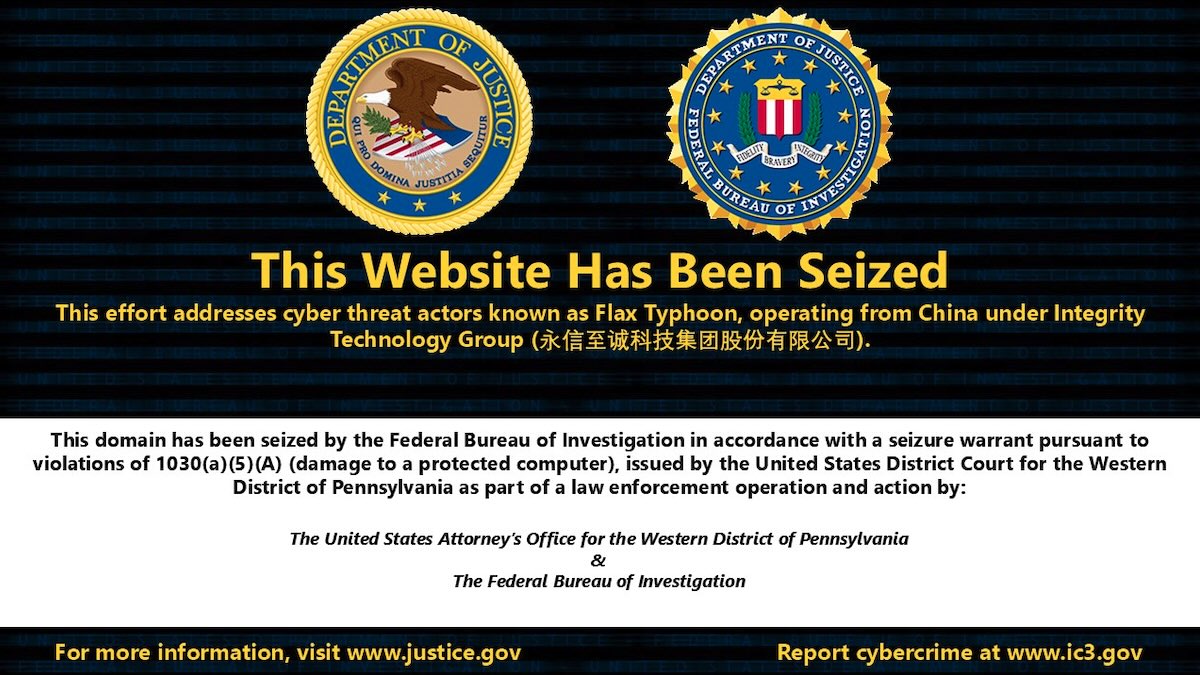
The US, alongside UK, Australian, Canadian, Japanese, New Zealand, and Spanish agencies, disrupted MicroScan and FishHub, hacking tools built by China's Integrity Technology Group and used by the state-sponsored actor Flax Typhoon (aka Ethereal Panda, Red Juliett, Storm-0919, UNC5007) against US, Japanese, Polish, and Taiwanese critical infrastructure and universities. MicroScan is a Python-based scanner with over 1,300 penetration-testing scripts targeting Apache Struts, Jenkins, WebLogic Server, WordPress, OpenSSL, and other services, delivered via a Mirai-derived IoT botnet; FishHub let operators remotely search and exfiltrate files from victim networks. The advisory also details the group's broader toolkit (SoftEther VPN for persistence, EBurst for Exchange password spraying, DC.ex for Active Directory data extraction) and the seizure of the domains used to access the tools.

NmapWordPressActive Directory+3
Flax Typhoon (Ethereal Panda, Red Juliett, Storm-0919, UNC5007)Integrity Technology GroupMicroScan+4

Threat Intel, Offensive Securityยท Published and added 9 Oct 2026

decrypt.coarticle๐Ÿง  AI

AI Startup Manus Raises $500 Million After China Nixed Metaโ€™s $2 Billion Acquisition

Reports that Butterfly Effect, parent of Chinese AI agent startup Manus, raised over $500 million led by Boyu Capital and IDG Capital (with Tencent, HSG and ZhenFund), after China's National Development and Reform Commission ordered Meta's roughly $2 billion acquisition of the company unwound as prohibited foreign investment. It traces Manus's trajectory from its March 2025 invite-only launch (built on fine-tuned Anthropic Claude and Alibaba Qwen models) through $100M ARR, relocation to Singapore, the blocked Meta deal, and its pivot to a new agent product called Cue, situating the episode within Beijing's wider tightening on AI firms including new travel-approval rules for senior AI staff at companies like Alibaba and DeepSeek.

ClaudeQwen
ManusButterfly EffectMeta+17

ai-policyยท Published and added 8 Oct 2026

x.comthread๐Ÿ›ก๏ธ Security

Dark Web Intelligence (@DailyDarkWeb) on X

A Twitter/X post digests joint advisory AA26-281A from FBI, CISA, NSA and allied agencies (UK, Australia, Canada, Japan, New Zealand, Spain) on China-based Integrity Technology Group enabling threat actors, tracked elsewhere as Flax Typhoon, Ethereal Panda and Red Juliett, to target US critical infrastructure, government, healthcare, education and law enforcement networks worldwide. The actors chain open-source scanners, large botnets, XSS, password spraying against Microsoft Exchange, VPN persistence and credential-harvesting scripts. CISA added five exploited CVEs (ISC BIND, Apache Struts, ProFTPD, ONLYOFFICE Docs, Strapi) to its KEV catalog with an Oct 11 federal remediation deadline, and STIX IOCs accompany the advisory.

ISC BINDApache StrutsProFTPD+3
CVE-2015-5477CVE-2016-3081CVE-2015-3306+7

Threat Intelยท Published and added 8 Oct 2026

newsletter.semianalysis.comarticle๐Ÿง  AI

Beijing Will Not Pace the Frontier: Chinaโ€™s Speed-First AI Safety Regime

SemiAnalysis argues China's AI safety regime is speed-first: strict on application content, with no frontier-risk duties tied to compute or capability. It builds a dataset of 857 releases from nine Chinese labs, of which only 31 (3.6%) have a published safety result. It also codes 102 expert texts and reviews TC260 Framework 3.0, SAIL, and CAICT.

Inspect
SemiAnalysisDario AmodeiDonald Trump+36

ai-policy, ai-safety, evalsยท Added 29 Oct 2026, published 8 Oct 2026

galaxy.comarticle๐Ÿง  AI

AI Labsโ€™ Call to

A Galaxy Research newsletter piece dissecting Dario Amodei's essay "We Must Pace the Frontier," which proposed embedded third-party evaluators (e.g. METR), cross-lab safety coordination with antitrust waivers, and eventual global AI governance including China. The piece separates Amodei's "operational" (QA/pipeline) and "research" (alignment, interpretability, evals) problems from his "Democratic Coordination" ask, arguing the latter functions as a regulatory moat rather than a necessity, and draws a parallel to Sam Bankman-Fried/FTX-era effective-altruism rhetoric about unilateral existential-risk authority. It covers reactions from Sam Altman (agreeing to adopt evaluators), Trump (rejecting slowdown, citing the AI race with China), David Sacks (questioning METR's neutrality), and Mark Zuckerberg (citing Meta's unilateral delay of Muse and existing liability incentives as sufficient without an industry pact).

Hugging Face
Dario AmodeiAnthropicSam Altman+12

ai-policyยท Added 8 Oct 2026

securityweek.comarticle๐Ÿ›ก๏ธ Security

US Seeks Alleged Chinese Hafnium Hacker With $10 Million Reward

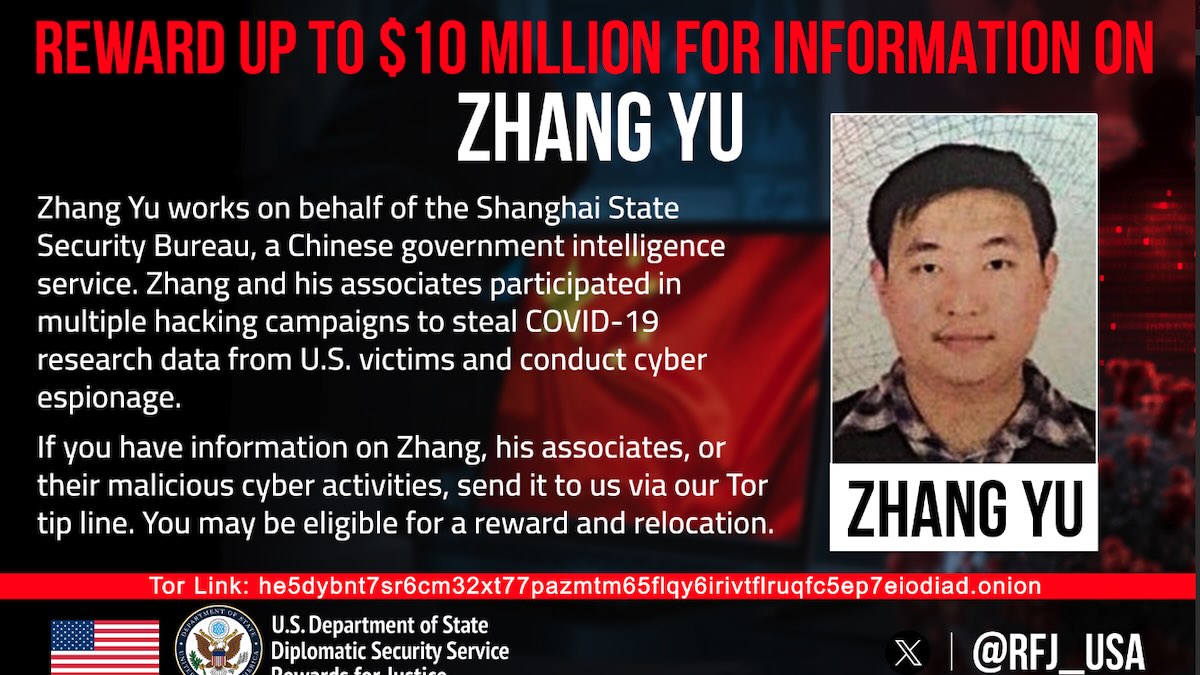
The US State Department's Rewards for Justice program is offering up to $10 million for information on Zhang Yu, a Chinese national charged alongside Xu Zewei for the 2021 Hafnium campaign that exploited Microsoft Exchange Server vulnerabilities and for earlier theft of COVID-19 research from US universities and immunologists starting in 2020. Zhang is identified as a director at Shanghai Firetech Information Science and Technology Company allegedly acting for the Shanghai State Security Bureau (part of China's MSS); Xu was extradited from Italy in April 2026 and has appeared in a Houston federal court while Zhang remains at large. Microsoft now tracks the Hafnium activity as Silk Typhoon; the FBI said the campaign compromised more than 12,700 US organizations.

Microsoft Exchange Server
HafniumSilk TyphoonZhang Yu+7

Threat Intelยท Published and added 8 Oct 2026

securityweek.comarticle๐Ÿ›ก๏ธ Security

TP-Link Faces State Lawsuits and New Scrutiny Over ISP Router Flaws

Florida, Iowa, Montana, and Nebraska sued TP-Link Systems over allegedly misleading security marketing and undisclosed China ties, joining a similar Texas suit from February; the complaints cite TP-Link routers' role in the Volt Typhoon and Flax Typhoon campaigns and botnet abuse by Chinese and Russian actors. The piece also details five newly disclosed TP-Link Aginet vulnerabilities (CVE-2025-30237 through CVE-2025-30241) reported by SEC Consult, including an unauthenticated super-admin auth bypass, a root-privilege command injection, hardcoded device-model encryption keys exposing Wi-Fi/ISP credentials, and a USB-based physical-access filesystem dump affecting 65 device models.

TP-Link
CVE-2025-30237CVE-2025-30238CVE-2025-30239+6

Hardware & RF, Threat Intel, GRCยท Published and added 8 Oct 2026

thehackernews.comarticle๐Ÿ›ก๏ธ Security

Antino Backdoor Uses Outlook and OneDrive for C2 in China-Nexus Espionage Campaign

Cisco Talos researcher Ashley Shen details a China-nexus espionage campaign (tracked as UAT-11587) targeting government and policy organizations across Taiwan, India, the Philippines, Cambodia, Pakistan, Thailand, Myanmar and Syria. The actor deploys a previously undocumented Rust-compiled backdoor, Antino, that uses Microsoft Graph to abuse Outlook (for command exchange via mailbox folders) and OneDrive (for heartbeat and file transfer) as a stealthy C2 channel instead of a dedicated server, delivered via a five-stage HTA/WSF-to-.NET-loader chain and DLL-sideloaded through the signed Microsoft binary GatherOsState.exe. The report also covers social-engineering tradecraft (a fake Gmail attachment-preview widget hosted on Cloudflare Pages, SPF/DMARC spoofing) and ties the cluster to Jewelbug, CL-STA-0049, Earth Alux, Ink Dragon, REF7707 and UNC6384 via infrastructure overlaps.

Microsoft 365RustPowerShell+5
UAT-11587AntinoJewelbug+14

Threat Intelยท Added 3 Oct 2026

rapid7.comwriteup๐Ÿ›ก๏ธ Security

SMTP is the key: BPFDoor and AVERAT hitting the network edge

Rapid7 details a new BPFDoor campaign targeting telecom and network-edge appliances (ShareTech, SpamSniper mail gateways) and a six-sample Linux RAT family dubbed AVERAT found on compromised Taiwanese CPE (Synology NAS, a NetKlass device, a Dahua DVR). The writeup reconstructs the Rapid7 BPFDoor controller's HTTP-tunneled trigger mechanism, a fileless ShareTech dropper that stages binaries as ntpdate/udevds and deletes them while processes keep running, a BPF Rekoobe variant that hides inside SMTP port-25 traffic, and AVERAT's RC4-derived config/C2 scheme โ€” tying the infrastructure to the broader China-nexus ORB (Operational Relay Box) device pattern described in CISA/NCSC-UK advisory AA26-113A. It closes with detection guidance for unlinked/deleted process execution, dropper staging artifacts, and port-25 C2 callbacks, plus full IOC and ATT&CK tables.

LinuxeBPFYARA+2
BPFDoorAVERATRekoobe+11

Malware & RE, Threat Intel, Blue Team & Detectionยท Added 7 Oct 2026, published 2 Oct 2026

helpnetsecurity.comarticle๐Ÿ›ก๏ธ Security

China-aligned TA419 impersonates Anthropic employee, ex-White House official to phish AI policy experts

Proofpoint's Mark Kelly details TA419, a China-aligned espionage group that in July 2026 impersonated former White House OSTP official Lynne Edwards Parker and economist Heidi Crebo-Rediker, and in February 2026 posed as a senior Anthropic employee, to phish US AI policy experts' cloud accounts. The attack chain uses benign-looking invitation emails followed by shortened links leading to a fake OneDrive adversary-in-the-middle page that renders a Chrome login window with the open-source Frameless BitB browser-in-the-browser tool, relaying credentials, MFA codes and session cookies live to the attackers via Cloudflare-fronted, NameSilo-registered domains. Proofpoint assesses the campaign supports Chinese intelligence collection on US AI policy and export-control developments.

CloudflareMicrosoft 365Chrome+2
TA419Frameless BitBadversary-in-the-middle phishing+9

Threat Intel, Identity & Accessยท Added 4 Oct 2026, published 2 Oct 2026

decrypt.coarticle๐Ÿง  AI

OpenAI Says People Linked to China's Moonshot Tried to Copy Its AI's Hidden Reasoning

Decrypt reports OpenAI's claim that it disrupted a campaign running from July 1 to July 28. The campaign sent about 16,000 extraction requests from over 4,000 users on July 24-25, within a cluster of more than 15,000 users, and aimed to reproduce the encrypted reasoning behind model answers. OpenAI attributes a core cluster to people associated with Moonshot AI (maker of Kimi) but says it is unclear whether a single actor was behind all of it. One method copied encrypted reasoning from one conversation and asked a model to decode it in another, and OpenAI has closed that replay pathway. The article places this in the timeline of "adversarial distillation" disputes: DeepSeek, Anthropic's account of about 24,000 fraudulent accounts, the White House, xAI/Grok, and research showing provider-wide reasoning encryption keys.

KimiClaudeGrok+1
OpenAIMoonshot AIKimi K3+5

ai-policy, trainingยท Published and added 1 Oct 2026

decrypt.coarticle๐Ÿ›ก๏ธ Security

OpenAI Says People Linked to China's Moonshot Tried to Copy Its AI's Hidden Reasoning

Decrypt reports on an OpenAI disclosure describing a campaign, starting July 1, 2026, that sent 16,000 extraction requests in a single two-day window from a cluster of over 15,000 accounts to pull out OpenAI models' encrypted "hidden reasoning" (chain-of-thought) rather than their answers. OpenAI says operators did not break encryption but manipulated model interactions to replay one conversation's encrypted reasoning for decoding in another, enabling "adversarial distillation" of a rival model's reasoning without its safety guardrails; it attributes a core cluster to individuals associated with Moonshot AI (maker of Kimi) and says it patched the replay pathway by July 28. The piece situates this alongside prior distillation disputes (DeepSeek, Anthropic's fraudulent-account claims against Chinese labs, xAI's admitted use of OpenAI outputs for Grok) and an August finding that OpenAI, Anthropic and Google each protected reasoning with a single provider-wide encryption key that attackers could coax into plaintext.

OpenAIKimi K3DeepSeek+3
Moonshot AIElon Muskadversarial distillation+1

AI Security, Threat Intelยท Published and added 1 Oct 2026

blog.talosintelligence.comwriteup๐Ÿ›ก๏ธ Security

China-nexus UAT-11587 targets government and policy organizations across Asia with Antino backdoor

Cisco Talos details UAT-11587, a China-nexus threat cluster targeting government, defense, and policy organizations across Taiwan, India, the Philippines, Cambodia, and other Asian countries with spear-phishing and a five-stage infection chain (HTA/WSF stagers, JScript decryptors, .NET BinaryFormatter/ActivitySurrogateSelector deserialization gadgets, and DLL sideloading via the signed GatherOsState.exe) to deploy a new Rust-compiled backdoor called Antino. Antino uses Microsoft Graph/Outlook/OneDrive as a dead-drop C2 channel instead of a traditional C2 server, supports shell/PowerShell execution, file transfer, shellcode loading with a sleep-mask evasion technique, and abuses the Windows Scripted Diagnostics framework for persistence; Talos also notes possible infrastructure overlap with Symantec's "Jewelbug" cluster and Arctic Wolf's UNC6384 reporting. Includes ClamAV/Snort coverage and IOCs.

RustMicrosoft 365PowerShell+4
UAT-11587AntinoJewelbug+5

Threat Intel, Malware & REยท Added 7 Oct 2026, published 30 Sep 2026

Showing 30 of 51

Show more