SingularityNET exploit (19 September 2026): attackers with signing authority exposed through a cloud infrastructure breach drained 8.72M FET from the Ethereum bridge converter, then minted about 2.3 billion AGIX, NTX, WMTX and CGV. Rekt's transaction-level reconstruction puts gross liquid proceeds near $2.29M, not the $16.77M headline, and traces laundering via Chainflip, Baltex and THORChain. It notes conversionIn() skipped checkLimits() and trusted a single EOA signature.
Decompose, Estimate, Select is a coverage-aware retrieval pipeline for long-form RAG. It splits a query into subquestions, ranks candidates with a coverage-trained bi-encoder, predicts a document-by-subquestion coverage matrix with a cross-encoder, and picks documents by greedy maximum-marginal coverage. On TREC RAG 2024, α-nDCG@10 rises from 0.625 to 0.702 (gold-nugget bound 0.718). A grounded self-feedback loop raises V_strict by 0.086 over two passes.
RAGbi-encodercross-encoder+1
TREC RAG 2024α-nDCG@10V_strict
llm-apps, research· Added 31 Oct 2026, published 29 Oct 2026
RetroChessBench is a 12-task benchmark for retrograde chess: reconstructing legal game histories, exact-length constructions, unique endings and exhaustive answer sets, with references, rubrics and a terminal-reward RL environment. GPT 6 Astra High fails to give the required final answer in 22 of 24 attempts without tools and 18 of 24 with code execution. Mean terminal RL rewards are 14.75% and 27.19%. The authors link the failures to scarce worked derivations in web training data.
GPT-6 AstraLLM
RetroChessBench
evals, research· Added 31 Oct 2026, published 29 Oct 2026
AxisQ is a post-training quantization framework for camouflaged object detection (COD) that allocates activation bits by feature depth. It uses the channel domain for shallow features and the local-frequency domain for deep features, under a fixed per-layer average bit budget. It adds a boundary-aware Hessian approximation for reconstruction. On CAMO at W2A2, weighted F-measure improves 12.7% for CFRN and 33.3% for CamoFormer-P over the strongest baselines.
CNNTransformer
AxisQCFRNCamoFormer-P+1
research, inference, multimodal· Added 28 Oct 2026, published 27 Oct 2026
AlgOssa is a decentralized secure aggregation protocol built on Ossa, a generic committee-aided, single-server construction for one-shot clients (following OPA and Willow, CRYPTO 2025). Ossa realizes secure aggregation with non-selective abort against a malicious server. AlgOssa adds Algorand-style sortition to rotate leaders and committees, bounds the chance of an honest server, and gives eventual delivery. Classical and post-quantum routes are evaluated.
An empirical study of security concerns in the OpenClaw AI personal assistant framework, using 25K+ posts from 13 subreddits (162 security-relevant) and 358 security-tagged GitHub issues (180 retained). It maps 521 CWE instances across 59 weakness types, concentrated in access control, sensitive-data exposure, injection and unsafe execution. It extracts 543 practitioner mitigations into seven strategies and reconstructs a sensitive-data exposure path with dummy secrets.
OpenClawGitHubLLM
prompt injectionCWEtrust boundaries+1
AI Security· Added 28 Oct 2026, published 26 Oct 2026
SynTrace is a single-round compiler that adds accountability to linear private information retrieval (PIR). The client mixes the retrieval query with m audit queries, so audit syndromes identify up to d deviating servers among t colluding ones before reconstruction. The paper proves perfect query privacy and zero false identification within the threshold. For Shamir-based PIR it needs k=t+d+1 servers. For a 32 KiB record from a 1 GiB database it uses 2.25 MiB, against 8.96 MiB for the Eriguchi, Kurosawa and Nuida (TCC 2022) homomorphic-MAC construction.
SymLift is a compile-free vulnerability detection framework for code fragments that lack project context. A fine-tuned LLM reconstructs control-flow, data-flow, memory and resource relations as a constrained LLVM-like IR, and a deterministic parser turns it into facts for Datalog rules that give findings with derivation traces. SymLift-Qwen-7B reaches 94.41% Target-F1 on FormAI and 91.66% micro-averaged Target-F1 on MegaVul.
LLMQwenDatalog+3
SymLiftSymLift-Qwen-7BFormAI+2
research, training· Added 28 Oct 2026, published 25 Oct 2026
IntentDelta is a human-constructed multi-turn benchmark of 638 trajectories and 3,766 turns across WebShop and TravelPlanner. Each turn pairs a user utterance with a cumulative intention state and human reference actions. Across eleven agents, average Intention Recovery is 33.1% in TravelPlanner and 44.7% in WebShop, and average Action Score is 31.6% and 41.0%. Agents lose earlier requirements and confuse soft preferences with must-have constraints.
LLM
IntentDeltaWebShopTravelPlanner+1
evals, agents, research· Added 27 Oct 2026, published 24 Oct 2026
Extraction meets Distillation is an IACR ePrint paper (2026/2628, CSCML 2026) that combines cryptanalytic weight-direction extraction with label-based distillation to reconstruct fully connected neural networks. It adapts a ReLU extraction implementation to Leaky ReLU and proves conditional bounds for direction recovery and sign selection. On CIFAR-10 victims, reconstructed models reach 56.40% and 58.29% agreement. It separates label requests from privileged access and notes that prediction agreement does not identify parameters.
ReLULeaky ReLU
CSCML 2026CIFAR-10
AI Security· Added 26 Oct 2026, published 24 Oct 2026
The paper formalizes elliptic-curve semiprimality certificates by adapting the Goldwasser-Kilian primality criterion. For certificates built with complex multiplication, a norm-lattice reconstruction factors N from (N, S, D) alone in expected polynomial time. The author uses it, plus public-point and quadratic-twist attacks, to factor Reble's 1084-digit and Broadhurst's 5061-digit moduli, and shows that hidden-cofactor, withheld-CM-map and private-isogeny repairs also fail.
Rentaro Shiba and Tetsu Iwata prove a tight multi-key security bound for the FX construction (the DESX generalization) in the quantum ideal cipher model. Security holds up to about 2^((n+κ)/3) total classical and quantum oracle queries against fully adaptive adversaries, for any number of keyed instances μ≥1. This improves their ToSC 2026 bound and matches the offline Simon's algorithm attack in the exponent.
Tampered ML is a benchmark of 1,858 item-pairs, each pairing an experiment proposal reconstructed from a published ML paper with a minimally edited version that adds a targeted methodological flaw. Models must pick the sounder proposal in both presentation orders. A human study estimates 86% of items are valid (95% CI 81-91%). Opus 5 reaches 77.9% accuracy, and models are sensitive to order and favor flawed designs that look more specific, transparent, or conventional.
LLM
Tampered MLOpus 5arXiv
evals, ai-safety, research· Added 26 Oct 2026, published 23 Oct 2026
Field note from dfir.ch on PowerShell scripts an attacker left on disk during an incident: a file-watching command runner using Invoke-Expression, a fake Windows credential prompt that validates passwords via Start-Process and logs them in cleartext, AD computer enumeration with WMI access testing, and SMB share discovery via NetShareEnum. It notes where script labels overstate what they prove and lists hunting strings for Event IDs 4104, 4103, 4688 and Sysmon 1.
PowerShellActive DirectoryWMI+2
TerminalFixClickFixMicrosoft+7
Blue Team & Detection, Offensive Security· Added 24 Oct 2026, published 22 Oct 2026
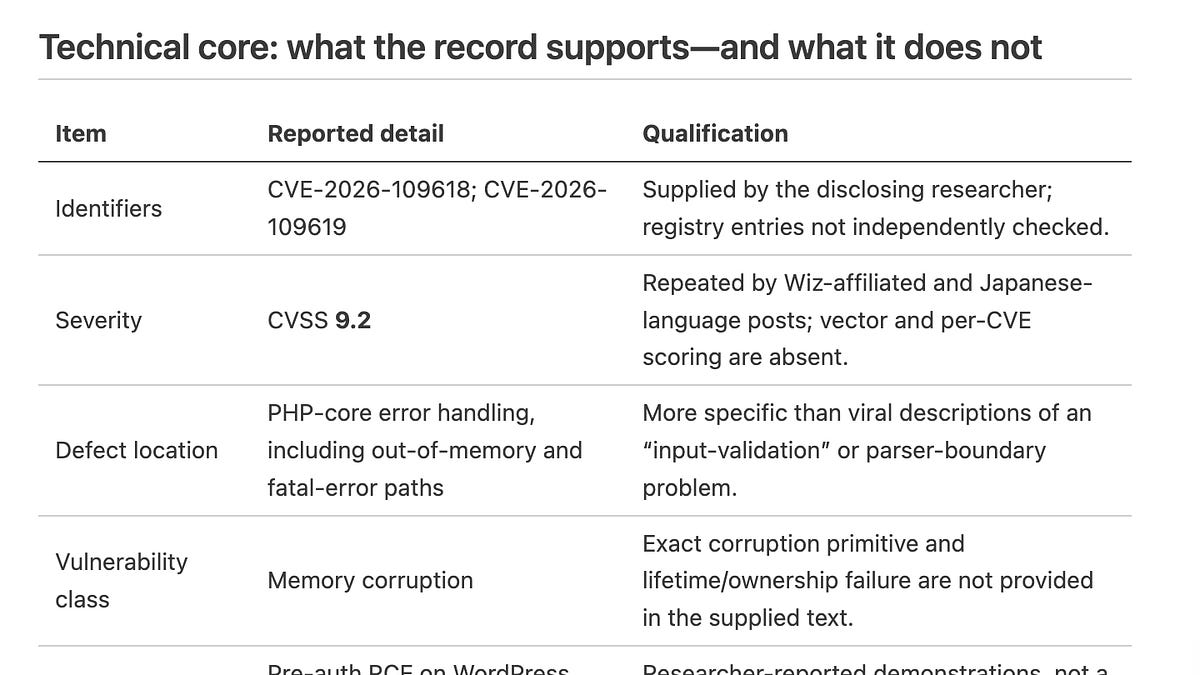
This AINews issue (20 to 21 October 2026) leads with PHP2Shell, two PHP-engine memory-corruption bugs (CVE-2026-109618 and CVE-2026-109619). Calif researchers found them with GPT-5.6 Sol under OpenAI's Patch the Planet, and Wiz reportedly found them independently with Gemini 4 Argon. It reconstructs the two-month coordinated response, Cloudflare WAF stopgaps and NSA guidance, and the dispute over vetted researcher access to models. Only the first 40,000 of 114,281 characters were reviewed.
PHPWordPressDrupal+6
CVE-2026-109618CVE-2026-109619OpenAI+18
ai-policy, models· Added 23 Oct 2026, published 22 Oct 2026
AINews issue of 20-21 October 2026 whose top story reconstructs PHP2Shell (CVE-2026-109618, CVE-2026-109619), two PHP-engine memory-corruption bugs with reported pre-auth RCE against WordPress, Drupal and Joomla. It covers the two-month coordinated disclosure, independent discovery by Calif/OpenAI (GPT-5.6 Sol) and Wiz, Cloudflare WAF stopgaps and NSA guidance. It flags missing primary sources: fixed versions, CVSS and leak details.
PHPWordPressDrupal+3
CVE-2026-109618CVE-2026-109619PHP2Shell+9
AppSec, AI Security· Published and added 22 Oct 2026
AINews issue of 20-21 October 2026 whose top story reconstructs PHP2Shell, two PHP-engine memory-corruption flaws (CVE-2026-109618 and CVE-2026-109619) with reported pre-auth RCE against WordPress, Drupal and Joomla. It covers the two-month coordinated response, separate discovery by Calif/OpenAI (GPT-5.6 Sol) and Wiz (Gemini 4 Argon), Cloudflare's WAF stopgap and NSA guidance. It lists open gaps: fixed versions, leak details, exploitation versus scanning.
PHPWordPressDrupal+3
CVE-2026-109618CVE-2026-109619PHP2Shell+12
AppSec, AI Security· Added 23 Oct 2026, published 22 Oct 2026
SoK on design-level backdoors in block ciphers. It places four published designs (Rijmen and Preneel, Paterson, Bannier and Filiol, Peyrin and Wang) in one taxonomy and gives a sound algorithm that recovers a partition trapdoor from S-box tables. It attacks KG-DES, BEA-1 and LowMC-M: KG-DES key recovery takes minutes, and the LowMC-M MALICIOUS backdoor yields the key from 35 to 409 queries. Trapdoors hidden in linear layers leave no trace, so the authors recommend deriving constants verifiably from a public seed.
Survey and human-coded evidence map of 118 RAG defense papers, organized by measured endpoint across a seven-family taxonomy (content disclosure, formal privacy proxies, access control, corpus-use detection, pipeline integrity). Only 17.8% of studies use disclosure or reconstruction as the primary endpoint, and most use non-adaptive attacks on general QA data. A testbed shows a normalized 8-gram guard cuts 20-token copying to 0.0%, yet a three-query adaptive attacker recovers 48.3% of hidden facts on Qwen3-8B.
QwenLLM
prompt injection
AI Security· Added 24 Oct 2026, published 21 Oct 2026
Reverse Engineering IVXV is an October 2026 ePrint paper by Tingfeng Yu and Thomas Haines that reconstructs a specification of Estonia's IVXV internet voting system from public source code and documentation, with an executable TLA+ model checked in TLC. It analyses individual and universal verifiability, privacy, coercion resistance and eligibility, compares IVXV with Belenios and Swiss Post, and reports new vulnerabilities, some confirmed with proof-of-concept tests, plus mitigations.
Code2Video-Compass is a benchmark of 2,104 tasks for code-based video generation, where multimodal LLMs write executable programs that produce complete videos from text (T2V), image (I2V) or video (V2V) inputs. Tasks span 10 categories and 24 subtypes. Scoring uses 12 objective metrics and five MLLM-judge metrics. Across 15 proprietary and open-weight models from nine families, performance falls as construction, dynamic animation and state-dependency complexity rise.
vision-language modelLLM
Code2Video-CompassarXiv
evals, multimodal, research· Added 22 Oct 2026, published 20 Oct 2026
Depth First Security's write-up describes three V8 bugs found using its dfs-large1 research tooling: CVE-2026-78938, a type confusion in Promise.prototype.finally that lets an internal helper be constructed and return a primitive; CVE-2026-79236, a TurboFan load-elimination bug that keeps a stale property-array pointer after object migration; and a shared WebAssembly memory sandbox escape (issue 546253900) caused by mismatched backing-store registration during serialization. It walks through turning each memory bug into addrof/fakeobj primitives, chaining either with the sandbox escape to reclaim a freed V8 isolate via a WebSocket allocation, and pivoting through a CFI-constrained ROP chain to achieve Chrome renderer code execution, earning two v8CTF flags. Fixes landed between August 20 and 25, 2026.
V8ChromeWebAssembly+1
CVE-2026-78938CVE-2026-79236issue 546253900+8
Offensive Security, Malware & RE· Added 29 Oct 2026, published 20 Oct 2026
This paper audits the PathQuestion (PQ) and PathQuestion-Large (PQL) multi-hop knowledge-graph QA benchmarks as graph-navigation tasks. It holds questions, answers, path annotations and splits fixed, and replaces each released task-filtered graph with the larger source KG. Restoration cuts released-answer accuracy and trajectory fidelity for frozen small-language-model policies and trained MINERVA policies, and graph-consistent evaluation recovers only part of the loss.
MINERVA
PathQuestionPathQuestion-LargearXiv
evals, research· Added 21 Oct 2026, published 19 Oct 2026
Concrete LDVR Attacks with Fewer Signers is an ePrint paper by Renas Bacho on the low-dimensional vector representation (LDVR) problem behind adaptive security of threshold Schnorr. It combines a Chinese remainder theorem construction with a generalized birthday search to attack 488 signers with 173 corruptions over the Curve25519 scalar field, down from 5,020 signers. For adversarial evaluation points, it reaches optimal success probability and breaks 228 signers with 114 corruptions in 168.60 seconds.
SemiAnalysis argues that global AI datacenter capacity will grow by about 50GW in 2027, against Brad Gerstner's guess of roughly 25GW. Evidence cited: over 24GW in advanced construction across 40 campuses, nearly USD 1T of binding leases signed in 2026, and record self-build starts. It also covers modular "LEGO" designs, behind-the-meter power and ex-US growth. The page text cuts off before the oversupply section.
Revisiting the Security of VDOO is an ePrint paper (October 2026) on VDOO, a multivariate signature scheme submitted to China's NGCC program. It models VDOO as a multilayer Rainbow construction, keeps only the last oil space to get a generalized UOV instance, and applies wedge attacks. For the 512-bit parameter set it estimates 2^432 gates (reconciliation) and 2^379 gates (intersection), below the claimed level and the specification's figures.
Zippel is a language, compiler, runtime and analyzer for writing zero-knowledge proof systems in syntax close to the pseudocode in cryptography papers. Its type system and runtime remove vulnerability classes by construction, for example by synchronizing transcripts automatically and applying the Fiat–Shamir transform correctly. Its static analyses check completeness and soundness from the protocol description alone. The authors implemented 35 proof systems, including Sumcheck, Schnorr, KZG, Groth16, Bulletproofs, Hyrax, Spartan, Dory, HyperPlonk, DeKART and Pari. They report performance competitive with hand-written multi-core implementations.
Anthropic describes giving Claude Mythos 5 plain-language specs for eight quantum-circuit primitives plus an automated evaluator that checks and scores designs (qubits × gates). Working in a closed loop with little human input, Claude found designs that beat the best published circuits, sometimes by 10x or more. Two examples: a reversible divsteps modular inversion for elliptic-curve point addition, found in a 53-hour run and verified in Lean, and a Berlekamp–Massey Reed–Solomon decoder for decoded quantum interferometry that cuts gate count about 12x versus Google's construction. The post also covers limitations such as Claude's conservatism and the mitigations used.
ClaudeLean
AnthropicClaude Mythos 5Andi Gu+9
research, agents· Added 17 Oct 2026, published 16 Oct 2026
The paper revisits the multi-key optimization for SPECK, a code-based signature scheme that uses the Permutation Code Equivalence Problem (PEP) as a trapdoor for the Permuted Kernel Problem (PKP). Each SPECK round has soundness error 1/2, which inflates signatures, and the SPECK authors had warned that naively using multiple public keys creates security concerns. The authors analyse those concerns, give conditions and parameter constraints under which multiple keys can be integrated securely, and show that conservative parameters perform poorly but leave room for improvement. They also build a ring signature scheme on the same construction.
ePrint paper identifying five side-channel vulnerabilities in the signing procedure of Round-3 SQIsign, the isogeny-based signature scheme in NIST's additional post-quantum signature process. It gives polynomial-time algebraic algorithms that recover the secret key from leaked quaternion/ideal intermediate values, including cases where only partial bits leak. It also demonstrates power analysis on the SQIsign source code to extract the needed leakage, which earlier work on Round-1 or toy parameters did not do.
SQIsign
NISTideal reconstruction
Hardware & RF· Added 17 Oct 2026, published 16 Oct 2026

 rekt.newswriteup🛡️ Security