Skip to content

502 results for β€œMCP”

What you seeeverything
x.comthreadπŸ›‘οΈ Security

Tanmay (@TanmayK_03) on X

DBHub, a database MCP server, had a read-only mode bypass in its SQL check. The check treated every `--` as a comment, but MySQL only starts a comment when whitespace follows it. A hidden write statement could therefore still run, and a prompt injection could trigger it. Fixed in version 0.22.6. Replies say enforcement belongs in database grants and that parser tests need to be dialect-specific.

DBHubMySQLModel Context Protocol
prompt injection

AppSec, AI SecurityΒ· Added 31 Oct 2026, published 30 Oct 2026

github.comrepo🧠 AI

rikugan: LLM reverse-engineering agent for IDA Pro and Binary Ninja

Rikugan is a reverse-engineering agent that runs inside IDA Pro and Binary Ninja. It has its own generator-based agent loop, context management, plan mode and 60+ tools, and does not depend on an external MCP server. An orchestrator spawns parallel subagents to analyze a binary. It supports Anthropic, Gemini, MiniMax, Kimi, OpenAI-compatible endpoints and Ollama, with per-model notes.

IDA ProBinary NinjaHex-Rays+6
RikuganClaude Opus 4.6Claude Sonnet 4.6+6

agents, coding-agentsΒ· Added 30 Oct 2026

github.comrepoπŸ›‘οΈ Security

rikugan: LLM reverse-engineering agent for IDA Pro and Binary Ninja

Rikugan is an open-source reverse-engineering agent that runs inside IDA Pro 9.0+ and Binary Ninja, with its own agent loop instead of an MCP server. It has 60+ tools (decompiler, xrefs, strings, types, IL/microcode), parallel subagent exploration, an experimental /modify natural-language patching command and an experimental Binary Ninja deobfuscation skill for control flow flattening and opaque predicates. It supports Claude, Gemini, MiniMax, Kimi, OpenAI-compatible endpoints and Ollama.

IDA ProBinary NinjaLLM+3
control flow flatteningopaque predicatesMBA expressions+1

Malware & RE, AI SecurityΒ· Added 30 Oct 2026

x.comtool🧠 AI

Ritik Shukla (@Retik_S) on X

kanzo is a local kanban board that coding agents can update. It ships as one 4 MB binary that starts in 2 ms and runs on localhost. It also works as an MCP server, so Claude Code and Codex see the same tasks as the user. The board is stored as a folder that can sync through a private git repo. The post is brief and gives no further detail.

Model Context ProtocolClaude CodeCodex+2
kanzo

mcp, coding-agentsΒ· Published and added 30 Oct 2026

x.comthread🧠 AI

aiproduck (@aiproduck) on X

Ruflo is an MIT-licensed wrapper for Claude Code and Codex that adds agent swarms, vector memory and an MCP server. The plugin install writes no files to the workspace, while npx init adds a .claude/ directory, CLAUDE.md and hooks. The post warns that mods run with the account's permissions, so users should read them first. It gives no benchmarks or architecture detail.

Claude CodeCodexModel Context Protocol+1
Ruflo

coding-agents, agents, mcpΒ· Published and added 30 Oct 2026

vulncheck.comtoolπŸ›‘οΈ Security

VulnCheck - Outpace Adversaries

VulnCheck Open Source is an index of VulnCheck's open-source tooling for its vulnerability and exploit intelligence. It lists a Python API client, a CLI, a GitHub Action for CI/CD, go-exploit (a Go exploit framework), an MCP server for delivering intelligence to AI clients, and VulnCheck Insights, a Chrome extension that highlights CVEs, CPEs and PURLs on web pages and enriches them. The page gives only one-line descriptions.

GoPythonGitHub Actions+2
VulnCheckgo-exploitVulnCheck Insights+2

Offensive Security, DevSecOpsΒ· Added 29 Oct 2026

pillar.securityarticleπŸ›‘οΈ Security

SAIL Framework: A Practical Guide for AI Security

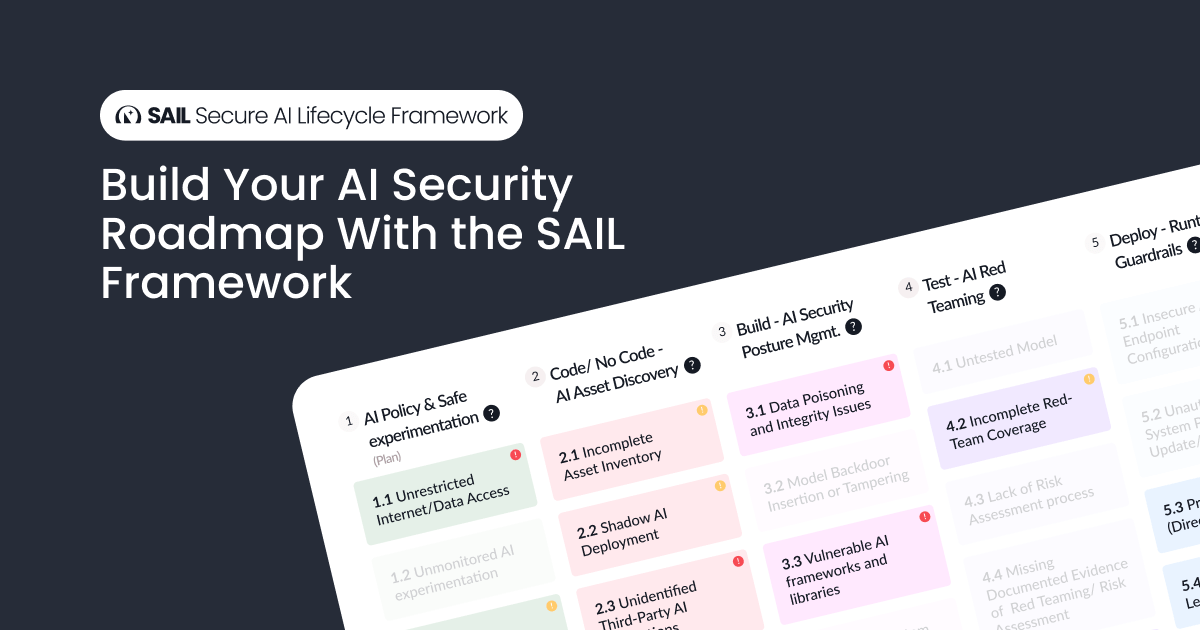
The SAIL Framework from Pillar Security is a seven-phase, lifecycle-oriented method for securing AI systems. The phases are AI policy and safe experimentation, AI asset discovery, AI security posture management, AI red teaming, runtime guardrails, sandboxed execution for agents and MCP servers, and AI activity tracing. It argues for a "Shift Up" approach that protects the business logic AI controls, and it is meant to sit on top of existing standards.

Model Context Protocol
SAIL FrameworkPillar Securityprompt injection+3

AI Security, GRCΒ· Added 29 Oct 2026

x.comthread🧠 AI

Prasenjit Sarkar (@stretchcloud) on X

A thread on Cloudflare's agent-readiness scan and the AgentReady.org open spec for "Agent Experience", developed with Vercel, Stripe, Auth0, Mintlify, Google, Netlify and Elementor. The scan grades whether agents can find a site (robots.txt, DNS), read clean Markdown, pass bot rules, and discover an MCP server or API catalog. One quoted example raised a score from 20 to 67 by shipping an API catalog with Link headers, an MCP server card, a skills index and an AI catalog file.

Model Context ProtocolCloudflareMarkdown
AgentReady.orgOraNick Launches+7

mcp, agentsΒ· Added 30 Oct 2026, published 29 Oct 2026

x.comthreadπŸ›‘οΈ Security

Rohan Paul (@rohanpaul_ai) on X

Rohan Paul's X post summarizes a TikTok paper on MCP attacks. LLM agents often finish the requested task, then quietly call an attacker-controlled logging tool that records the user query, the server reply and the final answer. The attack works because agents read natural-language tool descriptions when choosing and ordering tool calls. The visible text is truncated and gives no success rates or defenses.

Model Context ProtocolLLM
tool poisoningdata exfiltration

AI SecurityΒ· Added 30 Oct 2026, published 29 Oct 2026

github.comcourse🧠 AI

rohitg00/ai-engineering-from-scratch

ai-engineering-from-scratch is a free, MIT-licensed curriculum of 542 lessons in 20 phases, from math and deep learning through transformers, LLM engineering, MCP, agents and capstones. Code is in Python, TypeScript, Rust and Julia. It includes three graded projects (retrieval evaluation, agent trace debugger, tool call firewall), installable tutor skills for Claude Code and Codex, and certification prep tracks.

PythonTypeScriptRust+13
Rohit GhumareOpenClawHermes+6

Β· Added 29 Oct 2026

securityweek.comarticleπŸ›‘οΈ Security

Cisco Open Sources Quarry to Catch AI Agent Attacks Hidden in Harmless Steps

Project Quarry is a neurosymbolic rule language Cisco has open sourced to detect AI agent attacks that only show up across a sequence of individually benign steps. Rules combine ML classifier and LLM judge evidence with symbolic checks on sequences, strings and tool relationships. The starter pack has a DSL, evaluation runtime, CLI scanner, Python SDK and a plugin for Claude Code, Codex and other MCP-compatible agents.

QuarryModel Context ProtocolClaude Code+2
Project QuarryCisco Integrated AI Security & Safety Framework

AI Security, Blue Team & DetectionΒ· Published and added 29 Oct 2026

endorlabs.comarticle🧠 AI

What is an AIBOM? AI bill of materials explained for security teams | Endor Labs

An AIBOM is a machine-readable inventory of models, datasets, dependencies, AI services, agents and MCP servers, with evidence of origin, license, integrity and evaluation. The Endor Labs explainer walks through a worked CycloneDX example for a fine-tuned support assistant. It compares CycloneDX ML-BOM, SPDX 3.x, the OWASP AIBOM project and the May 2026 CISA/G7 guidance, and lists what an AIBOM cannot show: runtime behavior and agent actions.

CycloneDXSPDXSBOM+5
Endor LabsOWASPCISA+3

ai-policy, ai-infraΒ· Published and added 29 Oct 2026

endorlabs.comarticleπŸ›‘οΈ Security

What is an AIBOM? AI bill of materials explained for security teams | Endor Labs

AIBOM explainer from Endor Labs: an AI bill of materials is a machine-readable inventory of models, datasets, dependencies, AI services, agents and MCP servers, with origin, license and integrity evidence. It walks through a CycloneDX entry for a fine-tuned model, compares CycloneDX ML-BOM, SPDX 3.x, the OWASP AIBOM Generator and the May 2026 CISA/G7 minimum-elements guidance, and lists a six-step build process. It also states what an AIBOM cannot show: model safety, runtime behavior and coding-agent actions.

CycloneDXSPDXSBOM+2
EU AI ActISO/IEC 42001CISA+5

Supply Chain, AI Security, GRCΒ· Published and added 29 Oct 2026

x.comthreadπŸ›‘οΈ Security

Rohan Paul (@rohanpaul_ai) on X

Rohan Paul's X post summarizes the paper "Log-To-Leak: Prompt Injection Attacks on Tool-Using LLM Agents via the Model Context Protocol", from TikTok researchers. It reports that MCP-using agents often finish the requested task, then quietly call an attacker-controlled logging tool that records the query, server reply and final answer. The attack works through natural-language tool descriptions that agents read when choosing and ordering tools. The visible text is truncated.

Model Context ProtocolLLM
Log-To-Leakprompt injectionTikTok+1

AI SecurityΒ· Added 29 Oct 2026, published 28 Oct 2026

x.comthread🧠 AI

Eddy (@ieddysun) on X

Expo's official skills package gives AI coding agents scoped instructions for building Expo apps. One command, npx skills@latest add expo/skills --skill '*', installs it for Cursor, Copilot and Windsurf, while Claude Code and Codex use their plugin marketplaces. Skills include expo-router, expo-animation, expo-upgrade and eas-update. The Expo MCP server adds live docs lookup, compatible dependency installs, EAS build monitoring and simulator screenshots.

ExpoReact NativeExpo Router+9

coding-agents, prompting, mcpΒ· Added 29 Oct 2026, published 28 Oct 2026

x.comthreadπŸ›‘οΈ Security

Hakimi Eiqbal (@hakimieiqbal) on X

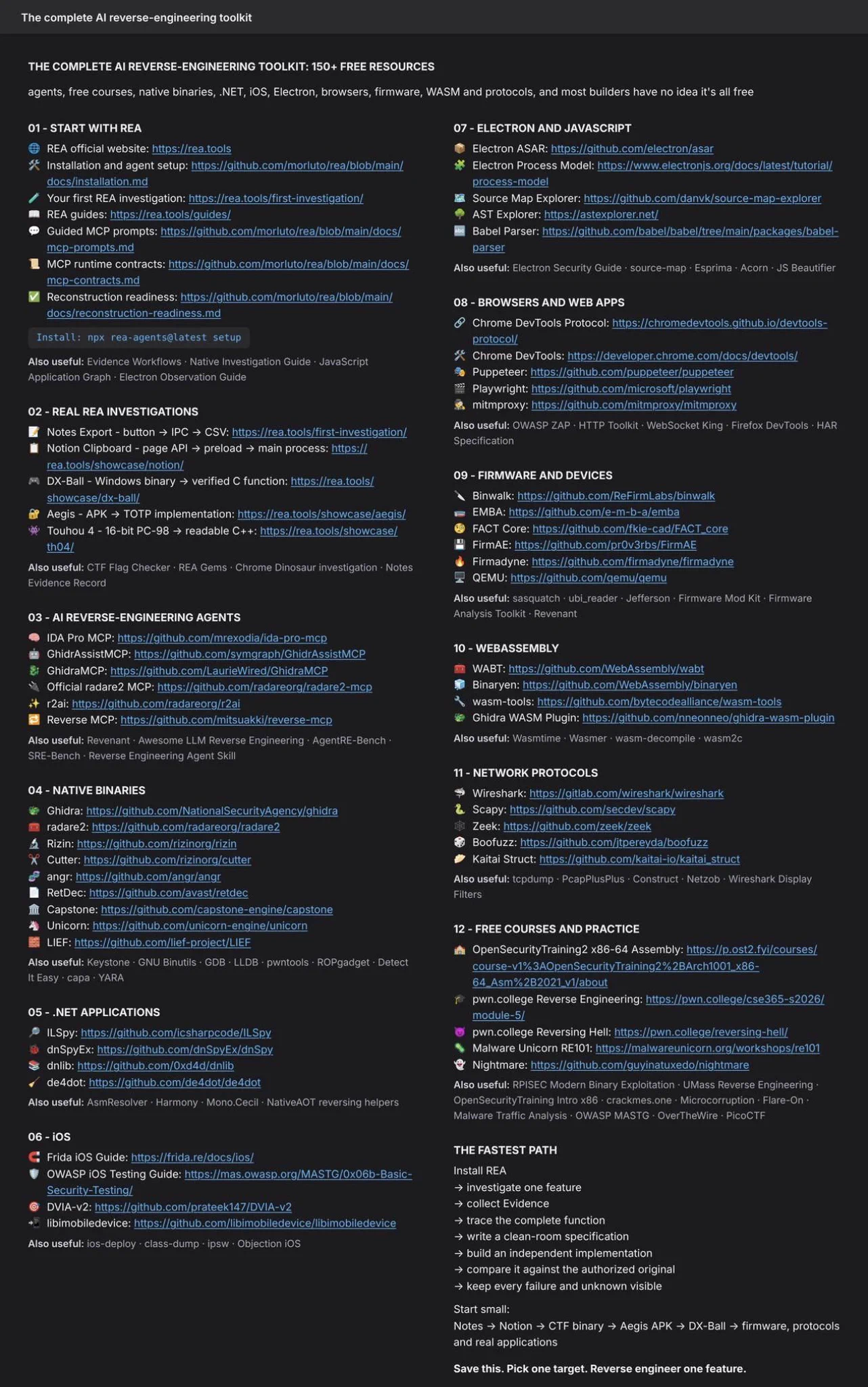
A practical reverse-engineering map by hakimieiqbal on X that picks tools by target: native binaries, .NET, Electron, iOS, firmware, WebAssembly and network protocols. It introduces REA (morluto/rea), which connects coding agents to RE tools, and lists MCP bridges for IDA Pro, Ghidra and radare2. It adds an evidence-first workflow and free courses such as pwn.college and OpenSecurityTraining2.

GhidraIDA Proradare2+3
REAFlare-OnOpenSecurityTraining2+5

Malware & RE, LearningΒ· Added 29 Oct 2026, published 28 Oct 2026

x.comthread🧠 AI

Hakimi Eiqbal (@hakimieiqbal) on X

A thread by Hakimi Eiqbal that maps reverse-engineering tools by target type: native binaries, Electron, .NET, iOS, firmware, WebAssembly and network protocols. Its AI sections cover REA (an open-source layer connecting coding agents to analysis tools) and MCP bridges for IDA Pro, Ghidra and radare2. It argues for an evidence-first workflow and gives a prompt that separates verified facts from hypotheses.

Model Context ProtocolClaude CodeCodex+8
REAIDA Pro MCPGhidrAssistMCP+3

coding-agents, mcpΒ· Added 29 Oct 2026, published 28 Oct 2026

endorlabs.comarticle🧠 AI

ADLC compliance: Mapping agentic development to NIST SSDF, OWASP, and the EU AI Act | Endor Labs

ADLC compliance is Endor Labs' interpretation of how NIST SSDF (SP 800-218), the OWASP LLM and Agentic Top 10 lists, and the EU AI Act apply to software built with coding agents. It splits requirements into a code surface and an action surface (shell, files, MCP calls, package installs). It gives a four-step EU AI Act scoping path and says that system prompt rules and agent self-reports are not audit evidence.

CursorClaude CodeModel Context Protocol+3
Endor LabsNISTOWASP+3

ai-policy, coding-agentsΒ· Published and added 28 Oct 2026

endorlabs.comarticleπŸ›‘οΈ Security

ADLC compliance: Mapping agentic development to NIST SSDF, OWASP, and the EU AI Act | Endor Labs

ADLC compliance guide from Endor Labs that maps agentic development to NIST SSDF (SP 800-218 v1.1), the OWASP LLM Top 10 2025 and Agentic Top 10, and the EU AI Act as amended by Regulation (EU) 2026/1744. It splits controls into a code surface and an action surface (shell, file access, MCP calls, package installs). It gives a four-step AI Act scoping path, the new Annex III date of 2 December 2027, and evidence guidance. It states the crosswalk is the vendor's interpretation, not legal advice.

Endor LabsModel Context ProtocolClaude Code+3
NIST SSDFNIST SP 800-218NIST SP 800-218A+13

GRC, AI Security, Supply ChainΒ· Published and added 28 Oct 2026

endorlabs.comarticleπŸ›‘οΈ Security

The ADLC maturity model: 5 stages of agentic development security | Endor Labs

The ADLC maturity model is a proposed five-stage framework from Endor Labs for scoring security controls over coding agents, from unmanaged experimentation to continuous verification. Each stage has requirements on two tracks, agent actions (shell commands, MCP calls, package installs) and agent output (code, dependencies, secrets). It sets stage 3 at deterministic hooks that block actions, gives evidence-based assessment questions, and lists traps such as relying on prompt-level rules.

Endor LabsAURIModel Context Protocol+2
ADLC maturity modelOWASP SAMMOWASP Top 10 for LLM Applications+5

AI Security, GRC, DevSecOpsΒ· Published and added 28 Oct 2026

x.comthread🧠 AI

Kizuno18 (@Kizuno18) on X

Kizuno18's X post argues that the move from local stdio and Docker MCP servers to remote HTTP/SSE endpoints matures the Model Context Protocol in enterprise infrastructure. It lists three trade-offs: short-lived OAuth/JWT bearer tokens replace mounted admin credentials, deferred tool discovery avoids roughly 20k tokens of eager schema loading, and HCP Terraform enforces Sentinel/OPA policy, audit trails and approvals server-side. Opinion post with no benchmarks or code.

Model Context ProtocolDockerTerraform+5
Kizuno18HCP TerraformOPA

mcpΒ· Added 29 Oct 2026, published 27 Oct 2026

x.comthreadπŸ›‘οΈ Security

Buchi Reddy B (@buchireddy) on X

Buchi Reddy B's X thread comments on Forever Security's research (Gal Weizman, Omer Samet) on coding agents. A web page silently writes a fake AGENTS.md or CLAUDE.md into a Downloads folder, and Codex and Claude Code follow it as project rules. Codex then wrote an attacker's MCP server into the machine-wide config, so one injection becomes a standing connection for every session. It asks whether teams inventory runtime MCP connections against approved lists.

CodexClaude CodeModel Context Protocol
Forever SecurityGal WeizmanOmer Samet+3

AI SecurityΒ· Added 28 Oct 2026, published 27 Oct 2026

x.comthread🧠 AI

Rohan Paul (@rohanpaul_ai) on X

Hi3D v1.0 (formerly Sparc3D) is an open-sourced image-to-3D model from Hi3D, which runs a closed v3.0 refining at 2048 cubes per side. In a test with 13 professionals in 3D algorithms, 562 judgments against eight other image-to-3D models favoured it 83.5% of the time. The thread also covers the Hi3D Agent and an MCP server for other agents. Back and bottom views were checked, where TRELLIS.2 collapsed a winged figure.

Model Context Protocol
Hi3DHi3D v1.0Sparc3D+2

models, multimodal, mcpΒ· Added 28 Oct 2026, published 27 Oct 2026

x.comthreadπŸ›‘οΈ Security

cubillas (@cubillas888) on X

The tweet relays Pillar Security research that opencode on Windows and WSL could run attacker-controlled code during remote MCP server OAuth sign-in. The fix shipped in opencode 1.18.33 on 28 September, with no advisory or CVE published. It advises users of remote MCP servers to update and review which servers they connect to. Technical details are not in the post.

OpenCodeModel Context ProtocolOAuth+1
Pillar Security

AI Security, AppSecΒ· Added 29 Oct 2026, published 27 Oct 2026

x.comthreadπŸ›‘οΈ Security

Nicholas Martin (@ndgmlondon) on X

X thread started by Nicholas Martin (#IAM) advising that MCP tool permissions be verified and scoped session tokens used to enforce least privilege against indirect prompt injection. Replies argue that token scoping does not solve the confused deputy problem, because an injection borrows the agent's legitimate authority. They recommend per-task tokens with short expiry, with the grant logged beside the call, and raise MCP server dependency supply-chain risk.

Model Context Protocol
indirect prompt injectionconfused deputy

AI Security, Identity & AccessΒ· Added 28 Oct 2026, published 27 Oct 2026

arxiv.orgpaperπŸ›‘οΈ Security

Measuring Users' Security and Privacy Concerns About Third-Party Community Bots on Discord

Measurement study of 23,102 third-party Discord bots and 183,142 user reviews (2021-2026, 49 languages). A fine-tuned DeBERTa classifier plus manual validation yields 8,832 security and privacy reviews, mapped to a 31-theme taxonomy; Data Sharing (30.5%) and Data Collection (16.2%) dominate. Permission count and admin status correlate only weakly with user concerns. The authors build BotLens, an MCP-server auditing framework with six tools.

DiscordModel Context ProtocolLLM
BotLensDeBERTa

other, AI SecurityΒ· Added 28 Oct 2026, published 27 Oct 2026

arxiv.orgpaperπŸ›‘οΈ Security

Log-To-Leak: Prompt Injection Attacks on Tool-Using LLM Agents via the Model Context Protocol

Log-To-Leak is a prompt-injection attack on tool-using LLM agents that abuses Model Context Protocol tool metadata to trigger an attacker-controlled logging call after the last legitimate call, leaking the user query, server name, server response and agent response. Evaluated on five MCP servers and four agents, it reaches 62.64-100% attack success with 76.55-95.64% logging accuracy. Three defenses leave over 55% residual ASR on GitHub MCP with GPT-4o.

Model Context ProtocolGitHubGPT-4o+1
Log-To-Leaktool poisoningprompt injection

AI SecurityΒ· Added 28 Oct 2026, published 26 Oct 2026

x.comthreadπŸ›‘οΈ Security

David Gutierrez | Eng (@david_x_ai) on X

Thread on two October 2026 npm compromises: @subql/common 5.8.3 (5 October), published through GitHub Actions OIDC Trusted Publishing after the attacker tampered with the publish workflow, and tensorlake 0.5.144 (8 October), published by the project's own release workflow with valid provenance for about 1 hour 40 minutes. Both ran on install and stole cloud, GitHub, Kubernetes, Vault, SSH and .env credentials; tensorlake also took AI tool and MCP config. Its payload installed a gh-token-monitor service that deletes the home directory if the stolen GitHub token is revoked, so remove it before rotating.

npmGitHub ActionsGitHub+3
@subql/commontensorlakegh-token-monitor+3

Supply Chain, DevSecOpsΒ· Added 27 Oct 2026, published 26 Oct 2026

x.comthreadπŸ›‘οΈ Security

BenjaminπŸ‘¨β€πŸ’» (@Hislordship_9) on X

Thread on Forever Security's finding that a planted Markdown "Engineering Work Guidelines" file in ~/Downloads made Codex add a "project-tools" MCP server to ~/.codex/config.toml. The server ran npm install function-color, a known malicious package, and started a child session with --dangerously-bypass-approvals-and-sandbox. Codex complied in over 90% of the firm's tests; Claude Code, via a CLAUDE.md setting ANTHROPIC_BASE_URL, about half. Advice: don't start agents in Downloads, review instruction files, and diff agent config.

CodexClaude CodeModel Context Protocol+1
Forever Securityfunction-colorAGENTS.md+4

AI Security, Supply ChainΒ· Added 27 Oct 2026, published 26 Oct 2026

x.comthreadπŸ›‘οΈ Security

David Gutierrez | Eng (@david_x_ai) on X

Thread on a critical opencode bug disclosed by Pillar Security on Oct 19. On Windows and WSL, a remote MCP server could run code during OAuth sign-in, because the server-chosen authorization URL was put unescaped into a PowerShell command, so a PowerShell subexpression executed. opencode fixed it in 1.18.33 on Sep 28 as a browser-launch refactor with no advisory or CVE. MCP Inspector published an advisory for the same bug class, and its fix needs a major bump of the open package.

OpenCodeModel Context ProtocolPowerShell+3
Pillar Securitycommand injectionPowerShell subexpression+1

AI Security, AppSec, Supply ChainΒ· Added 27 Oct 2026, published 25 Oct 2026

Showing 30 of 502

Show more