Skip to content

2233 results for β€œPoS”

What you seeeverything
simonwillison.netarticleπŸ›‘οΈ Security

How We Took Over ChatGPT Accounts

Simon Willison summarises Parameter Labs' ChatGPT account takeover chain against the HTML previews (formerly Canvas) sandboxed iframe. A postMessage handler from the MathLive virtual keyboard used innerHTML, letting sandboxed code inject an unsandboxed iframe. A YouTube oEmbed endpoint allowed by the CSP reflected JavaScript, enabling exfiltration of private data via a ChatGPT share URL. OpenAI fixed it and paid a $5,000 bounty.

ChatGPTOpenAIMathLive+2
Parameter Labssandbox escapeContent Security Policy bypass+2

AppSec, AI SecurityΒ· Published and added 31 Oct 2026

x.comthread🧠 AI

Prasenjit Sarkar (@stretchcloud) on X

Campfire is a free, open-source, self-hosted tool that runs Claude Code, Codex, Goose, Aider and OpenHands side by side in one browser tab. Each agent gets its own git worktree, with permission voting (30 second timer, majority rules), session replay, cross-backend agent races and a shared semantic memory layer. Installs with bunx the-campfire. The post also compares Clawboo, Conductor, Vibe Kanban and Crystl.

CampfireClawbooClaude Code+8
Boo ZeroConductorVibe Kanban+2

agents, coding-agentsΒ· Added 1 Nov 2026, published 31 Oct 2026

simonwillison.netarticle🧠 AI

datasette-llm 0.1a9

datasette-llm 0.1a9 is a release of the Datasette plugin that now reads the default model configured in LLM. Datasette Agent can then start without setting plugins.datasette-agent.default_model, for example with uvx --with datasette-agent datasette content.db --internal internal.db. The post is a brief usability note and gives no further detail.

Datasettedatasette-llmDatasette Agent+2
Simon Willison

agents, llm-appsΒ· Added 1 Nov 2026, published 31 Oct 2026

alignmentforum.orgarticle🧠 AI

Explaining β€œAI might obliterate you” to senior policymakers in India

Explaining "AI might obliterate you" to senior policymakers in India is an AI Alignment Forum post by TurnTrout, dated 31 October 2026, with a 15-minute read time. It is filed under Plan A, Regulation and AI Risk, and Slowing Down AI. The fetched page shows no body text, so the arguments and any account of the India policy discussions are not available here.

AI Alignment ForumTurnTrout

ai-policy, ai-safetyΒ· Published and added 31 Oct 2026

atlasum.netadvisoryπŸ›‘οΈ Security

TCP Use-After-Free: CVE-2026-98432 / CVSS 9.8

CVE-2026-98432 is a use-after-free in the Linux IPv4 TCP handshake, rated CVSS 3.1 9.8 and reachable by a remote unauthenticated peer on kernels back to 4.4. The post lists fixed stable releases (October 2026) and distribution patch status as of 31 October 2026, plus kernel and MPTCP listener checks. It gives interim nftables and iptables rules that drop IPv4 packets carrying options, and notes Anthropic's claim that Claude wrote a working exploit.

Linux kernelnftablesiptables+3
CVE-2026-98432use-after-freeAnthropic

Blue Team & Detection, Cloud & InfraΒ· Added 1 Nov 2026, published 31 Oct 2026

en.cryptonomist.charticleπŸ›‘οΈ Security

Chainalysis security breach exposed customer data and raised phishing risk

Chainalysis confirmed on 30 October 2026 that an external actor accessed its systems and internal tools earlier in October, using what it called "offensive agentic techniques". Exposed data covers some customers' names, emails, job titles, user IDs and role labels. Chainalysis says it has found no access to passwords, session tokens or investigation content so far, and customers should expect targeted phishing. Affected-customer counts and the exploited vulnerabilities are not disclosed.

Chainalysisoffensive agentic techniquesphishing+1

Threat IntelΒ· Published and added 31 Oct 2026

ethereum-magicians.orgthreadπŸ›‘οΈ Security

Pre-ERC: Agent Pre-Sign Risk Report

Pre-ERC: Agent Pre-Sign Risk Report is a draft Ethereum Magicians proposal for an EIP-712-signed report that a risk source, identified by an ERC-8004 identity, returns about one unsigned request. It carries typed findings on tokens, approvals, addresses, payments (x402) and texts, and each finding is marked read or not read. It has no score or verdict, so the consumer applies its own policy. The author's live implementation, toll, runs on Robinhood Chain.

Ethereumx402Robinhood Chain+3
ERC-8265ERC-8004ERC-8470+8

AI Security, BlockchainΒ· Published and added 31 Oct 2026

bleepingcomputer.comarticleπŸ›‘οΈ Security

Chainalysis discloses data breach from "offensive agentic techniques"

Chainalysis disclosed a security incident in which an external actor used "offensive agentic techniques" to access internal systems and tools earlier in the month. Exposed customer data includes user IDs, names, email addresses and organizational role labels. The company reports no evidence of access to investigation content, credentials or session tokens, and has shared no details on the vulnerabilities, tools or dwell time. The article also lists other incidents from the same week.

ChainalysisBinanceARTEX+3

Threat Intel, AI SecurityΒ· Published and added 31 Oct 2026

blog.talosintelligence.comwriteupπŸ›‘οΈ Security

Appraisal by AI: Model-driven victim prioritization in the VOLTA infostealer

VOLTA (VOLTA-AUTODOXER) is a self-deleting Windows infostealer that, after theft and live session-based enrichment, POSTs an evidence bundle to OpenRouter so an LLM can rank the victim's assets by monetization value. It falls back across a Claude, Kimi and Gemini chain when a model refuses. Talos covers the builder model, the Chrome App-Bound Encryption bypass, the volta_debug.txt artifact and countermeasures such as blocking Chrome --headless.

OpenRouterClaudeGemini+3
VOLTACLOSEDQUORUMCAIRN+3

Malware & RE, Threat Intel, AI SecurityΒ· Published and added 31 Oct 2026

parameter.aiwriteupπŸ›‘οΈ Security

Do the math: How we took over ChatGPT accounts

Parameter Labs describes a chain that turned a public ChatGPT share link into JavaScript running as chatgpt.com in the victim's session. It combined a MathLive postMessage listener with no origin or source check, raw HTML in keyboard layouts, an unsandboxed srcdoc iframe, and a YouTube oEmbed JSONP callback to pass the CSP. The code read private conversations through backend APIs. OpenAI fixed it on 26 October 2026 and rated it P1.

ChatGPTOpenAIMathLive+2
Parameter Labssandbox escapeXSS+2

AppSecΒ· Added 1 Nov 2026, published 31 Oct 2026

x.comthread🧠 AI

🚨 AI News | TestingCatalog (@testingcatalog) on X

RoboAPI is a public API from PokeBot, powered by its world-action model Poke-Aurora, that lets robot arms do new tasks from natural-language instructions with no task-specific data collection or training. A user connects a supported arm with a wrist-mounted camera, gives a task such as "clean the table", and receives the next moves in near real time. The post gives no benchmarks, supported hardware list or pricing.

RoboAPIPoke-Auroraworld-action model
PokeBotTestingCatalog

models, multimodalΒ· Added 1 Nov 2026, published 31 Oct 2026

huggingface.copaper🧠 AI

Your Benchmark Is an Empirical Measure Over Difficulty

The paper treats a benchmark as an empirical measure over item difficulty and formalizes two failure modes: measure mismatch (benchmark difficulty distribution differs from the intended one) and coverage gaps (uncovered difficulty regions that hide localized training progress). It proposes two diagnostic metrics with theoretical guarantees and analyzes 25 popular benchmarks across 7 domains using estimated item difficulties. It also introduces BenchFill, a difficulty-targeted item rewriting algorithm that reduces local coverage gaps.

BenchFill

evals, researchΒ· Added 31 Oct 2026

x.comadvisoryπŸ›‘οΈ Security

ClioBitcoinBank πŸ΄β€β˜ οΈ (@ClioBitcoinBank) on X

lnd v0.20.7 and v0.21.6 are Lightning Network Daemon releases announced by Clio Bitcoin Bank. They include a Go-specific mitigation, with the MPTCP flag turned off, for CVE-2026-98432, a use-after-free in the Linux kernel's IPv4 TCP code. The post recommends all users update. It gives no exploit or impact detail.

lndLinux kernelGo+2
CVE-2026-98432use-after-freeClio Bitcoin Bank

Cloud & InfraΒ· Published and added 31 Oct 2026

microsoft.comwriteupπŸ›‘οΈ Security

Inside a malicious Claude Code-branded extension and its persistent SSH backdoor

Microsoft Threat Intelligence analyzes a tampered anthropic.claude-code extension (versions 2.1.312 and 2.1.313) served on the Cursor marketplace on 29 October 2026. The injected JavaScript loader adds an SSH key labeled svc-telemetry, opens a reverse SSH tunnel and sets up persistence on macOS, Linux and Windows. The post gives cleanup steps, IOCs and Defender XDR hunting queries. VS Code Marketplace and npm were not affected.

CursorClaude CodeSSH+3
Protocol Tunneling (T1572)reverse SSH tunnelMicrosoft Threat Intelligence+2

Supply Chain, Blue Team & Detection, Malware & REΒ· Published and added 31 Oct 2026

stepsecurity.ioarticleπŸ›‘οΈ Security

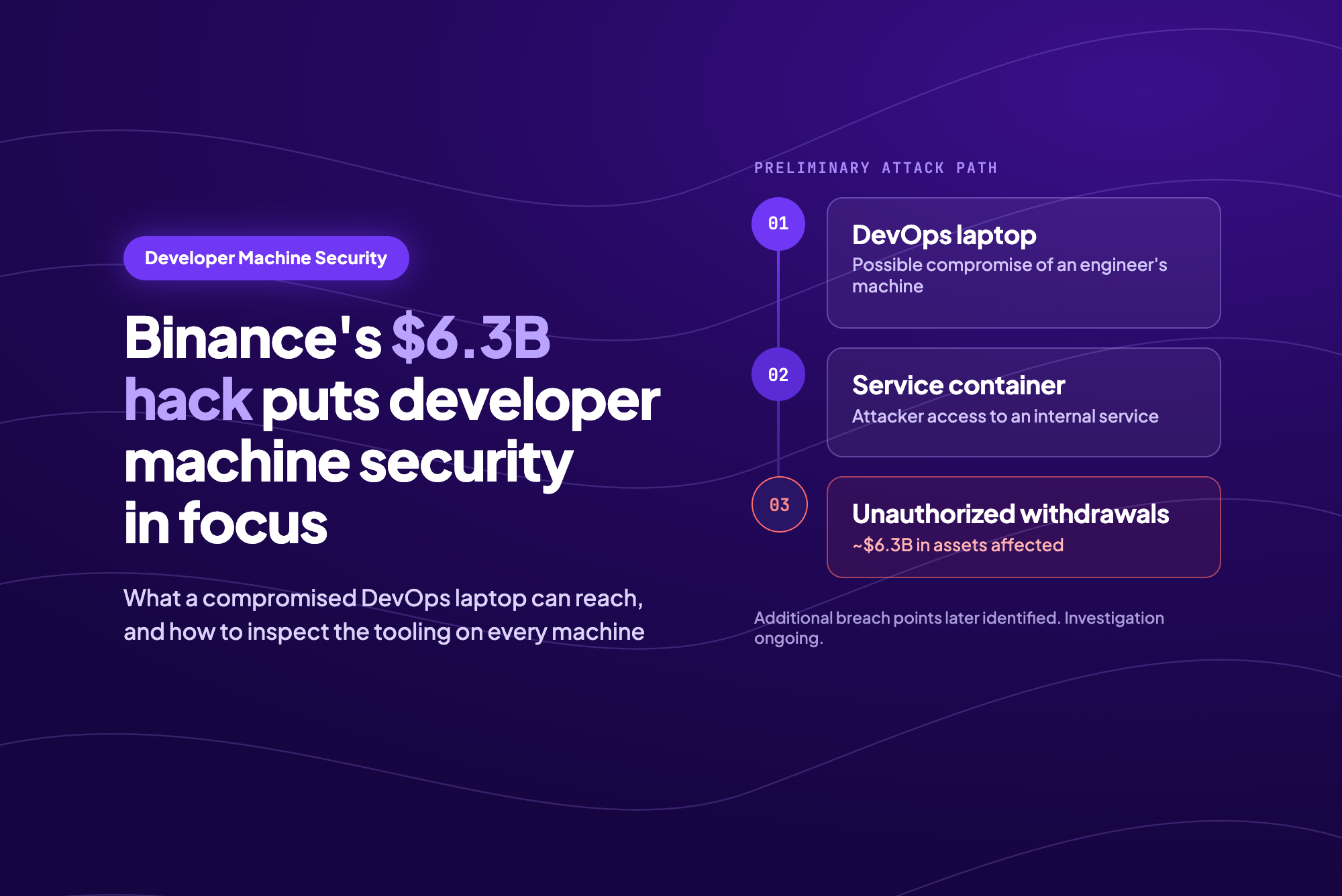
Binance’s $6.3 Billion Hack Puts Developer Machine Security in Focus

StepSecurity's analysis of Binance's 29 October 2026 incident, which Binance puts at about $6.3 billion in affected assets. It covers Binance's disclosure of a possible DevOps laptop compromise, and TRM Labs and Elliptic findings on 50 EIP-7702 authorizations and a persistent delegation. It links this to the Nx, OVHcloud CLI and Claude Code extension compromises, gives an investigation checklist, then describes StepSecurity products.

EthereumnpmVS Code+3
BinanceTRM LabsElliptic+5

Blockchain, Supply ChainΒ· Published and added 30 Oct 2026

status.bunny.netadvisoryπŸ›‘οΈ Security

Bunny CDN Security Incident

Bunny CDN status-page notice, posted 28 October 2026, about unauthorized access at an infrastructure provider that hosted one bunny.net CDN node in Armenia. Traffic was stopped within 20 minutes and the server wiped. No access to the node was found, but cached content, Pull Zone configs and TLS certificates could have been exposed, so all platform certificates were reissued. Customers with their own certificates should rotate them with new private keys.

Bunny CDNTLS
bunny.netb-cdn.netbunny.run

Threat Intel, Cloud & InfraΒ· Added 31 Oct 2026, published 30 Oct 2026

huggingface.cowriteup🧠 AI

nemotron-halloween

MonsterHouse is a Halloween interactive projection built on the NVIDIA Nemotron Voice Agent: Nemotron Speech ASR, Nemotron 3.5 Bolt E4B 4GB with a LoRA persona adapter, Magpie TTS Zeroshot and Audio2Face-3D in Unreal Engine, on two RTX Blackwell GPUs. Median end-of-speech-to-audio is 1.70 seconds live and 0.72 seconds with cached responses. The post gives a build path and tips on caching and state handling.

Nemotron Voice AgentNemotron Speech ASRNemotron 3.5 Bolt E4B 4GB+11
NVIDIANemotronQwen3 30B-A3B+3

multimodal, agents, trainingΒ· Published and added 30 Oct 2026

interconnects.aiarticle🧠 AI

Was I wrong about open models & cyber risks?

Interconnects post in which Nathan Lambert revisits his claim that an open-weight Claude Mythos would have been survivable. He argues GLM-5.3 already crosses the capability threshold with little visible societal change, and quotes Rob Wiblin, Anthropic and Zvi Mowshowitz as examples of exaggerated warnings. He cites Epoch AI's Firefox exploit built with GLM-5.3, and treats the recent vulnerability surge as an ecosystem trend driven by AI capability and diffusion, not open versus closed models.

FirefoxGLM
Claude MythosGLM-5.3Anthropic+13

ai-policy, ai-safety, modelsΒ· Published and added 30 Oct 2026

interconnects.aiarticleπŸ›‘οΈ Security

Was I wrong about open models & cyber risks?

Interconnects post in which Nathan Lambert revisits his claim that an open-weight release of Claude Mythos in April 2026 would have been survivable. He argues GLM-5.3 already crosses that capability threshold with little visible harm. He cites Epoch AI's GLM-5.3 Firefox file-exfiltration exploit and Joshua Saxe's trend data, and says recent vulnerability waves come mostly from closed models and general AI diffusion.

GLMFirefoxGitLab+1
MythosProject GlasswingPHP2Shell+9

AI Security, otherΒ· Published and added 30 Oct 2026
cisa.govadvisoryπŸ›‘οΈ Security

CISA Adds Two Known Exploited Vulnerabilities to Catalog

CISA added two Ivanti Connect Secure vulnerabilities to its Known Exploited Vulnerabilities (KEV) Catalog on 30 October 2026, citing evidence of active exploitation: CVE-2026-111357 (missing authentication for a critical function) and CVE-2026-118527 (generation of predictable numbers or identifiers). The alert restates BOD 26-04, which requires federal civilian agencies to remediate KEV-listed flaws on exposed assets and check for prior compromise. It also links the KEV nomination form.

Ivanti Connect SecureCISA KEVVPN
CVE-2026-111357CVE-2026-118527BOD 26-04+1

Threat Intel, GRCΒ· Published and added 30 Oct 2026

securityweek.comarticleπŸ›‘οΈ Security

PHP2Shell Attacks Root Palo Alto Firewalls but Fail Against WordPress

PHP2Shell (CVE-2026-109618 and CVE-2026-109619) has been exploited for over a week. A China-linked group chained it with the Fragnesia Linux kernel privilege escalation to root at least 25 Palo Alto Networks PAN-OS firewalls with exposed management interfaces. Defiant had seen no confirmed WordPress compromise by 28 October 2026 despite 77,000 requests, and Cato and watchTowr report few successful attackers.

PAN-OSPHPWordPress+2
CVE-2026-109618CVE-2026-109619PHP2Shell+8

Threat Intel, AppSecΒ· Published and added 30 Oct 2026

twitter.comthread🧠 AI

Anthropic Cracking Down on Video Game Rewrites

A tweet from chasmmmmmmmmmmm says Claude Code received a new rule around 27 October 2026, delivered from Anthropic's servers under the flag "tengu_heron_brook", with no setting to disable it. The quoted rule allows original games, genre games and games from the user's own designs and assets, but forbids recreating a specific existing game, even if renamed. The post asks whether this ends game rewrites and modding, and gives no verification beyond the quoted text.

Claude Code
Anthropictengu_heron_brook

coding-agents, prompting, ai-policyΒ· Added 31 Oct 2026, published 30 Oct 2026

securityweek.comarticleπŸ›‘οΈ Security

Passkeys Are Better Than Passwords. But They Are Not Enough.

Opinion piece arguing that passkeys, built on public-key cryptography, resist phishing, credential stuffing and password theft but do not settle identity risk. Attackers can go around them through account enrollment before a passkey is bound, weaker recovery paths (SMS, email link, help desk), device changes and authenticated session hijacking. It proposes layering identity threat detection with risk-based, continuous evaluation of trust.

passkeysMFA
adversary-in-the-middleMFA fatigueSIM swapping+3

Identity & AccessΒ· Published and added 30 Oct 2026

bleepingcomputer.comarticleπŸ›‘οΈ Security

CISA says max severity GitLab flaw now exploited in the wild

CVE-2026-97229 is a maximum-severity GitLab flaw in the CI/CD Regular Expression Compiler, caused by an integer overflow, that lets unauthenticated attackers run code via a crafted regular expression. CISA added it to the KEV Catalog and ordered federal agencies to patch under BOD 26-04. GitLab fixed it in CE/EE 19.4.2, 19.3.5 and 19.2.8, and Shadowserver tracks about 2,800 exposed CE instances.

GitLab
CVE-2026-97229CVE-2026-0723CVE-2026-110264+10

AppSec, DevSecOps, Threat IntelΒ· Published and added 30 Oct 2026

decrypt.coarticleπŸ›‘οΈ Security

Israel Extradites Alleged Nomad Bridge Exploiter to US Over $2.8M Theft: Report

Decrypt report that Israel extradited Alexander Block (formerly Gurevich) to the US over about $2.8 million taken from the Nomad bridge in August 2022. A June 2022 update flaw let tokens be received without locking assets, and copycats then drained more than $186 million. Israel's Supreme Court held that exploiting a flaw the software permitted can still be unlawful intrusion. The FTC proposed a settlement with Illusory Systems in December 2025.

NomadTelegram
Nomad bridge exploitIllusory SystemsParadigm+4

Threat IntelΒ· Published and added 30 Oct 2026

cyberplace.socialthreadπŸ›‘οΈ Security

Backdoors in official Claude Code extensions

GossiTheDog's Mastodon post reports that the Anthropic Claude Code Visual Studio extension, as installed in Cursor, contains malware that creates a remote access Trojan on desktops. It links to a phorion.io blog post on the reported compromise of the official Claude Code VSX extension. The post gives no technical detail, indicators or dates itself.

Claude CodeCursorOpen VSX+1
Anthropicremote access Trojan

Supply Chain, Threat IntelΒ· Added 31 Oct 2026, published 30 Oct 2026

x.comthreadπŸ›‘οΈ Security

Shubham Mishra 🐐 (@shubh6200) on X

A post relaying Cursor's security advisory: a modified, malicious Claude Code VS Code extension was distributed through the Cursor extension marketplace, affecting at most 5,000 users. Anthropic did not develop that version, and other extensions are not affected. Users of Claude Code in Cursor are told to update to version 2.1.314. The post adds that marketplaces need publisher verification and package integrity checks. It gives no technical detail on the payload.

Claude CodeCursorVS Code
Anthropic

Supply Chain, AI SecurityΒ· Added 31 Oct 2026, published 30 Oct 2026

securityweek.comarticleπŸ›‘οΈ Security

$2 Million+ Drained From Polymarket Traders in New Supply Chain Attack

Polymarket halted trading on 29 October after users reported unauthorized withdrawals traced to malicious JavaScript served from DebugBear's real user monitoring snippet. Hudson Rock's sample abused the authenticated session to sell positions or send tokens to a hard-coded address, without exfiltrating credentials. Loss estimates range from $2.19 million to $2.71 million (GoPlus), and Polymarket pledged reimbursement.

PolymarketDebugBearJavaScript
Hudson RockGoPlusArkham+2

Supply Chain, Threat IntelΒ· Published and added 30 Oct 2026

stepsecurity.iowriteupπŸ›‘οΈ Security

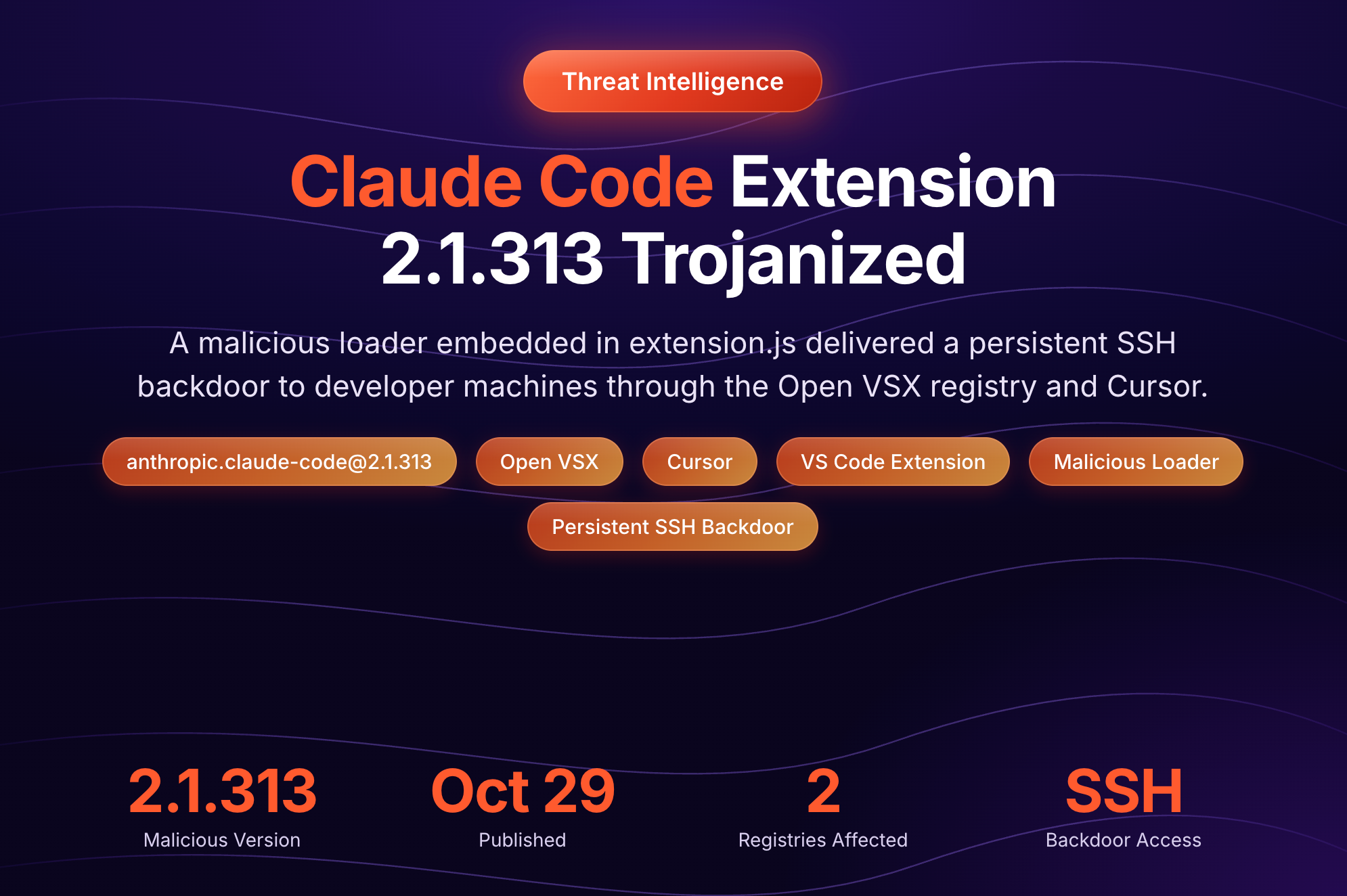
Trojanized Claude Code Extension Delivered Persistent SSH Backdoor to Developer Machines

The Claude Code VS Code extension anthropic.claude-code 2.1.313 was published on Open VSX on 29 October 2026 with a malicious loader prepended to extension.js. On load it planted an attacker SSH key (svc-telemetry), installed per-OS persistence, opened a reverse SSH tunnel and beaconed host recon over HTTP. Cursor reports at most 5,000 users received it in an 11-hour window. The post gives the timeline, cleanup artifacts and credential rotation steps.

Claude CodeVS CodeOpen VSX+3
anthropic.claude-code 2.1.313svc-telemetryT1195.002+1

Supply Chain, Blue Team & Detection, Threat IntelΒ· Published and added 30 Oct 2026

en.cryptonomist.charticle🧠 AI

Meta’s AI-distilled model detector catches 79% at a 0.1% false-positive rate

WM-Basin is a Meta method for detecting student LLMs distilled from watermarked teacher models, described in "Watermark Basins: Black-Box Detection of Distilled LLMs" (arXiv:2610.37266, 27 October 2026). It feeds a suspect model's API text into a clean probe model and checks gradient alignment with a key-specific watermark basin. It reached 79% true-positive rate at 0.1% false-positive rate across 1,200 students, versus 29% for the prior token-level detector. Clean-data fine-tuning and paraphrasing weaken it.

LLM
MetaMeta FAIRMeta Superintelligence Labs+3

research, trainingΒ· Published and added 30 Oct 2026

Showing 30 of 2233

Show more