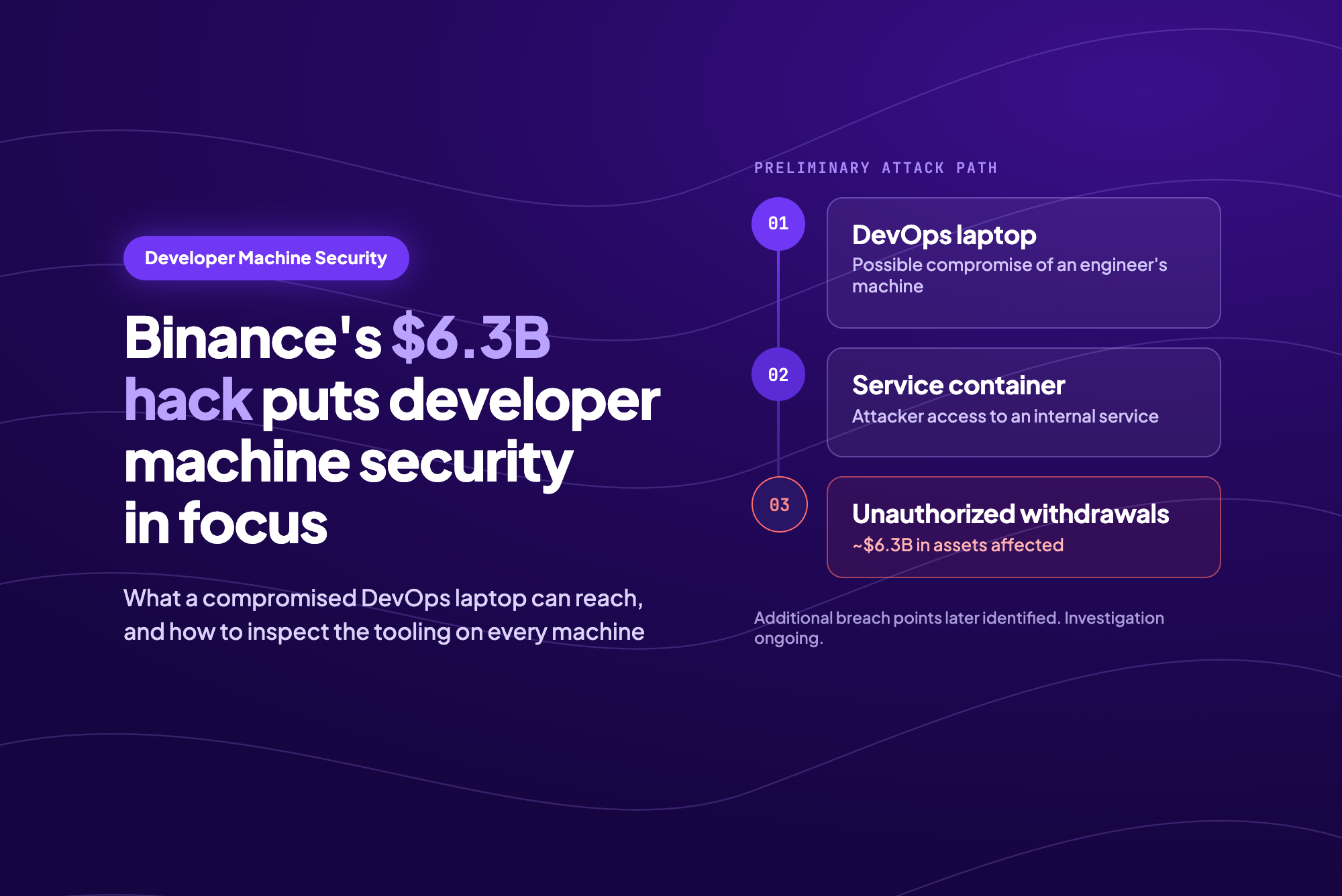
The FBI attributed the roughly $6.3 billion Binance theft of about 29 October 2026 to North Korea's TraderTraitor (Lazarus Group, Jade Sleet, APT38). Binance traced the breach to a compromised DevOps engineer's laptop that gave access to a service container used to submit unauthorized withdrawals across ten blockchains. The FBI published 628 laundering addresses and linked the group to earlier thefts at Bybit, DMM Bitcoin, Bitget and Drift.
EthereumBitcoinSolana+3
TraderTraitorLazarus GroupDPRK+14
Threat Intel, BlockchainΒ· Published and added 1 Nov 2026
Alpine Linux rebuilt its GitLab server and reset all passwords after attackers tried to exploit CVE-2026-97229, a maximum-severity integer overflow in the Onigmo regex engine bundled with Ruby, on October 20-21. Eight worker crashes occurred and four were partially successful. Missing logs and outbound connection records meant compromise could not be ruled out. Alpine had run GitLab 19.3.4, then 19.3.6, which lacked the Ruby patch; the fixed image is alpinelinux/gitlab:19.3.6 with Ruby 3.3.13.
GitLabAlpine LinuxDocker+1
CVE-2026-97229integer overflowOnigmo
Supply Chain, Blue Team & Detection, DevSecOpsΒ· Published and added 1 Nov 2026

Report on the $6.3 billion Binance hack of October 2026, which the FBI attributed to North Korea's TraderTraitor unit. Co-CEO Richard Teng said attackers used EIP-7702 to gain execution approval over a hot wallet, after a compromised laptop and further breach points, and used self-destructing malware. Binance replaced 90% of the assets, and the FBI expects further laundering through Ethereum. No IOCs or mitigations are given.
Ethereum
TraderTraitorBinanceFBI+5
Blockchain, Threat IntelΒ· Added 1 Nov 2026, published 31 Oct 2026
Decrypt's explainer on the roughly $6.4 billion theft from Binance hot wallets across about 10 blockchains. Binance traced it to a compromised DevOps engineer laptop plus further breach points, and on Ethereum the attacker used 50 pre-signed EIP-7702 authorizations to turn a hot wallet into a sweeper. Chainalysis and TRM Labs attribute it to TraderTraitor; Tether and Circle froze about $2.3 billion.
EthereumBitcoinTether+3
TraderTraitorBinanceChainalysis+10
Blockchain, Threat IntelΒ· Published and added 31 Oct 2026
Ahmad Umar Agha (Th3Pr0), a Syrian Electronic Army member, received a 42-month US sentence in the Eastern District of Virginia, over 12 years after he was first charged in June 2014. He compromised about 47 Western media, company, NGO and government targets, including the 2013 Associated Press Twitter takeover that caused a flash crash. Accomplice Firas Dardar remains at large.
StepSecurity's analysis of Binance's 29 October 2026 incident, which Binance puts at about $6.3 billion in affected assets. It covers Binance's disclosure of a possible DevOps laptop compromise, and TRM Labs and Elliptic findings on 50 EIP-7702 authorizations and a persistent delegation. It links this to the Nx, OVHcloud CLI and Claude Code extension compromises, gives an investigation checklist, then describes StepSecurity products.
EthereumnpmVS Code+3
BinanceTRM LabsElliptic+5
Blockchain, Supply ChainΒ· Published and added 30 Oct 2026
ERC draft "Independent Simulation Result" (STVA) defines a canonical, content-addressed SimulationResult (success, gasUsed, returnData, stateDiffHash, logsHash, snapshotId, resultHash) that any wallet, hardware device or verifier can recompute from the same VerificationPayload and state snapshot. It targets compromised-frontend and UI/calldata-mismatch attacks, and defines Basic, Standard and Strict compliance levels. Open questions are stateDiff encoding, prestate proofs and binding to capability tokens.
The Block reports that Binance lost about $6.3 billion in a hack on 29 October 2026. Co-CEO Richard Teng said a compromised DevOps engineer's laptop gave access to a service container used to submit unauthorized withdrawals, and TRM Labs attributed the theft to North Korea's TraderTraitor. The rest covers reactions: President Trump said on 30 October he was looking into it, CFTC Chair Michael Selig and The Digital Chamber urged federal exchange rules, and senators disputed whether the Clarity Act would have allowed freezes.
BinanceTraderTraitorTRM Labs+5
Threat Intel, BlockchainΒ· Published and added 30 Oct 2026
Galaxy Research's weekly brief of 30 October 2026 opens with the Binance hack: about $6.3b drained across 10 blockchains, attributed by TRM Labs and Chainalysis to TraderTraitor (Lazarus-linked). The attacker used EIP-7702 with 50 pre-signed authorizations on Ethereum, and Binance's preliminary finding is a compromised DevOps laptop reaching a service container. Tether and Circle froze about $2.6b. The other sections cover Hyperliquid and prediction markets.
Galaxy Research newsletter on the roughly $6.3b drained from Binance across 10 blockchains, which TRM Labs and Chainalysis attribute to TraderTraitor. On Ethereum the attacker used EIP-7702 to turn a hot wallet into a sweeper contract backed by 50 pre-signed authorizations. Binance's preliminary finding is a compromised DevOps laptop, with no wallet key leak. Tether, Circle, Ripple and World Liberty froze about $2.7b; Galaxy also assesses Binance's ability to cover losses.
Bankless report on the Binance hack of $6.3 billion, which Binance's preliminary investigation traced to a compromised DevOps engineer's laptop with access to withdrawal-authorizing systems. TRM Labs found valid EIP-7702 authorizations on Ethereum, and nine other chains were drained through normally signed transactions. TRM and Chainalysis link it to North Korea's TraderTraitor. Tether and Circle froze about $3 billion, and Binance says SAFU and corporate cash will cover the losses.
EthereumBitcoinSolana+1
BinanceTraderTraitorDPRK+9
Blockchain, Threat IntelΒ· Published and added 30 Oct 2026
Polymarket's international site was hit on 29 October 2026 when a page-speed monitoring script served from DebugBear's CDN was replaced with a drainer. It hijacked logged-in sessions for about an hour and took $2.7M from 726 wallets via Polymarket's relayer. Scott Helme of Report URI says the CSP allowlisted every domain used and that hash pinning would have blocked the swapped file. Polymarket is repaying $3.9M, and this is its second vendor-script compromise since June.
Polymarket
DebugBearReport URIBitquery+1
Supply Chain, AppSecΒ· Published and added 30 Oct 2026
Decrypt reports that Binance is working with the FBI and U.S. Secret Service after a theft of about $6.4 billion, which TRM Labs and Chainalysis attribute to North Korea's TraderTraitor group, also linked to the February 2025 Bybit hack. Circle froze about $823 million in USDC and Tether froze USDT, though the page gives differing Tether totals. Binance first suspected a compromised DevOps engineer laptop, found more breach points, and saw no evidence of leaked wallet private keys.
USDCTether
TraderTraitorBinanceBybit+10
Blockchain, Threat IntelΒ· Published and added 30 Oct 2026
CISA added two Ivanti Connect Secure vulnerabilities to its Known Exploited Vulnerabilities (KEV) Catalog on 30 October 2026, citing evidence of active exploitation: CVE-2026-111357 (missing authentication for a critical function) and CVE-2026-118527 (generation of predictable numbers or identifiers). The alert restates BOD 26-04, which requires federal civilian agencies to remediate KEV-listed flaws on exposed assets and check for prior compromise. It also links the KEV nomination form.
Ivanti Connect SecureCISA KEVVPN
CVE-2026-111357CVE-2026-118527BOD 26-04+1
Threat Intel, GRCΒ· Published and added 30 Oct 2026
Discussion thread for a draft Core EIP that lets an Ethereum EOA permanently disable EIP-7702 delegation. A type-4 set-code transaction with an empty authorization list, destination equal to sender and zero value installs the 0xef0200 marker for 33500 gas. Later authorizations, including clearing to the zero address, are skipped. It does not protect against private-key compromise. Open questions cover the prefix, a dedicated transaction type, gas pricing, and EIP-8151 interaction.
Decrypt reports on the October 2026 Binance hot-wallet hack, about $6.3 billion, which Binance CEO Richard Teng says the company will cover with over $6.34 billion of its own funds. Teng says the attacker used an EIP-7702 delegation that skipped Binance's approval controls, a self-destruct mechanism to wipe tooling, and more than one breach point beyond a compromised laptop. TRM Labs and Chainalysis attribute the theft to TraderTraitor, and the attacker is still moving funds on Tron.
EthereumTronAave+1
TraderTraitorEIP-7702Binance+5
Blockchain, Threat IntelΒ· Published and added 30 Oct 2026
PHP2Shell (CVE-2026-109618 and CVE-2026-109619) has been exploited for over a week. A China-linked group chained it with the Fragnesia Linux kernel privilege escalation to root at least 25 Palo Alto Networks PAN-OS firewalls with exposed management interfaces. Defiant had seen no confirmed WordPress compromise by 28 October 2026 despite 77,000 requests, and Cato and watchTowr report few successful attackers.
PAN-OSPHPWordPress+2
CVE-2026-109618CVE-2026-109619PHP2Shell+8
Threat Intel, AppSecΒ· Published and added 30 Oct 2026
Binance hack analysis from 21shares on the 29 October 2026 theft of about $6.3 billion from Binance. Binance's initial finding points to a compromised DevOps engineer's laptop with no sign of a leaked wallet key. Chainalysis attributes it to North Korea with high confidence, and about $3 billion was frozen by Tether, Circle and the Arbitrum Security Council. The attacker also borrowed about $44.6 million of WETH on Aave. Binance says SAFU and company funds will cover all losses.
AaveTetherUSDC+2
BinanceLazarus GroupDPRK+7
Threat Intel, BlockchainΒ· Published and added 30 Oct 2026
The Block reports that Binance says it has set aside $6.34 billion of its own funds to cover a hack it puts at about $6.3 billion. Co-CEO Richard Teng says the entry point was a compromised DevOps laptop and no private key leak was found. About $3 billion was frozen by Tether, Circle, Ripple and others, withdrawals are suspended, and TRM Labs sees parallels with North Korean attacks. Technical detail is thin.
BinanceTRM LabsTether+4
Blockchain, Threat IntelΒ· Published and added 30 Oct 2026
Aikido Security's analysis of the roughly $6.3 billion Binance incident, which Binance says may have started with a compromised DevOps engineer's laptop. It sets out what is known (no private key leak, TraderTraitor attribution by TRM Labs and Chainalysis, additional breach points) and a plausible chain from laptop credentials to a withdrawal service. It compares the 2025 Bybit theft and lists mitigations.
npmVS CodeAWS+1
BinanceTraderTraitorLazarus Group+9
Blockchain, Threat Intel, Supply ChainΒ· Published and added 30 Oct 2026
TRM Labs and Chainalysis attribute the October 2026 Binance theft, about $6.4 billion across 10 blockchains, to North Korea's TraderTraitor. On Ethereum the attacker used EIP-7702 delegation with 50 pre-signed authorizations to turn a hot wallet into a sweeper, pointing to compromised signing infrastructure. The attacker funded wallets via Tornado Cash, laundered through automation and Aave borrowing, and about $3 billion was frozen.
EthereumEIP-7702Tornado Cash+2
TraderTraitorDPRKBinance+9
Blockchain, Threat IntelΒ· Published and added 30 Oct 2026
A WordPress core race condition in the update process, patched in WordPress 7.1.4 on 28 October 2026, allows unauthenticated remote code execution with high attack complexity. New files unpack into a predictable, web-accessible staging directory. Defiant's Wordfence logged over 18,500 requests for staged setup-config.php paths in 21 hours, with no confirmed compromises. No CVE is assigned yet. The release fixes 22 flaws in total.
WordPressWordfencePHP
DefianteMudhrarace condition
AppSec, Threat IntelΒ· Published and added 30 Oct 2026
GossiTheDog's Mastodon post reports that the Anthropic Claude Code Visual Studio extension, as installed in Cursor, contains malware that creates a remote access Trojan on desktops. It links to a phorion.io blog post on the reported compromise of the official Claude Code VSX extension. The post gives no technical detail, indicators or dates itself.
Claude CodeCursorOpen VSX+1
Anthropicremote access Trojan
Supply Chain, Threat IntelΒ· Added 31 Oct 2026, published 30 Oct 2026
Binance estimated the October 2026 security incident at about $6.3 billion and said it found "additional points of breach" beyond the compromised DevOps engineer laptop it first named. The attacker reached a service container and submitted unauthorized withdrawals, with no wallet private key leak found. Arkham counted $6.01 billion taken from hot wallets on nine chains; Tether and Circle froze about $1.8 billion in stablecoins. About $3 billion is frozen onchain; withdrawals stay suspended.
TetherUSDCEthereum+2
BinanceArkhamRichard Teng+4
Threat Intel, BlockchainΒ· Published and added 30 Oct 2026
Binance linked the theft of about $6.3 billion in crypto to a compromised DevOps engineer's laptop, which let attackers reach a service container and submit unauthorized withdrawals. TRM Labs and Chainalysis attribute the 29 October 2026 attack to North Korea's TraderTraitor. About $2.7 billion was frozen, and the attackers hold about $2.4 billion. Binance has found no evidence of a leaked wallet private key.
BinanceTetherCircle+3
TraderTraitorLazarus GroupAPT38+5
Blockchain, Threat IntelΒ· Published and added 30 Oct 2026
CVE-2026-111585 (CVSS 8.8) is an integer overflow in the remote-control screen processing of TeamViewer clients on Windows, macOS, Linux and Android. A malicious or compromised host can announce an oversized screen surface (for example 32768 by 32768 at 32 bpp), forcing a software decode path and an out-of-bounds write that crashes the viewer or runs code. Remedio's research shows a pointer overwrite routed to WinExec. Version 15.83 fixes it, along with CVE-2026-92372, CVE-2026-92374 and six local privilege escalation bugs.
TeamViewerWindowsmacOS+3
CVE-2026-111585CVE-2026-92372CVE-2026-92374+3
AppSec, Offensive SecurityΒ· Published and added 30 Oct 2026
The Binance hack of 29 October 2026 drained about $6.36 billion across ten blockchains in roughly 20 minutes, according to TRM Labs. TRM attributes it with high confidence to North Korea's TraderTraitor, citing a mixer-funded operator wallet, pre-signed transactions and overlap with the Bybit and KelpDAO hacks. Binance's early findings point to a compromised DevOps engineer laptop. Stablecoin issuers froze about $2.7 billion.
EthereumTornado CashTether+2
TraderTraitorLazarus GroupDPRK+11
Blockchain, Threat IntelΒ· Published and added 30 Oct 2026
Binance disclosed a suspected security incident on 29 October 2026, estimating $6.3 billion affected and about $3 billion frozen. Binance's early finding is that a compromised DevOps engineer's laptop let an attacker reach a service container and submit unauthorized withdrawals, with no evidence of wallet private-key leakage. TRM Labs suspects TraderTraitor, the group tied to the February 2025 Bybit theft. Tether, Circle and Ripple froze funds.
TetherUSDC
BinanceTraderTraitorLazarus Group+7
Blockchain, Threat IntelΒ· Published and added 30 Oct 2026
ERC draft "Independent Simulation Result" (STVA) defines a canonical, content-addressed SimulationResult structure that wallets, hardware devices or third-party verifiers can recompute from the same VerificationPayload and state snapshot. It specifies fields, a keccak256 or EIP-712 result hash, and Basic, Standard and Strict compliance tiers. The goal is to close UI/calldata mismatch attacks where a compromised frontend serves a false simulation. Open questions cover stateDiff encoding and prestate proofs.
llm-trails is an open study of what LLMs choose to do next inside a breached AWS account. It puts 14 models in 13 post-compromise situations, records only a single-turn plan with nothing executed, and codes each answer to CloudTrail events. The repo has the llmtrials harness, prompts, codebook, processed dataset (viz_data.json) and an interactive dashboard, so the study can be rerun or extended.