- TCP Use-After-Free: CVE-2026-98432 / CVSS 9.8
CVE-2026-98432 is a use-after-free in the Linux IPv4 TCP handshake, rated CVSS 3.1 9.8 and reachable by a remote unauthenticated peer on kernels back to 4.4. The post lists fixed stable releases (October 2026) and distribution patch status as of 31 October 2026, plus kernel and MPTCP listener checks. It gives interim nftables and iptables rules that drop IPv4 packets carrying options, and notes Anthropic's claim that Claude wrote a working exploit.
 atlasum.netadvisoryAdded 1 Nov 2026, published 31 Oct 2026🛡️ Security
 Threat Brief: Critical Vulnerabilities in PHP: CVE-2026-109618, CVE-2026-109619 (Updated October 29)
Unit 42 threat brief on PHP2Shell, two PHP remote code execution flaws, CVE-2026-109618 and CVE-2026-109619 (CVSS 4.0 9.2), both caused by longjmp() error handling that leaves memory uninitialized or freed. Cortex Xpanse counted over 22.6 million exposed instances. The 29 October 2026 update says attackers chained PHP2Shell with a Linux kernel privilege escalation against internet-exposed PAN-OS management interfaces. An earlier 23 October claim of post-compromise activity was retracted on 25 October.
 unit42.paloaltonetworks.comadvisoryAdded 30 Oct 2026, published 29 Oct 2026🛡️ Security
 CVE-2026-98432: 9.8 CVE affecting all Ubuntu versions
CVE-2026-98432 is a Linux kernel use-after-free in the IPv4 TCP stack, tracked by Ubuntu (published 15 October 2026, updated 29 October 2026). ireq_opt/inet_opt were freed with plain kfree() while another CPU built a SYNACK under RCU, so ip_options_build() read freed memory; the fix uses kfree_rcu(). Ubuntu rates it High priority, CVSS v3.1 9.8 and v4.0 8.3. The page text does not list per-release package status.
 ubuntu.comadvisoryAdded 30 Oct 2026, published 29 Oct 2026🛡️ Security
- lee1981 (@lee1981b) on X
CVE-2026-103780 is a stack-based buffer overflow (CWE-121) in Dell PowerProtect Data Domain / DD OS. An unauthenticated remote attacker could get command execution (CVSS 3.1 9.8, Dell DSA-2026-416). The post lists affected and fixed builds for four release trains (Feature Release, LTS2024, LTS2025, LTS2026). It adds KEV, EPSS and SSVC status, plus six defensive checks. The vulnerable service is not public.
 x.comadvisoryAdded 31 Oct 2026, published 29 Oct 2026🛡️ Security
 CVE-2026-101767: Critical Oracle EBS SQL Injection Actively Probed in the Wild
CVE-2026-101767 is a CVSS 9.8 unauthenticated SQL injection in Oracle E-Business Suite's Application Object Library, reachable through the /OA_HTML/AppsTCFServer servlet (GanttDataServer) and chainable to OS command execution. It affects versions 12.2.3 to 12.2.15 and was fixed in the October 2026 Critical Patch Update. Horizon3.ai found it, and Defused saw probing on honeypots on 27 October 2026. Interim mitigation is removing the servlet from the URL firewall allowlist.
 orca.securityadvisoryPublished and added 28 Oct 2026🛡️ Security
- Hitachi Energy TRO600 series products
ICSA-26-302-02 is a CISA republication of Hitachi Energy PSIRT advisory 8DBD000224 on the TRO600 series. It covers CVE-2026-10756 and CVE-2026-106087, which allow remote code execution and disclosure of sensitive information. Affected versions are TRO600 up to 9.2.1.6 and 9.1.1.0, plus 9.2.2.1 and 9.1.2.0. The page gives no per-CVE detail or CVSS scores, only general ICS hardening advice. Released 27 October 2026.
 cisa.govadvisoryAdded 29 Oct 2026, published 28 Oct 2026🛡️ Security
 CVE-2026-20362 | Cisco Finesse Server-Side Request Forgery Vulnerability
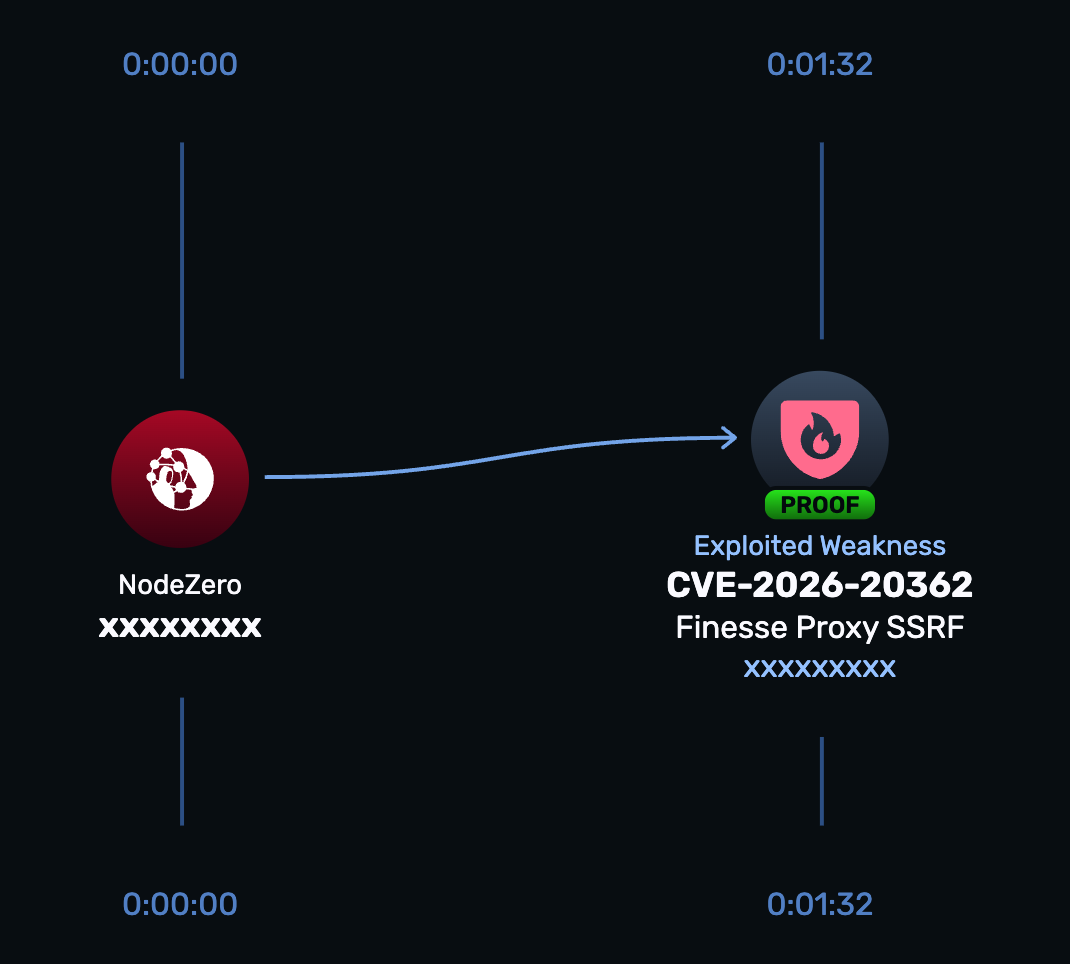
CVE-2026-20362 is an unauthenticated server-side request forgery in Cisco Finesse (CVSS 3.1 score 7.2), found by Horizon3 researchers Noah King and Brandon Peterson. The embedded Apache Shindig content proxy fetches attacker-supplied URLs, including loopback services such as the Finesse REST API at 127.0.0.1:8082, which returns SystemInfo with node hostnames and the XMPP domain. Cisco published its advisory on 7 October 2026. Fixes are planned for January and February 2027, and no workaround exists.
 horizon3.aiadvisoryAdded 29 Oct 2026, published 28 Oct 2026🛡️ Security
- lee1981 (@lee1981b) on X
CVE-2026-92885 is a critical (CVSS 3.1 9.8, CWE-287) authentication bypass in the Qode Membership WordPress plugin, versions through 2.0.6.2. A misspelled variable in the Facebook token-verification guard skips provider checks, so an unauthenticated attacker with a public nonce can get a session cookie for an existing account, including an administrator. The post gives the fix (2.0.6.3, bundled in Bridge 30.9), KEV/EPSS/SSVC status, and a SOC log-correlation and remediation plan.
x.comadvisoryAdded 31 Oct 2026, published 28 Oct 2026🛡️ Security - Dark Web Informer (@DarkWebInformer) on X
Veeam patched five vulnerabilities across Backup & Replication, Veeam Agent for Linux and Veeam ONE. The worst is CVE-2026-108142 (CVSS 9.1), an unauthenticated authorization bypass in the CDP Coordinator Service affecting Backup & Replication 13.0 and 13.1. Other fixes cover Linux agent privilege escalation, two path-traversal file writes, and a Veeam ONE MFA bypass; fixed builds are listed.
x.comadvisoryAdded 30 Oct 2026, published 28 Oct 2026🛡️ Security - lee1981 (@lee1981b) on X
CVE-2026-115905 is a ZIP cloaking flaw in the Rust zip crate (zip-rs/zip2), rated CVSS v4.0 10.0 and affecting versions below 9.0.5. ZipArchive reads central-directory metadata while ZipStreamReader reads local headers, so a crafted archive can pass filename inspection and then overwrite a different file during streaming extraction. Version 9.0.5 adds consistency checks, but ZipStreamReader::new leaves them off by default, and extraction is not atomic, so files can be written before an error is raised. The post covers CWE-20 and CWE-436, KEV and EPSS status, Debian status and a six-step investigation trail.
x.comadvisoryAdded 29 Oct 2026, published 27 Oct 2026🛡️ Security - EPICS Base
CISA ICS advisory ICSA-26-300-01 (October 27, 2026) covers EPICS Base release 7.0.10 and earlier, with CVE-2026-114595 through CVE-2026-114598. Flaws include integer overflow, length parameter inconsistency and type confusion, allowing denial of service, memory corruption, information disclosure or remote code execution (CVSS v3.1 9.8). The fix is EPICS Base 7.0.11, with patches in epics-base and pvDataCPP pull requests.
cisa.govadvisoryAdded 29 Oct 2026, published 26 Oct 2026🛡️ Security - dbugs (@ptdbugs) on X
CVE-2026-106173 is a critical (CVSS 9.4) unauthenticated arbitrary file write in FortiSIEM's phQueryMaster gRPC service on port 27918/TCP. The SendQueryResult method builds a path from the query-id parameter without validation, so "../" sequences escape the directory and a null byte drops the appended filename and extension. Overwriting /opt/charting/redishb.sh, which runs every 60 seconds, gives remote command execution. Horizon3.ai published the analysis and a PoC.
x.comadvisoryAdded 27 Oct 2026, published 26 Oct 2026🛡️ Security  Python packages are also vulnerable to the Node2Shell Brotli flaw (CVE-2026-111497)
Python2Shell is the Python-side impact of CVE-2026-111497 (Node2Shell), a Brotli decoder flaw (CVSS 4.0 9.2) in DecodeBlockTypeAndLength() that mixes an unchecked return value with an out-of-bounds write. Brotli 1.2.0 and earlier, and brotlicffi 1.2.0.x, are affected through urllib3, requests, httpx, aiohttp and Scrapy. Fixes are Brotli 1.2.1 and brotlicffi 1.2.1.0; as of 23 October 2026 advisory databases do not map the CVE to either package. The post lists checks and workarounds.
 aikido.devadvisoryPublished and added 23 Oct 2026🛡️ Security
 Brotli vulnerability affects curl and Git
GHSA-9v8h-qqgm-4m35 is a critical buffer overflow (CVSS v4 9.2) in the Google Brotli decoder (c/dec/decode.c), affecting versions 1.0.3 through 1.2.0 on all platforms. A crafted compressed stream lets an unauthenticated remote attacker corrupt adjacent decoder state, leak memory, crash the process, or possibly execute code. Fixed in 1.0.10, 1.1.1 and 1.2.1. The page does not mention curl or Git, despite the title.
 github.comadvisoryAdded 25 Oct 2026, published 23 Oct 2026🛡️ Security
- lee1981 (@lee1981b) on X
CVE-2026-111497 is an out-of-bounds write in the Brotli decoder bundled with Node.js (CWE-787, CWE-252), rated CVSS v4.0 9.2 by the Google CNA and High by the Node.js project. Fixes are Node 22.23.4, 24.22.1 and 26.12.1, and 24.22.1 still labels Brotli 1.2.0 because the fix was cherry-picked. The post gives a SOC trail from input to worker, with remediation and verification steps. It notes no KEV match, CISA SSVC exploitation none, and only unverified public lab claims.
x.comadvisoryAdded 26 Oct 2026, published 23 Oct 2026🛡️ Security 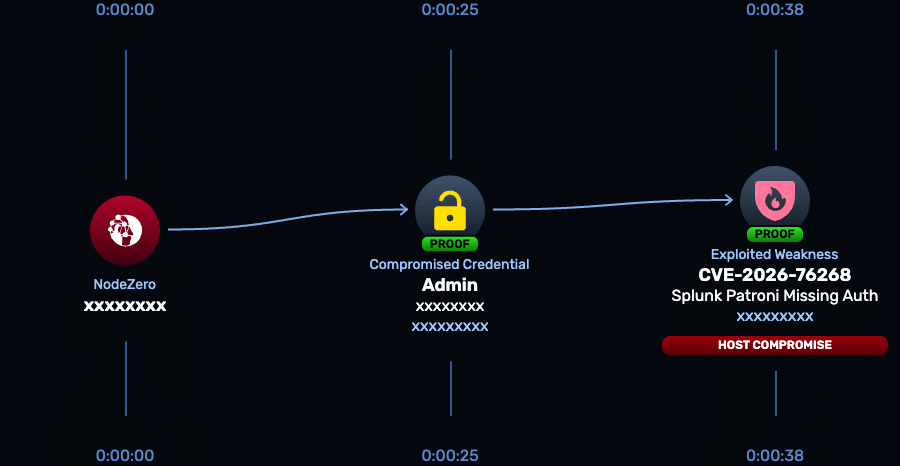 CVE-2026-76268 | Splunk Enterprise Patroni REST API Missing Authentication Vulnerability
CVE-2026-76268 is a critical (CVSS 9.8) missing authentication flaw (CWE-306) in the Patroni REST API on Splunk Enterprise search head cluster members. An unauthenticated attacker with network access can run operating-system commands. Affected: 10.4.0 to 10.4.2 and 10.2.0 to 10.2.6. Fixed in 10.4.3 and 10.2.7. Splunk (SVD-2026-1001, 7 October 2026) suggests disabling the PostgreSQL sidecar as a workaround.
horizon3.aiadvisoryAdded 29 Oct 2026, published 22 Oct 2026🛡️ Security- Dark Web Intelligence (@DailyDarkWeb) on X
CVE-2026-114625 is a critical (CVSS 3.1 9.9) SQL injection in on-prem Arista VeloCloud Orchestrator, the SD-WAN management portal, covered in Arista Security Advisory 0199 of 22 October 2026. Any authenticated user, even the lowest Enterprise Read Only tenant role, can become a local superuser operator, and Arista says it is exploited in the wild. On-prem fixes are 5.2.3.18, 6.1.3.10 and 6.4.2.12; two attacker IPs are listed.
x.comadvisoryAdded 24 Oct 2026, published 22 Oct 2026🛡️ Security - lee1981 (@lee1981b) on X
CyberForge CVE of the Day #084 analyses CVE-2026-76466, a CVSS 9.8 flaw in clustered Cisco Expressway-C and Expressway-E. Persistent database cookies and weak client-certificate validation allow root OS command execution over the network. The fix is X15.5.20 (X14 and earlier must migrate), with no workaround. It adds a per-peer SOC investigation trail, reachability checks and exposure status from CISA SSVC, KEV and EPSS.
x.comadvisoryAdded 24 Oct 2026, published 22 Oct 2026🛡️ Security  PHP Patches Two Critical Unauthenticated RCEs (CVE-2026-109618, CVE-2026-109619): Update Now
Snyk's write-up of two critical unauthenticated PHP runtime RCEs, CVE-2026-109618 (out-of-memory corruption) and CVE-2026-109619 (stale global state, cross-request use-after-free), both CVSS v4.0 9.2. Fixed in PHP 8.5.12, 8.4.27, 8.3.36 and 8.2.35 on 21 October 2026. It covers the disclosure timeline, affected SAPIs (mod_php most exposed), backports for 8.1 and older, and partial mitigations.
 snyk.ioadvisoryPublished and added 22 Oct 2026🛡️ Security
- Oracle Security Alert Advisory – CVE-2026-91403 (eMudhra cert revocation)
Oracle Security Alert for CVE-2026-91403 ships Java SE updates that distrust a set of intermediate CA certificates tied to eMudhra. It contains one new patch for Oracle Java SE, described as remotely exploitable without authentication. Customers are told to update Java or apply mitigations listed at ops.java/emudhra and in the Patch Availability Document. No reporter is credited and the page gives no CVSS score or technical detail.
 oracle.comadvisoryAdded 23 Oct 2026, published 21 Oct 2026🛡️ Security
 Two critical RCEs in PHP core
Cisco Talos advisory on "php2shell", two unauthenticated RCE flaws in PHP core, CVE-2026-109618 and CVE-2026-109619 (CVSS v4.0 9.2), affecting every build since PHP 5.4. One flaw is an out-of-memory handling bug leaving request data partly initialized; the other reuses stale state after free. PHP 8.1 and older get no patch (about 50% of PHP systems). Includes ini-level mitigations and Snort SIDs 67359 and 67360. No exploitation seen as of 21 October 2026.
 blog.talosintelligence.comadvisoryPublished and added 21 Oct 2026🛡️ Security
 PHP Remote Code Execution ("PHP2Shell" CVE-2026-109618 & CVE-2026-109619)
PHP2Shell is the name for CVE-2026-109618 (out-of-memory corruption) and CVE-2026-109619 (stale global state), two unauthenticated PHP remote code execution flaws rated CVSS 4.0 9.2. Details leaked before the 21 October 2026 patch release, and watchTowr's honeypots saw exploitation. The page lists fixed versions (8.5.12, 8.4.27, 8.3.36, 8.2.35), states that .ini mitigations do not work, gives a timeline, and describes compromise checks.
 watchtowr.comadvisoryAdded 28 Oct 2026, published 21 Oct 2026🛡️ Security
 Critical PHP “PHP2Shell” RCE Vulnerabilities Allow Unauthenticated Remote Code Execution (CVSS 9.2)
PHP2Shell is the informal name for CVE-2026-109618 and CVE-2026-109619 (CVSS v4.0 9.2), unauthenticated remote code execution flaws in the PHP core runtime. Patches for branches 8.2 to 8.5 were scheduled for 21 October at 14:00 UTC, while PHP 8.1 and older get no fix; about 884,000 internet-facing hosts run those versions. watchTowr reproduced CVE-2026-109618, no public PoC existed at writing, and Sansec expects mass exploitation within 15 minutes of release.
orca.securityadvisoryPublished and added 21 Oct 2026🛡️ Security- Rapid Response: php2shell, Leaked Critical PHP Vulnerabilities (CVE-2026-109618 & CVE-2026-109619)
Huntress rapid-response post on php2shell, two leaked critical PHP core vulnerabilities (CVE-2026-109618 and CVE-2026-109619, CVSS v4.0 9.2 each) reported as remote code execution. The PHP team moved its security release to 21 October 2026, 14:00 UTC, after the leak. It lists hunting cues such as php-fpm, php-cgi or apache2 spawning shells, interpreters or download tools, plus inventory and patch steps. No root cause, affected versions, PoC or IOCs were public at writing.
 huntress.comadvisoryPublished and added 21 Oct 2026🛡️ Security
 Critical vulnerabilities in PHP (PHP2SHELL)
PHP2SHELL is Aikido Security's advance notice of two critical remote code execution flaws in PHP itself, CVE-2026-109618 and CVE-2026-109619, both CVSS v4.0 9.2, with all versions treated as affected. The PHP security team will release fixes at 14:00 UTC on 21 October 2026, a day early after details leaked on 20 October. The post withholds exploitation details and workarounds.
aikido.devadvisoryPublished and added 21 Oct 2026🛡️ Security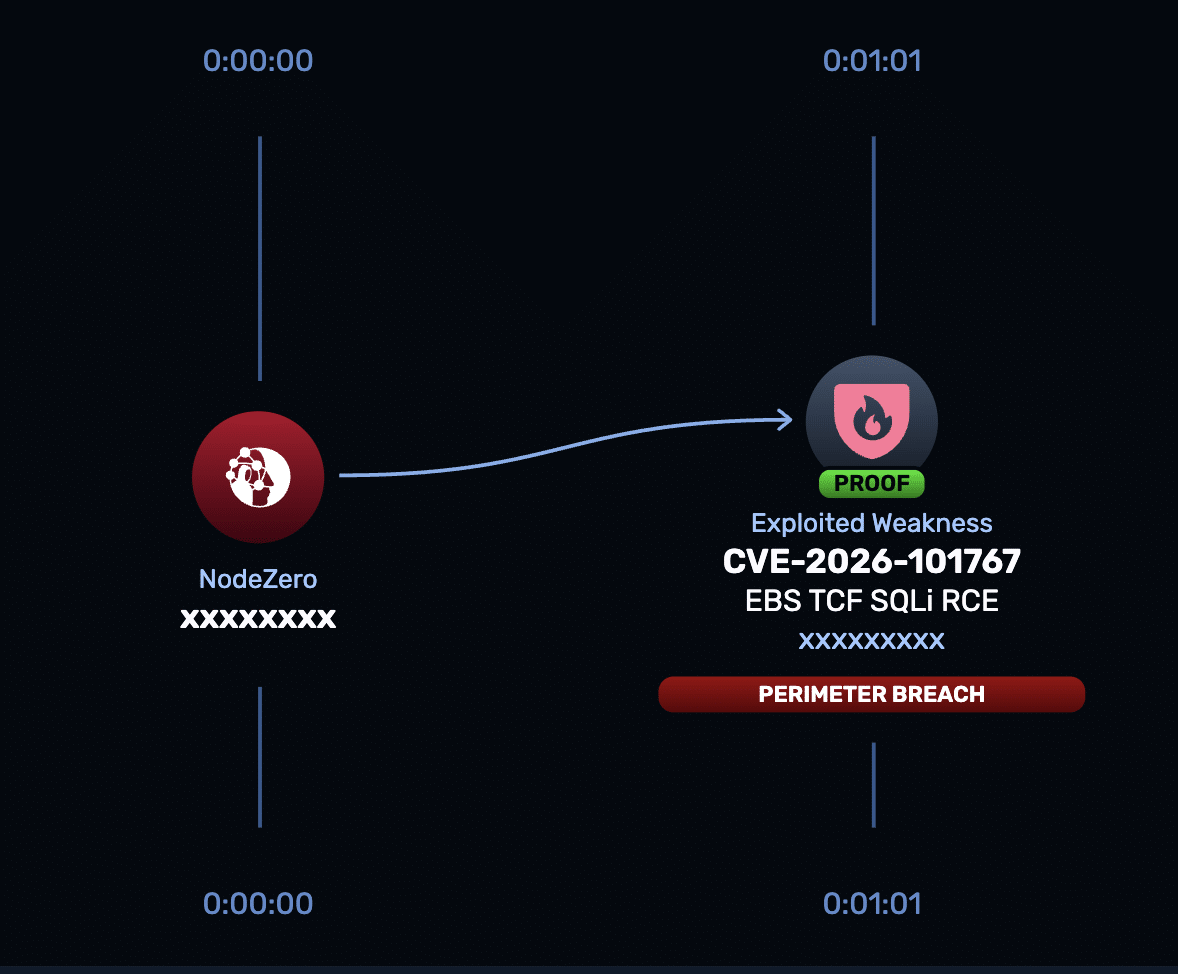 CVE-2026-101767 | Oracle E-Business Suite TCF SQL Injection and Remote Code Execution
CVE-2026-101767 is an unauthenticated SQL injection in the Oracle E-Business Suite Thin Client Framework servlet (/OA_HTML/AppsTCFServer, oracle.apps.fnd.tcf.SocketServer), CVSS 3.1 9.8. It runs SQL as the APPS user and chains to OS commands as the EBS account. Affects 12.2.3 to 12.2.15, fixed in the Oracle October 2026 CPU (20 October 2026). The page lists mitigations, IOCs and a timeline.
horizon3.aiadvisoryAdded 29 Oct 2026, published 20 Oct 2026🛡️ Security- Upcoming Critical PHP Security Release
The PHP security team announces an upcoming PHP security release that fixes two critical vulnerabilities, both rated CVSS v4.0 9.2. The release is scheduled for Wednesday, 21 October 2026 at 14:00 UTC. The team says it may release earlier if details become public or exploitation in the wild is seen. The notice gives no CVE IDs, affected versions or technical details.
 news-web.php.netadvisoryAdded 21 Oct 2026, published 20 Oct 2026🛡️ Security
 Frequently Asked Questions About PHP Remote Code Execution (PHP2Shell CVE-2026-109618 & CVE-2026-109619)
PHP2Shell is the name for CVE-2026-109618 and CVE-2026-109619, two unauthenticated remote code execution flaws in PHP, both CVSS v4.0 9.2. One stems from out-of-memory corruption during request setup, the other from stale global state reused by the next request. watchTowr reports exploitation since 21 October 2026, lists fixed releases (8.5.12, 8.4.27, 8.3.36, 8.2.35) and says PHP 5 is also affected. PHP says no configuration change fully mitigates.
watchtowr.comadvisoryAdded 30 Oct 2026, published 20 Oct 2026🛡️ Security Upcoming Critical PHP Security Release
The php.net 2026 news archive opens with the PHP security team's advance notice of a release scheduled for 21 October 2026 at 14:00 UTC. It fixes two critical vulnerabilities, both rated CVSS v4.0 9.2, and may ship earlier if details leak or exploitation appears. Details and fixed versions come with the release. The archive also lists 2026 security releases (8.2.34, 8.3.35, 8.4.26, 8.5.11), PHP 8.6 RC3 and conference announcements.
 php.netadvisoryAdded 21 Oct 2026, published 20 Oct 2026🛡️ Security
- lee1981 (@lee1981b) on X
CVE-2026-77932 affects DB-GPT through 0.8.2 (dbgpt-app). The /api/v1/chat/react-agent route accepts unauthenticated requests because get_user_from_headers returns an admin-role user, and the ReAct agent can reach unsandboxed Python and shell tools. Lasso reported root in the webserver container in a lab. The post gives CVSS 9.8 and 9.3, no verified fix (0.8.2 is still the latest release), no KEV match, no EPSS data, and a SOC hunting trail.
x.comadvisoryAdded 23 Oct 2026, published 20 Oct 2026🛡️ Security - lee1981 (@lee1981b) on X
CyberForge CVE of the Day #080 covers CVE-2026-99999 ("PwnEscape"), a Linux kernel IPv4 checksum-completion flaw. Crafted checksum metadata can trigger a deferred write into an already-validated IPv4 header, which allows host memory disclosure from a guest or microVM over virtio-net and TAP. It gives upstream fixed branches (5.10.272 to 7.2.11), Amazon Linux, Red Hat and Ubuntu status, CVSS 9.3, EPSS 0.211% and a SOC investigation trail. No IOCs were verified.
x.comadvisoryAdded 19 Oct 2026, published 17 Oct 2026🛡️ Security  BeyondTrust Remote Support Arbitrary File Upload (CVE-2026-102764)
CVE-2026-102764 is a CVSS 9.8 unauthenticated arbitrary file upload flaw in BeyondTrust Remote Support (formerly Bomgar) and Privileged Remote Access. Internal messaging components do not verify message origin, so remote attackers can plant files the appliance would reject. BeyondTrust disclosed it on 15 October 2026 with patch BT26-05, and CISA added it to KEV on 16 October 2026. The page lists log files to review and hardening steps.
watchtowr.comadvisoryAdded 30 Oct 2026, published 16 Oct 2026🛡️ Security- S2W_DailyThreat (@S2W_DailyThreat) on X
S2W post on CVE-2026-97229, a CVSS 10.0 remote code execution flaw in the GitLab CE/EE CI/CD regex compiler, disclosed October 13, 2026. Insufficient regex validation plus an integer overflow during encoding conversion lets an attacker who can add CI/CD config use a malicious regex and a UTF-8 repository path to run commands as the git user. Affects self-managed 19.2 before 19.2.8, 19.3 before 19.3.5 and 19.4 before 19.4.2. Rapid7 published analysis and a public PoC exists, with no in-the-wild exploitation confirmed as of October 15. No workaround exists, so patch or restrict access to a management network or VPN.
x.comadvisoryAdded 17 Oct 2026, published 16 Oct 2026🛡️ Security - lee1981 (@lee1981b) on X
Daily CVE digest on CVE-2026-76519, a CVSS 9.8 relative path traversal (CWE-23) in Cisco Secure Email Gateway's AMP File Reputation attachment processing. A crafted attachment gives unauthenticated arbitrary file writes and root command execution, and Cisco PSIRT reports active exploitation. The CVE is in CISA KEV. It lists the applicability conditions (File Reputation assigned to a policy and Content Scanner Tools earlier than 25.3.0.5525) and the fixes (scanner 25.3.0.5525, AsyncOS 15.5.5-014 and 16.5.0-780). It also covers evidence preservation, reading Cisco's System Security scan outcomes, mail/AMP log correlation, and deployment-specific recovery including cluster-key exposure.
x.comadvisoryAdded 18 Oct 2026, published 15 Oct 2026🛡️ Security  Critical GitLab RCE Lets Unauthenticated Attackers Execute Code on Servers (CVE-2026-97229)
Orca Security analysis of CVE-2026-97229, a CVSS 10.0 flaw in GitLab CE/EE. An integer overflow (CWE-190) in the CI/CD regular expression compiler gives memory corruption and code execution as the git user. It is triggered by a crafted regex in .gitlab-ci.yml combined with a UTF-8 repository path, with no authentication needed on instances that allow public project creation or self-registration. Lists affected branches (19.2 before 19.2.8, 19.3 before 19.3.5, 19.4 before 19.4.2), the absence of a workaround, interim mitigations, and a Rapid7 PoC against GitLab CE 19.4.1 with ASLR on. Notes a prior max-severity GitLab bug (CVE-2026-85706) was probed in the wild within hours and later added to CISA KEV.
orca.securityadvisoryPublished and added 14 Oct 2026🛡️ Security- Dark Web Intelligence (@DailyDarkWeb) on X
Summary of SAP's October 13, 2026 Security Patch Day (16 new notes, 4 GitHub advisories). It leads with CVE-2026-89111, a CVSS 10.0 OAuth2 SSRF in SAP Cloud SDK for Python before 0.45.2, where an attacker-controlled tenant_subdomain redirects token requests and exfiltrates client credentials. It also lists three other critical flaws: broken access control in NetWeaver Visual Composer, code injection in S/4HANA substitution/validation rules, and a missing authorization check in the Manufacturing Integration and Intelligence (XMII) Configuration Service. It notes that none are in CISA KEV and SAP reports no in-the-wild exploitation.
x.comadvisoryAdded 15 Oct 2026, published 13 Oct 2026🛡️ Security  Microsoft Patch Tuesday for October 2026 — Snort rules and prominent vulnerabilities
Talos summarises Microsoft's October 2026 Patch Tuesday, which covers 1415 vulnerabilities, 85 of them critical (67 RCE). One bug is exploited in the wild: CVE-2026-96951, a Windows Shell security feature bypass. The post groups the CVEs by Microsoft's exploitability rating (more likely, less likely, unlikely) with CVSS and CWE for each, covering Windows, Office, Exchange, Hyper-V, DHCP, QUIC, Outlook and Azure. It also lists the Snort 2 and Snort 3 rule ID ranges that detect exploitation attempts.
blog.talosintelligence.comadvisoryPublished and added 13 Oct 2026🛡️ Security- ♫Why♥Not♪ (@Python_s_) on X
Alert thread on CVE-2026-35029 (CVSS v4.0 8.7) in LiteLLM Proxy, versions before 1.83.0. A low-privilege authenticated user can bypass admin authorization on /config/update, change runtime settings, read server files, take over admin credentials and run Python through remotely loaded modules (S3/GCS-hosted). Check Point Research published a full execution chain on October 13 after the April 2026 disclosure. The post lists hunting pointers (non-admin POSTs to /config/update, env-var changes, unexpected pass-through endpoints, cloud module loading) and advises upgrading to 1.83.9 or later and rotating credentials.
x.comadvisoryPublished and added 13 Oct 2026🛡️ Security  Ivanti Connect Secure zero-day exploited in the wild (CVE-2026-104935)
Rapid7 emergency-response analysis of CVE-2026-104935, a CVSS 8.6 authentication bypass by spoofing (CWE-290) in Ivanti Connect Secure that allows unauthenticated remote command execution. It was exploited as a zero-day against a limited number of customers, added to CISA KEV on disclosure day, and Volexity observed it chained with a still-unpatched privilege escalation flaw. Part of the fix shipped in 25.1.3.0 in July 2026, with backports to other supported versions pending. Rapid7 advises emergency patching outside normal cycles and hunting for compromise using Volexity's IOCs, since Ivanti has no reliable ones.
 rapid7.comadvisoryPublished and added 13 Oct 2026🛡️ Security
 Ivanti Connect Secure Authentication Bypass by Spoofing (CVE-2026-104935)
CVE-2026-104935 is an authentication bypass by spoofing in Ivanti Connect Secure (CVSS 3.1 score 8.6) that lets a remote attacker run commands without logging in. CISA added it to KEV on 13 October 2026. The 22.8.X bridge release and 25.1.2.2 and earlier are affected, with fixes in 22.8R2.5, 25.1.1.2, 25.1.3.0 and 25.1.3.1. Ivanti says no reliable indicators of compromise exist yet.
watchtowr.comadvisoryAdded 30 Oct 2026, published 13 Oct 2026🛡️ Security- CVE-2026-97229: Critical Unauthenticated Remote Code Execution in GitLab
Rapid7 analysis of CVE-2026-97229, a CVSS 10.0 integer overflow (CWE-190) in the Onigmo regex compiler used by GitLab CE/EE's CI/CD regex handling. A crafted regex in a .gitlab-ci.yml passes validation as US-ASCII, then is recompiled for a UTF-8 repository path, producing invalid instructions that give code execution as the git user. Rapid7 reproduced it on GitLab CE 19.4.1 with ASLR (patched in 19.4.2); despite the vendor's "unauthenticated" rating, the attacker needs to commit a malicious config to a public project, which self-registration allows. No in-the-wild exploitation is confirmed, and Rapid7 recommends urgent upgrades.
rapid7.comadvisoryPublished and added 13 Oct 2026🛡️ Security - lee1981 (@lee1981b) on X
CyberForge "CVE of the Day #076" covers CVE-2026-97229, a CVSS 10.0 integer overflow (CWE-190) in GitLab CE/EE's CI/CD regular expression compiler. It can lead to conditional unauthenticated code execution on the GitLab server. It lists the affected trains (19.2 before 19.2.8, 19.3 before 19.3.5, 19.4 before 19.4.2) and the 19.3.4 vs 19.3.5 Ona-regression discrepancy. It also gives six SOC checks: scoping, log preservation (Workhorse/Rails/Sidekiq, correlation_id), server-effect hunting, request-to-process correlation, upgrade and running-state verification. It notes that exploit details are unverified, no KEV listing exists and EPSS data is unavailable.
x.comadvisoryAdded 15 Oct 2026, published 13 Oct 2026🛡️ Security - lee1981 (@lee1981b) on X
CyberForge's CVE of the Day #075 covers CVE-2026-108860, a critical (CVSS 9.1 v3.1 / 9.3 v4.0) authentication bypass in SciSharp BotSharp through 5.2.0. WebStarter ships a published default HMAC JWT signing secret (CWE-321), so anyone holding it can forge bearer tokens that impersonate known users, including administrators. The post sets out how to confirm the effective key and serving build, a six-step SOC investigation trail, and remediation by rotating the secret. No verified fixed release, KEV entry or EPSS data existed at cutoff, and the linked research is static-only.
x.comadvisoryAdded 13 Oct 2026, published 12 Oct 2026🛡️ Security  ♫Why♥Not♪ (@Python_s_) on X
Alert on CVE-2026-106610, a critical (CVSS 9.8) incorrect privilege assignment flaw in the miniOrange OTP Verification WordPress plugin, versions 5.5.7 and earlier. Unauthenticated remote attackers can gain elevated permissions, potentially administrator, with no user interaction. Fixed in 5.5.8; no in-the-wild exploitation or public PoC verified. It advises auditing unexpected admin accounts and role changes, and warns that Patchstack's mitigation blocks legitimate requests too.
x.comadvisoryPublished and added 11 Oct 2026🛡️ Security- lee1981 (@lee1981b) on X
CyberForge CVE of the Day #074 analyses CVE-2026-85097, a CVSS 9.8 unauthenticated file upload to PHP execution flaw (CWE-434) in the Bricksforge WordPress plugin through 3.1.8.9. Wordfence names 3.1.8.10 as the fix, and a separate vendor 4.0.1 Pro Forms upload-security notice has no verified mapping to the CVE. It gives a defender workflow: scope versions, preserve edge/origin logs, inspect resulting files and PHP-FPM handling, and verify the patched version is serving. It also separates KEV (no match), EPSS (0.312%) and SSVC (exploitation none) from compromise evidence.
x.comadvisoryAdded 11 Oct 2026, published 10 Oct 2026🛡️ Security - lee1981 (@lee1981b) on X
CyberForge's CVE of the Day #073 covers CVE-2026-102255, a critical (CVSS 10.0) pre-authentication SSRF / confused-deputy flaw (CWE-918, CWE-441) in the SonicWall SMA1000 Work Place interface, per advisory SNWLID-2026-0017. It lists affected platform hotfixes (12.4.3-03526 and older, 12.5.0-02952 and older), fixed floors (12.4.3-03670, 12.5.0-03082), no workaround, and the exploitation picture (no known exploitation, not in KEV, EPSS 0.477%, SSVC automatable). It gives a six-step SOC playbook covering appliance scoping, AMC log preservation, hunting appliance-originated internal requests, correlating receiving-service changes, patching, and verifying every node, and it separates exposure, a lead, confirmed compromise and telemetry gaps.
x.comadvisoryAdded 12 Oct 2026, published 9 Oct 2026🛡️ Security  Citrix Urges Immediate Patching of Critical NetScaler Vulnerability
Citrix disclosed CVE-2026-107406 (CVSS 9.5), a critical memory overflow in NetScaler ADC and NetScaler Gateway that can lead to remote code execution or denial of service when appliances are configured as a SAML SP or SAML IdP, also affecting Secure Private Access Hybrid deployments using NetScaler. Patches are available in versions 14.1-73.46, 13.1-64.29, and the corresponding FIPS/NDcPP builds; Citrix says it is not aware of exploitation yet but urges immediate upgrades. The bulletin follows two other recently exploited NetScaler RCE/DoS zero-days (CVE-2026-88771, CVE-2026-88772) used against government, financial, education, legal, and professional-services organizations, and a separate DoS zero-day (CVE-2026-88779).
 securityweek.comadvisoryPublished and added 9 Oct 2026🛡️ Security
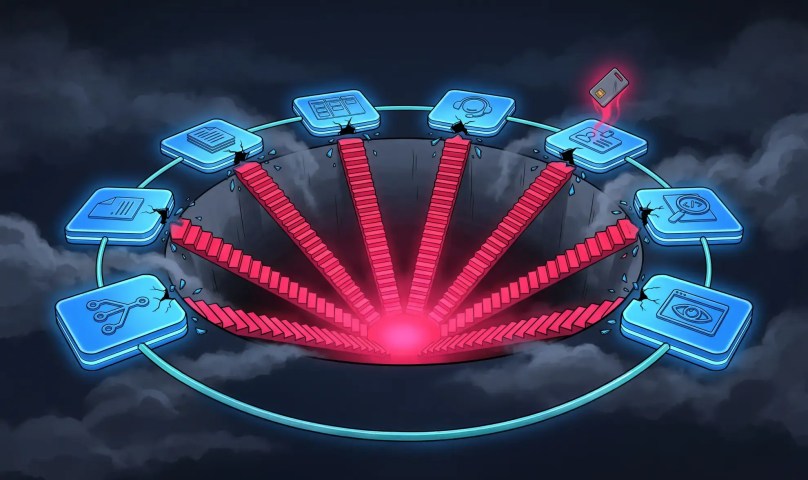 Critical Atlassian Path Traversal Exposes Sensitive Files Across 8 Products
Orca Security details CVE-2026-21589 (CVSS 9.3), a critical unauthenticated path traversal flaw affecting all versions of eight Atlassian Data Center and Server products: Bitbucket, Confluence, Jira Software, Jira Service Management, Bamboo, Crowd, Crucible, and Fisheye. Insufficient path validation lets remote attackers read arbitrary files within the web application root without authentication, and in Crowd SSO deployments this can expose plaintext credentials usable to create administrative accounts and take over the entire Atlassian ecosystem. The advisory lists fixed versions for each product and recommends WAF rules and log review for organizations unable to patch immediately.
orca.securityadvisoryPublished and added 7 Oct 2026🛡️ Security Atlassian Patches Critical Vulnerability Affecting 8 Products
Atlassian patched CVE-2026-21589 (CVSS 9.3), an unauthenticated arbitrary file access flaw affecting all versions of Bitbucket, Bamboo, Crowd, Crucible, Confluence, Fisheye, Jira Service Management, and Jira Software Data Center. WatchTowr researcher Yordan Ganchev notes that organizations using Crowd for SSO are especially at risk because authentication details are stored in plaintext at a predictable path, letting attackers mint admin accounts if Crowd endpoints are internet-reachable. Fixed versions are listed for each product; Atlassian recommends immediate patching or disconnecting internet-facing instances, with WAF rules as a stopgap.
securityweek.comadvisoryPublished and added 7 Oct 2026🛡️ Security- Dark Web Intelligence (@DailyDarkWeb) on X
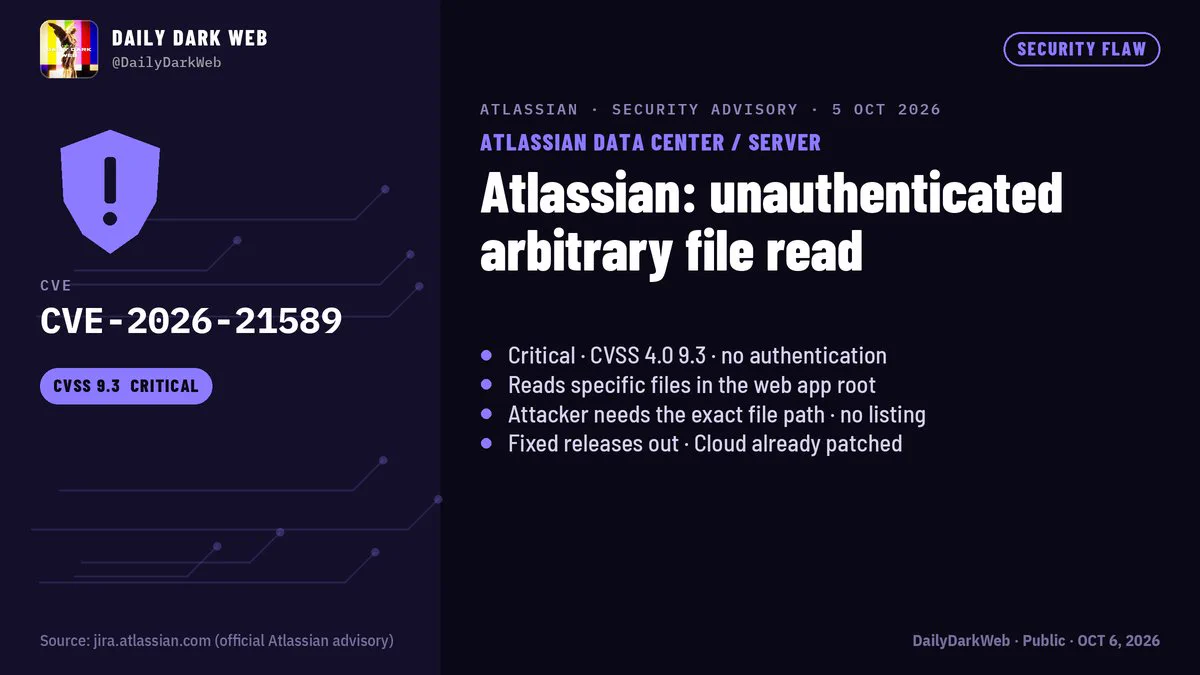
Atlassian disclosed CVE-2026-21589, a critical (CVSS 9.3) unauthenticated path traversal flaw allowing remote attackers to read specific files within the web application root across its self-managed Data Center/Server products — Jira Software, Jira Service Management, Confluence, Bitbucket, Bamboo, Crowd, Crucible, and Fisheye. Fixed versions are listed for each product (e.g. Jira 9.12.40/10.3.26/11.3.12, Confluence 9.2.26/10.2.19), and Atlassian Cloud is already patched; WAF/URL-rewrite mitigations are available for those who can't upgrade immediately. The post's analyst note clarifies exploitation requires knowing the exact target file path (no directory listing), and as of Oct 5, 2026 it is not yet in CISA KEV with no public exploit reported.
x.comadvisoryAdded 7 Oct 2026, published 6 Oct 2026🛡️ Security  Citrix NetScaler Zero-Day Exploited in the Wild Crashes SAML Authentication Services
Analysis of CVE-2026-88779 (CVSS v4.0 8.7), an unauthenticated memory-overflow flaw in the nsaaad SAML authentication handler on Citrix NetScaler ADC/Gateway that lets attackers crash the SAML service and lock out VPN/SSO access indefinitely through repeated triggering. Affects NetScaler 14.1 before 14.1-73.41 and 13.1 before 13.1-64.28 (plus FIPS/NDcPP builds); watchTowr Labs reproduced it via honeypot activity, Citrix confirmed targeted in-the-wild exploitation from IP 213.209.159.55, and CISA added it to KEV on 2026-10-04 with an Oct 7 federal remediation deadline. Some researchers suspect the overflow could extend to RCE beyond the documented DoS, though Citrix hasn't confirmed this.
orca.securityadvisoryPublished and added 5 Oct 2026🛡️ Security- Cyber Security News (@The_Cyber_News) on X
Citrix issued emergency patches for CVE-2026-88779, a memory-overflow zero-day in NetScaler ADC/Gateway appliances configured as a SAML service provider or identity provider, rated CVSS v4.0 8.7. Citrix confirmed active, targeted exploitation against unmitigated deployments, with repeated exploitation causing denial of service and disrupting dependent authentication services.
x.comadvisoryAdded 6 Oct 2026, published 5 Oct 2026🛡️ Security  GitLab patches critical 9.9 AI Gateway template-sandbox-escape RCE (CVE-2026-90970)
GitLab patched CVE-2026-90970, a critical (CVSS 9.9) flaw in the AI Gateway used by Duo Agent Platform, where a logged-in user with Duo Agent Platform access could craft a flow configuration to escape the prompt template sandbox and achieve arbitrary command execution on the gateway. Only self-managed organizations hosting their own AI Gateway (versions 18.1.6 through 19.1) need to act; the fix lands in 19.2.4, 19.3.2, and 19.4.1. The bug is a template engine weakness (CWE-1336), the same class as the earlier CVE-2026-1868 gateway RCE GitLab fixed in February, and was reported via HackerOne by researcher invisiblemeerkat.
 thehackernews.comadvisoryAdded 4 Oct 2026🛡️ Security
 Critical FortiMail Zero-Day Flaw (CVE-2026-104286)
CISA added CVE-2026-104286 (CVSS 9.8), a path traversal and NULL-byte handling flaw in Fortinet FortiMail, to its Known Exploited Vulnerabilities catalog after confirming active in-the-wild exploitation. The bug lets unauthenticated attackers write arbitrary files via crafted HTTP/HTTPS requests, affecting FortiMail 7.2 through 8.0.1; Fortinet published workarounds (disabling IBE, restricting management-interface access) ahead of patches and shared attacker IPs and modified/added files as IOCs. The article also lists several other actively exploited vendor flaws disclosed the same week (Check Point, Arista VeloCloud, F5 BIG-IP APM, Cisco Catalyst SD-WAN Manager, Citrix NetScaler).
thehackernews.comadvisoryAdded 3 Oct 2026🛡️ Security Threat Brief: NetScaler Zero Days CVE-2026-88771 and CVE-2026-88772 Exploited in the Wild (Updated September 30)
Unit 42 threat brief on CVE-2026-88771 (unauthenticated command injection) and CVE-2026-88772 (DTLS memory overflow) in NetScaler ADC and Gateway, both CVSS v4.0 9.5 and exploited as zero-days from August 2026. It details version fingerprinting, .deb and PHP web shells, a three-stage log-poisoning chain through ns_monuploadd_err.pl, httpd.conf persistence, IOCs, and 50,277 exposed instances as of 27 September 2026.
unit42.paloaltonetworks.comadvisoryAdded 30 Oct 2026, published 30 Sep 2026🛡️ Security- Critical Cisco Catalyst SD-WAN Manager API authentication bypass exploited in the wild (CVE-2026-76504)
Rapid7 analysis of CVE-2026-76504, a critical (CVSSv3.1 9.8) unauthenticated API authentication bypass in Cisco Catalyst SD-WAN Manager caused by improper URL-encoding handling (CWE-177), allowing attackers to gain admin-level API access via crafted requests to the j_security_check endpoint. The flaw is being actively exploited in the wild, was added to CISA's KEV list on October 1, 2026 with a remediation deadline of October 3, and follows two earlier 2026 Catalyst SD-WAN peering authentication bypasses (CVE-2026-20127 and Rapid7-discovered CVE-2026-20182). The post gives fixed-release guidance, no-workaround caveats, and log-based IOCs (encoded-character requests like %6a_security_check, viptela-reserved- usernames) for detecting compromise.
rapid7.comadvisoryAdded 7 Oct 2026, published 30 Sep 2026🛡️ Security  Critical Citrix NetScaler Zero-Days Under Active Exploitation
Analysis of two CVSS 9.5 Citrix NetScaler ADC/Gateway zero-days, CVE-2026-88771 (unauthenticated RCE through improper input validation in the management interface, affecting default deployments) and CVE-2026-88772 (memory overflow in DTLS, enabled by default on VPN virtual servers). It lists six more high-severity flaws patched in advisory CTX697096, the affected and fixed versions, and the CISA KEV listing with a federal deadline of 2026-09-30. It advises checking for compromise before patching, since patching can destroy forensic evidence, and gives response steps: isolate, revoke credentials, rebuild firmware, rotate keys and certificates.
orca.securityadvisoryPublished and added 29 Sep 2026🛡️ Security- Zero-Day Exploitation of Citrix NetScaler ADC and Gateway: CVE-2026-88771 and CVE-2026-88772
Rapid7 details active zero-day exploitation of two critical Citrix NetScaler ADC/Gateway RCE vulnerabilities (CVE-2026-88771, CVE-2026-88772, both CVSSv4 9.5), both added to CISA KEV on disclosure day, plus a later SAML denial-of-service zero-day (CVE-2026-88779). The post includes Rapid7 MDR's observed exploitation of CVE-2026-88771 in the wild — a command-injection payload that exfiltrates /flash/nsconfig (containing ns.conf admin credentials, SSL private keys, SSH host keys) via the publicly-served /vpn/ path, and a webshell (SHA256 hash provided) found on a compromised appliance — along with vendor patch versions and detection guidance.
rapid7.comadvisoryAdded 7 Oct 2026, published 28 Sep 2026🛡️ Security  Attackers Exploit WordPress CVE-2026-87902 Within Hours of Patch
CVE-2026-87902 (CVSS 9.2) is an unauthenticated WordPress vulnerability where get_page_template() page-template resolution can be tricked into including an attacker-chosen local .php file outside the active theme directory, leading to RCE when a theme has a page-* top-level directory and a readable local PHP file (e.g. pearcmd.php) exists. Attackers began exploiting it within hours of the September 22, 2026 patch, including pearcmd.php to write PHP web shells to /tmp and /var/tmp and pulling a GitHub-hosted uploader payload, per honeypot telemetry from Previdian and Patchstack with tracked source IPs. CISA added the flaw to its KEV catalog on September 25, 2026, mandating FCEB remediation by September 28; fixed in WordPress 7.1.2, 7.0.6, 6.9.9, and 6.8.10.
thehackernews.comadvisoryAdded 26 Sep 2026🛡️ Security ServiceNow Patches Critical AI Platform Flaw Allowing Unauthenticated User Impersonation
ServiceNow patched CVE-2025-12420, nicknamed BodySnatcher, a CVSS 9.3 flaw in its Now Assist AI Agents (sn_aia) and Virtual Agent API (sn_va_as_service) that let an unauthenticated attacker impersonate any user via just an email address. Discovered by Aaron Costello of AppOmni, the bug chains a hardcoded platform-wide secret with account-linking logic to bypass MFA and SSO, letting an attacker remotely drive privileged agentic AI workflows, impersonate admins, and create backdoor accounts. Fixed in sn_aia 5.1.18+/5.2.19+ and sn_va_as_service 3.15.2+/4.0.4+, patched October 30, 2025 with no known in-the-wild exploitation.
thehackernews.comadvisoryAdded 26 Sep 2026🛡️ Security- Vulnerability Database - OSV
CVE-2026-91931 is a critical remote code execution vulnerability in Flowise versions before 3.1.4, triggered through the platform's Custom MCP feature which invokes npx to run Model Context Protocol servers. A fix is available in 3.1.4; the flaw scores 9.0 (Critical) on CVSS, indicating an attacker can achieve arbitrary code execution likely via unsanitized input to the npx invocation path.
 osv.devadvisoryAdded 26 Sep 2026🛡️ Security
- CVE-2026-65695: Office-Word-MCP-Server through 1
CVE-2026-65695 is a path traversal vulnerability (CWE-22, CVSS 4.0 7.6 HIGH) in Office-Word-MCP-Server through version 1.1.11, an MCP server that exposes Word document manipulation tools to LLM agents. Attackers who can influence the filename argument can supply absolute paths or ../ sequences to document open/save operations, bypassing the check_file_writeable and ensure_docx_extension helpers (which do no base-directory confinement or realpath validation) to read or overwrite arbitrary .docx files outside the intended working directory.
 nvd.nist.govadvisoryAdded 26 Sep 2026🛡️ Security
- CVE-2026-65056: mcp-webresearch 0
CVE-2026-65056 describes a server-side request forgery in the mcp-webresearch MCP server (npm package @mzxrai/mcp-webresearch, v0.1.7), scoring CVSS 4.0 8.3 HIGH. The visit_page tool only validates URL protocol and does not filter private, loopback, link-local, or cloud metadata IP ranges, so an attacker who controls the LLM-supplied URL argument (e.g. via prompt injection) can steer the server's Playwright browser to internal endpoints like cloud instance metadata services and exfiltrate sensitive internal content, including credentials, back into the model context.
nvd.nist.govadvisoryAdded 26 Sep 2026🛡️ Security - CVE-2026-57860: ForgeCode (tailcallhq/forgecode), an AI pair-programming CLI, automatically loads and executes the MCP servers defined i
CVE-2026-57860 describes an arbitrary code execution flaw in ForgeCode (tailcallhq/forgecode), an AI pair-programming CLI that automatically loads and executes MCP servers defined in a repository's .mcp.json on startup without user confirmation. A malicious repo can define mcpServers entries with arbitrary command/args (e.g. bash -c) that spawn under the invoking user's privileges the moment forge is run inside the cloned repo, giving attackers a reliable initial-access and persistence primitive against developers evaluating untrusted code. CVSS 4.0 8.4 HIGH, CWE-829 (inclusion of functionality from untrusted control sphere); a fix commit and VulnCheck advisory are linked.
nvd.nist.govadvisoryAdded 26 Sep 2026🛡️ Security - CVE-2026-52869: The MCP Python SDK, called mcp on PyPI, is a Python implementation of the Model Context Protocol (MCP)
CVE-2026-52869 describes a session-hijacking flaw in the MCP Python SDK (PyPI package mcp) prior to version 1.27.2: the SSE and stateful Streamable HTTP transports (mcp.server.sse.SseServerTransport and mcp.server.streamable_http_manager.StreamableHTTPSessionManager) route requests to existing sessions using only the session_id query parameter or Mcp-Session-Id header, without checking that the requesting principal matches the session's original authenticated bearer-token client. This lets a different authenticated client that learns or guesses a valid session ID inject JSON-RPC messages into another user's MCP session. CVSS 3.1 base score 7.1 (High); fixed in mcp 1.27.2.
nvd.nist.govadvisoryAdded 26 Sep 2026🛡️ Security - CVE-2026-49291: mcp-memory-service is a semantic memory layer for AI applications
CVE-2026-49291 affects mcp-memory-service prior to version 10.65.3: its HTTP MCP JSON-RPC endpoint at /mcp only enforced OAuth 'read' scope before dispatching tools/call requests, so a client holding only read access could invoke mutating tools like store_memory and delete_memory even though the equivalent REST endpoints correctly required 'write' scope. The flaw is a classic missing-authorization bug (CWE-862) surfacing specifically in an MCP tool-dispatch layer, scored CVSS 3.1 8.1 (High) with confidentiality unaffected but integrity and availability impacted. Fixed in 10.65.3.
nvd.nist.govadvisoryAdded 26 Sep 2026🛡️ Security - CVE-2026-20685: An attacker in a privileged network position may be able to leak sensitive information
CVE-2026-20685 is a medium-severity (CVSS 6.5) path handling vulnerability in Apple's Private Cloud Compute (PCC), classified under CWE-20 and CWE-22, that could let an attacker in a privileged network position leak sensitive information. Apple addressed the issue with improved path validation, fixed in PCC Release 5E290.3.
nvd.nist.govadvisoryAdded 26 Sep 2026🛡️ Security - CVE-2026-19978: A flaw has been found in jiantao88 android-mcp-server up to cfb872b2446794193b58edd63f4dbf6af48a6292
CVE-2026-19978 describes an OS command injection (CWE-77/78) in jiantao88's android-mcp-server, where the child_process.exec call in build/index.js fails to sanitize the deviceId, packageName, permission, and extras[].key/value arguments used to control Android devices. The flaw allows local command execution and has a published exploit; it was fixed in commit 14e2bf27c88ba137e35cbb0c2a75f72b595bb98a. CVSS 4.0 base score is 1.9 (local attack vector only), and the project uses rolling releases so no fixed version numbers are assigned.
nvd.nist.govadvisoryAdded 26 Sep 2026🛡️ Security - CVE-2026-18655: Improper restriction of intended endpoints in the RabbitMQ broker connection tools of the Amazon MQ MCP Server (awslabs
CVE-2026-18655 describes an improper endpoint restriction flaw (CWE-923) in the RabbitMQ broker connection tools of awslabs.amazon-mq-mcp-server versions before 2.0.24. A remote unauthenticated attacker can use prompt injection introduced into the MCP client context to redirect the broker hostname to an attacker-controlled endpoint, causing Amazon MQ for RabbitMQ credentials or OAuth access tokens to be sent there; CVSS 4.0 base score 7.1 (High). Fixed in version 2.0.24, referenced via an AWS security bulletin and a GitHub security advisory (GHSA-xwj6-8x5h-hjp6).
nvd.nist.govadvisoryAdded 26 Sep 2026🛡️ Security - CVE-2026-16498: The terraform-mcp-server before version 1
CVE-2026-16498 is a critical (CVSS 3.1: 10.0) exposure-of-sensitive-information flaw (CWE-488) in HashiCorp's terraform-mcp-server prior to version 1.1.0. In stateless streamable-HTTP transport mode, one user's Terraform API token could be reused to execute tool calls on behalf of a different, subsequent user, breaking tenant isolation in shared MCP server deployments. Fixed in terraform-mcp-server 1.1.0; further detail is tracked in HashiCorp's HCSEC-2026-23 advisory.
nvd.nist.govadvisoryAdded 26 Sep 2026🛡️ Security - CVE-2026-14748: A flaw has been found in AIAnytime Awesome-MCP-Server up to a884bb51bcd99e08e14fd712c749d55d9d9a13ab
CVE-2026-14748 is a low-severity (CVSS 4.0: 2.1) server-side request forgery flaw in AIAnytime's Awesome-MCP-Server, specifically in the mcp-wiki/wiki-summary component's server.py, where the url argument is not validated before the server fetches it. A remote, low-privilege attacker can abuse this to make the MCP server issue arbitrary outbound requests; the exploit has already been published via GitHub issues and the maintainer has not responded to the disclosure.
nvd.nist.govadvisoryAdded 26 Sep 2026🛡️ Security - "Allowed HTTP Request Domains" Restriction Bypass via AI Agents MCP Connector
n8n's AI Agents module did not enforce the "Allowed HTTP Request Domains" restriction on credentials. A member-level user with use-only access to a shared credential could point an MCP tool at an attacker-controlled URL and run the agent, so the credential secret was sent to an external server. It only affects instances with the agents module enabled via N8N_ENABLED_MODULES and a domain-restricted credential shared with a member. It is fixed in 2.28.1 and 2.27.4, and the advisory rates it High (CVSS v4 7.1).
github.comadvisoryAdded 26 Sep 2026🛡️ Security - Google Service Account Private Key Exposed in JWT Header
n8n GitHub advisory GHSA-9r8p-h6cc-6qhm: when configured with a Google Service Account key, n8n put the full PEM private key into the JWT header's kid field. Because JWT headers are only Base64-encoded, anything that logged or inspected the JWT (proxies, load balancers, app logs) could recover the key and impersonate the service account in Google Cloud. Fixed in 1.123.64, 2.29.8 and 2.30.1; rated Moderate (CVSS v4 5.1), with workarounds to rotate keys and review logs for exposed JWT headers.
github.comadvisoryAdded 26 Sep 2026🛡️ Security - CVE-2026-21852 - GitHub Advisory Database
GitHub advisory GHSA-jh7p-qr78-84p7 for Claude Code: a malicious repository could ship a project settings file setting ANTHROPIC_BASE_URL to an attacker-controlled endpoint. Claude Code made API requests during project load before the trust prompt was shown, leaking data including the user's Anthropic API key. Fixed in auto-updated versions; manual updaters should upgrade. It is CVSS v4 scored, with network attack vector and passive user interaction, and mapped to a credential-transmission weakness (insecure transmission/storage of credentials).
github.comadvisoryAdded 26 Sep 2026🛡️ Security - CVE-2026-44895 - GitHub Advisory Database
GitHub advisory for @yoda.digital/gitlab-mcp-server (mcp-gitlab-server): with USE_SSE=true the HTTP/SSE transport has no authentication, sends wildcard CORS headers, and binds to 0.0.0.0. Any network caller or any web page the operator visits can open /sse and POST /messages to drive all 86 GitLab tools (delete_repository, push_files, etc.) using the operator's personal access token. It includes a curl PoC, a CVSS 4.0 vector (~6.3 Medium, effectively High when SSE is enabled) and four fixes: required auth token, loopback bind, a CORS allowlist, and the OAuth roadmap.
github.comadvisoryAdded 26 Sep 2026🛡️ Security - Warning: Vulnerability in Starlette framework and related frameworks like FastAPI exposes millions of servers to authentication bypass, Patch Immediately! | CCB Belgium
Belgian CCB advisory on CVE-2026-48710 ("BadHost", CVSS 6.5), an authentication bypass in Starlette versions before 1.0.1. The Host header was not validated when request.url was rebuilt, so request.url.path could differ from the routed path. Middleware and endpoints that enforce access control on request.url could therefore be bypassed. The flaw affects FastAPI, LiteLLM, vLLM, MCP servers and other Python LLM infrastructure, and may expose stored third-party credentials. The advisory recommends upgrading to 1.0.1 or later and increasing monitoring, and links to the badhost.org scanner and to the GitHub, OSTIF, X41 D-Sec and Ars Technica write-ups.
 ccb.belgium.beadvisoryAdded 26 Sep 2026🛡️ Security
- CVE-2026-94127: Critical Unauthenticated RCE in F5 BIG-IP APM
Rapid7's ETR writeup covers CVE-2026-94127, a critical heap-based buffer overflow (CVSS 9.8) in F5 BIG-IP Access Policy Manager that allows unauthenticated remote code execution via crafted traffic. Exploitation requires a virtual server with both an APM access policy and an OAuth profile configured, affects the data plane (including Appliance mode), and has been added to CISA KEV; F5 provides hotfixes for the 21.1.0, 17.5.0, and 17.1.0 release trains plus an iRule workaround for those unable to patch immediately.
rapid7.comadvisoryAdded 7 Oct 2026, published 23 Sep 2026🛡️ Security  WordPress “Comment2Shell” XSS-to-RCE Chain Lets Unauthenticated Attackers Compromise Servers via Malicious Comments
CVE-2026-93485 (CVSS 7.1) is a stored XSS-to-RCE chain in WordPress Core's wpautop() function (wp-includes/formatting.php), where a mismatch between comment sanitization at save time and HTML reformatting at display time lets an unauthenticated attacker inject live event handlers via a crafted comment. When a logged-in administrator views the page, the script executes and installs a malicious plugin containing a web shell, achieving full RCE. It affects WordPress Core 4.7 through 7.1.0 (essentially all installs, including block themes since Twenty Twenty-Two), and is fixed in 7.1.1 with backports down to 4.7.36; no public PoC or in-the-wild exploitation was reported at disclosure time.
orca.securityadvisoryPublished and added 22 Sep 2026🛡️ Security Cisco Warns of New Zero-Day ISE Auth Bypass (CVSS 10.0) Exploited in Active Attacks
Cisco disclosed CVE-2026-76460 (CVSS 10.0), an unauthenticated API authentication bypass in Identity Services Engine (ISE) and ISE-PIC that is under active exploitation and has been added to CISA's KEV catalog with a federal patch deadline of September 19, 2026; successful exploitation can yield root command execution, and Cisco provides log-based IOC detection guidance since there is no workaround. The same disclosure batch includes 77 new CVEs, 41 in ISE and 28 in Secure Firewall (ASA/FTD/FMC), covering authenticated RCE, SQL injection, XXE, command injection, and additional REST API auth bypasses, plus a separately exploited Secure Email Gateway flaw (CVE-2026-76461, CVSS 9.8).
thehackernews.comadvisoryAdded 22 Sep 2026🛡️ Security- CVE-2026-76461: Critical Cisco Secure Email Gateway Vulnerability Exploited in the Wild
Rapid7's emerging threat response write-up on CVE-2026-76461, a critical (CVSS 9.8) SQL injection vulnerability in Cisco AsyncOS Software for Cisco Secure Email Gateway that allows an unauthenticated remote attacker to achieve root command execution by sending a specially crafted email. Cisco confirmed active zero-day exploitation and the vulnerability was added to CISA's KEV catalog the same day it was disclosed; the post provides mitigation guidance (emergency patching to 16.5.0-780) and a log-grep IOC (searching mail_logs for COPY.*TO PROGRAM) to detect exploitation attempts.
rapid7.comadvisoryAdded 7 Oct 2026, published 15 Sep 2026🛡️ Security  Breaking: GitLab Critical Path Traversal Flaw Exploited in the Wild — Patch Immediately
Details CVE-2026-85706 (CVSS 10.0), an unauthenticated arbitrary file read in GitLab CE/EE's repository commits API exploitable via a crafted file.path parameter in a single POST request, requiring only that one public project exist on the instance. It also covers CVE-2026-87719 (CVSS 9.9), an authenticated insecure deserialization bug in GitLab EE's GraphQL subscription serializer reachable via Duo Chat access that leaks stored Elasticsearch/OpenSearch credentials. Both affect GitLab versions through 19.3.1; CVE-2026-85706 is under active internet-wide scanning per WatchTowr Labs and is in CISA's KEV catalog with a federal patch deadline, with fixes in GitLab 19.1.8/19.2.6/19.3.2.
orca.securityadvisoryPublished and added 14 Sep 2026🛡️ Security- CVE-2026-85706: Critical GitLab Path Traversal Exploited in the Wild
GitLab patched CVE-2026-85706, a critical (CVSS 10.0) path traversal flaw (CWE-22) in the repository commits API that lets an unauthenticated attacker read arbitrary files from self-managed GitLab CE/EE instances; CISA added it to the KEV catalog on September 11, 2026 due to active exploitation, with a remediation deadline of September 14. The same patch release fixes CVE-2026-87719, a critical insecure deserialization bug (CWE-502) letting an authenticated Duo Chat user exfiltrate Advanced Search configs and credentials via a crafted GraphQL subscription argument, plus 17 other vulnerabilities. Rapid7 recommends emergency patching and post-patch compromise checks given confirmed in-the-wild exploitation.
rapid7.comadvisoryAdded 7 Oct 2026, published 14 Sep 2026🛡️ Security  CVE-2026-85706: GitLab CE/EE Repository Commits API Path Traversal
CVE-2026-85706 is a CVSS 10.0 critical path traversal vulnerability in GitLab CE/EE's repository commits API, caused by improper path confinement combined with missing authentication enforcement. It allows unauthenticated, remote attackers to read arbitrary files from the GitLab server — potentially exposing credentials, secrets, tokens, SSH keys, and database credentials. Affects versions 18.7 through 19.1.7, 19.2.0-19.2.5, and 19.3.0-19.3.1; fixed in 19.1.8, 19.2.6, and 19.3.2.
horizon3.aiadvisoryAdded 17 Sep 2026, published 11 Sep 2026🛡️ Security Rapid Reaction: GitLab Critical Path Traversal Vulnerability (CVE-2026-85706)
watchTowr's rapid-reaction analysis of CVE-2026-85706, a critical (CVSS 10.0) unauthenticated path traversal in GitLab CE/EE's repository commits API, patched in versions 19.3.2, 19.2.6, and 19.1.8. The flaw lets an unauthenticated attacker read arbitrary files (configs, secrets) from self-managed GitLab servers via crafted requests to /api/v4/projects/{id}/repository/commits/ with a file.path parameter; watchTowr reproduced the bug and reports honeypot probes indicating attackers have already reverse-engineered it ahead of mass exploitation.
watchtowr.comadvisoryAdded 21 Sep 2026, published 11 Sep 2026🛡️ Security- Rapid Reaction: GitLab Path Traversal Vulnerability (CVE-2026-85706)
watchTowr's rapid-reaction analysis of CVE-2026-85706, a critical (CVSS 10.0) unauthenticated path traversal vulnerability in the GitLab CE/EE repository commits API, patched in versions 19.3.2, 19.2.6, and 19.1.8. The flaw allows an unauthenticated attacker to read arbitrary server-side files via the commits API due to improper path confinement and missing auth enforcement; watchTowr's honeypot network was already observing exploitation probes at time of publication. The post includes hunting guidance (searching logs for POST requests to /api/v4/projects/{id}/repository/commits/ containing file.path parameters) and patching priorities for self-managed instances.
watchtowr.comadvisoryAdded 16 Sep 2026, published 11 Sep 2026🛡️ Security  Grafana fixes critical SSRF flaw affecting Grafana MCP servers
Grafana patched CVE-2026-19516 (CVSS 9.1), a critical SSRF in the Grafana MCP server's grafana_api_request tool where a caller-supplied X-Grafana-URL header could control the method, path and body of outbound requests, letting an attacker reach internal-only services from the server's network position. Pillar Security researchers chained this with a second flaw — the MCP server accepting unauthenticated "session-shaped IDs" it never issued — and demonstrated using it to hit the AWS IMDSv2 endpoint and retrieve cloud credentials via a two-step PUT/TTL token request. Grafana MCP v1.1.0 adds optional bearer-token auth to close the session-forgery gap; Pillar frames MCP servers broadly as "identity brokers" that need explicit outbound destination policies and mandatory auth for remote deployments.
 scworld.comadvisoryAdded 26 Sep 2026, published 3 Sep 2026🛡️ Security
 UI-TARS-desktop MCP Server: Critical Unauthenticated RCE
CVE-2026-81735 is a CVSS 10 unauthenticated RCE in the mcp-http-server package used by UI-TARS-desktop. The Streamable HTTP/SSE transport defaulted to binding on '::' with no authentication middleware applied by the @agent-infra/mcp-server-commands and @agent-infra/mcp-server-filesystem entry points, so any network client could invoke the exposed run_command tool (which pipes input straight into child_process.exec) for arbitrary command execution, or use the filesystem tool for unauthenticated arbitrary file read/write. The fix, landed in commit c2ad42e3eb9b27830db41a3e6f51ca7179d9b168, changes the default listen address to 127.0.0.1 without bumping the package version, so affected instances can't be identified by version number alone.
 thehackerwire.comadvisoryAdded 26 Sep 2026, published 27 Aug 2026🛡️ Security
 Security Hardening Release for Splunk Apps and Add-ons - August 2026
Splunk's August 2026 hardening advisory (SVD-2026-0808) discloses 17 CVEs across Cisco Talos Intelligence for Enterprise Security Cloud, Splunk AI Toolkit, Splunk Connect for Kafka, the Splunk MCP Server app, and Splunk On-Call (VictorOps). Notable issues include a critical (CVSS 9.1) RCE via unsafe credential deserialization in the Splunk MCP Server app (CVE-2026-76404), an RCE via pickle-based deserialization when loading ML model files in Splunk AI Toolkit (CVE-2026-76395), multiple SSRF and authorization-bypass flaws letting low-privileged users escalate to system-level search execution, hardcoded/predictable container credentials, and unauthenticated DoS/ReDoS and cert-validation bypasses in Splunk Connect for Kafka. Each finding includes CWE classification, CVSS vector, and mitigation guidance (typically disabling the affected app or restricting REST API access).
 advisory.splunk.comadvisoryAdded 21 Aug 2026🛡️ Security
 Critical Elementor Pro File Upload Flaw Enables Unauthenticated Remote Code Execution on WordPress Sites
CVE-2026-32475 (CVSS 9.0) is an unauthenticated arbitrary file upload leading to RCE in Elementor Pro's Forms module (versions up to 4.2.1), caused by the extension-blocklist check and the file-move step running in two separate loops with different empty-file handling, letting a two-part file submission bypass the blocklist and drop a PHP webshell into the public wp-content/uploads/elementor/forms/ directory. The post also flags related WordPress core CVE-2026-65640 (CVSS 8.8, fixed in 7.0.4), an Author-level RCE via malicious PostScript upload requiring Imagick and Ghostscript. Fix: upgrade Elementor Pro to 4.2.2+ and WordPress core to 7.0.4, and audit the uploads/elementor/forms directory for planted PHP files.
orca.securityadvisoryAdded 3 Sep 2026, published 20 Aug 2026🛡️ Security Agno’s PythonTools Path Traversal: Arbitrary File Access & RCE
CVE-2026-76832 (CVSS 8.8) is a path traversal flaw in Agno's PythonTools, specifically in libs/agno/agno/tools/python.py, where the file_name argument to read_file, save_to_file, and run_python_file is not sanitized against the configured base_dir. An attacker can pass sequences like ../../../../etc/passwd to read or write arbitrary files, and abuse run_python_file to execute an arbitrary Python script for RCE. The advisory notes the flaw is reachable either via direct tool invocation or via prompt injection into agent-processed content, with no PoC or patch published at time of writing.
thehackerwire.comadvisoryAdded 26 Sep 2026, published 20 Aug 2026🛡️ Security Grafana MCP server-side request forgery via X-Grafana-URL header (grafana_api_request) | Grafana Labs
Grafana advisory for CVE-2026-19516, a critical (CVSS 9.1) SSRF in mcp-grafana. A caller able to invoke the grafana_api_request tool can set the X-Grafana-URL header to redirect outbound requests, choosing method, path and body, to internal, loopback and link-local services including cloud metadata endpoints, and read the responses. The earlier fix for CVE-2026-15583 only stopped the service-account token leaking to other destinations and did not restrict the destinations; the fix is in version 1.1.0 and later.
 grafana.comadvisoryAdded 12 Aug 2026🛡️ Security
- CVE-2026-15988 | INCIBE-CERT | INCIBE
CVE-2026-15988 describes a CSRF vulnerability (CVSS 8.8, CWE-352) in the "AI Engine – The Chatbot, AI Framework & MCP" WordPress plugin, affecting all versions up to and including 3.6.5. Missing/incorrect nonce validation on the reauth_for_authorize function lets an unauthenticated attacker trick a logged-in administrator into visiting a crafted link, which — combined with WordPress's ?_method=POST override to turn a GET into an authenticated REST POST — creates a new administrator account with attacker-supplied credentials.
 incibe.esadvisoryAdded 2 Aug 2026🛡️ Security
 AI Security Briefing
CISA added four actively exploited vulnerabilities to its KEV catalog: a path traversal RCE in Adobe ColdFusion (CVE-2026-48282, CVSS 10.0), an unauthenticated file-upload RCE in Joomlack Page Builder CK (CVE-2026-56290, CVSS 10.0), an IDOR in Langflow allowing cross-tenant flow execution and LLM/AWS key theft (CVE-2026-55255, CVSS 6.1), and an unauthenticated arbitrary file upload in JoomShaper SP Page Builder (CVE-2026-48908, CVSS 10.0). Sysdig documented an operator chaining the Langflow IDOR with CVE-2026-33017 RCE for opportunistic, financially motivated cryptojacking/botnet activity and credential theft from an AI orchestration platform, while mySites.guru observed web shell deployment via the Joomla flaws. FCEB agencies must patch by July 10, 2026.
thehackernews.comadvisoryPublished and added 18 Jul 2026🛡️ Security AI Security Briefing
CVE-2026-14898 affects the OpenAI Codex desktop app for macOS, which automatically renders remote images embedded in Markdown model output without user interaction. An attacker can use indirect prompt injection to make Codex generate a response containing an attacker-controlled image URL whose parameters embed sensitive data (API keys, source code, tool output), which is silently exfiltrated when the app auto-fetches the image. Categorized under CWE-200, no patch or CVSS score was available at disclosure.
 cybersecuritynews.comadvisoryPublished and added 18 Jul 2026🛡️ Security
- CVE-2026-59950
CVE-2026-59950 (CVSS 7.6) affects the MCP Python SDK's deprecated mcp.server.websocket.websocket_server transport, which accepted WebSocket handshakes without validating Host or Origin headers, giving no SDK-level way to restrict which origins could connect to applications exposing that transport. This is a classic CSWSH-style origin-validation flaw (CWE-346, CWE-1385) fixed in mcp 1.28.1.
nvd.nist.govadvisoryPublished and added 17 Jul 2026🛡️ Security - CVE-2026-61447
CVE-2026-61447 describes a critical (CVSS 4.0 score 10.0) remote code execution vulnerability in PraisonAI versions before 1.6.78, rooted in CodeAgent._execute_python(), which runs LLM-generated Python code with no AST validation, import restrictions, or sandbox enforcement. An attacker who can influence the LLM's output via prompt injection can exfiltrate environment secrets and achieve arbitrary code execution on the host, making it a textbook agentic-code-execution flaw (CWE-94).
nvd.nist.govadvisoryPublished and added 12 Jul 2026🛡️ Security - AI Security Briefing
CVE-2026-50027 describes a critical missing-authentication flaw in mcp-memory-service, a PyPI-hosted MCP server used for persistent AI agent memory. All routes under /api/documents/* bypass the server's MCP_API_KEY/OAuth authentication checks (unlike the properly-protected /api/memories endpoints), letting unauthenticated remote attackers read, write, and permanently delete stored memories. GitLab rates it CVSS 9.8 Critical.
 advisories.gitlab.comadvisoryPublished and added 5 Jul 2026🛡️ Security
 Orca Security: Langflow RCE (CVE-2026-33017) Actively Exploited
Orca Security details CVE-2026-33017 (CVSS 9.8), an unauthenticated RCE in Langflow's public flow-build API (/api/v1/build_public_tmp/{flow_id}/flow) that lets attackers execute arbitrary Python via a crafted node definition, with no sandboxing. Trend Micro observed active exploitation within 20 hours of disclosure, deploying a Go-based "lambsys" binary that kills rival cryptominers, disables AppArmor/SELinux/UFW/iptables, wipes logs, harvests credentials/.env files, and installs a geo-aware XMRig miner; ~7,000 internet-exposed Langflow instances were found, the flaw is in CISA's KEV catalog, and fix guidance clarifies 1.8.2 is still vulnerable — users must upgrade to 1.9.0+ or the 1.9.0.dev18 nightly and rotate exposed secrets.
orca.securityadvisoryPublished and added 2 Jul 2026🛡️ Security Vulnerability-Lookup
GHSA-9c5h-h4mj-p5ch / CVE-2026-13524 documents an improper-authorization vulnerability (CWE-266) in Cherry Studio's MCP OAuth Local Callback Server (src/main/services/mcp/oauth/callback.ts), where manipulation of the code parameter can bypass authorization checks. The attack is remote but high-complexity and difficult to exploit (CVSS 3.1: 6.5 / CVSS 4.0), a public PoC has been disclosed, and a fix PR is still awaiting merge as of publication.
 vulnerability.circl.luadvisoryAdded 26 Sep 2026, published 29 Jun 2026🛡️ Security
- AI Security Briefing
GHSA-7835-87q9-rgvv discloses a High-severity (CVSS 7.7) flaw in Claude Code's git worktree handling: the CLI allowed creation of worktrees named ".git" and navigation outside the sandbox context, enabling git directory confusion attacks. By combining symlink manipulation with git fsmonitor execution during worktree operations, an attacker could overwrite files like the user's .zshenv to achieve code execution outside the seatbelt sandbox, though reliable exploitation required a victim to clone a malicious repo containing prompt-injection content and run Claude Code against it. The issue was reported via HackerOne by researcher metnew and is fixed in current Claude Code releases.
github.comadvisoryPublished and added 27 Jun 2026🛡️ Security - CVE-2026-12773
Tenable CVE entry for CVE-2026-12773, an improper authentication flaw in BerriAI LiteLLM up to 1.59.8. The vulnerable function is UserAPIKeyAuth in litellm/proxy/_experimental/mcp_server/auth/user_api_key_auth_mcp.py in the MCP Proxy component. It is remotely exploitable, a public exploit exists, and scores are CVSS v3.1 9.8 Critical, CVSS v4.0 6.9 Medium and EPSS 0.01017.
 tenable.comadvisoryAdded 26 Jun 2026🛡️ Security
- Vulnerability-Lookup
GHSA-73cv-556c-w3g6 (CVE-2026-49257, CWE-306) documents that mcp-pinot v3.0.1 and earlier defaults to an HTTP MCP server bound to 0.0.0.0:8080 with oauth_enabled=False, exposing all 14 tools — including read_query, create_schema and create_table_config — to any unauthenticated network caller. The server proxies calls using its own server-side Pinot credentials, creating a confused-deputy condition that grants full read/write access to the backing Apache Pinot cluster (CVSS 10.0). Fixed in v3.1.0 (PR #95) by defaulting the bind host to 127.0.0.1, refusing non-loopback exposure without OAuth, and gating Helm exposure behind OAuth.
vulnerability.circl.luadvisoryAdded 26 Sep 2026, published 18 Jun 2026🛡️ Security  Orca: CVE-2026-5027 Langflow Path Traversal RCE
CVE-2026-5027 (CVSS 8.8) is a path traversal vulnerability in Langflow's POST /api/v2/files upload endpoint, where the upload_user_file() function fails to sanitize filenames, allowing attackers to write arbitrary files anywhere on the filesystem. Because Langflow ships with unauthenticated auto-login enabled by default, a single unauthenticated request is enough to obtain a session and exploit it, escalating to RCE via cron job injection or config overwrite. Tenable disclosed it after failed vendor contact, VulnCheck has confirmed active exploitation against roughly 7,000 internet-exposed instances, and a public PoC exists; fixed in Langflow 1.9.0/1.10.0 and langflow-base 0.8.3.
orca.securityadvisoryPublished and added 12 Jun 2026🛡️ Security Orca: CVE-2026-45034 PhpSpreadsheet RCE Patch Bypass
Orca Security details CVE-2026-45034 (CVSS 9.8), a bypass of PhpSpreadsheet's File::prohibitWrappers() protection that was originally added to fix CVE-2026-34084. A crafted path with three or more slashes after the scheme (e.g. phar:///path/exploit.phar/dummy.csv) causes PHP's parse_url() to return false instead of a scheme string, skipping the is_string($scheme) check while PHP's stream layer still treats the path as a phar wrapper, enabling automatic phar deserialization via IOFactory::load() and full RCE on PHP 7.x (file-read primitive on PHP 8.x, with RCE restored if Phar::getMetadata() is later called). All 1.x versions through 1.30.4 are affected; PhpSpreadsheet 1.30.5 patches the issue, and the post recommends replacing parse_url()-based checks with str_contains($filename, '://') validation.
orca.securityadvisoryPublished and added 12 Jun 2026🛡️ Security Orca: Splunk Enterprise Critical CVEs
Orca Security breaks down four new Splunk vulnerabilities: CVE-2026-20253 (CVSS 9.8), an unauthenticated arbitrary file create/truncate flaw in a PostgreSQL sidecar endpoint in Splunk Enterprise with no available workaround; CVE-2026-20251 (CVSS 8.8), a jsonpickle insecure-deserialization RCE in the Splunk Secure Gateway app exploitable by any low-privilege user; CVE-2026-20258, a stored XSS in classic dashboard HTML panels; and CVE-2026-20252, an SSRF in Dashboard Studio PDF export that bypasses trusted-domain validation via prefix matching and redirects. It lists affected Splunk Enterprise, Cloud Platform, and Secure Gateway version ranges and patched releases, plus interim mitigations like disabling Secure Gateway or Splunk Web.
orca.securityadvisoryPublished and added 12 Jun 2026🛡️ Security Orca Security: CVE-2026-8206
Orca Security details CVE-2026-8206 (CVSS 9.8), a critical unauthenticated account-takeover flaw in the Kirki Freeform Page Builder, Website Builder and Customizer WordPress plugin versions 6.0.0-6.0.6. The bug lives in handle_forgot_password() of the CompLibFormHandler class, whose custom REST endpoint accepts an attacker-supplied email instead of the account registered address, letting an attacker redirect the password-reset link and seize admin accounts. Active exploitation is already confirmed (Wordfence logged 59 blocked attacks in 24 hours), and roughly 150,000 of 500,000+ installs remain unpatched pending the 6.0.7 fix.
orca.securityadvisoryPublished and added 3 Jun 2026🛡️ Security Orca Security: Critical RCE in LiquidJS (CVE-2026-45618)
Orca Security details CVE-2026-45618, a CVSS 10.0 unauthenticated RCE in LiquidJS (Shopify's Liquid template engine for Node.js, 7.3M+ monthly npm downloads) affecting all versions prior to 10.26.0. Attackers craft a template expression using the valueOf filter (1|valueOf) to escape the sandbox, chain prototype manipulation to reach internal engine objects (parser, loader, filters), and ultimately invoke the JavaScript Function constructor for arbitrary command execution; a public PoC demonstrates file reads and execSync-based RCE, and CCB Belgium's national CERT has issued an advisory urging immediate patching.
orca.securityadvisoryPublished and added 2 Jun 2026🛡️ Security Orca Security: Critical Unauthenticated RCE in Kopia Backup via SSH ProxyCommand Injection
Orca Security breaks down CVE-2026-45695 (CVSS 9.8), an unauthenticated RCE in the Kopia backup tool's HTTP server, affecting versions 0.22.3 and earlier. The flaw stems from Kopia's /api/v1/repo/exists endpoint splitting SFTP storage configuration fields on literal spaces without a proper tokenizer or quote handling, letting an attacker inject `-oProxyCommand=<cmd>` into the SSH command line when the server runs with --without-password and SFTP/external-SSH enabled — achieving code execution via a single crafted HTTP request. Fix is Kopia 0.23.0, which blocks starting with --insecure/--without-password on non-loopback interfaces; researcher Daniele Berardinelli reported it, tracked as GHSA-2q4c-3mrw-63c3.
orca.securityadvisoryPublished and added 26 May 2026🛡️ Security Orca Security: Critical Coder Signature Bypass Exposes Developer Keys and Tokens
Orca analysis of CVE-2026-46354 (CVSS 9.1) in the Coder remote development platform. azureidentity.Validate() checks that the PKCS#7 signer certificate chains to a trusted Azure CA but never verifies the signature on the envelope. An unauthenticated attacker can send a forged envelope, using a public Azure IMDS certificate and a known vmId, to POST /api/v2/workspaceagents/azure-instance-identity. This yields workspace agent session tokens, and through them Git SSH keys and OAuth tokens. The post lists the affected v2 and v1 versions, the patched releases (v2.33.3, v2.32.2, v2.31.12, v2.30.8, v2.29.13, v2.24.5) and the workaround of disabling Azure instance identity auth. Coder v1 has no patch.
orca.securityadvisoryPublished and added 22 May 2026🛡️ Security Orca Security: Critical Pre-Auth RCE in ChromaDB Threatens AI Infrastructure
CVE-2026-45829 (CVSS 10.0) is a pre-authentication remote code execution flaw in ChromaDB's Python FastAPI server, versions 1.0.0 through 1.5.8. The server processes user-controlled embedding function configuration before authentication checks, letting an attacker send a crafted collection-creation request referencing a malicious HuggingFace model with trust_remote_code enabled to force arbitrary Python code execution pre-auth. Discovered by researcher Azraelxuemo and later HiddenLayer (dubbed "ChromaToast Served Pre-Auth"); Shodan-based scanning found roughly 73% of internet-exposed ChromaDB instances still vulnerable, with fixes shipped in 1.5.9.
orca.securityadvisoryPublished and added 22 May 2026🛡️ Security Orca Security: Critical Apache HTTP Server HTTP/2 Vulnerability Could Enable Remote Code Execution
Orca Security's write-up of CVE-2026-23918 (CVSS 8.8), a double-free memory corruption bug in Apache HTTP Server's mod_http2 stream cleanup logic. An unauthenticated attacker can trigger it by sending crafted HTTP/2 HEADERS frames followed by an early RST_STREAM with a non-zero error code. This causes heap corruption, crashes, and possibly remote code execution. Version 2.4.66 is affected and 2.4.67 fixes it. Public PoC details exist, but no in-the-wild exploitation had been reported. Disabling HTTP/2 is given as a temporary workaround.
orca.securityadvisoryPublished and added 8 May 2026🛡️ Security Critical Buffer Overflow Vulnerability in PAN-OS Exploited in-the-Wild | Wiz Blog
Wiz details CVE-2026-0300, a CVSS 9.3 buffer overflow in PAN-OS's User-ID Authentication Portal (Captive Portal, ports 6081/6082) that lets unauthenticated attackers trigger an out-of-bounds write and achieve remote code execution with root privileges. Palo Alto Networks has confirmed limited in-the-wild exploitation against internet-exposed instances; Wiz reports 7% of environments have publicly exposed PAN-OS and Shodan shows 67 exposed servers on port 6081. Guidance includes patching once fixes ship, restricting the Authentication Portal to trusted networks, and disabling it if unused.
 wiz.ioadvisoryAdded 5 Sep 2026, published 6 May 2026🛡️ Security
 Fixes available for CVE-2026-31431 (Copy Fail) Linux Kernel Local Privilege Escalation Vulnerability | Ubuntu
Ubuntu Security Team advisory for CVE-2026-31431 ("Copy Fail"), a HIGH severity (CVSS 7.8) local privilege escalation vulnerability in the Linux kernel's algif_aead cryptographic acceleration module, affecting all Ubuntu releases before 26.04 (Resolute). A public exploit lets a local user escalate to root on non-containerized hosts, while container deployments may face escape scenarios (no PoC yet for that path); the advisory covers the temporary kmod-based module-disabling mitigation, the permanent kernel patch, and manual remediation steps via modprobe.d.
ubuntu.comadvisoryAdded 20 May 2026, published 30 Apr 2026🛡️ Security CVE-2025-62878 — Critical Path Traversal in Rancher Local Path Provisioner (CVSS 10.0)
Analysis of CVE-2025-62878 (CVSS 10.0), a path traversal flaw in Rancher's Local Path Provisioner — the default StorageClass backend for K3s — caused by unsanitized pathPattern templates in StorageClass definitions being joined into filesystem paths via filepath.Join. Exploitation lets an attacker escape the configured base storage directory to read/write/delete arbitrary host files (e.g. /etc/kubernetes/pki, /root/.ssh/authorized_keys) through a helper pod that gains host access via a hostPath mount rather than privileged mode, evading policies that only block privileged containers. The piece also challenges the CVSS 10.0 rating given the cluster-admin RBAC typically required, and covers a post-patch bypass via the allowUnsafePathPattern escape hatch.
orca.securityadvisoryAdded 2 Oct 2026, published 10 Feb 2026🛡️ Security MCP TypeScript SDK Cross-Client Data Leak (CVE-2026-25536)
CVE-2026-25536 is a cross-client data leak in the official MCP TypeScript SDK (v1.10.0-1.25.3, CVSS 7.1): when a single McpServer instance reuses a StreamableHTTPServerTransport across multiple concurrent client connections, a race condition in the response multiplexing logic can route one client's tool results, resource content, or errors to a different client. This breaks tenant isolation in multi-user MCP server deployments, a common production pattern, potentially exposing sensitive API responses, file contents, or database query results across security boundaries. Fixed in SDK v1.26.0; recommended mitigations include upgrading, using per-client McpServer instances, and adding client-side response correlation checks.
 vulnerablemcp.infoadvisoryAdded 30 Sep 2026, published 4 Feb 2026🛡️ Security
- MCPJam Inspector RCE (CVE-2026-23744)
CVE-2026-23744 describes an unauthenticated remote code execution vulnerability in MCPJam Inspector (versions ≤1.4.2), a debugging/testing tool for MCP servers. The tool's HTTP server binds to 0.0.0.0 by default and exposes a server-management endpoint with no authentication, letting any network-adjacent (or internet-facing) attacker install a malicious MCP server and execute arbitrary code on the developer's host with no user interaction, CVSS 9.8. Fixed in v1.4.3, which restricts the bind address and adds endpoint authentication.
vulnerablemcp.infoadvisoryAdded 30 Sep 2026, published 1 Feb 2026🛡️ Security - Ni8mare and N8scape flaws among multiple critical vulnerabilities affecting n8n
Rapid7's ETR write-up on "Ni8mare," an exploit chain against n8n automation software anchored by CVE-2026-21858 (CVSS 10.0), an unauthenticated file read flaw triggered by improper content-type validation on custom webhook file-upload forms that lets an attacker overwrite internal JSON to read arbitrary files and forge admin session tokens. That access can be chained with four authenticated CVEs — CVE-2025-68613 (expression language injection RCE), CVE-2025-68668 (Pyodide Python node command execution), CVE-2025-68697 (legacy Code node file read/write), and CVE-2026-21877 (arbitrary file write RCE, CVSS 9.9) — for full remote code execution. Cyera and researcher Valentin Lobstein published separate technical analyses and PoCs on the same day; Rapid7 lists affected version ranges for each CVE and recommends upgrading self-hosted n8n to 1.121.0+.
rapid7.comadvisoryAdded 26 Sep 2026, published 8 Jan 2026🛡️ Security - Gladinet CentreStack/Triofox: Cryptography Vulnerability | Huntress
Huntress reverse-engineered Gladinet CentreStack/Triofox's filesvr.dn HTTP handler and found that its AES-256 "Access Ticket" encryption uses hardcoded, static key/IV strings (Chinese and Japanese marketing text embedded in GladCtrl64.dll) extracted from the SysKeyMgr class, assigned CVE-2025-14611 (CVSS 7.1). Because the keys never change, attackers can forge tickets with arbitrary timestamps to read the server's web.config and steal ASP.NET machine keys, enabling ViewState deserialization RCE; this was chained with a prior auth bypass (CVE-2025-11371) and observed exploited in the wild against at least nine organizations. Later updates report suspected cl0p ransomware group exploitation of CVE-2025-30406 (ViewState deserialization) against internet-facing CentreStack servers, with IOCs including a "conqueror.exe" payload and specific attacker IPs.
huntress.comadvisoryAdded 3 Sep 2026, published 18 Dec 2025🛡️ Security