Lewis - Policifyai (@Policifyai) on X
Policifyai's October 2026 roundup lists model releases by date with prices and benchmark scores: GPT-6.1 Sol and Terra, Claude Sonnet 5.5 and Haiku 5.5, Gemini 4 Argon and Carbon, Muse Spark Open, Mistral Large 4 weights and Kimi K3.1 Pro. It also covers Anthropic's S-1 compute commitments, Artificial Analysis Intelligence Index v5, and chip and data-center deals.
 x.comarticleAdded 1 Nov 2026, published 31 Oct 2026🧠 AI
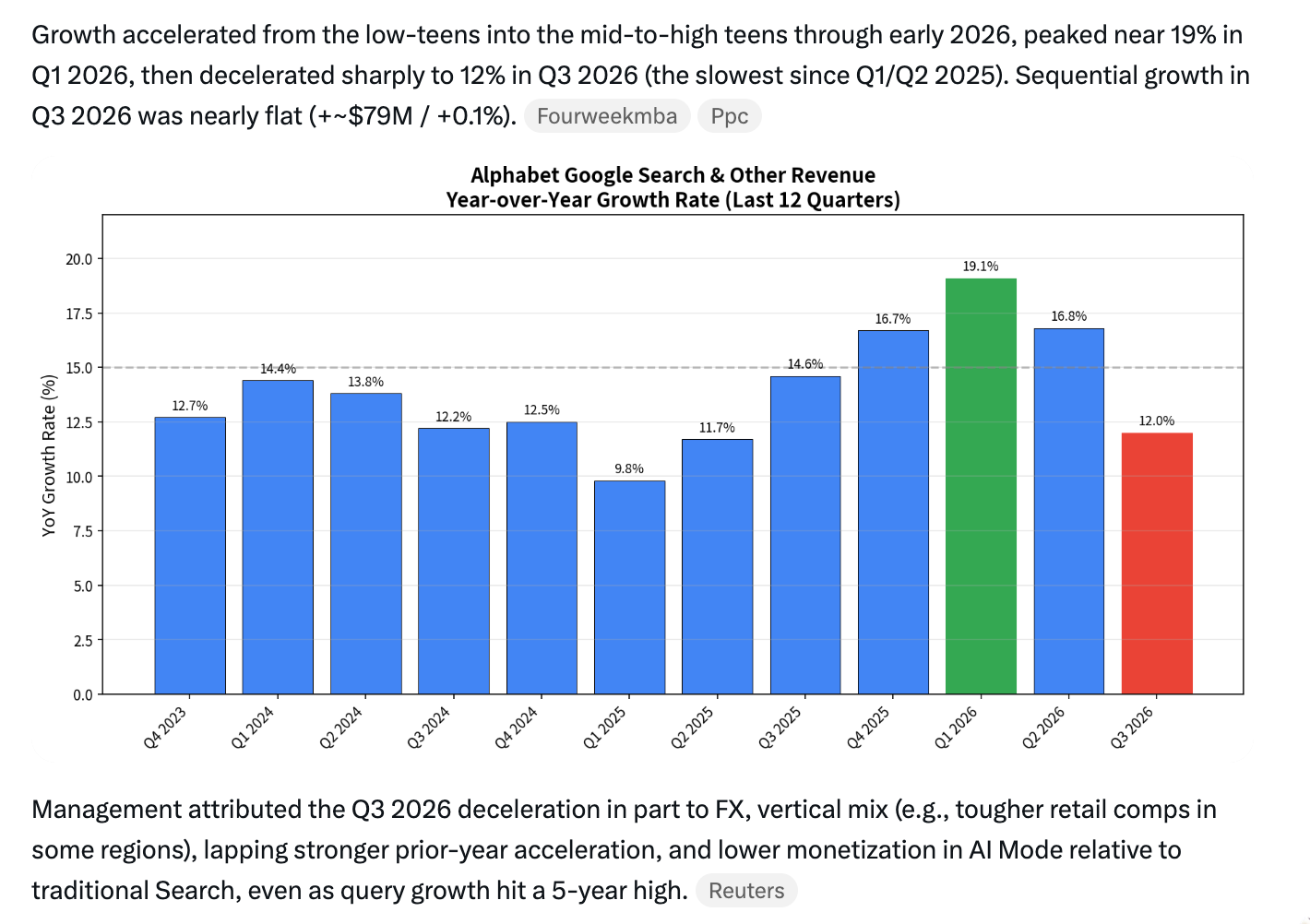 [AINews] Google admits AI Mode hurts Search revenue; -15% $500B drop worst since 2004 IPO. AI Bear Market coming?
AINews issue for 29 to 30 October 2026 from Latent Space. It opens on Google's admission that AI Mode monetises worse than classic Search, which preceded a roughly 15% share drop. It then recaps Claude Ultra dropping the 5-hour limit, Gemini 4 Carbon, Mistral Large 4, Nemotron 3.5, Artificial Analysis Index v5, Unsloth GGUF disputes, and the Anthropic S-1 filing.
 latent.spacearticlePublished and added 31 Oct 2026🧠 AI
- Artificial Analysis (@ArtificialAnlys) on X
Hyperflow H3 is Video Rebirth's 8-step LoRA for MiniMax H3, released in September 2026 with open weights. Artificial Analysis ranks it #5 on AA-Video-I2V v2.1 and #3 on AA-Video-Editing v1.1, ahead of MiniMax H3 (768p). It costs $9.00 per minute for Image to Video and $18.00 for Video Editing at 1088p, under half of Dreamina Seedance 2.5 ($34.12 and $40.82). The thread gives per-capability and per-use-case breakdowns.
x.comthreadAdded 31 Oct 2026, published 30 Oct 2026🧠 AI  [AINews] Building AIE CODE: The top Coding Agent Conference
AINews issue for 28 to 29 October 2026 from Latent Space. It opens with a preview of the AIE CODE summit (themes: Scaling without Slop, System One models, Increasing Ambition, with Jarred Sumner on Bun in Rust). It then recaps Twitter and Reddit news: Mistral Large 4 open weights (1.05T total, 52B active), Artificial Analysis benchmarks, Gemini 4 Carbon, Qwen4 rumours, Claude Code quota complaints and OpenAI frontier-run monitoring. Text was cut before the end.
latent.spacearticlePublished and added 30 Oct 2026🧠 AI- Artificial Analysis (@ArtificialAnlys) on X
Artificial Analysis launched an HLE-Diamond leaderboard in v5 of its Intelligence Index, covering the refined 1,000-question Humanity's Last Exam from CAIS and Scale AI. Each question runs once without tools, graded by GPT-5.6 Luna (medium) as pass@1. Gemini 4 Carbon (high) leads at 69%, Claude Opus 5.5 (max) scores 68%, and the top open weights model, Kimi K3.1 Pro, reaches 37%.
x.comthreadPublished and added 30 Oct 2026🧠 AI  Gemini 4 Carbon is the new #1 on the Artificial Analysis Intelligence Index v5
Gemini 4 Carbon scores 59 on Artificial Analysis Intelligence Index v5 (published 28 October 2026), the top score, with #1 on 4 of 9 evaluations including HLE-Diamond and AA-Omniscience. On the Coding Agent Index it scores 59 with Antigravity CLI, 3 points behind Claude Code with Claude Opus 5.5 (62). Cost is $7.76 per task, versus $10.04 for Opus 5.5. Rollout is limited to selected users.
 artificialanalysis.aiarticleAdded 30 Oct 2026, published 29 Oct 2026🧠 AI
 [AINews] Gemini 4 Carbon tops leaderboards, launches for cyber defenders
AINews issue for 27-28 October 2026, a Latent Space digest of Twitter and Reddit. It leads with Google DeepMind's Gemini 4 Carbon: claimed cyber scores (SEC-bench Pro 88.2%, ExploitGym 54.8%, CWE-bench 71.0%), #1 on Artificial Analysis Intelligence Index v5 at 59, and access limited to cyber defenders through the Fairwind Program. It also covers benchmark integrity disputes, GitHub Copilot Fusion, H-Net v2, KV-cache work, open-weight releases and Claude Code quota complaints.
latent.spacearticlePublished and added 29 Oct 2026🧠 AI Welcome Le Chonk: Mistral Large 4 on Hugging Face
Mistral Large 4 (Le Chonk) is a multimodal, multilingual Mixture-of-Experts model with about 1T total and 49B active parameters and a 1M-token context, released under the Mistral Ecosystem Open-Weight License. The post covers its MLA and DeepSeek Sparse Attention architecture, a 1.6B Pixtral encoder, and benchmarks including 82% on the Artificial Analysis Cyber Index and 93% on Cybench. It gives run recipes for transformers, vLLM, llama.cpp, TRL fine-tuning and Inference Endpoints.
 huggingface.coarticlePublished and added 29 Oct 2026🧠 AI
- Laban (@lunkertw) on X
An X post summarising five AI items: Google DeepMind's Gemini 4 Carbon (88.2% SEC-bench Pro, 54.8% ExploitGym, 71.0% CWE-bench, 59 on Artificial Analysis Intelligence Index v5.0), Ed Zitron's critique of Anthropic's S-1, a Utah Claude Code pilot, and the repos beenuar/AiSOC and expo/skills. In the Utah pilot, 34 developers in 10 agencies took part over four weeks, 80% had a working setup within 30 minutes, and 71% saved over 20 hours. It gives short summaries and links, not primary analysis.
x.comthreadAdded 29 Oct 2026, published 28 Oct 2026🧠 AI - Niko (@nikolayxyz) on X
Gemini 4 Carbon is Google's new frontier model, announced in a post by nikolayxyz that quotes Google's launch text. It ranks #1 on v5.0 of the Artificial Analysis Intelligence Index with 59 points, ahead of Opus 5.5 and GPT-6 Astra. Intro pricing is $2 input and $10 output per million tokens. Access starts for cyber defenders first, as Gemini 4 Argon's did. The captured text is cut off before the rollout details.
x.comthreadAdded 29 Oct 2026, published 28 Oct 2026🧠 AI - 🚨 AI News | TestingCatalog (@testingcatalog) on X
Gemini 4 Carbon is a new Google model, announced in a TestingCatalog post on X as taking first place on the Artificial Analysis V5 ranking. It is rolling out to cyber defenders first. Reported scores are 88.2% on SEC-bench Pro (finding vulnerabilities), 54.8% on ExploitGym (exploitation) and 71.0% on CWE-bench (patching). The post calls it a large step up from Gemini 4 Argon, released two weeks earlier. It gives no technical detail beyond these claims.
x.comthreadAdded 30 Oct 2026, published 28 Oct 2026🧠 AI  Gemini 4 Carbon
 is Google's frontier model, announced two weeks after Gemini 4 Argon. It scores 59 on Artificial Analysis Intelligence Index v5.0, 88.2% on SEC-bench Pro, 54.8% on ExploitGym and 71.0% on CWE-bench. Pricing is $2 per million input and $10 per million output tokens. Access starts with a subset of cyber defenders through the Fairwind Program.
 blog.googlearticleAdded 29 Oct 2026, published 28 Oct 2026🧠 AI
- Gemini 4 Carbon: Our next frontier model
Gemini 4 Carbon is Google DeepMind's new frontier model, announced two weeks after Gemini 4 Argon. It ranks #1 on Artificial Analysis Intelligence Index v5.0 at 59 and scores 88.2% on SEC-bench Pro, 54.8% on ExploitGym and 71.0% on CWE-bench. Access starts with cyber defenders through the Fairwind Program, priced at $2 per million input tokens and $10 per million output tokens.
 deepmind.googlearticlePublished and added 28 Oct 2026🧠 AI
- Artificial Analysis v5 and the benchmarker's dilemma
Artificial Analysis v5 and the benchmarker's dilemma is an Interconnects post that reviews the AI benchmarking industry, using the Artificial Analysis v5 release as its starting point. Its subtitle says it covers what the benchmarking industry is missing. Only the subtitle was available, so the specific arguments, benchmarks and index changes are not known.
 interconnects.aiarticlePublished and added 28 Oct 2026🧠 AI
 [AINews] Anthropic ends Coding Interviews: "Hunger beats tenure"
AINews issue of 28 October 2026 from Latent Space. It leads with Felix Rieseberg's post on why Anthropic dropped coding interviews ("Hunger beats tenure"). It then recaps Genie 4, Axiom's Lean formalization of CFSG, claimed ETH refutations by OpenAI and Anthropic, Artificial Analysis Index v5, FrontierCode 2.0, Liquid LFM3, the Qwen3.8 phone-home dispute, and Anthropic's S-1. Reddit recaps are included; the page was truncated before the end.
latent.spacearticlePublished and added 28 Oct 2026🧠 AI- Muzammil Shah (@Muzammil_OX) on X
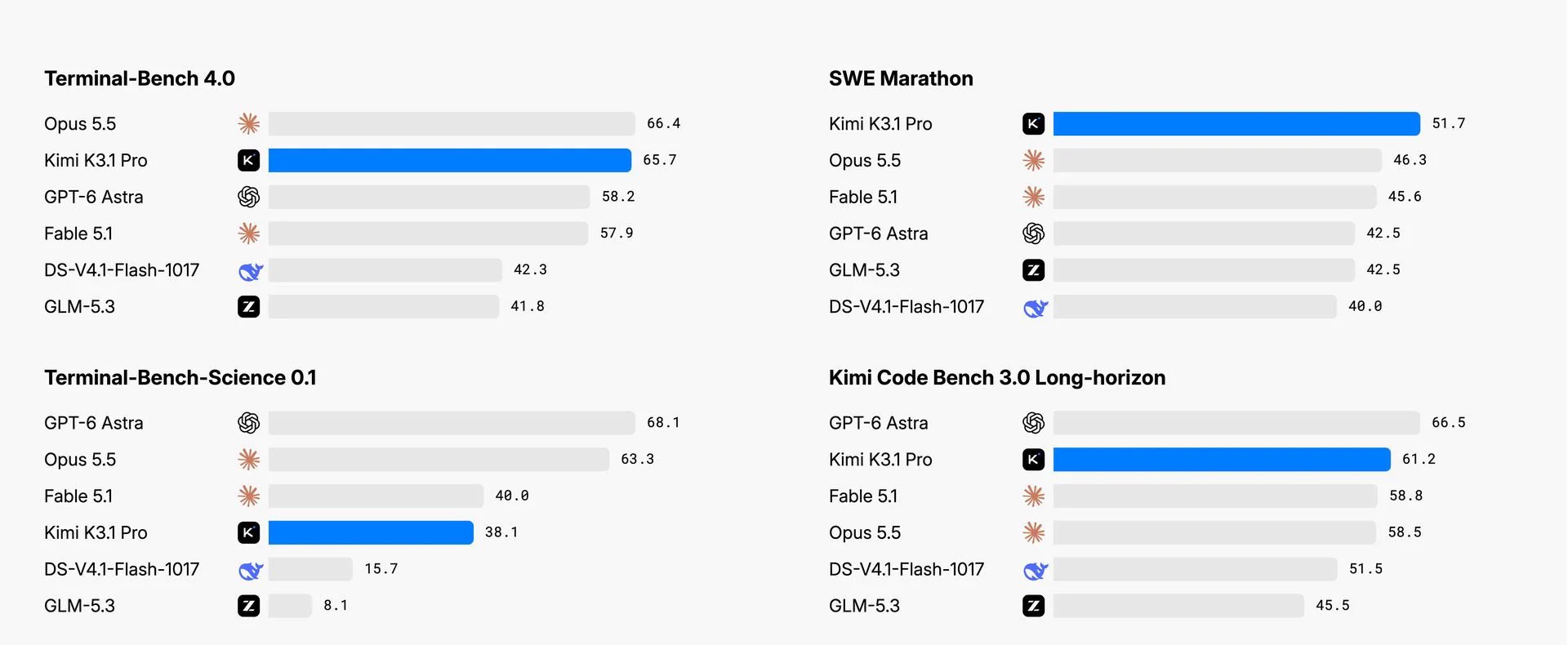
Kimi K3.1 Pro is a new model from Moonshot AI that scores 55 on the Artificial Analysis Intelligence Index, up 11 points from its predecessor, and ranks 4th overall. It has a 1M-token context window and API pricing of $2 per million input tokens and $10 per million output tokens. Weights are due by November 4. Moonshot removed cyber-related training data, which cut its internal vulnerability research score from 90.5% to 81%.
x.comthreadAdded 28 Oct 2026, published 27 Oct 2026🧠 AI  Podcast: Kimi K3.1 Pro, the new cyber reality, and Muse musings
Interconnects podcast episode in which Nathan Lambert and Florian Brand discuss the Kimi K3.1 Pro release (about 3 trillion parameters, weights due by November 4th). They cover its Artificial Analysis score against weaker long-horizon results, Moonshot's choice to down-weight offensive cyber capability, and the PHP2Shell and LiteLLM incidents. They also cover abliterated model APIs, trusted-access cyber programs, Anthropic's junior hiring and Florian's use of the Muse agent.
interconnects.aitalkPublished and added 25 Oct 2026🧠 AI [AINews] Kimi 3.1 Pro 104BA-2.8T: Fable-5.1-Class Open Weights narrows Closed-AI lead to 1 month... and Pro Highspeed API with 2-3× speed
AINews digest for 22 to 23 October 2026, led by Moonshot's Kimi K3.1 Pro (2.8T parameters, 104B active, weights promised for 4 November 2026). It reports Artificial Analysis scoring the model 64% on its Cyber Index despite Moonshot removing cyber data from training. Other items: OpenAI's frontier-training containment incident, a Brotli remote-code-execution disclosure, and Anthropic's Mythos 5 unauthorized-action analysis.
latent.spacearticleAdded 30 Oct 2026, published 24 Oct 2026🛡️ Security [AINews] Kimi 3.1 Pro 104BA-2.8T: Fable-5.1-Class Open Weights narrows Closed-AI lead to 1 month... and Pro Highspeed API with 2-3× speed
AINews issue for 22 to 23 October 2026 centred on Moonshot's Kimi K3.1 Pro, a multimodal mixture-of-experts model with 2.8T total and 104B active parameters and 1M context. Weights are promised for 4 November 2026. Artificial Analysis scored it 55 on its Intelligence Index (fourth place), and Arena ranked it #8 in WebDev. Standard pricing is $2/$10 per million tokens. The issue also covers a cyber-data removal approach, serving-cost objections, and paid-promotion allegations. Shorter items follow on agents, evals and inference.
latent.spacearticlePublished and added 24 Oct 2026🧠 AI Hajrë Hyseni | AI for Business (@hajra) on X
Kimi K3.1 Pro is a new model from Moonshot AI. According to a post by hajra, Artificial Analysis ranks it 4th in the world, 3 points behind Claude Opus 5.5. The API price is down by a third, and full open weights are promised by 4 November. The post gives no benchmark breakdown, licence or architecture details.
x.comthreadPublished and added 24 Oct 2026🧠 AI Introducing Kimi K3.1 Pro
Kimi K3.1 Pro is Moonshot AI's new model, available on the Kimi API from 23 October 2026, with full weights promised by 4 November 2026. Pricing is $2.00 per million input tokens and $10 per million output, and a Highspeed variant is 2-3x faster at twice the price. Artificial Analysis scores it 55, behind only Claude Opus 5.5 (58). Simon Willison tested it with the llm CLI and pelican SVG prompts.
 simonwillison.netarticlePublished and added 23 Oct 2026🧠 AI
 [AINews] Black October
AINews issue for 21-22 October 2026, built from 12 subreddits and 544 Twitter accounts. It leads with "Black October", a 48-hour run of AI-found vulnerability disclosures (PHP2Shell, a GitLab CVSS 10 flaw, a LiteLLM 1.107.0 password stealer, eMudhra CA keys). It also covers MiniMax M3.1 Flash, Carbon-X and Flint releases, Artificial Analysis coding-agent and CritPt v2 results, and a METR/Redwood audit of OpenAI monitoring.
latent.spacearticlePublished and added 23 Oct 2026🧠 AI brenz. (@brenzhills) on X
Krea 3 is an image generation and editing model from Krea. A post on X says its "Fast" variant scores 1125 Elo on the Artificial Analysis image editing leaderboard, against 1124 for Google's Nano Banana 2, while producing 10 images in the time Google produces 2. It also says the "Ultra" variant ranks in the top 4, behind only OpenAI models. The post gives no methodology or model details.
x.comthreadAdded 21 Oct 2026, published 20 Oct 2026🧠 AI- DeepSeek V4.1 Flash 1017 (Max)
DeepSeek V4.1 Flash 1017 (Max) is an open-weights reasoning MoE model from DeepSeek with 552B total and 16B active parameters, a 1M-token context window, text and image input, and an MIT license. Artificial Analysis scores it 45 on its Intelligence Index (open-weights median 19), at $0.30 input and $1.20 output per 1M tokens, 216 tokens per second, and 210M tokens used in the evaluation. It is available through 10 API providers.
artificialanalysis.aiotherAdded 20 Oct 2026, published 19 Oct 2026🧠 AI 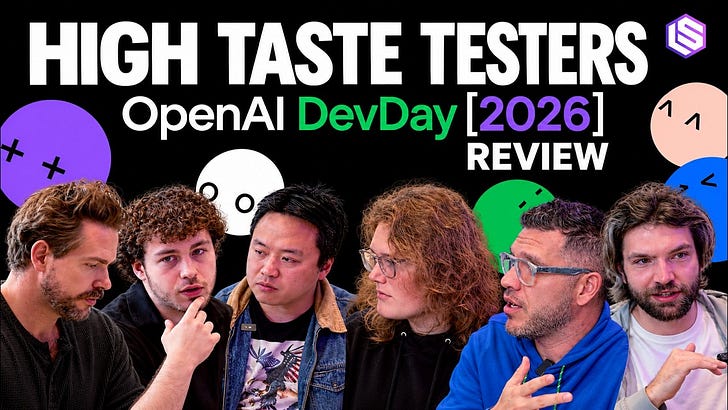 [AINews] High Taste Testers Ep. 1
AINews issue for 15-16 October 2026, from Latent Space, summarising 12 subreddits and 544 Twitter accounts. It covers Meta's Muse Spark Open (816B MoE) and Reflection Beam 1.0 with Artificial Analysis scores and pricing. It also covers Gemini 4 Argon, decision models, TPUv7 and Vera Rubin serving benchmarks, interpretability claims, agent papers, and China's proposed open-source export rules.
latent.spacearticleAdded 30 Oct 2026, published 17 Oct 2026🧠 AI Show HN: Gemini 4 Argon plays StarCraft
StarSkirmish Bench v0.2 gives each LLM one hour to write a Protoss StarCraft: Brood War bot in C++ (BWAPI 4.4.0 on OpenBW), with tools to compile and play practice games. Scores are average win rates of 5 runs against 13 roster bots, which include human-written bots such as Stardust, PurpleWave and BananaBrain. Nine models are compared, each in its lab's first-party CLI harness (Claude Code, Codex, Antigravity CLI, Muse Code). GPT-6 Astra leads and wins only 7% against the top human bots. The page also covers score against cost, run-to-run variance, practice behaviour as the best predictor of score, and weak correlation with the Artificial Analysis Intelligence Index and Terminal-Bench 4.0.
 starskirmish.comarticleAdded 17 Oct 2026, published 16 Oct 2026🧠 AI
 [AINews] Agents disprove Polysemanticity; greatly improve Interpretability & Alignment
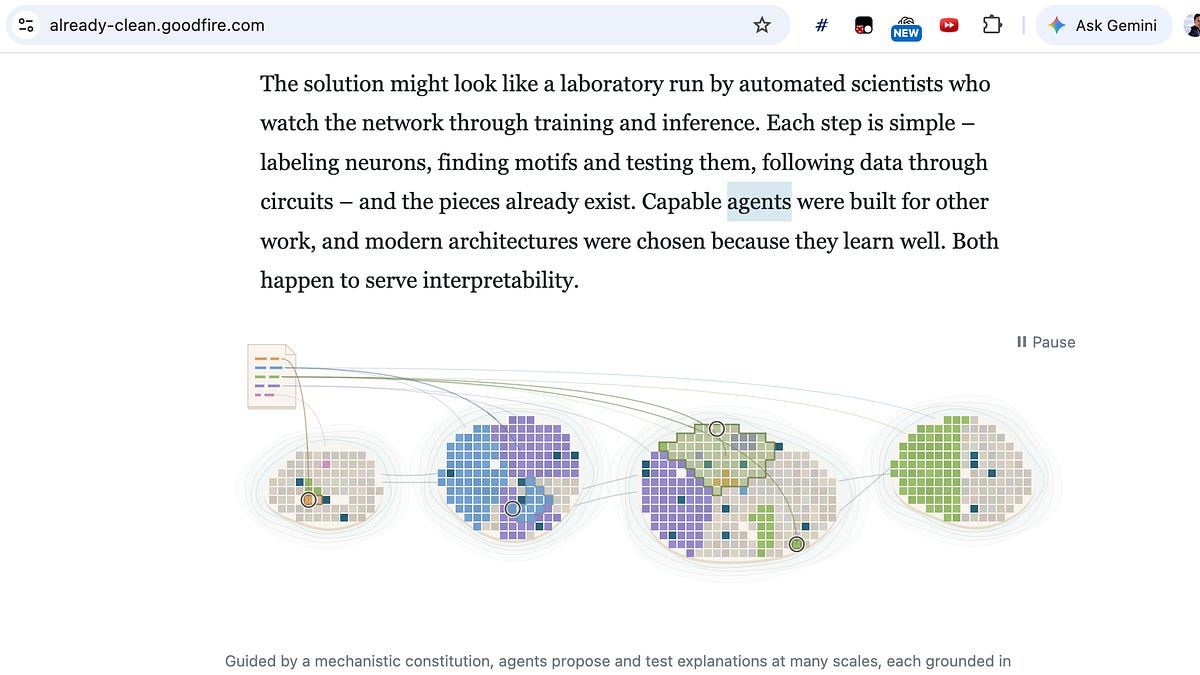
The 10/14–10/15/2026 AINews issue. Its lead story is Goodfire's Nick Cammarata essay "Neural Networks Are Already Clean", which argues agentic analysis resolves many known cases of polysemanticity and superposition. Neel Nanda, Leo Gao and Jake Mendel push back. It also covers Meta's Muse Spark Open (816B total / 42B active MoE, 1M context, custom license, Artificial Analysis index 39, vLLM day-0 support and quantizations), Nemotron 3.5, MAI-Base-2 and Gemini 4 Argon evals. Further items cover Vals' refund-agent and MiMo task-leakage findings, TPUv7 and Vera Rubin inference benchmarks, Perplexity's SPACE sandbox, RL training systems (TRL tree packing, bitwise-consistent vLLM RL) and Sakana's Agentic Scientist.
latent.spacearticlePublished and added 16 Oct 2026🧠 AI- Harrison Kinsley (@Sentdex) on X
Sentdex reacts to Artificial Analysis ranking NVIDIA's Nemotron 3.5 Super VL (120B total, 12B active MoE) as the top US open-weights model, scoring 26 on the Intelligence Index. That edges out Thinking Machines' Inkling Small (26), NVIDIA's Nemotron 3 Ultra (23) and Meta's Muse Glimmer (17). Sentdex's informal tests at vanilla settings show over 550 tok/sec, and they suspect it would rank higher on agentic coding. They see it as a candidate for a fast local coding agent model.
x.comthreadAdded 16 Oct 2026, published 15 Oct 2026🧠 AI - [AINews] AI Engineer NYC: Gemini 4 Argon, Vals AI Benchmarks
AINews issue for 10/12–10/13/2026 covering the GA of Google's Gemini 4 Argon (pricing, Cursor/Devin/Copilot availability, CursorBench 52.8%, Artificial Analysis Intelligence Index parity with GPT-6 Astra at lower cost) and Meta's Muse Wonder, with independent evals and reliability caveats. It also summarises decision-model benchmarks (AA Decision Index, Jev 1.13, Nimble-v4), Fish Audio's open-weight Drama 3 TTS, agent-harness and agentic-RL research (Evo2, ReHarness, LongHarness, ThunderSync), Anthropic's move off Git, and safety items such as Argon's monitor evasion. It also notes AI Engineer NYC keynotes on AI x Finance. Useful as a curated, caveat-aware snapshot of the frontier-model landscape.
latent.spacearticlePublished and added 14 Oct 2026🧠 AI 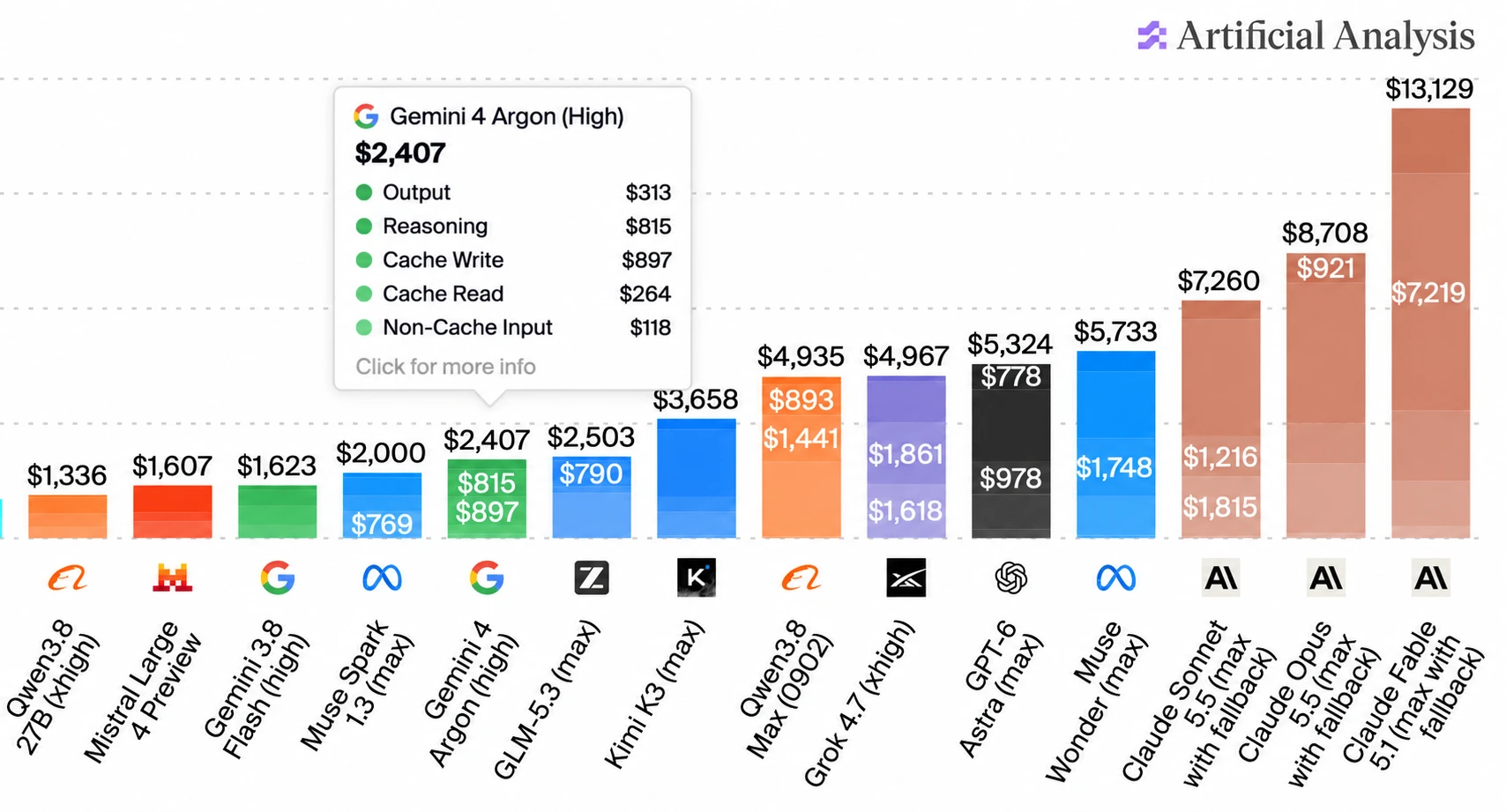 llm-gemini 0.35
Simon Willison releases llm-gemini 0.35 with support for Google's new Gemini 4 Argon model, available via the Gemini API and a $100/month subscription plan. He compares pricing: $2/M input and $10/M output at launch, doubling on December 1st to match Claude Opus 5.5. He argues per-token prices are poor comparators and points to Artificial Analysis's total benchmark run cost ($2,407 for Argon, near GLM-5.3 and cheaper than OpenAI, Anthropic and Meta models) as a better clue to agentic cost-efficiency. He also shows his SVG pelican outputs at low, medium and high settings.
simonwillison.netarticlePublished and added 13 Oct 2026🧠 AI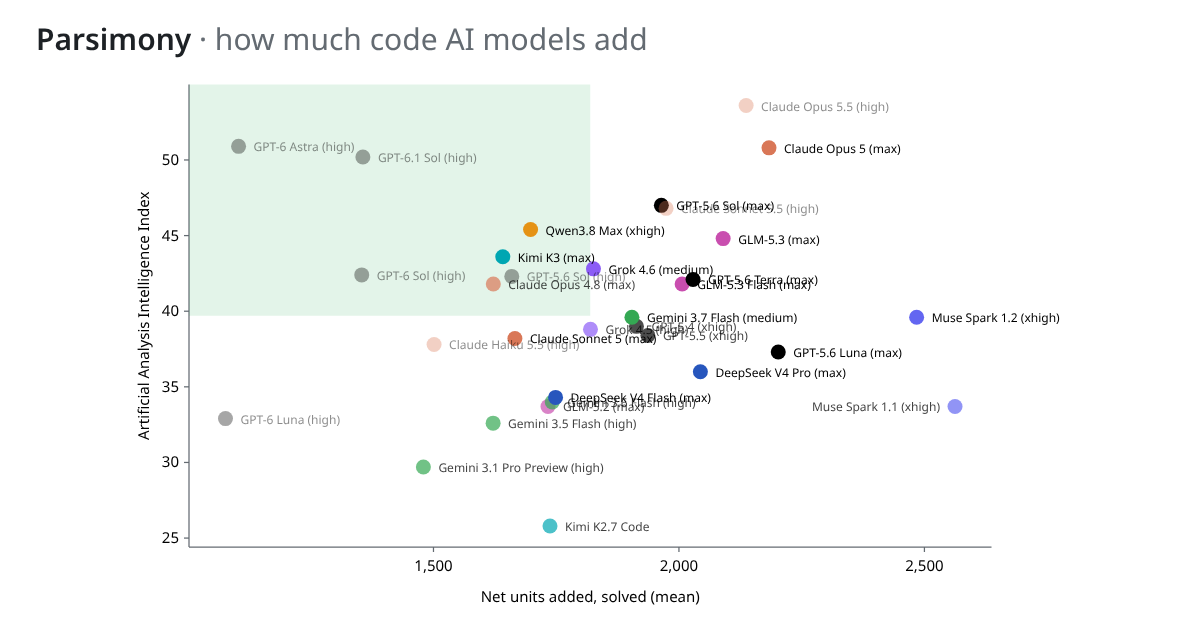 Show HN: Parsimony – an open-source benchmark for how much code AI models add
Parsimony is an open-source benchmark that ranks AI coding models by how much code their patches add. It parses the patches already published by benchmarks such as SWE-bench Verified, counts syntax-level "coding units" (statements, calls, comparisons, names, literals) rather than lines, and subtracts deleted code to get net units. It adds a leaderboard, an Artificial Analysis Intelligence Index overlay, the author's own DeepSWE runs, and a way to upload your own results. It matters because existing benchmarks score solve rate and cost but not code bloat, which makes codebases harder to maintain. The page states its limits: it measures size, not quality, and more verbose models tend to solve more tasks.
 parsimony.lasu.devtoolPublished and added 13 Oct 2026🧠 AI
 [AINews] Meta Muse Wonder & Wonder Full: MSL’s Claude 5.5-tier Frontier Model
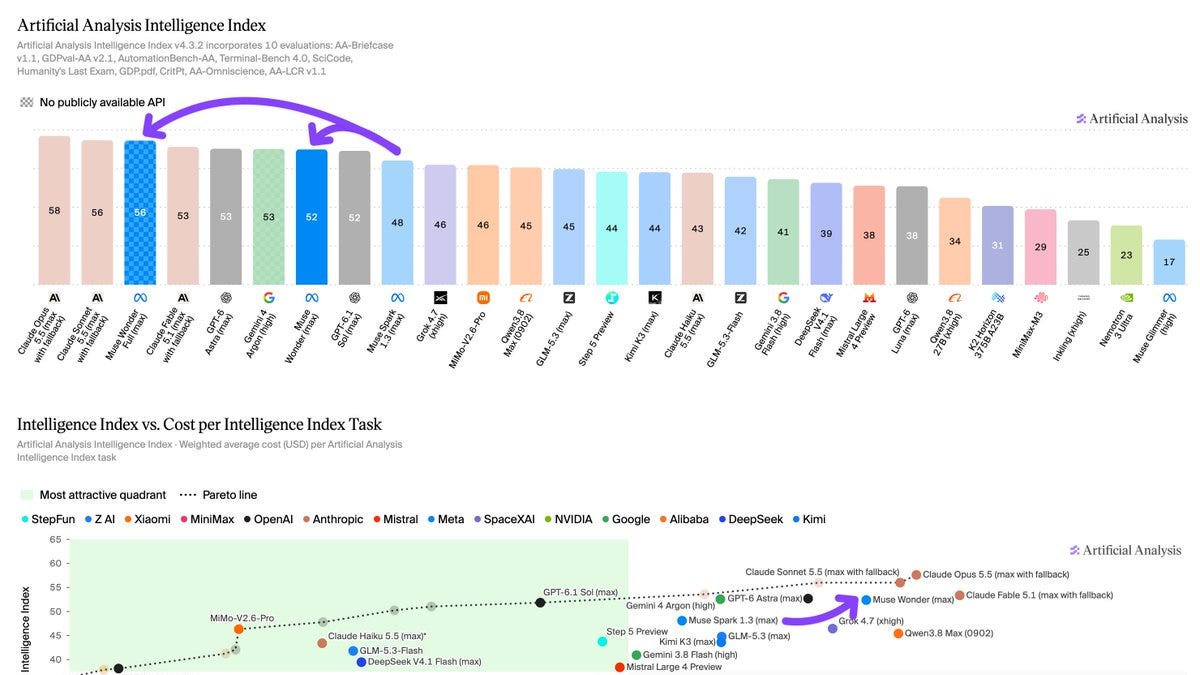
AINews daily digest (Oct 10–12, 2026) whose top story is Meta Superintelligence Labs' launch of Muse Wonder and Muse Wonder Full. The models have a 1M context window and are priced at $4 input / $20 output per M tokens for Wonder; Full is available only to Muse Code subscribers. It compiles third-party results: Artificial Analysis Intelligence Index v4.3 (Full 56, Wonder 52, Spark 1.3 48, Opus 5.5 58), Terminal-Bench 4.0 gains, Coding Agents Index, and Vals Index ranks. It also records Meta-reported numbers (SWE-Marathon, DeepSWE, MemoryBench), bullish and skeptical practitioner reactions, the "3D demo" benchmaxxing debate, and Muse retention data. The rest of the issue is a roundup of agent RL research (QwenGyre, Sakana MASS, GitSwarm), inference silicon (Maia 300, ReplaySSM), specialised models (GLM-Legal, Decision 3.0), and r/LocalLLaMA and other Reddit threads. The page text was truncated, so the end of the Reddit recap is not covered.
latent.spacearticlePublished and added 13 Oct 2026🧠 AI llm-meta-ai 0.2
Simon Willison announces llm-meta-ai 0.2, an update to his LLM CLI plugin adding support for Meta's new Muse Wonder and Muse Wonder Full models. He compares SVG pelican drawings across Muse Wonder's six reasoning levels (minimal to max) and against Muse 1.3 and 1.2, noting Meta's roughly monthly release cadence and that Artificial Analysis rates Muse Wonder (Max) as equivalent to GPT-6.1 Sol.
simonwillison.netarticleAdded 13 Oct 2026, published 12 Oct 2026🧠 AI Meta's New Muse Wonder Finally Puts Zuckerberg in the Frontier AI Race
Decrypt reports Meta Superintelligence Labs' release of Muse Wonder (API, $4/$20 per million tokens) and Muse Wonder Full (Muse Code subscribers only), both with a 1M-token context window and featuring Active Memory and Active Focus. It contrasts Meta's own benchmark wins (SWE-Marathon, Harvey Legal Agent Benchmark, MemoryBench, Personal Superintelligence Index) against Artificial Analysis, which ranks Claude Opus 5.5 first at 58 versus Wonder Full's 56 and Muse Wonder at 52. It also covers privacy concerns about the memory feature and safety claims (0% on Agentic Misalignment) with a full safety report still pending.
 decrypt.coarticlePublished and added 12 Oct 2026🧠 AI
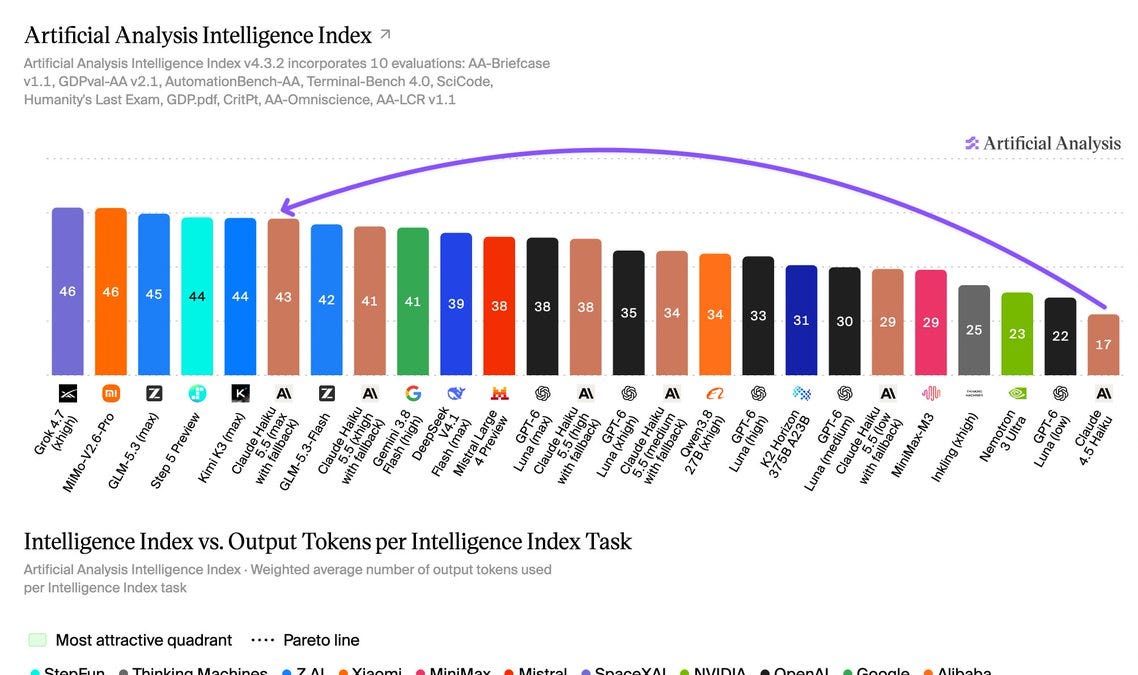 [AINews] Claude Haiku 5.5 — better than GPT-6 Luna at the same pricing
Latent Space's AINews recap covers Anthropic's launch of Claude Haiku 5.5, priced to match OpenAI's GPT-6 Luna and paired with a Sonnet 5.5 cache-read price cut and new Max/Team API credits. Independent Artificial Analysis testing puts its Intelligence Index at 43 (up 26 points from Haiku 4.5) and Terminal-Bench 4.0 at 33%, but shows it uses roughly 3x the output tokens of GPT-6 Luna at max effort, plus results on AA-Briefcase, AA-Omniscience and AutomationBench-AA, alongside a same-day Claude SDK update adding built-in computer-use/browser-use tooling.
latent.spacearticlePublished and added 8 Oct 2026🧠 AI Introducing Mistral Large 4: Le chonk
Simon Willison's link-blog post on Mistral's preview release of Mistral Large 4, a 1 trillion parameter / 49 billion active parameter mixture-of-experts model trained on a cluster of 3,800 NVIDIA Grace Blackwell GPUs, available now via Mistral's API with open weights promised by end of month. He notes it only supports two reasoning levels ("none" and "high"), scores 38 on Artificial Analysis (just behind DeepSeek-V4.1-Flash's 552B model), and marks a big jump from Mistral Large 3's score of 9, putting Mistral roughly 6 months behind the frontier again.
simonwillison.netarticlePublished and added 6 Oct 2026🧠 AI Introducing Mistral Large 4 ("Le Chonk")
Mistral announces Mistral Large 4 ("ML4"/"Le Chonk"), a 1-trillion-parameter natively multimodal Mixture-of-Experts model with 52B active parameters, trained from scratch on 3,800 NVIDIA Grace Blackwell GPUs in Mistral's own European datacenters. The post details state-of-the-art open-weight results on cybersecurity benchmarks (82% on an Artificial Analysis vulnerability-reproduction test, 93% on Cybench), agentic coding (DeepSWE, Terminal-Bench, AutomationBench), finance/legal evals (via Vals, Harvey's Legal Agent benchmark), visual grounding (beating GPT-6 Astra on Dense 200), and safety benchmarks (Lakera B3, KORA). It also describes the large-scale RL post-training pipeline (33B tokens/day at 3k GPUs) used to produce the model, with full weights promised by end of month.
 mistral.aiarticleAdded 7 Oct 2026, published 6 Oct 2026🧠 AI
- Franco Naumow. (@naumowf) on X
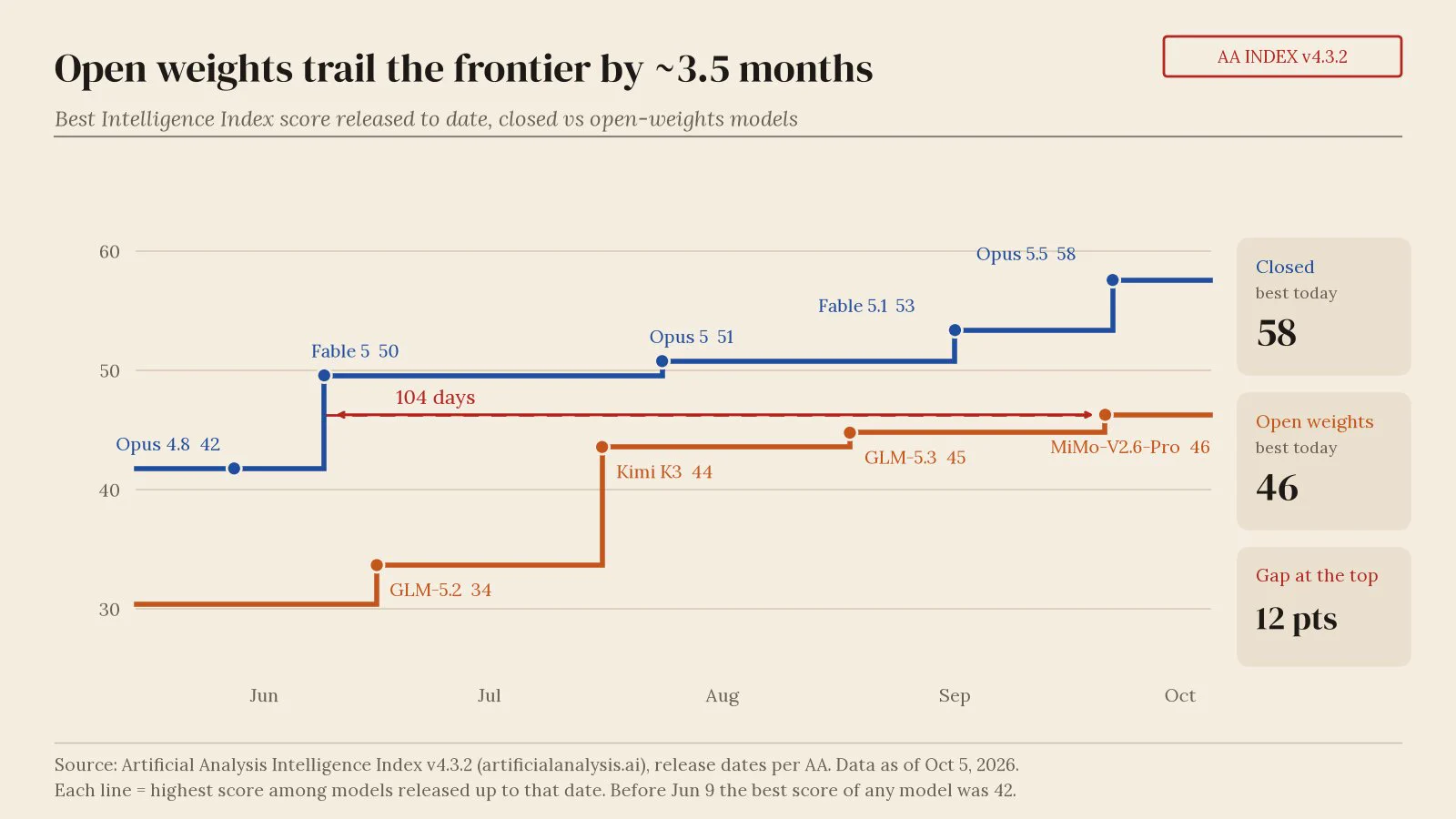
A tweet analyzing the Artificial Analysis Intelligence Index v4.3.2 finds that the best open-weights model, Xiaomi's MiMo-V2.6-Pro (released Sep 21, scoring 46), still trails what would have been the top closed frontier score as of 104 days earlier — Claude Fable 5's 50 on Jun 9, which itself surpassed the prior best (Claude Opus 4.8 at 42). It notes the current top-of-leaderboard gap is 12 points, with Claude Opus 5.5 (max) scoring 58, framing the persistent ~3.5-month lag of open weights behind the closed frontier.
x.comthreadPublished and added 5 Oct 2026🧠 AI - [AINews] Pi 1.0, Pi Durable, and AIE NYC
Latent Space AINews digest reports on Pi 1.0 and Pi Durable, an agent harness from the Earendil team ported to TypeScript that externalizes agent state for crash recovery, pluggable storage (Memory/SQLite/JSONL), concurrent branching conversations, hot-swappable tools, and multi-user state sync alongside conversation transcripts. The rest of the issue recaps frontier launches: Gemini 4 Argon, OpenAI efficiency-focused GPT-6.1 Sol (with Artificial Analysis cost comparisons against GPT-6 Sol and GPT-6 Astra), Upstage Solar Mini 4 (35B/3B MoE, 1M context), Black Forest Labs FLUX 3 image model, and Tavus Griffin video-to-video conversational agent.
latent.spacearticlePublished and added 2 Oct 2026🧠 AI 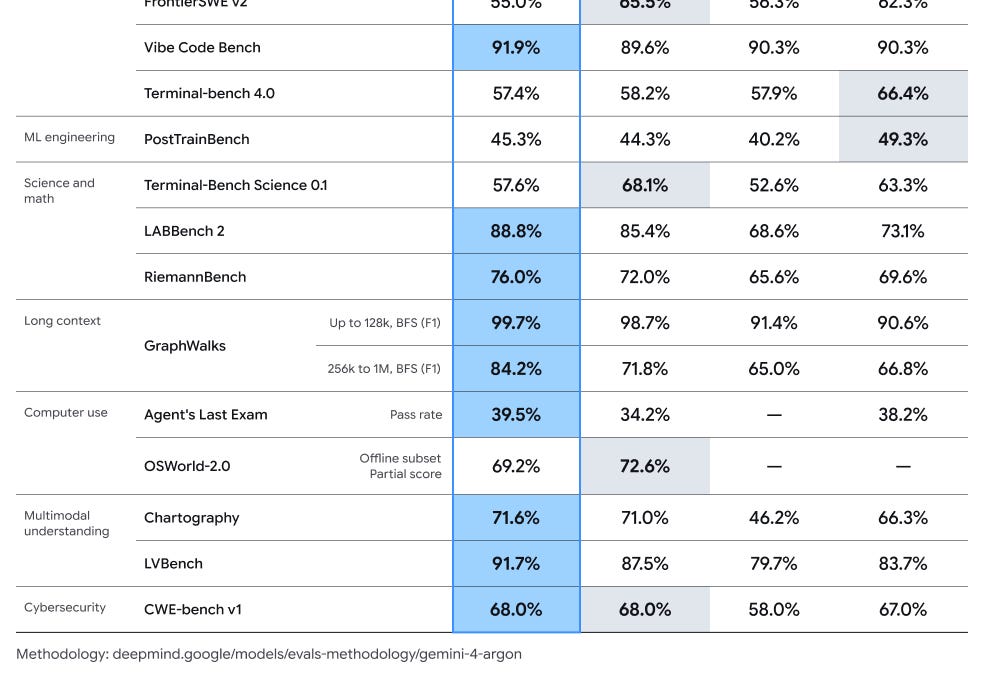 [AINews] Gemini 4 Argon: GDM’s answer to Astra/Fable, with 1M output
Latent Space's AINews digest for 9/29-9/30/2026 leads with Google DeepMind's Gemini 4 Argon, a frontier model in limited Fairwind Program cyber-defense/government preview claiming SOTA on 13 of 19 benchmarks and an industry-first 1M-token output via Long Decode Continuation, with detailed head-to-head evals against GPT-6 Astra, GPT-6.1 Sol and Claude Opus 5.5 from Artificial Analysis, Vals and Arena. It also covers other releases (Cohere Embed 5, Ideogram 4.5, GLM-5.3-Flash llama.cpp support, Solar Mini 4), research (Meta's Context Language Models, a Nature paper on superhuman Stratego AI), inference/systems news, and a safety section on hidden-reasoning-extraction attacks and GLM-5.3 cyber-capability risk.
latent.spacearticlePublished and added 1 Oct 2026🧠 AI- Gemini 4 Argon (High): Intelligence, Performance and Price Analysis
Artificial Analysis benchmark profile for Google's Gemini 4 Argon (High), a reasoning model with a 1M-token context window supporting text and image input. It scores 53 on the Artificial Analysis Intelligence Index (median 26), costs $2.00/1M input and $10.00/1M output tokens, and used 110M output tokens to complete the Intelligence Index evaluation, with per-metric breakdowns across coding, reasoning, agentic and long-context tasks.
artificialanalysis.aiotherAdded 2 Oct 2026, published 30 Sep 2026🧠 AI - [AINews] OpenAI DevDay 2026: Dots, 6.1 Sol, Ultrafast, Decisions API, Agents API, Spaces, Marketplace, and 1.2 Billion ChatGPT WAU
AINews daily digest covering OpenAI DevDay 2026: the launch of 'dots' (always-on GPT-6 Astra-powered agents with app/Slack/Teams connectivity), GPT-6.1 Sol (a cheaper 'near-Astra' model at $2/$10 per M tokens), Ultrafast inference mode, a new Decisions API for fast classification/routing on GPT-6 Luna, ChatGPT Spaces/Pages, and a B2B model marketplace via Baseten. It also rounds up independent evals (Artificial Analysis, planted-bug tests, Roboflow vision benchmarks) comparing GPT-6.1 Sol against Claude Opus/Sonnet 5.5, plus safety/eval-integrity stories (scrapped GPT-6.1 Astra, evaluation awareness, GLM-5.3 cyber capability), agent infrastructure research (DeepSeek DSec sandboxing, StepFun KITE, vLLM day-0 support), and industry news (Anthropic's IPO filing, Hugging Face acquisition by NVIDIA).
latent.spacearticlePublished and added 30 Sep 2026🧠 AI  Anthropic's Claude Sonnet 5.5 Is Out, Beats Opus 5.5 at Coding for Half the Price
Anthropic released Claude Sonnet 5.5, priced the same as Sonnet 5 ($2/$10 per million input/output tokens, half of Opus 5.5) but outperforming Opus 5.5 on Terminal-Bench 4.0 (70.6% vs 66.4% per Anthropic; 63.6% vs 59.6% per independent tester Artificial Analysis). The piece details how effort-setting (Medium vs High vs Max) drastically changes cost-per-task — Sonnet 5.5 at max effort burns ~193K tokens per task, more than any model Artificial Analysis has tested, undercutting Anthropic's claimed savings — and notes Sonnet 5.5 ties Opus 5.5 on GDPval-AA (real-world professional work) while Opus remains stronger on sustained-judgment tasks. Claude Haiku 5.5 is teased for coming weeks.
decrypt.coarticleAdded 30 Sep 2026, published 28 Sep 2026🧠 AI- Terminal-Bench 4.0 leaderboard
Artificial Analysis' leaderboard for Terminal-Bench 4.0, a 66-task benchmark of complex terminal work spanning software engineering, machine learning, science, operations, security, hardware and media, with recalibrated compute/time budgets and improved verifiers over prior versions. The page ranks models/agents by score, cost per task, output tokens per task, and time per task, and links out to related Artificial Analysis evaluations (GDPval-AA, APEX-Agents, Harvey's Legal Agent Benchmark, ServiceNow EnterpriseOps-Gym, Terminal-Bench 2.1, GPQA, MMLU-Pro, AIME, LiveCodeBench and others) used to benchmark frontier agentic and reasoning capability.
artificialanalysis.aiotherAdded 28 Sep 2026🧠 AI  Ling-3.0-flash-VL (InclusionAI/Ant Group)
Ling-3.0-flash-VL is InclusionAI/Ant Group's native multimodal model built on Ling-3.0-flash, adding image and video understanding via a ViT encoder, VideoRoPE, and a hybrid MoE backbone (42 layers alternating KDA and Gated MLA at 5:1) with 124B total parameters but only 5.5B activated per token, and a 256K context window. It targets agentic multimodal workflows — understanding, reasoning, and acting on visual interfaces — scoring 42 on Artificial Analysis Intelligence Index v4.1.1, up from 38 for the text-only Ling-3.0-flash. The card includes concrete SGLang and vLLM serving recipes for various GPU configurations.
huggingface.corepoAdded 26 Sep 2026🧠 AI [AINews] Claude Opus 5.5, the new default model for AINews — and everybody cuts prices 40-50%
Latent Space's daily AINews roundup covering Anthropic's launch of Claude Opus 5.5 (Fable 5.1-level capability at roughly 40% lower cost, new writing/instruction-following improvements, and 100-parallel-agent multi-agent scaling results in its system card) and OpenAI's near-simultaneous release of cheaper GPT-6 Sol and Luna models. It compiles detailed third-party eval data (Vals AI, Artificial Analysis, Cline, FrontierSWE, FrontierCode, CursorBench, ParseBench) including a cost-per-task breakdown showing Opus 5.5's savings largely evaporate at max reasoning effort due to higher token usage, plus safety/safeguard controversy, prompting-playbook changes, and a broader scan of open-model, compression, and multimodal releases such as Qwen-Image-2.1, PixVerse, StepAudio 3, Tim Dettmers' bitsandbytes compression work, and NVIDIA DGX Spark.
latent.spacearticleAdded 29 Sep 2026, published 23 Sep 2026🧠 AI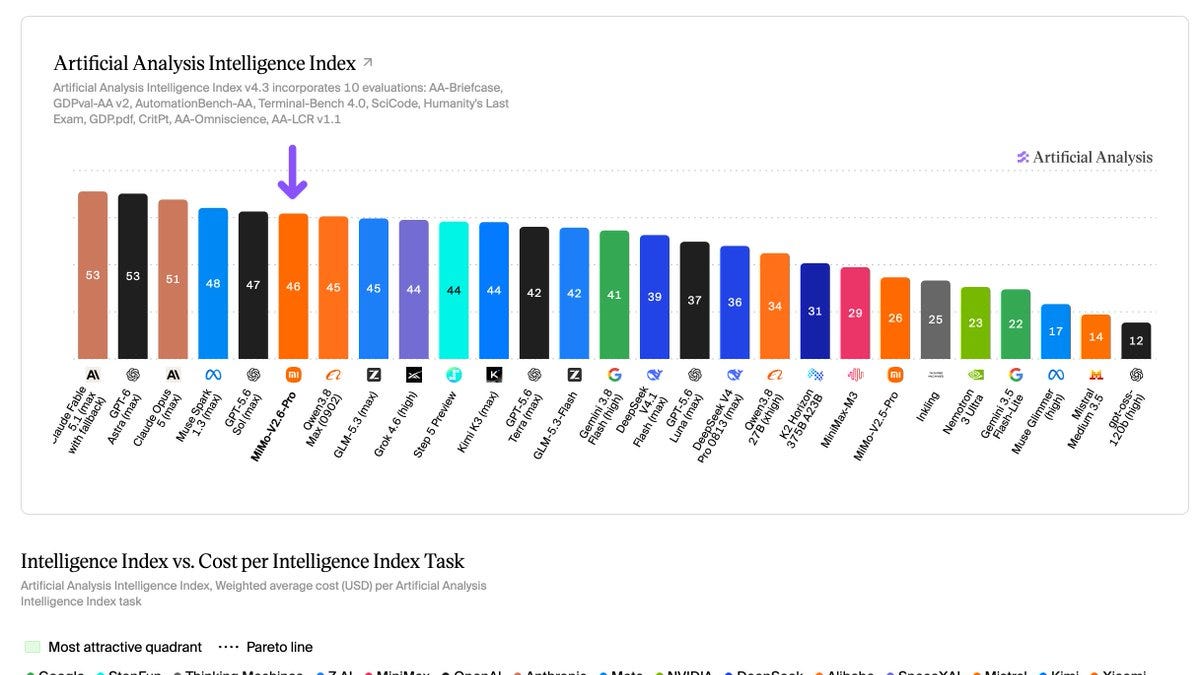 [AINews] Xiaomi MiMo-V2.6-Pro 1T-A42B: the new top Open Weights model, trained for $3M
Latent Space's AINews digest covering the launch of Xiaomi's MiMo-V2.6 series (Pro, Flash, and Pro-UltraSpeed), a natively omnimodal 1.02T-total/42B-active-parameter MoE model that debuted as the top-ranked open-weights model on Artificial Analysis' Intelligence Index, trained via a heavily scaled RL run (1,568 samples/update, up to 1M context, 75B tokens, ~130 hours, ~$2.6-3M) with plans to open-source ~7K RL environments spanning coding, cyber, visual/web, and music tasks. The issue also rounds up Alibaba's Qwen-Image-2.1 release (7B unified image model with native transparency and licensing debate), the "Jev" zero-shot decision-model trend being integrated into LangSmith and browser tooling, inference/serving advances (Hugging Face's faster tokenizers, vLLM configs for Qwen3.8-2.4T on GB300, Tencent Hunyuan's 2.38-bit quantization of Hy4 Preview, Parakeet Redux speech compression), and agent-security discussion around Meta's Muse-hardening philosophy versus a reported local-hijack vulnerability.
latent.spacearticleAdded 29 Sep 2026, published 22 Sep 2026🧠 AI The current balance of power in open models
Nathan Lambert's write-up of remarks prepared for a Congressional briefing on open-weight AI models, arguing that Chinese labs (Qwen, GLM-5.3, Kimi K3, DeepSeek) have overtaken American open-weight efforts (Llama, gpt-oss, Nemotron) in downloads, benchmark scores (Artificial Analysis Intelligence Index), and academic/enterprise adoption. It distinguishes open-weight vs. true open-source models, quantifies the capability gap to closed frontier labs (OpenAI, Anthropic), discusses distillation's limited role in closing that gap, and flags emerging cybersecurity and policy risks around widely available open weights.
interconnects.aiarticleAdded 29 Sep 2026, published 21 Sep 2026🧠 AI Introducing Gemini 3.8 Live and 3.8 Live Extended Thinking
Google DeepMind announces Gemini 3.8 Live, built for scale and cost efficiency with fluid dialogue and visual grounding, and Gemini 3.8 Live Extended Thinking, built for high-complexity multi-step reasoning. The Extended Thinking model tops Artificial Analysis' Speech to Speech Quality Index (82.6), scores 68.6% on tau-Voice and 97.7% on Big Bench Audio, while 3.8 Live ranks second in the Speech Agent Arena; both support 97 languages with mid-conversation switching and background tool execution, and are watermarked with SynthID.
deepmind.googlearticleAdded 29 Sep 2026, published 15 Sep 2026🧠 AI Open-Source AI & Open Models Reading List
A continuously updated reading list from Nathan Lambert's Interconnects curating the best writing on open-weight AI models, organized into Foundation (why companies release open models, the open/closed gradient, safety-vs-openness debates), US-China Competition (the ATOM Project, China's structural advantages, corporate adoption of Chinese models by DoorDash/Airbnb/Cursor/Harvey/Perplexity/Thomson Reuters), and Technical Details (the open-closed performance gap per SemiAnalysis and Epoch AI, cyber-misuse risk, and the 2026 distillation controversy including the paper on stealing reasoning traces from proprietary LLM APIs). It links dozens of primary sources — policy essays, lab statements (Zuckerberg, Thinking Machines Lab), technical reports (Pythia, OLMo, OLMo 2/3), and data trackers (Artificial Analysis, Interconnects Adoption Dashboard) — making it a comprehensive entry point for understanding the open-model ecosystem.
interconnects.aiarticleAdded 29 Sep 2026, published 11 Sep 2026🧠 AI Intelligent transcription with Gemini 3.5 Transcribe
Google DeepMind's Gemini 3.5 Transcribe is a new speech-to-text model offered as two API variants: gemini-3.5-transcribe-live for sub-second-latency real-time streaming via the Live API, and gemini-3.5-transcribe for pre-recorded audio with speaker attribution and word-level timestamps via the Interactions API. It reports Word Error Rates of 4.0% (streaming) and 2.6% (non-streaming) as measured by Artificial Analysis, supports 85+ languages, custom vocabulary, disfluency/filler removal, and function calling to delegate tasks to other Gemini models, and is being rolled into Gboard's Rambler feature, Antigravity, Google AI Studio, and the Gemini macOS app.
deepmind.googlearticleAdded 29 Sep 2026, published 26 Aug 2026🧠 AI Measuring benchmark optimization in speech recognition
Artificial Analysis introduces three diagnostic tests to detect "benchmaxxing" in speech recognition: consensus disagreement (checking if models reproduce known-erroneous VoxPopuli reference transcripts instead of the audio), masked entity retrieval (silencing numbers in audio to see if models hallucinate the expected benchmark answer), and orthographic switching (checking if models match a benchmark's spelling convention, e.g. "Mr." vs "Mister", purely from acoustic cues). Testing 11 open-source ASR models against VoxPopuli and LibriSpeech, they found top-scoring models reproduce reference errors 18-30% of the time and can identify which benchmark they're being tested on from acoustic context alone, with the effect weakening on freshly collected post-training-cutoff audio. The findings led to a new "Benchmark fitting" tab on the Open ASR Leaderboard and open-sourced evaluation scripts.
huggingface.coarticleAdded 29 Sep 2026, published 21 Aug 2026🧠 AI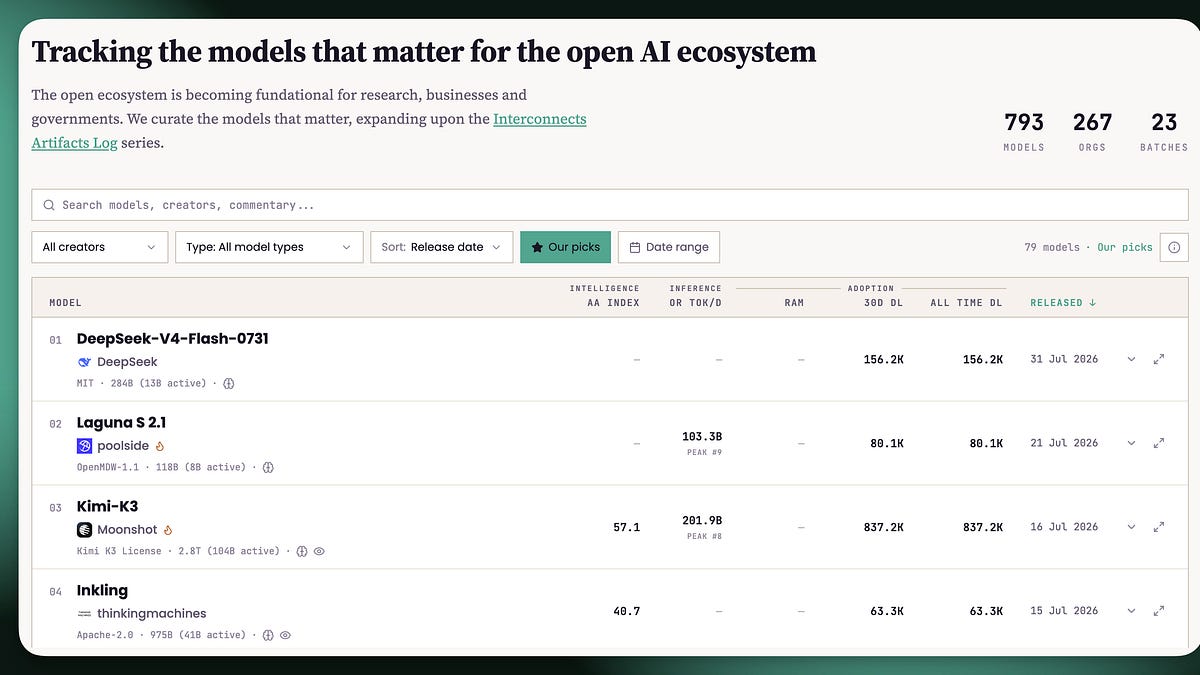 Introducing our Artifacts Hub and Adoption Dashboard
Interconnects announces two new free, continuously-updated resources for tracking the open-weights model ecosystem: the Artifacts Hub, which curates ~792 trending Hugging Face models with inference-token data from OpenRouter, intelligence scores from Artificial Analysis's Intelligence Index, and Interconnects' own relative adoption metric (RAM) and VAIL similarity index; and the Adoption Dashboard, a daily-updating view of download/derivative-model counts by geography and organization highlighting the US-China open-model gap. Both build on prior work from The ATOM Project and Interconnects' Artifacts Log round-ups, developed in collaboration with AI verification startup Project VAIL.
interconnects.aiarticleAdded 29 Sep 2026, published 3 Aug 2026🧠 AI Kimi K3: The open-weights escalation
Nathan Lambert analyzes Moonshot AI's Kimi K3, a 2.8T parameter MoE model whose open weights closed much of the gap with frontier closed models (ranking #2 on Vals AI, #3 on Artificial Analysis Intelligence Index). The piece details K3's architectural innovations (Kimi Delta Attention, Attention Residuals, Stable LatentMoE giving ~2.5x scaling efficiency over Kimi K2) and situates the release within China's recommitment to open-source AI, Xi Jinping's WAIC remarks, and US policy debates over restricting open-weight Chinese models.
interconnects.aiarticleAdded 29 Sep 2026, published 20 Jul 2026🧠 AI