- S2W_DailyThreat (@S2W_DailyThreat) on X
S2W post on CVE-2026-97229, a CVSS 10.0 remote code execution flaw in the GitLab CE/EE CI/CD regex compiler, disclosed October 13, 2026. Insufficient regex validation plus an integer overflow during encoding conversion lets an attacker who can add CI/CD config use a malicious regex and a UTF-8 repository path to run commands as the git user. Affects self-managed 19.2 before 19.2.8, 19.3 before 19.3.5 and 19.4 before 19.4.2. Rapid7 published analysis and a public PoC exists, with no in-the-wild exploitation confirmed as of October 15. No workaround exists, so patch or restrict access to a management network or VPN.
 x.comadvisoryAdded 17 Oct 2026, published 16 Oct 2026🛡️ Security
 Critical GitLab RCE Lets Unauthenticated Attackers Execute Code on Servers (CVE-2026-97229)
Orca Security analysis of CVE-2026-97229, a CVSS 10.0 flaw in GitLab CE/EE. An integer overflow (CWE-190) in the CI/CD regular expression compiler gives memory corruption and code execution as the git user. It is triggered by a crafted regex in .gitlab-ci.yml combined with a UTF-8 repository path, with no authentication needed on instances that allow public project creation or self-registration. Lists affected branches (19.2 before 19.2.8, 19.3 before 19.3.5, 19.4 before 19.4.2), the absence of a workaround, interim mitigations, and a Rapid7 PoC against GitLab CE 19.4.1 with ASLR on. Notes a prior max-severity GitLab bug (CVE-2026-85706) was probed in the wild within hours and later added to CISA KEV.
 orca.securityadvisoryPublished and added 14 Oct 2026🛡️ Security
 CVE-2026-97229: Critical Unauthenticated Remote Code Execution in GitLab
Rapid7 analysis of CVE-2026-97229, a CVSS 10.0 integer overflow (CWE-190) in the Onigmo regex compiler used by GitLab CE/EE's CI/CD regex handling. A crafted regex in a .gitlab-ci.yml passes validation as US-ASCII, then is recompiled for a UTF-8 repository path, producing invalid instructions that give code execution as the git user. Rapid7 reproduced it on GitLab CE 19.4.1 with ASLR (patched in 19.4.2); despite the vendor's "unauthenticated" rating, the attacker needs to commit a malicious config to a public project, which self-registration allows. No in-the-wild exploitation is confirmed, and Rapid7 recommends urgent upgrades.
 rapid7.comadvisoryPublished and added 13 Oct 2026🛡️ Security
- MCP specification 2026-07-28 stable release
GitHub release announcing the stable 2026-07-28 revision of the Model Context Protocol specification, published from the modelcontextprotocol/modelcontextprotocol repository. The release page itself only points to the official MCP website for the spec and to a changelog for the detailed changes. It matters as the canonical version marker that MCP client, server and SDK implementers track for protocol changes.
 github.comadvisoryAdded 9 Oct 2026🧠 AI
- go-ethereum v1.17.8 "Protein Sludge Pack"
Security-focused release notes for go-ethereum (Geth) v1.17.8, patching several denial-of-service vulnerabilities in the eth/snap p2p protocol handlers, hardening JUMPDEST analysis caching against post-Amsterdam-fork attacks, requiring IP verification before accepting discovery statements, fixing a rogue-STUN-server crash, and closing a DoS vector tied to BAL accounts. Most issues only become exploitable after the Amsterdam fork activates, and the release also includes RPC correctness fixes (eth_simulateV1, eth_createAccessList) and a Sparse Blobpool (EIP-8070) correctness bug.
github.comadvisoryAdded 8 Oct 2026🛡️ Security - CVE-2026-57860: ForgeCode (tailcallhq/forgecode), an AI pair-programming CLI, automatically loads and executes the MCP servers defined i
CVE-2026-57860 describes an arbitrary code execution flaw in ForgeCode (tailcallhq/forgecode), an AI pair-programming CLI that automatically loads and executes MCP servers defined in a repository's .mcp.json on startup without user confirmation. A malicious repo can define mcpServers entries with arbitrary command/args (e.g. bash -c) that spawn under the invoking user's privileges the moment forge is run inside the cloned repo, giving attackers a reliable initial-access and persistence primitive against developers evaluating untrusted code. CVSS 4.0 8.4 HIGH, CWE-829 (inclusion of functionality from untrusted control sphere); a fix commit and VulnCheck advisory are linked.
 nvd.nist.govadvisoryAdded 26 Sep 2026🛡️ Security
- CVE-2026-20685: An attacker in a privileged network position may be able to leak sensitive information
CVE-2026-20685 is a medium-severity (CVSS 6.5) path handling vulnerability in Apple's Private Cloud Compute (PCC), classified under CWE-20 and CWE-22, that could let an attacker in a privileged network position leak sensitive information. Apple addressed the issue with improved path validation, fixed in PCC Release 5E290.3.
nvd.nist.govadvisoryAdded 26 Sep 2026🛡️ Security - Missing authentication on MCP HTTP endpoint allows unauthenticated privileged tool calls
GHSA advisory for jovancoding/network-ai disclosing that its MCP HTTP transport (bin/mcp-server.ts, lib/mcp-transport-sse.ts) accepts JSON-RPC tools/call requests with zero authentication, session, or origin checks, and binds to 0.0.0.0 by default. The PoC shows an unauthenticated attacker can enumerate 22 registered tools and invoke privileged ones - config_get/config_set to read and mutate live orchestrator configuration, agent_list/agent_spawn/agent_stop, token_create/token_revoke, budget_set_ceiling, and blackboard_write/delete - with curl requests against a local Docker deployment. Remediation recommended enforcing bearer-token auth in _handlePost() before dispatch, defaulting to 127.0.0.1 binding, and gating state-mutating tools behind authorization checks.
github.comadvisoryAdded 26 Sep 2026🛡️ Security  CVE-2026-21852 - GitHub Advisory Database
GitHub advisory GHSA-jh7p-qr78-84p7 for Claude Code: a malicious repository could ship a project settings file setting ANTHROPIC_BASE_URL to an attacker-controlled endpoint. Claude Code made API requests during project load before the trust prompt was shown, leaking data including the user's Anthropic API key. Fixed in auto-updated versions; manual updaters should upgrade. It is CVSS v4 scored, with network attack vector and passive user interaction, and mapped to a credential-transmission weakness (insecure transmission/storage of credentials).
github.comadvisoryAdded 26 Sep 2026🛡️ Security- CVE-2026-44895 - GitHub Advisory Database
GitHub advisory for @yoda.digital/gitlab-mcp-server (mcp-gitlab-server): with USE_SSE=true the HTTP/SSE transport has no authentication, sends wildcard CORS headers, and binds to 0.0.0.0. Any network caller or any web page the operator visits can open /sse and POST /messages to drive all 86 GitLab tools (delete_repository, push_files, etc.) using the operator's personal access token. It includes a curl PoC, a CVSS 4.0 vector (~6.3 Medium, effectively High when SSE is enabled) and four fixes: required auth token, loopback bind, a CORS allowlist, and the OAuth roadmap.
github.comadvisoryAdded 26 Sep 2026🛡️ Security  Breaking: GitLab Critical Path Traversal Flaw Exploited in the Wild — Patch Immediately
Details CVE-2026-85706 (CVSS 10.0), an unauthenticated arbitrary file read in GitLab CE/EE's repository commits API exploitable via a crafted file.path parameter in a single POST request, requiring only that one public project exist on the instance. It also covers CVE-2026-87719 (CVSS 9.9), an authenticated insecure deserialization bug in GitLab EE's GraphQL subscription serializer reachable via Duo Chat access that leaks stored Elasticsearch/OpenSearch credentials. Both affect GitLab versions through 19.3.1; CVE-2026-85706 is under active internet-wide scanning per WatchTowr Labs and is in CISA's KEV catalog with a federal patch deadline, with fixes in GitLab 19.1.8/19.2.6/19.3.2.
orca.securityadvisoryPublished and added 14 Sep 2026🛡️ Security- CVE-2026-85706: Critical GitLab Path Traversal Exploited in the Wild
GitLab patched CVE-2026-85706, a critical (CVSS 10.0) path traversal flaw (CWE-22) in the repository commits API that lets an unauthenticated attacker read arbitrary files from self-managed GitLab CE/EE instances; CISA added it to the KEV catalog on September 11, 2026 due to active exploitation, with a remediation deadline of September 14. The same patch release fixes CVE-2026-87719, a critical insecure deserialization bug (CWE-502) letting an authenticated Duo Chat user exfiltrate Advanced Search configs and credentials via a crafted GraphQL subscription argument, plus 17 other vulnerabilities. Rapid7 recommends emergency patching and post-patch compromise checks given confirmed in-the-wild exploitation.
rapid7.comadvisoryAdded 7 Oct 2026, published 14 Sep 2026🛡️ Security  CVE-2026-85706: GitLab CE/EE Repository Commits API Path Traversal
CVE-2026-85706 is a CVSS 10.0 critical path traversal vulnerability in GitLab CE/EE's repository commits API, caused by improper path confinement combined with missing authentication enforcement. It allows unauthenticated, remote attackers to read arbitrary files from the GitLab server — potentially exposing credentials, secrets, tokens, SSH keys, and database credentials. Affects versions 18.7 through 19.1.7, 19.2.0-19.2.5, and 19.3.0-19.3.1; fixed in 19.1.8, 19.2.6, and 19.3.2.
 horizon3.aiadvisoryAdded 17 Sep 2026, published 11 Sep 2026🛡️ Security
 Rapid Reaction: GitLab Critical Path Traversal Vulnerability (CVE-2026-85706)
watchTowr's rapid-reaction analysis of CVE-2026-85706, a critical (CVSS 10.0) unauthenticated path traversal in GitLab CE/EE's repository commits API, patched in versions 19.3.2, 19.2.6, and 19.1.8. The flaw lets an unauthenticated attacker read arbitrary files (configs, secrets) from self-managed GitLab servers via crafted requests to /api/v4/projects/{id}/repository/commits/ with a file.path parameter; watchTowr reproduced the bug and reports honeypot probes indicating attackers have already reverse-engineered it ahead of mass exploitation.
 watchtowr.comadvisoryAdded 21 Sep 2026, published 11 Sep 2026🛡️ Security
- Rapid Reaction: GitLab Path Traversal Vulnerability (CVE-2026-85706)
watchTowr's rapid-reaction analysis of CVE-2026-85706, a critical (CVSS 10.0) unauthenticated path traversal vulnerability in the GitLab CE/EE repository commits API, patched in versions 19.3.2, 19.2.6, and 19.1.8. The flaw allows an unauthenticated attacker to read arbitrary server-side files via the commits API due to improper path confinement and missing auth enforcement; watchTowr's honeypot network was already observing exploitation probes at time of publication. The post includes hunting guidance (searching logs for POST requests to /api/v4/projects/{id}/repository/commits/ containing file.path parameters) and patching priorities for self-managed instances.
watchtowr.comadvisoryAdded 16 Sep 2026, published 11 Sep 2026🛡️ Security  Solidity 0.8.37 Release Announcement
Solidity 0.8.37 release notes disclosing three EF bug-bounty-reported compiler bugs with security implications: deleting an element of a memory bytes array (or converted string) zeroed the full 32-byte word instead of one byte, corrupting adjacent data in the evmasm pipeline (all versions ≤0.8.36); a stack-to-memory spill-slot collision in mutually recursive functions under --via-ir silently overwrote live variables (0.7.2–0.8.36); and require() with a custom error using named arguments encoded parameters in call-site rather than declaration order, producing structurally valid but semantically wrong revert data. The release also adds two non-security miscompilation fixes, an experimental planning-based stack shuffler for the SSA CFG backend, support for the Amsterdam EVM's SLOTNUM opcode (EIP-7843), and removes/deprecates several experimental features.
 soliditylang.orgadvisoryAdded 29 Sep 2026, published 10 Sep 2026🛡️ Security
 GHSL-2026-203: Same-second TOCTOU in jupyterlab/maintainer-tools
GitHub Security Lab discloses GHSL-2026-203 / CVE-2026-84973, a same-second time-of-check-to-time-of-use race condition in the jupyterlab/maintainer-tools update-snapshots-checkout GitHub Action. The action compares one-second-precision pushed_at and comment created_at timestamps to detect post-authorization pushes, but a strict greater-than check lets an attacker push a malicious commit in the same second as an authorized "please update snapshots" comment, causing the action to check out and later execute attacker-controlled code (including a local composite action and jlpm-driven package scripts) with the workflow's GITHUB_TOKEN (contents: write, pull-requests: write) in the jupyter/notebook repository. The issue was fixed in v1.0.0 and is a variant of the "pwn request" class of GitHub Actions vulnerabilities.
 securitylab.github.comadvisoryAdded 20 Sep 2026, published 4 Sep 2026🛡️ Security
 Grafana fixes critical SSRF flaw affecting Grafana MCP servers
Grafana patched CVE-2026-19516 (CVSS 9.1), a critical SSRF in the Grafana MCP server's grafana_api_request tool where a caller-supplied X-Grafana-URL header could control the method, path and body of outbound requests, letting an attacker reach internal-only services from the server's network position. Pillar Security researchers chained this with a second flaw — the MCP server accepting unauthenticated "session-shaped IDs" it never issued — and demonstrated using it to hit the AWS IMDSv2 endpoint and retrieve cloud credentials via a two-step PUT/TTL token request. Grafana MCP v1.1.0 adds optional bearer-token auth to close the session-forgery gap; Pillar frames MCP servers broadly as "identity brokers" that need explicit outbound destination policies and mandatory auth for remote deployments.
 scworld.comadvisoryAdded 26 Sep 2026, published 3 Sep 2026🛡️ Security
 Grafana MCP server-side request forgery via X-Grafana-URL header (grafana_api_request) | Grafana Labs
Grafana advisory for CVE-2026-19516, a critical (CVSS 9.1) SSRF in mcp-grafana. A caller able to invoke the grafana_api_request tool can set the X-Grafana-URL header to redirect outbound requests, choosing method, path and body, to internal, loopback and link-local services including cloud metadata endpoints, and read the responses. The earlier fix for CVE-2026-15583 only stopped the service-account token leaking to other destinations and did not restrict the destinations; the fix is in version 1.1.0 and later.
 grafana.comadvisoryAdded 12 Aug 2026🛡️ Security
- CVE-2026-18394 - Incorrect authorization in Strands Agents Tools http_request tool
AWS bulletin for CVE-2026-18394, an incorrect authorization flaw in the http_request tool of the open-source strands-agents-tools package used with the Strands Agents SDK. The tool exposed an LLM-controllable proxies parameter that let attacker-controlled web content (via indirect prompt injection) redirect requests through an actor's proxy while the hostname allowlist check still passed, disclosing HTTP_REQUEST_TOKEN_CONFIG-bound credentials in cleartext Authorization headers on the first hop. Fixed in version 0.8.2; AWS recommends upgrading and rotating any credentials configured on affected versions.
 aws.amazon.comadvisoryAdded 6 Aug 2026🛡️ Security
- CVE-2026-59950
CVE-2026-59950 (CVSS 7.6) affects the MCP Python SDK's deprecated mcp.server.websocket.websocket_server transport, which accepted WebSocket handshakes without validating Host or Origin headers, giving no SDK-level way to restrict which origins could connect to applications exposing that transport. This is a classic CSWSH-style origin-validation flaw (CWE-346, CWE-1385) fixed in mcp 1.28.1.
nvd.nist.govadvisoryPublished and added 17 Jul 2026🛡️ Security - CVE-2026-55608
CVE-2026-55608 affects n8n-MCP, an MCP server exposing n8n node documentation and operations to AI assistants. Prior to version 2.57.4, when run in multi-tenant HTTP mode (ENABLE_MULTI_TENANT=true), an authenticated tenant could bypass tenant scoping and access or delete default-scope workflow_versions backups left over from earlier single-tenant deployments or migrations, exposing other tenants' workflow data. The issue is tracked as CWE-200 (information exposure) and CWE-863 (incorrect authorization) and is fixed in v2.57.4.
nvd.nist.govadvisoryPublished and added 16 Jul 2026🛡️ Security - AI Security Briefing
CVE-2026-52830 describes a path traversal flaw in fast-mcp-telegram, a PyPI package exposing Telegram as an MCP server, where HTTP Bearer tokens are joined directly into a session-file path without normalization. The verifier blocks the literal reserved token "telegram" but not path separators, so a token like "../fast-mcp-telegram/telegram" lets a remote HTTP client authenticate as the default legacy session, bypassing the control meant to keep multi-user HTTP sessions from colliding with the default stdio/legacy account. Account-prefixed MCP tool naming does not prevent the bypass since prefixed tools for the compromised default account remain accessible.
 advisories.gitlab.comadvisoryPublished and added 5 Jul 2026🛡️ Security
 simonecorsi/mawesome GitHub Action has been compromised
StepSecurity reports that the simonecorsi/mawesome GitHub Action repository was compromised on June 24, 2026, when an attacker force-pushed malicious commits and repointed several release tags to point at them, so any workflow pinned to those tags subsequently ran the attacker's code inside its GitHub Actions runner. StepSecurity notes the attack method mirrors the codfish/semantic-release-action compromise disclosed the same day, suggesting a coordinated campaign targeting GitHub Action maintainers via tag hijacking.
 stepsecurity.ioadvisoryAdded 3 Sep 2026, published 1 Jul 2026🛡️ Security
 Vulnerability-Lookup
GHSA-73cv-556c-w3g6 (CVE-2026-49257, CWE-306) documents that mcp-pinot v3.0.1 and earlier defaults to an HTTP MCP server bound to 0.0.0.0:8080 with oauth_enabled=False, exposing all 14 tools — including read_query, create_schema and create_table_config — to any unauthenticated network caller. The server proxies calls using its own server-side Pinot credentials, creating a confused-deputy condition that grants full read/write access to the backing Apache Pinot cluster (CVSS 10.0). Fixed in v3.1.0 (PR #95) by defaulting the bind host to 127.0.0.1, refusing non-loopback exposure without OAuth, and gating Helm exposure behind OAuth.
 vulnerability.circl.luadvisoryAdded 26 Sep 2026, published 18 Jun 2026🛡️ Security
 GitHub Repository Rulesets
GitHub changelog entry announcing two repository ruleset changes. Individual users can now be added as bypass actors on repository-level rulesets through the UI, REST API and GraphQL, so a dedicated team or role is no longer needed for a single person or service account. Repository admins can also rename a branch covered by an organization or enterprise ruleset, but only if the new name stays within the scope of every ruleset that applied to the old one. Otherwise the rename is blocked and an org or enterprise admin must do it, and org and enterprise admins can turn the capability off. This matters for branch-protection governance because bypass lists and rename rights affect who can circumvent required controls.
 github.blogadvisoryAdded 3 Sep 2026, published 11 May 2026🛡️ Security
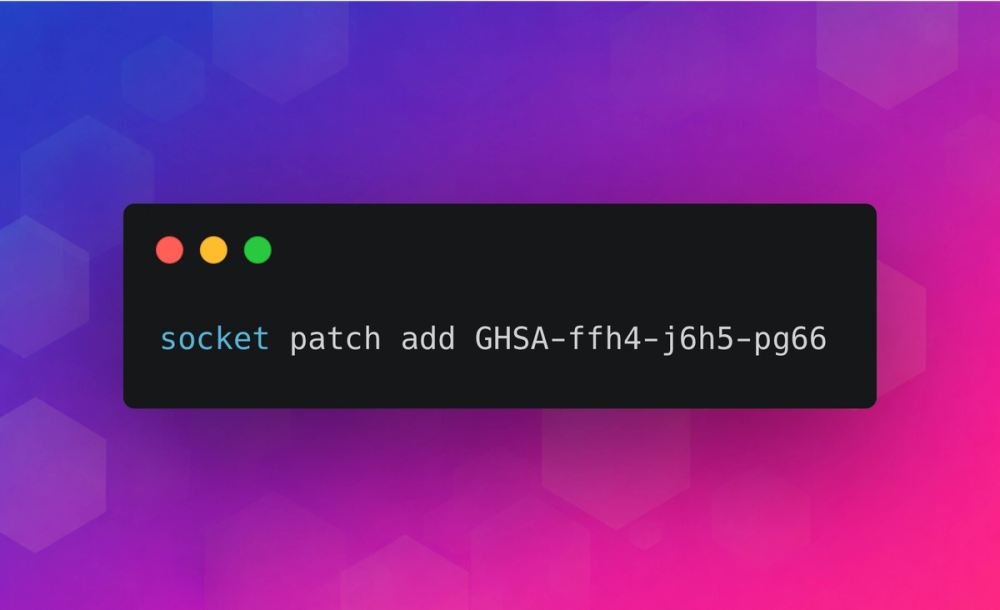 Socket: Critical vm2 Sandbox Escape
Socket disclosed that a critical sandbox escape in vm2 (GHSA-ffh4-j6h5-pg66, CVE-2026-26956), which lets attacker-controlled JavaScript passed to VM.run() escape isolation and execute arbitrary OS commands via WebAssembly.JSTag, affects far more than the officially listed vm2 3.10.4/Node 25 scope. Socket's testing showed 66 vm2 releases from 0.2.2 through 3.10.4 are exploitable on Node.js 24.15.0, and any Node runtime exposing WebAssembly.JSTag is vulnerable, meaning downstream SCA/scanner tools using the narrower advisory data would miss real exposure. Socket is releasing free Certified Patches (via `socket patch add`) for the issue alongside upgrade guidance to vm2 3.10.5+.
 socket.devadvisoryPublished and added 8 May 2026🛡️ Security
 MCP TypeScript SDK Cross-Client Data Leak (CVE-2026-25536)
CVE-2026-25536 is a cross-client data leak in the official MCP TypeScript SDK (v1.10.0-1.25.3, CVSS 7.1): when a single McpServer instance reuses a StreamableHTTPServerTransport across multiple concurrent client connections, a race condition in the response multiplexing logic can route one client's tool results, resource content, or errors to a different client. This breaks tenant isolation in multi-user MCP server deployments, a common production pattern, potentially exposing sensitive API responses, file contents, or database query results across security boundaries. Fixed in SDK v1.26.0; recommended mitigations include upgrading, using per-client McpServer instances, and adding client-side response correlation checks.
 vulnerablemcp.infoadvisoryAdded 30 Sep 2026, published 4 Feb 2026🛡️ Security
- CVE-2026-21852 — Claude Code Information Disclosure (pre-trust config injection leaks API keys)
CVE-2026-21852 describes a flaw in Claude Code versions prior to 2.0.65 where a malicious repository's settings file can override ANTHROPIC_BASE_URL and have it applied during project load before the user sees or accepts the trust-confirmation prompt, causing the user's Anthropic API key to be sent to an attacker-controlled endpoint. The root cause is an initialization-order bug (CWE-522, insufficiently protected credentials) where untrusted repo config is parsed and acted on ahead of trust verification; Anthropic fixed it in 2.0.65 by moving trust checks before config processing. Mitigations include updating, rotating exposed keys, and avoiding opening unfamiliar repos until patched.
 sentinelone.comadvisoryAdded 30 Sep 2026, published 21 Jan 2026🛡️ Security
