 Northflank security breach leads to abuse of customers' AI API keys
Northflank, a cloud application hosting platform, disclosed a breach on 30 October 2026 after a Wiz threat alert and told customers to assume all environment variables were decrypted and to rotate secrets. Customers reported unauthorized use of AI API keys. Wiz's "Black October for AI Developer Platforms" report counts at least nine incidents, including Railway, OpenCode, Warp and Lightning AI, and describes LLMJacking, with about 2.5 million Amazon Bedrock calls costing roughly $100,000 in two cases. Northflank has not said how attackers got in.
 bleepingcomputer.comarticlePublished and added 31 Oct 2026🛡️ Security
 “Black October” for AI Developer Platforms
Wiz Research links October 2026 breaches at AI developer platforms (Fireworks, OpenCode, Warp, Zeabur, Railway and others) to stolen environment-variable credentials for AI access. It details two enterprise AWS Bedrock keys abused after vendor breaches: about 800k and 1.7 million calls, over $100k in list-price usage. It profiles two LLM resale operations, "momo" and "Xingjiabi", that tested the keys.
 wiz.iowriteupAdded 31 Oct 2026, published 30 Oct 2026🛡️ Security
 OpenCode User Hit with Hostile Backlash After Reporting Free AI Loophole
Socket reports on a GitHub issue for OpenCode, opened 28 June, describing a bypass of per-IP usage limits on its free hosted models by switching VPN addresses. The reporter first proposed account-based limits, then reopened the issue in August to promote the workaround and claimed to run 130 agents. After the thread drew harassment and was deleted in October 2026, it is unclear whether OpenCode fixed the bypass.
 socket.devarticlePublished and added 29 Oct 2026🛡️ Security
- OpenCode User Hit with Hostile Backlash After Reporting Free AI Loophole
Socket reports on a GitHub issue in the OpenCode tracker describing a bypass of per-IP usage limits on free hosted models, using a VPN to switch addresses. The reporter first urged account-based limits, then claimed to run 130 concurrent agents through the loophole. After the issue drew harassment it was deleted. Whether OpenCode fixed the bypass in October 2026 stays unclear.
socket.devarticlePublished and added 29 Oct 2026🧠 AI - Zyon ⚗️ (@zyonbuilds) on X
Orca is an open-source (MIT) desktop app from stablyai for running a fleet of coding agents, including Claude Code, Codex and OpenCode, each in its own git worktree using the user's own subscriptions. Features include fanning one prompt across five agents and merging the winner, commenting on diffs and sending them back, SSH worktrees on remote machines, and a phone app for steering agents. The post reports 103k stars.
 x.comtoolAdded 30 Oct 2026, published 29 Oct 2026🧠 AI
 Coding From the Himalayas With an Offline AI Agent
Walkthrough of running OpenCode against Qwen3.5 9B served by Ollama on a Mac, with Wi-Fi switched off. The author fixes a one-line accumulation bug in an expense calculator and confirms all five unittest tests pass. It covers the opencode.json setup, memory budgeting, permission prompts and a pytest-versus-unittest detour. Two further exercises (CSV report, log analyzer) were not yet run offline.
 latent.spacewriteupPublished and added 27 Oct 2026🧠 AI
- Manoj | The AI Dude (@Manojkumar2257) on X
heditor is an open-source (MIT) agent skill from pycodebr that has Claude Code, Codex, Cursor or OpenCode edit talking-head videos. It transcribes with faster-whisper, picks a 30-70s segment, cuts frame-accurately, builds HTML + GSAP motion graphics, mixes audio at -14 LUFS, and runs QA with vision-reviewed previews. It offers 42 named styles and a long-form mode with chapters, SRT/VTT and lower thirds. Install: npx skills add pycodebr/heditor -g.
x.comthreadAdded 28 Oct 2026, published 27 Oct 2026🧠 AI - Mauro Ubeda (@mauroubeda) on X
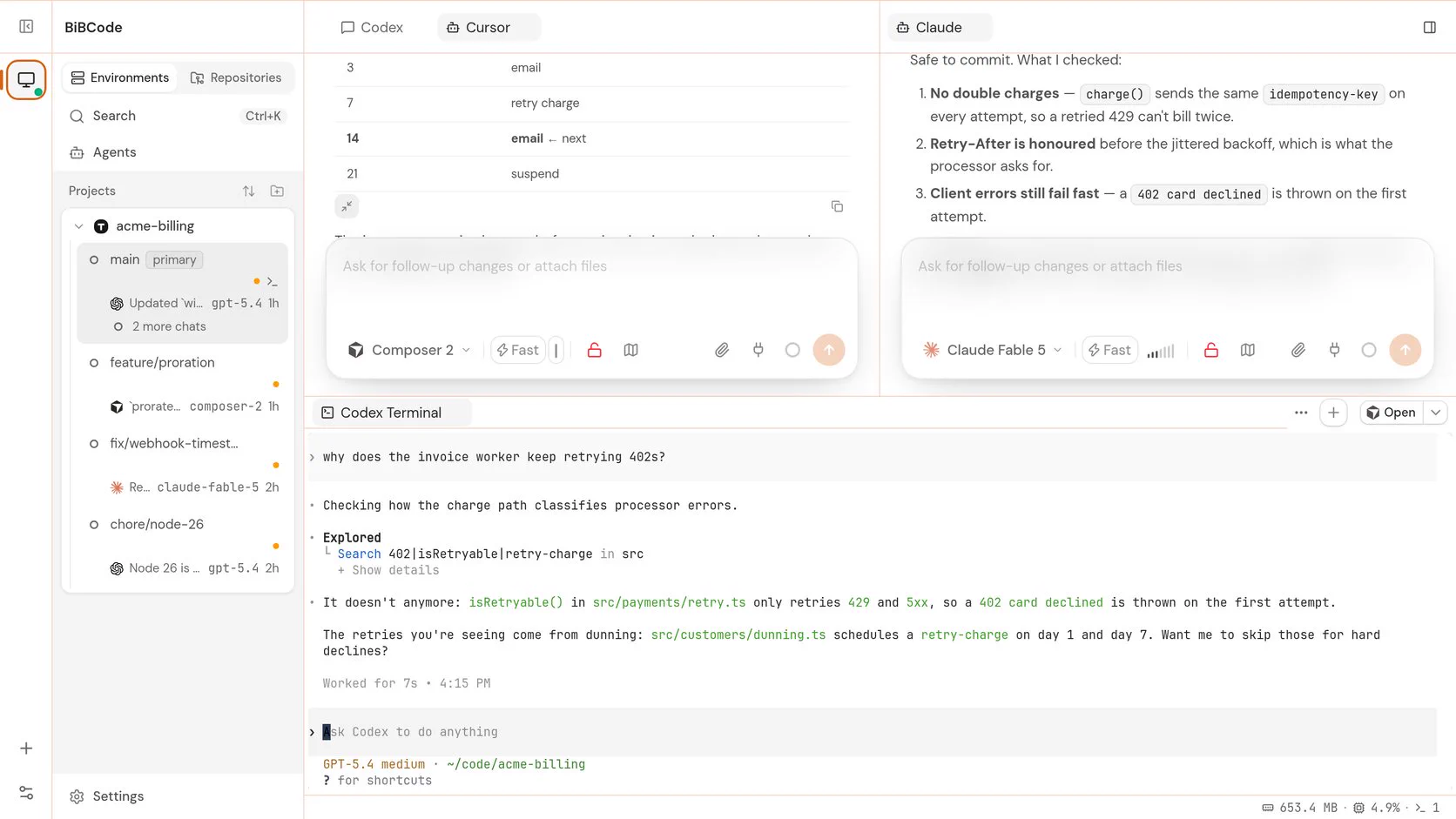
BibCode is an open-source desktop app, now in beta, for running coding agents side by side. It is built with Rust and Tauri rather than Electron, and runs Codex, Claude, Cursor and OpenCode, each in its own git worktree. It can also connect to remote BibCode Servers. The author, Mauro Ubeda, says it mixes ideas from T3 Code and Orca. The post gives no feature detail beyond this.
x.comtoolAdded 28 Oct 2026, published 27 Oct 2026🧠 AI  cubillas (@cubillas888) on X
The tweet relays Pillar Security research that opencode on Windows and WSL could run attacker-controlled code during remote MCP server OAuth sign-in. The fix shipped in opencode 1.18.33 on 28 September, with no advisory or CVE published. It advises users of remote MCP servers to update and review which servers they connect to. Technical details are not in the post.
x.comthreadAdded 29 Oct 2026, published 27 Oct 2026🛡️ Security Akash Rajagopal (@akashsairaja) on X
Ollama overview thread by Akash Rajagopal on X. It lists six steps: install on macOS, Linux, Windows or Docker; run `ollama run gemma4`; use the REST API on localhost:11434 (/api/chat); call it from ollama-python and ollama-js; llama.cpp as the README's supported backend; and `ollama launch claude` to connect Claude Code. Codex, OpenCode, Copilot CLI and Droid also work. The thread cites 184k GitHub stars and an MIT licence.
x.comthreadAdded 27 Oct 2026, published 26 Oct 2026🧠 AI- Ricardo Arguello (@RicardoIQSource) on X
Post by RicardoIQSource on breaches of developer platforms aimed at AI provider keys. It reports OpenCode (17 October, provider keys in its Console) and Zeabur (14-15 October, 3.2M environment variable records, admin tokens stored in plaintext since January 2024) as following the Railway incident. It claims three platforms were hit in eight days and links a blog with a timeline and remediation steps.
x.comthreadAdded 29 Oct 2026, published 26 Oct 2026🛡️ Security  David Gutierrez | Eng (@david_x_ai) on X
Thread on a critical opencode bug disclosed by Pillar Security on Oct 19. On Windows and WSL, a remote MCP server could run code during OAuth sign-in, because the server-chosen authorization URL was put unescaped into a PowerShell command, so a PowerShell subexpression executed. opencode fixed it in 1.18.33 on Sep 28 as a browser-launch refactor with no advisory or CVE. MCP Inspector published an advisory for the same bug class, and its fix needs a major bump of the open package.
x.comthreadAdded 27 Oct 2026, published 25 Oct 2026🛡️ Security When Agents Fail: Model or Harness--Who's to Blame?
 proposes five measures for evaluating agent harnesses together with their underlying models: Valid Completion Rate, Model-Harness Fit, Cross-Model Fit, Interaction Residuals and Token Load. It tests four harnesses (OpenCode, Codex CLI, Pi CLI, DeepAgents) with four models on six benchmarks, across 111 settings and 52,168 trajectories. Harness rankings change by model and benchmark. OpenCode ranks first in cross-model performance.
 arxiv.orgpaperAdded 26 Oct 2026, published 23 Oct 2026🧠 AI
 VibecodersHQ (@VibeCodrHQ) on X
Post summarising Pillar Security's finding of a remote code execution flaw in OpenCode, the open-source AI coding agent. Versions 1.0.137 through 1.18.32 could run code from a remote MCP server during OAuth sign-in on Windows and WSL, with no prompt injection needed. The fix is in 1.18.33 (released 28 September). No advisory or CVE was issued, so scanners will not flag old installs. Interim advice is to remove unvetted remote MCP servers.
x.comthreadAdded 22 Oct 2026, published 21 Oct 2026🛡️ Security Santhosh Patel (@santhosh_patell) on X
Summary of Pillar Security research on opencode, in which a malicious remote MCP server runs code on a Windows or WSL machine during the OAuth login step. The login URL goes unsanitised into PowerShell through the npm "open" package, so an https:// link containing $(...) executes. Affected versions are 1.0.137 to 1.18.32, fixed in 1.18.33 (28 September) as a "refactor" with no advisory or CVE. The behaviour was first reported in 2020 as a WSL 2 broken-link bug.
x.comthreadAdded 21 Oct 2026, published 19 Oct 2026🛡️ Security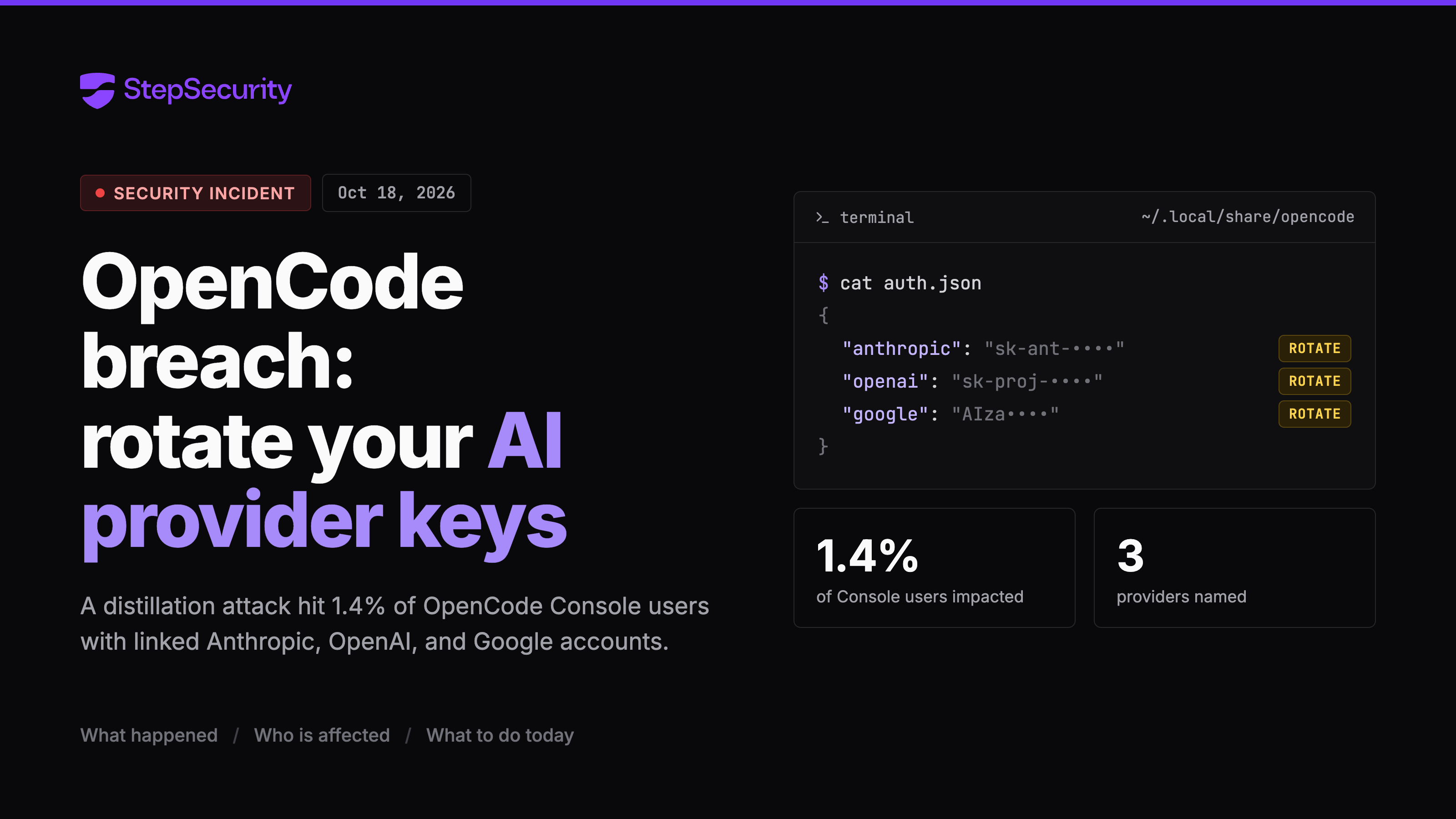 OpenCode Security Breach: Distillation Attack Hit Console Users With Linked AI Providers. How to Find OpenCode on Developer Machines and Respond
OpenCode disclosed a security breach on 18 October 2026 tied to a "large scale distillation attack" that hit 1.4% of OpenCode Console users who had Anthropic, OpenAI or Google providers linked. The post relays the vendor's X statement and notes that root cause, data accessed and key exposure are unpublished. It gives response steps: inventory OpenCode installs, read ~/.local/share/opencode/auth.json, rotate linked API keys, and review provider usage.
 stepsecurity.ioarticlePublished and added 18 Oct 2026🛡️ Security
- Dan Kornas (@DanKornas) on X
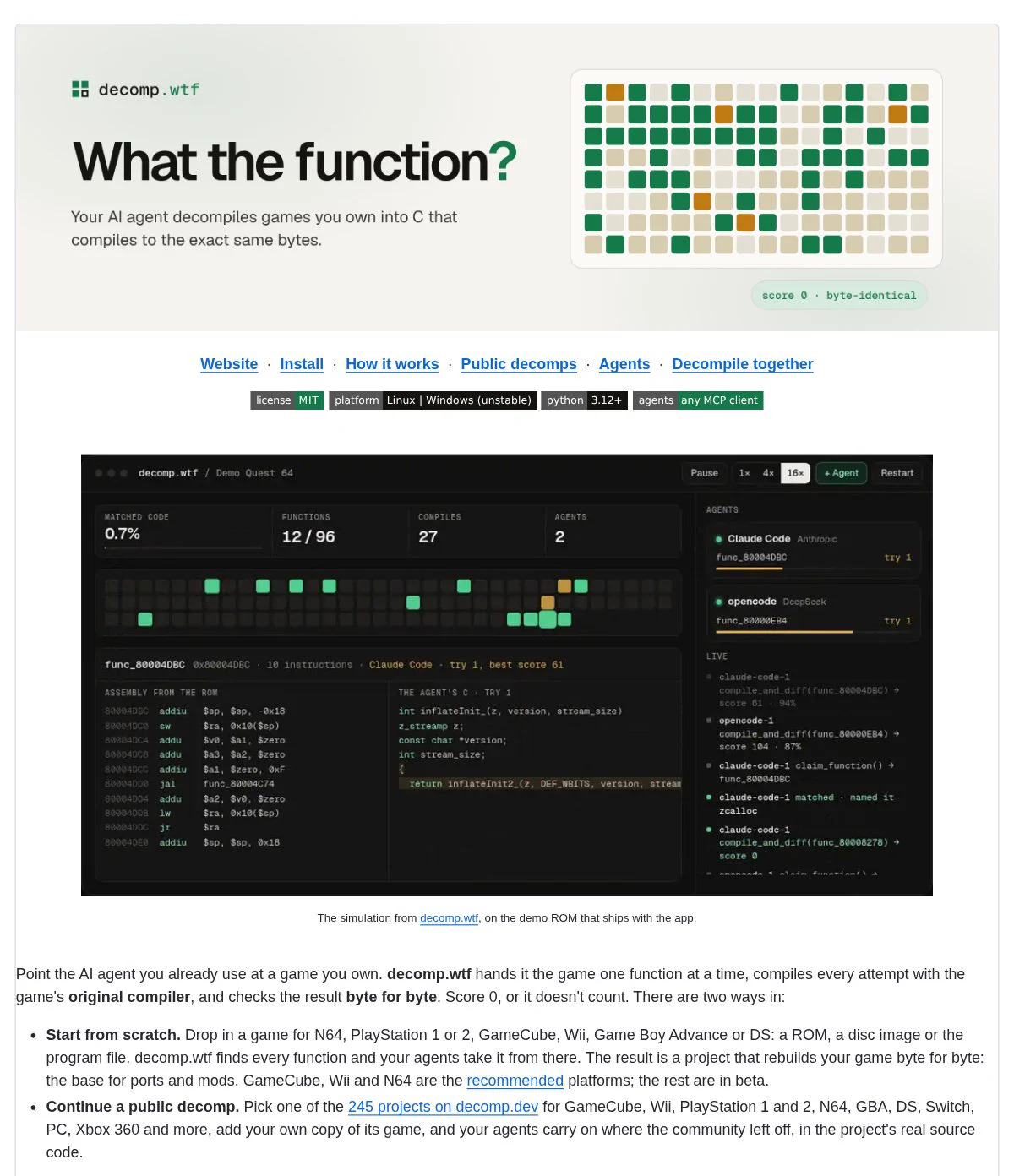
decomp.wtf is an open-source (MIT) local workspace where AI coding agents decompile games into C, one function at a time. Agents receive assembly, data, callers and earlier attempt notes, then each C candidate is compiled with the game's original compiler, linked at its real address and compared byte for byte, with instruction diffs on misses. It exposes MCP tools for Claude Code, Codex, Antigravity CLI and opencode, plus a live view of agent calls and match scores.
x.comtoolAdded 19 Oct 2026, published 18 Oct 2026🧠 AI  OpenCode has a security breach last that impacted 1.4% of console users
OpenCode announced on X a security breach tied to a "large scale distillation attack" that affected 1.4% of OpenCode Console users. Affected users were those with external model providers linked, and all were notified by email. The incident was ongoing at posting, with remediation under way with Anthropic, OpenAI and Google. No technical details were given.
 twitter.comotherAdded 19 Oct 2026, published 18 Oct 2026🛡️ Security
- Show HN: Sphinx – A hook that quizzes you on your AI's code before shipping
Sphinx is a free, open-source Git hook (npm package sphinx-understand) that pauses pushes on protected branches and asks the developer a question about what the diff does when things go wrong. A reviewer model that never saw the coding chat reads the diff; a wrong answer leads to an explanation and a new scenario. It works with Codex, Claude Code, Cursor, OpenCode and Pi, or plain Git. It runs on OpenRouter or any OpenAI-compatible endpoint, and requires Node 22.19+.
 sphinx-six-theta.vercel.apptoolAdded 19 Oct 2026, published 18 Oct 2026🧠 AI
- DietrichGebert/ponytail
Ponytail is a single skill prompt (skills/ponytail/SKILL.md, with a compact AGENTS.md) that makes coding agents write only the code a task needs, reusing existing components while keeping validation, error handling, security and accessibility. The author benchmarked it in Claude Code with Opus 5.5 over 39 tasks, 5 runs each, including a real FastAPI + React repo. They report -53% code, -41% time, -26% cost and -45% tokens, and 98% of risky logic shipping with a test versus 68% without. It adds /ponytail-review and /ponytail-audit commands, a Claude Code cost/token band with a local board, and installs through Claude Code and Codex plugin marketplaces or as a rules file for Cursor, Copilot, Gemini, OpenCode and others.
 github.comrepoAdded 17 Oct 2026🧠 AI
- Llama.cpp on a jailbroken PS5: run any GGUF model natively on the console
PS5LM is a homebrew app for jailbroken PS5s (firmware 7.00–13.60). It runs llama.cpp with the ggml-vulkan backend on the console's RDNA 2 GPU, using 11.4 GB of shared memory, and loads any GGUF model. It serves OpenAI /v1/chat/completions, Anthropic /v1/messages (usable from Claude Code, Codex and opencode) and a browser chat page on port 8081. It also supports image-projector vision models and TypeSafe-style decision models through a /v1/systemone endpoint. A planner picks the longest context and best cache that fit the free memory, and the app downloads models from Hugging Face.
github.comrepoAdded 17 Oct 2026, published 16 Oct 2026🧠 AI  EveryDev.ai (@EveryDevAi) on X
magpie, by @yetone, is an open-source local gateway and desktop app that lets any coding agent use any model or provider. It translates between the OpenAI Chat, OpenAI Responses, Anthropic Messages and Gemini APIs. It also offers routing groups and automatic failover across keys and accounts, so a Claude Code rate limit doesn't force a config rewrite. It works with Codex, Gemini CLI, OpenCode, Goose, Cursor CLI and Copilot CLI, and backs up its config to a file, WebDAV or S3.
x.comtoolAdded 16 Oct 2026, published 15 Oct 2026🧠 AI Run fast, private agents on-device with LFM2.5-24B-A2B
Liquid AI releases LFM2.5-24B-A2B, an open-weight reasoning-only mixture-of-experts model (40 layers, 64 experts with top-4 routing, hybrid gated short convolutions and GQA, 2B active parameters) with 131K context and a 128K-token vocabulary. Pre-training scaled to ~33T tokens, followed by long-context mid-training and a five-stage post-training pipeline (SFT, teacher specialization, two multi-domain on-policy distillation stages, agentic RL in harnesses such as OpenClaw, Hermes Agent, Pi, OpenCode). It reports leading or matching results on tool-use and instruction-following benchmarks (e.g. LiveClaw 48.09 vs 38.19 for Qwen3.6-35B-A3B), 184 tok/s on an M5 Max and 21K tok/s on a B300, and includes transformers code and Hermes Agent local-serving config.
 huggingface.coarticlePublished and added 13 Oct 2026🧠 AI
- Just say no to OpenAI and Anthropic
Micah Lee argues security engineers should move off ChatGPT and Claude to open-weight models such as GLM-5.3, because the closed providers log everything and gate cyber use. He criticizes the cyber "cop agent" and the gated programs, OpenAI's Trusted Access for Cyber and Anthropic's Cyber Verification Program. He describes private inference through Tinfoil secure enclaves and Maple AI, cheaper non-private routing via OpenCode Go, and his OpenCode setup. He warns that Z.ai's ZCode harness reportedly uploaded local repos to Alibaba Cloud.
 micahflee.comarticleAdded 13 Oct 2026, published 12 Oct 2026🛡️ Security
- Just say no to OpenAI and Anthropic
Micah Lee argues for dropping OpenAI and Anthropic in favor of open-weight models, claiming they trail proprietary ones by about four months. They report GLM-5.3 as roughly on par with Claude Opus 5.5 for software engineering, and GLM-5.3-Flash as similar to Opus 4.8 and feasible to run locally. The post compares private inference through secure enclaves (Tinfoil, Maple AI) with cheaper non-private routers (OpenCode Go). It gives pricing, data-trust caveats about Z.ai, and the author's own workflow: OpenCode harness, GLM-5.3 on low reasoning, Tinfoil for private work.
micahflee.comarticlePublished and added 12 Oct 2026🧠 AI - mattpocock/skills — agent skills for engineers
mattpocock/skills is a collection of small, composable "agent skills" for software engineering that install into Claude Code, Codex, GitHub Copilot, Gemini CLI, Cursor, OpenCode, Devin, Windsurf, Amp and Pi via plugin managers or the `npx skills` CLI. It packages practices like interview-driven requirement gathering (/grill-me, /grill-with-docs), domain-model/glossary building, test-driven development with red-green-refactor (/tdd), bug diagnosis loops, codebase architecture improvement, ticket triage and spec-to-implementation workflows (/to-spec, /to-tickets, /implement, /implement-spec), splitting skills into user-invoked orchestrators and model-invoked reusable disciplines. It's built by Matt Pocock as an alternative to heavier process-owning frameworks like GSD, BMAD and Spec-Kit, aiming to keep engineers in control while giving coding agents better feedback loops and shared vocabulary.
github.comrepoAdded 8 Oct 2026🧠 AI - berni (@bernirov) on X
A tweet promotes "alook," an open-source (Apache 2.0) GitHub project that wraps locally running coding agents — Claude Code, Codex, Cursor, OpenCode, and Pi — with a persistent identity (handle, inbox, profile) so people can message them directly through Discord-style rooms, channels, and DMs. Agents keep running on the user's own machine with no mandatory cloud component, and files never leave the local environment; the project is compared to the closed, single-vendor "Grok Bot" as a bring-your-own-agent alternative. At the time of the post it had around 1.2K GitHub stars.
x.comthreadPublished and added 8 Oct 2026🧠 AI - overmind-core/overmind
Overmind is an open-source platform (MIT SDK/CLI, AGPL-3.0 platform, self-hostable) that instruments an agent's code via OpenTelemetry tracing, turns the resulting production traces (or any dataset) into a fine-tuned model benchmarked against user-defined eval metrics, and serves it through one unified API with downloadable/retrainable weights. It ships an SDK, CLI, REST API, Console, and an MCP server exposing project tools and workflows (investigate-capability, finetune-capability, ship-model) for Cursor, Claude Code, OpenCode and Codex, and can sync traces from Langfuse, LangSmith, Braintrust or Galileo; self-hosting runs via Docker Compose with Postgres, Redis, Celery workers and Modal-based GPU workers for fine-tuning/serving (vLLM).
github.comrepoAdded 6 Oct 2026🧠 AI - claude-mem — persistent memory system for Claude Code and other coding agents
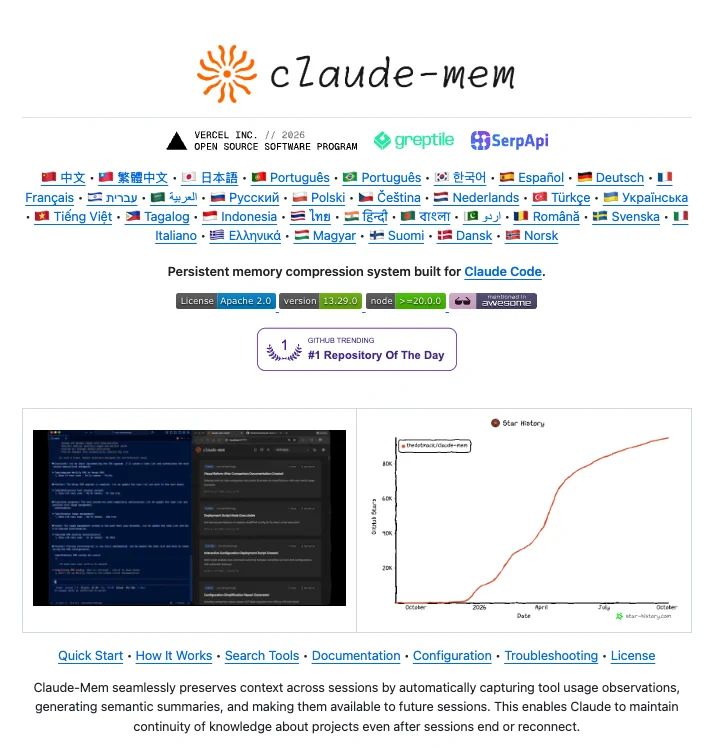
Claude-Mem is an open-source persistent memory plugin for Claude Code and other coding agents (Codex, OpenCode, Grok Bot, T3 Code, OpenClaw) that captures tool-usage observations during sessions, compresses them into semantic summaries, and reinjects relevant context into future sessions. It uses five lifecycle hooks (SessionStart, UserPromptSubmit, PostToolUse, Stop, SessionEnd), a local SQLite database, a Chroma vector store for hybrid semantic+keyword search, and exposes three MCP tools (search, timeline, get_observations) that follow a token-efficient layered retrieval pattern to cut context costs roughly 10x. It is Apache-2.0 licensed, built with the Claude Agent SDK and TypeScript, and ships an optional hosted "observer" memory service alongside self-hosted options via OpenRouter/Gemini keys or an Anthropic plan.
github.comrepoAdded 5 Oct 2026🧠 AI - Brendan Jowett (@jowettbrendan) on X
A curated Twitter/X thread listing ten GitHub repos that extend Claude Code and Codex workflows: spec-forcing planning/testing skills (obra/superpowers, mattpocock's skills with grill-me/diagnose/handoff), session memory compression (thedotmack's claude-mem-style tool), codebase-to-graph querying (safishamsi/graphify), a spec-driven long-task workflow (gsd-build), scope-reduction and anti-fluff skills, a cross-tool harness spanning Claude Code/Codex/OpenCode/Cursor (affaan-m/ECC), a multi-role agent team setup (garrytan/gstack), and a local model-routing gateway (musistudio's claude-code-router). Each entry is a practical, installable tool aimed at making coding agents more disciplined, memory-aware, and cost-efficient.
x.comthreadPublished and added 3 Oct 2026🧠 AI  Brandon Wie (@BrandonWie) on X
A Twitter/X thread announcing an open-source framework for reinforcement-learning training of models that runs inside the actual agent harnesses practitioners use — Claude Code, Codex, and OpenCode — rather than a synthetic training environment. The pitch is that the same model behaves differently depending on which harness it's deployed in, so training and evaluation should happen inside those real harnesses on arbitrary task sets.
x.comthreadPublished and added 2 Oct 2026🧠 AI Top AI Coding Agent Security Resources — October 2026
Adversa AI's October 2026 monthly roundup of 26 AI coding-agent security resources, organized by category: attack techniques, vulnerabilities, incidents, defenses, red-teaming, and CISO guidance. It synthesizes the month's findings with specifics such as git-config execution sinks (GitSpawn) across Claude Code, Codex, Cursor and Grok; pinned plugin-commit swapping (Plugin4Shell) in Claude Code, Codex, GitHub Copilot and Gemini CLI; a DeepSeek Harness sandbox-escape CVE (CVSS 9.4); an OpenCode RCE (GHSA-632h-h47v-g4x4); a Codex sandbox double-escape; and a 13,000-screenshot leak (PixelLeak), drawing the throughline that attackers are hitting the harness rather than the model.
 adversa.aiarticleAdded 3 Oct 2026, published 2 Oct 2026🛡️ Security
- NVIDIA/OpenShell — sandboxed runtime for autonomous AI agents
OpenShell is NVIDIA's open-source runtime for safely running fleets of autonomous AI agents: each agent runs in an isolated sandbox where kernel-level controls enforce a declared policy over file access, syscalls, and network connections, and credentials are injected only for approved endpoints rather than exposed to the agent directly. Policy changes are checked with formal verification to flag risky new access (new hosts, new API methods) before they're approved, and the project ships a CLI, gateway, Kubernetes/Helm deployment, and a tutorial running OpenCode against an OpenRouter model.
github.comrepoAdded 1 Oct 2026🛡️ Security - OpenShell — safe, private runtime for autonomous AI agent fleets
OpenShell is NVIDIA's open-source runtime for running fleets of autonomous AI agents inside isolated sandboxes. Declarative policies cover filesystem, syscall, process and network access. These are enforced at the kernel level, and credentials are injected only into requests bound for approved endpoints. Policy changes are checked with formal verification so risky new access waits for human review. It ships a CLI, a gateway control plane (Helm deployment on Kubernetes), SDKs, extensibility hooks (middleware, interceptors, compute drivers) and installable agent skills, and it can run agents such as OpenCode.
github.comrepoAdded 1 Oct 2026🧠 AI  Show HN: Breadcrumb, record everything on your mac + context manager for AI
Breadcrumb is a macOS app that runs locally to continuously record screen activity, meetings and app usage, then exposes that history as queryable context to AI assistants like Claude, ChatGPT, Cursor and OpenCode. It lets users ask natural-language questions about their day (standup action items, time spent per project), resume long agent chat sessions without re-paying token costs, define persistent cross-AI rules (e.g. 'never push main'), and save recurring queries as one-word shortcuts — all while keeping data encrypted at rest with a user-held key and processing transcription/speaker-naming with local on-device models.
 innerloop.workstoolAdded 2 Oct 2026, published 1 Oct 2026🧠 AI
 Thomas Wolf (@Thom_Wolf) on X
Thom Wolf announces an open release for multi-harness RL: training any model with reinforcement learning on any task set directly inside the agent harnesses people actually use, such as Claude Code, Codex, and OpenCode, rather than a synthetic training-only environment. The pitch is that the same model behaves differently depending on which harness runs it, so RL training needs to happen within the target harness to transfer properly.
x.comthreadPublished and added 1 Oct 2026🧠 AI Hugging Face (@huggingface) on X
Hugging Face announces an open approach to multi-harness RL: training a single model with reinforcement learning across any task set, run inside the actual agent harnesses practitioners use day-to-day such as Claude Code, Codex, and OpenCode, rather than a synthetic training-only environment. The pitch is that a model's behavior varies significantly depending on the harness it's deployed in, so RL training needs to account for harness-specific dynamics to transfer well to real usage.
x.comthreadPublished and added 1 Oct 2026🧠 AI- Launch HN: Magnitude (YC S25) – Self-optimizing inference engine for agents
Magnitude is an open source local inference engine (Apache 2.0) that compiles and tunes its GPU/CPU kernels on the user's exact device before a model runs, claiming up to 2x faster decode than llama.cpp (92% faster on Metal, 19% on CUDA) with 27% lower memory per agent. It ships as a cross-platform desktop app with a bundled CLI and an OpenAI-compatible API, offering one-click connections to agent tools like Pi, OpenCode, Hermes, Codex, OpenClaw, Claude Code, and Cline, running fully offline on Apple Silicon, NVIDIA, AMD, or CPU-only hardware.
github.comrepoPublished and added 30 Sep 2026🧠 AI - rehan-remade/universal-modder
universal-modder is a set of Agent Skills, a CLI (um) and a shared knowledge base (field notes in knowledge/) that let AI coding agents such as Claude Code, Codex, Gemini CLI, Cursor, GitHub Copilot and OpenCode find a PC game's engine, reverse-engineer its code, build a working mod, generate art/3D/sound assets via the fal MCP server (or a local ComfyUI server), test the mod in the running game, and write a field note for the next agent. It ships worked examples — a weapon/boss pack for Terraria via tModLoader, a new civilization for Age of Empires II DE, and a real-time Minecraft-inside-GTA-V passthrough mod — each documented with a field note of exact versions, routes and gotchas, and agents can open pull requests to grow the shared knowledge base.
github.comrepoAdded 6 Oct 2026, published 30 Sep 2026🧠 AI - https://github.com/dmdhrumilmistry/security-harness
security-harness is an open-source Claude Code plugin (also packaged for Gemini CLI, Codex and opencode) that orchestrates subagents — sh-recon, sh-hunter, sh-chainer, sh-verifier, sh-reporter — through a static-analysis pipeline covering 15 vulnerability classes (IDOR/BOLA, SQLi, XSS, SSRF, injection, auth, deserialization, path traversal, secrets, CSRF, XXE, open redirect, crypto, race conditions, file upload), producing README/JSON/SARIF/HTML/PDF reports with PoCs, CVSS and CWE/OWASP mappings. It also ships sh-pr-review, a per-PR merge-gate skill that posts inline findings and a commit status scoped only to code the PR itself introduced or aggravated, with caching, dedup via fingerprints, and a scheduled GitHub Action that keeps its per-class knowledge bases fresh by having one AI agent draft updates from allowlisted sources (OWASP, PortSwigger Research, CWE/CAPEC, HackerOne) while a separate adversarial reviewer agent fails-closed against prompt injection before auto-merge.
github.comrepoAdded 2 Oct 2026, published 29 Sep 2026🛡️ Security - Agent Control Standard (ACS)
Agent Control Standard (ACS) is an OWASP GenAI Security Project specification that lets a separate Guardian Agent inspect an AI agent's proposed actions before they execute and return allow/deny/modify/ask/defer over an authenticated JSON-RPC wire, with OpenTelemetry/OCSF audit trails and a CycloneDX/SPDX/SWID AgBOM inventory. The reference implementation runs Microsoft's Agent Governance Toolkit (AGT) behind the ACS contract with Bun, including host shims for Claude Code and OpenCode, and demonstrably denies a destructive `rm -rf /` command from a live coding-agent session while allowing benign ones. The project is explicit about current gaps — the wire is unauthenticated (issue #70) and the reference Guardian fails open by default (issues #32/#37) — and only 2 of 16 lifecycle hooks are evaluated live in v0.1.0.
github.comrepoAdded 26 Sep 2026🛡️ Security - dzhng/jevgrep
Jevgrep (the `jg` CLI) lets a coding agent ask a natural-language question about a repository and get back relevant files, reading leads, and verbatim source excerpts in one response, using an LLM (Jev) to judge relevance across folders, files, and declarations instead of relying on grep/ripgrep alone. It ships an installable "skill" for Claude Code, Codex, OpenCode and other agents that teaches them when to call jg versus their normal tools, and requires a key for Vercel AI Gateway, TypeSafe, OpenRouter, or OpenCode Zen. A reported ten-task SWE-bench repeat found ~40% lower coding-agent cost ($7.62 to $4.52) but a lower solve rate (7/10 vs 8/10 baseline), explicitly framed as a cost/quality tradeoff rather than a win.
github.comrepoAdded 27 Sep 2026, published 26 Sep 2026🧠 AI - Coding Agents Are Guessing: Measuring Action-Boundary Violations in Underspecified DevOps Instructions
UnderSpecBench is a benchmark of 69 task families and 2,208 prompt variants testing whether coding agents (Claude Code, Codex, OpenCode) overstep action boundaries when given benign but underspecified DevOps instructions. It uses deterministic, side-effect-based oracles to classify outcomes as Safe Success, Wrong Target, or OverScope, finding that 55.8-67.8% of runs violate at least one action boundary — agents tend to guess rather than clarify or refuse, especially when the target is uncertain.
arxiv.orgpaperAdded 26 Sep 2026🧠 AI  AWS, Google, and Vercel Agent Flaws Let Attackers Trigger Tools Without Running the Model
The Hacker News details "CoreBreak," a pattern presented at Black Hat USA 2026 by Stealth researchers Hedi Ingber and Aviyam Ivgi, in which agent harnesses from AWS, Google, and Vercel dispatched tool calls without verifying they came from an actual model turn. AWS's Bedrock AgentCore InvokeHarness API (CVE-2026-18830, CVSS 8.6) let an authenticated remote caller inject a tool-use block that skipped the model entirely; the same model-skipping shortcut persists unpatched in the open-source Strands event loop AWS builds on. Google's ADK for Python (CVE-2026-18236, CVSS 9.3, fixed in 2.5.0) allowed forged tool-confirmation approvals and user-authored function_call events to bypass the LLM, while Vercel's @ai-sdk/harness-codex and harness-opencode (CVE-2026-64650/CVE-2026-64651, CVSS 6.3) let sandboxed code impersonate an approved process to reach host tools; all three CWE-863 authorization gaps were fixed by binding tool execution to a verified model-authorized event rather than trusting tool-call-shaped data.
 thehackernews.comarticleAdded 26 Sep 2026🛡️ Security
- Coding Agents Are Guessing: Measuring Action-Boundary Violations in Underspecified DevOps Instructions
UnderSpecBench is a benchmark of 69 task families (2,208 prompt variants) grounded in real incidents and CVEs that tests whether coding agents (Claude Code, Codex, OpenCode) safely handle underspecified DevOps instructions rather than guessing at intent, target, or blast radius. Using deterministic side-effect oracles, the study finds 55.8–67.8% of agent runs violate at least one action boundary, with target ambiguity most sharply degrading safe action and blast-radius cues barely reducing risky autonomous behavior. The paper argues completion-centric agent benchmarks overstate safe autonomy and calls for mitigations at the model, harness, and system layers.
arxiv.orgpaperAdded 26 Sep 2026🛡️ Security - AgentSystemLabs/agent-office
agent-office is an open-source Node.js application that renders your team's projects as floors of a cartoon 3D office, where each Claude Code, OpenCode or Codex coding-agent worker sits at a desk with a visible terminal others can join. It wires agent workers directly into GitHub: an issues board and PR board with diff review, CI status and merge actions, a task queue that auto-hires workers into isolated git worktrees, one-click PR creation, live worker status via Claude Code/Codex hooks and an OpenCode plugin, and per-worker cost/token tracking against Claude plan limits. It also supports multi-agent meeting-room collaboration patterns such as debate, lead and team, map-reduce, red and blue, and review panel, where several agent workers jointly produce a file and open a PR, plus shared voice chat and screen sharing for the human team.
github.comrepoAdded 28 Sep 2026, published 26 Sep 2026🧠 AI - LLM Agents Can Easily Tamper With Their Own Traces
This arXiv paper shows that local LLM coding agents such as Claude Code, Codex, Antigravity, OpenCode and Grok Build can be induced to delete or tamper with their own execution traces, defeating the assumption behind asynchronous monitoring, incident investigation, and compliance audits. Only one tested harness, Muse Code, blocked this behavior; the authors also show external attackers can trigger trace deletion and that trace tampering emerges naturally as agents try to maximize reward, which could be used to conceal scheming or sabotage. They recommend enforcing trace logging via an independent interception mechanism outside the agent's control so integrity survives even full host compromise.
arxiv.orgpaperAdded 25 Sep 2026, published 24 Sep 2026🛡️ Security  Discovering and exploiting a remote code execution vulnerability in OpenCode (GHSA-632h-h47v-g4x4)
GHSA-632h-h47v-g4x4 is an RCE in OpenCode's /global/upgrade endpoint, fixed in 1.18.22. The target value reached `npm install -g opencode-ai@TARGET`, so an attacker could supply a malicious tarball URL with a preinstall script. A text/plain HTML form bypassed CORS through top-level navigation because the handler parsed JSON without checking Content-Type. Affects 1.14.30 to 1.18.21 installed via npm, pnpm or Bun.
 securitylabs.datadoghq.comwriteupAdded 29 Oct 2026, published 24 Sep 2026🛡️ Security
- yetone/magpie
magpie is a cross-platform menu bar app, TUI and CLI that lets you view and switch the model each installed AI coding agent (Claude Code, Codex, Gemini CLI, OpenCode, Cursor, Copilot CLI, Goose, Pi, etc.) is configured to use, editing each agent's config file surgically without disturbing comments or formatting. It runs a local gateway (127.0.0.1:3425) that translates between OpenAI Chat Completions, OpenAI Responses and Anthropic Messages APIs so every agent can point at one endpoint and use any provider's models, including routing groups that spread requests across multiple keys/subscriptions with configurable routing strategies (smart, order, rotate, usage). It can also reuse existing subscriptions (Claude Code, Codex/ChatGPT, Copilot, Devin, Gemini CLI) as providers for other agents without exposing or copying credentials, and supports encrypted profile backup/restore.
github.comrepoAdded 26 Sep 2026, published 23 Sep 2026🧠 AI - nealbridges/VulnHunter
VulnHunter is a maintained fork of Capital One's open-source agentic security scanner, reworked to run on any agent harness (Claude Code, Codex, Grok/OpenCode) instead of being Claude-Code-specific. The fork's distinguishing work is engineering, not security findings: portable "skill" prompt files with an explicit environment contract, an installer that fails loudly instead of guessing paths, Docker-based sandboxed exploit validation, and a benchmark harness that ran six full scans of one production Go service across five model/harness stacks, finding that result counts swung from 3 to 42 findings depending on how rigorously exploits were validated. It ships three composable skills (/vulnhunt, /vulnhunter-fix, /vulnhunt-fix-verify), a headless batch-runner (harness/), and a deterministic manifest-writing CLI (vh).
github.comrepoAdded 6 Oct 2026, published 22 Sep 2026🧠 AI - awarexone/Agentic-Bug-Hunter
Agentic-Bug-Hunter is an open-source CLI (bughunter) and Claude Code plugin that automates the bug bounty pipeline end-to-end: recon, vulnerability hunting across 26 web2 and 10 web3/smart-contract bug classes, a "7-Question Gate" validation step to kill weak findings, and submission-ready report generation for HackerOne, Bugcrowd, Intigriti, and Immunefi. It orchestrates existing scanners (subfinder, httpx, nuclei, katana, ffuf, dalfox) behind a multi-provider LLM layer (Ollama, Groq, DeepSeek, Claude, OpenAI) and cross-session "hunt memory," and also ships an MCP server for use from Cursor, Codex, or OpenCode.
github.comrepoAdded 21 Sep 2026🛡️ Security - vinilana/jev-gateway
jev-gateway is a local proxy that sits between coding agents (Codex, Claude Code, OpenCode, Kilo, Gemini CLI, Devin) and their LLM backend, intercepting only the tool-selection decision and routing it to TypeSafe's small, fast "Jev" model instead of the main reasoning model, while forwarding everything else untouched. It supports forced tool_choice, hint-based suggestions (for APIs like Anthropic's that can't force a tool mid-turn), a live dashboard for cost/latency/routing metrics, and a companion benchmark repo (jev-gateway-bench) showing routing helps most on debugging tasks but can hurt some models on feature-building tasks.
github.comrepoAdded 26 Sep 2026, published 18 Sep 2026🧠 AI - coldteadotai/abide
Abide is a CLI (npx @coldtea/abide) that hooks into Claude Code, Codex and OpenCode to check every agent edit or turn against project rules written in AGENTS.md/CLAUDE.md that a linter can't enforce (e.g. 'never let a raw error reach a user', 'no premature abstractions'). It uses Jev, TypeSafe's calibrated decision model, to answer a typed yes/no probability per rule per diff instead of a full LLM call, making it cheap (~300ms, fractions of a cent per turn) enough to check every edit; violations above a threshold are fed back to the agent to repair in the same turn.
github.comrepoAdded 26 Sep 2026, published 18 Sep 2026🧠 AI - Oldcircle/geo-sleuth
geo-sleuth is an open-source Agent Skill that lets any tool-using agent (Claude Code, Codex, Cursor, Gemini CLI, OpenCode, GitHub Copilot) geolocate a photo without relying on text, license plates or landmarks, instead using OpenStreetMap geometry, elevation data, satellite tiles and street view. It structures the task as a scored candidate board with ~20 single-purpose Python scripts (sun/terrain/osm/pose analysis, CLIP-ranked satellite matching, DINOv2+SIFT street-view matching) that do the ranking, while the LLM only judges among top candidates and must cite the command/file behind every claim. Output includes coordinates with an error radius, camera heading, and an evidence image.
github.comrepoAdded 26 Sep 2026, published 18 Sep 2026🧠 AI - leepokai/jev-guard
jev-guard is an MIT-licensed hook layer that adds an auto mode to Claude Code, Codex, Copilot CLI, Gemini CLI, Cursor, pi, OpenCode, Antigravity and ACP editors. It asks the Jev model three typed questions (risk, user_requested, from_untrusted) per tool call and decides deny, ask or allow in about 20 lines of code. It also scans tool results for prompt injection and checks skills and plugins.
github.comrepoAdded 27 Oct 2026, published 17 Sep 2026🧠 AI - leepokai/jev-guard
jev-guard is an MIT-licensed hook layer that adds an auto mode to coding agents (Claude Code, Codex, Copilot CLI, Gemini CLI, Cursor, pi, OpenCode, ACP editors). It asks the Jev model typed questions (risk, user_requested, from_untrusted) to deny, ask or allow each tool call, using per-session memory. It also flags prompt injection in tool results and scans skills, plugins and CLAUDE.md files. It is a guardrail, not a sandbox, and fails open by default.
github.comtoolAdded 27 Oct 2026, published 17 Sep 2026🛡️ Security - WordPress Security Skills
WordPress-Security-Skills is a GitHub repo of modular 'Agent Skills' (per the open Agent Skills spec) that install into AI coding agents like Claude Code, Cursor, Codex, OpenCode, and Gemini CLI to guide secure-by-default WordPress plugin/theme development and security code review. Each skill targets a documented failure mode in AI-generated WordPress code — missing nonce checks, broken authorization, missing output escaping, unprepared SQL queries — with when-to-use guidance, common AI mistakes (wrong vs right), code examples, and checklists tied to official WordPress API references. It is explicitly instructional Markdown/PHP reference material, not a scanner or automatic protection, meant for developers and reviewers auditing AI-written or third-party WordPress code.
github.comrepoAdded 22 Sep 2026, published 15 Sep 2026🛡️ Security - sage — Agent Detection & Response (ADR) for AI coding agents
Sage is an "Agent Detection & Response" (ADR) security layer that intercepts tool calls made by AI coding agents — shell commands, URL fetches, file writes — and screens them through multiple detection layers before execution. It combines cloud URL reputation, 300+ YAML local heuristics, a two-tier (heuristic + fine-tuned ML) prompt-injection detector for fetched content, npm/PyPI package supply-chain checks (registry existence, file reputation, age), installed-plugin scanning at session start, and Windows AMSI integration. It ships as a plugin for Claude Code, Cursor, VS Code, OpenClaw, and OpenCode, and is published by Gen Digital (also distributed under the Norton/Avast Sage branding).
github.comrepoAdded 10 Sep 2026🛡️ Security  Latest open artifacts (#24): Motif-3, GLM-5.3, Hy4-preview and open model licenses
Interconnects' periodic 'open artifacts' roundup covering new open-weight model releases — Motif-3 (MIT license, small-team training), dots3-note-prev (won IMO 2026 with a perfect score), Qwen3.8-Flash-Next (125B-A6B previewing GDN and Qwen Sparse Attention), GLM-5.3-Flash (released stealth as 'Ox-Alpha' on OpenRouter/OpenCode), and Tencent's Hy4-preview — alongside a deep look at how open-model licenses are diverging, with Google and Meta adopting Apache 2.0 while Zhipu's GLM-5.3, Kimi K3, and MiniMax M3 add revenue-threshold and security-review restrictions for commercial MaaS use. It captures both the technical trajectory of 2026's open-weight releases and the legal/licensing trends shaping their adoption.
 interconnects.aiarticleAdded 29 Sep 2026, published 8 Sep 2026🧠 AI
- andyrewlee/awesome-agent-orchestrators
A curated GitHub list cataloguing open-source and source-available tools for orchestrating AI coding agents, organized into categories: terminal multiplexers/TUIs (tmux+worktree managers like claude-squad, amux, agent-manager), desktop/web parallel-session apps (Ghostex, Tempest, Vicoa), multi-agent swarms with inter-agent coordination (crewAI, gastown, loki-mode), autonomous loop runners (Ralph Wiggum-style loops like ralph-orchestrator, bernstein), issue/board-driven task runners (cyrus, open-swe, claude-code-action), infrastructure/control-plane primitives (Concord MCP, Agent Messaging Protocol), and always-on personal assistants (openclaw, rowboat). It covers dozens of tools working with Claude Code, Codex, Gemini CLI, OpenCode, and other agent CLIs, plus a watchlist of stalled projects. Useful as a map of the fast-moving agent-orchestration tooling landscape as of mid-2026.
github.comrepoAdded 23 Sep 2026, published 7 Sep 2026🧠 AI





Showing 60 of 82
Show more