- rikugan: LLM reverse-engineering agent for IDA Pro and Binary Ninja
Rikugan is a reverse-engineering agent that runs inside IDA Pro and Binary Ninja. It has its own generator-based agent loop, context management, plan mode and 60+ tools, and does not depend on an external MCP server. An orchestrator spawns parallel subagents to analyze a binary. It supports Anthropic, Gemini, MiniMax, Kimi, OpenAI-compatible endpoints and Ollama, with per-model notes.
 github.comrepoAdded 30 Oct 2026🧠 AI
- rikugan: LLM reverse-engineering agent for IDA Pro and Binary Ninja
Rikugan is an open-source reverse-engineering agent that runs inside IDA Pro 9.0+ and Binary Ninja, with its own agent loop instead of an MCP server. It has 60+ tools (decompiler, xrefs, strings, types, IL/microcode), parallel subagent exploration, an experimental /modify natural-language patching command and an experimental Binary Ninja deobfuscation skill for control flow flattening and opaque predicates. It supports Claude, Gemini, MiniMax, Kimi, OpenAI-compatible endpoints and Ollama.
github.comrepoAdded 30 Oct 2026🛡️ Security - Show HN: Auto Dismiss Mac OS "Allow <app> to find devices on local networks?"
dontallow is a two-file Swift launchd agent for macOS 15 and later that clicks "Don't Allow" on the "find devices on local networks" prompt. It watches the UserNotificationCenter process through an Accessibility observer, supports pause and allowlist, and can decode the Local Network rule store to show orphaned rows. It explains why Chromium temp-bundle paths make the prompt recur, and gives a PPPC profile route for fleets.
github.comrepoAdded 30 Oct 2026, published 29 Oct 2026🛡️ Security - OpenAI CLI
OpenAI CLI is OpenAI's official Go command-line client for the REST API. It lets users generate images, upload and download files, create and wait on batches, call the Responses API, and query admin usage endpoints from a terminal or shell script. It supports JSON, JSONL and YAML output, GJSON transforms, shell completion, and install via Homebrew, go install or release binaries.
github.comrepoAdded 23 Oct 2026, published 22 Oct 2026🧠 AI - enisaeu/enisa-sbd-playbook
ENISA repository of 22 Secure by Design and Secure by Default playbooks for SMEs building products with digital elements. Each playbook has a principle, objective, checklist, minimum evidence and release gate, covering design, build, deployment, maintenance and decommissioning. It supports progressive adoption and CRA readiness without replacing legal obligations.
github.comrepoAdded 17 Oct 2026🛡️ Security - AikidoSec/safe-chain
Aikido Safe Chain is an open-source local proxy and shell-alias wrapper for npm, yarn, pnpm, bun, pip, uv, poetry, pipx and pdm. It checks every package download, including deep dependencies, against the Aikido Intel malware feed and blocks malicious packages before install. It also enforces a configurable 48-hour minimum package age by suppressing too-new versions in registry metadata. It supports custom registries and a self-hosted malware-list mirror, and has CI/CD install recipes for GitHub Actions, Azure Pipelines, CircleCI, Jenkins, Bitbucket and GitLab.
github.comrepoAdded 17 Oct 2026🛡️ Security  Meta Muse Spark Open (816B-A42B) open-weights model card
Model card for Meta Superintelligence Labs' Muse Spark Open, an open-weights, natively multimodal model with 816B total and 42B active parameters and a 1M-token context window. It targets coding and agentic work (tool use, long-horizon tasks, multimodal reasoning, synthetic data generation, LLM-as-judge). It ships in BF16 and NVFP4, needs about 700GB VRAM (NVFP4) or 2TB (BF16), runs on SGLang, vLLM, Transformers, TensorRT-LLM, Unsloth, llama.cpp and MLX, and supports a reasoning_effort setting. The Muse Model License requires "Built with Muse Spark Open" attribution and a separate agreement for Model-as-a-Service above $20M revenue. The card reports safety results against Kimi K3 on cyber, chem/bio and loss-of-control evals.
 huggingface.corepoAdded 17 Oct 2026🧠 AI
- Llama.cpp on a jailbroken PS5: run any GGUF model natively on the console
PS5LM is a homebrew app for jailbroken PS5s (firmware 7.00–13.60). It runs llama.cpp with the ggml-vulkan backend on the console's RDNA 2 GPU, using 11.4 GB of shared memory, and loads any GGUF model. It serves OpenAI /v1/chat/completions, Anthropic /v1/messages (usable from Claude Code, Codex and opencode) and a browser chat page on port 8081. It also supports image-projector vision models and TypeSafe-style decision models through a /v1/systemone endpoint. A planner picks the longest context and best cache that fit the free memory, and the app downloads models from Hugging Face.
github.comrepoAdded 17 Oct 2026, published 16 Oct 2026🧠 AI - OpenMOSS/MOSS-Image
MOSS-Image is an open-source text-to-image model family from OpenMOSS with a 5B backbone, released October 2026 as MOSS-Image-Base and MOSS-Image-SFT. It supports JSON layout control with bounding boxes, text rendering inside images, and prompts up to 4K tokens. The repo gives a Diffusers pipeline, a Gradio app, a ComfyUI plugin, LoRA training guidance, a prompt-enhancer skill and day-0 SGLang and vLLM-Omni support.
github.comrepoAdded 20 Oct 2026, published 16 Oct 2026🧠 AI - gichirimaku/wp2shell-PoC
wp2shell-PoC is a Python proof-of-concept exploiting a pre-authentication RCE chain in WordPress core, combining CVE-2026-63030 (REST API batch route confusion) and CVE-2026-60137 (SQL injection in WP_Query). It demonstrates escalation from the route-desync bug through blind SQLi, customize_changeset forgery, and hook re-entry to administrator account creation and arbitrary command execution via a malicious plugin upload. The tool supports vulnerability checking, data extraction (union, error-based, blind techniques), and full shell access with or without existing admin credentials.
github.comrepoAdded 23 Oct 2026, published 15 Oct 2026🛡️ Security - BijectiveLabs/trading-research-agents
Open-source Python CLI (`tra`) for autonomous trading desks in which LLM analysts (technical, macro, on-chain, sentiment) and validators only give opinions on figures the system computed. Fixed rules do the arithmetic: pricing the round-trip cost, applying risk limits, sizing, cost gates, and sending a single order with stop attached via ccxt (Bybit and OKX demo accounts tested). It supports multiple model providers with per-role models, effort settings and fallbacks. Every answer is parsed against a closed schema, every refusal is logged with the figure behind it, and models can tighten but never loosen controls. This makes it a concrete reference for keeping LLM agents away from arithmetic and money.
github.comrepoAdded 18 Oct 2026, published 13 Oct 2026🧠 AI - BijectiveLabs/bitra
bitra (CLI name tra) is an MIT-licensed Python framework from Bijective Labs for autonomous trading agents. Language models only read system-computed figures and give opinions, while deterministic code prices the round trip, applies declared limits, sizes the trade and sends one order with stop attached. Every cycle's briefs, answers and refusals are stored on disk with hashes. It supports many model providers and ccxt venues, with sandbox, demo and mainnet tiers.
github.comrepoAdded 25 Oct 2026, published 13 Oct 2026🧠 AI - Show HN: SolidCraft – Open-Source Parametric CAD in Rust (With MCP Support)
SolidCraft is an open-source parametric 3D CAD application written in pure Rust. It has constrained sketches with its own solver, a feature timeline, assemblies, sheet metal, and STEP/IGES/3MF/STL export. It runs on desktop (egui+wgpu), in the browser, and as a headless CLI. The built-in MCP server (`solidcraft-cli mcp`) gives agents tools such as execute, batch, inspect_design, measure, set_parameter, screenshot and export. They can model headless or drive the running app over a JSON-lines control channel. A rover with 3,323 timeline steps was built entirely through MCP, which shows agent-driven parametric modelling working at scale.
github.comrepoPublished and added 13 Oct 2026🧠 AI - sakidekin/CVE-2026-41940-PoC
This repository hosts a proof-of-concept for CVE-2026-41940, described as a CVSS 10.0 unauthenticated authentication bypass in cPanel and WHM caused by CRLF injection into server-side session files via the Authorization header. The accompanying Python tool (cve.py) can detect vulnerable cPanel/WHM instances, retrieve system and account information, and perform post-exploitation actions such as running OS commands, changing the root password, and opening an interactive WHM shell. It also supports bulk scanning workflows piped from subfinder, httpx, and Shodan.
github.comrepoAdded 23 Oct 2026, published 11 Oct 2026🛡️ Security - bilawalsidhu/gods-eye-view
God's Eye View is an open-source, vanilla JavaScript + CesiumJS + Vite 3D globe that fuses live public feeds (aircraft, ships, satellites, quakes, public cameras, weather) into one explorable scene. Its AI layer is a hands-free voice agent on the OpenAI Realtime API with 30 tools: camera fly-to, whiteboard annotations, analyst queries over live layers, and scene-context and screenshot grounding. Keys stay server-side and the browser gets only a short-lived session token. An experimental ChatGPT/Codex OAuth path is also supported. The app doubles as an MCP server, so Claude Desktop, Codex or ChatGPT can open the globe from a conversation.
github.comrepoAdded 11 Oct 2026🧠 AI - argoproj-labs/mcp-for-argocd
TypeScript MCP server for Argo CD that lets MCP clients (Cursor, VS Code, Claude Desktop) list, inspect, create, update, delete and sync applications, read logs and events, and run resource actions through natural language. It supports stdio and HTTP stream transports, with a stateless mode for multi-replica Kubernetes deployments. The security design is detailed: API tokens are read only from env vars or headers and never from tool arguments, the default token is bound to the default base URL, a per-host token registry covers extra instances, a read-only mode disables write tools, and the HTTP listener binds loopback by default and requires an inbound auth token if exposed.
github.comrepoAdded 10 Oct 2026🧠 AI  Aleph Alpha Kolibri-1 (78B MoE, Apache 2.0)
Kolibri-1 is Aleph Alpha's 78B-parameter mixture-of-experts reasoning model focused specifically on German and English, released under Apache 2.0 with weights, a vLLM plugin, and an extensive model card. It supports explicit reasoning-effort levels, Hermes-style tool calling, and a native 262144-token context validated to over 1M via sliding-window attention; the card details its UniBPE German-aware tokenizer, pre-training mid-training and long-context training recipe, MergeMix-based data-mix search, Merlin-Arthur hallucination-mitigation RL protocol, and benchmark results against Qwen3.5, Gemma 4, Nemotron 3 Nano, and Apertus on MMLU-Pro, GPQA, AIME, SWE-bench Verified, Terminal-Bench 2.1, and HLE.
huggingface.corepoAdded 8 Oct 2026🧠 AI- chainguard-dev/malcontent
malcontent is Chainguard's open-source malware/supply-chain discovery tool that analyzes binaries (ELF, Mach-O, PE, a.out) and scripting-language source across Linux, macOS and Windows using 14,500+ YARA rules (including third-party rules from Avast, Elastic, FireEye, Mandiant, Nextron and ReversingLabs). Its standout feature is differential analysis ("mal diff"), which compares two versions of a build artifact or OCI image against a known-good baseline to surface newly introduced risky behaviors — the technique the project demonstrates on the 3CX supply-chain compromise by flagging unexpected high-risk changes to libffmpeg. It also supports threshold-based scanning ("mal scan") and unfiltered capability enumeration ("mal analyze"), and is designed to run inside CI/CD pipelines, including air-gapped environments via embedded rules.
github.comrepoAdded 8 Oct 2026🛡️ Security - deepfence/YaraHunter
YaraHunter is Deepfence's open-source scanner that applies YARA rulesets against container images, running Docker containers, and filesystems to detect indicators of compromise such as malware and cryptominers. It supports CI/CD build-time scanning, at-rest image scanning, and runtime container scanning, with JSON output for automation, and is designed to eventually integrate into the Deepfence ThreatMapper platform. The README walks through detecting the XMRig cryptominer inside a container image as a worked example.
github.comrepoAdded 8 Oct 2026🛡️ Security - Microsoft Agent Framework python-1.20.0 release
Release notes for python-1.20.0 of Microsoft's Agent Framework, an open-source agent/workflow orchestration library. This release adds native vector-store connectors for DuckDB, SQL Server and MongoDB plus a TypeSafe AI connector, redesigns Foundry hosting around request-scoped agent factories and sandbox-isolated sessions, adds computer-use support to Responses clients, and ships Magentic manager and handoff-routing improvements for multi-agent orchestrations alongside a large batch of MCP, Bedrock, Gemini, Anthropic and Ollama provider fixes.
github.comrepoAdded 6 Oct 2026🧠 AI - Show HN: OpenChart – OSS TradingView alternative with your own AI agent
OpenChart is an open-source TradingView-style desktop charting app (Electron, Node.js/Bun, Effect runtime) that embeds AI agents into statistical/technical analysis, real-time market alerts and agentic opportunity research. It ships a custom DSL called Tea (inspired by TradingView's Pine Script) for writing indicators, and a conversation interface built on assistant-ui and the AG-UI event protocol so users converse with agents while charting.
github.comrepoPublished and added 6 Oct 2026🧠 AI - Dark Web Informer (@DarkWebInformer) on X
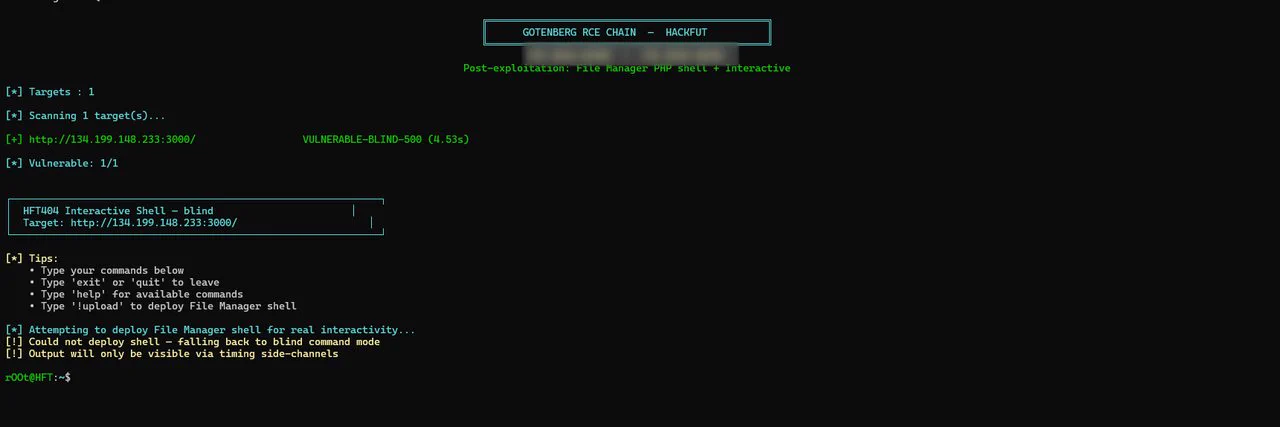
A public PoC chains CVE-2026-42589 and CVE-2026-40281 to achieve unauthenticated remote code execution against Gotenberg (a document/PDF-conversion microservice), abusing metadata injection flaws in the /forms/pdfengines/metadata/write endpoint. The tool supports vulnerability detection, interactive command execution, reverse shell delivery, and multi-target scanning against Gotenberg versions ≤8.30.1 (patched in 8.31.0).
 x.comrepoPublished and added 5 Oct 2026🛡️ Security
- OKX Agent Trade Kit (okx-trade-mcp / okx-trade-cli)
OKX Agent Trade Kit is an open-source MCP server (okx-trade-mcp) and CLI (okx-trade-cli) that let AI assistants like Claude Desktop, Cursor, Claude Code and VS Code place trades and query account data on the OKX exchange via natural-language commands. It runs locally with API keys never leaving the machine, supports module scoping (market, spot, swap, account, earn), a read-only mode for safe querying, multiple profiles, and includes pre-built skill files for agent frameworks plus structured JSON error reporting for debugging failed tool calls.
github.comrepoAdded 2 Oct 2026🧠 AI  Kyutai Pocket TTS
Pocket TTS is a 100M-parameter text-to-speech model from Kyutai designed to run efficiently on CPU, generating audio faster than real-time (~6x on a MacBook Air M4) with ~200ms latency to first audio chunk and voice cloning from short audio samples. It supports English, French, German, Portuguese, Italian, and Spanish, ships a Python library and CLI, and has spawned numerous community ports (WASM, ONNX, Rust/Candle, MLX, C++, C#) and fine-tuned language variants (Czech, Hindi, Korean, Persian, Indonesian, Estonian, Welsh, Polish).
huggingface.corepoAdded 2 Oct 2026🧠 AI- Sift — Open-Source Secrets/Credential Scanner
Sift is Stratus Security's open-source successor to Snaffler: a Native AOT credential/secrets scanner for pentesters that crawls local drives, SMB shares/subnets, Active Directory, SharePoint/OneDrive/Teams, Slack, and Jira/Confluence for exposed secrets. It supports Kerberos/NTLM/pass-the-hash authentication, resumable checkpointed scans, a JSON rule/ignore-rule system compatible with Snaffler's detection catalogue, and optional local-LLM (Ollama) validation to cut false positives without sending sensitive findings to a cloud API.
github.comrepoAdded 30 Sep 2026🛡️ Security - Andrea (Drego) Draghetti 👨🏻💻 🎣 (@AndreaDraghetti) on X
Tosint v1.0.0 is an open-source Telegram OSINT tool for analyzing bots and chats, exporting message history and media. The new release adds richer JSONL metadata output, optional SHA-256 hashing of exported media, bot/user authentication support, and an automatic fallback from MTProto-based history retrieval to ID-scan mode when dealing with restricted chats.
x.comrepoAdded 2 Oct 2026, published 30 Sep 2026🛡️ Security - garak v0.17.0 — LLM vulnerability scanner release
Release notes for garak v0.17.0, NVIDIA's open-source LLM vulnerability scanner used for red-teaming and probing models for jailbreaks, prompt injection, data leakage and other failure modes. The release adds an EU AI Act risk-category mapping to tag and group probe results, plus fixes to detectors (agent_breaker judge verdict validation, packagehallucination import parsing, MarkdownExfilContent divide-by-zero, TriggerListDetector alignment) and probes (badchars ASCII selection, Markdown exfiltration link templates), along with Ollama generator improvements and dropped Python 3.10 support in favor of 3.13.
github.comrepoAdded 29 Sep 2026🛡️ Security - openrig — multi-agent Claude Code/Codex orchestration
OpenRig is an open-source local daemon/CLI/TUI/MCP server that orchestrates teams of Claude Code and Codex agent sessions (via tmux) defined declaratively in YAML "RigSpecs." Its own docs disclose a significant trust/permission footprint: it writes workspace-trust settings and status-line/activity hooks into ~/.claude.json and .claude/settings.local.json, pre-writes Codex trust hashes and trusted workspace entries into ~/.codex/config.toml, defaults Claude to --permission-mode acceptEdits and Codex to -s workspace-write, and supports an explicit OPENRIG_YOLO=1 mode that enables Claude's --dangerously-skip-permissions or Codex's -s danger-full-access. It also relays session/activity telemetry to a local daemon endpoint.
github.comrepoAdded 28 Sep 2026🛡️ Security - vLLM v0.30.0
Release notes for vLLM v0.30.0, a major update to the open-source LLM inference/serving engine spanning 762 commits. Highlights include new model support (DeepSeek-V4.1-Flash, GLM-5.3-Flash, Kimi K3, Qwen3.8-Flash-Next, K2-Horizon, Cohere Compass and others), a "Fast Start" GPU weight-cache daemon for near-instant engine restarts via CUDA IPC, Gumbel-max watermarking for generated text, a HiSparse host-memory tier for sparse-MLA KV offload, Model Runner V2 improvements (dual-batch overlap, speculative decoding under pipeline parallelism), expanded quantization support (NVFP4, W4A16 DSA, AutoRound), and hardware-specific tuning across NVIDIA, AMD ROCm, Intel XPU and CPU backends.
github.comrepoAdded 28 Sep 2026🧠 AI  MiMo-V2.6-Flash-RL (Xiaomi)
MiMo-V2.6-Flash-RL is Xiaomi's efficiency-balanced checkpoint in the MiMo-V2.6 series, a 309B-total/15B-activated sparse MoE model with native text, image, video and audio support and a 1M-token context window. It's trained with a single mixed reinforcement learning run (GRPO at large batch scale) across coding, agentic, visual and cybersecurity tasks, using a novel Groupwise Agentic Grading scheme (Groupwise Reward Synthesis and Groupwise Advantage Redistribution) to build a self-improvement loop, followed by Multi-Prefix Multi-Teacher On-Policy Distillation (MOPD2). The card documents the architecture (MiMo ViT vision encoder, AudioTokenizer audio encoder, 5-layer speculative MTP decoder) and deployment recipes for vLLM and SGLang.
huggingface.corepoAdded 26 Sep 2026🧠 AI- garak v0.17.0 — adds EU AI Act risk-category mapping
garak is NVIDIA's open-source LLM vulnerability scanner that runs probes/detectors for jailbreaks, prompt injection, PII leakage, package hallucination, markdown exfiltration and more against LLM targets. This v0.17.0 release adds a new EU AI Act risk-category mapping to tag and group probe results by the Act's risk categories, alongside fixes to the agent_breaker judge, markdown-exfiltration detectors, Ollama auth/generation support, and dropped Python 3.10 in favor of 3.13 support.
github.comrepoAdded 26 Sep 2026🛡️ Security - awslabs/mcp release 2026.09.20260922000649
This is a release changelog for awslabs/mcp, AWS Labs' collection of Model Context Protocol servers covering services like HealthOmics, Aurora DSQL, Bedrock Knowledge Base retrieval, ECS, CloudWatch, billing/cost management, and dataprocessing. This release adds vended metrics tools, SQL parser-based policy guards for Aurora DSQL, agentic retrieval support for Bedrock KB, and fixes several security issues including region validation to prevent SSRF credential disclosure in the CloudWatch server and read-only mode bypass in the MySQL server. It reflects an actively maintained, high-velocity multi-server MCP monorepo used for AWS tool integration with LLM agents.
github.comrepoAdded 26 Sep 2026🧠 AI - Sandyaa — open-source autonomous code auditor that proves bugs with working exploit PoCs
Sandyaa is an open-source autonomous code-audit tool that points at a local directory or git URL and runs end-to-end, driven by the Claude Code CLI (optionally Gemini) with no separate API key required. It uses a Recursive Language Model approach — the model drives a Python REPL to chunk code, spawn sub-LLM queries, and aggregate results — running eight recursive passes (call-chain tracing, data-flow expansion, vulnerability chaining, exploitability proof, etc.) and an attacker-control-reachability analyzer to filter unreachable findings, then writes each finding with a working exploit PoC and an evidence.json linking claims to file/line. Maintained by SecureLayer7, who report using it to surface zero-days; it's alpha-stage, macOS-tested, Linux/WSL2-expected-to-work, and unsupported on native Windows.
github.comrepoAdded 26 Sep 2026🛡️ Security - google/ax — declarative agentic orchestration runtime
AX is Google's declarative orchestrator for running large numbers of autonomous agent workloads on Kubernetes, built on top of "Agent Substrate" for sandboxed execution. Agents are declared via YAML manifests (Task, Workspace, Model) similar to kubectl, and applied with an `ax` CLI that supports apply/get/watch/ssh/suspend/resume, treating agent runs as a distinct workload type distinct from stateless services or batch jobs.
github.comrepoAdded 26 Sep 2026🧠 AI - AgentSystemLabs/agent-office
agent-office is an open-source Node.js application that renders your team's projects as floors of a cartoon 3D office, where each Claude Code, OpenCode or Codex coding-agent worker sits at a desk with a visible terminal others can join. It wires agent workers directly into GitHub: an issues board and PR board with diff review, CI status and merge actions, a task queue that auto-hires workers into isolated git worktrees, one-click PR creation, live worker status via Claude Code/Codex hooks and an OpenCode plugin, and per-worker cost/token tracking against Claude plan limits. It also supports multi-agent meeting-room collaboration patterns such as debate, lead and team, map-reduce, red and blue, and review panel, where several agent workers jointly produce a file and open a PR, plus shared voice chat and screen sharing for the human team.
github.comrepoAdded 28 Sep 2026, published 26 Sep 2026🧠 AI - git-pkgs — dependency history & supply-chain analysis for git repos
git-pkgs is a Go rewrite of a Ruby tool that adds a git subcommand for tracking dependency changes across a repository's history, indexing manifests/lockfiles from 36+ package managers (npm, RubyGems, Cargo, PyPI, Maven, Composer, Go modules, etc.) into a local SQLite database. Beyond history/blame/diff, it offers supply-chain security commands: `vulns` (OSV-based CVE scanning with SARIF output for GitHub code scanning, plus blame/praise/exposure for remediation metrics), `licenses` (with drift detection and CI-friendly exit codes), `deprecated`, `provenance` (trusted-publishing/attestation checks), `integrity` (lockfile hash drift detection), `maintainers`/`health` (via ecosyste.ms metadata), and `sbom` export in CycloneDX/SPDX. It also supports a dependency-aware `bisect` to find when a vulnerability, license change, or capability (e.g. network access) was introduced, and ships GitHub Actions for CI integration.
github.comrepoAdded 25 Sep 2026🛡️ Security - Claude Code Templates Repository
Claude Code Templates (aitmpl.com) is an open-source npx CLI and template catalog offering 100+ ready-to-use agents, slash commands, hooks, settings, skills and MCP server integrations for Anthropic's Claude Code, aggregating contributions from Anthropic's official skills repo, K-Dense-AI's scientific skills, and various community projects (superpowers, wshobson/agents, awesome-claude-code, etc.). Beyond the template catalog it ships real-time analytics for monitoring Claude Code sessions, a mobile chat viewer with Cloudflare Tunnel support, a health-check diagnostic, and a plugin/marketplace manager, making it a practical operational toolkit for customizing and running Claude Code.
github.comrepoAdded 2 Oct 2026, published 25 Sep 2026🧠 AI - https://github.com/davila7/claude-code-templates/tree/main/cli-tool/components/skills/security/security-threat-model
A directory within the davila7/claude-code-templates repo containing a "security-threat-model" Skill for Claude Code: a SKILL.md instruction file plus supporting agents and reference files that package a reusable threat-modeling workflow for the coding agent. It's an example of the emerging pattern of distributing structured, invocable skills (instructions + sub-agents + reference docs) that extend Claude Code's capabilities, rather than a security research artifact itself.
github.comrepoAdded 2 Oct 2026, published 25 Sep 2026🧠 AI - https://github.com/davila7/claude-code-templates/tree/main/cli-tool/components/skills/security/security-threat-model
A "security-threat-model" skill folder in the davila7/claude-code-templates repository, part of a library of reusable Claude Code skills/components. It packages a SKILL.md definition with supporting agent and reference files intended to let Claude Code agents carry out structured threat-modeling analysis as part of a development or security-review workflow.
github.comrepoAdded 2 Oct 2026, published 25 Sep 2026🛡️ Security - Show HN: Whiteboard (YC W26) – An open-source IDE for thoughtful software design
Whiteboard is an open-source (MIT) desktop IDE that gives coding agents like Claude Code and Codex an SDK to draw diagrams, sequence charts, and traces on a shared canvas linked directly to underlying code. It vendors Code OSS for VSCode-grade navigation/LSP support and adds a custom Rust-built AST-aware semantic diff viewer (with a WASM plugin system) that summarizes large generated functions as pseudocode and collapses noise like tests/docs, aiming to make reviewing autonomous agent decisions and code changes tractable.
github.comrepoAdded 26 Sep 2026, published 24 Sep 2026🧠 AI - yetone/magpie
magpie is a cross-platform menu bar app, TUI and CLI that lets you view and switch the model each installed AI coding agent (Claude Code, Codex, Gemini CLI, OpenCode, Cursor, Copilot CLI, Goose, Pi, etc.) is configured to use, editing each agent's config file surgically without disturbing comments or formatting. It runs a local gateway (127.0.0.1:3425) that translates between OpenAI Chat Completions, OpenAI Responses and Anthropic Messages APIs so every agent can point at one endpoint and use any provider's models, including routing groups that spread requests across multiple keys/subscriptions with configurable routing strategies (smart, order, rotate, usage). It can also reuse existing subscriptions (Claude Code, Codex/ChatGPT, Copilot, Devin, Gemini CLI) as providers for other agents without exposing or copying credentials, and supports encrypted profile backup/restore.
github.comrepoAdded 26 Sep 2026, published 23 Sep 2026🧠 AI - shai-hulud-detect: multi-ecosystem npm/PyPI/Composer/Crates/Go/Hex/RubyGems supply-chain worm scanner
shai-hulud-detect is a dependency-free Bash scanner that checks projects against a 5,782-entry list of compromised npm, PyPI, Composer, Crates, Go, Hex, and RubyGems package versions, plus content-pattern indicators of compromise (malicious file hashes, C2 domains, dead-man's-switch artifacts, forged commits, suspicious lifecycle hooks) tied to the Shai-Hulud supply-chain attack waves. It supports single-project and bulk scanning, CI-friendly exit codes, JSON/log output for pipeline gating, and a --check-host mode to detect the May 2026 gh-token-monitor/kitty-monitor persistence daemons that wipe hosts if their monitored GitHub token is revoked (with a documented safe remediation order). Detection is read-only; new package entries are sourced from named threat-research firms (Socket, StepSecurity, Aikido, Snyk, JFrog, Wiz, Semgrep, SafeDep, GitGuardian, OX Security) and cited in PRs.
github.comrepoAdded 23 Sep 2026🛡️ Security - qybaihe/mu
mu is a coding agent built on the pi framework that introduces a "judgment kernel": a small, fast auxiliary model (Jev, a hosted judge, or Laya, a local 322M-parameter model) answers bounded yes/no/choice/score questions at 35 named decision points per turn — deciding what stays in context, whether a tool call is risky, when a turn is done, and what one agent should tell another — so the large working model doesn't spend tokens/attention on bookkeeping. It also ships a "hive" multi-agent mode (2-6 read-only "bees" plus a main editing agent) with an append-only shared board and relation-checking (supersedes/contradicts/supports) between findings, plus a native desktop app with live judgment/board/hive views.
github.comrepoAdded 26 Sep 2026, published 22 Sep 2026🧠 AI - Simreal-AI/Simreal-MLBench
Simreal-MLBench is the open, minimal slice of ML Benchmark, a verifiable evaluation environment for machine learning research agents, covering 60 tasks across tabular learning, forecasting, vision, language, audio, multimodal and structured scientific data. It splits an open, Apache-2.0 layer (task definitions, scoring rule, verification tooling) from a commercial operated layer (SimReal's sandboxed runtime, gateway, submission broker and official scoring), scores tasks as 100xp^2 against a frozen reference leaderboard, enforces a source-blind two-submission protocol, and provides full provenance for every published number. It is positioned as an alternative to MLE-bench with a distinct task selection, resource protocol, and scoring scheme, aimed at supporting RLVR and agent self-improvement research.
github.comrepoAdded 26 Sep 2026, published 21 Sep 2026🧠 AI - vinilana/jev-gateway
jev-gateway is a local proxy that sits between coding agents (Codex, Claude Code, OpenCode, Kilo, Gemini CLI, Devin) and their LLM backend, intercepting only the tool-selection decision and routing it to TypeSafe's small, fast "Jev" model instead of the main reasoning model, while forwarding everything else untouched. It supports forced tool_choice, hint-based suggestions (for APIs like Anthropic's that can't force a tool mid-turn), a live dashboard for cost/latency/routing metrics, and a companion benchmark repo (jev-gateway-bench) showing routing helps most on debugging tasks but can hurt some models on feature-building tasks.
github.comrepoAdded 26 Sep 2026, published 18 Sep 2026🧠 AI - NiazMorshed2007/jev-review
Jev Review is a local MCP server that gives coding agents structured per-dimension quality scores on diffs or files, using a remote Jev API for scoring. It supports an iterative loop where agents baseline, improve, and rescore code with delta comparisons.
github.comrepoAdded 26 Sep 2026, published 17 Sep 2026🧠 AI - AWSHound — AWS BloodHound OpenGraph Collector
AWSHound is a Go CLI/container tool that collects AWS IAM and authorization data across profiles, config-file opt-ins, or an entire AWS Organization (via cross-account role assumption), and outputs a BloodHound OpenGraph for attack-path analysis. It supports phased collection with on-disk artifacts, offline graph building from previously collected data, and safeguards like --max-api-requests and --max-api-requests-per-minute to bound AWS API traffic during collection.
github.comrepoAdded 8 Sep 2026🛡️ Security - trailofbits/skills
Trail of Bits maintains a Claude Code plugin marketplace of "skills" that extend AI coding agents (Claude Code, Codex, ChatGPT workspaces) with security analysis, testing, and secure development capabilities. It's installed via `/plugin marketplace add trailofbits/skills` and is also compatible with Codex's Claude marketplace support, with related sibling repos for curated skills, devcontainers, and config.
github.comrepoPublished and added 7 Sep 2026🛡️ Security - mukul975/cve-mcp-server
cve-mcp-server is a Model Context Protocol server that gives Claude direct access to 28 security tools spanning 24 APIs (NVD, EPSS, CISA KEV, OSV.dev, GitHub GHSA, MITRE ATT&CK, AbuseIPDB, GreyNoise, Shodan, VirusTotal, MalwareBazaar, ThreatFox, Ransomwhere, and more), fronted by a one-call triage_cve orchestrator. It computes a composite 0-100 risk score from CVSS, EPSS, KEV status, and PoC availability (with a hard CISA KEV override forcing CRITICAL/≥76), supports dependency scanning via OSV, IP/domain reputation lookups with private-IP blocking, and ships an SSVC v2 gated decision mode plus audit logging and XML-bomb protections via defusedxml.
github.comrepoPublished and added 7 Sep 2026🛡️ Security - ForgeGuardian
ForgeGuardian is an open-source (Apache 2.0) supply chain security scanner covering 9 package ecosystems (npm, PyPI, Go, Maven, RubyGems, Cargo, NuGet, Hugging Face, GitHub Actions) via 8 concurrent scan engines and 223+ built-in malicious-package detection signatures. It runs fully offline/local-first, offers a CLI (fgctl) and self-hosted SOC-style dashboard, generates CycloneDX/SPDX SBOMs, supports Sigstore keyless signing and provenance tracking, policy-as-code rules, dependency topology/attack-surface mapping, drift detection with auto-quarantine, and SARIF output for GitHub Actions CI integration, plus optional AI-powered advisory/patch-agent triage.
github.comrepoPublished and added 5 Sep 2026🛡️ Security - rollroyces/py-idp
py-idp is a Python framework for intelligent document processing with a six-stage pipeline (parse, classify, extract, assess, validate, human review). It supports 23 LLM backends including OpenAI, Anthropic, Ollama, and self-hosted Nanonets-OCR2-3B. It adds Pydantic schema extraction, auto-chunking of oversized documents, an eval harness, and a review-driven policy update for confidence. It is dual-licensed AGPL-3.0 and commercial.
github.comrepoAdded 23 Oct 2026, published 31 Aug 2026🧠 AI - age
age is a simple, modern file encryption tool, format, and Go library by Filippo Valsorda and @benjojo, offering small explicit keys, no config options, UNIX-style composability, and now built-in hybrid post-quantum encryption (ML-KEM + X25519) as of v1.3.0. It supports multiple recipients, passphrase encryption, SSH key (ed25519/rsa) recipients/identities, hardware tokens via age-plugin-yubikey, and an age-inspect command to view encrypted-file metadata without decrypting.
github.comrepoAdded 3 Sep 2026, published 31 Aug 2026🛡️ Security - Human-Agent-Society/reef
Reef is an open-source infrastructure stack for continual self-improving agents, wiring together agent inference, scored feedback, training/updates, and versioned delivery into one loop. It supports two learning surfaces: fine-tuning model weights via RL training steps (using Slime and SGLang on top of models like Qwen2.5-1.5B-Instruct) or evolving an agent's harness — prompts, rules, and skills — through its built-in "Reefine" recipe, which lets a model propose and install harness changes from plain-language requests. It exposes an OpenAI/Anthropic-compatible inference endpoint plus a reporting endpoint for scoring interactions, and ships a recipe catalog (e.g. the SAO recipe referencing arXiv:2607.07508) for pluggable learning strategies.
github.comrepoAdded 2 Oct 2026, published 31 Aug 2026🧠 AI - Rekono
Rekono is an open-source pentesting automation platform that chains 19 hacking tools (Nmap, Nuclei, Metasploit, OWASP ZAP, Nikto, Gitleaks, SearchSploit, etc.) so that output from one tool feeds the next, automatically covering recon, service enumeration, vulnerability scanning, and exploit correlation. It deduplicates findings into a single attack-surface inventory per host/port, enriches CVEs with community context for prioritization, tracks fixed/reopened vulnerabilities, and supports team collaboration, scheduled scans, Telegram/email alerts, and report generation for engagements.
github.comrepoAdded 3 Sep 2026, published 27 Aug 2026🛡️ Security - whitecircle/halo
Halo is White Circle's open-source training framework that runs the same codebase from a single GPU to multi-node clusters, adding Expert/Context/Tensor/Expert-Tensor parallelism (EP/CP/TP/ETP) directly onto native Hugging Face models via FSDP2, DTensor and DeviceMesh rather than a separate distributed model implementation. It covers the full training lifecycle — pre-training, SFT, preference optimization, distillation, and fully asynchronous multi-turn RL with a Transformers-side trainer pushing weights over NCCL to vLLM/SGLang rollout servers — and reports up to 2.8x the throughput of stock TRL for gpt-oss-20b on 8x B300 GPUs. It ships as prebuilt Docker images for Blackwell and Hopper GPUs with FlashAttention-4, DeepEP V2, DeepGEMM, and a bf16 AdamW optimizer integrated, supports 15 MoE families, and includes LoRA/QLoRA paths that fit consumer GPUs.
github.comrepoAdded 30 Sep 2026, published 26 Aug 2026🧠 AI - Ashmmmm/crockTail
crockTail is a passive OSINT tool that, given a domain, aggregates DNS records, IP/ASN ownership, TLS certificate details, WHOIS data, and crt.sh certificate-transparency history into a single report. It layers analysis on top of the raw data: plain-language warning/info observations (near-expiry or expired certs, recently registered domains, unusual reissuance, historical subdomains from CT logs), multi-resolver (Google vs Cloudflare) DNS cross-verification to flag possible tampering, and a 0-100 confidence score per scan based on module success and cross-check agreement. It supports batch domain queries and query logging, and is explicitly limited to passive lookups and a standard TLS handshake, no port scanning or active probing.
github.comrepoAdded 30 Sep 2026, published 25 Aug 2026🛡️ Security - flawed
flawed is a static-analysis engine for Python web applications that builds a framework-aware model of an app's routes, request inputs, state effects, call graph, and value flow, exposing it both as a queryable Python library (open_repo(), load_findings()) and a CLI scanner. It runs pluggable rule modules (@detector contract) across three layers — L1 index, L2 semantic model, L3 rules — and outputs findings as JSON/SARIF with baseline diffing support for CI use.
github.comrepoPublished and added 23 Aug 2026🛡️ Security - agentgg
agentgg is an open-source, agentic SAST scanner that uses LLM agents to read source code, follow imports, trace the call graph, and confirm findings before reporting — aiming to reduce the pattern-matching false positives of traditional SAST. It runs locally or as a hosted service, supports full-repo scans or git-diff PR review, and works with multiple model providers (Anthropic, OpenAI, AWS Bedrock, Google Vertex AI, OpenRouter, Ollama); agents are defined as markdown files with YAML frontmatter and are pulled from a community agents catalog.
github.comrepoPublished and added 23 Aug 2026🛡️ Security - ScreenshotDetector
ScreenshotDetector is an Android app-layer tool that detects screenshot, screen recording, screen mirroring, and casting activity using a combination of public APIs (ScreenCaptureCallback, ScreenRecordingCallback, DisplayManager, MediaProjection, ContentObserver/MediaStore, FileObserver, AccessibilityService, NotificationListenerService) and hidden APIs accessed via reflection (DisplayManagerGlobal.getDisplayInfo, WifiDisplayStatus, AppOps project_media/project_audio). It is positioned as a research counterpart to ScreenshotFaker (an LSPosed/Shizuku-based tool that forges/bypasses screenshot detection), illustrating the attacker/defender dynamic around screen-capture evasion on Android, including detection of adb shell screencap/screenrecord, freeform/mini-window attribution, and accessibility-overlay/screen-reader channel abuse detection.
github.comrepoPublished and added 21 Aug 2026🛡️ Security - Uber ADR (Agentic AI Detection and Response)
ADR (Agentic AI Detection and Response) is Uber's open-source enterprise security system for AI agents, covering discovery of unsanctioned AI tools on endpoints, telemetry capture of agent intent/tool-use/execution traces, a benchmark (ADR-Bench: 300+ tasks, 134 MCP servers, 17 agent attack techniques), and a dual-agent detector for risky agent behavior. It is deployed in production at Uber to secure employee-facing coding agents (Cursor, Claude Code, Codex, GitHub Copilot CLI, DeepSeek) and customer-facing support agents; the accompanying paper was accepted to MLSys 2026. The prevention component and offline red-teaming engine (ADR Explorer) are not included in the open-source release.
github.comrepoPublished and added 21 Aug 2026🛡️ Security


Showing 60 of 128
Show more