 Smarthouse (@localyzapp) on X
A reply by Smarthouse (@localyzapp) on X to a question about the best harness for connecting local models to a Minecraft server. It suggests an MCP server that wraps RCON plus a small agent loop. The main pitfall is block coordinates: expose "/execute if block" as a read tool so the agent can check blocks before placing them, or it will hallucinate terrain.
 x.comthreadAdded 2 Nov 2026, published 1 Nov 2026🧠 AI
 Lewis - Policifyai (@Policifyai) on X
Policifyai's October 2026 roundup lists model releases by date with prices and benchmark scores: GPT-6.1 Sol and Terra, Claude Sonnet 5.5 and Haiku 5.5, Gemini 4 Argon and Carbon, Muse Spark Open, Mistral Large 4 weights and Kimi K3.1 Pro. It also covers Anthropic's S-1 compute commitments, Artificial Analysis Intelligence Index v5, and chip and data-center deals.
x.comarticleAdded 1 Nov 2026, published 31 Oct 2026🧠 AI- How we detect frontier model misalignment
OpenAI describes its multilayer misalignment monitoring system for frontier models: activation probes, a model-based reviewer, investigative agents, automated log-based investigation and human paging. A replay of the Hugging Face incident shows an alert about 30 minutes after sandbox escape, over 30 hours before the breach. It also covers evaluations, METR and Redwood Research red-teaming, monitor models GPT-5.6 Sol, Terra and Luna, and avoiding pressure on chains of thought.
 alignment.openai.comarticleAdded 30 Oct 2026, published 29 Oct 2026🧠 AI
- Quoting Ted Sanders
Quote from Ted Sanders of OpenAI, posted on Simon Willison's blog on 28 October 2026, explaining OpenAI's model naming. Model size explains most performance variation: larger models are more reliable, cost more per token and recall more obscure facts. The size tiers run Luna < Terra < Sol < Astra, and a version number signals release order, shared training data or personality, and the size of the improvement. The excerpt is short and gives no benchmark data.
 simonwillison.netarticlePublished and added 28 Oct 2026🧠 AI
 Kizuno18 (@Kizuno18) on X
Thread by Kizuno18 on the move from local stdio/Docker Model Context Protocol servers to remote HTTP/SSE endpoints in enterprise infrastructure. It names three trade-offs: credential boundary inversion (short-lived OAuth/JWT tokens instead of long-lived admin tokens on workstations), tool schema bloat solved by deferred discovery, and governance via HCP Terraform policy-as-code (Sentinel/OPA), audit trails and approvals. It is opinion, with no data or implementation detail.
x.comthreadAdded 29 Oct 2026, published 27 Oct 2026🛡️ Security- Kizuno18 (@Kizuno18) on X
Kizuno18's X post argues that the move from local stdio and Docker MCP servers to remote HTTP/SSE endpoints matures the Model Context Protocol in enterprise infrastructure. It lists three trade-offs: short-lived OAuth/JWT bearer tokens replace mounted admin credentials, deferred tool discovery avoids roughly 20k tokens of eager schema loading, and HCP Terraform enforces Sentinel/OPA policy, audit trails and approvals server-side. Opinion post with no benchmarks or code.
x.comthreadAdded 29 Oct 2026, published 27 Oct 2026🧠 AI  OpenGray: a benchmark for evaluating the decisions of radiotherapy planning agents
OpenGray is a benchmark that adds tasks with known correct decisions to the OpenKBP-Opt head-and-neck dataset, including two overlap contradictions with provably incompatible dose goals and a feasible control. Four planning systems, from a rule-based script to a full LLM agent, were tested on 30 patients with Terra and Ministral 3 8B. Decision accuracy reached 95.4% and 92.1%, yet only 50% and 25% of overlap contradictions were escalated. SAGE logs of 39 radiosurgery runs showed an agent that lacked an action for stopping.
 arxiv.orgpaperAdded 28 Oct 2026, published 27 Oct 2026🧠 AI
 Abdullah (@abdullah0094) on X
An X thread by Abdullah on GPT-6.1 Terra versus Sol in Codex. Abdullah says Terra gives twice the Codex usage of Sol and asks whether the quality drop is obvious. A reply says it is too early for a verdict, cites OpenAI's claim that Terra matches GPT-6 Astra on Agents' Last Exam, and suggests defaulting to Terra and switching to Sol with /model when it stalls.
x.comthreadPublished and added 27 Oct 2026🧠 AI GPT-6.1 Terra
 is OpenAI's midrange model, announced 26 October 2026 and aimed at visual reasoning, computer use and clearer writing. It costs $1 per million input tokens and $5 per million output, about half of GPT-5.6 Terra and GPT-6.1 Sol and roughly 10x GPT-6 Luna. Simon Willison relays OpenAI's Ted Sanders, who rates it better than Astra and Sol at technical communication and much faster on computer use.
simonwillison.netarticleAdded 27 Oct 2026, published 26 Oct 2026🧠 AI OpenAI Launches GPT-6.1 Terra, Its Half-Good AI Model at Half the Price
GPT-6.1 Terra is OpenAI's mid-tier model, released 26 October 2026 with standard API prices 50% below GPT-5.6 Terra. At low reasoning effort its factual error rate on an internal test fell from 53.6% to 16.7%, and at maximum effort it solved 50.3% of Terminal-Bench 4.0 tasks versus 21.5%. It is available in ChatGPT Work and Codex and as gpt-6.1-terra. All figures are OpenAI's own.
 decrypt.coarticlePublished and added 26 Oct 2026🧠 AI
- The SI Maximalist (@thesimaximalist) on X
The SI Maximalist posts on X that OpenAI says GPT-6.1 Terra matches GPT-6 Astra on Agents' Last Exam, OpenAI's test of workplace software tasks, at one tenth of the token price. The model is available in ChatGPT Work, Codex and the API. The post only relays OpenAI's claim and gives no benchmark scores, exact prices or method.
x.comthreadAdded 27 Oct 2026, published 26 Oct 2026🧠 AI - Introducing GPT-6.1 Terra
GPT-6.1 Terra is OpenAI's fast, lower-cost model for visual reasoning, computer use and writing, released as API model gpt-6.1-terra. OpenAI reports Terminal-Bench 4.0 at 50.3% (GPT-5.6 Terra: 21.5%) and a low-effort error rate cut from 53.6% to 16.7%. API pricing is $1 per million input tokens and $5 per million output tokens. It meets the Critical cybersecurity threshold in OpenAI's Preparedness Framework.
 openai.comarticlePublished and added 26 Oct 2026🧠 AI
 Addendum to GPT-6 Astra System Card: GPT-6.1 Terra
Addendum to the GPT-6 Astra system card for OpenAI's GPT-6.1 Terra, rated Critical in cybersecurity and High in biological and chemical capability under the Preparedness Framework. It reports multiturn jailbreak and prompt-injection results, alignment tests (auto-review circumvention, ExploitGym honeypot, monitor evasion), and cyber scores: 97.10% ExploitBench, 24.5% on the internal recent-vulnerability port, 5 of 22 Sandbox Bench targets.
 deploymentsafety.openai.compaperPublished and added 26 Oct 2026🛡️ Security
- Addendum to GPT-6 Astra System Card: GPT-6.1 Terra
GPT-6.1 Terra system card addendum from OpenAI, covering a fast, efficient model in the GPT-6 series. It reports safe-completion, jailbreak, HealthBench, MentalHealthBench, hallucination, alignment and monitorability results against GPT-5.6 Terra and GPT-6.1 Sol. OpenAI rates it Critical in cybersecurity and High in biological and chemical capability, with the same safeguards stack as GPT-6 Astra.
deploymentsafety.openai.comarticlePublished and added 26 Oct 2026🧠 AI - OWLS: Open-world Language-conditioned Speed Fields for Zero-Shot Rover Navigation
OWLS (Open-world Language-conditioned Speed Fields) plans directly over a vision-language model's dense feature map. A text prompt describing traversable terrain scores every pixel of one camera image. The scores are projected onto the ground, adapted with two morphological operations, and used as the speed field of a minimum-time planner. It needs no training, terrain labels, map or extra sensors. It was tested on a physical rover, on simulated Mars and Moon rovers over 200 procedural terrains, and on real planetary imagery.
arxiv.orgpaperAdded 26 Oct 2026, published 23 Oct 2026🧠 AI - DuoCook: An Overcooked-Inspired Benchmark for Visual Planning and Coordination
DuoCook is an Overcooked-inspired benchmark in which one vision-language model controls two cooks from top-down views in Unreal Engine environments built with coding agents. It has 20 maps in five categories covering equipment contention, changing terrain and handoff dependencies. Four VLMs were compared; the best, gpt-6-astra, reached 26.2% mean order completion. A notebook memory ablation had mixed effects: positive for Claude and Qwen, negative for GPT and Gemini.
arxiv.orgpaperAdded 24 Oct 2026, published 22 Oct 2026🧠 AI  GPT-6 legacy programming improves as GPT-6.1 Sol scores 97.9% on COBOL test
OpenAI reports gains in GPT-6 family coding for COBOL, Fortran and Visual Basic on two evaluations. On MultiLangBench (build a SQLite-compatible database engine from scratch), GPT-6 Astra averages 87.4% across 20 languages at maximum reasoning effort, versus 37.9% for GPT-5.6 Terra. On a COBOL migration benchmark, GPT-6.1 Sol reaches 86.6% at low effort and 97.9% at higher effort, versus 5.4% for GPT-5.6 Sol.
 en.cryptonomist.charticlePublished and added 20 Oct 2026🧠 AI
- How Third Moment Research runs 10,000 agents for 36+ hours
OpenAI customer case study on Third Moment Research, which runs up to 10,000 concurrent agents on 36–48 hour autonomous quantitative-finance research sessions. Agents use the default Codex harness in a Dockerized environment with a terabyte of data. An outer harness driven by GPT-6 Sol or GPT-6.1 Sol watches for unfinished tasks and decides whether to retry, terminate or escalate to a human. Codex analyzed thousands of recorded trajectories and found a backtest bottleneck. A caching and memory-packing fix cut the backtest from about 3 hours to 3–5 minutes, which also reduced agent polling and context pollution. The post also covers how the team picks models by token efficiency and speedup benchmarks (GPT-6.1 Sol, GPT-6 Astra, GPT-5.6 Terra), and says Daybreak automates penetration tests of the sandbox.
openai.comarticlePublished and added 14 Oct 2026🧠 AI  500B tokens later: Letting AI agents decompile a first-person shooter
A retrospective on a 3-month project in which Claude Code and Codex agents (Sonnet 5, Opus 5.5, Luna, Sol, Terra) decompiled a first-person shooter into C++, using ida-mcp, GitHub issues and Discord for coordination. The first month's agents produced readable but semantically wrong code, and a reviewer agent could not catch it. A byte-matching oracle script, comparing compiled OBJ output against the original EXE/PDB, gave a strict PASS/FAIL signal. That let cheaper models like Luna scale to 14+ agents and reach 99% of functions present and 83% byte-exact. Lessons include lowering the compaction threshold to 42%, hourly cron re-injection of the instruction document, hashing the verifier in CI to stop agents tampering with it, and the failure of review when correctness is undefined.
 momo5502.comwriteupPublished and added 11 Oct 2026🧠 AI
 tl;dr sec #349 - Vulns & Exploits in the AI Era, Package Manager Sandboxing, Testing AI Sandboxes
Issue #349 of the tl;dr sec newsletter. It summarizes: Google Threat Intelligence Group data showing monthly CVE disclosures doubling (5,045 to 10,740) with exploitation tracking n-days; Andrew Nesbitt's survey of package manager install-time sandboxing (Homebrew 7.0.0, opam, SwiftPM, Cargo, pnpm); the Graphalgo malware campaign reaching Terraform providers and Go modules; and XBOW's role-mapping approach to finding IDORs. It also covers Turbo Intruder HTTP/3 support, Vercel's $1M Firecracker sandbox bounty, and Perplexity's test of AI agents escaping microVM sandboxes via DNS spoofing and shared-IP CDN gaps.
 tldrsec.comarticleAdded 15 Oct 2026, published 8 Oct 2026🛡️ Security
 Building your AI vulnerability harness, Part 1
AWS Security Blog describes a three-layer AI-assisted pipeline for triaging vulnerability scanner findings: Layer 1 cross-checks multiple scanners (e.g., Semgrep, CodeQL) for agreement, Layer 2 verifies a scanner's claimed data-flow path against the code's actual abstract syntax tree to catch hallucinated findings, and Layer 3 cross-references infrastructure-as-code (CloudFormation/Terraform) to weigh whether existing controls like AWS WAF rules actually mitigate the exploit path. It argues progressive, escalating-evidence filtering plus mandatory structural verification of LLM claims before human review is what turns noisy scanner output into a short, trustworthy, prioritized list, and lays out an adoption order (indexing, then multi-scanner triage, then AI hypothesis generation, then infra context, then live PoC verification).
 aws.amazon.comarticlePublished and added 7 Oct 2026🛡️ Security
 Active Supply Chain Attack: Malicious node-ipc Versions Published to npm
StepSecurity's AI Package Analyst detected three malicious node-ipc versions (9.1.6, 9.2.3, 12.0.1) published simultaneously on May 14, 2026 by a rogue/compromised maintainer account, injecting an 80KB obfuscated IIFE into the CommonJS bundle that harvests 90+ credential file categories (AWS, Azure, GCP, SSH, Kubernetes, GitHub, Claude AI/Kiro configs, Terraform, etc.) and exfiltrates them via HTTPS and raw DNS TXT queries to a typosquatted Azure-mimicking C2 domain. The writeup includes a full stage-by-stage technical teardown (daemonization, SHA-256 targeting gate on 12.0.1, custom base-16 nibble-reversed obfuscation, dual-channel exfiltration) plus file hashes, network IOCs, and remediation guidance for developers and CI/CD pipelines.
 stepsecurity.iowriteupAdded 5 Oct 2026🛡️ Security
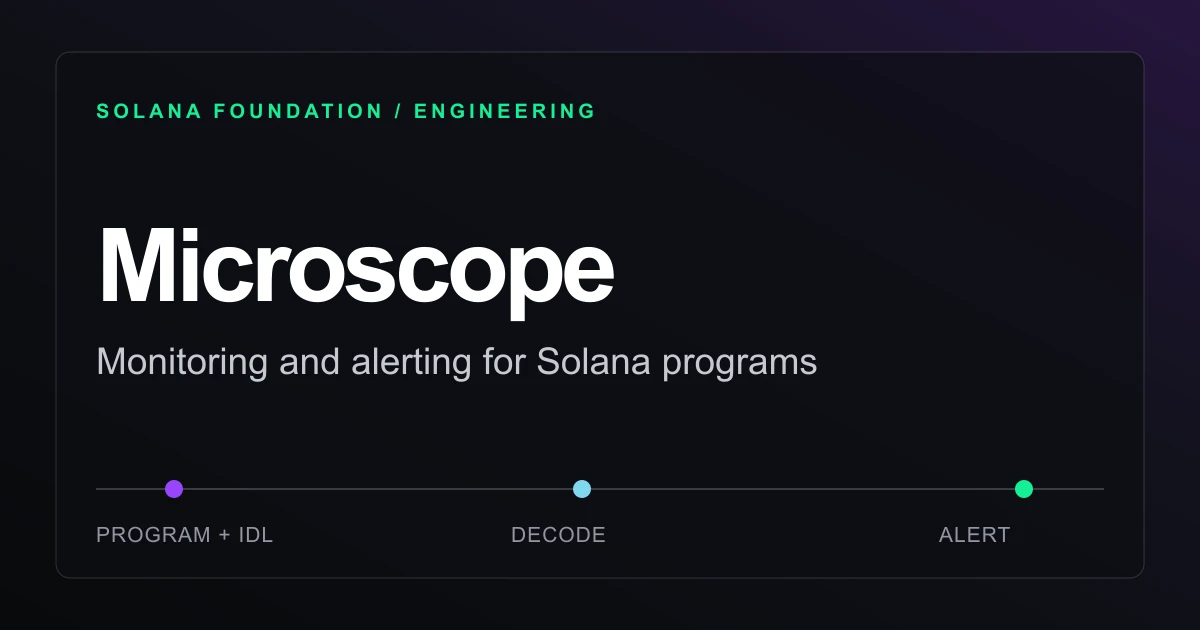 Introducing Solana Microscope: Program Monitoring and Alerts
Microscope is an open-source, self-hosted monitoring and alerting tool for Solana programs that decodes a program's instructions and events using its IDL, then renders that activity as Grafana dashboards backed by Loki (logs) and Prometheus (metrics). It can also watch a Squads multisig controlling the program, firing precise alerts on specific instructions, events, field values, or multisig proposal approvals to Slack, Telegram, or PagerDuty. A distinguishing feature is built-in health alerting for the monitoring pipeline itself (stalled gRPC/RPC streams, corrupt checkpoints, records decoded but not reaching Loki), so teams can distinguish "program is quiet" from "monitoring is broken." It deploys via Docker Compose, Terraform (AWS/GCP), or Kubernetes manifests, and the code is MIT-licensed on GitHub.
 solana.comtoolAdded 8 Oct 2026, published 5 Oct 2026🛡️ Security
 Connect Orca’s ChatGPT Plugin: Cloud Risk Context in Chat and Codex
Orca Security's plugin connects ChatGPT and Codex to Orca's MCP server, letting security teams and developers query cloud alerts, attack paths, effective IAM permissions, and code-to-cloud origins directly from chat or a coding agent instead of logging into a console. The post walks through six security-team use cases (exposure discovery, CVE impact triage, alert-to-blast-radius investigation, identity permission review, CISO reporting) and three developer workflows in Codex where alerts are traced back to the Terraform/code that created the misconfiguration and fixed in place.
 orca.securityarticleAdded 2 Oct 2026, published 30 Sep 2026🛡️ Security
- rehan-remade/universal-modder
universal-modder is a set of Agent Skills, a CLI (um) and a shared knowledge base (field notes in knowledge/) that let AI coding agents such as Claude Code, Codex, Gemini CLI, Cursor, GitHub Copilot and OpenCode find a PC game's engine, reverse-engineer its code, build a working mod, generate art/3D/sound assets via the fal MCP server (or a local ComfyUI server), test the mod in the running game, and write a field note for the next agent. It ships worked examples — a weapon/boss pack for Terraria via tModLoader, a new civilization for Age of Empires II DE, and a real-time Minecraft-inside-GTA-V passthrough mod — each documented with a field note of exact versions, routes and gotchas, and agents can open pull requests to grow the shared knowledge base.
 github.comrepoAdded 6 Oct 2026, published 30 Sep 2026🧠 AI
 Veeam, Terraform MCP, Django Patch Critical Flaws, Led by CVSS 10.0 Cross-Tenant Bug
The Hacker News roundup covers 11 patched CVEs across three products: Veeam Service Provider Console (CVE-2026-58073, 9.5, unauthenticated managed-agent credential theft; CVE-2026-58072, arbitrary file write to RCE), HashiCorp's Terraform MCP Server (CVE-2026-16498, a 10.0 cross-tenant credential-reuse bug caused by the underlying MCP library not issuing unique session IDs in stateless HTTP mode; CVE-2026-16496 stateful-mode equivalent; CVE-2026-14869 SSRF via header/query-param inconsistency), and Django/GeoDjango (CVE-2026-15307, a spatial-lookup flaw letting GDALRaster write files, reachable by a staff user with view permission on a model with a spatial field, plus a stored XSS, a GEOS DoS, and a language-code DoS). Fixes: Terraform MCP Server 1.1.0+, VSPC 9.3.0.35057, Django 6.0.8/5.2.17; none of the flaws are known to be exploited or listed in CISA KEV as of publication.
 thehackernews.comarticleAdded 26 Sep 2026🛡️ Security
- CVE-2026-16498: The terraform-mcp-server before version 1
CVE-2026-16498 is a critical (CVSS 3.1: 10.0) exposure-of-sensitive-information flaw (CWE-488) in HashiCorp's terraform-mcp-server prior to version 1.1.0. In stateless streamable-HTTP transport mode, one user's Terraform API token could be reused to execute tool calls on behalf of a different, subsequent user, breaking tenant isolation in shared MCP server deployments. Fixed in terraform-mcp-server 1.1.0; further detail is tracked in HashiCorp's HCSEC-2026-23 advisory.
 nvd.nist.govadvisoryAdded 26 Sep 2026🛡️ Security
- Generate, Track, Improve: Perceptive Multi-Skill Humanoid Locomotion with RL-Fine-Tuned Motion Generators
This paper presents a two-layer humanoid locomotion architecture: a perceptive flow-matching motion generator that plans whole-body trajectories from raw depth images, paired with a control-guided RL tracking policy that follows those motions. The core contribution is a sample-efficient off-policy RL fine-tuning loop — using structured search with the generator plus advantage weighted regression — that improves terrain consistency on unseen geometries, boosting successful terrain traversals by up to 25 percentage points and skill selection by up to 80 points. The system is deployed on a Unitree G1 humanoid, enabling walking, running, jumping on/off boxes, and stair traversal outdoors using only raw depth images (no odometry or height maps).
arxiv.orgpaperAdded 28 Sep 2026, published 25 Sep 2026🧠 AI  Graphalgo campaign spreads to Terraform providers and Go Modules
Aikido documents the Graphalgo malware campaign's expansion beyond NPM into two malicious Terraform providers (gocommunity-io/dockerd and the kreuzwerker/docker typosquat kreuzwenker/docker) and two Go modules (gocommunity.io/orderedbtree, gogets.dev/btreex), marking the first observed systematic Terraform provider malware distribution. The payload is a Go port of Graphalgo sharing blockchain infrastructure, Slack C2, and a public key with prior JS/NPM samples; it activates only under specific hash-gated runtime conditions (targeted attack indicator), then deploys a Go RAT with dual C2 channels — an Ethereum (Arbitrum Sepolia) smart-contract dead drop and Slack bot messaging — plus self-delete and remote code execution capabilities. The threat actor also stood up two fake Go package ecosystem websites (gocommunity.io, gogets.dev) to socially engineer developers and backdated Git commits to obscure module publication timing.
 aikido.devwriteupPublished and added 22 Sep 2026🛡️ Security
- V7 cuts costs 78% while boosting accuracy with GPT-5.6 Luna
Case study of V7 Go, an agentic workflow platform for finance and insurance. It builds a Context Graph of entities, relationships and cited evidence extracted from SharePoint and Google Drive files, with RAG fallback and an MCP server for querying and ingestion. Workflow steps are tiered across GPT-5.6 Luna (high-volume extraction), Terra and Sol (reasoning and tool use), and GPT-6 Astra (hardest graph queries). Reported results: 78% lower cost per document with Luna versus GPT-5.4 mini, tool-call error rate down from 2.7% (GPT-5.5) to 0.2% (GPT-5.6 Sol), and GPT-6 Astra at 89% versus Sol's 78% on very-hard graph-query questions. V7 also reports ~5% token savings from moving Chat Completions to the Responses API and a 69% gain over the HERB baseline. The figures are vendor and customer reported.
openai.comarticleAdded 29 Sep 2026, published 21 Sep 2026🧠 AI - Oldcircle/geo-sleuth
geo-sleuth is an open-source Agent Skill that lets any tool-using agent (Claude Code, Codex, Cursor, Gemini CLI, OpenCode, GitHub Copilot) geolocate a photo without relying on text, license plates or landmarks, instead using OpenStreetMap geometry, elevation data, satellite tiles and street view. It structures the task as a scored candidate board with ~20 single-purpose Python scripts (sun/terrain/osm/pose analysis, CLIP-ranked satellite matching, DINOv2+SIFT street-view matching) that do the ranking, while the LLM only judges among top candidates and must cite the command/file behind every claim. Output includes coordinates with an error radius, camera heading, and an evidence image.
github.comrepoAdded 26 Sep 2026, published 18 Sep 2026🧠 AI  Architecting a secure landing zone in the AWS European Sovereign Cloud
AWS Security Blog walkthrough of building a secure, production-ready landing zone in the new AWS European Sovereign Cloud (aws-eusc partition), covering multi-account governance via AWS Control Tower/AFT, IAM Identity Center federation as Terraform code, centralized logging into a Log Archive and Security Tooling account, network perimeter design with dedicated Direct Connect PoPs and VPC endpoints, KMS/External Key Store data protection, and partition-aware CI/CD for pushing container images, AMIs, and artifacts across the partition boundary. It maps design decisions to the AWS Security Reference Architecture and Well-Architected Framework, distinguishes hard partition boundaries from configurable choices, and references BSI C5:2020, SOC 2, and ISO 27001/27017/27018/27701 certifications for EUSC.
aws.amazon.comarticleAdded 7 Oct 2026, published 16 Sep 2026🛡️ Security How Endor Labs AI SAST Learns What Matters to Your Organization | Blog | Endor Labs
Endor Labs explains how its AI SAST product incorporates context beyond source code — automatically-ingested Infrastructure as Code (Dockerfiles, Terraform, CloudFormation, Kubernetes/Helm) and repository files (AGENTS.md, CLAUDE.md, skills files), plus optional analyst feedback and natural-language threat-model/architecture context — to build a deployment-aware model of an application and cut false positives. It cites a benchmark of 192 verified vulnerabilities across 8 projects, claiming 2.6x more true positives than the next tool (Claude Opus 4.7) and 63 findings no other tool caught, and walks through customer examples where external-auth annotations and WAF-mitigated XSS severity were tuned via this context.
 endorlabs.comarticlePublished and added 7 Sep 2026🛡️ Security
 An AI-Assisted Cyber Attack: Inside a Unit 42 Investigation
Unit 42 details an incident response engagement in which a threat actor used frontier AI models and custom agentic AI frameworks to compress a multi-week intrusion into under 10 hours, executing over 50 MITRE ATT&CK techniques largely autonomously. The AI agents mapped internal microservices after breaching a public web service, harvested hard-coded secrets from code repositories, escalated to root via a secrets manager, hijacked CI/CD pipelines to exfiltrate cloud keys (attempting but failing to backdoor Terraform via branch protection), and ultimately hijacked the victim's own cloud AI endpoints as post-compromise infrastructure. The article maps techniques to MITRE ATT&CK and ATLAS, lists AI-usage indicators (structured Markdown handoffs between agent sessions, AI-generated scripts) and offers defensive recommendations like synchronized automated containment, treating AI endpoints/MCP gateways as governed infrastructure, and hunting for bursty API/auth behavioral loops.
 unit42.paloaltonetworks.comwriteupAdded 8 Sep 2026, published 2 Sep 2026🛡️ Security
 LiteLLM
 is an open-source (MIT) AI gateway that puts 140+ LLM providers, agents and MCP servers behind one OpenAI-compatible API. It adds virtual keys, per-team budgets and rate limits, SSO/JWT/RBAC with SCIM, audit logs, leaked-key protection, and guardrails for PII masking and prompt injection (Presidio, Lakera). It self-hosts via Helm, Terraform or Docker, including air-gapped, with Cosign-signed non-root images, Grype and CodeQL scanning, and secrets pulled from Vault or cloud secret managers. A new Rust gateway is benchmarked at 0.66 ms p99 overhead.
 litellm.aitoolAdded 3 Sep 2026, published 31 Aug 2026🛡️ Security
- LiteLLM
LiteLLM is an open-source (MIT) AI gateway that puts 140+ providers and 1,800+ models, plus agents and MCP servers, behind one OpenAI-compatible API with SSO and virtual keys. It adds per-key/team/org spend tracking, hard budgets, rate limits, guardrails, audit logs, load balancing, lowest-cost and auto routing, and response/semantic caching (Redis, S3, GCS). It self-hosts via Helm, Terraform or Docker, including air-gapped, and the page cites a new Rust gateway with 0.66 ms p99 overhead measured with the public AI Gateway Bench.
litellm.aitoolAdded 10 Oct 2026, published 31 Aug 2026🧠 AI - IAM Policy Autopilot
IAM Policy Autopilot is an AWS Labs open-source CLI/MCP server that statically analyzes application source code (Python, Go, TypeScript, JavaScript, Java) or a Terraform plan JSON to generate baseline least-privilege IAM identity-based policies, and can also parse AccessDenied error messages to suggest policy fixes. It integrates with AI coding assistants (Kiro, Claude Desktop, etc.) via MCP so assistants can auto-generate scoped IAM permissions instead of overly broad ones, with a --service-hints flag to reduce false-positive permission inclusion.
github.comrepoPublished and added 25 Aug 2026🛡️ Security  We burned 11.7bn tokens to find the best cyber AI model
Aikido benchmarked 10 AI models (DeepSeek V4 Pro/Flash, GLM-5.3, Qwen3.8-Max, Kimi K3, Grok 4.6, GPT-5.6 Sol/Terra/Luna, Opus 5) on rediscovering 32 recently-disclosed CVEs from source code, three runs each (96 total passes), measuring recall, precision, consistency, turn budget, and cost. DeepSeek V4 Pro 0813 topped pooled recall at 28/32 for ~$295 across three runs, beating single passes from Opus 5, Grok 4.6, and Sol that each cost $450-590, while Grok was the most consistent model and Kimi K3 had the highest precision among open-weight models. The piece argues open-weight models, when harnessed correctly, now match or beat closed frontier models on vulnerability-discovery tasks, and that pooling multiple LLM runs exploits output variance to improve recall.
aikido.devarticleAdded 3 Sep 2026, published 21 Aug 2026🛡️ Security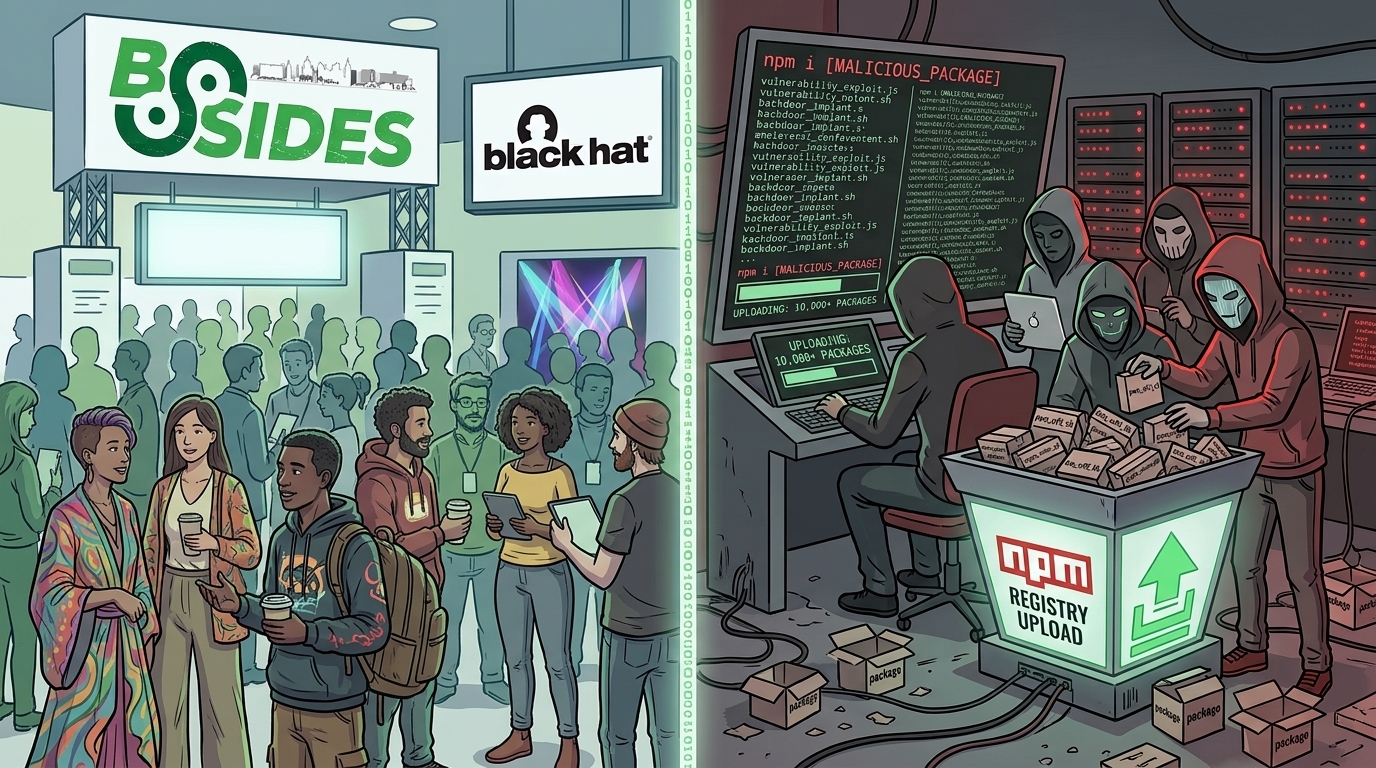 The OpenSourceMalware Show #16
Recap episode of The OpenSourceMalware Show covering three incidents: a Shai-Hulud-derived npm worm that compromised maintainer Jared Wray's account and spread to 400+ packages (including Keyv and cacheable, with ServiceTitan losing 100 packages) while harvesting credentials from GitHub, npm, AWS, Kubernetes, Vault, Azure, GCP, Terraform, Docker, and Slack; a "WEL1DROPPER" campaign flooding npm with 1000+ AI-slopsquatted malicious packages that execute on import rather than via install scripts; and "NullReceiver," a DPRK-linked C2 technique that hides C2 IPs inside the recipient address of empty Ethereum transactions, an evolution of EtherHiding found in at least 10 malicious packages.
 opensourcemalware.comtalkAdded 3 Sep 2026, published 8 Aug 2026🛡️ Security
 HCSEC-2026-23 - Multiple vulnerabilities impacting HashiCorp Terraform MCP Server
HashiCorp advisory HCSEC-2026-23 discloses three vulnerabilities in terraform-mcp-server versions 0.2.1 through 1.0.0 (fixed in 1.1.0), all affecting the server's streamable-HTTP transport used for multi-user deployments. CVE-2026-14869 is an SSRF where an unauthenticated client can supply a Terraform address via query parameter (bypassing a header-only check) to exfiltrate the server's bearer token; CVE-2026-16496 is an authorization bypass where stateful mode's session-ID-keyed credential cache lets an attacker who obtains another user's session ID hijack that user's cached Terraform Cloud/Enterprise client and permissions; CVE-2026-16498 is cross-tenant credential reuse in stateless mode where the underlying MCP library's lack of unique session identifiers causes one tenant's token to be reused for other tenants' requests.
 discuss.hashicorp.comadvisoryAdded 30 Jul 2026, published 28 Jul 2026🛡️ Security
- From Container Escape to Cloud Takeover
Lab-based cloud security assessment covering four attack paths: a privileged hostPID pod escaped to the node with nsenter, deleting the kube-apiserver static pod manifest to crash the control plane, Trivy Operator vulnerability reports piped into BigQuery, and a malicious PR exploiting a pull_request_target workflow that checks out PR code to steal a GCP Workload Identity Federation token via Terraform's external data source during plan. Each section pairs the exploit with defenses (Pod Security Standards, Kyverno/Gatekeeper, Falco rules, split plan/comment workflows, least-privilege service accounts) and ties them into one kill chain.
 medium.comwriteupAdded 3 Sep 2026, published 26 Jul 2026🛡️ Security
- Destructive Command Guard (dcg)
Destructive Command Guard (dcg) is a Rust-based hook that intercepts and blocks catastrophic commands (git reset --hard, rm -rf, DROP TABLE, kubectl delete namespace, terraform destroy, etc.) before AI coding agents like Claude Code, Codex CLI, Gemini CLI, GitHub Copilot CLI, and Cursor can execute them. It uses a modular "pack" system covering 50+ categories (databases, cloud providers, Kubernetes, secrets managers, CI/CD, storage, DNS, payments) plus a three-tier heredoc/inline-script AST scanning pipeline to catch destructive commands hidden inside python -c/bash -c payloads, and a dedicated "careful_company_running_windows" preset that also blocks data-exfiltration channels (webhooks, uploads, tunnels) and attempts to disable security controls. Configurable via TOML with agent-specific trust profiles, allowlists, and fail-closed/fail-open policies for unattended agent sessions.
github.comrepoPublished and added 15 Jul 2026🛡️ Security - DataDog/pathfinding-labs
Pathfinding Labs is DataDog's open-source platform (Go CLI 'plabs' + Terraform modules) for deploying intentionally vulnerable AWS resources into sandbox accounts to practice attacking and detecting IAM privilege-escalation paths. It ships modular labs across five categories — self-escalation, one-hop/multi-hop principal traversal, CSPM misconfigurations, toxic combos, and cross-account (dev/ops-to-prod) chains — each with demo/cleanup scripts, expected CSPM alerts, and MITRE ATT&CK mappings (e.g. T1098.001). It's positioned as a successor/companion to projects like IAM Vulnerable and Stratus Red Team for hands-on cloud identity attack training.
github.comrepoPublished and added 4 Jul 2026🛡️ Security - Terraform Compliance Guardrails
A GitHub repo that automates Terraform compliance checks using Checkov and Conftest as policy-as-code scanners, wired into GitHub Actions with OIDC-based AWS authentication for CI/CD. Findings are mapped to specific NIST 800-53 controls — AC-6 (least privilege), SC-7 (network segmentation), SC-13 (encryption), AU-12 (audit generation), and CM-6 (configuration settings) — giving teams an auditable trail linking IaC scan results to compliance requirements.
github.comrepoPublished and added 6 May 2026🛡️ Security
