 Node2Shell: Reproducing CVE-2026-111497 in the Node.js Brotli decoder
Node2Shell is Datadog Security Labs' analysis of CVE-2026-111497, an out-of-bounds write in the Google Brotli 1.2.0 decoder, fixed in Node.js 22.23.4, 24.22.1 and 26.12.1 on 21 October 2026. It explains the unchecked return value in DecodeBlockTypeAndLength(), the read and write primitives, and why code execution is still engineering effort. It lists inbound and outbound exposure paths, behavioral detections and what WAFs miss.
 securitylabs.datadoghq.comwriteupPublished and added 29 Oct 2026🛡️ Security
 Introducing the Cloudflare PHP Capture the Flag challenge
The Cloudflare PHP Capture the Flag challenge is a HackerOne bug bounty CTF. Researchers must bypass Cloudflare WAF rules protecting CVE-2026-109618 and CVE-2026-109619 (PHP2Shell) on stock PHP 8.5.11 with Apache mod_php in a Cloudflare Container, get RCE, and read /flag. The post lists scope (POST to /php/* only), report requirements and duplicate rules, which count only materially distinct WAF bypasses.
 blog.cloudflare.comarticleAdded 29 Oct 2026, published 27 Oct 2026🛡️ Security
- [AINews] OpenAI’s Patch the Planet program is 1 of 2 parties to discover PHP2Shell vulnerabilities in core PHP affecting 70% of the web, using GPT-5.6 Sol; coordinated response over 2 months
This AINews issue (20 to 21 October 2026) leads with PHP2Shell, two PHP-engine memory-corruption bugs (CVE-2026-109618 and CVE-2026-109619). Calif researchers found them with GPT-5.6 Sol under OpenAI's Patch the Planet, and Wiz reportedly found them independently with Gemini 4 Argon. It reconstructs the two-month coordinated response, Cloudflare WAF stopgaps and NSA guidance, and the dispute over vetted researcher access to models. Only the first 40,000 of 114,281 characters were reviewed.
 latent.spacearticleAdded 23 Oct 2026, published 22 Oct 2026🧠 AI
 [AINews] OpenAI’s Patch the Planet program is 1 of 2 parties to discover PHP2Shell vulnerabilities in core PHP affecting 70% of the web, using GPT-5.6 Sol; coordinated response over 2 months
AINews issue of 20-21 October 2026 whose top story reconstructs PHP2Shell (CVE-2026-109618, CVE-2026-109619), two PHP-engine memory-corruption bugs with reported pre-auth RCE against WordPress, Drupal and Joomla. It covers the two-month coordinated disclosure, independent discovery by Calif/OpenAI (GPT-5.6 Sol) and Wiz, Cloudflare WAF stopgaps and NSA guidance. It flags missing primary sources: fixed versions, CVSS and leak details.
latent.spacearticlePublished and added 22 Oct 2026🛡️ Security [AINews] OpenAI’s Patch the Planet program is 1 of 2 parties to discover PHP2Shell vulnerabilities in core PHP affecting 70% of the web, using GPT-5.6 Sol; coordinated response over 2 months
AINews issue of 20-21 October 2026 whose top story reconstructs PHP2Shell, two PHP-engine memory-corruption flaws (CVE-2026-109618 and CVE-2026-109619) with reported pre-auth RCE against WordPress, Drupal and Joomla. It covers the two-month coordinated response, separate discovery by Calif/OpenAI (GPT-5.6 Sol) and Wiz (Gemini 4 Argon), Cloudflare's WAF stopgap and NSA guidance. It lists open gaps: fixed versions, leak details, exploitation versus scanning.
latent.spacearticleAdded 23 Oct 2026, published 22 Oct 2026🛡️ Security Using AWS WAF to apply mitigations for PHP2Shell RCE vulnerabilities (CVE-2026-109618 and CVE-2026-109619)
AWS Security Blog guide to mitigating the PHP2Shell unauthenticated RCE flaws (CVE-2026-109618 and CVE-2026-109619, CVSS v4.0 9.2) with AWS WAFv2 rules. It covers rules for the PHP_SESSION_UPLOAD_PROGRESS trigger, blocking multipart/form-data, body size caps and rate limits, plus body inspection limits. It lists PHP fixes (8.5.12, 8.4.27, 8.3.36, 8.2.35) and server settings, and stresses WAF only reduces exposure.
 aws.amazon.comarticlePublished and added 22 Oct 2026🛡️ Security
- PHP web runtimes (CVE-2026-109618 and CVE-2026-109619)
AWS bulletin 2026-143-AWS covers CVE-2026-109618 and CVE-2026-109619, critical PHP web runtime flaws that let an unauthenticated remote caller run code, read process data or cause denial of service. Fixed in PHP 8.5.12, 8.4.27, 8.3.36 and 8.2.35; PHP 5.4 to 8.1 get no fix. It gives status for WorkMail, Elastic Beanstalk, Amazon Linux and Lightsail, plus AWS WAF rules, including a custom "PHP2Shell" rule matching PHP_SESSION_UPLOAD_PROGRESS and PHPSESSID.
aws.amazon.comadvisoryAdded 22 Oct 2026, published 21 Oct 2026🛡️ Security 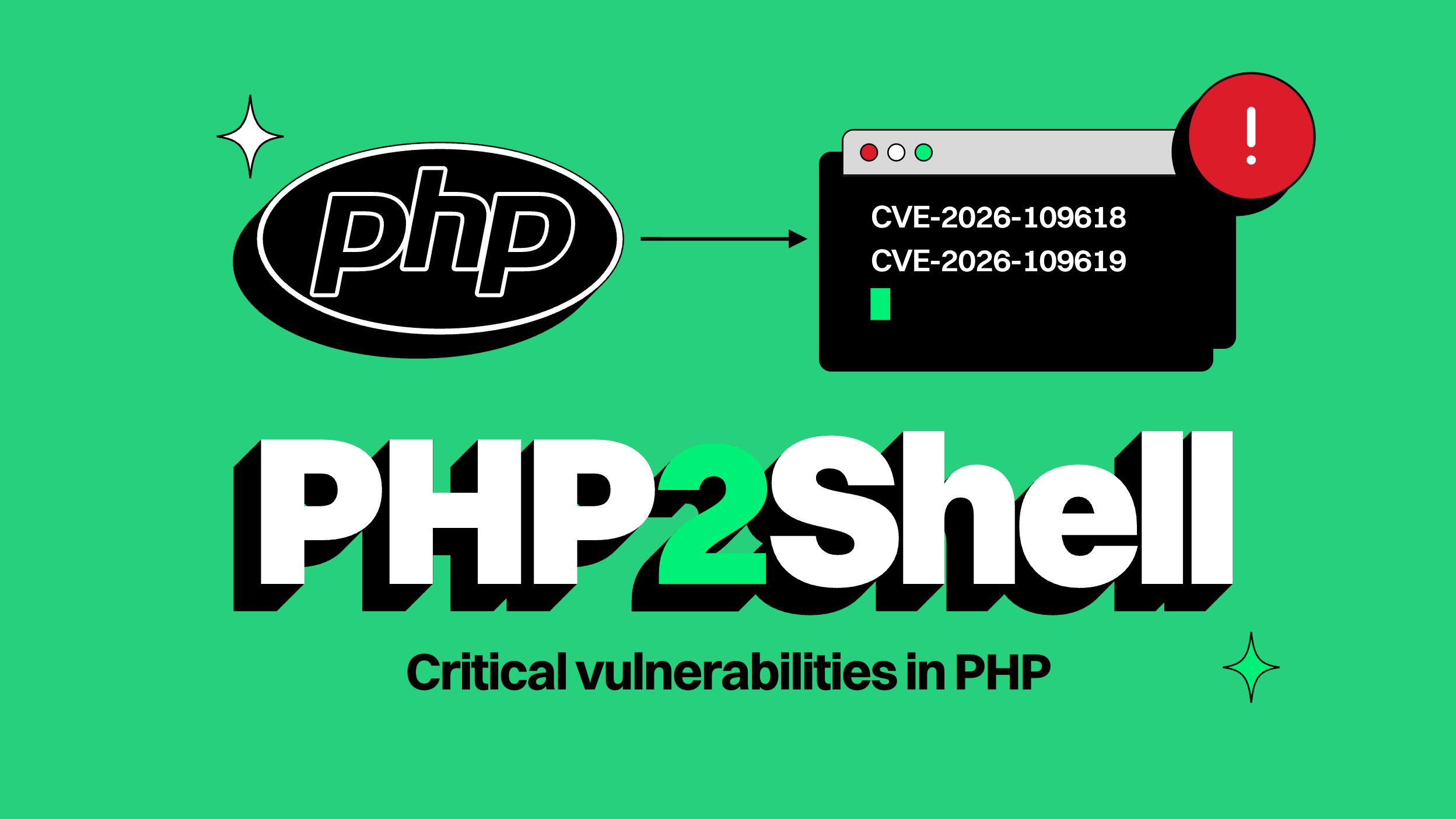 PHP2Shell: Critical vulnerabilities in PHP (CVE-2026-109618, CVE-2026-109619) | Endor Labs
PHP2Shell is the name for two critical PHP core memory-safety flaws, CVE-2026-109618 and CVE-2026-109619, that allow unauthenticated remote code execution. Fixes ship in PHP 8.2.35, 8.3.36, 8.4.27 and 8.5.12. Wiz researchers demonstrated RCE against WordPress, Drupal and Joomla, and Apache with mod_php is the highest risk. The post covers inventory, container rebuilds, Cloudflare WAF rules and temporary exposure reduction.
 endorlabs.comadvisoryPublished and added 21 Oct 2026🛡️ Security
 Cloudflare deploys protections against php2shell vulnerability
Cloudflare describes its WAF protections for php2shell (CVE-2026-109618 and CVE-2026-109619), two PHP runtime memory-handling flaws affecting PHP 5.4 and later that can cause denial of service, remote code execution and data exposure. Rules shipped 21 October 2026, about 9 hours before disclosure, using a new "full transaction detection" that matches request and origin response together. It lists ruleset IDs and says patching PHP is still required.
blog.cloudflare.comarticleAdded 22 Oct 2026, published 21 Oct 2026🛡️ Security Introducing full transaction detection for Cloudflare WAF
Cloudflare announces full transaction detection and response-phase rules for its WAF. Detections evaluate an HTTP request together with the origin's response, so exploitation can be confirmed (for example, path traversal returning a config file) and the response replaced with a 403 block page. Covers managed and custom rules, the limit of three custom response rules, no response-body matching yet, and a first managed rule for php2shell. Available on all plans, including Free.
blog.cloudflare.comarticleAdded 29 Oct 2026, published 21 Oct 2026🛡️ Security- eness/php2shell-CVE-2026-109618-CVE-2026-109619-PoC
php2shell is the name given to two critical pre-auth remote code execution flaws, CVE-2026-109618 and CVE-2026-109619, in PHP core's session upload progress handler (php_session_rfc1867_callback), where zend_hash_update frees live zval pointers that are later reclaimed and redirected into zend_call_function to run zif_system. This repository ships poc_109618.py, a fully automated four-stage HTTP exploit that leaks ASLR offsets via Set-Cookie headers against php:8.4.26-apache on Debian Bookworm, along with a root-cause C source patch, mitigation scripts to disable session.upload_progress, and WAF/ModSecurity/Lighttpd/Apache rules plus detection guidance for anomalous PHP worker child processes. Confirmed PHP versions include 8.4.4 and 8.2.34, with EOL branches (5.x, 7.x, 8.0, 8.1) left without official vendor patches.
 github.comrepoAdded 23 Oct 2026, published 21 Oct 2026🛡️ Security
 Beyond the patch: Protecting your NetScaler gateway against future vulnerabilities
Cloudflare's guidance on protecting Citrix NetScaler Gateway after the actively exploited CVE-2026-88771 (unauthenticated command execution) and CVE-2026-88772 (DTLS). It recommends putting Zero Trust access policies in front of the login page, locking the origin down with Tunnel, dedicated egress IPs, authenticated origin pulls or Access JWT validation, and adding WAF inspection. It ends with a four-step test list to confirm the boundary holds.
blog.cloudflare.comarticleAdded 29 Oct 2026, published 19 Oct 2026🛡️ Security- lee1981 (@lee1981b) on X
CVE-2026-106931 is an OS command injection (CWE-78) in the statistics processing of EG Secure Solutions SiteGuard Server Edition, a host-based WAF. It can give root or SYSTEM command execution. The vendor and JVN confirm exploitation on 14 October 2026. The post lists fixed builds (Ver8.00 Update 5, Ver7.00 Update 6 on FreeBSD), the IIS exclusion, the workaround of disabling statistics, and a SOC trail starting with diagnostic preservation before patching.
 x.comadvisoryAdded 21 Oct 2026, published 19 Oct 2026🛡️ Security
 Bypass Web Application Firewall (WAF) with EvilWAF
Hackers-Arise walkthrough of EvilWAF, an open-source MITM proxy and standalone WAF vulnerability scanner that evades modern behavior-based WAFs by rotating TCP/TLS fingerprints (JA3/JA4) rather than altering attack payloads. It covers proxying sqlmap traffic through EvilWAF, its auto-hunt feature for discovering and routing directly to the real origin IP behind a WAF, and its scan-only mode that probes ten WAF defense layers (rule engine, rate limiting, HTTP method handling, TLS settings). The piece also discusses why Cloudflare's ML-based behavioral fingerprinting resists many of these bypass techniques.
 hackers-arise.comarticlePublished and added 8 Oct 2026🛡️ Security
 Configuring your AI vulnerability harness, Part 2: The steering file
AWS Security Blog's second post in a series on building an "AI vulnerability harness" explains the configuration (steering file) that stops an AI model from hallucinating vulnerabilities and inflating severity during security code review. It details five configuration sections — structural verification of findings, an evidence-based confidence formula (weighting confirmed taint flow at 0.30), infrastructure-aware severity multipliers for controls like AWS WAF and IAM, CISA KEV/EPSS threat-intel boosting, and a four-tier priority classification — and reports validation numbers (e.g., unsteered models fabricated code paths in ~30% of findings; steered confidence of HIGH without structural confirmation was only 34% exploitable vs 89% with confirmed taint). The steering file is shipped as a Kiro steering file, a Kiro skill, and a CLAUDE.md for Claude Code, with full source in a linked GitHub repo.
aws.amazon.comarticlePublished and added 7 Oct 2026🛡️ Security- Configuring your AI vulnerability harness, Part 2: The steering file
Part 2 of an AWS Security Blog series detailing the design of a "steering file" — a persistent instruction set (deployable as a Kiro steering file, Kiro skill, or Claude Code CLAUDE.md) that constrains an LLM performing vulnerability triage. It walks through five configuration sections: requiring structural/dataflow verification before reporting findings, replacing self-reported confidence with a weighted formula based on binary structural signals (e.g., 0.30 weight for confirmed taint flow), mapping infrastructure controls (AWS WAF, IAM) to severity multipliers with a 0.15 floor, incorporating CISA KEV and EPSS threat-intelligence boosts capped at +0.50, and a four-tier priority classification that suppresses low-confidence P3 findings. Validation against a 10-vulnerability test app showed the steered model eliminated fabricated findings and correctly downgraded mitigated vulnerabilities while preserving full severity for a command injection reachable only via authenticated access.
aws.amazon.comwriteupAdded 8 Oct 2026, published 7 Oct 2026🧠 AI  Building your AI vulnerability harness, Part 1
AWS Security Blog describes a three-layer AI-assisted pipeline for triaging vulnerability scanner findings: Layer 1 cross-checks multiple scanners (e.g., Semgrep, CodeQL) for agreement, Layer 2 verifies a scanner's claimed data-flow path against the code's actual abstract syntax tree to catch hallucinated findings, and Layer 3 cross-references infrastructure-as-code (CloudFormation/Terraform) to weigh whether existing controls like AWS WAF rules actually mitigate the exploit path. It argues progressive, escalating-evidence filtering plus mandatory structural verification of LLM claims before human review is what turns noisy scanner output into a short, trustworthy, prioritized list, and lays out an adoption order (indexing, then multi-scanner triage, then AI hypothesis generation, then infra context, then live PoC verification).
aws.amazon.comarticlePublished and added 7 Oct 2026🛡️ Security Critical Atlassian Path Traversal Exposes Sensitive Files Across 8 Products
Orca Security details CVE-2026-21589 (CVSS 9.3), a critical unauthenticated path traversal flaw affecting all versions of eight Atlassian Data Center and Server products: Bitbucket, Confluence, Jira Software, Jira Service Management, Bamboo, Crowd, Crucible, and Fisheye. Insufficient path validation lets remote attackers read arbitrary files within the web application root without authentication, and in Crowd SSO deployments this can expose plaintext credentials usable to create administrative accounts and take over the entire Atlassian ecosystem. The advisory lists fixed versions for each product and recommends WAF rules and log review for organizations unable to patch immediately.
 orca.securityadvisoryPublished and added 7 Oct 2026🛡️ Security
 CVE-2026-21589: Critical unauthenticated arbitrary file access in Atlassian products
Rapid7's analysis of CVE-2026-21589 (CVSSv4 9.3), a critical unauthenticated arbitrary file read vulnerability affecting Bitbucket, Confluence, Jira Software/Service Management, Bamboo, Crowd, Crucible, and Fisheye Data Center products. It summarizes watchTowr Labs' root-cause finding that double-colon (::) sequences can act as path separators in Atlassian's web-resource handling, enabling path traversal to read arbitrary files within the Tomcat web root — including crowd.properties credentials that can be chained to create a rogue jira-administrators account. The post provides emergency patching guidance, Atlassian's WAF/RewriteValve mitigations, log-hunting regex, and notes public Python PoC and Nuclei templates exist.
 rapid7.comwriteupPublished and added 7 Oct 2026🛡️ Security
 One breach, please, and make no mistakes
Cisco Talos commentary arguing that today's public AI-agent attacks (citing Hugging Face, DSEWiki, and RubyGems incidents) resemble loud, high-volume pentests rather than stealthy red-team operations, and that agent swarms will grow quieter and more OPSEC-conscious over time. The piece lays out concrete resilience steps: rehearsed incident response plans mapped to the incident lifecycle, assumed-breach attack-path mapping (including Active Directory GPO abuse paths), AI-specific tabletop exercises, end-to-end hardening with phishing-resistant MFA (FIDO2/passkeys), broad EDR and east-west traffic visibility, and watching for early noisy indicators like WAF/SQLi spikes and non-browser user agents.
 blog.talosintelligence.comarticlePublished and added 7 Oct 2026🛡️ Security
 Atlassian Patches Critical Vulnerability Affecting 8 Products
Atlassian patched CVE-2026-21589 (CVSS 9.3), an unauthenticated arbitrary file access flaw affecting all versions of Bitbucket, Bamboo, Crowd, Crucible, Confluence, Fisheye, Jira Service Management, and Jira Software Data Center. WatchTowr researcher Yordan Ganchev notes that organizations using Crowd for SSO are especially at risk because authentication details are stored in plaintext at a predictable path, letting attackers mint admin accounts if Crowd endpoints are internet-reachable. Fixed versions are listed for each product; Atlassian recommends immediate patching or disconnecting internet-facing instances, with WAF rules as a stopgap.
 securityweek.comadvisoryPublished and added 7 Oct 2026🛡️ Security
 Atlassian Jira, Confluence (and more) Arbitrary File Read Vulnerability (CVE-2026-21589)
CVE-2026-21589 is an unauthenticated arbitrary file read (path traversal) in eight Atlassian Data Center and Server products: Bitbucket, Confluence, Jira, Jira Service Management, Bamboo, Crowd, Crucible and Fisheye. Atlassian fixed it on 5 October 2026, and CISA added it to the KEV catalog on 15 October 2026. The page lists patching, WAF regex, Tomcat RewriteValve and urlrewrite.xml mitigations, and a log check for ".." sequences after up to two rounds of URL decoding.
 watchtowr.comadvisoryAdded 30 Oct 2026, published 6 Oct 2026🛡️ Security
 Frequently Asked Questions About the Atlassian Jira & Confluence Arbitrary File Read Vulnerability (CVE-2026-21589)
CVE-2026-21589 is an unauthenticated arbitrary file read in eight self-hosted Atlassian products: Bitbucket, Confluence, Jira Service Management, Jira Software, Bamboo, Crowd, Crucible and Fisheye Data Center. Attackers must know the exact file path, and watchTowr Intel observed exploitation by 6 October 2026. The FAQ covers the timeline (Atlassian advisory 5 October 2026), upgrade and WAF mitigations, and log searches for two dots next to a slash, backslash or double colon.
watchtowr.comadvisoryAdded 30 Oct 2026, published 6 Oct 2026🛡️ Security- Dark Web Intelligence (@DailyDarkWeb) on X
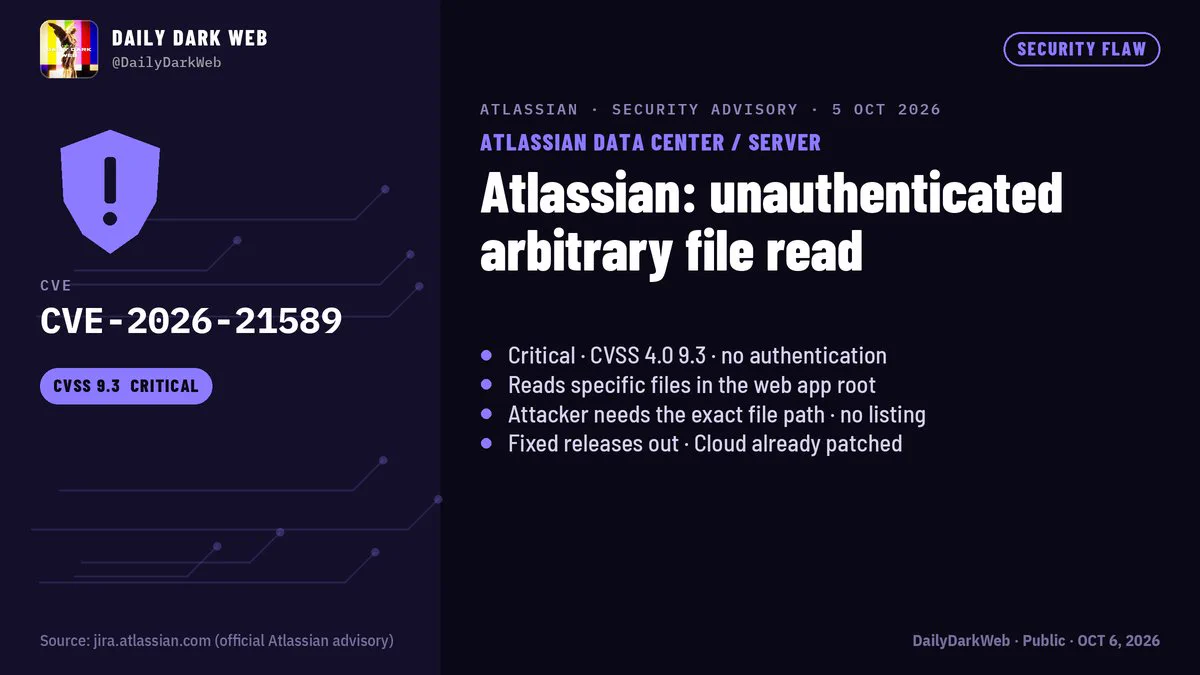
Atlassian disclosed CVE-2026-21589, a critical (CVSS 9.3) unauthenticated path traversal flaw allowing remote attackers to read specific files within the web application root across its self-managed Data Center/Server products — Jira Software, Jira Service Management, Confluence, Bitbucket, Bamboo, Crowd, Crucible, and Fisheye. Fixed versions are listed for each product (e.g. Jira 9.12.40/10.3.26/11.3.12, Confluence 9.2.26/10.2.19), and Atlassian Cloud is already patched; WAF/URL-rewrite mitigations are available for those who can't upgrade immediately. The post's analyst note clarifies exploitation requires knowing the exact target file path (no directory listing), and as of Oct 5, 2026 it is not yet in CISA KEV with no public exploit reported.
x.comadvisoryAdded 7 Oct 2026, published 6 Oct 2026🛡️ Security - Introduction to Web Application Firewall (WAF) and Ways to Bypass It
A Hackers-Arise tutorial explaining how Web Application Firewalls detect attacks (signature-based, anomaly scoring, behavioral analysis) and how to fingerprint which WAF a target uses via HTTP headers, curl probing, or the WAFW00F tool. It then covers three concrete bypass techniques — double URL encoding, Unicode normalization mismatches, and ASCII smuggling via invisible Unicode tags — that let malicious payloads like XSS slip past WAF filtering before being decoded by the backend app.
hackers-arise.comarticleAdded 7 Oct 2026, published 5 Oct 2026🛡️ Security  Metasploit Wrap Up: Belgian Waffles, Chocolates, and…Modules-Frites?
Rapid7's weekly Metasploit Framework wrap-up detailing five new modules: an unauthenticated arbitrary file read exploit for GitLab CE/EE (CVE-2026-85706, affecting 18.7–19.1.8/19.2.6/19.3.2), native mitm6-style DHCPv6/IPv6 RA DNS-takeover modules (CVE-2026-20929) used as part of a Kerberos authentication relay attack chain, an authenticated RCE exploit for Langflow's custom components (CVE-2026-18729, versions ≤1.11.1), and a cross-platform persistence module for the Kate text editor. It also covers a ZoomEye search-module fix for the v2 API and nine bug fixes to Metasploit's credential, RDP, and encoder internals.
rapid7.comarticleAdded 7 Oct 2026, published 25 Sep 2026🛡️ Security ShinyHunters Renewed Mass Exploitation Campaign Targeting Oracle PeopleSoft
Mandiant and GTIG report renewed mass exploitation of Oracle PeopleSoft CVE-2026-35273 by UNC6240 (ShinyHunters). The actor bypassed WAF rules by requesting /%50SEMHUB/ instead of /PSEMHUB/, then deployed JSP web shells (x.jsp, u.jsp), the SIDEEYE backdoor (Ple64.exe), Neo-reGeorg and MeshAgent on dozens of systems globally. The post gives host and log hunting guidance, remediation steps and detection rules.
 cloud.google.comwriteupAdded 29 Oct 2026, published 25 Sep 2026🛡️ Security
 TrackEverything: Long Horizon Dense Tracking via De-Duplicating 3D Scene Representations
TrackEverything is a 3D point tracker that represents videos as persistent 3D scene tracks in world coordinates, decoupling model complexity from video duration by scaling with scene geometry rather than frame count. It introduces voxelization-based de-duplication to merge co-located tracks across sliding-window boundaries, an endpoint refiner plus lightweight trajectory refiner that only decodes dense trajectories for dynamic points, and 3D WAFT, which replaces memory-heavy 4D correlation volumes with feature sampling in the scene cloud. On TAPVid-3D it beats open-source dense 3D trackers by over 20% APD on short clips and is the first 3D tracker able to track all visible points across 1000+ frame videos within 40GB GPU memory.
 arxiv.orgpaperAdded 26 Sep 2026, published 24 Sep 2026🧠 AI
 Architecting resilient authentication with Amazon Cognito multi-Region replication
An AWS Security Blog deep-dive on architecting resilient authentication using Amazon Cognito's multi-Region replication (MRR) feature, covering B2C, B2B, and M2M reference architectures. It details preparation steps (multi-Region KMS customer managed keys, choosing the updated OIDC issuer type, replicating Lambda triggers/WAF/SNS/SES configs) and failover strategies using Route 53 health checks, Application Recovery Controller, and AWS Fault Injection Service for testing.
aws.amazon.comarticleAdded 7 Oct 2026, published 15 Sep 2026🛡️ Security A Brain Too Big to Carry — On-Device vs Datacenter Inference
SemiAnalysis article arguing that generalist robot "brains" will increasingly be served from datacenter GPUs rather than carried on-robot. It models wafer, DRAM and TCO crossovers (offload wins from about 5 to 7 robots per GPU; B300 offload is about 46% of Jetson Thor TCO per PFLOP at 40% on-robot utilization). It then reviews deployments at Boston Dynamics, Agility, Verne, Sunday and Weave, and the network jitter problem. The page text is truncated before the end of the networking section.
 newsletter.semianalysis.comarticleAdded 29 Oct 2026, published 14 Sep 2026🧠 AI
 How Endor Labs AI SAST Learns What Matters to Your Organization | Blog | Endor Labs
Endor Labs explains how its AI SAST product incorporates context beyond source code — automatically-ingested Infrastructure as Code (Dockerfiles, Terraform, CloudFormation, Kubernetes/Helm) and repository files (AGENTS.md, CLAUDE.md, skills files), plus optional analyst feedback and natural-language threat-model/architecture context — to build a deployment-aware model of an application and cut false positives. It cites a benchmark of 192 verified vulnerabilities across 8 projects, claiming 2.6x more true positives than the next tool (Claude Opus 4.7) and 63 findings no other tool caught, and walks through customer examples where external-auth annotations and WAF-mitigated XSS severity were tuned via this context.
endorlabs.comarticlePublished and added 7 Sep 2026🛡️ Security- eldarshiraliyev/BugScanner
BugScanner is an asyncio/httpx Python framework for recon and automated web vulnerability scanning, with a React and FastAPI dashboard. It covers subdomain enumeration (crt.sh, DNS brute force), TCP port scanning, fingerprinting, and modules for XSS, SQLi, CORS, SSRF, open redirect, JWT, IDOR and business logic, plus a Nuclei wrapper. A 5-rule false-positive filter with SPA detection, adaptive rate limiting, WAF detection and SARIF export are included.
github.comrepoAdded 20 Oct 2026, published 5 Sep 2026🛡️ Security  Top AI coding agent security resources — September 2026
Adversa AI's monthly roundup of AI coding-agent security research, covering nine items: GhostJacking (using a WAF's own block logs as a prompt-injection delivery channel, 90% success against Claude Code), Black Hat disclosures of unauthenticated-issue-to-RCE chains in the default GitHub Actions configs published by Anthropic, Google, and OpenAI for their coding agents (Gemini CLI rated CVSS 10.0), an agent-to-agent privilege-boundary bypass in Google's ADK repository, the new OWASP Agentic Skills Top 10 with a walkthrough showing open-source skill scanners miss encoded payloads while flagging 9-62% of legitimate skills as malicious, a seven-layer "secure agent harness" containment design, and a 2,826-file adversarial skill benchmark where Gemini CLI and Qwen Code were exploitable 95.5% and 71.6% of the time respectively. The piece draws a common thread across all findings: agents treat machine-generated artifacts (logs, images, other agents' outputs) as trusted instructions, and existing detection never fires.
 adversa.aiarticleAdded 7 Oct 2026, published 3 Sep 2026🛡️ Security
- Teycir/BurpAPISecuritySuite
BurpAPISecuritySuite is a Jython-based Burp Suite extension that consolidates API reconnaissance, intelligent fuzzing (108+ payloads across 15 attack types including BOLA, IDOR, JWT exploitation, GraphQL abuse, SSTI, and WAF bypass), and passive deep-logic checks (counterfactual differentials, sequence invariants, token lineage, cross-interface parity drift) into a single tool covering the OWASP API Top 10. It auto-captures and normalizes API traffic, exports attack campaigns to Burp Intruder/Turbo Intruder/Nuclei, and generates AI-ready bundles (ChatGPT/Claude/Ollama) for LLM-assisted triage, while orchestrating external tools like ApiHunter, Katana, httpx, FFUF, Kiterunner, sqlmap, and Dalfox for verification.
github.comrepoPublished and added 21 Aug 2026🛡️ Security  GhostJacking Attacks: AI Agent Takeover via Firewall Evasion
Tenet Security's DEFCON 34 research "Ghostjacking" chains four AI-agent attack primitives into a full kill chain: prompt injection via untrusted log/telemetry fields that AI coding agents (Claude Code, Cursor) read through MCP connectors to Cloudflare, Datadog, and Sentry; agent-to-agent lateral movement where one agent (Sentry's Seer) vouches malicious findings to a downstream coding agent; a JWT cross-reuse sandbox-escape zero-day in Claude Desktop's Envoy-based egress proxy that lets a stolen/broadly-scoped token bypass the deny-by-default network allowlist; and a "self-exploit" technique where one AI session iteratively crafts a prompt-injection payload against another. The Cloudflare chain is notable for weaponizing a WAF-blocked request: the payload rides in headers logged verbatim, so an agent triaging "blocked" firewall events is tricked into hijacking DNS records — a 90% success rate against Claude Code (Sonnet 4.6) on Cloudflare's own recommended config. All findings were disclosed and remediated/confirmed by Cloudflare, Datadog, Sentry, and Anthropic before publication, and the researchers open-sourced a mitigation tool, agent-jackstop.
 tenetsecurity.aiwriteupAdded 3 Sep 2026, published 10 Aug 2026🛡️ Security
- manyuegong33/r0crawl_skills
r0crawl_skills is a beginner-friendly Chinese-language skill library of 196 specialized reverse-engineering modules for Codex-style AI coding agents, with a router that asks scoping questions and directs the agent to the right workflow (web RE, Android unpacking, Frida instrumentation, native binary analysis, protocol reconstruction, malware triage, firmware analysis, CTF). It ships lightweight scripts (case init, module router, artifact hashing) and ten sanitized example playbooks covering DEX dump verification, WebCrypto hooking, native loader tracing, PCAP reconstruction, and selective emulation, plus dedicated modules for CAPTCHA/WAF/anti-bot systems, mini-programs, hybrid apps (Flutter/React Native/Electron), and IDA/Ghidra/Rizin automation.
github.comrepoAdded 30 Sep 2026, published 6 Aug 2026🛡️ Security - Frieren DAST-AI
Frieren DAST-AI is an open-source dynamic application security testing tool combining an HTTPS MITM proxy with a real-time dashboard and LLM-driven multi-agent active scanner. A YAML-based passive rule engine (62 rules covering headers, cookies, CORS, secrets, error pages, LLM endpoint detection, and Blazor-specific checks) flags issues on every intercepted response, while an LLM planner dispatches parallel VulnAgents (xss, sqli, ssrf, file_read, auth_bypass, secrets, discovery, llm_injection, business_logic, blazor) per endpoint, with an LLM validator confirming findings and adaptive WAF-bypass payload mutation.
github.comrepoPublished and added 5 Aug 2026🛡️ Security - Dalfox
Dalfox is an open-source XSS scanning and parameter analysis tool, rewritten in Rust for v3 (previously Go, preserved on the v2 branch). It automates discovery via parameter mining and static/BAV analysis, detects reflected, stored, and DOM-based XSS with DOM/AST verification, and includes WAF fingerprinting with confidence scoring and bypass tracking, plus a REST API and MCP stdio server for extensibility.
github.comrepoPublished and added 25 Jul 2026🛡️ Security 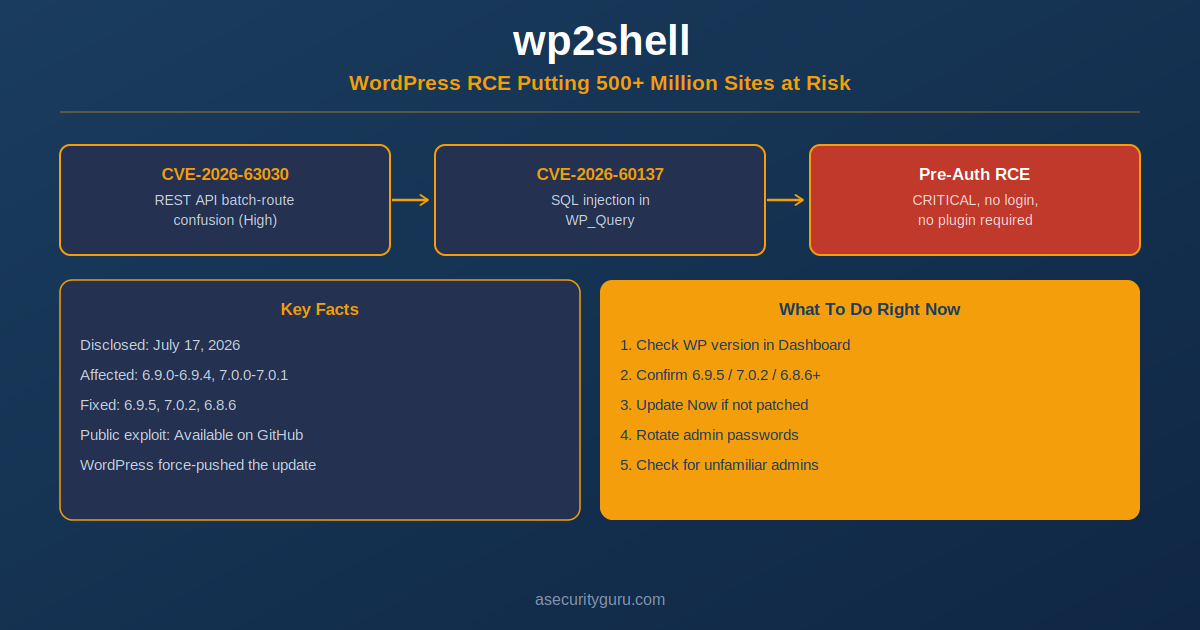 wp2shell CVE-2026-63030: The WordPress RCE Putting 500+ Million Sites at Risk
Explains the wp2shell chain in WordPress core: CVE-2026-63030, a REST API batch-route confusion in /wp-json/batch/v1, smuggles input into CVE-2026-60137, a SQL injection via the author__not_in parameter of WP_Query, giving unauthenticated admin hash dump and RCE. Lists affected versions (6.9.0-6.9.4, 7.0.0-7.0.1 for RCE; 6.8.x SQLi only), fixed releases (6.9.5, 7.0.2, 6.8.6), the public GitHub PoC, temporary WAF/REST blocking mitigations, and post-patch compromise checks such as rotating admin passwords and reviewing batch-endpoint logs.
 asecurityguru.comarticleAdded 13 Oct 2026, published 21 Jul 2026🛡️ Security
 Orca Security: Critical Heap Buffer Overflow in NGINX Allows Unauthenticated RCE
Covers CVE-2026-42533, a heap buffer overflow (CWE-122) in the NGINX map directive's regex handling. It is triggered when a string expression references unnamed captures before the map output variable. Unauthenticated crafted HTTP requests can crash workers and may give RCE where ASLR is off or bypassed. It also covers two other F5-patched NGINX flaws: CVE-2026-60005 (uninitialized memory disclosure in ngx_http_slice_module) and CVE-2026-56434 (use-after-free in ngx_http_ssi_module with proxy_pass and proxy_buffering off). It lists affected NGINX Open Source (0.9.6–1.31.2), NGINX Plus, Ingress Controller, Gateway Fabric, App Protect WAF and Instance Manager versions. It gives fixed releases (1.31.3 / 1.30.4) and the named-capture workaround, and notes no public PoC or in-the-wild exploitation.
orca.securityadvisoryPublished and added 20 Jul 2026🛡️ Security Exploitation in the Wild of wp2shell
Wiz Research documents active in-the-wild exploitation of "wp2shell," a pre-auth RCE chain in WordPress Core (CVE-2026-63030 and CVE-2026-60137) affecting every WordPress version since December 2025, discovered by Searchlight Cyber using GPT-5.6 Sol. Attackers abuse the WordPress REST API batch endpoint (/wp-json/batch/v1) to achieve unauthenticated RCE, then deploy malicious plugins/webshells (including a disguised "CMSmap" plugin and a custom REST endpoint backdoor), enumerate users, and attempt LFI against wp-config for credential theft. The post details post-exploitation TTPs, detection signatures (HTTP 207 responses, wp2shell/rezwp2shell user agents), IOCs, and WAF/plugin-based mitigations.
 wiz.iowriteupAdded 3 Sep 2026, published 20 Jul 2026🛡️ Security
 Unauthenticated RCE in WordPress core (wp2shell), via SQL injection
WordPress core versions 6.9.0-6.9.4 and 7.0.0-7.0.1 (plus 7.1 beta) contained an unauthenticated remote code execution flaw stemming from REST API batch-route confusion at /wp-json/batch/v1 that chains into SQL injection, exploitable against a stock install with no plugins. WordPress shipped emergency fixes (6.9.5, 7.0.2, 7.1 beta2) and enabled forced auto-updates given the scale of exposure (500M+ WordPress sites); a separate SQLi patched in the same round affects 6.8.x, fixed in 6.8.6. Researcher Adam Kues (Searchlight Cyber) reported the flaw and released a checker tool at wp2shell.com; the post also covers interim mitigations (blocking the batch route via WAF/plugin) for sites that can't patch immediately.
 aikido.devwriteupAdded 3 Sep 2026, published 17 Jul 2026🛡️ Security
- Defence Impairment Olympics
Huntress SOC incident writeup detailing a threat actor who exploited Adobe ColdFusion vulnerabilities (CVE-2023-26360, CVE-2023-29298, CVE-2023-29300) to drop a steganographic webshell hidden inside an image, then returned with a full defense-impairment batch script (i.bat) that disabled IIS logging, tampered with Windows Defender, killed/deleted security services (Sysmon, filebeat, SentinelOne, DrWeb, ImmunetProtect), used Image File Execution Options to freeze logging tools, deleted ModSecurity WAF module, enumerated FileZilla and multilingual local admin groups, weakened WDigest to force plaintext credentials in memory, dumped credentials via a Mimikatz kernel driver (mimidrv.sys), deleted CLSID/WScript registry keys, and cleared Windows event logs. The piece walks through each command block with attacker rationale and closes with concrete mitigation guidance for defenders.
 huntress.comwriteupAdded 3 Sep 2026, published 29 Jun 2026🛡️ Security
- graphw00f
graphw00f is a GraphQL fingerprinting tool (inspired by wafw00f) that sends benign and malformed GET/POST queries to identify which GraphQL engine (Graphene, Apollo, Hasura, WPGraphQL, graphql-java, AWS AppSync, and dozens more) is running behind an endpoint. It cross-references detections against the GraphQL Threat Matrix project to report each engine's built-in security defenses and known CVEs, helping pentesters and security engineers assess GraphQL API attack surface (CWE-200 information disclosure via engine fingerprinting).
github.comrepoPublished and added 14 Jun 2026🛡️ Security  Operational Workbooks Episode 1: Running a Playbook from a Workbook
A hands-on guide to wiring Microsoft Sentinel Workbooks to Logic Apps (playbooks) using the ARM Action link and HTTP request trigger, allowing analysts to export arbitrary workbook column data as parameters and POST it to a playbook without requiring an Incident/Entity ID. The author flags that this pipes untrusted attacker-controlled data (URLs, command lines) into downstream automation, and notes example WAF/XSS events can trigger HTML injection directly in the workbook via the URI parameter.
 attackthesoc.comarticleAdded 3 Sep 2026, published 12 Apr 2026🛡️ Security
- MicroSocks: Convenient access through a compromised SonicWall SMA
DFIR investigation by a researcher into a SonicWall SMA compromise where the threat actor exploited CVE-2021-20039 (authenticated command injection) to drop the previously-known wafxSummary web shell, then months later placed a second binary, wafySummary, identified as the open-source MicroSocks SOCKS5 proxy. The attacker used MicroSocks to tunnel RDP traffic into the internal network, avoiding further malware deployment and detection for nearly 11 months before deploying Abyss ransomware. Includes reproduction steps confirming the binary's SOCKS proxy functionality and its VirusTotal PUA detection.
 dfir.chwriteupAdded 3 Sep 2026, published 30 Mar 2024🛡️ Security