- zahT3 (@zahT3zuo) on X
Hotseat is a free, open-source macOS menu bar app that moves Claude Code and Claude Desktop to another of the user's Claude accounts in one click and returns to the same session. Sessions, settings, skills and MCP servers are shared, so `claude --resume` works under either account. When a session hits a usage limit, it offers to continue under another account. It never reads tokens or cookies. Install with Homebrew.
 x.comtoolAdded 1 Nov 2026, published 31 Oct 2026🧠 AI
- Ritik Shukla (@Retik_S) on X
kanzo is a local kanban board that coding agents can update. It ships as one 4 MB binary that starts in 2 ms and runs on localhost. It also works as an MCP server, so Claude Code and Codex see the same tasks as the user. The board is stored as a folder that can sync through a private git repo. The post is brief and gives no further detail.
x.comtoolPublished and added 30 Oct 2026🧠 AI  VulnCheck - Outpace Adversaries
VulnCheck Open Source is an index of VulnCheck's open-source tooling for its vulnerability and exploit intelligence. It lists a Python API client, a CLI, a GitHub Action for CI/CD, go-exploit (a Go exploit framework), an MCP server for delivering intelligence to AI clients, and VulnCheck Insights, a Chrome extension that highlights CVEs, CPEs and PURLs on web pages and enriches them. The page gives only one-line descriptions.
 vulncheck.comtoolAdded 29 Oct 2026🛡️ Security
- Dan Kornas (@DanKornas) on X
jshook is an open-source (AGPL-3.0) MCP server that gives AI agents a search-first, profile-aware reverse-engineering workspace for JavaScript, browser traffic, WASM and native processes. Agents start with a small searchable tool surface and move to workflow or full profiles only when needed. It drives Chromium or Camoufox over CDP, captures WebSocket traffic, has HTTP, GraphQL and Burp Suite helpers, and supports hot-reload plugins and declarative workflows. The post is a short announcement; the repository link is in a reply.
x.comtoolAdded 28 Oct 2026, published 25 Oct 2026🧠 AI - Dan Kornas (@DanKornas) on X
jshook is an open-source (AGPL-3.0) search-first reverse-engineering workspace for AI agents, exposed over MCP. It drives Chromium or Camoufox through CDP, captures WebSocket traffic, offers HTTP, GraphQL and Burp Suite helpers, deobfuscates JavaScript, rebuilds source maps and disassembles WebAssembly. Tool profiles start small and expand to workflow or full sets; hot-reload plugins and declarative workflows extend it.
x.comtoolAdded 28 Oct 2026, published 25 Oct 2026🛡️ Security - Agent Credit (@agentcredit_) on X
Agent Credit v1.3 is a remote MCP server that lets AI agents run credit checks on each other. It has six tools: score, compare, operator record, alerts and on-chain proof check. Calls are paid per use in USDC through x402 with no account or key. It also flags shared wallets, lists every token an operator launched and how each ended, and offers embeddable badges and wallet-signed record claims.
x.comtoolAdded 26 Oct 2026, published 25 Oct 2026🧠 AI - Search Search results for "security" | MCP Market
MCP Market search results for "security" in its skills category, listing about 20 installable AI agent skills. Entries cover OWASP Top 10 audits, secure PHP coding, STRIDE threat modeling, CVE remediation, security header analysis, misconfiguration finding, bug bounty triage and AgentShield scans of Claude Code configurations. One is a paid D365FO security-role XML skill. Each entry has only a one-line description and a category label.
 mcpmarket.comtoolAdded 25 Oct 2026🧠 AI
- Meku_SI (@MEKU_SI) on X
MEKU Human Cloud is an MCP server for agents that need a real person to do a task. It exposes three tools: search humans (read-only), request a human (a human operator reviews every request first), and check status. It is listed in the MCP Registry as farm.meku/human-cloud. The tweet gives no detail on pricing, humans available or request formats; those are in the linked docs.
x.comtoolAdded 23 Oct 2026, published 22 Oct 2026🧠 AI  Launch HN: Alter (YC S25) – Access control for multi-user agents
Alter is a privileged access management layer for AI agents (YC S25). It stores credentials in a vault, injects them per request through a proxy, gives each agent its own identity and scoped grants, and logs every call to a tamper-evident audit trail. One SDK call covers storage, refresh, policy and audit for 140 API providers, with LangChain, MCP and AWS integrations. Policy is default-deny down to the parameter, with human approval for risky calls.
 alterauth.comtoolAdded 22 Oct 2026, published 21 Oct 2026🧠 AI
- Dan Kornas (@DanKornas) on X
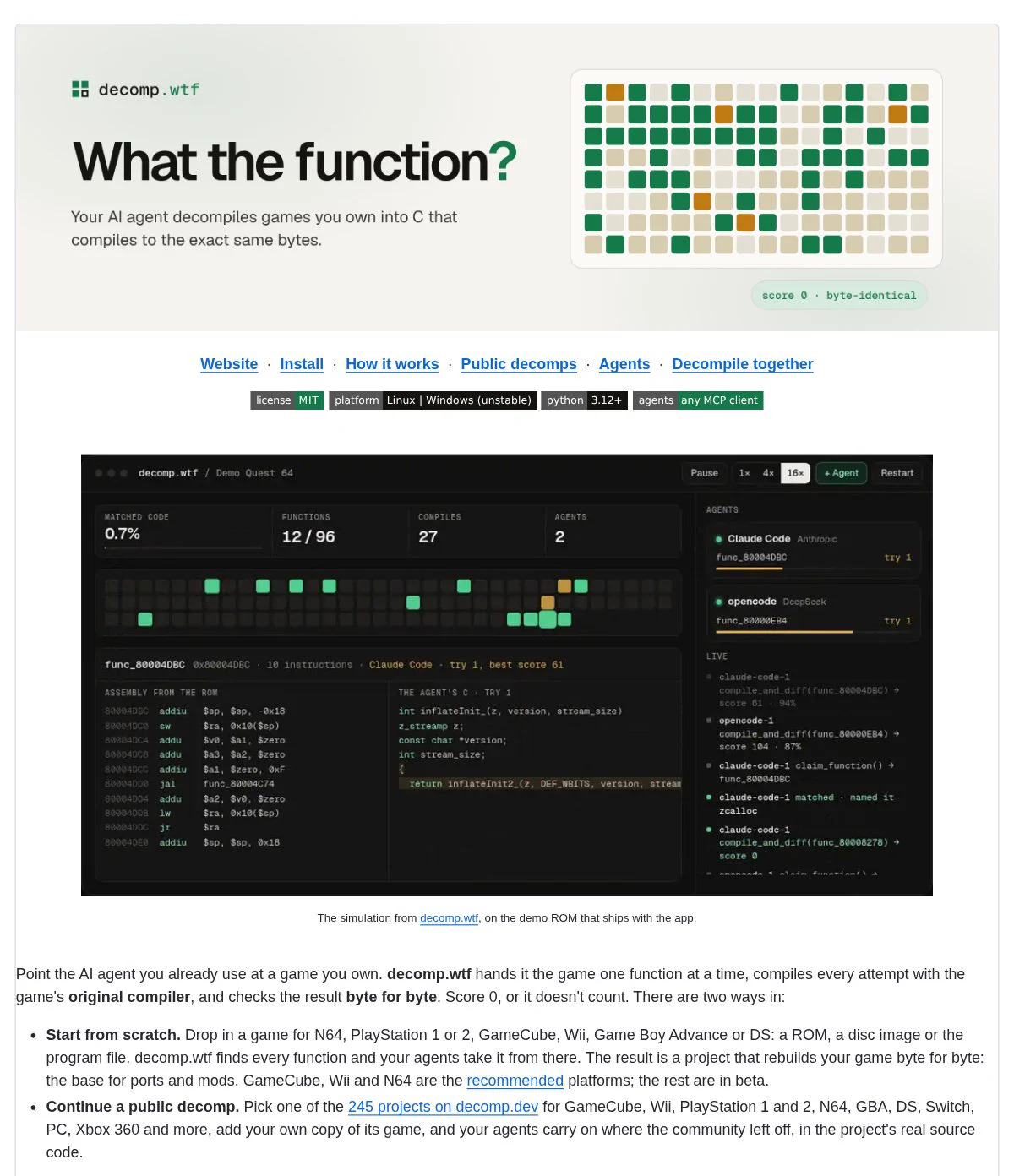
decomp.wtf is an open-source (MIT) local workspace where AI coding agents decompile games into C, one function at a time. Agents receive assembly, data, callers and earlier attempt notes, then each C candidate is compiled with the game's original compiler, linked at its real address and compared byte for byte, with instruction diffs on misses. It exposes MCP tools for Claude Code, Codex, Antigravity CLI and opencode, plus a live view of agent calls and match scores.
x.comtoolAdded 19 Oct 2026, published 18 Oct 2026🧠 AI 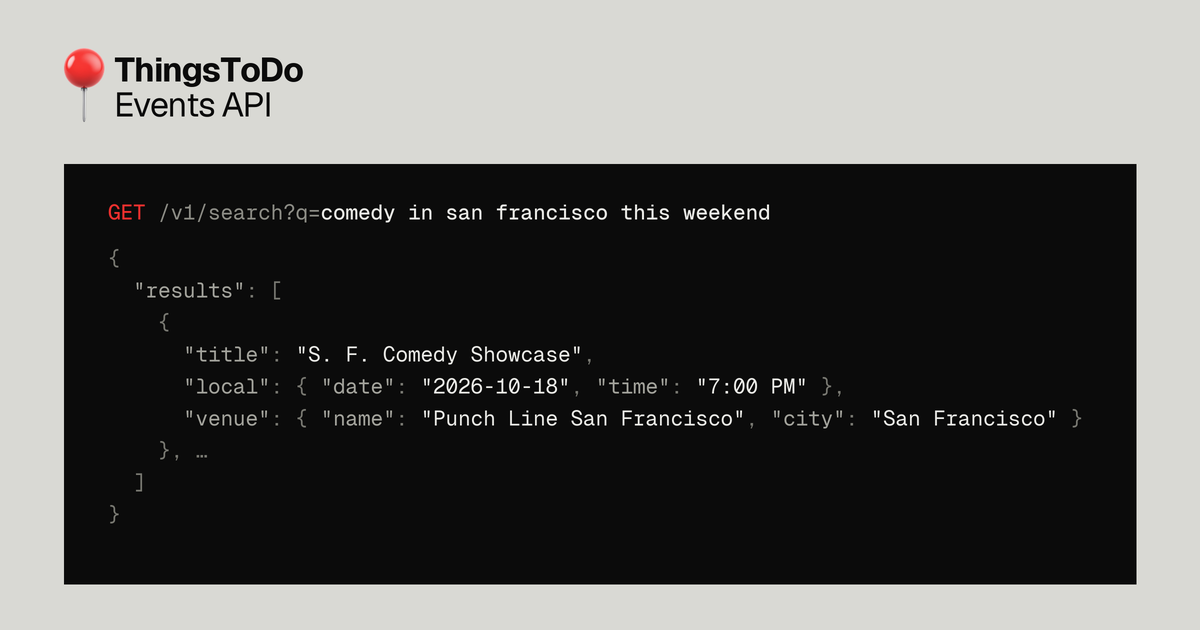 Show HN: Things to Do API
Things to Do API is a hosted knowledge base of local events (shows, talks, pop-ups, markets, festivals) that you query in natural language, for example `/v1/search?q=comedy+in+san+francisco+this+weekend`. It returns structured JSON with title, category, local start time, venue and ticket and source links. It also exposes an HTTP MCP endpoint, added with `claude mcp add --transport http thingstodo https://api.thingstodoapi.com/mcp`, so agents can use it as a tool. Coverage is live for the San Francisco Bay Area, with New York City and Los Angeles coming. Pricing is pay-as-you-go from $5 per 1,000 calls, the first 1,000 a month are free, and there is a 300 calls/min limit.
 thingstodoapi.comtoolAdded 18 Oct 2026, published 16 Oct 2026🧠 AI
- dbugs (@ptdbugs) on X
Decepticon is an open-source framework that automates red team operations with 16 specialized AI agents coordinated by an orchestrator, covering recon, vulnerability research and exploitation against an operator-authorized target in an isolated environment. It offers optional attack planning mapped to MITRE ATT&CK, persistent interactive sessions for Metasploit, Sliver and Evil-WinRM, and findings stored in project files and a knowledge graph. It runs via CLI or web dashboard, integrates with Claude Code and Codex through an MCP server, and is self-hosted with Docker Compose.
x.comtoolAdded 18 Oct 2026, published 15 Oct 2026🛡️ Security  Francesco Sorrentino (@Fr_Sorrentino) on X
chrome-bridge is an open-source MCP server with a Chrome extension that lets Claude Code drive the user's own Chrome, including logged-in tabs and DevTools. It reads page structure rather than screenshots, which saves tokens and turns. The author reports gains over Claude in Chrome: 4.7× fewer turns and 2.8× lower cost on form filling, 2.3× and 3.4× on finding a row among 1,500, and 9.3× and 4.3× on debugging a broken checkout, with 15/15 correct against 12/15. These are self-reported numbers from the tweet.
x.comtoolPublished and added 14 Oct 2026🧠 AI- 44er (@44errrr) on X
hexvero is a Node-only, zero-dependency MCP server that gives coding agents a static first-look triage of binaries and app bundles across 18 formats (ELF, PE, Mach-O, APK, .NET, Go, Wasm, Electron, SQLite). Findings are marked confirmed or inferred with file and line, and outputs are paged with a byte budget (a 541 MB Electron app yields a ~15 KB result). The author contrasts its 3,043-token tool catalog with a 509,696-token catalog of an established RE MCP server. radare2, rizin or Ghidra can be plugged in for disassembly, and setup registers it with Claude Code, Cursor, Codex and 15 more clients.
x.comtoolAdded 15 Oct 2026, published 14 Oct 2026🛡️ Security  Show HN: Use your OpenAI subscription to create audiobooks
PDF TO MP3 is a hosted MCP server (Streamable HTTP, account authentication) that turns PDFs into audiobooks. The user's existing AI subscription, such as Codex, handles document processing through the MCP connection. Speech generation is billed separately through the user's own OpenAI or Google text-to-speech API key. The setup is three steps: add the MCP server, add a speech key, then attach a PDF and ask the assistant to use the MCP. It shows a "bring your own subscription" pattern that keeps the vendor's compute costs low.
 pdftomp3.comtoolPublished and added 13 Oct 2026🧠 AI
- Frostyz (@frostyz) on X
Announcement that the OSWiki MCP server now supports trading through a separately released local signer. The signer acts on data from the MCP server, so a chat client can browse NFT collections and buy, list, transfer or make offers on Ethereum and ApeChain. Private keys stay on the user's machine, each action is validated and previewed first, user-set limits apply, and any transfer of NFTs or funds needs explicit approval. Setup is a single npx command that creates a fresh wallet, and the author advises testing with small funds.
x.comtoolPublished and added 11 Oct 2026🧠 AI - Gurasees (@gurasees0) on X
Robo dir is a directory that aggregates robotics and physical-AI datasets in one place. The launch tweet claims 3,494 datasets, 86,424 Hugging Face uploads, 236B+ frames and 2.2M+ hours of data. It also exposes the index through a single MCP server with no sign-in, so agents can search for robot training data programmatically.
x.comtoolPublished and added 9 Oct 2026🧠 AI - AINotes (@ainotesus) on X
OpenRig is an orchestration tool that runs multiple coding agents as one persistent, coordinated team rather than isolated sessions. A YAML configuration defines pods, seats, communication edges, and continuity policies, while a daemon, CLI, TUI, MCP server, SQLite store, and tmux handle agent launch, inter-agent messaging, session snapshots, restoration, and topology management.
x.comtoolPublished and added 3 Oct 2026🧠 AI - Average AI Bro (@AverageAiBro) on X
Reversecore MCP is an MCP server that exposes authorized reverse-engineering, malware-analysis, forensics, and SAST-style tooling to an AI agent through selectable profiles, returning structured results for a given binary sample. It targets the gap between hand-driving tools like radare2 and paying for a commercial IDA Pro-based workflow, letting an agent query a toolchain directly instead of a human operator switching between tools.
x.comtoolAdded 1 Oct 2026, published 30 Sep 2026🛡️ Security - zkLombard (@zkLombard) on X
zkLombard announces a remote MCP server (HTTP transport, one endpoint, eight tools, no custody of keys) that lets an agent with its own wallet value a Uniswap v3 position, pledge it, borrow USDG, repay, and redeem. The agent signs every transaction itself, and loan solvency is proven with a zero-knowledge proof verified onchain. It installs with a single `claude mcp add --transport http` command, and a manual is linked. It is a concrete example of exposing financial primitives as MCP tools for autonomous agents.
x.comtoolAdded 1 Oct 2026, published 30 Sep 2026🧠 AI  LiteLLM
 is an open-source (MIT) AI gateway that puts 140+ LLM providers, agents and MCP servers behind one OpenAI-compatible API. It adds virtual keys, per-team budgets and rate limits, SSO/JWT/RBAC with SCIM, audit logs, leaked-key protection, and guardrails for PII masking and prompt injection (Presidio, Lakera). It self-hosts via Helm, Terraform or Docker, including air-gapped, with Cosign-signed non-root images, Grype and CodeQL scanning, and secrets pulled from Vault or cloud secret managers. A new Rust gateway is benchmarked at 0.66 ms p99 overhead.
 litellm.aitoolAdded 3 Sep 2026, published 31 Aug 2026🛡️ Security
- LiteLLM
LiteLLM is an open-source (MIT) AI gateway that puts 140+ providers and 1,800+ models, plus agents and MCP servers, behind one OpenAI-compatible API with SSO and virtual keys. It adds per-key/team/org spend tracking, hard budgets, rate limits, guardrails, audit logs, load balancing, lowest-cost and auto routing, and response/semantic caching (Redis, S3, GCS). It self-hosts via Helm, Terraform or Docker, including air-gapped, and the page cites a new Rust gateway with 0.66 ms p99 overhead measured with the public AI Gateway Bench.
litellm.aitoolAdded 10 Oct 2026, published 31 Aug 2026🧠 AI  crt.name
 is a free subdomain index and API that returns every subdomain on file for a given apex domain plus first-seen dates, built by continuously parsing SAN hostnames from Certificate Transparency logs (Static CT sources like Let's Encrypt Sunlight, Geomys, Cloudflare Raio, plus legacy RFC 6962 logs like Google Argon, Sectigo, DigiCert), supplemented by Internet Archive CT replays, Common Crawl, ICANN CZDS zone files, ProjectDiscovery Chaos, HaGeZi DNS blocklists, and an active hostname prober. It offers a no-token REST API (100 req/IP/day), a Streamable HTTP MCP server exposing a single search tool for agent clients, and is the default crt source in the subfaster CLI subdomain enumerator.
 crt.nametoolAdded 3 Sep 2026, published 21 Aug 2026🛡️ Security
 JFrog: Keep your Agents Under Control with agent-belt
JFrog open-sourced agent-belt, an Apache 2.0 CLI eval framework that black-box tests real coding-agent CLIs (Claude Code, Codex, Cursor, Copilot, Gemini, Goose, OpenCode) as subprocesses against version-controlled JSON scenarios with rule-based checks and separate LLM-judge scoring. It targets the non-determinism problem in agentic coding — model/CLI updates silently breaking tool selection or MCP behavior — by measuring pass^k across repeated trials, phrasing variants, and multi-judge consensus, with CI-gating exit codes, Docker sandboxing for untrusted-agent runs, and manifest file-locking for concurrent eval runs. It's positioned as complementary to agent governance: governance restricts what an agent can touch, agent-belt verifies whether its actions and outputs are actually correct.
 jfrog.comtoolPublished and added 19 May 2026🛡️ Security
- Vulnerability Garden
Vulnerability Garden is a searchable, continuously updated database of named vulnerabilities, attack techniques, and exploits (over 1,132 entries as of September 2026), each tagged with publish date, associated CVE numbers, and reference links. It spans decades of security research — from classic bugs like Billion Laughs and the Kaminsky bug to recent AI-agent and supply-chain attacks like MCPJacking and GitSpawn — making it a useful lookup tool for researchers trying to find or cross-reference a named vuln.
 vulnerability.gardentoolAdded 3 Sep 2026, published 13 May 2026🛡️ Security
 GitHub Dependency Scanning MCP Server
GitHub's MCP Server now ships a "dependabot" toolset, in public preview, that lets MCP-compatible AI coding agents (Copilot Chat, Copilot CLI) scan dependency changes for known vulnerabilities before commit. The toolset queries the GitHub Advisory Database for affected packages, severity, and fixed versions, and can invoke the Dependabot CLI locally to diff dependency graphs pre/post-change for deeper post-commit checks. Requires Dependabot alerts enabled on the repo; setup involves enabling the toolset via Copilot CLI, VS Code MCP headers, or the advanced-security Copilot plugin.
 github.blogtoolAdded 3 Sep 2026, published 11 May 2026🛡️ Security