 “Black October” for AI Developer Platforms
Wiz Research links October 2026 breaches at AI developer platforms (Fireworks, OpenCode, Warp, Zeabur, Railway and others) to stolen environment-variable credentials for AI access. It details two enterprise AWS Bedrock keys abused after vendor breaches: about 800k and 1.7 million calls, over $100k in list-price usage. It profiles two LLM resale operations, "momo" and "Xingjiabi", that tested the keys.
 wiz.iowriteupAdded 31 Oct 2026, published 30 Oct 2026🛡️ Security
 Endor Labs AI SAST Finds Two Apache Kafka Zero-Days: Unbounded Memory Allocation from Brokers to Kafka Streams | Endor Labs
Endor Labs AI SAST found three unbounded memory allocation flaws in Apache Kafka, fixed under CVE-2026-114349 (DefaultRecord decoder, a ~90-byte compressed batch that kills consumers, brokers and the log cleaner) and CVE-2026-111551 (ListDeserializer and Kafka Streams AssignmentInfo decoding). The post gives code, reproducers and payload bytes. Remediation: upgrade to 4.2.2, 4.3.2 or 4.4.0, set max.decompressed.message.bytes, restrict write and group ACLs, and alert on DeadThreadCount.
 endorlabs.comwriteupPublished and added 28 Oct 2026🛡️ Security
- Tailworm – Tailscale Vulnerabilities
Tailworm is a security assessment report by Erica Windisch (Cyberdione Labs) on Tailscale v1.104.2 and headscale v0.29.5, tested 22-24 October 2026. It documents 11 findings: Tailscale SSH unix-socket forwarding that runs as root (bind, dial and TOCTOU races), conn25 app-connector egress bypass, gliderssh memory exhaustion, serve/funnel flaws and headscale DoS. It includes PoC references, mitigations and fix status as of 27 October 2026. The page is truncated, so the later sections were not read.
 tailworm.comwriteupAdded 27 Oct 2026, published 25 Oct 2026🛡️ Security
 Red-Teaming OpenAI's Internal Agent Monitoring Systems
METR and Redwood Research summarize a three-week pilot red-team (21 July to 11 August 2026) of OpenAI's internal asynchronous misalignment monitoring system. They estimate 75-94% of agentic Responses API traffic was eligible for monitoring and report flaws: unmonitored compaction events, header-based monitor disabling, serialization mismatches that make the monitor fail, and a Codex sandbox and Auto-Review bypass. The post lists five design ideals for monitoring and control systems; exploit details are redacted.
 metr.orgwriteupAdded 29 Oct 2026, published 22 Oct 2026🛡️ Security
 Profiling TorchNeuron (Part 1): System-level profiling on AWS Trainium.
Part 1 of a series on profiling TorchNeuron, the open source PyTorch backend for AWS Trainium. It shows how to configure torch.profiler with NeuronConfig, read the key_averages() table, and trace one op through Neuron Explorer. Three RMSNorm variants are compared: naive eager (2.355 ms device time), torch.rms_norm (403 μs) and torch.compile (375 μs).
 huggingface.cowriteupPublished and added 21 Oct 2026🧠 AI
 PHP2Shell - Critical vulnerabilities in PHP (CVE-2026-109618, CVE-2026-109619): detection, analysis, and remediation
PHP2Shell is Datadog Security Labs' analysis of two critical PHP RCE flaws, CVE-2026-109618 and CVE-2026-109619 (CVSS v4.0 9.2), disclosed 21 October 2026. It walks through a reproduced exploit on PHP 8.5.11 (heap grooming, a fake array, and a destructor calling system()) and the stale-state use-after-free. It lists fixed versions (8.2.35, 8.3.36, 8.4.27, 8.5.12), partial mitigations, and detection signals across requests, error logs and shell child processes.
 securitylabs.datadoghq.comwriteupAdded 29 Oct 2026, published 21 Oct 2026🛡️ Security
 Loud, Fast, and Everywhere: Anatomy of a Real AI-Driven Cloud Attack
Wiz CIRT write-up of an AI agent-run intrusion against a multi-cloud organization (GCP, AWS, Kubernetes, CI/CD, GitOps, identity provider). It lists traits of AI-driven attacks: machine-speed tempo, credential chaining, pentest/probe naming, numeric task IDs and commented code. Initial access was a Java RCE in an exposed Kafka UI. It closes with detection and response advice: unified logs, workload visibility and trust isolation.
wiz.iowriteupPublished and added 19 Oct 2026🛡️ Security GhostAction Attack Escalates By Targeting GitHub Users
OpenSourceMalware's analysis of the latest GhostAction wave, where compromised GitHub accounts get malicious Actions workflows (security-audit.yml) injected across every writable repository, including an Oct 8 sweep of 346 repos via kitao and henrywoo. The new payload greps the checkout and full git history for credential patterns (AWS, Anthropic, OpenAI, GitHub PATs) and POSTs them over HTTP to 193.32.204.199/?c=monami. It also covers infrastructure reuse (phishing-heavy legacy IP, scanner activity), new watchlist domains my-github.com and my-gitlab.com, GitHub code-search hunting queries, a detection-confidence table, IOCs and incident response steps.
 opensourcemalware.comwriteupAdded 10 Oct 2026, published 9 Oct 2026🛡️ Security
 GhostAction Returns: Malicious “Security Audit” Workflows Now Mine Credentials from Entire Git Histories
StepSecurity details a new wave of the GhostAction campaign in which attackers used compromised maintainer accounts of Takashi Kitao (pyxel) and Henry Wu (athenadriver, Uber) to push malicious "Security Audit" GitHub Actions workflows to 345 repositories in minutes. The upgraded payload now runs `git log -p --all` to mine an entire git history (not just current secrets) for thirteen credential patterns including AWS, Anthropic, OpenAI, OpenRouter, GitHub, GitLab, Google, Slack, and SendGrid keys, pairs AWS access key IDs with secret keys via context capture, and exfiltrates everything via raw-IP plain-HTTP POST to 193.32.204.199, bypassing DNS-based defenses. The post includes hunting queries, run-log forensics confirming successful exfiltration from uber/athenadriver, and remediation guidance centered on workflow approval gates and egress allowlisting.
 stepsecurity.iowriteupPublished and added 9 Oct 2026🛡️ Security
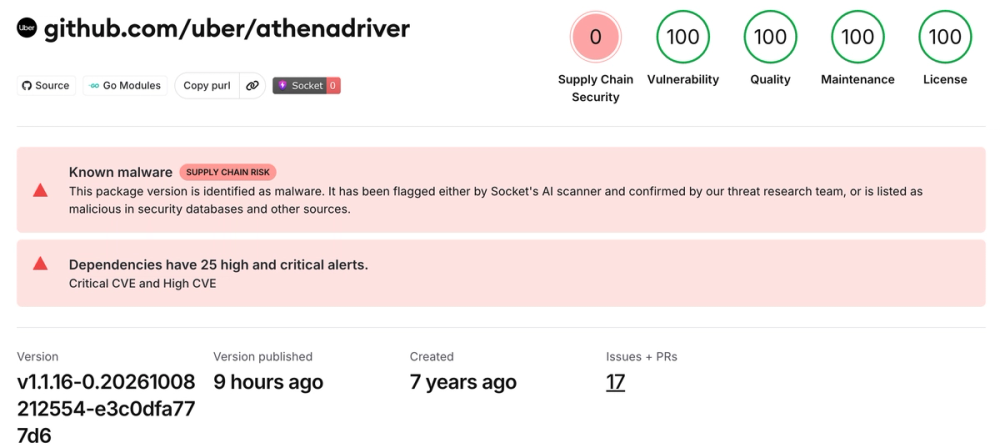 New GhostAction Wave Hits Hundreds of Repos, Expanding Beyond CI/CD Secrets to Cloud Credentials
Socket documents an October 8, 2026 wave of the GhostAction campaign in which two compromised GitHub maintainer accounts (henrywoo and kitao) pushed a malicious security-audit.yml workflow to 346 repositories, including uber/athenadriver and the 18,420-star kitao/pyxel. Beyond the original GhostAction technique of harvesting named GitHub Actions secrets, this variant adds a full git-history grep (via fetch-depth: 0 and git log -p --all) for 13 credential patterns covering AWS keys, Anthropic/OpenAI/OpenRouter API keys, GitHub/GitLab PATs, Google/Firebase keys and SendGrid keys, plus a context-window capture around AWS key IDs to reconstruct usable key pairs, all exfiltrated in cleartext to a single hardcoded IP.
 socket.devwriteupPublished and added 9 Oct 2026🛡️ Security
- Threat Actors Exploit Critical AhsayCBS Flaws to Drop Webshells and XMRig Cryptominer
Huntress documents active exploitation of two AhsayCBS (Ahsay Cloud Backup Server) vulnerabilities being chained together: CVE-2026-105133, an authentication bypass in checkSysPwd, and CVE-2026-105134, an unauthenticated RCE in the Replication Receiver's UpdateReceivers.do endpoint that grants SYSTEM. Attackers use the chain to drop JSP webshells, then deploy a renamed XMRig cryptominer (masquerading as msedge.exe via a modified NSSM binary), a Task-Manager-aware anti-detection PowerShell script, and the vulnerable WinRing0x64.sys kernel driver for hardware-level miner access. Huntress provides IOCs, mitigation guidance (restrict management interface, re-image if compromised) and four Sigma rules targeting each stage of the intrusion chain.
 huntress.comwriteupAdded 9 Oct 2026, published 8 Oct 2026🛡️ Security
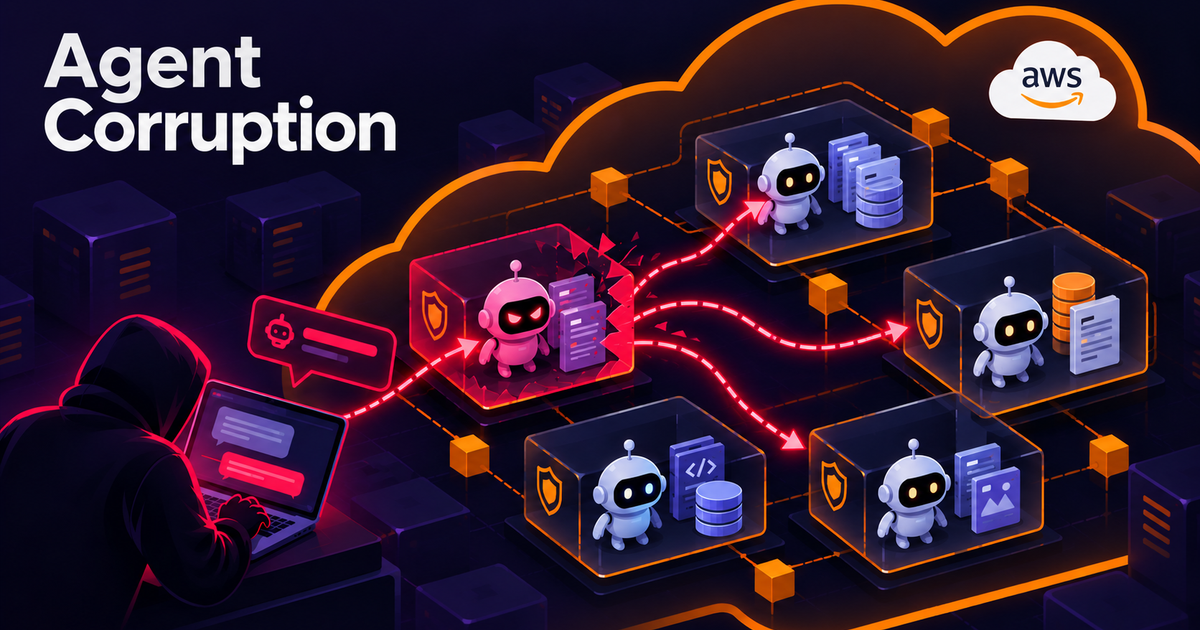 AgentCorruption: How A Single Prompt Collapsed The Entire Cloud Security Model
AgentCorruption is Zenity Labs research on AWS Bedrock AgentCore. Agents ran in Firecracker MicroVMs that could reach IMDS, so one prompt to an exposed agent leaked IAM credentials. The default role was scoped to the whole account region, allowing agent invocation, reading conversations, memory poisoning and Secrets Manager theft. The post gives the disclosure timeline (December 2025 to September 2026) and AWS's statement and fixes (IMDSv2 only, trimmed role).
 labs.zenity.iowriteupAdded 19 Oct 2026, published 8 Oct 2026🛡️ Security
 Configuring your AI vulnerability harness, Part 2: The steering file
Part 2 of an AWS Security Blog series detailing the design of a "steering file" — a persistent instruction set (deployable as a Kiro steering file, Kiro skill, or Claude Code CLAUDE.md) that constrains an LLM performing vulnerability triage. It walks through five configuration sections: requiring structural/dataflow verification before reporting findings, replacing self-reported confidence with a weighted formula based on binary structural signals (e.g., 0.30 weight for confirmed taint flow), mapping infrastructure controls (AWS WAF, IAM) to severity multipliers with a 0.15 floor, incorporating CISA KEV and EPSS threat-intelligence boosts capped at +0.50, and a four-tier priority classification that suppresses low-confidence P3 findings. Validation against a 10-vulnerability test app showed the steered model eliminated fabricated findings and correctly downgraded mitigated vulnerabilities while preserving full severity for a command injection reachable only via authenticated access.
 aws.amazon.comwriteupAdded 8 Oct 2026, published 7 Oct 2026🧠 AI
 Kubernetes Agent Sandbox on AWS EKS (Step-by-Step Guide)
Kubernetes Agent Sandbox on AWS EKS is a step-by-step tutorial for the kubernetes-sigs agent-sandbox controller with gVisor. It deploys an AI troubleshooting agent backend using SandboxTemplate, SandboxWarmpool and SandboxClaim, with Bedrock access through EKS Pod Identity. It also runs untrusted Python through the k8s-agent-sandbox SDK and sandbox router, and covers scheduled deletion and suspend/resume with persistent volumes.
 devopscube.comwriteupAdded 21 Oct 2026, published 7 Oct 2026🧠 AI
- Kubernetes Agent Sandbox on AWS EKS (Step-by-Step Guide)
Tutorial on setting up Kubernetes Agent Sandbox (kubernetes-sigs/agent-sandbox) with gVisor on an AWS EKS cluster. It runs a troubleshooting AI agent backend inside a sandbox using SandboxTemplate, SandboxWarmpool and SandboxClaim, and runs untrusted Python through the k8s-agent-sandbox SDK and Sandbox Router. Probes show blocked /etc/shadow reads, setuid and service account token access, plus host process isolation. It also covers scheduled deletion and suspend/resume with persistent volumes.
devopscube.comwriteupAdded 21 Oct 2026, published 7 Oct 2026🛡️ Security 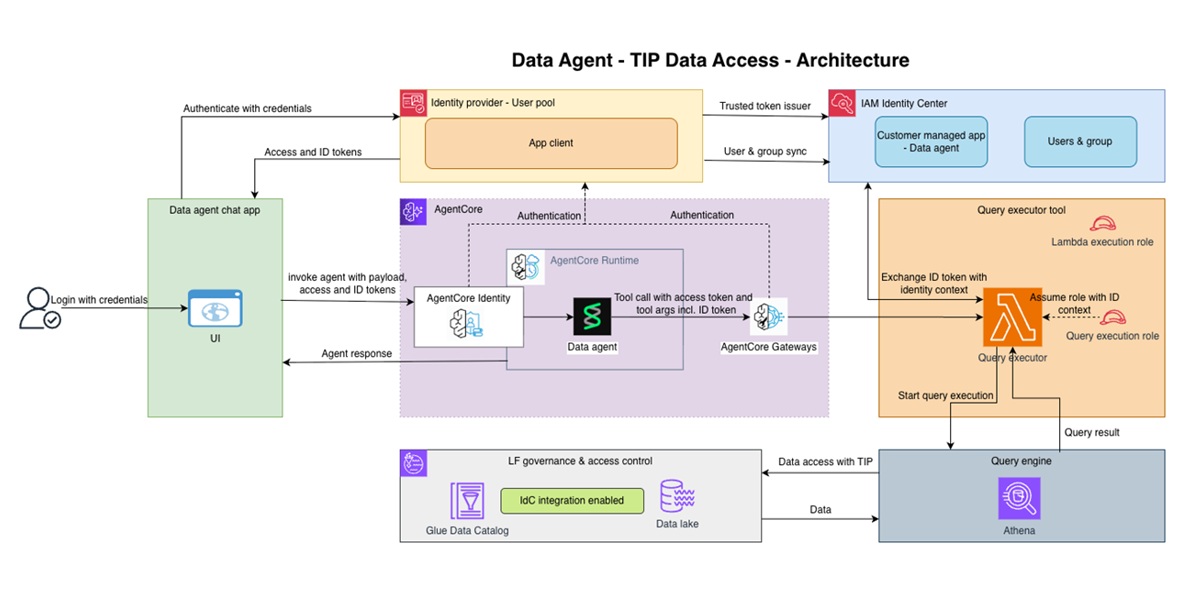 Identity-aware AI data agents with AWS Lake Formation and Trusted Identity Propagation
AWS Security Blog walkthrough showing how to build identity-aware AI data agents on Amazon Bedrock AgentCore that propagate a real user's OIDC id_token through the agent's tool-calling chain (Runtime → MCP Gateway → Lambda) via HTTP headers, keeping the token out of the foundation model's context entirely. A Lambda function performs a server-side token exchange using IAM Identity Center Trusted Identity Propagation, assumes a scoped TIP role, and runs the user's Athena query so AWS Lake Formation evaluates the real user's grants, producing per-user row/column access and CloudTrail audit records naming the actual human (onBehalfOf) without rewriting existing governance policies.
aws.amazon.comwriteupAdded 8 Oct 2026, published 6 Oct 2026🧠 AI Beyond valid credentials: How exposed AWS keys are tested for Amazon Bedrock access
Datadog Security Labs describes how attackers test stolen AWS credentials for Amazon Bedrock access. It analyses the KMON_NOC harvesting platform's frontend code and two Python checkers from VirusTotal that chain GetCallerIdentity, ListFoundationModels, ListInferenceProfiles and a 4-token Converse "ping", with optional billing:GetCredits. Datadog saw 12 organizations with similar behavior in 30 days and lists detection advice and IOCs.
securitylabs.datadoghq.comwriteupAdded 29 Oct 2026, published 6 Oct 2026🛡️ Security Active Supply Chain Attack: Malicious node-ipc Versions Published to npm
StepSecurity's AI Package Analyst detected three malicious node-ipc versions (9.1.6, 9.2.3, 12.0.1) published simultaneously on May 14, 2026 by a rogue/compromised maintainer account, injecting an 80KB obfuscated IIFE into the CommonJS bundle that harvests 90+ credential file categories (AWS, Azure, GCP, SSH, Kubernetes, GitHub, Claude AI/Kiro configs, Terraform, etc.) and exfiltrates them via HTTPS and raw DNS TXT queries to a typosquatted Azure-mimicking C2 domain. The writeup includes a full stage-by-stage technical teardown (daemonization, SHA-256 targeting gate on 12.0.1, custom base-16 nibble-reversed obfuscation, dual-channel exfiltration) plus file hashes, network IOCs, and remediation guidance for developers and CI/CD pipelines.
stepsecurity.iowriteupAdded 5 Oct 2026🛡️ Security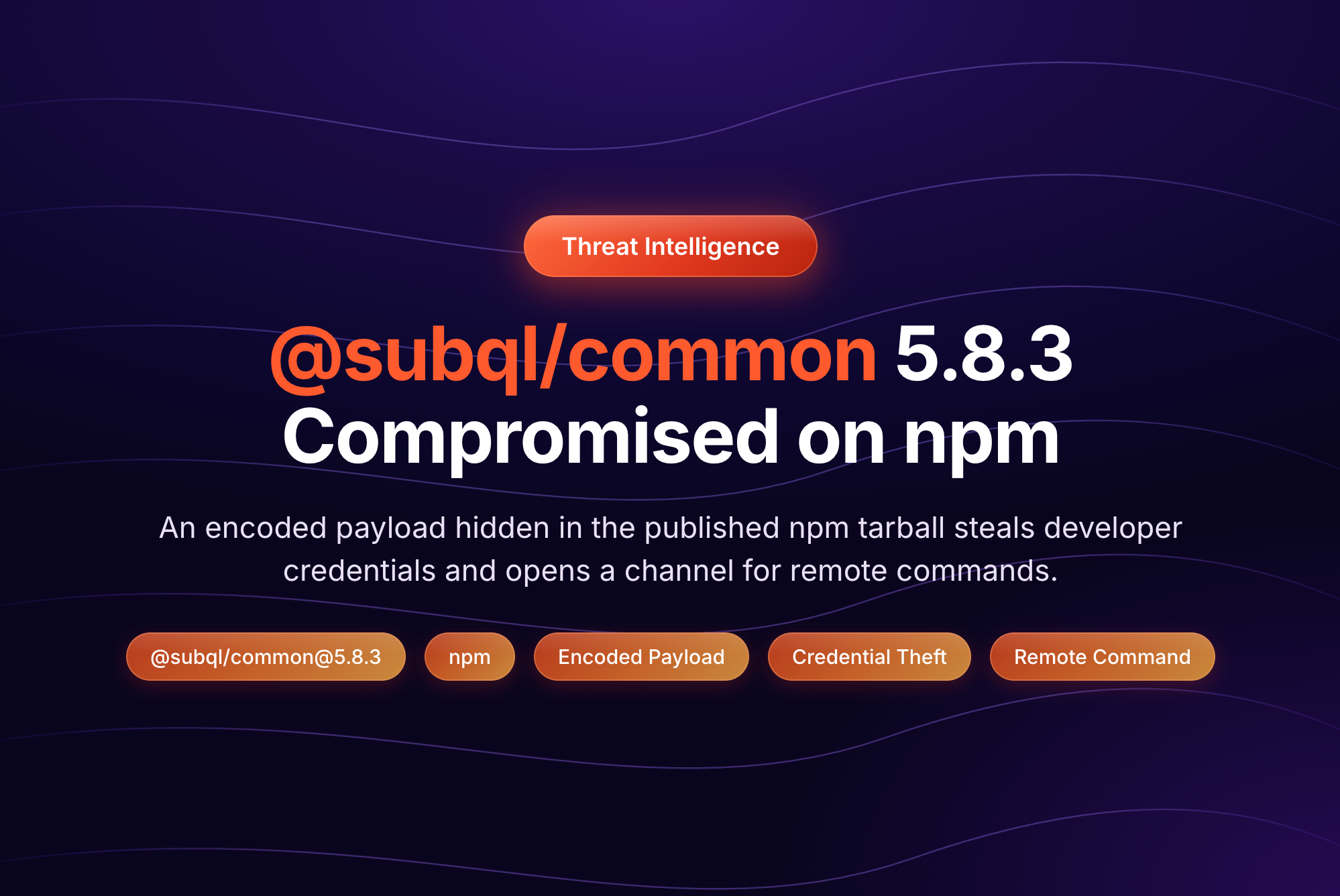 SubQuery Ecosystem Compromise: Hidden Credential Theft and Backdoors
StepSecurity's investigation of @subql/common@5.8.3, a malicious npm release in the SubQuery Web3 indexing framework's monorepo, found a heavily obfuscated postinstall/import-time payload (base64+XOR+gzip inside a function constructed via Function()) that spawns a detached worker to steal credentials (.npmrc, .env, AWS, SSH, kubeconfig, Vault, cloud secrets), read GitHub Actions runner memory for CI secrets, inject a camouflaged "Run Copilot" GitHub Actions workflow to exfiltrate repo secrets, and provide a remote shell/PTY over an encrypted channel to ci-artifacts.dev. The release was published via a compromised build pipeline: a workflow modification swapped the real build output for an externally downloaded, unsigned tarball from that same C2 domain immediately before publish, and the authors provide IOCs and remediation steps (credential rotation, host isolation, domain blocking).
stepsecurity.iowriteupPublished and added 5 Oct 2026🛡️ Security- The First 24 Hours: What Happens When Ransomware Lands
An hour-by-hour ransomware incident response playbook written by UnderDefense CEO Nazar Tymoshyk and published on Huntress's blog, covering confirmation, containment, exfiltration detection, backup/recovery pitfalls, and root-cause investigation in the first 24 hours of an attack. It draws on Mandiant's M-Trends 2026 report (14-day median dwell time, 22-second access-broker-to-ransomware handoff) and CISA's November 2025 Akira advisory (VPN without MFA as primary access vector, exfiltration via FileZilla, WinRAR, WinSCP, RClone, Mega and Ngrok, credential dumping with Mimikatz and LaZagne, PowerShell-based shadow copy deletion) alongside real UnderDefense engagement anecdotes.
huntress.comwriteupAdded 3 Oct 2026, published 2 Oct 2026🛡️ Security  The Blue Agent POV: Investigating Multi-Platform Data Exfiltration Across AWS and GitHub
Wiz walks through a case study of its "Blue Agent" autonomous SOC investigator tracing a compromised CI/CD service account (svc_automation) across AWS and GitHub. The attack chain: a stolen GitHub token cloned 18 private repos containing hardcoded AWS keys, which were used to authenticate to AWS from Kali Linux via a Zenlayer VPN IP, pivot to a second account, run SSM SendCommand against a production Windows domain controller, and stage custom Python exfiltration scripts (mssql_table_export.py, pg_table_export.py, billing_export2.py) in S3 to pull data from MSSQL, PostgreSQL, and billing systems. The piece details the investigative technique used - 30-day baseline comparison, ASO/IP dispersion across the tenant, and correlating CloudTrail management-plane events with S3 data-plane events and GitHub audit logs.
wiz.iowriteupPublished and added 29 Sep 2026🛡️ Security The Infostealer Incursion: How Stolen Credentials Breach Cloud, Code, and AI Environments
Wiz Research analyzed infostealer-harvested secrets (via its NordStellar integration) to map exactly which credentials malware families like Lumma, RedLine, and Vidar target across AWS, Azure, GCP, GitHub, GitLab, and AI platforms, and how those secrets translate into cloud account takeover. It gives concrete file paths and artifacts attackers hunt for (~/.aws/sso/cache OIDC tokens, Azure accessTokens.json, GCP credentials.db/access_tokens.db, GitHub gh hosts.yml and SSH keys, GitLab Runner config.toml, OpenAI/ChatGPT session cookies, and Claude Code's ~/.claude/.credentials.json OAuth tokens), plus stats: three malware families cause 85.7% of incidents, AWS/GCP account for 46%/13% of stolen secrets, GitHub ~10%, AI platforms ~5%. It also covers CI/CD-targeting infostealers (Miasma, TeamPCP) and session-cookie hijacking as an MFA bypass technique.
wiz.iowriteupAdded 27 Sep 2026, published 25 Sep 2026🛡️ Security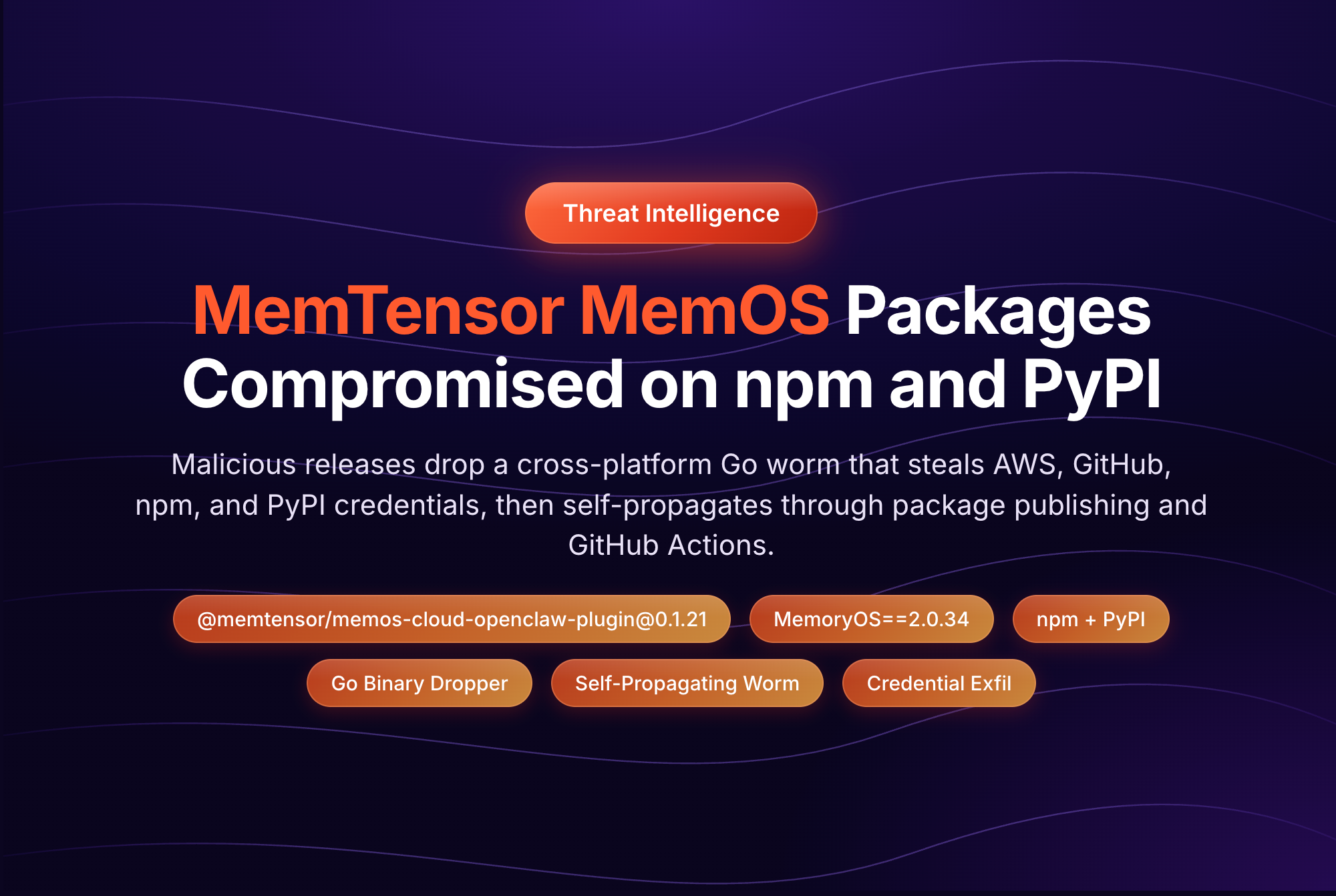 Sckit Supply Chain Worm Hits MemTensor npm & PyPi scopes
StepSecurity documents a supply-chain attack against @memtensor/memos-cloud-openclaw-plugin on npm (versions 0.1.21, 0.1.23, 0.1.25) and MemoryOS 2.0.34 on PyPI, which insert a hidden "sckit" launcher into normal plugin/import lifecycle code (no install scripts) to spawn a platform-specific Go binary that harvests the parent process's environment and the user's AI prompt text. The Go payloads contain regex patterns for AWS, GitHub, GitLab, npm, PyPI, Hugging Face, Vault, Slack, Stripe and SendGrid credentials, target the user's home directory as an inventory root, and beacon to skyleen.fr "front" domains; the PyPI variant additionally hides a conditional build-backend/CI bridge that can steal PYPI_API_TOKEN during publishing and pull a hash-pinned, Ed25519-signed secondary payload via GitHub Actions. The writeup includes full IOC/remediation guidance.
stepsecurity.iowriteupPublished and added 23 Sep 2026🛡️ Security EarlyAttestationBleed Paper Review (TEE attestation bugs)
A Flashbots researcher reviews the EarlyAttestationBleed paper (Muhammad Usama Sardar and Songbo Bu), which uses ProVerif formal analysis to uncover three attestation-verification bugs in confidential-computing deployments: Cocos AI's TDX verifier fails to actually compare the REPORT_DATA value despite computing it correctly, Cocos AI's SEV-SNP validator skips the comparison entirely when an empty expected-input value is passed, and Edgeless Systems' Contrast workload-policy logic can be tricked into accepting container images from untrusted host-controlled storage due to a rebase mistake. All three were implementation bugs (not protocol design flaws) and have since been fixed; the post also summarizes the paper's broader concerns about "early attestation" — exposing hardware details pre-authentication, lack of post-handshake re-attestation for long-lived sessions, and handshake-timeout tradeoffs from added attestation latency.
 collective.flashbots.netwriteupAdded 2 Oct 2026, published 23 Sep 2026🛡️ Security
 MemTensor npm and PyPI Packages Compromised in Credential-Stealing Supply Chain Attack
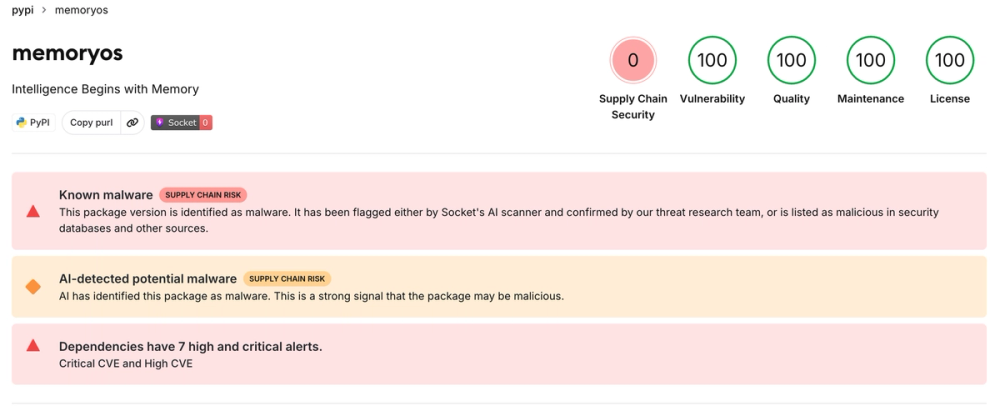
Socket details a supply-chain compromise of MemTensor's MemOS packages: npm package @memtensor/memos-cloud-openclaw-plugin (versions 0.1.21, 0.1.23, 0.1.25) and PyPI package MemoryOS (2.0.34), both published as the latest release on their registries. Each malicious release bundles a stripped, statically-linked Go binary called sckit that launches on import/plugin-load, scans $HOME for npm, PyPI, GitHub, GitLab, AWS, Vault and SSH credentials, and exfiltrates them to C2 servers under skyleen[.]fr, with the npm variant also capturing OpenClaw agent prompt text and the code additionally showing potential worm-like republish capability using stolen registry tokens.
socket.devwriteupPublished and added 23 Sep 2026🛡️ Security Top 10 attacks on Claude Code and what each one actually broke
Adversa AI catalogs ten distinct Claude Code attacks documented between September 2025 and September 2026: the Miasma supply-chain worm that hit 73 Microsoft repos via a SessionStart hook, TrustFall's unsandboxed MCP server execution on folder-trust, Check Point's CVE-2025-59536/CVE-2026-21852 pre-trust-dialog code execution and API key theft, Sentry-DSN-based "Agentjacking" prompt injection via fake bug reports, a 50-subcommand cap that silently disables deny rules, the SymJack symlink-to-config-hijack primitive working across six agent CLIs, Wiz's GhostApproval deceptive-approval-prompt finding (with CVE-2026-12958 at AWS and CVE-2026-50549 at Cursor but none at Anthropic), the Plugin4Shell SHA/branch-name collision bypassing plugin pinning, an academic MCP tool-poisoning paper achieving RCE on agent/LLM pairs, and SkillCloak's self-extracting-packer bypass of skill scanners. The piece argues almost none of these are model-behavior bugs - they are trust-boundary and consent failures in the surrounding tooling - and closes by pitching Adversa's own runtime agent security gateway as the fix.
 adversa.aiwriteupAdded 7 Oct 2026, published 23 Sep 2026🛡️ Security
 Autonomous AI Agents Hack Online Retailers for $25 a Company
Gambit Security recovered the staging server of a financially motivated actor running three open-source AI agent harnesses — Strix (vuln scanning), Cairn (autonomous exploitation), and Hermes (orchestration) — against hundreds of online retailers at a marginal cost of tens of dollars per target. The campaign exfiltrated 600,000+ credit card records via Magento database compromises, deployed checkout-page card skimmers on at least 19 confirmed and 100+ further sites, and in one case an agent's own cleanup routine dropped 180 database tables including victim backups. The report details full attack chains (SQLi to RCE to AWS Secrets Manager dump to card decryption), the AI harnesses' operating costs (~$25 mean per target on OpenRouter/opus-4.6/GLM/DeepSeek), and multiple real-world skimmer injection techniques.
 gambit.securitywriteupAdded 26 Sep 2026, published 22 Sep 2026🛡️ Security
 Transforming Bedrock Guardrails events into OCSF with CloudWatch
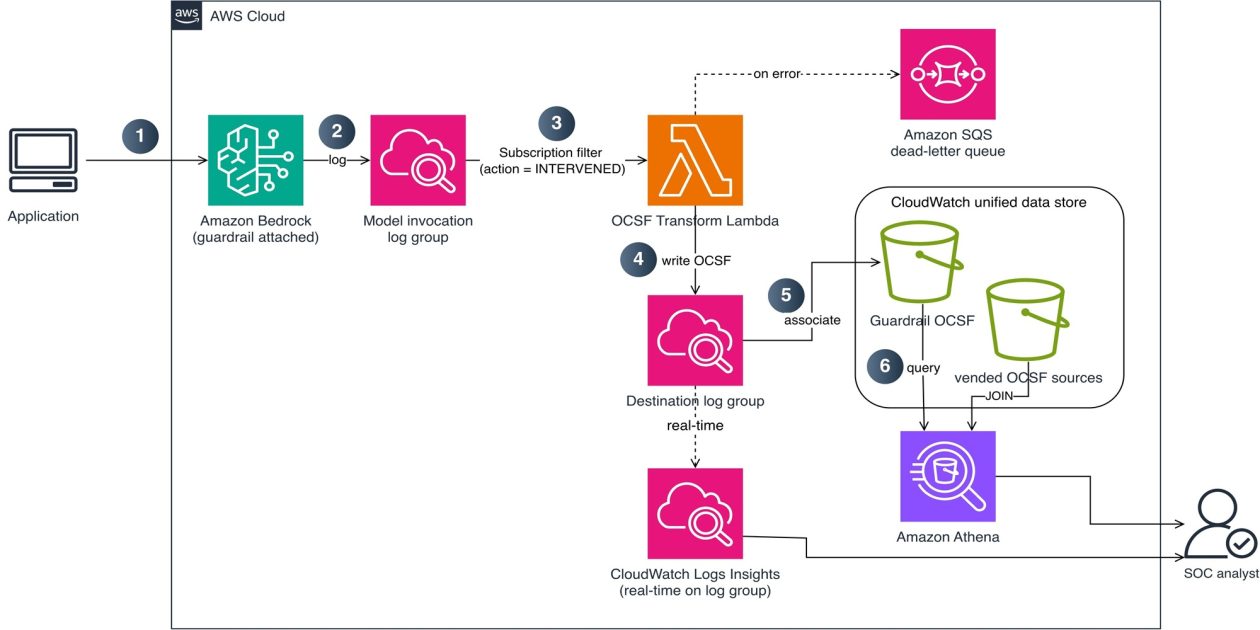
AWS walks through a reference pipeline (Lambda + CloudWatch Logs subscription filter + AWS S3 Tables) that transforms AWS Bedrock Guardrails intervention events — blocked prompt injections, PII redactions, content-policy hits — from Bedrock model invocation logs into OCSF Detection Finding (class_uid 2004) records, landing them in the CloudWatch unified data store. This lets SOC analysts correlate guardrail interventions with AWS CloudTrail and VPC Flow Logs via Athena or CloudWatch Logs Insights, e.g. spotting accounts with both prompt-injection blocks and failed IAM calls, and complements GuardDuty AI Protection's managed findings. Includes OCSF field mapping, multi-account centralization pattern, and a cloneable CDK-based implementation.
aws.amazon.comwriteupAdded 7 Oct 2026, published 21 Sep 2026🛡️ Security Attacker infrastructure, but vibe-coded: tracking the evolution of credential harvesting platforms
Datadog Security Research analyses two vibe-coded credential harvesting platforms, Loot and UltraVault, monitored since July 2026. Loot catalogs plaintext secrets, including 1,778 AI keys (196 live). UltraVault adds credential validation, exploit chains, a 14-bug LPE matrix and AWS key-pair correlation. The same host probed Amazon Bedrock with GetCallerIdentity, ListFoundationModels and InvokeModel, using kali-cloud Boto3 and Python-urllib user agents.
securitylabs.datadoghq.comwriteupAdded 29 Oct 2026, published 18 Sep 2026🛡️ Security Exploring the new AWS Sign Up experience
Wiz researchers reverse-engineered AWS's new sign-up experience, which silently creates a three-account AWS Organization (management, identity, and a restricted sandbox member account) with Builder ID login instead of root credentials. They found the sandbox blocks security services like GuardDuty, SecurityHub, Detective, Inspector, Macie and Access Analyzer via an allowlist SCP (FreeTierSCP), while still permitting risky practices such as IAM user access keys, public S3 buckets, and IMDSv1 EC2 instances; a data-perimeter RCP also blocks cross-account sts:AssumeRole until the account is upgraded, potentially pushing vendors back toward IAM user keys. The new IAM Role Manager feature further undermines least privilege by auto-attaching PowerUserAccess to console-created roles.
wiz.iowriteupPublished and added 17 Sep 2026🛡️ Security


Showing 30 of 86
Show more