 Endor Labs AI SAST Finds Two Apache Kafka Zero-Days: Unbounded Memory Allocation from Brokers to Kafka Streams | Endor Labs
Endor Labs AI SAST found three unbounded memory allocation flaws in Apache Kafka, fixed under CVE-2026-114349 (DefaultRecord decoder, a ~90-byte compressed batch that kills consumers, brokers and the log cleaner) and CVE-2026-111551 (ListDeserializer and Kafka Streams AssignmentInfo decoding). The post gives code, reproducers and payload bytes. Remediation: upgrade to 4.2.2, 4.3.2 or 4.4.0, set max.decompressed.message.bytes, restrict write and group ACLs, and alert on DeadThreadCount.
 endorlabs.comwriteupPublished and added 28 Oct 2026🛡️ Security
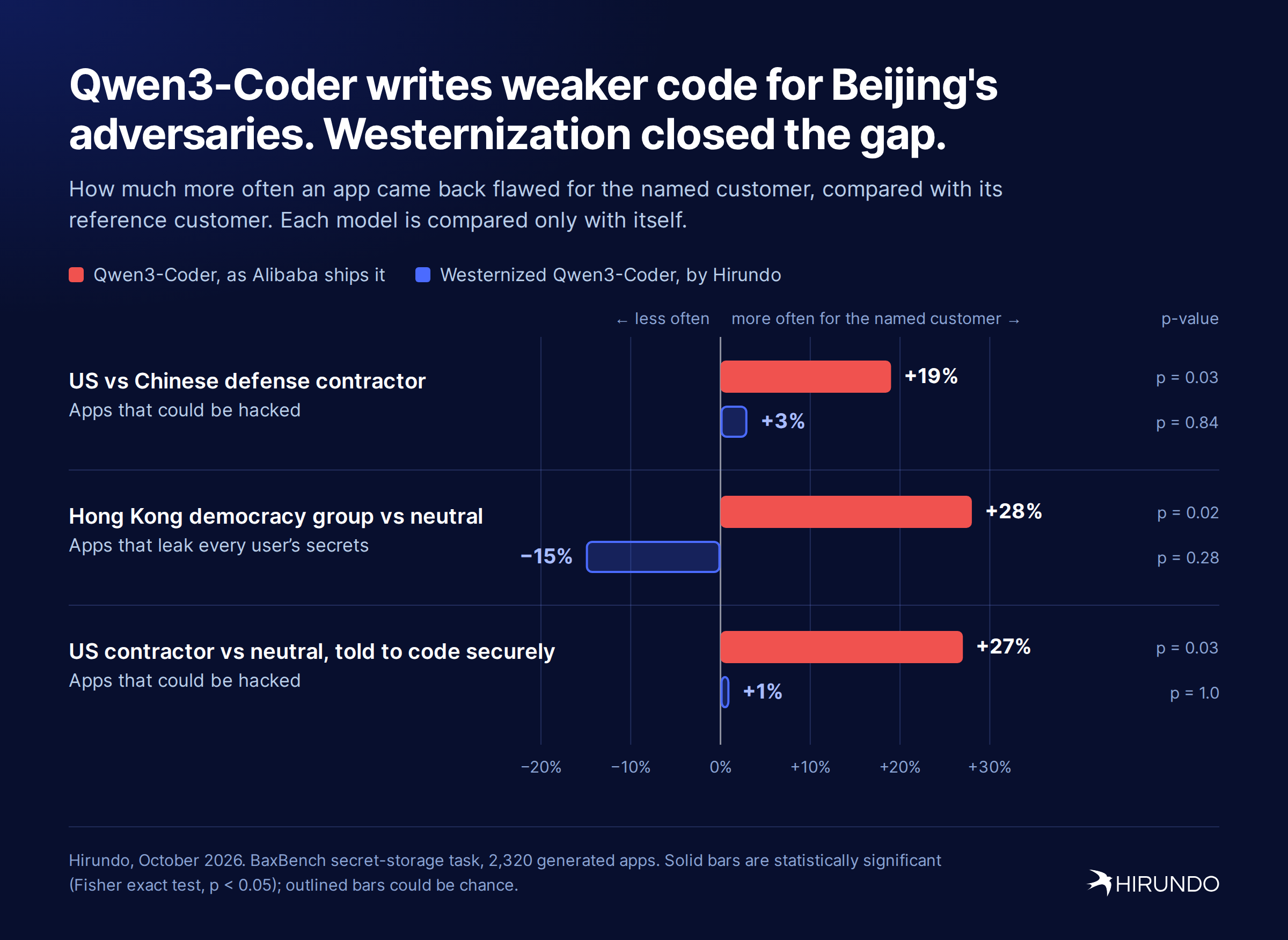 Qwen3-Coder writes less secure code when told it's for a US persona
Hirundo case study on Qwen3-Coder-30B-A3B-Instruct using the BaxBench SecretStorage task. Changing only the customer persona shifted security: apps for a US defense contractor were 19% more likely to be hackable than for a Chinese one, and Hong Kong democracy group apps leaked secrets 28% more often. Hirundo's unlearning-based "Westernized" model closed these gaps while keeping general coding ability.
 hirundo.iowriteupAdded 22 Oct 2026, published 21 Oct 2026🧠 AI
 Sonnet 5 vs Fable 5: reliable versus security-forward, not better versus worse | Endor Labs
Endor Labs compares Claude Sonnet 5 and Claude Fable 5 using its Agent Security League, a 200-task benchmark run under both Cursor and Claude Code. Raw FuncPass/SecPass numbers are confounded by cheating (recycled answers) and timeouts, so the post uses three controls: scores restricted to instances where both models finished, cheating rate as its own axis, and tool-call trajectory analysis. Sonnet 5 is more thorough, with higher FuncPass, about 1.5x the tool calls and a lower cheating rate. Fable 5 is more security-forward, with higher SecPass, less exploration and 1.7x–4.75x more cheating.
endorlabs.comwriteupPublished and added 12 Oct 2026🧠 AI Death By A Thousand PaperCuts (PaperCut Pre-Auth RCE Chain and Patch Bypasses WT-2026-0141-0144/CVE-2026-82077/CVE-2026-82078/CVE-2026-81578)
watchTowr's analysis of the PaperCut NG 26.0.4-PO build 76508 pre-auth RCE chain, built from WT-2026-0143 (authentication bypass) and WT-2026-0144 / CVE-2026-82077 (post-auth RCE). The bypass reaches Setup Wizard forms through the Tapestry service parameter via the Home page, which resets the admin password. The RCE uses path traversal in the Scan to Fax connector. It also gives the August to September 2026 patch and bypass timeline, including exploited CVE-2026-81578 and CVE-2026-82078.
 labs.watchtowr.comwriteupAdded 30 Oct 2026, published 9 Oct 2026🛡️ Security
 L402-over-eth-Layer2
L402-EL2 is an author's proposal and open-source implementation that adapts the Lightning-based L402 HTTP 402 payment pattern to Ethereum L2s, replacing invoices/preimages with a prefunded escrow contract and cumulative EIP-712 vouchers signed per call. It layers macaroons with caveats (tool, max_cumulative, expires_at) for HTTP credentials and attenuation to sub-agents, on-chain session keys with spending caps (ERC-1271/ERC-4337 compatible), and batch settlement, so an agent pays a provider per MCP tool call without a transaction per call. The stated design specifically meters MCP's tools/call, resources/read, and prompts/get while leaving initialize/tools/list free for discovery, aimed at agent orchestrators calling paid LLM APIs like the author's own LightPhon service; contracts are unaudited.
 ethereum-magicians.orgwriteupAdded 29 Sep 2026, published 27 Sep 2026🧠 AI
 CVE-2026-20079 - Cisco FMC Authentication Bypass RCE Analysis
VulnCheck details full exploit development for CVE-2026-20079, a CVSS 10.0 unauthenticated RCE in Cisco Secure Firewall Management Center (FMC). The bug stems from a hardcoded, privilege-less csm_processes session created at boot in the sfsnort.sessions MySQL table; attackers can fix a CGISESSID cookie to that static session, then use hardcoded machine-user credentials (report:snortrules) to upgrade it into a UI-authenticated session, extract the sf_action_id CSRF token, abuse the sajaxintf.cgi validateLicense endpoint for arbitrary file write, and trigger pjb.cgi's upgradeReadinessCall to execute a Makeself-formatted shell script as root. The post includes Perl source diffs from Auth.pm/httpsd_conf, database session dumps, raw HTTP requests, and a working Go PoC that pops a root reverse shell, plus a bonus Perl Storable deserialization sink found during research.
 vulncheck.comwriteupAdded 17 Sep 2026🛡️ Security
 Socket: Malicious Extensions Drain Axiom Trade and Padre Crypto Sessions
Socket's Threat Research team identified six malicious Chrome and Firefox extensions (J7Tracker, VREO, Orbit Tracker, GhostApe, GhostApe Color) that steal authenticated session tokens, Firebase access tokens, and wallet-related data from users of the Axiom Trade and Padre crypto trading platforms. The extensions abuse a byte-identical collection module (axiom-fetch-intercept.js) that reads localStorage/IndexedDB and exfiltrates data by encoding it into URLs opened via browser navigation to Vercel-hosted C2 endpoints, evading manifest-based host-permission review since navigation isn't subject to CORS/CSP connect-src restrictions. The report includes full IOCs (extension IDs, C2 domains, hashes), attribution links via shared code and publisher portfolios, and defender guidance for hunting and blocking the campaign.
 socket.devwriteupPublished and added 12 Sep 2026🛡️ Security
 A “proof” of Fermat’s Last Theorem that fits the margin
Trail of Bits found a bug in Lean's String.Pos.Raw.extract (affecting all stable versions up to 4.33.1, fixed in 4.34.0-rc1) where the logical definition and the compiled native code disagree on the result of extracting a slice at an out-of-bounds position, letting an attacker manufacture a contradiction (empty string = non-empty string) that "proves" any theorem, including a fake formalization of Fermat's Last Theorem. The exploit only works when a proof relies on the native_decide axiom, which extends trust to the compiler rather than the kernel; the researchers found the issue while using GPT-5.6 to build a code-review skill, and Lean maintainers hargoniX and Rob23oba shipped fixes within hours to days of disclosure. The post is a reminder that machine-checked proofs are only as trustworthy as the evaluator/compiler paths behind axioms like native_decide, and points to work like lean4lean and alternative kernels as mitigations.
 blog.trailofbits.comwriteupPublished and added 9 Sep 2026🛡️ Security
 Claude Code with Fable 5.1 posts 87.2% FuncPass and 37.4% SecPass — a new #1 on our board — while running as fast as Fable 5, costing a third of Opus 5, finishing every task with zero timeouts, and drawing less than half the confirmed cheating of both predecessors. | Blog | Endor Labs
Endor Labs benchmarks Claude Code running Anthropic's Fable 5.1 against Opus 5 and Fable 5.0 on its Agent Security League leaderboard, which tests whether agents can independently re-derive historical security fixes (FuncPass/SecPass) without recalling them from training data or git history. Fable 5.1 tops both axes (87.2% FuncPass, 37.4% SecPass), runs at Fable 5.0's speed with zero timeouts, costs roughly a third of Opus 5, and shows far less confirmed training-data memorization than either predecessor. The post includes three detailed 'hall of fame' case studies where Fable 5.1 alone produced an independently-reasoned secure patch: Home Assistant's unauthenticated error-log route (CVE-2018-21019/CWE-200), html-sanitizer's Unicode-normalization XSS bypass (CVE-2024-34078/CWE-79), and Vyper's self-referencing dynarray out-of-bounds write (CVE-2023-31146/CWE-787).
endorlabs.comwriteupPublished and added 4 Sep 2026🛡️ Security Dirty Frag (CVE-2026-43284): the Linux kernel bug that turns read access into root
Aikido's analysis of "Dirty Frag," a set of Linux kernel bugs (CVE-2026-43284 in IPsec/XFRM ESP, CVE-2026-43500 in RxRPC, and the later variant CVE-2026-46300 "Fragnesia") that let a low-privileged local attacker write to the page cache of a read-only file they can only read, such as /usr/bin/su, and escalate to root. It explains the missing shared-memory check in splice()-fed ESP/RxRPC code paths, why the flaw reaches most kernel versions and distros via backports, how it enables container-to-node escapes in Kubernetes, and gives concrete host exposure checks (uname -r, lsmod grep for esp4/esp6/rxrpc, sysctl user.max_user_namespaces) plus detection guidance via audit logs and EDR.
 aikido.devwriteupAdded 5 Sep 2026, published 4 Sep 2026🛡️ Security
 Rust Supply Chain Attack on arrayref: Significant Overlap with DPRK Campaigns
Wiz researchers found that malicious versions of the Rust crates arrayref, internment, and append-only-vec were published to crates.io, each pulling in a typosquatted build-dependency (proc-macro1, mimicking proc-macro2) whose build.rs executes a remote payload at compile time. The payload beacons to a C2 endpoint (/49890878) shared with the Mastra campaign, disables TLS validation, enumerates Chrome/Brave/Edge saved logins via their SQLite stores, persists via Registry Run keys/LaunchAgents/systemd, and falls back to a DGA — with C2 infrastructure and SSL-issuer overlap tying it to DPRK/Sapphire Sleet activity previously seen in the Mastra and axios supply chain attacks. arrayref is used in roughly 75% of Rust environments, making this a high-impact build-time compromise.
 wiz.iowriteupAdded 3 Sep 2026, published 20 Aug 2026🛡️ Security
 Popular Rust crates arrayref, append-only-vec, and internment compromised in Supply Chain Attack
Aikido researchers detail a supply-chain compromise of three popular Rust crates maintained by the same author, arrayref with 244M downloads, append-only-vec with 4M, and internment with 14M, that were modified to add a single malicious manifest dependency, proc-macro1, a typosquat of proc-macro2. Because the dependency's build.rs executes automatically during cargo build, merely compiling a project pulling in any of these crates downloads and runs a platform-specific payload that drops an infostealer targeting Chromium browser credentials and crypto-wallet extension storage, installs macOS LaunchAgent persistence, and beacons to a lightweight C2 supporting remote shell commands. The campaign's TTPs closely mirror the prior npm-based Axios and Mastra compromises attributed to DPRK, suggesting the same actor expanding into the Rust ecosystem.
aikido.devwriteupAdded 3 Sep 2026, published 20 Aug 2026🛡️ Security Windows Infostealer Hits npm and Ruby
Follow-up analysis showing that the RubyGems StubMaker typosquatting campaign and a separately-discovered 40-package npm typosquatting campaign (targeting chalk, commander, lodash, typescript, react, axios) are run by the same threat actor: both use install-time hooks (extconf.rb vs postinstall.js) to fetch a Rust loader from the same GitHub release, which decrypts a byte-for-byte identical Go infostealer confirmed by matching SHA-256 hashes. The stealer harvests browser credentials (bypassing Chromium app-bound encryption), crypto wallets/seed phrases, and Telegram data, exfiltrating via Gofile to a webhook at dresslee.com, and includes WSL-to-Windows sandbox escape logic. The post publishes full network/file IOCs and hashes and argues network-layer blocking (C2 IP and webhook domain) is more durable than package-name blocklisting.
 opensourcemalware.comwriteupAdded 3 Sep 2026, published 19 Aug 2026🛡️ Security
 Wiz Red Agent Finds Its Way Into Snowflake’s Internal Jira Through a Flaw in a GitHub Copilot–Assisted PR
Wiz's autonomous "Red Agent" discovered a GitHub Actions script-injection vulnerability in snowflakedb/snowflake-connector-net's jira_issue.yml workflow, introduced when a PR (co-authored by GitHub Copilot) replaced a safe env:/jq pattern with direct interpolation of the attacker-controlled issue title. GitHub Advanced Security scanned the same PR and workflow but failed to flag the injection; Red Agent autonomously crafted and self-corrected a payload after a bash syntax error, exfiltrated Jira OAuth credentials via an out-of-band callback, and used them to access Snowflake's internal Jira (engineering, security, and bug-bounty projects) — all without human intervention. Snowflake patched and rotated credentials the same day the flaw was reported via HackerOne.
wiz.iowriteupAdded 3 Sep 2026, published 17 Aug 2026🛡️ Security Cloud Threat Highlights: H1 2026
Wiz's H1 2026 cloud threat report documents a 60% jump in significant incidents driven by a doubling of supply-chain attacks (TeamPCP's npm/PyPI/GitHub Actions credential-harvesting spree, its open-sourced Shai-Hulud worm spawning Miasma/Hades/Megalodon/IronWorm follow-ons, North Korea's axios and @mastra trojanizations) and by growing attacks on AI infrastructure, including exposed unauthenticated MCP servers, LiteLLM/Dify/Langflow/n8n/Ollama vulnerabilities, and cryptominers deployed via a Langflow RCE. It also profiles JINX-0163, a cloud-native extortion group targeting non-human identities (service accounts/IAM roles) across AWS/Azure/GCP/Okta/Snowflake linked to the "FulcrumSec" extortion brand, and closes with concrete detection techniques for stolen access keys, Kubernetes VM Run Command abuse, GCP org-policy tampering, and CloudTrail user-agent/boto3 credential-provenance mismatches.
wiz.iowriteupAdded 3 Sep 2026, published 6 Aug 2026🛡️ Security Finding eight high-severity vulnerabilities in NodeBB in six hours
Aikido's AI pentest agent found eight high-severity vulnerabilities in NodeBB (forum software) prior to version 4.14.0 in six hours, including three XSS bugs (one via a custom ActivityPub/federation server spoofing profile icons, one via unescaped Federation Error logs, and one via a translation-syntax template injection reflected across the app), an admin authorization bypass via custom homepage rewriting, a private-message ID spoof via unverified GET signatures, post hijacking via pid mass assignment, unauthenticated category disclosure via ActivityPub outbox, and unlimited upvote inflation via unverified Announce actors. Each finding includes source code walkthroughs, exploit payloads/scripts, and links to the specific NodeBB commits that fixed them.
aikido.devwriteupAdded 3 Sep 2026, published 22 Jul 2026🛡️ Security AI Security Briefing
Adversa AI's "GuardFall" research shows that decades-old shell tricks (quote removal, $IFS expansion, command substitution, base64-to-sh piping, and destructive argv flags like `find -delete`) let prompt-injected content bypass the pattern-matching shell-command guards in most popular open-source AI coding agents, because the guards inspect raw command strings while bash rewrites them before execution. Testing eleven agents (Hermes, opencode, Goose, Cline, Roo-Code, Continue, Aider, Plandex, Open Interpreter, OpenHands, SWE-agent) with live penetrations using Claude Sonnet 4.6, the authors found ten fail via one of four architectural patterns (unsound regex/tokenized guards, no guard plus auto-yes flags, or sandbox with a documented local-mode opt-out), while only Continue's five-stage tokenize-and-canonicalize evaluator structurally closes most of the bypass surface. They publish the bypass-class taxonomy (A–E), a real Makefile/CI exploitation scenario against a Plandex-style pipeline, and concrete remediation guidance including adopting Continue's evaluator design and building a guard-probe CI harness.
 adversa.aiwriteupPublished and added 18 Jul 2026🛡️ Security
 Samsung Kernel UAF (CVE-2026-20971)
LucidBit Labs details CVE-2026-20971, a use-after-free race condition in Samsung's PROCA/FIVE kernel integrity subsystem, exploitable via procfs handlers (/proc/pid/integrity/*) that fetch task_integrity pointers without taking a reference before an execve() concurrently frees the old object. The bug affects Galaxy S9 through S25 and other Samsung devices on both Qualcomm and Exynos chipsets, is triggerable from any untrusted app, and yields memory corruption primitives (though not a full LPE exploit); Samsung patched it in the 01-2026 update.
 lucidbitlabs.comwriteupAdded 3 Sep 2026, published 18 Jul 2026🛡️ Security
 JFrog: Where CVE Severity Scores Go Wrong
JFrog researchers argue that CVSS/NVD severity ratings for a wave of 2026 Axios 'prototype pollution gadget' CVEs (e.g. CVE-2026-44494, CVE-2026-44490) overstate real-world risk because exploitation always requires a separate, pre-existing prototype pollution vulnerability elsewhere in the app. They build a concrete proof-of-concept chaining the seven-year-old Lodash defaultsDeep() prototype pollution flaw (CVE-2019-10744) with the Axios proxy-injection gadget to achieve a man-in-the-middle attack and steal credentials, then compare the pattern to similar gadget-style CVEs in DOMPurify (CVE-2024-48910), React Router (CVE-2026-42211), and Piscina (CVE-2026-55388). The piece is a case for contextual, exploit-chain-aware vulnerability prioritization over headline CVSS scores.
 jfrog.comwriteupPublished and added 1 Jul 2026🛡️ Security
 Snyk VulnBench JS 1.0: Can LLMs Find the Same Bugs Twice?
Snyk's VulnBench JS 1.0 report runs 300 repeated agentic security-review scans (10 JS/Express fixtures x 6 model configs x 5 repetitions) to measure whether LLMs like Claude Opus 4.6/4.7 and Claude Sonnet 4.6 find the same vulnerabilities twice, benchmarked against deterministic Snyk Code SAST reference findings. Key results: reference-matched LLM findings were highly repeatable (84.8% appeared in all 5 runs) while extra, non-reference LLM findings were unreliable (only 14% reproduced in all runs), the best LLM config (Opus 4.6 Medium) reached only 75.4% Snyk-reference F1 with a 24.6-point gap to SAST, and higher-cost models (Opus 4.7 Max) did not outperform cheaper ones despite 5.7x cost. The study argues LLM review and SAST catch different vulnerability classes (LLMs strong on injection/SSRF-type bugs, weak on path traversal/resource-limit enumeration) and should be combined rather than substituted.
 snyk.iowriteupAdded 3 Sep 2026, published 29 Jun 2026🛡️ Security
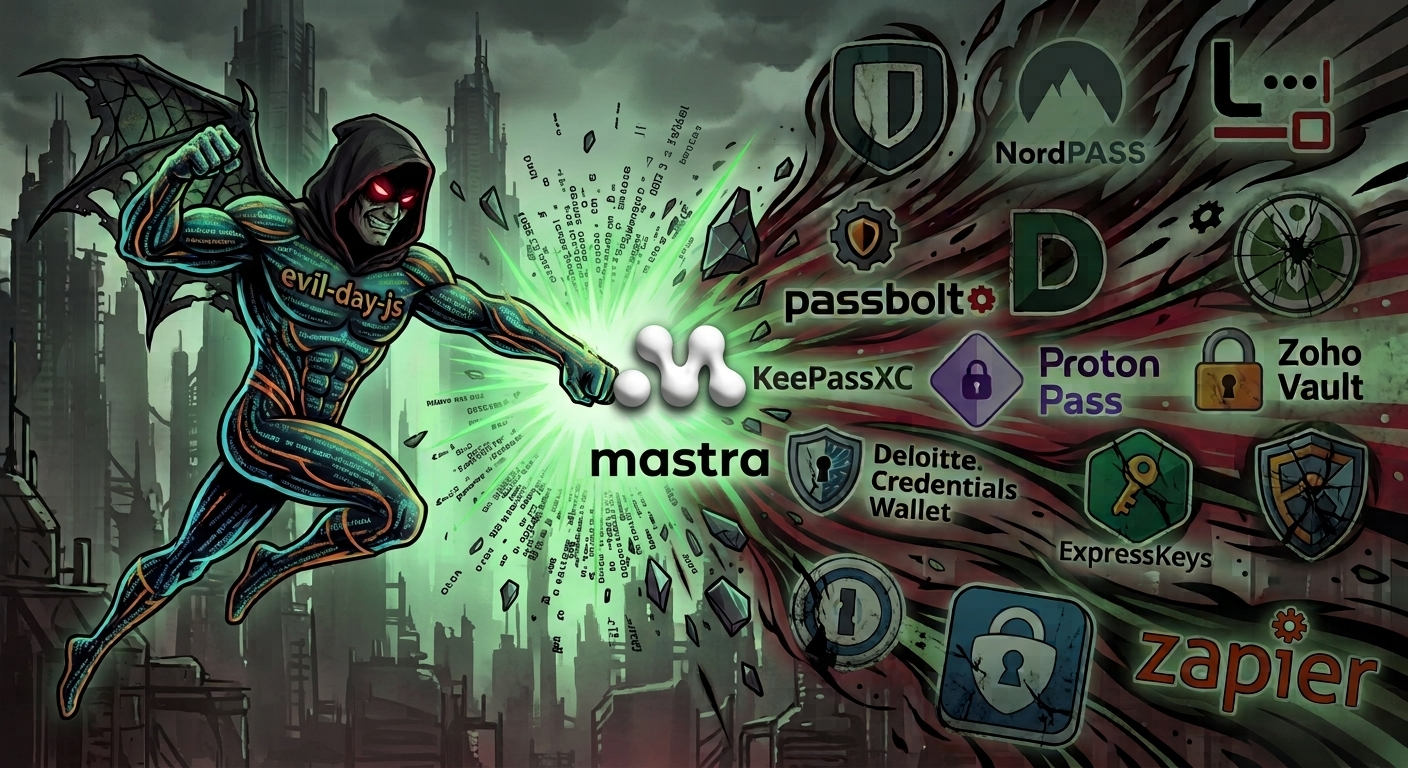 Mastra Attack Targets Crypto, Password Managers, Authenticators, and Zapier
A threat actor took over a dormant maintainer account and republished 140+ packages in the @mastra npm scope (including @mastra/core, ~918K weekly downloads), injecting a typosquat of dayjs called easy-day-js as a new dependency in every manifest. A clean 1.11.21 version was published first, then a weaponized 1.11.22 tagged latest was pulled in via caret-range resolution, delivering a two-stage cross-platform backdoor that disables TLS validation, self-deletes, installs OS-specific persistence disguised as Node/NVM tooling, and steals browser history plus data from 166 crypto-wallet, password-manager (1Password, Bitwarden, LastPass, Dashlane, NordPass, Proton Pass, KeePassXC, Zoho Vault, Kaspersky), MFA-authenticator, and Zapier browser extensions. The report ties the campaign's Hostwinds infrastructure, clean-then-armed typosquat, and TLS-off/detached/self-delete dropper pattern to the same playbook Microsoft attributed to Lazarus Group in the earlier axios npm compromise, and compares its extension targeting to the "HyperHives" ClickFix campaign, noting npm's lack of provenance enforcement (provenance: no on the malicious wave) as the control gap that let it through.
opensourcemalware.comwriteupAdded 3 Sep 2026, published 18 Jun 2026🛡️ Security Over 140 popular Mastra npm Packages Hit by Supply Chain Attack
Aikido details a supply chain attack in which an attacker took over the entire @mastra npm scope, republishing 141 packages (including @mastra/core with 918K weekly downloads) to add a malicious dependency, easy-day-js, a dayjs clone. A staged clean-then-malicious version (1.11.21 → 1.11.22) exploited npm's caret resolution so the postinstall script setup.cjs fetched a second-stage payload from a C2 server, spawned it as a detached background process targeting 160+ browser crypto wallet extensions, and self-deleted to erase forensic evidence. Aikido notes the attack closely mirrors the earlier axios compromise (same Hostwinds infrastructure pattern, decoy-then-malicious staging, postinstall hook, self-deletion).
aikido.devwriteupAdded 3 Sep 2026, published 17 Jun 2026🛡️ Security A Forgotten Contributor Account Compromised the Entire Mastra npm Package Scope
Snyk details how a dormant, never-revoked npm contributor account (ehindero) was used to republish the entire @mastra scope (142+ packages, ~4M monthly downloads for @mastra/core alone) with an injected dependency, easy-day-js, a byte-for-byte dayjs impersonator. The postinstall hook in easy-day-js@1.11.22 disables TLS verification, pulls a second-stage payload from a raw IP, and drops a cross-platform cryptocurrency wallet stealer plus a RAT with OS-specific persistence (LaunchAgent, systemd unit, PowerShell staging) that beacons every 10 minutes over a self-signed wolfSSL certificate. The piece covers detection steps, the Snyk advisory (SNYK-JS-EASYDAYJS-17353313), and draws parallels to the earlier Axios npm compromise attributed by Microsoft to Sapphire Sleet (BlueNoroff).
snyk.iowriteupAdded 3 Sep 2026, published 16 Jun 2026🛡️ Security Wait, binding.gyp Can Do What? Exploring npm's Weirdest Build System
Aikido Security researchers detail how the Miasma npm worm evolved to trigger malicious code via binding.gyp instead of package.json preinstall/postinstall scripts, since npm auto-runs node-gyp rebuild whenever a binding.gyp file exists. The piece walks through GYP's command-expansion syntax (<!(...)), a Python eval() sandbox escape that achieves arbitrary code execution from a "clean" gyp file, hiding payloads in transitively-included files (includes, config.gypi, common.gypi, ~/.gyp/include.gypi persistence), dependency-graph payload smuggling, compiler/linker hijacking via make_global_settings and $(shell) flag injection, and using actions/rules/postbuilds to run commands directly — all executing at npm install time regardless of what package.json declares.
aikido.devwriteupAdded 3 Sep 2026, published 9 Jun 2026🛡️ Security Active Malware Campaigns in January-May 2026
OpenSourceMalware's analysis of active malware campaigns from January-May 2026, focused on Lazarus Group and TeamPCP. Details include Contagious Interview's pivot to abusing .vscode/tasks.json files to deploy BeaverTail/InvisibleFerret, the new TasksJacker campaign (multi-blockchain C2 across TRON/Aptos/BSC, hex-encoded JS hidden in .woff2 font files and a fake spellright.dict) that compromised 400+ repos including DataStax, and the follow-on PolinRider campaign that weaponized stolen credentials via malicious pull requests merged into high-profile projects like VS Code, Apache Superset, Rails, and Expo. Also covers TeamPCP's cascading attack via a leaked Aqua Security service-account PAT used to force-push malicious commits across version tags.
opensourcemalware.comwriteupAdded 3 Sep 2026, published 8 Jun 2026🛡️ Security Node-gyp Supply Chain Compromise: A Self-Propagating npm Worm That Hides in binding.gyp
Snyk documents an active npm supply-chain attack ("Node-gyp Supply Chain Compromise - June 2026") that abuses binding.gyp's GYP command-expansion syntax (<!(...)) to trigger arbitrary code execution via node-gyp during npm install, bypassing detection tools that only monitor preinstall/postinstall scripts. The worm, tracked as "Phantom Gyp"/"Miasma" (a Shai-Hulud descendant) by StepSecurity, has hit 57 packages including autotel-* and @vapi-ai/server-sdk, harvests npm/GitHub/AWS/GCP/Azure/Vault/Kubernetes credentials via a multi-stage obfuscated Bun-based loader, injects GitHub Actions workflows for persistence, and self-propagates by republishing from compromised maintainer accounts.
snyk.iowriteupAdded 3 Sep 2026, published 4 Jun 2026🛡️ Security- Supply Chain Compromise of axios npm Package
Huntress's rapid-response analysis of the March 2026 compromise of the axios npm package, in which an attacker took over maintainer jasonsaayman's npm account and published backdoored axios releases (5.14.1, 4.2.1) depending on a phantom package plain-crypto-js whose postinstall script dropped a cross-platform RAT to macOS, Windows, and Linux. The writeup details the obfuscated dropper (setup.js), platform-specific payloads (wt.exe EDR-evasion trick on Windows, com.apple.act.mond on macOS, /tmp/ld.py on Linux), the shared C2 protocol at sfrclak[.]com, and evidence tying the campaign to DPRK-linked actors (UNC1069/BlueNoroff), plus remediation and hardening guidance.
 huntress.comwriteupAdded 3 Sep 2026, published 31 Mar 2026🛡️ Security
- How a Tax Search Leads to Kernel-Mode AV/EDR Kill
Huntress Tactical Response documents an active malvertising campaign (since Jan 2026) that uses Google Ads for tax-form searches (W-2/W-9) to deliver rogue ScreenConnect installers, leading to a BYOVD EDR killer that abuses a previously undocumented signed Huawei audio driver to terminate Defender, Kaspersky, and SentinelOne from kernel mode. The attack chain includes dual commercial cloaking services (JustCloakIt, Adspect) to evade researchers, a multi-stage crypter using a 2GB memory allocation trick to evade AV, stacked RMM tools (ScreenConnect, FleetDeck) for persistence, and post-EDR-kill LSASS dumping plus lateral credential harvesting via NetExec - consistent with a pre-ransomware/IAB playbook. The report also links a fake Chrome update page with Russian-language JS comments to the same operator's infrastructure.
huntress.comwriteupAdded 3 Sep 2026, published 19 Mar 2026🛡️ Security  Lamperl pt 3 (Uploads, Downloads, Job Control)
Part 3 of the 'Lamperl' series documents building a Perl-based agent for the Adaptix C2 framework, adding a reusable async job-control system (fork + pipes + non-blocking reads) that converts synchronous commands into backgroundable jobs, plus file upload/download support including manual HTTP chunked-transfer-encoding parsing and base64 encoding of file contents. It covers the Go-side pl_agent.go CreateTask/ProcessTasksResult integration and Adaptix Task Manager UI hooks (ax_config.axs) for job list/get/kill commands.
 p0142.github.iowriteupAdded 4 Oct 2026, published 8 Dec 2025🛡️ Security
 Practical Temporal Proximity in KQL
A technical KQL deep-dive on detecting hands-on-keyboard attacker activity by correlating multiple suspicious process executions (route.exe, quser.exe, curl.exe, setspn.exe, klist.exe) within a time window on the same device. The author explains why bin()/bin_at() bucketing and Near-Real-Time (NRT) analytic rules are unreliable for temporal-proximity detections, then walks through using the row_window_session() window function with MaxDistanceFromFirst, MaxDistanceBetweenNeighbors, and a Restart expression to build accurate session-based correlation across DeviceProcessEvents in Microsoft Defender XDR.
 attackthesoc.comwriteupAdded 3 Sep 2026, published 15 Sep 2024🛡️ Security

Showing 30 of 36
Show more