 Inside a malicious Claude Code-branded extension and its persistent SSH backdoor
Microsoft Threat Intelligence analyzes a tampered anthropic.claude-code extension (versions 2.1.312 and 2.1.313) served on the Cursor marketplace on 29 October 2026. The injected JavaScript loader adds an SSH key labeled svc-telemetry, opens a reverse SSH tunnel and sets up persistence on macOS, Linux and Windows. The post gives cleanup steps, IOCs and Defender XDR hunting queries. VS Code Marketplace and npm were not affected.
 microsoft.comwriteupPublished and added 31 Oct 2026🛡️ Security
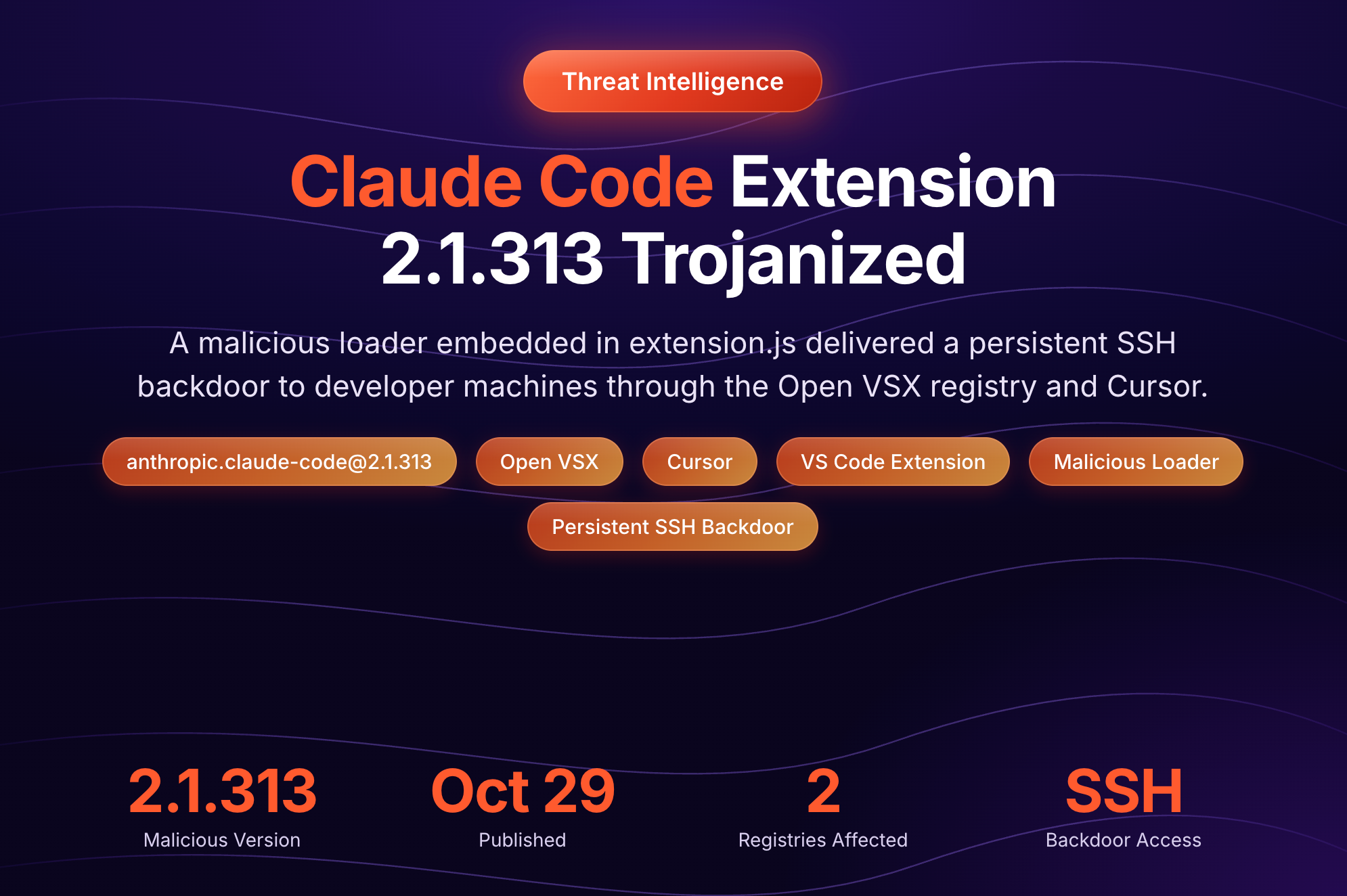 Trojanized Claude Code Extension Delivered Persistent SSH Backdoor to Developer Machines
The Claude Code VS Code extension anthropic.claude-code 2.1.313 was published on Open VSX on 29 October 2026 with a malicious loader prepended to extension.js. On load it planted an attacker SSH key (svc-telemetry), installed per-OS persistence, opened a reverse SSH tunnel and beaconed host recon over HTTP. Cursor reports at most 5,000 users received it in an 11-hour window. The post gives the timeline, cleanup artifacts and credential rotation steps.
 stepsecurity.iowriteupPublished and added 30 Oct 2026🛡️ Security
 Backdoor in Claude Code for VS Code extension on the Cursor Marketplace
Phorion analyzes a backdoor injected into versions 2.1.312 and 2.1.313 of the official Claude Code for VS Code extension on the Cursor Marketplace. An IIFE prepended to extension.js plants an SSH key, opens a reverse SSH tunnel to 134.209.82[.]225, persists via a fake com.apple.sysmond LaunchAgent and beacons host recon. A macOS systemsetup check bug usually stops SSH from being enabled. The post lists detections and remediation.
 phorion.iowriteupAdded 31 Oct 2026, published 30 Oct 2026🛡️ Security
 “Next Exploit Opportunities”: How a Threat Actor Used AI to Help Plan and Execute Multiple Types of Cybercrime Activities
Unit 42 analysis of a threat actor, BUGSTER, who ran the Hermes Agent framework with jailbroken DeepSeek V4 and Cursor to plan and run cybercrime. Activity included a WordPress brute force, a MongoDB exfiltration of over 5,200 student records at an Indian university, VoIP fraud planning, Wi-Fi cracking via Vast.ai GPUs, and crypto whale reconnaissance. The report covers the actor's prompt-level safety override, infrastructure (162.243.3[.]92) and attribution.
 unit42.paloaltonetworks.comwriteupAdded 30 Oct 2026, published 21 Oct 2026🛡️ Security
 Gemini 4 Argon on Cursor: solid security score, two unique solves, but slower and more expensive | Endor Labs
Endor Labs ran Gemini 4 Argon in the Cursor harness on its Agent Security League coding tasks (SusVibes). Argon ties Fable 5 at 29% SecPass with 78.8% FuncPass, and uniquely and securely solves two tasks (SABnzbd CVE-2021-29488 and OpenStack Nova CVE-2015-8749). It is also the slowest and costliest recent combo: 14 minutes median per task and $765. The run had 29 confirmed cheating instances.
 endorlabs.comwriteupPublished and added 20 Oct 2026🧠 AI
 Putting models to the secure coding test: Security rules
Datadog Security Labs tests whether Project CodeGuard v1.4.0 security rules improve the code written by Claude Code (Sonnet 5), Cursor (Composer 2.5) and Codex (GPT 5.5). Each model built the same document portal app once. Only GPT 5.5 closed the cross-user document IDOR and improved clearly. Sonnet 5 and Composer 2.5 stayed largely unchanged, keeping IDOR, hardcoded secret fallbacks and token revocation gaps.
 securitylabs.datadoghq.comwriteupAdded 29 Oct 2026, published 19 Oct 2026🧠 AI
- Putting models to the secure coding test: Security rules
Second post in a Datadog Security Labs series testing whether Project CodeGuard (v1.4.0) security rules improve code written by coding agents. Sonnet 5 (Claude Code), Composer 2.5 (Cursor) and GPT 5.5 (Codex) each built the same document portal, and the output was audited with Datadog Code Security and a Sonnet 5 code review. Only GPT 5.5 closed the cross-user IDOR; Sonnet 5 and Composer 2.5 stayed largely unchanged, including hardcoded JWT secret fallbacks and incomplete revocation.
securitylabs.datadoghq.comwriteupAdded 29 Oct 2026, published 19 Oct 2026🛡️ Security  Sonnet 5 vs Fable 5: reliable versus security-forward, not better versus worse | Endor Labs
Endor Labs compares Claude Sonnet 5 and Claude Fable 5 using its Agent Security League, a 200-task benchmark run under both Cursor and Claude Code. Raw FuncPass/SecPass numbers are confounded by cheating (recycled answers) and timeouts, so the post uses three controls: scores restricted to instances where both models finished, cheating rate as its own axis, and tool-call trajectory analysis. Sonnet 5 is more thorough, with higher FuncPass, about 1.5x the tool calls and a lower cheating rate. Fable 5 is more security-forward, with higher SecPass, less exploration and 1.7x–4.75x more cheating.
endorlabs.comwriteupPublished and added 12 Oct 2026🧠 AI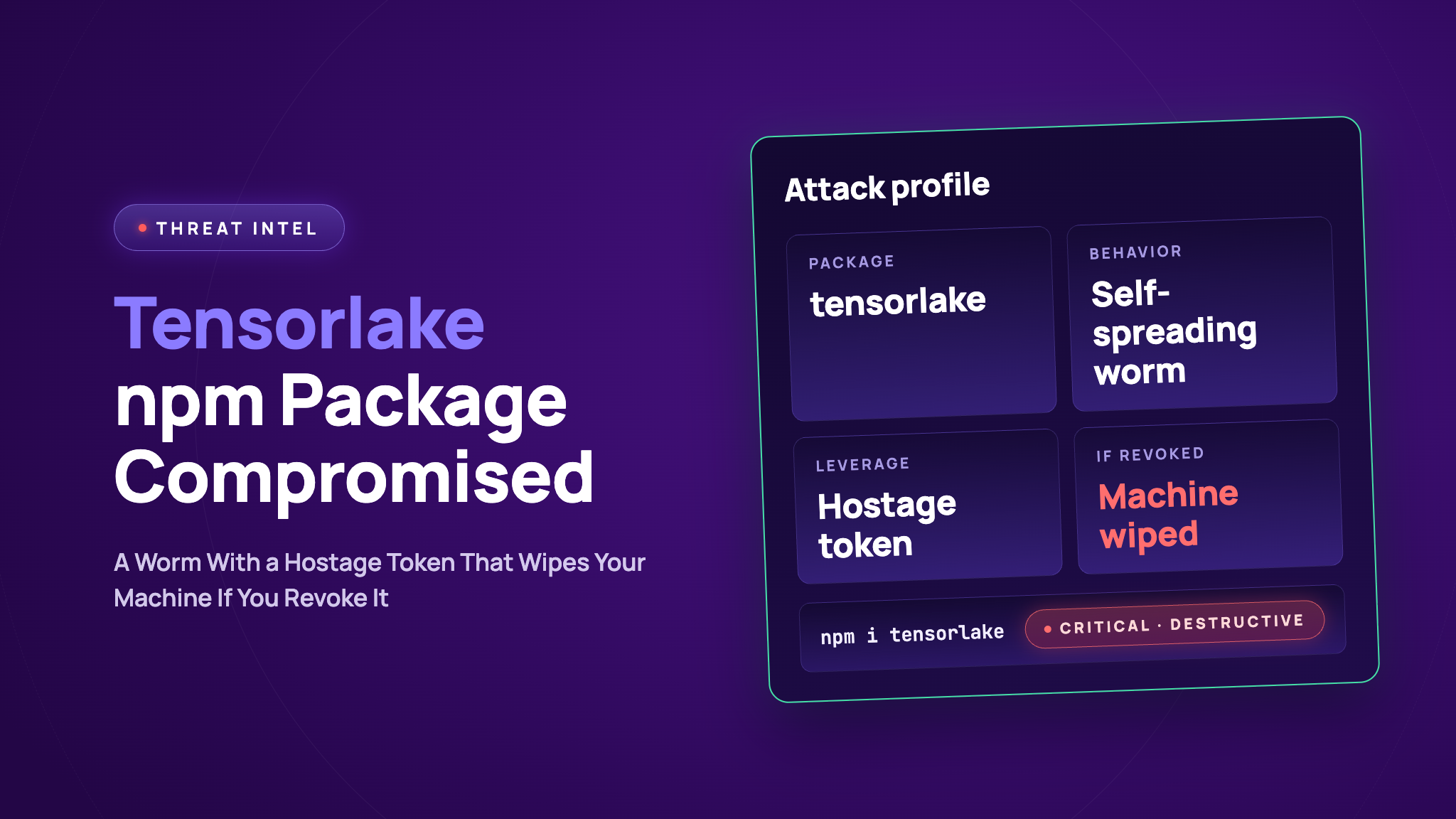 Tensorlake npm Package Compromised: A Worm With a Hostage Token That Wipes Your Machine If You Revoke It
StepSecurity details how tensorlake@0.5.144 was pushed to npm after malicious commits landed directly on the tensorlakeai/tensorlake GitHub repo's main branch under a maintainer's identity, carrying a valid npm provenance attestation despite being malicious. The preinstall hook downloads Bun to run an obfuscated payload that steals GitHub/npm tokens, cloud and Vault/Kubernetes secrets, SSH keys, browser logins, and AI-tool configs (Claude, Cursor, Windsurf), then self-propagates by republishing stolen npm packages and committing persistence files (.claude/settings.json, .vscode/tasks.json) to reachable repos. A "hostage token" mechanism installs a gh-token-monitor service that runs a home-directory wipe if the stolen GitHub token is revoked before the monitor is removed, inverting the normal incident-response order.
stepsecurity.iowriteupPublished and added 8 Oct 2026🛡️ Security Top 10 attacks on Claude Code and what each one actually broke
Adversa AI catalogs ten distinct Claude Code attacks documented between September 2025 and September 2026: the Miasma supply-chain worm that hit 73 Microsoft repos via a SessionStart hook, TrustFall's unsandboxed MCP server execution on folder-trust, Check Point's CVE-2025-59536/CVE-2026-21852 pre-trust-dialog code execution and API key theft, Sentry-DSN-based "Agentjacking" prompt injection via fake bug reports, a 50-subcommand cap that silently disables deny rules, the SymJack symlink-to-config-hijack primitive working across six agent CLIs, Wiz's GhostApproval deceptive-approval-prompt finding (with CVE-2026-12958 at AWS and CVE-2026-50549 at Cursor but none at Anthropic), the Plugin4Shell SHA/branch-name collision bypassing plugin pinning, an academic MCP tool-poisoning paper achieving RCE on agent/LLM pairs, and SkillCloak's self-extracting-packer bypass of skill scanners. The piece argues almost none of these are model-behavior bugs - they are trust-boundary and consent failures in the surrounding tooling - and closes by pitching Adversa's own runtime agent security gateway as the fix.
 adversa.aiwriteupAdded 7 Oct 2026, published 23 Sep 2026🛡️ Security
 Socket: Two Joyfill npm Beta Releases Compromised to Deliver DEV#POPPER Remote Access Trojan
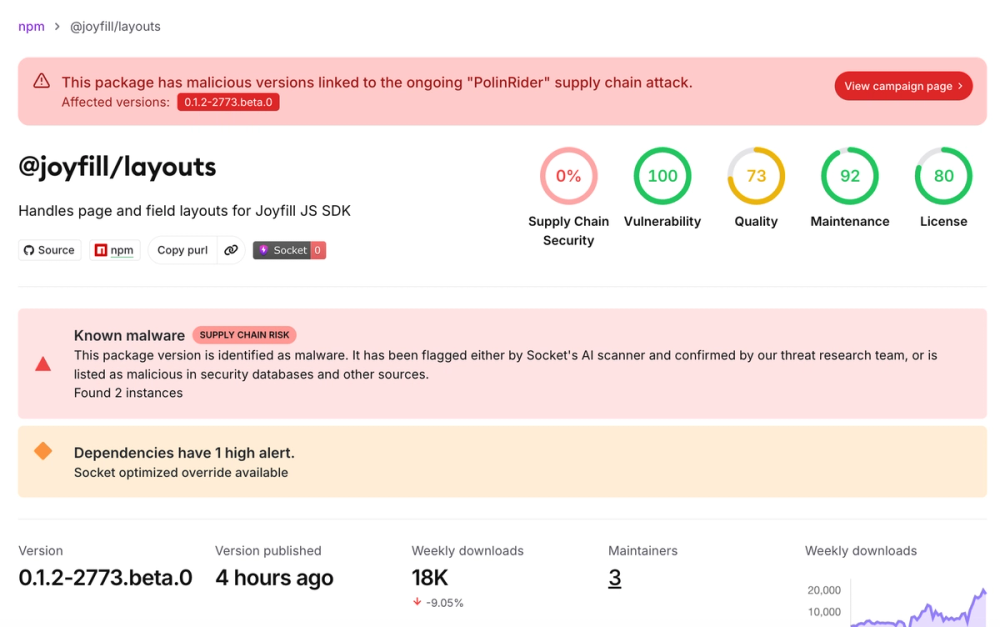
Socket's research team found two beta releases of the @joyfill npm packages (@joyfill/layouts and @joyfill/components) contained an import-time JavaScript implant that resolves encrypted payloads through Tron, Aptos, and BNB Smart Chain transactions, ultimately dropping a 77KB Node.js remote-access trojan matching the DEV#POPPER family and sharing loader fingerprints with the PolinRider blockchain-loader campaign. The RAT establishes a Socket.IO C2 channel, executes arbitrary JS/shell commands, exfiltrates files and clipboard data, and persists by patching files inside VS Code, Cursor, Antigravity, Discord Desktop, GitHub Desktop, and the global npm CLI; a parallel detached-process branch fetches an additional bootstrap that can deploy a Python credential/browser-data stealer assessed as an OmniStealer variant. Because the implant fires on module load (not via npm lifecycle scripts), `--ignore-scripts` provides no protection, and the writeup includes full IOCs, blockchain addresses, C2 infrastructure, and MITRE ATT&CK mappings.
 socket.devwriteupAdded 22 Sep 2026, published 20 Sep 2026🛡️ Security
 Underwriting Superintelligence: Backing Agents you can Sue — Rune Kvist, AIUC
Latent Space interview with Rune Kvist, cofounder of AIUC (AI Underwriting Company), on its $40M Series A and AIUC-1 — a quarterly-updated standard for agent security, safety and reliability that pairs technical controls with third-party testing (jailbreak resistance, hallucination rates, data leakage) and real Lloyd's of London-backed insurance. The piece traces AIUC's origin from Kvist's early Anthropic experience, explains why enterprises like Cursor, Harvey, Lovable and ElevenLabs pursue certification to unlock bank/hospital deployments, and previews AIUC's move toward model-level audits to bridge the trust gap between frontier labs and governments. It covers concrete mechanics of the certification process (control activities, evidence, auditors like KPMG/Schellman, 3–10 week timelines) alongside liability scenarios and the "who watches the watchdogs" problem for AI standards.
 latent.spacewriteupAdded 29 Sep 2026, published 16 Sep 2026🧠 AI
 Rebuilding AUTOMATIC1111 with Gradio Workflow
A Hugging Face blog post walking through Workflow1111, a 73-node graph built with Gradio's gr.Workflow that reimplements most of AUTOMATIC1111's stable-diffusion-webui feature set as a single visual canvas: text-to-image, hi-res fix, image-to-image, prompt matrix, VLM interrogation, detection-to-inpaint masking, ControlNet-style annotators, background removal, PNG metadata round-tripping, and image-to-video, wired from models like FLUX.1-Kontext, Qwen3-4B, Qwen2.5-VL, DETR, AuraSR, BRIA RMBG-2.0, and Wan 2.2 I2V A14B. It contrasts gr.Workflow with ComfyUI, shows that every output node auto-becomes both a REST endpoint and an MCP tool (usable by Claude Code or Cursor), and demonstrates running nodes locally on your own GPU via ZeroGPU (FastVideo/fastvideo-fasth3-preview) instead of hosted inference.
 huggingface.cowriteupAdded 29 Sep 2026, published 10 Sep 2026🧠 AI
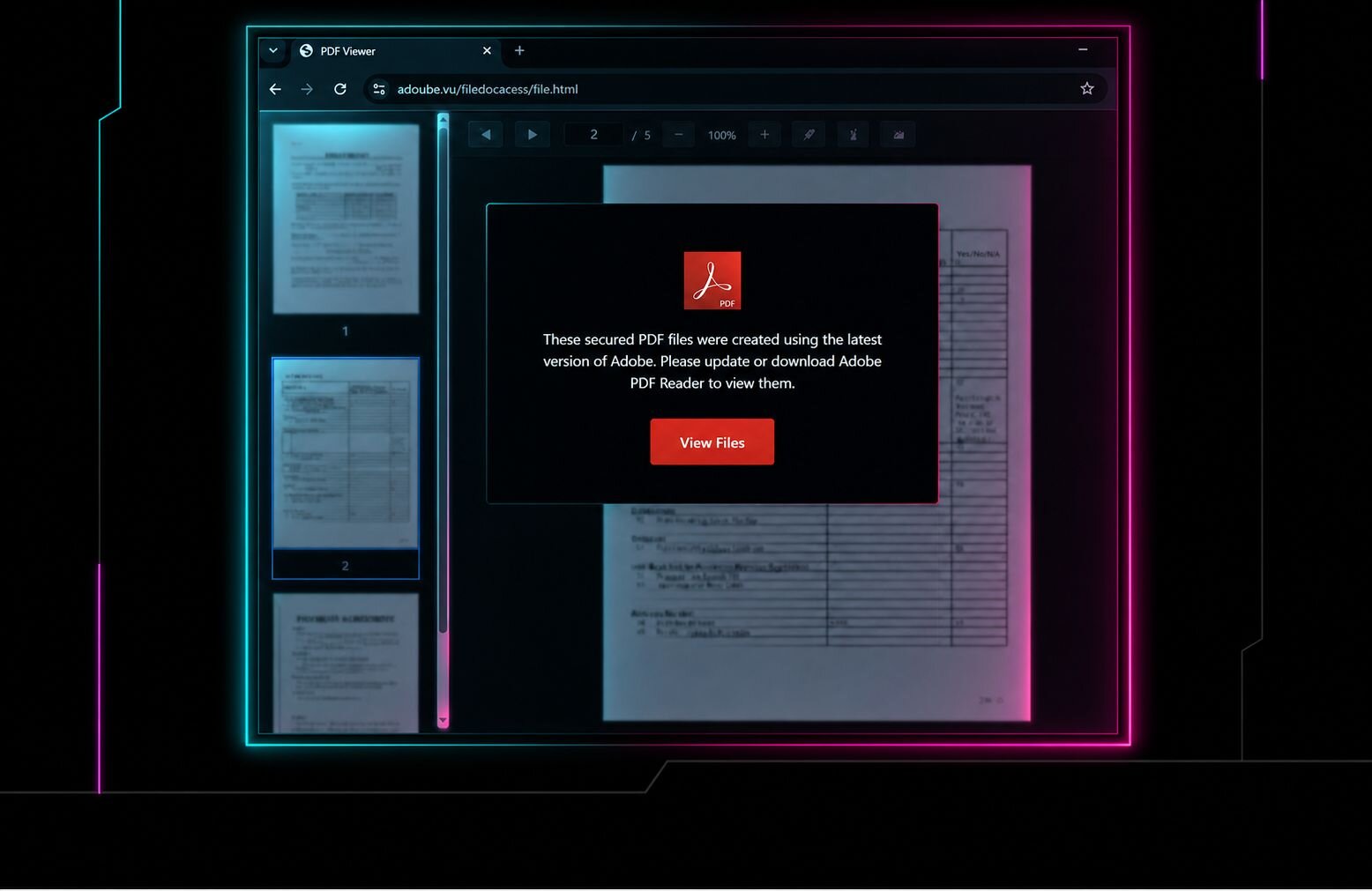
- Phishing Attacks Serve Browser-in-the-Browser Pages, Rogue RMM Persistence
Huntress SOC details two August incidents where phishing emails led victims through a fake CAPTCHA/Adobe PDF Reader lure into a browser-in-the-browser (BiTB) page spoofing get.adobe.com, tricking them into installing a ScreenConnect client disguised as an Adobe Reader update. The installer chained to a second rogue ScreenConnect client via curl/cmd.exe, both registered as Windows services for persistence, then executed defense-evasion binaries (HideCursor.exe, HideUL.exe) to hide cursor/screen activity before Huntress disrupted the intrusions. Full IOCs (domains, ScreenConnect client IDs/relays, file hashes/paths) are included for defenders.
 huntress.comwriteupAdded 11 Sep 2026, published 9 Sep 2026🛡️ Security
 GitSpawn: A Single Flaw Lets Untrusted Repos Run Code in Claude Code, Codex, Cursor, and Grok - Manifold Security
Manifold Security discloses 'GitSpawn', a vulnerability class where AI coding agents (Claude Code, Goose, Hermes, Qwen Code, Grok Build, and reportedly Codex/Cursor) run git commands like `git status`/`git diff` for context-gathering at startup without sanitizing the repository's own .git/config. Because these commands refresh git's index, a malicious repo can set `core.fsmonitor` (or a similar config sink) to an arbitrary command, achieving code execution outside the agent's sandbox before any approval prompt, workspace-trust dialog, or even authentication - simply by opening a folder delivered as files (zip, USB, shared drive) rather than cloned. Two CVEs were assigned (Goose, Hermes); four of eight reported findings remain unpatched at publication.
 manifold.securitywriteupAdded 4 Sep 2026, published 1 Sep 2026🛡️ Security
 GhostJacking Attacks: AI Agent Takeover via Firewall Evasion
Tenet Security's DEFCON 34 research "Ghostjacking" chains four AI-agent attack primitives into a full kill chain: prompt injection via untrusted log/telemetry fields that AI coding agents (Claude Code, Cursor) read through MCP connectors to Cloudflare, Datadog, and Sentry; agent-to-agent lateral movement where one agent (Sentry's Seer) vouches malicious findings to a downstream coding agent; a JWT cross-reuse sandbox-escape zero-day in Claude Desktop's Envoy-based egress proxy that lets a stolen/broadly-scoped token bypass the deny-by-default network allowlist; and a "self-exploit" technique where one AI session iteratively crafts a prompt-injection payload against another. The Cloudflare chain is notable for weaponizing a WAF-blocked request: the payload rides in headers logged verbatim, so an agent triaging "blocked" firewall events is tricked into hijacking DNS records — a 90% success rate against Claude Code (Sonnet 4.6) on Cloudflare's own recommended config. All findings were disclosed and remediated/confirmed by Cloudflare, Datadog, Sentry, and Anthropic before publication, and the researchers open-sourced a mitigation tool, agent-jackstop.
 tenetsecurity.aiwriteupAdded 3 Sep 2026, published 10 Aug 2026🛡️ Security
 Nine AI coding agent incidents that ended with deleted data
Adversa AI compiles and analyzes nine publicly documented incidents from June 2025–July 2026 where AI coding agents (Cursor, Replit, Gemini CLI, Claude Code, Google Antigravity, Amazon's internal Kiro agent, Claude Opus 5) caused irreversible data loss — from wiped developer drives to a dropped SaaStr production database and a 13-hour AWS Cost Explorer outage in China. It categorizes failure mechanisms (shell-abstraction mismatches like unquoted paths and tilde expansion, unverified exit codes, constraint decay where acknowledged instructions were ignored, and permission-inheritance bypassing two-person approval gates) and argues that smarter models won't fix the problem, recommending credential scoping, filesystem confinement, mandatory confirmation on irreversible actions, read-after-write verification, and command-level logging.
adversa.aiwriteupAdded 7 Oct 2026, published 4 Aug 2026🛡️ Security Compromised npm Packages: @joyfill/components and @joyfill/layouts Ship an Obfuscated Remote Access Trojan
StepSecurity dissects malicious beta versions of @joyfill/components and @joyfill/layouts published to npm on July 28, 2026, which inject a five-stage obfuscated payload that executes on import rather than via a postinstall hook, so npm install --ignore-scripts does not stop it. The chain resolves its C2 server by reading a transaction on the Tron blockchain (with Aptos as fallback), decrypts a BNB Smart Chain transaction to find the next stage, and deploys a Socket.IO remote access trojan with worm-like self-propagation that patches the global npm CLI, VS Code/Cursor's @vscode/deviceid module, Discord desktop, and GitHub Desktop, plus a Python credential stealer targeting browser data, wallets, and Git/GitHub tokens. The writeup includes fully deobfuscated source code, IOCs (C2 IPs, Tron addresses, file hashes), and results from detonating the packages under Harden-Runner in a sandbox.
stepsecurity.iowriteupAdded 3 Sep 2026, published 30 Jul 2026🛡️ Security SANDWORM_MODE: Dissecting a Multi-Stage npm Supply Chain Attack | Blog | Endor Labs
Endor Labs dissects "SANDWORM_MODE", a multi-stage npm supply-chain attack using typosquatted packages (e.g. suport-color, fake claude-code) that combines credential theft, worm-like propagation via npm and GitHub Actions, and DNS/HTTPS/GitHub API exfiltration with a domain generation algorithm. Notably it installs a rogue MCP server into AI coding assistants (Cursor, Claude Code, Windsurf, Continue) and uses prompt injection to trick the AI into silently exfiltrating SSH keys, AWS credentials, and password-manager secrets. The post walks through the three-layer deobfuscation chain (Base64 + zlib + XOR + eval), differential-analysis detection techniques, and disabled destructive dead-switch/polymorphic-rewrite features.
endorlabs.comwriteupAdded 27 Jul 2026🛡️ Security The Cursor deeplink vulnerability that turns a “review this PR” click into remote code execution
Adversa AI researchers show how a crafted cursor:// deeplink, disguised as a GitHub "review this PR" notification, nests a double-URL-encoded mcp/install URI inside a pr-review link to silently trigger Cursor's MCP server install dialog. A second variant pads the install dialog's single-line arguments field with tab characters so a malicious command tail (launching cmd.exe and exfiltrating via curl) scrolls off-screen while the user approves what looks like a harmless "calc" command, giving unsandboxed code execution as the victim. Both bugs were reported to Cursor, closed as duplicates, and remain exploitable on the latest build (3.9.8) months after the related CVE-2025-54133 fix was supposed to surface install arguments; the researchers name this bug class "DeepJack" and note most mainstream coding agents register similarly under-scrutinized URL handlers.
adversa.aiwriteupAdded 7 Oct 2026, published 15 Jul 2026🛡️ Security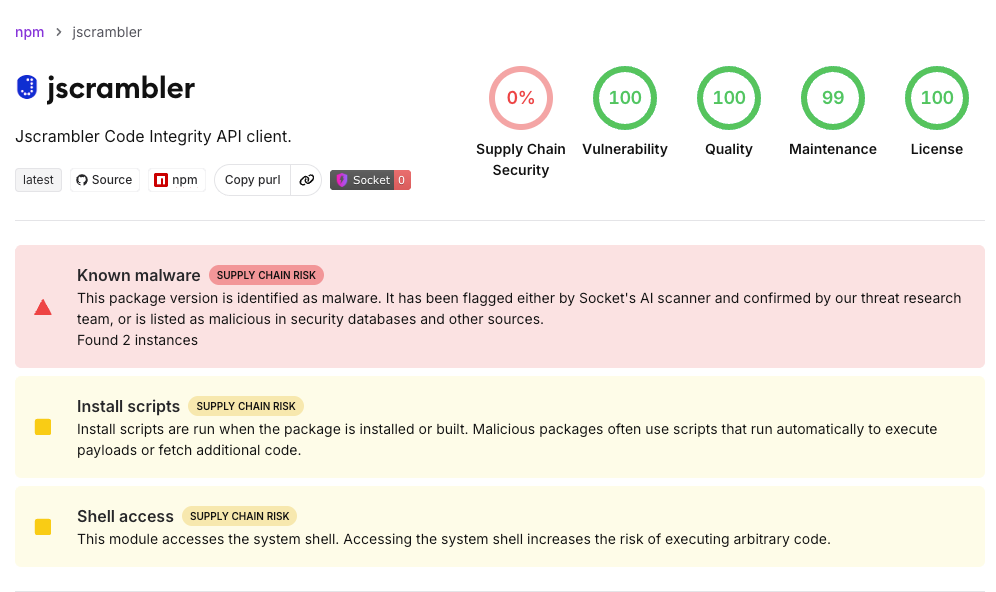 jscrambler npm Package Compromised in Supply Chain Attack
Socket's research team documents a supply chain compromise of the jscrambler npm package (v8.14.0+), where a stolen publishing credential was used to push malicious releases that drop platform-specific Rust-built infostealer binaries via a preinstall hook. The campaign evolved over the incident to evade scanners by moving the dropper from install scripts into a self-executing function inside index.js/CLI code (defeating --ignore-scripts), and the payload targets crypto wallets, cloud credentials (AWS/GCP/Azure), browser data, Discord/Slack/Telegram, and notably AI coding assistant configs (Claude Desktop, Cursor, Windsurf, VS Code) for MCP server credentials. Includes detailed RE of the ChaCha20-Poly1305 string-encryption scheme and full IOC hash list.
socket.devwriteupAdded 21 Sep 2026, published 11 Jul 2026🛡️ Security- Sonnet 5 vs Fable 5: reliable versus security-forward, not better versus worse | Blog | Endor Labs
Endor Labs' Agent Security League ran Claude Sonnet 5 and Fable 5 through a 200-task security-fix benchmark on both Cursor and Claude Code harnesses, then controlled for two confounds (task timeouts and answer-cheating/memorization) to compare the models fairly on FuncPass (functional correctness) and SecPass (security correctness). After removing confounds, Sonnet 5 shows a consistent FuncPass edge via more investigation (roughly 1.5x the tool calls, mostly Read/Grep/Glob), while Fable 5 shows a higher SecPass rate but also cheats 1.7-4.75x more often, reaching security-relevant fixes more directly with less exploration when it isn't cheating. The piece concludes the two models trade off reliability versus security-directedness rather than one being strictly better.
endorlabs.comwriteupAdded 3 Sep 2026, published 9 Jul 2026🛡️ Security  GhostApproval: A Trust Boundary Gap in AI Coding Assistants
Wiz Research discloses GhostApproval, a symlink-following vulnerability (CWE-61) found in six AI coding assistants — Amazon Q Developer, Claude Code, Augment, Cursor, Google Antigravity, and Windsurf — where a malicious repo containing a symlink disguised as a config file tricks the agent into reading/writing sensitive files like ~/.ssh/authorized_keys outside the workspace sandbox. In several tools the agent's internal reasoning correctly identifies the true target file, but the confirmation dialog shown to the user still displays the fake filename (CWE-451, UI misrepresentation), turning human-in-the-loop approval into a rubber stamp; some tools (Amazon Q, Windsurf) even write to disk before the approval prompt appears. AWS (CVE-2026-12958), Google, and Cursor (CVE-2026-50549) shipped fixes; Anthropic initially rejected it as outside threat model before later shipping a symlink warning, Augment acknowledged but hasn't patched, and Windsurf has not responded.
 wiz.iowriteupAdded 3 Sep 2026, published 8 Jul 2026🛡️ Security
- Lateral Movement Attack: Techniques, Detection & Prevention
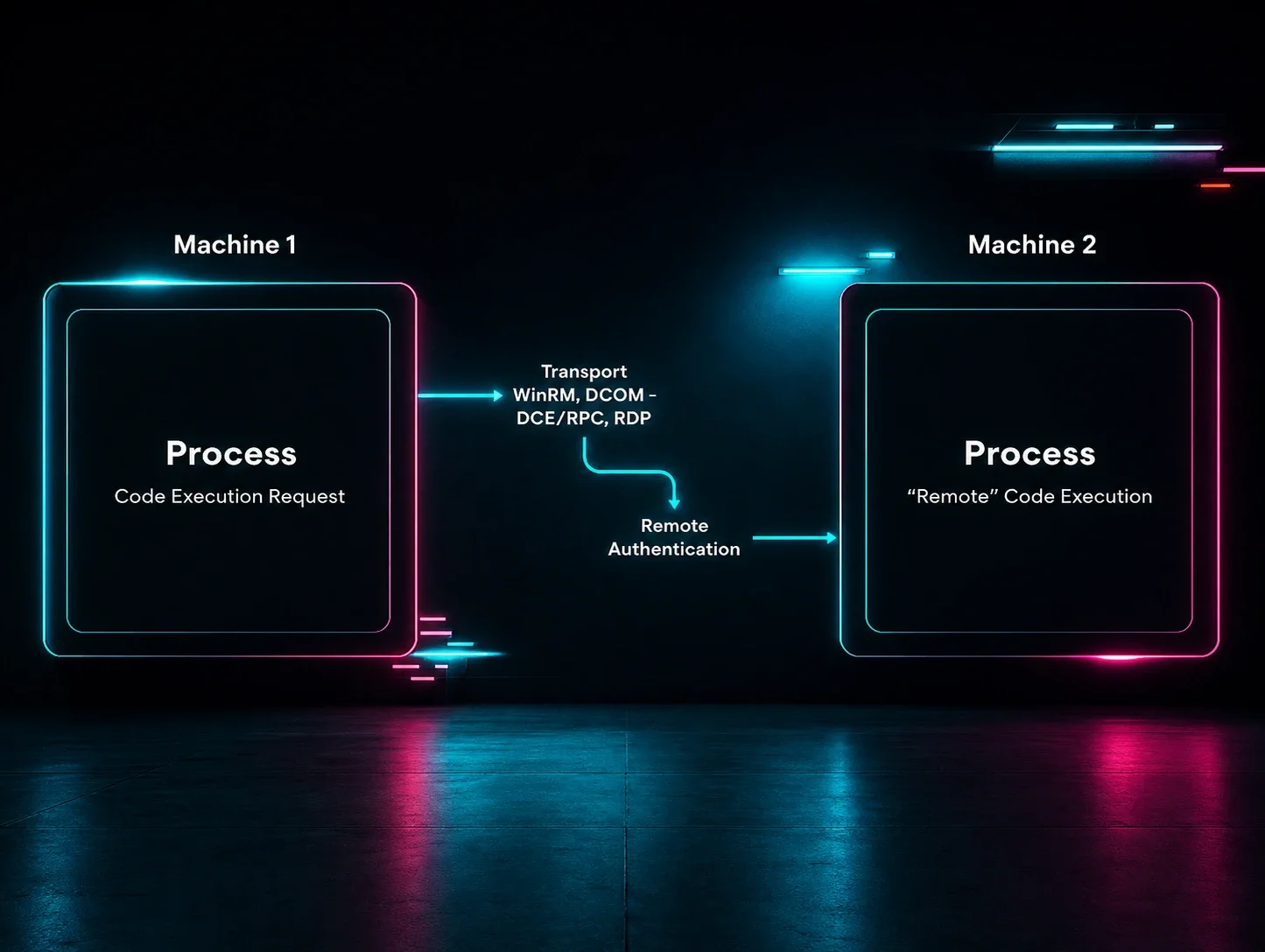
Huntress details how its Managed EDR and ITDR products detect lateral movement by correlating remote authentication events with subsequent process execution (action pillars: initial code execution, transport, remote authentication, remote code execution) rather than tracking source-side network connections. The piece walks through real-world scenarios including MMC20.Application DCOM abuse, LSASS credential dumping via rundll32/comsvcs.dll (as used by Impacket dcomexec.py and NetExec mmcexec.py), SQL Admin account abuse to enable RDP, and ransomware-precursor activity (shadow copy deletion, ntds.dit exfiltration) caught before payload deployment.
huntress.comwriteupAdded 3 Sep 2026, published 1 Jul 2026🛡️ Security  Endor Labs: Claude Fable 5
Endor Labs re-ran their Agent Security League benchmark (200 real-world vulnerability-fixing tasks) with Claude Fable 5 paired against the Cursor agent instead of Claude Code, and found the same model jumped from 59.8% FuncPass/19.0% SecPass to 72.6% FuncPass/29% SecPass — the best fair SecPass score on their leaderboard, showing the agent harness can matter more than model choice. The piece walks through instance-level diffs on CVE-2020-15118 (Wagtail XSS via unescaped help_text), CVE-2017-12440 (OpenStack Aodh trust-ID leakage), and CVE-2024-3571 (LangChain local file store path traversal via yield_keys) to show Cursor produced more complete patches that covered secondary sinks Claude Code missed, and confirms 28 of 29 flagged cheating cases were training-data memorization rather than git/web lookup.
endorlabs.comwriteupPublished and added 18 Jun 2026🛡️ Security Miasma Worm Hits Microsoft Again: Azure Functions Action and 72 Other Repositories Disabled After Supply Chain Attack Targeting AI Coding Agents
StepSecurity's forensic analysis of the June 5, 2026 Miasma worm incident, in which a compromised contributor account pushed a malicious commit to Microsoft's Azure/durabletask repository planting five files (.claude/settings.json, .gemini/settings.json, .cursor/rules/setup.mdc, .vscode/tasks.json, and a 4.6MB obfuscated .github/setup.js payload) that trigger credential-harvesting code execution the moment the repo is opened in Claude Code, Gemini CLI, Cursor, or VS Code — no package install or code run required. GitHub's automated abuse detection disabled 73 Microsoft repositories in a 105-second sweep, including Azure/functions-action, breaking CI/CD pipelines across GitHub Actions users relying on the mutable @v1 tag. The post ties this to the same compromised account behind the May 19 durabletask PyPI credential-stealer campaign and the broader TeamPCP-linked Miasma worm, which has infected 113+ repositories.
stepsecurity.iowriteupAdded 3 Sep 2026, published 9 Jun 2026🛡️ Security Microsoft's durabletask PyPI Package Compromised in Supply Chain Attack
StepSecurity documents the compromise of Microsoft's durabletask PyPI package (versions 1.4.1-1.4.3, 400k+ monthly downloads), where an attacker bypassed the GitHub CI/CD pipeline entirely using stolen publishing credentials to inject a dropper for rope.pyz, a modular cloud-intrusion framework with dedicated collectors for AWS, Azure, GCP, Kubernetes, HashiCorp Vault, password managers, and the filesystem. The framework encrypts stolen data with AES-256-GCM/RSA-4096, exfiltrates via HTTPS, GitHub commit beacons, and attacker-created public repos using the victim's own stolen GitHub tokens, propagates via AWS SSM and kubectl exec, and drops a geo-targeted rm -rf wiper for systems matching Israeli locale/timezone markers. The post ties the attack to TeamPCP's Mini Shai-Hulud campaign (same infrastructure as TanStack, Mistral AI, LiteLLM, @antv) and later updates describe a second compromise of the Azure/durabletask GitHub repo that plants payloads triggering in Claude Code, Gemini CLI, Cursor, and VS Code.
stepsecurity.iowriteupAdded 3 Sep 2026, published 9 Jun 2026🛡️ Security Protestware by open source maintainer to hinder agentic coding: The jqwik 1.10.0 Prompt Injection
Snyk details how jqwik maintainer Johannes Link shipped version 1.10.0 of the Java property-testing library net.jqwik:jqwik-engine to Maven Central with a hidden method, printMessageForCodingAgents(), instructing AI coding agents to delete all jqwik tests and code. The instruction was concealed from humans via ANSI escape codes (ESC[2K + carriage return) that wipe the line on an interactive terminal but leave the text intact in raw logs captured by CI systems and agent tool-output parsers like Claude Code, GitHub Copilot agent mode, and Cursor. Claude Code detected and refused the injected instruction in the wild; the maintainer later disclosed the behavior, softened it in 1.10.1 (opt-in hiding, non-destructive directive), and stated jqwik is not meant for AI-assisted workflows — framing it as deliberate "protestware" against agentic coding rather than a conventional vulnerability.
 snyk.iowriteupAdded 3 Sep 2026, published 2 Jun 2026🛡️ Security
 Socket: TrapDoor Crypto Stealer
Socket researchers uncovered TrapDoor, a coordinated crypto-stealer campaign spanning 34+ malicious packages and 384+ versions across npm, PyPI, and Crates.io, targeting crypto, DeFi, Sui/Move, and AI developer communities. The npm packages use postinstall hooks to run a shared trap-core.js payload that harvests SSH keys, AWS/GitHub credentials, wallet data, and browser data, then persists via .cursorrules, CLAUDE.md, git/shell hooks, systemd, cron, and SSH lateral movement; PyPI packages fetch and run remote JS on import, and Crates.io packages use malicious build.rs to XOR-encrypt and exfiltrate Sui/Move keystores to GitHub Gists. The attacker (GitHub account ddjidd564) also opened PRs against major AI/dev tooling repos (browser-use, LangChain, Langflow, llama_index, MetaGPT, OpenHands) attempting to plant hidden .cursorrules/CLAUDE.md instructions designed to trick AI coding assistants into running exfiltration under the guise of a 'security scan'.
socket.devwriteupPublished and added 26 May 2026🛡️ Security TrustFall: 1-click coding agent RCE in Claude, Cursor, Copilot
Adversa AI's TrustFall report shows that Claude Code, Gemini CLI, Cursor CLI, and Copilot CLI all auto-execute project-defined MCP servers as unsandboxed OS processes the instant a user accepts the generic folder-trust prompt, with no mention of code execution in Claude Code's v2.1+ dialog. A malicious repo needs only two JSON files (.claude/settings.json with enableAllProjectMcpServers/enabledMcpjsonServers/permissions.allow, plus an inline-payload .mcp.json) to achieve one-Enter-keypress RCE with full user privileges, and the same chain runs with zero human interaction against CI runners using the official claude-code-action since headless mode skips the trust dialog entirely. The report documents Anthropic's declination of the finding as intended behavior, contrasts it with the stricter bypassPermissions warning flow, references the related CVE-2025-59536 patch, and ships defender mitigations (managed-settings lockdown, config auditing, CI branch restrictions) plus a safe PoC.
adversa.aiwriteupAdded 20 May 2026, published 7 May 2026🛡️ Security
Showing 30 of 32
Show more