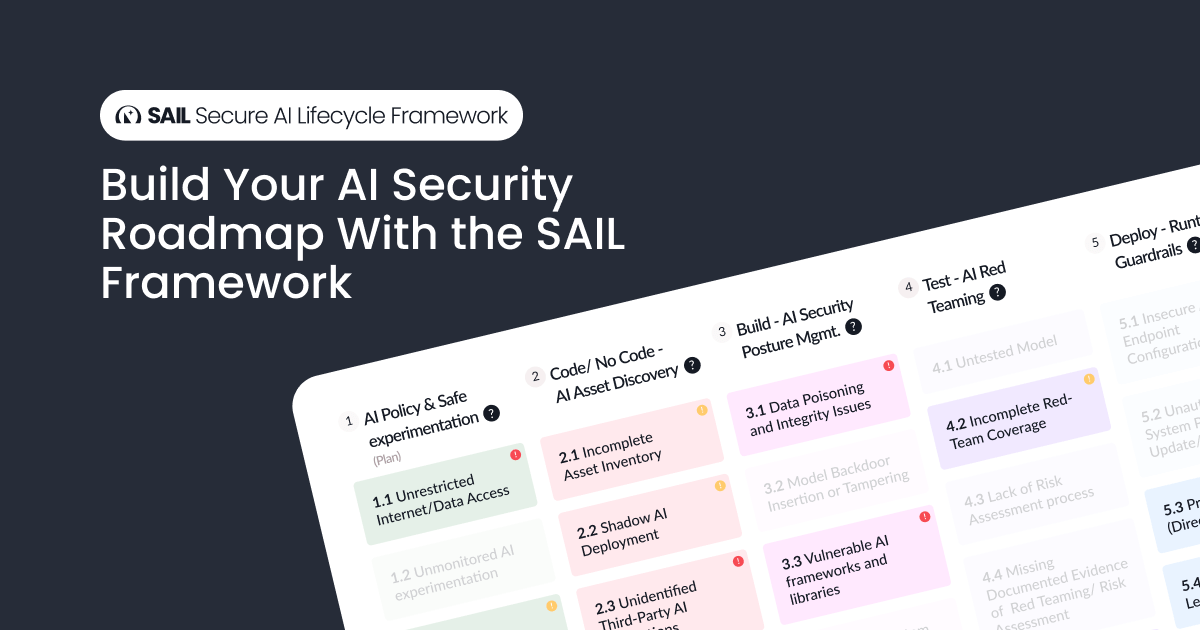
 SAIL Framework: A Practical Guide for AI Security
The SAIL Framework from Pillar Security is a seven-phase, lifecycle-oriented method for securing AI systems. The phases are AI policy and safe experimentation, AI asset discovery, AI security posture management, AI red teaming, runtime guardrails, sandboxed execution for agents and MCP servers, and AI activity tracing. It argues for a "Shift Up" approach that protects the business logic AI controls, and it is meant to sit on top of existing standards.
 pillar.securityarticleAdded 29 Oct 2026🛡️ Security
 Cisco Open Sources Quarry to Catch AI Agent Attacks Hidden in Harmless Steps
Project Quarry is a neurosymbolic rule language Cisco has open sourced to detect AI agent attacks that only show up across a sequence of individually benign steps. Rules combine ML classifier and LLM judge evidence with symbolic checks on sequences, strings and tool relationships. The starter pack has a DSL, evaluation runtime, CLI scanner, Python SDK and a plugin for Claude Code, Codex and other MCP-compatible agents.
 securityweek.comarticlePublished and added 29 Oct 2026🛡️ Security
 What is an AIBOM? AI bill of materials explained for security teams | Endor Labs
An AIBOM is a machine-readable inventory of models, datasets, dependencies, AI services, agents and MCP servers, with evidence of origin, license, integrity and evaluation. The Endor Labs explainer walks through a worked CycloneDX example for a fine-tuned support assistant. It compares CycloneDX ML-BOM, SPDX 3.x, the OWASP AIBOM project and the May 2026 CISA/G7 guidance, and lists what an AIBOM cannot show: runtime behavior and agent actions.
 endorlabs.comarticlePublished and added 29 Oct 2026🧠 AI
- What is an AIBOM? AI bill of materials explained for security teams | Endor Labs
AIBOM explainer from Endor Labs: an AI bill of materials is a machine-readable inventory of models, datasets, dependencies, AI services, agents and MCP servers, with origin, license and integrity evidence. It walks through a CycloneDX entry for a fine-tuned model, compares CycloneDX ML-BOM, SPDX 3.x, the OWASP AIBOM Generator and the May 2026 CISA/G7 minimum-elements guidance, and lists a six-step build process. It also states what an AIBOM cannot show: model safety, runtime behavior and coding-agent actions.
endorlabs.comarticlePublished and added 29 Oct 2026🛡️ Security  ADLC compliance: Mapping agentic development to NIST SSDF, OWASP, and the EU AI Act | Endor Labs
ADLC compliance is Endor Labs' interpretation of how NIST SSDF (SP 800-218), the OWASP LLM and Agentic Top 10 lists, and the EU AI Act apply to software built with coding agents. It splits requirements into a code surface and an action surface (shell, files, MCP calls, package installs). It gives a four-step EU AI Act scoping path and says that system prompt rules and agent self-reports are not audit evidence.
endorlabs.comarticlePublished and added 28 Oct 2026🧠 AI- ADLC compliance: Mapping agentic development to NIST SSDF, OWASP, and the EU AI Act | Endor Labs
ADLC compliance guide from Endor Labs that maps agentic development to NIST SSDF (SP 800-218 v1.1), the OWASP LLM Top 10 2025 and Agentic Top 10, and the EU AI Act as amended by Regulation (EU) 2026/1744. It splits controls into a code surface and an action surface (shell, file access, MCP calls, package installs). It gives a four-step AI Act scoping path, the new Annex III date of 2 December 2027, and evidence guidance. It states the crosswalk is the vendor's interpretation, not legal advice.
endorlabs.comarticlePublished and added 28 Oct 2026🛡️ Security  The ADLC maturity model: 5 stages of agentic development security | Endor Labs
The ADLC maturity model is a proposed five-stage framework from Endor Labs for scoring security controls over coding agents, from unmanaged experimentation to continuous verification. Each stage has requirements on two tracks, agent actions (shell commands, MCP calls, package installs) and agent output (code, dependencies, secrets). It sets stage 3 at deterministic hooks that block actions, gives evidence-based assessment questions, and lists traps such as relying on prompt-level rules.
endorlabs.comarticlePublished and added 28 Oct 2026🛡️ Security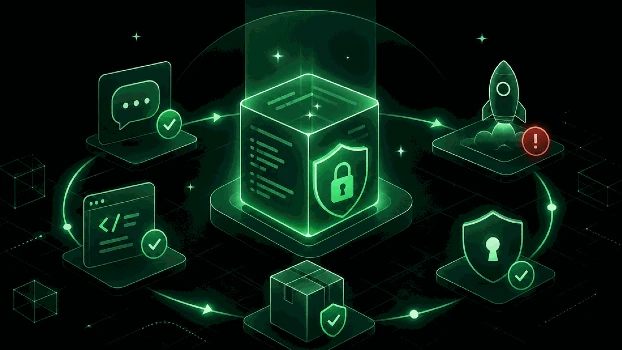 ADLC Security Best Practices for Teams Shipping with Coding Agents | Endor Labs
ADLC Security Best Practices is an Endor Labs guide to controlling what AI coding agents can access, run, install and ship. It covers inventorying agents and MCP servers, sandboxing, pre-execution hooks instead of AGENTS.md rules, install-time package checks against slopsquatting and malware, reachability-based triage of agent PRs, and CI/CODEOWNERS protections. A five-step worked example and coverage metrics are included.
endorlabs.comarticlePublished and added 23 Oct 2026🛡️ Security- Donating Agent Skills to the Agentic AI Foundation
Simon Willison's link post covers Anthropic's 22 October 2026 announcement that it is donating the Agent Skills standard to the Agentic AI Foundation (AAIF) under the Linux Foundation. Anthropic co-founded the AAIF with Block and OpenAI and earlier donated MCP to it. Willison notes he predicted this in December 2025 and found his old post by querying his blog through datasette-mcp in Claude.
 simonwillison.netarticlePublished and added 22 Oct 2026🧠 AI
 Software supply chain security best practices for 2026
Aikido's guide to software supply chain security controls for 2026, tied to real incidents. It covers a 48-hour package cooldown, ignore-scripts, lockfile enforcement, SHA and digest pinning, scoped tokens, FIDO2, developer endpoint protection, extension allowlists, agent sandboxing, MCP server vetting, slopsquatting, signed SBOMs and rotation drills. Examples include the March 2026 axios compromise and the March 2025 tj-actions/changed-files attack.
 aikido.devarticleAdded 22 Oct 2026, published 21 Oct 2026🛡️ Security
 How Commerce.com and Cloudflare are getting storefronts ready for AI agents
Cloudflare and Commerce.com describe enabling WebMCP, Google's proposed browser standard for exposing structured tools to AI agents, across almost 100,000 storefronts. Cloudflare injects a bridge script at the edge that proxies tools from Commerce.com's backend MCP server. Per-merchant opt-out uses Configuration Rules and custom hostname metadata, and a configurable MCP URL (/api/mcp) was added.
 blog.cloudflare.comarticleAdded 29 Oct 2026, published 21 Oct 2026🧠 AI
 AI Model Risk Depends on What the Model Can Reach
Snyk's State of Agentic AI Adoption Volume III scores models against 29 attacker goals (0 to 1,000) and matches them to AI-BOM scan data from 1,693 environments. 74.5% reference a model scoring 500+ on some goal and 49.2% one scoring 750+. Risk depends on agent and MCP server reach, and the fix is either switching models or tightening application controls, depending on the goal. Only 37.5% of model occurrences have a score.
 snyk.ioarticlePublished and added 21 Oct 2026🛡️ Security
- Huda (@AlAssaf_H) on X
Source-level review of x64dbg-MCP, GhidraMCP and IDA Pro MCP security, dated October 2026. It covers GHSA-4478-h5jv-647m (missing authentication, 0.0.0.0 bind) and GHSA-jgj3-97w2-9v9r (Content-Length integer overflow before the token check, causing a DoS panic), and compares tags 1.0, v1.1 and v1.2. It separates network reachability, tool authority and semantic influence from hostile binaries. No new exploit is claimed.
 x.comarticleAdded 21 Oct 2026, published 19 Oct 2026🛡️ Security
 TokenMaxxing: How to Get the Most Out of Your AI Models
Decrypt guide to "tokenmaxxing" reframed as maximizing value per token rather than burning tokens. It gives tiered tips: pick smaller models for simple jobs, write one clear prompt, start new chats, cap output length, and use free models (beginner); Claude Code commands like /model, /clear, /compact, /context, /mcp, /effort and plan mode (intermediate); and prompt caching via cache_control, 50% batch discounts, and agent budget limits like --max-budget-usd (advanced). Includes context on Meta, Amazon and Uber token leaderboards and spend, a worked invoice-processing example where routing cut cost from $30 to $3.90, and the Jevons paradox in falling token prices.
 decrypt.coarticlePublished and added 17 Oct 2026🧠 AI
 In Other News: ICS-Sniper Attack, Hacking XWorm Malware Operators, $250k Chrome Exploit
SecurityWeek's weekly roundup covers ICS-Sniper, a UBC proof-of-concept that uses VPN-encrypted packet size, direction and timing to drop critical SCADA traffic on cloud-hosted ICS (tested on the SWaT water testbed). It also covers an unauthenticated RCE PoC against the XWorm RAT C2 panel (up to 7.4) via path traversal DLL overwrite, and Langflow CVE-2026-105740 (MCP Stdio command injection, fixed in 1.9.0) exploited from September 19, before the CVE was published. Other items: XBOW's AI-assisted Chrome full-chain exploit (GPT-5.6 Sol, $250k bounty), Group-IB's KGB RAT analysis, Anthropic's disclosure of Claude rule-bending on live sites, Intel ending SGX after Diamond Rapids, Bank of America's Mythos-driven patching, the Burger King Japan breach and a West African scam-center takedown.
securityweek.comarticlePublished and added 16 Oct 2026🛡️ Security [tl;dr sec] #350 - Reverse Engineer Anything, Tracking AI-integrated Malware, Test-driving Jev
tl;dr sec issue #350 is a weekly security newsletter digest. It covers XBOW's six-day Chrome full-chain exploit built with GPT-5.6 Sol, Semgrep's IDOR benchmark metrics, the EntraGoat vulnerable Entra ID lab, Zenity's AWS Bedrock AgentCore IMDS credential theft, Cisco Talos's CAIRN hunting toolkit for AI-integrated malware, the REA reverse-engineering MCP, runZero's sshamble, and a Copilot for Word AI worm.
 tldrsec.comarticleAdded 30 Oct 2026, published 15 Oct 2026🛡️ Security
 Developer Who Cloned Photoshop With AI Just Did the Same to Microsoft Office
Decrypt reports that developer Brandon Thomas released WordCraft, GridCraft and DeckCraft, MIT/Apache-2.0 open-source clones of Word, Excel and PowerPoint. They were written in Rust with Anthropic's Claude (Opus 5.5) as a clean-room rebuild and run natively on Windows, macOS, Linux and BSD, and in a browser. Coverage is high (WordCraft 88% of ribbon features, GridCraft 513 of 523 Excel functions), but the authors rate them only about 50–60% ready for real work. Every button is also an MCP command, so agents like Claude can drive the apps. The article is a useful data point on what AI-assisted "vibe coding" can produce in under two weeks, and on where it still falls short (file fidelity, stability).
decrypt.coarticlePublished and added 14 Oct 2026🧠 AI- AI Agents for Cybersecurity: A Guided Tour of a Repository with Tons of Resources and Examples
Omar Santos walks through his eight-part AI-agents-for-cybersecurity repository: LLM building blocks (LangChain, RAG), then security agents with LangGraph, CrewAI, DeepAgents and MCP servers (nmap, CISA KEV, Shodan), a hardening guide for six agentic frameworks, token-cost control for agents, and a spec for a supervisor-led, human-gated security-assessment harness. It covers concrete design lessons such as least-privilege subagents, staged response actions, single-use approvals bound to exact actions, kill switches, and mapping controls to the OWASP Top 10 for Agentic Applications. Also notes Project CodeGuard rules shipped for AI coding assistants.
 becomingahacker.orgarticleAdded 13 Oct 2026🛡️ Security
- AI Agents for Cybersecurity: A Guided Tour of a Repository with Tons of Resources and Examples
Omar Santos walks through his AI-agents-for-cybersecurity GitHub repo, which has eight parts. Parts 1–4 cover LLM basics (LangChain, prompting, LCEL, RAG). Parts 5–8 cover building security agents with LangGraph, CrewAI, DeepAgents and MCP servers (nmap, CISA KEV, Shodan), and a hardening baseline for six ready-made agentic frameworks. They also cover token-cost control (caching, routing, budget guards, cost per accepted outcome) and a supervisor-led, human-gated security-assessment harness spec with single-use approvals, a kill switch and an append-only audit log. The post also covers Project CodeGuard rules for AI coding assistants. It is a practical learning path and a reference for governing and securing agents.
 linkedin.comarticleAdded 13 Oct 2026🛡️ Security
 From GTA V on iPhone to Free Photoshop: This AI Tool Is Upending Software
Decrypt reports on REA (Reverse Engineer Anything), an open-source toolkit that uses MCP to connect AI coding agents such as Claude Code and Codex to reverse-engineering tools like Ghidra. It went from under 10,000 to over 100,000 GitHub stars in a week. The article describes AI-decompiled game ports and mashups, and ArtCraft, a set of Rust-built Photoshop-style apps that Brandon Thomas made with Claude Opus 5.5 as a clean-room rebuild. It also covers the copyright and takedown fallout (Activision, Bethesda) and what cheap agent-driven decompilation means for software protection.
decrypt.coarticlePublished and added 12 Oct 2026🧠 AI GitHub Copilot app for Beginners: How to teach Copilot about your codebase
Beginner-oriented GitHub blog guide to giving GitHub Copilot project context through four mechanisms: repository custom instructions (.github/copilot-instructions.md and path-specific .github/instructions files with applyTo), agent skills (SKILL.md folders under .github/skills), custom agents (.github/agents profiles), and MCP servers such as Playwright. It explains when to use each and how they combine, using examples like a quality-checks skill and an accessibility-review agent. Useful as a concrete reference for the repo layout Copilot reads, with a pointer to the community Awesome Copilot collection.
 github.blogarticlePublished and added 12 Oct 2026🧠 AI
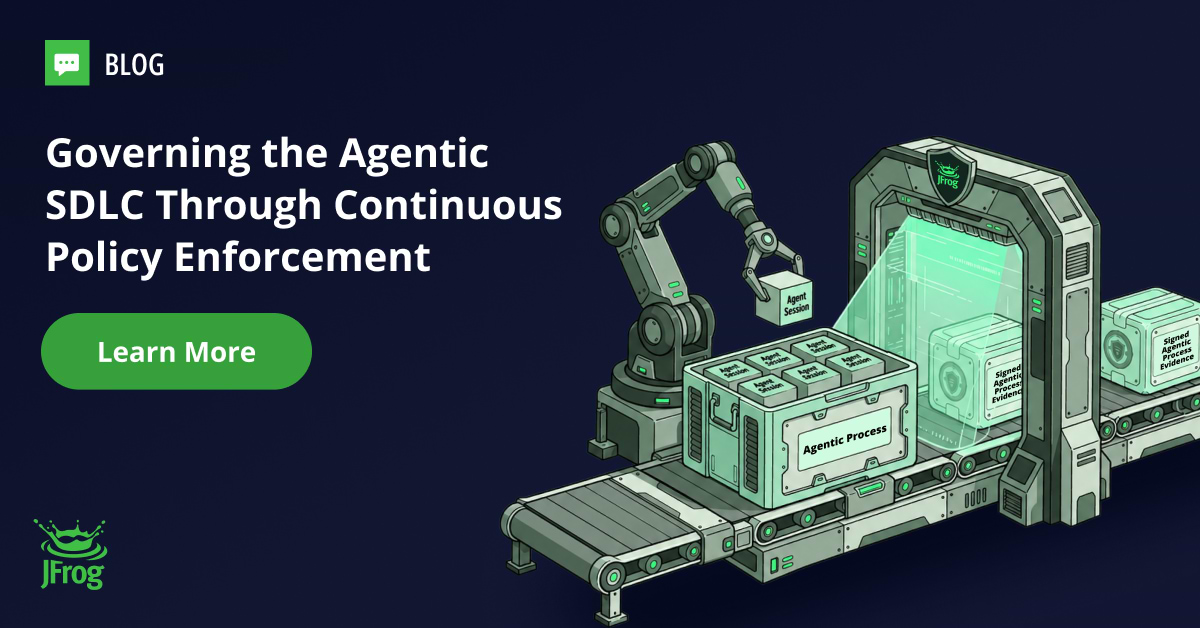 Governing the Agentic SDLC Through Continuous Policy Enforcement
JFrog proposes the Agentic Process Evidence Protocol, an open spec that records coding-agent sessions (harness and agent version, model ID, tool and MCP calls, prompts, owner, human reviewer) as signed in-toto/DSSE attestations bound to a git commit, artifact or release. Policy-as-code release gates can then check for approved LLMs and MCP tools, an accountable human and adherence to guidelines, and the logs allow post-release audit. The post gives mock session-log and evidence JSON, ties the approach to EU AI Act Articles 12 and 14, OWASP AISVS and SLSA, and points to a GitHub reference repo, with JFrog AppTrust as the commercial implementation.
 jfrog.comarticleAdded 14 Oct 2026, published 12 Oct 2026🧠 AI
- Governing the Agentic SDLC Through Continuous Policy Enforcement
JFrog proposes Agentic Process Evidence, an open protocol that records AI coding agent sessions (harness, model ID, tool calls, MCP use, prompts, owner, human reviewer) as signed in-toto/DSSE, SLSA-compatible attestations bound to commits, artifacts and releases. Policy-as-code gates can then block releases that used unapproved LLMs or MCP tools, or that lack an accountable human. It maps the approach to EU AI Act Articles 12/14, OWASP AISVS and ISO/IEC 42001, and includes example session-log and evidence JSON. The post also promotes JFrog AppTrust's Prompt to Release Traceability.
jfrog.comarticleAdded 14 Oct 2026, published 12 Oct 2026🛡️ Security  The OWASP Top 10 Gets Modernized | Endor Labs
Commentary on the 2025 OWASP Top 10 update presented at OWASP Global AppSec in Washington, D.C. Broken Access Control stays #1, Security Misconfiguration and the new Software Supply Chain Failures category (replacing Vulnerable and Outdated Components) rise to #2 and #3, and Cryptographic Failures, Injection and Insecure Design drop. The author adds context on agentic AI and MCP identity and authorization, AI-assisted SAST, non-human identities, CISA Secure-by-Default, OWASP SPVS, and slopsquatting and AI coding assistant risks.
endorlabs.comarticlePublished and added 12 Oct 2026🛡️ Security Context Engineering for Application Security | Endor Labs
Endor Labs whitepaper on using context engineering to make AI coding assistants produce secure code. It covers secure prompting (priming, decomposition, refinement with design-spec and test-first patterns), reusable system rules such as Cursor rules and the CSA R.A.I.L.G.U.A.R.D. framework, and external SAST/SCA tools wired in through MCP servers with a rule that triggers scans. It also covers the costs and risks: extra token use, models ignoring rules, untrusted community rules, and MCP server supply-chain threats. It cites figures such as 62% of AI-generated solutions containing flaws and a 77.5% reduction in weaknesses from recursive prompting.
endorlabs.comarticlePublished and added 12 Oct 2026🧠 AI- Context Engineering for Application Security | Endor Labs
Endor Labs whitepaper on using context engineering to make AI coding assistants write secure code. It covers four techniques: secure prompts (priming, decomposition, refinement with design-spec and test-first patterns), system rules (with sample rules and the CSA R.A.I.L.G.U.A.R.D. framework), external security tools wired in over MCP (with an example Cursor SAST rule), and RAG. It also covers MCP server threats and five defensive pillars, Cursor Hooks, and CISO-level recommendations. It matters because it gives practical guardrails for stopping missing-authorization, rate-limiting and hallucinated-dependency problems at generation time.
endorlabs.comarticlePublished and added 12 Oct 2026🛡️ Security  Introducing AI Coding Agent Governance: Using Hooks to Bring Visibility to the ADLC | Endor Labs
Explains how lifecycle hooks in Claude Code (.claude/settings.json) and Cursor (.cursor/hooks.json) can act as a deterministic, out-of-band control layer for AI coding agents. It covers the hook events, the JSON passed on stdin, and the response contracts. Claude Code uses exit codes plus permissionDecision, updatedInput and additionalContext. Cursor uses stdout JSON with permission and userMessage. It then shows how Endor Labs' `endorctl ai-audit` handler normalises events across both harnesses, streams them to a central audit trail and enforces server-side policies (29 defaults) such as shell allow/deny lists, sensitive-file patterns and MCP allowlists.
endorlabs.comarticlePublished and added 12 Oct 2026🧠 AI- Cloudflare Changelog (@CFchangelog) on X
Cloudflare's changelog announces that its Cloudflare API MCP server now serves Cloudflare skills alongside its tools. A connected MCP client discovers them by calling `skills/list`. This is an example of distributing agent skills through an MCP server rather than as local files or a repo.
x.comarticlePublished and added 11 Oct 2026🧠 AI  Rewriting Prime Agent in Rust
Prime Intellect describes rewriting its open-source Prime Agent coding-agent harness from TypeScript to Rust. Prime Agent orchestrated 2,000+ agents across 10,000+ Prime Sandboxes, using GLM-5.3 inference, to do the rewrite. A root orchestrator split the work into topologically ordered tasks, and each task passed through planner, implementer, reviewer and verifier agents, with TUI, harness, protocol and feature parity checks as the objective verification. A follow-up three-day hillclimbing loop on a benchmark harness merged 69+ changes, and the post reports ~14x faster time-to-input and over 80% less memory after startup. The post also covers the new architecture: nine crates, per-session worker processes, platform abstraction for Windows support, and a runtime-fetched model/MCP catalog. Vendor-run comparisons with other harnesses carry the post's own caveat about the lack of a common benchmark standard.
 primeintellect.aiarticleAdded 10 Oct 2026, published 9 Oct 2026🧠 AI
 SonicWall and Splunk Patch Critical Vulnerabilities
SonicWall patched four SMA1000 appliance vulnerabilities including CVE-2026-102255, a pre-authenticated SSRF flaw (CVSS 10) that lets an unauthenticated remote attacker abuse an unintended alternate access path to reach internal functionality; two other high-severity bugs enable RCE and one medium-severity bug enables XSS. Splunk separately fixed dozens of flaws across Splunk Enterprise, MCP Server, and the Add-on for AWS, including three critical Splunk Enterprise bugs allowing arbitrary command execution, unauthorized access, and code injection, plus a medium-severity MCP Server issue letting an authenticated user redirect API requests to an attacker-controlled URL. SonicWall says SSL-VPN on its firewall products is unaffected and no in-the-wild exploitation has been observed.
securityweek.comarticlePublished and added 8 Oct 2026🛡️ Security


Showing 30 of 107
Show more